
SPOILERS
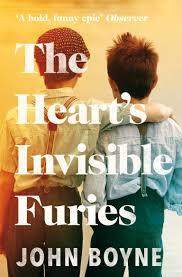
It sometimes occurs that I read a series of books that seem to speak to each other. If I were choosing my books through a chatbot, then I would assume that the sequence was driven by an algorithm. But my last two books were chosen because (a) A Visit from the Goon Squad was an Ivanhoe Reading Circle selection and (b) You Must Remember This was shortlisted for the Miles Franklin and I was interested to read the shortlist. Then The Heart’s Invisible Furies finally became available after literally months on hold at the library -reserved for a reason I can no longer remember- so it must be coincidence rather than an algorithm that has brought me three books in a row that ‘speak’ to each other.
It’s uncanny, though, that all three books look at a life or lives over a span of time, complete with the sliding-doors moment when things could have worked out differently. However, The Heart’s Invisible Furies, unlike the other two books, does not play around with sequencing and plotlines to show off (as in the case of Egan’s book) or to demonstrate a memory in decline (as in You Must Remember This). It’s a relief to read a book that starts at the beginning and just goes through to the end, without any narrative pyrotechnics.
The book in in three long parts, each with several chapters arranged chronologically. It opens in 1945 with the narrator’s sixteen year old mother Catherine Goggin being expelled from the Catholic church on account of her pregnancy. Her own family shuns her and she makes her way to Dublin, living with Sean and his lover Jack Smoot in a small flat as she manages to obtain a position in the tearoom at the Daíl Eireann , the Irish Parliament. Chapter II takes us to 1952 when our narrator Cyril is adopted by Charles and Maude Avery, a childless couple who, while feeding, housing and educating him, never let him forget that he’s ‘not a real Avery’. Cyril does not know his birth parents, and he has no interest in finding them. Charles is serially unfaithful to his wife and shady in his business dealings, while Maude writes books that she hopes no-one will read because it is ‘vulgar’ to be popular. As a seven year old boy, Cyril meets Julian Woodbead when his father Max is acting as Charles’ solicitor, and he falls in love with him instantly. Chapter III is set in 1959 when Julian and Cyril meet again at school and share a room. By 1966 in Chapter IV Cyril has finished school and is working at the Department of Education in the Daíl Eireann building where his unrecognized birth mother works. Meanwhile Julian is travelling through Europe with one of his many girlfriends while the unwilling Cyril becomes a reluctant but celibate boyfriend to one of his co-workers Mary-Margaret Muffet. (Boyne does have fun with his names). By 1973 in Chapter V we find Cyril engaged to Julian’s sister Alice, who had previously been jilted at the altar, and on his wedding day he finally admits to Julian his attraction to him. Julian is furious; the wedding goes ahead, but Cyril flees.
Part II ‘Exile’ opens in 1980 in Amsterdam, where Cyril fled after the wedding fiasco. He has found love with Bastiaan, a trainee doctor and he is working at the Ann Frank House. They socialize at MacIntyre’s pub, owned by Jack Smoot who, unknown to Cyril, had shared lodgings with Cyril’s mother. Together Cyril and Bastiaan take over the care of Ignac, a Slovenian rentboy they find on the street who has been pimped by his father. Again, Cyril needs to flee, ending up with Bastiaan and Ignac in New York in 1987 where Bastiaan is working as a physician dealing with AIDS patients. Here he encounters Julian again, and promises to pass a message back to his erst-while bride and Julian’s sister Alice. Before this happens, tragedy strikes.
In Part III by 1994 Cyril has returned to Ireland alone.Ignac has become a very popular children’s author and his adoptive father, Cyril, is in jail again for tax avoidance. His adoptive mother Maude has died of lung cancer and, although she would have hated the thought, her works have become highly lauded and she is a towering, if deceased, figure in the Irish literary scheme. He keeps his promise to tell Alice about Julian’s death, and becomes drawn into Alice’s family with her new partner, also called Cyril, and Alice’s son Liam. In 2001 he accompanies Ignac on a book tour to Slovenia and has become even more ensconced within Alice’s new family. By 2008 he is approaching death, having experienced both loss and discovery.
The book reminded me of Douglas Stewart’s Shuggie Bain and John of John but with the sprawling riotousness of a John Irving book (to whom the book is dedicated) mixed with Charles Dickens. I laughed out loud several times and I wondered just how long Boyne could sustain the tension of Cyril’s final admission of his homosexuality, and the discovery of his birth mother. Quite a while, as it turned out, but the missed opportunities only heightened the tension. He captures very well the censoriousness of Irish society, underpinned by the hypocrisy of the Catholic Church.
Having enjoyed the ride so far, I was disappointed in the ending which lapsed into sentimentality and excessive tidiness. My disillusionment with the ending was further heightened by the Author’s Note on The Heart’s Invisible Furies which started as a ‘how I came to write this book’ but descended into a spiteful denunciation of his failed relationships. I should have stopped reading a chapter before the end.
But until then, I really enjoyed a story told chronologically, with a flawed but ultimately likeable narrator. I hadn’t realized that John Boyne was the author of The Boy in the Striped Pyjamas, which despite its best-seller status has attracted much criticism. Boyne himself has had his own battles within the culture wars. I’m not going to let that spoil my enjoyment of the book: I could barely put it down, and the disappointment I had with the ending came from the book itself, and not the controversy surrounding its author.
My rating: – how to rate it? If I’d stopped before the last chapter it would have been a 9.5 but given that I didn’t, perhaps 8?
Sourced from: Yarra Plenty Regional Library
Read because: I think I must have read a very positive review of it somewhere. I have had it on reserve since last year, so an 8 month wait!
 The Resident Judge of Port Phillip