
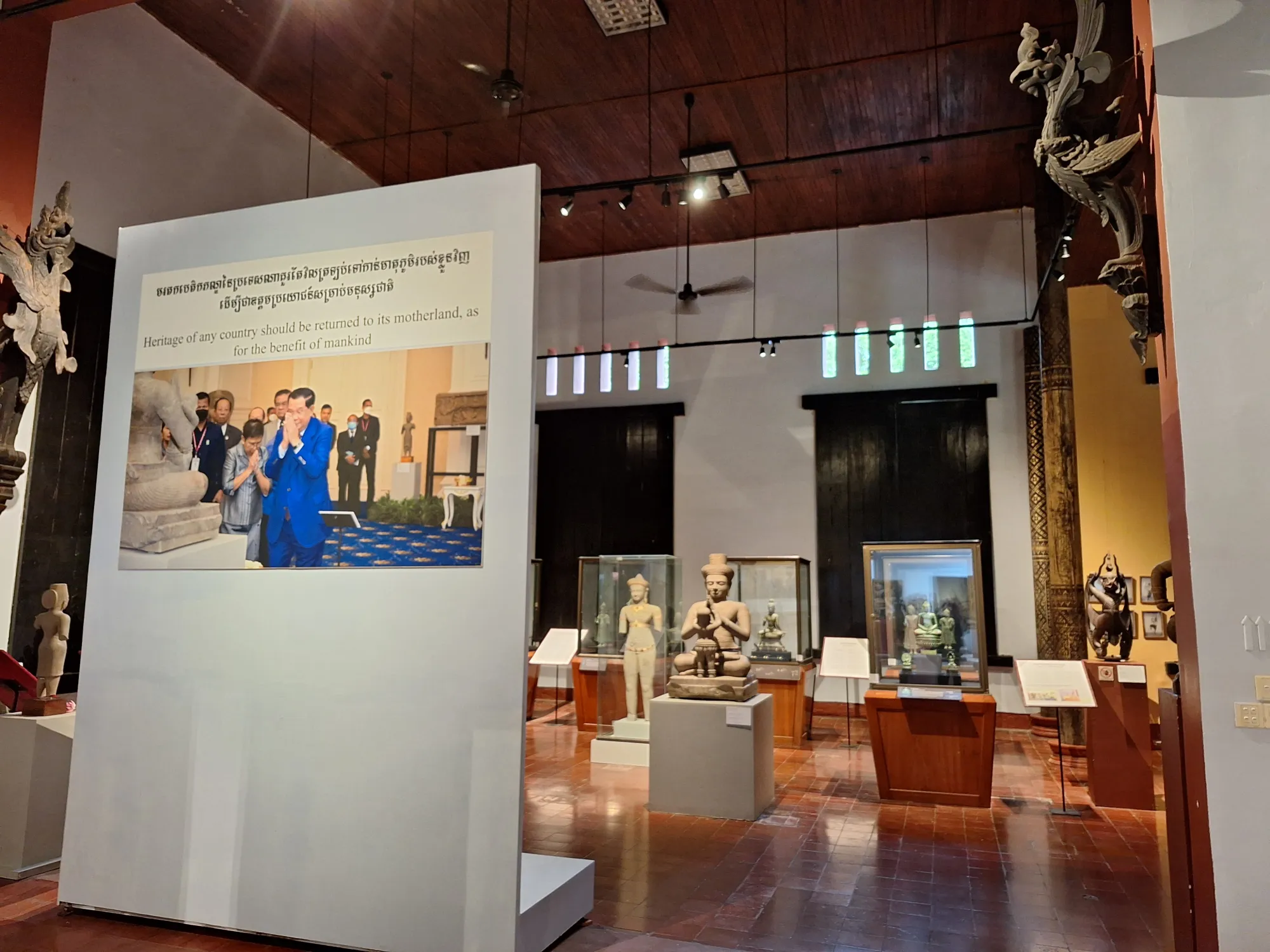
When I last visited the National Museum of Cambodia in 2024, there was a special gallery devoted to artefacts that had been returned from overseas museums. Alerted as we are to stolen artefacts by the ABC Program ‘The Things the British Stole’ and Australian’s own disgruntlement at the British Museum’s refusal to return the Gweagal Shield, I was interested to see the celebration of the return of Cambodia heritage objects. But having read this book, I will take even more interest next time because right there, in the middle of the picture is the statue of the Hindu God Shiva and his son Skanda (rendered as a little boy standing before Shiva) which is one of the cultural artefacts specially named in this book.
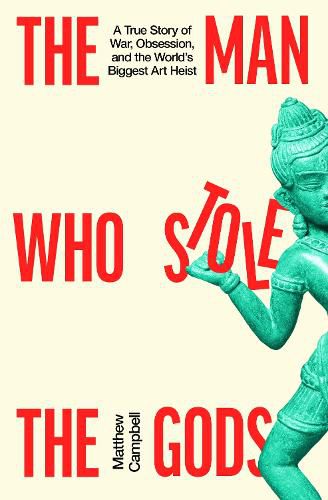
The ‘man who stole the Gods’ was British expatriate and Bangkok resident Douglas Latchford, who was first entranced by Cambodian artworks in the 1950s. By the 1970s, having become very wealthy as manager of an ‘agency’ bringing consumer goods to Thailand he was in a position to indulge his passion for Cambodian artefacts, following the example of an American spy Jim Thompson, who was a major collector. He channelled much of his stolen bounty to the Metropolitan Museum of Art through Thomas Hoving, its 36 year old director who was ambitious to bolster the Met’s collection during the boom years following WW2. His successor was Martin Lerner, who was appointed chief curator of Indian and Southeast Asian art at the Met. For the Met collectors, Douglas Latchford was their man.
Latchford had two passions. One of them was young Thai bodybuilders, and after a failed sham marriage to a Thai women which yielded a daughter, Julia, he was free to surround himself with powerfully built young men. His other passion was ancient Cambodian stone.
Latchford had an encyclopedic knowledge of Khmer civilization, attained through study, travel and incessant collection. He was generally dismissive of art historians and academics. He became a trusted partner to Spink & Son in London, Britain’s premier source for Asian antiquities, and developed a near-monopoly on the artefacts that he sent to UK. However, the 1970 UNESCO Convention on the Means of Prohibiting the Illicit Import, Export and Transfer of Ownership of Cultural Property meant that the artefacts he was sending had to have a minimally plausible origin story. He established a relationship with scholar Emma Bunker, who despite few publications to her name and no PhD, had sufficient academic reputation to convince buyers that their intended purchases would not fall foul of the 1970 UNESCO convention. She managed to obtain letterheads from legitimate dealers who had operated prior to the 1970 cutoff and had a signed letter from a prominent now-deceased Spink executive so that she could generate the paperwork to attest that the artworks had secure provenance. He also could draw on the reputation of Nancy Wiener, a prominent New York art dealer with a gallery on East 74th Street.
Meanwhile, suspicions were arising about Latchford’s activities, both in Cambodia and the United States. In US Special Agent Brendon Easter from the Department of Homeland Security (huh- perhaps they do act well sometimes) and Alexander Wilson, a prosecutor at the Southern District of New York court investigated the proposed sale by Sotherby’s Auctions of the Duryodhana, an important artefact excavated from Koh Ker. In Cambodia, archaeologist Bourdonneau excavated ruins and found pedestals where statues had been removed. Bradley Gordon, an attorney in Phnom Penh, led a team of young Cambodian lawyers acting from the Cambodian side.
Most importantly for the investigation, they found Toek Tik, who had been one of the men who had excavated the artefacts over many years. Living first under the Khmer Rouge, and then through the civil war which followed the Vietnamese invasion to topple Pol Pot, he was now old and sick and remorseful that he had ever been involved in the theft of Cambodia’s gods. Although unable to read and write, he had a good memory for what was located where, and he was able to lead investigators to the sites where the pedestals and remnants stood, making it possible to link the exported artefacts and the location.
But as the net closed in, it was never certain that the artefacts would actually be surrendered, even though it could be proved that they had been looted after the 1970 Convention (indeed, right up to the 1990s). One heavy purchaser from Latchford was Jim Clark, a computer-technology millionaire who had made his money through Netscape (remember Netscape?), who had spent $35 million on 30 pieces between 2003-2007 via Latchford, on the say-so of forged documentation. Julia Latchford, Latchford’s daughter and heir, found that her financial movements were circumscribed by the legal scrutiny under which Latchford’s affairs had been placed, and in 2021 she signed an agreement with the Cambodian government to return all of his Khmer works. Investigators found themselves poring over architectural magazines that featured luxury homes, in order to focus their search for particular objects.
Works from the Clark and Latchford collections found their way back to Cambodia, but most disturbing for me was the intransigence of the Metropolitan Museum of Art. While I note that two more pieces were returned on June 10 2026 to join the fourteen others returned in 2023 that I saw while in Phnom Penh, it wasn’t certain that the Met would relinquish custodianship.
The book’s focus is the stolen artefacts, but along the way it gives a good history of Cambodia generally for people who are not familiar with it. Matthew Campbell puts his journalistic skills to good use, combining his investigative work in tracking the networks across multiple continents, with a succinct telling of Cambodian history. I’ve been working on improving my knowledge of this history, but I admit that I hadn’t realized the length or tragedy of the civil war following Pol Pot’s overthrow. There is nothing good that can be said about the Khmer Rouge, but they did not intentionally damage the temples, and much of the looting that took place occurred during the civil war period when the whole society was in turmoil. That wealthy museums like the Met should take advantage of this societal breakdown, and so recently, is shameful.
It is right that these gods should be back in Cambodia where they belong. They have outlasted collectors, connoisseurs, museum curators, gallery owners, and the impoverished men who were drawn by the (meagre) money they were offered to dig up their own heritage. And that’s just the way it should be:
The artworks that had determined the course of Latchford’s life were as eternal as anything crafted by human hands. When he discovered them, they had already survived for a millennium or longer, silent witnesses to the rise and fall of kings, the arrival and retreat of new religions, and, ultimately, the ravaging of the nation that had created them, in the service of an ideology that would have been incomprehensible to their makers. To obtain them and hold on to them, to hoard them and profit from them, Latchford had stolen, lied, and cheated, ruining relationships and breaking laws. But even this intense connection was transient. Immortality was the preserve of gods in stone and bronze. (Ch. 28)
My rating: 8.5/10
Sourced from: purchased e-book (hence the absence of page numbers in my quotations)
Read because: my son in Phnom Penh recommended it. There’s a two-part ABC podcast about it called Kidnapping the Gods

