Yearly Archives: 2018

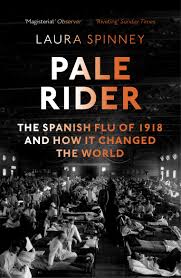
‘Pale Rider: The Spanish Flu of 1918 and how it changed the world’ by Laura Spinney

Spinney_palerider

2017, 295 & notes

It is like the final insult. After four years of death, injury, mud and sand in WWI, it was the ‘Spanish flu’ that killed soldiers  just as the war was turning. It engulfed the whole globe -not just those countries involved in the war-  with most of the deaths occurring in the thirteen weeks between mid-September and mid-December 1918.

Flu epidemics have been with us for thousands of years. Because writing only emerged 4500 years ago, we cannot know when the first one was. We know that there was a  flu epidemic in Uruk in Iraq around that time; there is speculation that flu devastated the armies in Sicily in 212 BC; the first recognized flu pandemic is thought to have begun in Asia in 1580; there was one in 1830 and another ‘Russian’ flu in 1889.

The ‘Spanish’ flu of 1918-19 didn’t start in Spain. Indeed, according to Laura Spinney’s book Pale Rider, a hundred years later we’re still not sure where it did start. Maybe in the poultry farms of Kansas; maybe in the army barracks at Etapes in northern France where birds flocked in the Somme estuaries; or maybe in Shansi province in China, where ducks were herded through the paddyfields to eat insects. What is common to these three locations is birds. Recent research  involved disinterring an obese woman from the permafrost to sequence the flu virus still present around her organs when she died in 1918, and sure enough, the “Spanish” flu was a form of avian flu which had crossed over to humans.

The ‘Spanish’ flu arrived in Spain in May 1918. It had been in America for two months and in France for at least a couple of weeks. But because any mention of flu was censored in nations at war, it was only in neutral Spain that it was reported in the local newspapers. Although “Spanish” was the name that stuck, most countries named it after another country- generally a country they didn’t like: in Senegal they called it Brazilian flu; in Brazil they called it the German flu, the Poles called it the Bolshevik disease; in Iran it was the British flu.

Whatever it was, it affected an estimated 500 million people, 1/3 of the global population in 1918. Between 50,000 and 100,000 million people died.  It came in three waves: the first in March-April 1918; the second and most deadly wave in August 1918 when it spread through most of Europe, Iran, India and China; a third wave in early 1919 which affected Australia which had largely escaped the other waves through effective quarantine; and perhaps a fourth wave in the winter of 1919-20.  In Australia, more than 12,000 people died.

Children and old people have always been vulnerable during an influenza epidemic. What was unusual about the ‘Spanish’ flu was that if you  map out the distribution mortality rates, it shows a W-shape, with people between  20-40 particularly susceptible. Spinney suggests that flu might have been particularly virulent among otherwise healthy people because their immune system went into overdrive. Perhaps some older people, who would normally have been susceptible, had gained some immunity from the 1889 ‘Russian’ flu.

Modern medicine was powerless. Aspirin was prescribed in huge doses, and indeed there has been a claim (which Spinney largely discounts) that very high doses of aspirin , which causes the lungs to fill with fluid, may have actually contributed to the deaths of a sizeable proportion of the flu’s victims. (p.122). However, this argument cannot explain why so many people died in India and other countries where aspirin was not available. Another common treatment was high doses of quinine which added vertigo and vomiting to the symptoms, and may have contributed to the visually “washed out” appearance of the world that many recovering victims reported.  At a time when there was no firm distinction between commercial and folk medicine, it is no wonder that people resorted to traditional medicine and practices to ward off the disease, like ‘black weddings’, an ancient Jewish ritual which involved choosing a groom and bride from the most unfortunate in society (beggars, disabled) and conducting a wedding in a graveyard to fend off the disease.

Spinney’s book has an introduction, eight parts and an afterword. Part I, ‘The Unwalled City’ places influenza within a historical context, both across the centuries and the immediate WWI medical and social environment. Part II ‘Anatomy of a Pandemic’ describes the spread of the Spanish flu across the world. Part III ‘Manhu or What Is It?’ deals with the incomprehension and impotence of medicine and governments against the pandemic when it first emerged.  Part IV ‘The Survival Instinct’, which I found the most interesting, looked at the medical and social responses across the globe. Part V ‘Post Mortem’ looks at the search for the first ‘Spanish’ flu victim, and the toting up of the final figures. Part VI ‘Science redeemed’ details medical and scientific progress in understanding the pandemic, while Part VII ‘The Post-Flu World’ looks at the fall-out medically, socially, culturally and militarily after the last wave.  Part VIII ‘Roscoe’s Legacy’ discussed disease control in the future. The Afterword ‘On Memory’ looks at how the pandemic has been remembered, or more pertinently, forgotten.

Spinney’s book joins a surge of interest in the 1918-19 epidemic now that it is coming up to its centenary. Unlike many books that concentrate on its effects in one city or country, hers is a truly global approach to the pandemic.  As a science writer, she focuses on the disease, its manifestations and the scientific response, but she also interweaves this with a consciousness of how the experience of suffering and recovering from the flu leached out into music and literature in the succeeding decade.

As for her claims for it changing the world?  I’m not quite convinced, given how easily it has been forgotten. She argues that it ended the war because the German soldiers were so sickly; she suggests that it led to the introduction of universal health care (I’m not so sure- the NHS, Medicare/Medibank etc were introduced post WWII), and posits that the British negligence in treating Indians with influenza was an eventual catalyst to Independence (another event that seems to me to be too chronologically distant from the pandemic to be convincing).

Nonetheless, I found this book a fascinating read. It is well written, well-researched and rather chilling.

Sourced from: Yarra Plenty Regional Library

Read because: I’m aware that the centenary is upon us.

Rating: 8.5


Movie: Vita and Virginia

This was a very wordy film, as you might expect given that it was set amongst writers and artists in the Bloomsbury circle. Elizabeth Debicki was excellent, playing an ungainly and  mentally fragile Virginia Woolf. There was rather too much of Vita and Virginia staring face-on to the camera in close-up, talking, and felt myself getting rather bored by it all. I wanted to like it more than I did.

I saw this as part of the British Film Festival.

I hear with my little ear: Podcasts 30 Oct – 5 November 2018

History Hour (BBC) I don’t know why it took me so long to find this program. The episode from April 29 2017 is a cracker: the campaign beginning in 1977 by the mothers of children who disappeared during the military dictatorship in Argentina who are now known as the Mothers of the Plaza de Mayo, Bulgaria’s attempt to crush Turkish language and culture. and a gruelling interview with a woman who survived Bosnia’s rape camps. I also listened to a recent one about when Russia’s richest man was jailed, which had a good section on the discovery of oil in Nigeria.

Conversations (ABC). Richard Fidler is such a good interviewer. I listened to him interviewing Leigh Sales about her new book Any Ordinary Day. And in Inside the Family: the bizarre and brutal Australian cult, from a writers festival somewhere Richard interviews the authors of a documentary and book on Ann Hamilton-Byrne’s cult up in the Dandenongs, where children were adopted under very questionable circumstances (originally broadcast in 2017)

Earshot (ABC) The Conquistador, the Walpiri and the Dog Whisperer is about two Chilean women, from different sides of Chilean politics who ended up working in Central Australia managing Warlukurlangu Art Centre in the desert community of Yuendemu. I have conflicted feelings about the industrializing and commercializing of traditional art, and feel even more conflicted after listening to this.

But Robert Manne’s Voice is absolutely, completely wonderful. Robert Manne is an Australian public intellectual who has spanned the political range from left wing to right wing and back again. He has recently had surgery for throat cancer, which means that this man, who continues to speak out about climate change and refugees, now speaks only in a whisper. Even if you don’t know who Robert Manne is, listen to this. It’s really good.

History Hour (ABC) For Armistice Day, there’s an interesting podcast about the tradition of the ‘minute’s silence’,  suggested by an Australian soldier who enlisted from England. He originally planned for five minutes silence until they realized how l-o-n-g five minutes of silence was.

Duolingo. Episode 13 Refugiados. An interesting episode about a political refugee from Uraguay during the military dictatorship during the 1970. A mixture of English and slowly-spoken Spanish. There’s a transcript on the webpage.

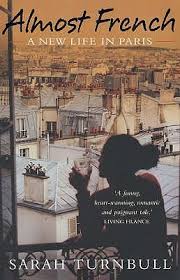
‘Almost French’ by Sarah Turnbull

turnbull_almost_french.jpg

2002, 309 p.

Somehow or other, the deluge of books about women going off to France seems to have rushed past me. I hadn’t particularly been drawn to dip my toes into the flow, but this book was chosen by my bookgroup and so I read it, some sixteen years after it was published.

At the time of writing it, Sarah Turnbull was an expatriate freelance journalist living in Paris. Most of her journalistic work was published in magazines (similar to the Weekend Magazine that comes with the Age), and the lightness of her touch and self-deprecation makes this an easy and very pleasant read. Food, fashion, the joys (or not) of pet ownership are topics that she addresses in the book, and could easily be lifted for lifestyle magazine consumption.

She only intended going to Paris for a week, having met Frederic in Budapest, and accepting his offer of a week in Paris on a whim.  She ended up staying eight years. In this time she came to realize the truth of the words of an elderly man she had met on the Greek  island of Samos on her travels. After migrating to Australia, he had returned to Greece but felt it “a bitter-sweet thing, knowing two cultures”.

She has to learn the language, and she feels excluded by her limited French and frustrated by her inability to assert herself. But more than words, she has to learn the French purpose of language in a social setting as a game, to show one’s quickness and wit. She struggles with the coldness of other French women until she recognizes it as a manifestation of competition. She mocks Frederic’s horror at her donning tracky-daks to go down to the nearby bakery, but finds herself equally affronted by the tackiness of English dress-sense when they go over to England for a weekend.

This book is laugh-out-loud funny in places, for example where Frederic quickly ties his jumper around his waist and affects a dodgy French accent when pretending to be an Australian tourist when they are challenged for trespassing. There are moments of poignancy too, like when she needs to don sunglasses in the plane when leaving Australia, looking at the Qantas advertisement and seeing the landscape curving away from her from her plane window.

This is really just a series of anecdotes, with no great plot shifts or crises. She is insightful in identifying the nuance and yet solidity of cultural difference. It is something that we can and should all be reminded of, going in the different direction, by people who are adjusting to Australia. It’s a light, enjoyable read- and yes, it made me wonder if perhaps I could go to France next year after all…..

My rating: 8/10

Sourced from: CAE bookgroups.

AWW-2018-badge-rose-199x300 I have put this title onto the Australian Women Writers Challenge database.

Movie: Jirga

There’s not a lot of dialogue in this film, or at least, not much dialogue that you and I will understand. An Australian ex-soldier, Mike, returns to Afghanistan where he served in the army some years earlier. He had been involved on a raid on a village, and he wants to make amends. He doesn’t speak Pashtun, and to put us as viewers in Mike’s place, nothing is translated.  The landscape is stark- no wonder armies founder there.

It’s an excellent meditation on repentance and forgiveness.

My rating: 4 stars.

And here’s an interesting video about the making of Jirga

I hear with my little ear: Podcasts 22 October-29 October

Revolutions podcast. Episode 9.09 The Tiger.  At last! Francisco Madero finally does something, Portfirio Diaz finally retires (after promising to do so thirty-odd years earlier) and we finally bring all the gang together by introducing Pancho Villa, whom I vaguely remember from History I back at La Trobe in 1974.

Articles of Interest. Episode 1 Kids’ Clothes introduces the concept of this podcast series about fashion and clothing and then goes on to explore the design restrictions on children’s clothing, especially for an adult of small stature who has to shop in the children’s wear department. Episode 2: Plaid looks at tartan, its history and its use as identity marker from Highlanders to the gay community. It starts with a woman with such a bad case of vocal fry that she sounds like she’ll just combust, or croak away into silence.

The Horror of Delores Roach I listened to Episode 2 You Know He Lives Underground, Right? I’m not really sure about this one. It’s pretty grimy and it has a lot of swearing. Even I am finding it gratuitous.

News in Slow Spanish Latino Episode #280

BBC History Hour This is a weekly broadcast that has about four stories in a 50 minute episode. Although there might be a contemporary event or publication that has prompted the segment, the podcasts themselves don’t date. I listened to an episode from 23 Dec 2017 about the filming of To Kill a Mockingbird and a fascinating one from May 6 2018 where Margaret Thatcher’s personal secretary, a left-leaning public servant, spoke about her ambivalent relationship with her. It also had a segment on the Childrens’ Crusade during the early 1960s civil rights movement, and the striking changes to the way Shakespeare is interpreted brought about the Royal Shakespeare Company.

Russia If You´re Listening (ABC) The series has officially finished, but Matt Bevan sometimes releases ‘Trumpdates’ if something has arisen worth discussing. In this podcast he is talking with Leon Neyfakh the host of the podcast ‘Slow Burn’ which examined Watergate in its first season, and White Water/Monica Lewinsky in its second season. Here they discuss Trump’s Russian travails against these earlier scandals. Couldn’t find the episode on the ABC website, so you might have to go to your ABC Listen app.

Rear Vision (ABC). This was an interesting podcast about Megacities, comparing the past and future of megacities in the global north and south.


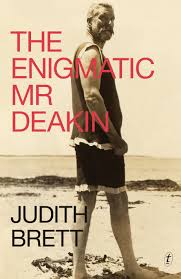
‘The Enigmatic Mr Deakin’ by Judith Brett

Brett_EnigmaticMrDeakin

2017, 434 p.& notes

Much of the commentary about recent Australian politics has decried the cycle of replacement of Prime Ministers over the last ten years, the spectre of minority governments and the congestion of hung parliaments as if they were an aberration. However, reading Judith Brett’s biography of Australia’s second Prime Minister Alfred Deakin, The Enigmatic Mr Deakin, the early years of the Australian federal government were unstable and chaotic as well.

Yet in these years the federal government established some of the most progressive legislation in the world in relation to voting practices, a basic wage, pensions and arbitration, later dubbed ‘The Australian Settlement’ by Paul Kelly (see here and here).  This post-federation ‘settlement’ survived until dismantled by the Hawke-Keating government of the 1980s and 1990s, a process accelerated by subsequent neo-liberal governments.

Alfred Deakin was a ‘liberal’ in the true, nineteenth-century sense of the word;  not as in the so-called ‘Liberal’ party today which has long been the party of big business and is becoming increasingly conservative and faith-based. His biographer, political scientist Judith Brett, has written extensively about Liberal Party politicians, most particularly Robert Menzies in Robert Menzies’ Forgotten People (1992), Australian Liberals and the Moral Middle Class: From Alfred Deakin to John Howard (2003)  and a number of Quarterly Essays, most particularly QE19: Relaxed and Comfortable: The Liberal Party’s Australia (2005) and QE29: Exit Right: The Unravelling of John Howard (2007). She is not  of the right herself, but she is drawn to studies of the middle class and their politics.

And what a wonderful biographical subject Alfred Deakin is! He was a prolific writer and correspondent, much of which is available today. Journalist, lawyer and politician, he wrote professionally, socially and most importantly, reflectively over the length of his career.  A gift to any biographer is his prayer diary, where he mused on spirituality and destiny, and a series of notebooks called ‘Clues’ where he collected epigrams, notes on his reading and reflections on life. In addition, he kept diaries between 1884-1916.

Alfred Deakin was born in Melbourne in 1856, one of the post-Gold Rush  ‘Australian-born’ generation. It was this Australian-born quality that marked him out among the other British-born politicians who drove Federation. He began his profession as a lawyer, but moved into journalism through his contact with David Syme, founder of ‘The Age’. In 1879 he entered the Victorian state parliament as the liberal candidate for West Bourke. He served in a number of coalition government ministries, state politics being just as volatile as the early federal governments were to be.  He was instrumental in establishing factory legislation and initiating irrigation in Mildura. However, with the 1890s Depression, he suffered a kind of mid-life crisis as he confronted the limits of politics and struggled with guilt over investments he had recommended for family and friends. He returned to the back bench and took up his legal career again. It was the push towards Federation that brought him back to politics again, and took him to the international and national stage. He then served in the new, wobbly federal parliament with three stints as Prime Minister within ten years.

Brett’s biography certainly integrates the political, the personal, and the spiritual aspects of this complex man. In an unstable parliament, compromise was necessary, even to the extent of a ‘Fusion’ party with the NSW free-traders, whose economic policies he deeply opposed.  He distinguished between liberals (as he described himself) and Conservatives:

the conflict between the particular and the more universal, between the everlasting Nay and the everlasting Yea, between those who obstructed and those who facilitated the forward movement of the spirit. (p.257)

He was not, however, a fan of the newly emergent Labor Party (the first in the world), because of their allegiance to the working class:

“their platform is selfish and their discipline admirable. They constitute a class in politics, and refuse to support representatives who have not been selected from among their own neighbours” (cited on p. 257)

There is no getting around the fact that one of the first pieces of legislation passed by this new, largely progressive parliament was the Immigration Restriction Act, which formed the cornerstone of the White Australia Policy. Brett warns us against imposing our twenty-first century frame onto this legislation, which while seen by Britain as an insult to their Japanese allies, was intended to maintain high wages and living standards. Deakin was oblivious to women as political actors, and silent on indigenous Australians.

Deakin’s personal life was revealed through his diaries and correspondence. He married his wife Pattie, the daughter of a prominent Melbourne spiritualist in 1882 and they lived in South Yarra. Brett suggests that even though Deakin was affectionate and conscientious, it was not the marriage of true minds that perhaps he might have craved.  However, this did not affect the longevity of his marriage. Indeed, as a demonstration of the ebb and flow of relationships, as Deakin became increasingly debilitated by age and memory loss, Pattie came into her own, much healthier in later, post-menopause life, than she had been as a younger woman.

It is the spiritual aspect of Deakin that is the most fascinating to me, and Brett explores it fully thanks to Deakin’s own frankness in writing about it. Deakin believed in contact beyond the grave and was heavily involved in the Spiritualist scene in Melbourne. While this would have raised eyebrows, it did not render him beyond the pale politically as it would today [I’ve often thought that all  Australia would need today is a shaky mobile phone of Scott Morrison speaking in tongues at his Pentecostal church for his support to evaporate among many voters]. Deakin approached the Melbourne Unitarian Church to explore the possibilities of becoming a minister there, where Rev. Martha Turner (very rightly) told him that his spiritualist leanings would not be accepted by the congregation there. Although in later life he looked back at his more youthful Spiritualist activities with some cynicism, his sense of destiny and acknowledgement of the spiritual wellspring of his identity remained throughout his life.

Brett closes her book with a consideration of Deakin’s place within Australian politics and historiography.

By 2001, when the centenary of federation was celebrated, Deakin had faded to a face on an information board, one of the bearded worthies who had made the constitution and after whom things are named: a suburb, an electorate, a university, a lecture series..Among the political cognoscenti too he had become more of a cypher than a man…He came to represent the now discarded policies of tariff protection, state paternalism, centralized arbitration, imperial nationalism and the racism of White Australia, policies which were shaped in the early decades of the twentieth century and all but gone by its closing (p. 431)

She locates the turn against Deakin within the Liberal Party itself under John Howard’s leadership, where economic issues dominated the agenda and a reactive social conservatism was adopted. Brett highlights Deakin’s statecraft and energy, his civility, optimism, ability to compromise and assumption of the existence of a consensual centre. Oh to have some of those qualities today.

This is an excellent, well-written, fleshed-out biography. No wonder it won the National Biography Award this year.

My rating: 9/10

Sourced from: Yarra Plenty Regional Library

AWW-2018-badge-rose-199x300 I’m reviewing this as part of the 2018 Australian Women Writers Challenge.


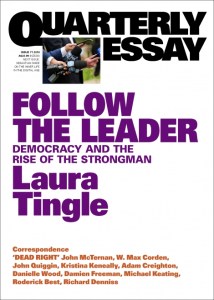
QE71 ‘Follow the Leader: Democracy and the Rise of the Strongman’ by Laura Tingle

tingle_follow_the_leader

2018, 90 p.

How frustrating it must have been to write this book!  The conclusion of the text is dated 27 August 2018, just three days after Australia’s 29th Prime Minister, Malcolm Turnbull, was overthrown for No 30, Scott Morrison. The volume was no doubt planned probably a year in advance (certainly they’re pre-advertised six months in advance) and, being one of Australia’s foremost journalists, Laura Tingle would have wanted the book to be current. As it turned out, the Liberal (i.e. conservative) party decided not to choose Peter Dutton, the closest thing Australia has to a ‘strong man’ as leader – thank heavens. I wonder how much she had to change the book at the last minute to accommodate this change?As it is, the book concentrates more on leadership and democracy, than the ‘strongman’ mentioned in the  title. Perhaps there were whole chapters that ended up in the bin.

This is the third book in a series of Quarterly Essays that Laura Tingle has written over recent years. In 2012 she released Great Expectations: Government, Entitlement and an Angry Nation and in 2015 she followed it with Political Amnesia: How We Forgot to Govern, both of which have been released in a single volume called In Search of Good Government, where she added a new essay on Turnbull in Power (huh!)  Perhaps I’ve seen and heard too much of her elsewhere, now that she’s on the 7.30 Report and Philip Adams still ‘mingles with Tingle’ on ABCRN. I felt as if there wasn’t anything particularly new in this book. After all, others have commented on the obsession with popularity, the search for a strong man,  the ubiquity of ‘stakeholders’ instead of experts, and the deluge of information from a splintering of sources.

There were a few things that were new, though, and I’ve found myself thinking on them over the last couple of days. First, she uses as her analytic frame the work of Ronald Heifetz from the Kennedy School of Government, who published a book called Leadership Without Easy Answers in 1994. In it, he distinguished between leadership, power and formal authority. Leadership he defined as “helping a community embrace change”. This is not necessarily a party thing:  leadership can come from outside the formal power and authority structures, and indeed, this is what she ends up arguing for.

Heifetz defined leadership as helping a community embrace change, offering a map, a clear option to deal with a problem, and corralling factions to a compromise. For him, leadership is about possessing the skills with which to read and push a community (p.83)

Second, she compares a number of different leaders. She cites Miranda Carter’s article in the New Yorker in 2018 comparing Trump with Kaiser Wilhelm II.  Carter noted the Kaiser’s conviction that his one-on-one “personal diplomacy  would fix foreign policy”, just as Trump seems to view whole countries in terms of whether he ‘likes’ a leader, and more importantly that they ‘like’ him too. Like Trump, Kaiser Wilhelm viewed people instrumentally; he lied; he patronized the aggressive nationalistic right, and he was touchy and unpredictable.

Tingle then turns to two European alternatives. The first of these is Angela Merkel, where the cobbling together of coalitions means that she needs to listen and lead from behind. Tingle comments that in Australian politics, political barbs are always personalized against the leader, rather than the government or opposition they lead- note, for example, the almost instinctive response to immediately attack a policy in terms of the leader “But Shorten…” “But Morrison….”. She doesn’t say this, but a coalition of smaller parties would broaden the focus from just the leader.  The second alternative is Emmanuel Macron who leads from the “front, sides and middle” (p.47). He seems to break all the Heifetz rules, and like Trump, in his own way wants to break the system and make France “great again”. However, she says, unlike Trump so far he has been doing this without finding scapegoats, with a clear purpose and a sense of direction. Tingle is not quite sure about him though: there is a danger that he will resort to strongman tactics.

Third, she gives a real life example of Australia acting as a middle power- Turnbull’s “awful” phone call with Donald Trump after his inauguration, congratulating him on the presidency and ensuring that Trump honoured the refugee-swap arranged with Obama. It is a verbatim transcript, and she quotes it in full. I’m not really sure that it advances her argument much, but it’s just too delicious. It’s important, too, because it shows how slippery and self-centred Trump is in those relationships he so prizes with other leaders. I hadn’t seen the transcript previously in full, and she does us a service in reproducing it.  Quite apart from Trump’s childishness, skittishness and self-obsession, it also appalled me to see how little Turnbull was actually asking of him (even though Trump certainly didn’t see it that way). Turnbull was in effect telling Trump that he didn’t have to take a single refugee under the deal worked out with Obama; that all he had to do was go through the motions. In fact, it amazes me that Trump took any refugees at all (he has taken about 400). Even though I knew it at the time, it reinforced how instrumental and risk-averse the arrangement was for Australia to take 12000 Christian-only refugees when the Syrian situation was at its worst.

Finally, she returns to Australian politics and the failures of the leaders we have had over the last ten years.  Her prescription for leadership is bland and obvious, but harder to achieve than it sounds:

To be a leader, you don’t necessarily have to have a vision, but you either have to know what it is that you want to persuade other people to do, or else have the knack of identifying and synthesizing an issue on which people are seeking leadership. You also need to know how you are going to do something about such issues. And you have to know which are the most important things to get done at any given point in time. Then you have to make the rest of us understand why these things are important and what you are going to do about them. This task might simply be an echo of a crystallised or uncrystallised public mood. Or something that involves reimagining all the barriers and structures around a difficult issue. But it does ultimately require you to bring people with you.(p. 81)

She concludes that a large part of the job of political leadership now is “to rebuild the national political discussion after years of it being under assault”, and to recognize that “their own room to move is going to be vastly expanded if there are other leaders in the community with whom they can speak”(p.86). In Heifetz’s terms, this involves protecting the voices of leadership outside the political realm (Human Rights Commissioners and climate scientists spring immediately to mind).

In this, I agree with her.  I inwardly groan when I hear the panellists on Q&A on a Monday night as you see the same old faces and can predict the tenor of the ‘debate’ as soon as the camera sweeps along the table. Sometimes, just sometimes, there’s a new voice from outside, and you wonder “Why don’t we hear more of this person”?

AWW-2018-badge-rose-199x300

I’m adding this to the Australian Women Writer’s Challenge. During the month of October Brona, the convenor of the Non-Fiction round-ups challenged people to read a short non-fiction. This was just the push I needed to actually unwrap some of the Quarterly Essays which sit on my shelf (much to my son’s frustration: I figure that she who buys the Quarterly Essay gets to open the Quarterly Essay, no matter how much he wants to read it).


Movie: The Ladies in Black

It’s romantic, it’s feel-good and it’s look-good. And I loved it.

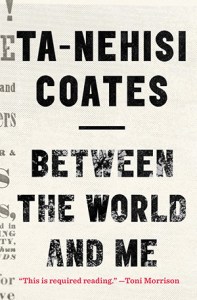
‘Between the World and Me’ by Ta-Nehisi Coates

Coates_worldandme

2015, 176 p.

This is only a small book – an extended essay really –  but it positively burns with anger. It is written in the form of a letter to the author’s fifteen year old son Samori.  Samori had been  watching television with his father, when it was reported that no charges would be brought against the Ferguson police officer who killed the unarmed teenager Michael Brown. Samori left the room, not wanting his father to watch his response.

This letter is a two-way framing device. On the one hand it echoes James Baldwin’s opening letter “My Dungeon Shook: Letter to My Nephew on the One Hundredth Anniversary of the Emancipation” that prefaced Baldwin’s book The Fire Next Time – a book which strongly influenced the author. On the other hand, Coates is drawing on his own bafflement and anger when his own  college friend Prince Jones died at the hands of the police years earlier. This is the letter that he might have wished he had received when he was younger.

This is not an easy read: there are no answers for Coates’ son, and no answers for us either. Coates admits that his son’s experience will be the same as his own: after all, his son had grown up seeing a black President (something that would have been incomprehensible in Coates’ childhood) seeing Afro-American women on television, and knowing real-life women who didn’t straighten their hair (as women did in Coates’ childhood). But, he asserts, deep down nothing has changed.   It is a violent book, in its emphasis on the pain and degradation meted onto the black body, presidents and hairstyles notwithstanding.

There is no uplifting way to say this. I have no praise anthems, nor old Negro spirituals. The spirit and soul are the body and brain, which are destructible- that is precisely why they are so precious….It had to be blood. It had to be nails driven through tongue and ears pruned away…It could only be the employment of carriage whips, tongs, iron pokers, handsaws, stones, paperweights, or whatever might be handy to break the black body, the black family, the black community, the black nation (p. 75)

And this violence on the body is not a thing of the past. It was not cleansed by the Civil War or expunged by the civil rights movement, or muted by Barak Obama. Instead, the construction of white identity  and the Dream of white American life (“perfect houses with nice lawns”) is based on this same, present-day violence on the body. It’s not just adolescents with their hoodies and sagging denims; it’s the four-year old Samori, pushed from an escalator by the white woman behind him. The swaggering insolence on the street is a cover for fear, because all the power lies with White America.

The book weaves together memoir, polemic, history and literature, and it is relentless in its argument. There are no exhortations to action, just the heavy weight of inevitability and impotence.

I read this book after I read his most recent collection of essays We Were Eight Years in Power, which is probably not the way that most people would approach Ta-Nehisi Coates. Having read the most recent book, which comprises essays and blog posts written over the years of Obama’s presidentship, I can see that he has integrated ideas developed over eight years into this essay. It’s not that he has copied-and-pasted; it’s more that you can see the origin and continuity of his ideas.

I also read this book in the midst of the Serena William cartoon controversy, at a time when there was overt and much-discussed emphasis on the black body. It made Coates’ analysis ring even more true. I don’t know how to rate this book. I feel complicit and condemned because, although I live on the other side of the world,  I too am part of the White Dream .

Source: Yarra Plenty Regional Library