Monthly Archives: December 2016

This Week in Port Phillip 1841: 25-30 November 1841

More on ‘The Tasmanians’ or the ‘Van Diemen’s Land Blacks’

You might remember that a fortnight previously the newspapers were reporting that the Commissioner for Crown Lands, Mr Powlett, had been unsuccessful in apprehending the ‘Van Diemen’s Land Blacks’ who were ‘committing outrages’ in the Western Port district.

On 25 November the Port Phillip Patriot reported that they had been captured.

CAPTURE -At a late hour last evening we  received intelligence of the capture of the black marauders whose numerous depredations had rendered them the terror of the settlers in the neighbourhood of Western Port.  They were apprehended by the party who started from Melbourne about a fortnight since in pursuit of them.  The party with their prisoners encamped on Tuesday night at Dandenong, on their way to Melbourne, and may be expected to arrive today.  These blacks consist of two males, well armed, and three females; they form part of that “family” for whose removal from Flinder’s Island to Port Phillip Mr Robinson, the Chief Protector, obtained, some time since, the permission of the Governor [PPP25/11/41]

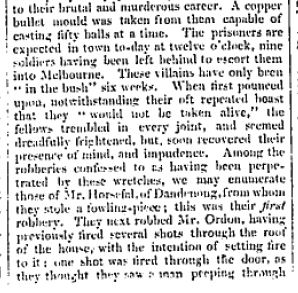
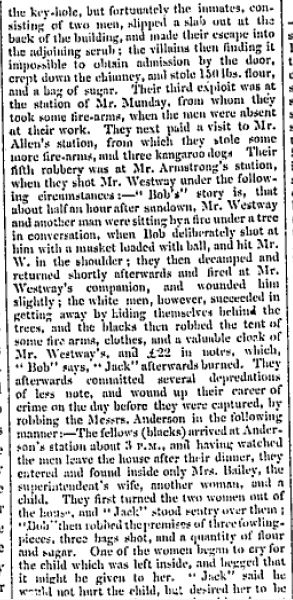
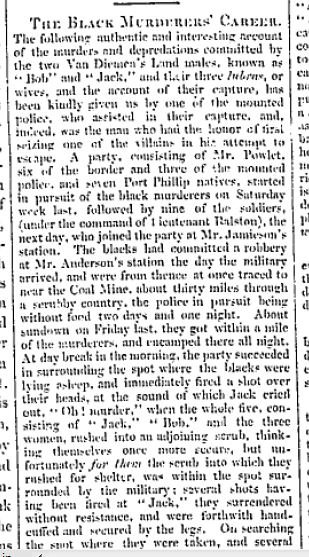
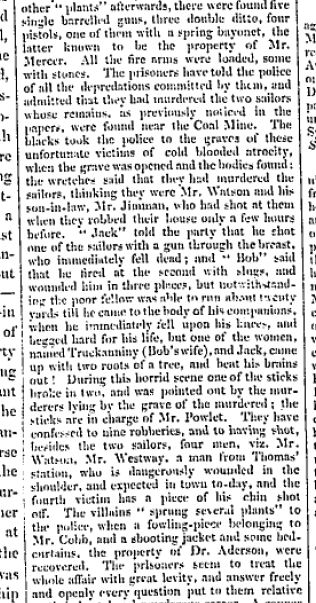
The Port Phillip Herald of 26th November carried this lengthy account, supposedly given to them by one of the captors. Whatever its inaccuracies or silences, this was the report read by people at the time:
tunner1

tunner2

tunner3

tunner4

tunner5

On 26 November they were  placed at the bar of the Police Office and a preliminary inquiry was undertaken.  The witnesses were unable to identify the prisoners as the assailants.  Protector Robinson testified to the long contact he had had with the group, testifying that Jack had been brought up by him from childhood and had accompanied him in all his journeys and that Bob and the lubras had been in his charge for the past fourteen years.  The next day (Saturday) the prisoners were brought up again. Watson, the miner, identified them as the persons by whom he had been wounded, and his wife and daughter swore than the group had robbed and burned the hunt.  One of the women described the circumstances of the murder of two whalers from Lady Bay and produced the bloody bludgeons.  The group was remanded, to  be brought before the court again.  The Port Phillip Patriot noted that:

The prisoners are obviously a different race of men from the Aborigines of New Holland: their colour is much deeper,and in the general character of their appearance there is much more of the African features. (PPP 29/11/41 p.2)

Meanwhile….

At the very same time that the Tasmanians were appearing in court, the Port Phillip Herald carried the news that Mr Sandford George Bolden would be tried for the murder of an Aboriginal near Port Fairy.  According to this report, Mr Bolden with one of his stock-keepers came upon a native driving off a number of cattle, he left his stock keeper and rode to a station in the neighbourhood and returned with a loaded gun. His defence was that the black pointed his spear at him and that he fired in self defence. (PPH 30/11/41)

The Boldens were fairly well known in Melbourne. The accused’s brother,  Rev Bolden lived in Heidelberg, nearby to Judge Willis, who would be presiding over the case.  Two high-profile cases involving indigenous people and death were in the public consciousness at the same time: one where aborigines were said to have killed white people; the other where a white settler was said to have killed aborigines.

Well, that didn’t happen… yet

The Port Phillip Gazette reported that Melbourne was to have a botanical garden:

BOTANICAL GARDEN. “Sir George Gipps, having approved of the establishment of a public domain, for the purposes of rearing and cultivating indigenous and exotic plants having any peculiar or rare properties, it has been determined by the local Government to set apart “Batman’s Hill” and the surrounding land down to the Yarra Yarra for such reserve.  The Survey Department has received instructions forthwith to mark out the boundary lines, with a view to its early enclosure; when the long talked of Botanical Garden will be placed under the direction of an experienced Horticulturalist and Botanist. The present season is too far advanced to allow of any operations beyond the mere “laying out” of the promenades, and subdividing the allotment into its due proportions for the reception of seeds and plants at the fit periods during the ensuing season.  The sooner, however, the work is commenced the better; as delays in such matters are generally productive of evil to the public. [PPG 27/11/41]

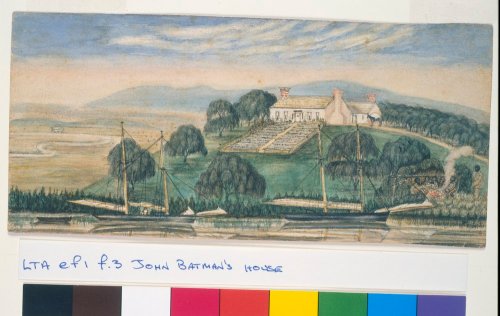
I’m not sure what “evil to the public” accrued from the lack of a botanical garden, but Melbourne had to endure it for another five years until a new site was selected in 1846 where the Royal Botanic Gardens are now, rather than on the Batmans Hill site mentioned here. The flat part of the Batman’s Hill site was already used at that time by the public for horse racing and cricket matches and the hill formed a natural amphitheatre.
john-batmans-house

John Batman’s House by W.F.E. Liardet showing the garden and slope down to the river flats. Source: State Library of Victoria.

http://handle.slv.vic.gov.au/10381/57035

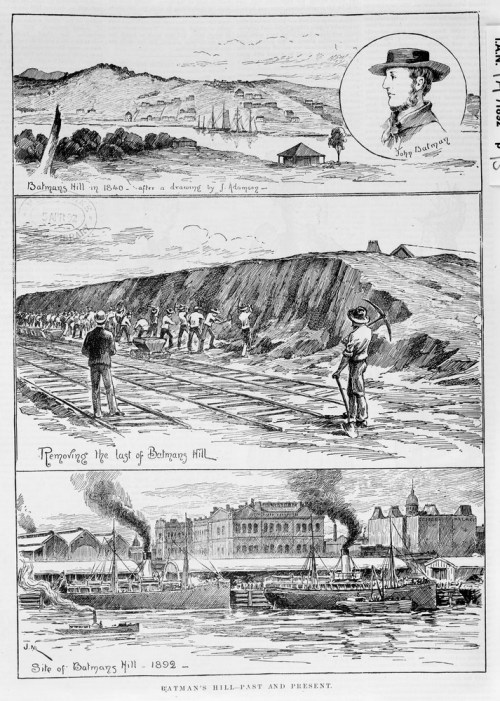
Batman’s Hill was excavated for railway lines in the 1850s and further levelled in the 1880s and 1890s for railway works in what became Spencer Street Station (now Southern Cross Station).
batmans-hill-past-and-present

Batman’s Hill Past and Present, J. Macfarlane (1892) originally published Illustrated Australian News 1 April 1892. Source: State Library of Victoria

http://handle.slv.vic.gov.au/10381/256601

And the weather?

Light winds; a gale and heavy winds from 27th to 29th. Top temperature for the period was 88F (31C) with a low of 47 (8.3)
This Week in Port Phillip 1841: 17-24 November

Step up! Step up!

At this time, what we now know as the Old Melbourne Gaol was under construction, replacing a succession of smaller, temporary jails. The first gaol  was a converted shepherd’s hut on Batman Hill set off Collins Street between King and Spencer Street. It was burnt down in an escape by two Kulin men being held for trial in April 1838.  The gaol shifted briefly to a brick store on the corner of William and Flinders Streets until another gaol was built adjoining the police office and the stocks on William Street between Collins and Flinders Lane. The fourth and last of the temporary gaols was opened in 1840, located   close to where the the very first gaol had been sited, back near the corner of Collins and Spencer Street.  It would serve until 1844 when the present Old Melbourne Gaol was opened, although the three-storey building still standing in Russell Street today was not opened until  1853.

Prisoners sentenced to hard labour often worked on the roads, where they were often the butt of criticism and derision from passerby who accused them of loafing. During this week news came of plans for a treadmill to be erected outside the ‘new gaol’ as an additional punishment that could be ordered by the court, meaning by ‘new gaol’ the fourth, temporary gaol.  A treadmill was listed as one of the assets in the Port Phillip District as on 12 September 1841 so I’m not sure if there was an earlier one.  Nonetheless, the papers reported in early November that:

Among the various works for the accommodation and improvement of her Majesty’s lieges, now in progress, we ought not to omit to mention the treadmill which is to be erected in a building recently commenced in the rear of the jail. We are delighted with the prospect of the speedy introduction of this agreeable species of moral and corporeal exercise (PPP 15/11/41)

The tender for the treadmill was accepted in early November for a cost of £180.  However, the treadmill was to cause nothing but trouble, often being inoperable. Within a year it was found that the heat caused by friction on the ironwork caused the woodwork to warp and become loose.  There were multiple attempts to repair it, and there were hopes that by attaching it to a maize mill, it would prevent the problem from recurring and be more useful.  In 1844 the treadmill was shifted to the ‘new’ Old Melbourne Gaol where both it, and the supervisors appointed to oversee it continued to cause trouble- in the latter case through drunkenness or failure to stop escape attempts.

There are few mentions of the treadmill in the Criminal Record Books for the Supreme Court, although it may have been used more for internal discipline purposes within the gaol itself.  It was obviously operational by 15 March 1842 when Judge Willis ordered two prisoners to work on it: the first for a rape conviction, where the prisoner was ordered to spend time on the treadmill at fortnightly intervals for three months; the second for turkey stealing where the prisoner was sentenced to three months jail, with alternative weeks on the treadmill in the last two months.  A third sentence on 7 April over theft of alcohol was for one month jail with the second and last week spent on the treadmill. There were no other sentences involving the treadmill recorded- perhaps it had become too problematic!

The Port Phillip Patriot reported on 22 November on the number of prisoners in the gaol

STATE OF HER MAJESTY’S GAOL AT MELBOURNE Saturday Nov 20 1841. “For trial, 22 males and 3 female; for hard labour, 27 males and 1 female; for iron gangs 10 males; for solitary confinement 4 males and 1 female; for debt 2 males.  Total 70. Five persons who have been committed for trial are also out of bail.  PPP 22/11/41

Dr Lang and the Australian College

During this week in 1841, the Presbyterians of Melbourne briefly welcomed Dr John Dunmore Lang from Sydney. What a fascinating man Lang was! and he keeps popping up in different contexts. Born in Scotland, he arrived in  New South Wales in May 1823 where he was the first mainland Presbyterian minister in the colony (there was another in Tasmania). A disputatious, forthright fellow, he brawled with fellow Presbyterians who he felt to have fallen into error, and was publicly critical of the influx of Catholics from Ireland. He was involved in education and politics, he was an immigration organizer, a writer and  newspaper editor. His mobility back and forth between Australia and England is remarkable, making at least eight visits to and from England and two to the United States over his long life.  He arrived in Port Phillip on 15 November for a fleeting visit to solicit financial assistance from Port Phillip for the Australian College, which he had established in Sydney in 1831.  On one of his trips to England he had received a grant of £3500 from the Colonial Office for the establishment of a private college if the same sum could be raised privately (an early private-public partnership!)  He put much of his own money from a bequest from his father into the institution, but it was still struggling financially in 1841: so much so- spoiler alert- that it closed between 1841 and 1846 before opening again to struggle on for another eight years.  He bemoaned the fact that he had not been given an endowment for the college from the local government in Sydney, which  he attributed to narrow minded jealousy, personal hostility to himself and the fact that the majority of members of the Legislative Assembly did not themselves enjoy a college education.

And so here he was in Melbourne, suggesting that the Presbyterian residents of Melbourne form “The Port Phillip Education Society” to contribute £200 annually for four years to endow a professor at the college. What was in it for the Port Phillip Presbyterians, you might wonder?  Well, the Australian College could educate local lads for the ministry, thus providing a home-grown cadre of Presbyterian ministers. He proceeded to Launceston and Hobart to make a similar suggestion to the Van Diemen’s Land Presbyterians. (PPP 15/10)  before returning  to discuss the matter more fully at a meeting called for the 3rd of December for interested participants.

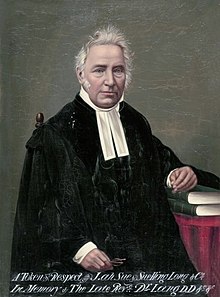
Posthumous portrait of Lang, circa 1888.

Posthumous image J. D. Lang (painted 1888

How’s the weather?

Well, summer had arrived, with a top temperature of 90F (32C) on the 15th and 16th November, followed by a cool change.  There was no rain during the week at all.