Monthly Archives: July 2009

More on the Burchett boys

I recently wrote about the three Burchett brothers who arrived in Port Phillip in the late 1830s/early 40s- Charles Gowland Burchett (1817-1856), Henry Burchett (1820-1872), Frederick Burchett (1824-1861) and Alfred Burchett (1831-1888).

I came across a reference to the Burchetts in William Westgarth’s  Personal Recollections of Early Melbourne and Victoria in his chapter on Early Western Victoria:

Thence I reached “Burchetts’ of the Emus” less finished, indeed, but hardly less attractive. They were business clients of my pleasant old friend Charles Barnes, whose name I gave as my pass, with, however, but little need in those open-door days.  This was a sheep station, as it was a drier locality, the other stations having been more suited for cattle.  We sat joyously chatting in the bright midwinter sunshine.  The air was redolent of humour, for which the Burchetts had a name.  One of them was rather deaf– indeed very deaf, but when he did pick up the current subject, he seldom failed to contribute good sauce.  With regret I remounted next morning, for with business finished in this direction, I was resolved to push on to the Glenelg, as I wished to see through Victoria westwards while I had the opportunity.  So I turned my steed north for the Wannon.

The reference to ‘The Emus’  and the deafness of one of the brothers confused me, and I assumed that they might be different Burchetts. But I’ve also been reading George Augustus Robinson’s journals, and found that on his Western Victoria travels, he also came across some Burchetts.   The editor, Ian Clark, identified them as “my” Burchetts.

A few miles from Gray’s came to another branch creek of the Hopkins on which was a sheep station of Burchett’s.  From this station proceeded to Burchett’s head station.  There are three brothers of the Burchetts’ they are from Kentish Town, London and the eldest is well informed.  They had on a curious costume: common floss jackets much too large for their little persons.  Two of the brothers are deaf.  There is also a Mr Bayley, an elderly person in partnership with them.  They have cattle and sheep.  It was raining when we arrived.  A youth, the youngest of all the Burchetts came out of the hut.  We asked the time; he said half past four by the appearance of the sun.  We judged it later and asked him how he knew.  He said, by the cattle coming home; they were to come home at four and they had just arrived. I asked a woman at one other hut and she said between five and six; she was correct.  The elder brother gave us directions to Muston’s to which station we were anxious to get this evening. He said if we kept the bank of the creek we were upon it would bring us to Muston’s.  I asked Burchett if he had been troubled by the blacks.  Said no, but he had heard that the natives had been at Kemp’s.  (The Journal of George Augustus Robinson, Volume Two: 1 October 1840-31 August 1841, p. 125, 3 April 1841).

There’s the same reference to deafness- although Robinson says that two of the brothers are deaf.  Well,  according to Google Maps, Penhurst and Mt Rouse (where I know that the Burchetts settled) are  about 50ks from the Hopkins River, so I assume that it’s the same group.   They sound a hospitable bunch.
‘The Age of Wonder’ by Richard Holmes

holmes

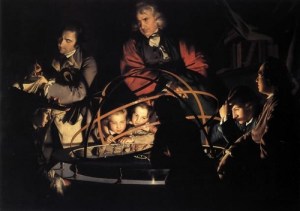
The front cover of Richard Holmes’ book The Age of Wonder: How the Romantic Generation discovered the Beauty and Terror of Science shows the beautiful painting ‘A Philosopher giving that Lecture on the Orrery in which a Lamp is put in place of the Sun‘ by Joseph Wright of Derby, 1766.   Quite apart from the impact of the lighting, the expressions on the faces and the spread of generations depicted, the title of the painting is important- a philosopher– and in Richard Holmes’ book we explore the shift from ‘philosopher’ to ‘scientist’ in the nineteenth century.  The term ‘scientist’ itself is of fairly recent origin, coined as part of this transition between 1830-1834, and initially rejected because of its analogy with ‘atheist’ but rapidly taken up in common usage.

Holmes argues that the bifurcation between science and romanticism took place only  in the mid 19th century, and was preceded by a period in which what we now call ‘science’ was part of a broader fascination with theology, poetry, painting and literature.   In this multiple biography, not unlike Jenny Uglow’s  The Lunar Men (which I’m also looking forward to reading), Holmes uses Sir Joseph Banks as a type of bookend to encapsulate a number of other interwoven biographies.  The book opens with Joseph Banks in the South Seas, the young, libertine ethnographer who literally ‘goes native’  during his voyage of exploration.  It closes with Banks’ death in London, where he is the bedrock of the Royal Society and a one-man communication hub between the  ‘philosophers’  he championed and mentored across the globe.   Between these bookends are other biographies: particularly those of William and Caroline Hershel the astronomers and Humphrey Davy the chemist and inventor, who each have two distinct chapters, as if Holmes himself is orbiting them.  Mungo Park the African explorer is here too, reaching into the darkness and emptiness of Africa as it was known then;  as are the balloonists in England and France who had the first glimpse of the earth from on high, just as momentous and re-orienting as the photographs of the earth taken from space 150 years later.  This is not just a ‘great man’ approach: there is also the more troubling diversion into the experiments into galvanism (news of which travelled all the way to Port Phillip) and attempts to create life itself as displayed in Mary Shelley’s Frankenstein.

These ‘philosophers’ were not set apart from artists and poets: instead they were friends with them, and in many cases were themselves poets and writers- especially Humphrey Davy who, for me, is the luminous presence of the book.  Holmes’  incorporation of women philosopher/scientists – Caroline Hershel, the indefatigable assistant to her brother and astronomer in her own right, Mary Shelley and Mary Somerville – does not feel forced, while acknowledging the societal structures that privileged their male colleagues.

Holmes is a wonderful biographer.  His footnotes at the end of the book are spare but painstaking, reflecting the depth of archival research he has undertaken.  They are supplemented by the occasional note at the bottom of the page, denoted by a trefoil, that provides glimpses of the biographer at work and in thought.  His note, for example, attached to a glancing reference to a ribbon that Davy enclosed in a letter:

In 1795 Pitt had levied a tax on hair powder, to help raise funds for military campaigns abroad.  The ribbon fell out of Beddoe’s letter as I unfolded it in the Truro archive, and I let out a republican whoop! that almost led to my ejection. (p. 252)

This is not just a series of scientific biographies: it is an argument about Romanticism and science, and the nature of human intellect and endeavour.  It is a deeply rewarding read.

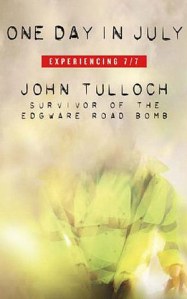
‘One Day in July: Experiencing 7/7’ by John Tulloch

Tulloch2

2006, 223 p.

Today is the fourth anniversary of the London bombings.   A memorial has been unveiled in Hyde Park this year, and I have no doubt that every passenger on the Underground today will think of the bombings, even if just to push the whole idea away as too terrifying to contemplate (or maybe I’m projecting my own claustrophobia here.)

John Tulloch, an Australian academic, became one of the ‘iconic’ images of the bombing as he was led from Edgware Road, a bandage wrapped around his head, with eyes darting sideways. His studies specialized in the media and risk, and he brings this perspective to his experience of the bombings.  This is more than a survivor story- although he writes graphically and minutely of the bombing and its aftermath- but the real strength of his telling is the intelligence and insight he brings to the experience and its portrayal in the media, theatre and literature.  Here he is able to step away and analyse the intent and techniques in the narrative as it is portrayed through different media.  He puts his politics upfront: he is vehemently anti-Blair, anti-Bush (and anti-Howard); he is convinced of the relationship between our involvement in Iraq and the bombings and clear eyed about our own complicity in allowing the war to continue.  Ironically, he found himself used as a political image to further Britain’s involvement, rather than to question it.

tulloch3

John Tulloch is obviously a sharp and rather irascible ‘older’ academic, and he puts his wisdom, experience and deep knowledge to its best use by adding shades of complexity, contingency and nuance to events that are too easily depicted in only black and white language- something that I’m pleased to see our Federal Government is moving towards consciously expunging from the political lexicon.

‘Addition’ by Toni Jordan

Grace Lisa Vandenburg is an unemployed teacher on sick leave after a breakdown triggered by a young boy’s accident in the schoolyard.  But Grace’s problems lie deeper than this: she counts obsessively and incessantly, as a way of trying to control her world and all around her.  Into this ordered and tense life comes Seamus, who is attracted to her humour and quickness, and steers her towards therapy and medication as a way of overcoming her obsessiveness.  We lose our perky, wisecracking, passionate and controlled narrator as the medication submerges her into a slow, passive inertia. Will she lose the medication or lose her man? Or both?

This is all the stuff of good chick-lit, in this case bolstered by clever use of narrative to reveal the personality change that Grace undergoes as a result of her medication.  In this regard, it reminded me of Daniel Keye’s short story Flowers for Algernon, which was picked up as the film ‘Charly’.  I think that this use of narrative voice to denote change is one of the real strengths of the book, along with a main character who is not just sassy but also sees the world quite differently.  The book also introduced me to Nikola Tesla, a Croatian engineer who was likewise driven by the need to count, but for him it ended in madness.  The book explores the often narrow line between habit and obsession;  routine and ritual; self control and control of others; passivity and strength; eccentricity and madness.  In these regards, it steps out of the chicklit genre into something more complex.

But Toni Jordan has not been served well by her publishers, methinks.  There are several versions of the front cover, and none really does justice to a book that is more than just chick-lit.

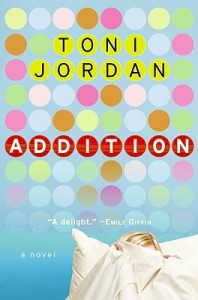
Here’s the American version.  Who the hell is Emily Giffen? Thank you Wikipedia-  Emily Giffen is obviously the Queen of Chicklit. Her insightful blurb  calls it “A delight”. I hope that no-one offered their first-born child in exchange for such a glowing endorsement.  I wonder if her books are so nuanced?  And in case you think it’s a primary school textbook- a not unreasonable assumption really-  the cover helpfully labels it as ‘A novel’.

jordanaddition2

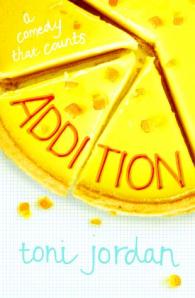
The English version has a little pun – “A comedy that counts”.  The lemon tart is nice and cheerful- but surely it should be a flourless orange cake sprinkled with poppy seeds- if you’ve read the book, you’ll know why.

jordanaddition3

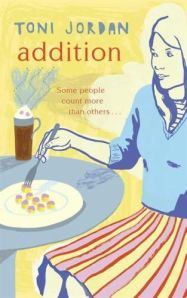
There’s a second UK cover that sticks with the pun on counting: this time “Some people count more than others”.

jordanaddition4uk

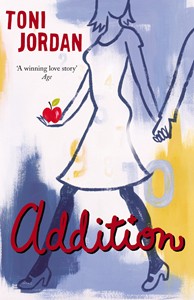
One of the covers available in Australia resembles this British one, but with a sassier girl who looks more like a model and less like a schoolgirl.  The blurb cites The Age’s recommendation:  “A winning love story”.

jordan5aust

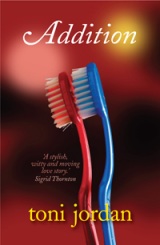
Then finally, there’s one that perhaps gets closer to the tone of the book.  Sigrid Thornton (much loved of Sea Change) endorses it as “A stylish, witty and moving love story”.   But as the Resident Husband commented “Since when has Sigrid Thornton been a book reviewer?”  Maybe I should keep an eye on my toothbrush, lest it also get up to shenanigans.

JordanAddition

There is a happy ending in this feel-good, romantic fiction book, and it’s good fun, engaging and heartwarming.  I gobbled it up, and shut the book with a smile.  I think we can all do with a bit of this, in small doses.  And, of course, only as part of a well-rounded reading diet.