
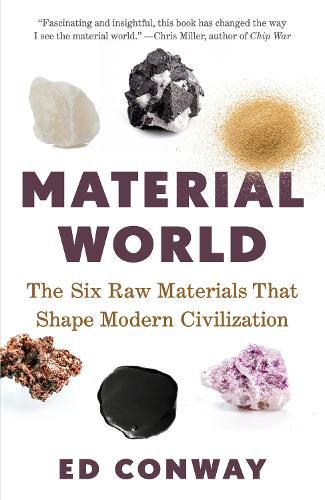
When my son said that this was his favourite book of 2025, I took notice. When I told him that I had borrowed it from the library, he hedged a bit, saying that he didn’t know if I’d like it. He’s wrong: I loved it. I could barely put it down over the three days that I read it: sand, beach and grandchildren notwithstanding.
I’m not a particularly science-y person, but this book is far more than ‘just’ science. Like a Mark Kurlansky book (think Salt, Cod etc.) it combines science, history and travel, but it also packs quite a bit of political analysis as well. I’m writing this on 5 January 2025 as the reality of Trump’s bombing of Venezuela and imposition of US oil interests is sinking in, and Conway’s comments about autarky (i.e. the policy of being self-sufficient that underlies Trump’s ‘America First’ policy) seem particular apposite right now. Ed Conway is the economics and data editor of Sky News and a columnist for The Times (London), which are right-wing connections that do not engender my trust. However these contexts are not particularly apparent in Conway’s book, except perhaps for the ultimately optimistic viewpoint with which he ends the book. Quite apart from his politics, his journalist background equips him with the eagle eye for a good anecdote and the ability to bring the narrative back onto more general-reader territory when it threatens to wade into technologically and scientific details.
In the introduction he identifies himself as a denizen of what he calls ‘the ethereal world’:
…a rather lovely place, a world of ideas. In the ethereal world we sell services and management and administration; we build apps and websites; we transfer money from one column to another; we trade mostly in thoughts and advice, in haircuts and food delivery (p.13)
He distinguishes this from ‘The Material World’, which undergirds our everyday lives by actually making things work, often through companies whose names are unknown to us, but which are more important than the brands that use their output:
…operating stuff in the Material World….you have to dig and extract stuff and turn it into physical products…a difficult, dangerous and dirty business (p.14)
He chooses six raw materials – sand, salt, iron, copper, oil and lithium- which are not only important substances in the world, but are the primary building blocks of our world and have fuelled the prosperity of empires in the past. They are the very hardest to replace. These six materials form the basis of products several steps up the chain: sand, for instance, is the basis of silica which underpins optical fibre and the concrete and cement that makes modern high-rise cities possible. In analysing these materials, he traces back their ‘discovery’ to ancient civilizations, often by accident or through observation, before being intentionally created with processes that often form the basis of present methods. Concrete, for example, was ‘discovered’ three times: there is evidence of cement use in Neolithic ruins in Turkey that date back more than 10,000 years; the Bedouins created concrete-like structures in 6500BCE, and the Roman used a form of concrete in many of their buildings before the recipe was lost for hundreds of years following the fall of the Roman Empire. The discovery of On Architecture by Roman architect Vitruvius, and its translation into French and English, triggered the 18th and 19th century quest for new concoctions to replicate or surpass the Roman recipe (p. 75). Perhaps because he is a British journalist, he highlights deposits in the British Isles rather more than we would think of today, and both German and British ingenuity are highlighted, as well as American. Thomas Edison makes several appearances, but the complete absence of any women at all highlights the male-dominated nature of science and invention.
The structure of the book has a sense of symmetry that I find appealing: six raw materials examined in six parts, each with three chapters, an introduction to the book and a conclusion. I can’t vouch for the reliability of his information, but each time I exclaimed “Hey, did you know…?” to my much more scientifically-oriented husband, he already did know and what he knew aligned with the information in the book.
Unlike many in the media companies and publications he works for, Conrad does not deny the reality of climate change and the environmental degradation that occurs as part of the mining and extraction of his six materials. However, as he points out, the production of an environmentally harmful material was often prompted by the desire to replace an earlier, even more harmful energy source which would have brought about an even more devastating environmental impact. e.g. coal replacing wood, kerosene replacing whale oil, or polyethylene replacing gutta-percha from the rapidly disappearing Malaysian guttapercha tree. It is this pattern that contributes to his optimism about our ability to mitigate climate change in the long term, if we can overcome the short-termism of the political cycle and make financial and lifestyle sacrifices for an unborn generation- actions for which there is equivocal evidence so far.
However, he is not completely Panglossian. Australia, and Rio Tinto in particular come in for trenchant criticism over the destruction of the Juukan Gorge for the extraction of iron ore. As he points out, part of the luxury of living in the ‘Ethereal World’ is that we can shunt the environmental impacts of our lifestyle into the ‘Material World’ which often happens to be a third world country. Wealthier countries, like Chile and Australia to a lesser extent are starting to question the environmental costs when the extraction occurs in their country instead of someone else’s.
Despite the shift towards autarky promoted by Trump in particular, and turbo-charged by the world’s realization of the precariousness of supply chains during COVID, the story of these six materials is also the story of globalization. Here in Australia we see the shipping out of raw materials (especially to China), but the circulation is much broader than this, with the finished product integrating multiple processing steps from right across the globe. Such processes make the world more inter-connected than America/Australia/China first politicians might desire.
The Material World is – well, material- but it has political implications. While the rest of the world panics about China’s dominance of the battery supply chain, China panics about its reliance on the rest of the world for its raw materials- hence China’s Belt and Road strategy. Particularly in relation to the production of advanced silicon chips, security is uppermost in the attempt to prevent industrial espionage and to make sure that China does not gain this ability. Ironically, China is unlikely to develop the hyper-pure silicon from which the silicon chip ‘wafers’ are made because the crucibles to melt it are available (so far) only from a single site at Spruce Pine, in North Carolina, operated by only two companies, Sibelco (Belgium) and the Quartz Corp (Norway). This raises the unsettling question of the effects of a landslide on the road that winds to Spruce Pine, or the malicious spraying of the mines with a particular chemical. But this single source is unusual: there is usually another source or another product to take the place of a threatened material. His six materials highlight the international reach of companies based in one country, and the diversification of such companies into new processes as part of the evolution of products and materials.
This evolution of products and materials lies at the heart of the optimism of the book. We have worked out how to turn complex products into commonplace and increasingly cheap items (for example solar panels and semiconductors). Although he has chosen six materials for his analysis, they are intertwined: batteries are just as reliant on copper as they are on the lithium inside them; steel inside concrete is a better building product than either alone. Even though we need to keep extracting materials to make the very ambitious transition to net zero, with solutions like hydrogen and wind turbines requiring huge amounts of energy, there is one major difference. In the past we used fossil fuels to burn, but now we are using them to build.
For years, people assumed that it would be impossible to make iron and steel at the scale we can today. Rediscovering the recipe for concrete seemed like a pipe dream. Scientists doubted that we would ever be able to tame extreme ultraviolet light, let alone use it to mass produce silicon chips. Will we look back in a decade or two and wonder why we ever fretted about producing enough hydrogen to back up the world’s energy grids, or why we struggled to generate copious power from the hot rocks deep beneath the earth?…If there is one lesson you should take from our trip through the Material World, it is that with enough time, effort and collaboration, these things usually happen….Humankind has, since its very first days, left a visible imprint on the earth. There is no point pretending otherwise. It is part of our story. It has allowed us to live longer, more comfortable lives than ever before. It has enabled us to fill the planet with more individuals than anyone could have imagines, with 8 billion brains and 8 billion sets of hopes and dreams. We are also capable of living far more sustainable, cleaner lives, diminishing our destruction and contamination and living in closer harmony with the planet. We will do so not by eschewing or dismissing the Material World, but by embracing it and understanding it. (p. 443)
I hope he’s right.
My rating: 9/10
Sourced from: Yarra Plenty Regional Library.



 The Resident Judge of Port Phillip