Tag Archives: family

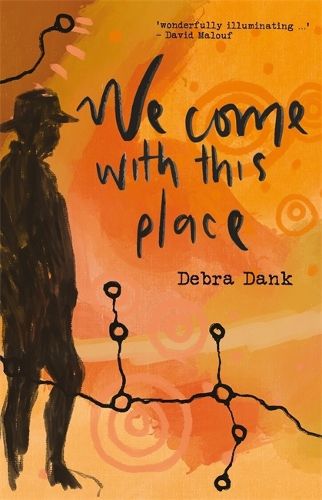
‘We Come With This Place’ by Debra Dank

2022, 249 p.

As a local historian and having lived all my life within a 10 km radius, I have a strong sense of place, but I acknowledge that it is not the same as the First People’s sense of Country. That’s Country with a capital C, and there’s no ‘the’. It’s just Country, and I respect First People’s embeddedness in it, but deep down I know that don’t really understand it in the same way. Debra Dank’s We Come With This Place is probably the best explanation and expression of it that I have read.

Dank is a Gudanji/Wakaja woman: teacher, wife, mother and grandmother. She grew up in Camooweal in Queensland but her family, are from the south-western Gulf of Carpentaria and their dreaming is the three travelling Water-women, birthed from the salt water, who became the first tellers of stories and grew the country as they moved through it. The Water-women, and the knowledge of water runs through this book, opening and closing the narrative. This is probably the only conventional part of the telling, as different generations’ stories are interwoven without clear signposting, and as pain and abuse occur over and over again.

The introduction to the Yoorook ‘Truth be Told’ report spoke of putting First Peoples’ Stories against the written, European histories. A number of years ago, historian Ann McGrath wrote a history Born in the Cattle (1989), which used oral histories to tell the stories of Indigenous people living on pastoral stations in the Northern Territory, a ‘no-shame’ job which enabled the cattle workers and their families to live on Country, maintain traditional obligations, and earn a living. It seemed a rather rose-tinted analysis even at the time, and seems even more so thirty years later with our later knowledge of the Stolen Wages, and the Massacre Map. Dank herself gives a different view of the pastoral workers’ life through her father’s story, and through her own as well, as she spent several living on stations with her family, where they were treated with varying degrees of acceptance.

Her father, Soda, was born on the banks of the birthing creek on Wakaja Country, on what became known as Alexandria Station. After witnessing his mother being raped, and accused of poddy (calf) stealing and pursued by white co-workers on the path of vengeance, he escaped the Station and crossed the Queensland border into Camooweal, where he met Dank’s mother and married her and established a family. The indigenous community is not necessarily supportive of marriage between indigenous partners: Soda’s mother-in-law, an Indigenous woman who was protective of her status in a small, tightly-knit Methodist community, reported Debra’s birth to the Aboriginal Protector, who at that time had the power to take lighter-skinned children from their families. It didn’t happen in this case. Debra’s mother, who had benefited from Westernized schooling, put a heavy emphasis on education, and indeed she oversaw not only her children’s education when the family was living on a pastoral station, but that of the station-master’s children as well. Her father could neither read nor write. Her love for both parents is unmistakable, but she is clear-eyed about domestic violence within her family, and the recurrent injustice, racism and pain that recurs across the generations.

Despite her maternal grandmother’s hostility, Dank had a close relationship with her grandparents and from them she learned about Country. Her descriptions of camping, of tramping through desert scrub looking for water, and the vast landscape are beautiful. Through a series of short chapters, she tells of the lives of her grandparents (and further back) and parents but she does not necessarily help the reader by giving a straight-forward chronological account. At times, I found myself flipping back to see whose story it was – her father’s? Her grandfather’s?- but I’m sure that this is intentional. Violence and dispossession seeped through the generations, as did the love and knowledge of Country. It’s a love and knowledge that she is giving to her children, and to us too as readers. The cyclical story pattern reflects First People’s story-telling and its sense of time and patterns. She uses language as well, without the support of a glossary at the back, and so you need to deduce the meanings of words which, ever the teacher herself, she uses several times within a few paragraphs so that you can work out the context.

I was particular struck by one passage where she describes looking for food in desert country with her father, on land that was not their country. I realized that our Acknowledgements of Country embody similar sentiments, but without the promises of benign intention.

We had been cautious when we approached. Dad had been extra careful to talk to that place and to assure the old people there that we were coming to gather some food, and to let them known who we were and where we had come from. He went on to tell them we meant no harm and we would take only enough to feed us on that day, that our country and our people, like us, were grateful to be given food there. We would leave enough to share with the turkeys that would arrive soon, he assured those that dwelt there. And they were kind to us. We had enough to satisfy our needs, but it was always like that. Talk to the country, talk to old people, talk, talk, talk. Talk your story into this place to sit there with the ancestors. (p. 104)

If only we were able to acknowledge country so honestly.

This book was shortlisted for several awards in 2023, and it won four categories in the NSW Literary awards, the Australian Literary Society Gold Medal and the University of Queensland Non-Fiction award that year. It deserved such recognition. It is very, very good.

My rating: 9/10

Sourced from: Yarra Plenty Regional Library

Read because: I borrowed her most recent book about her family story, and I realized that I should read the original book first.
Does it matter?

Day 3 of my Real Attention Challenge. Today I had to do one task about 80% as well as I otherwise would, and let that be good enough. Huh!

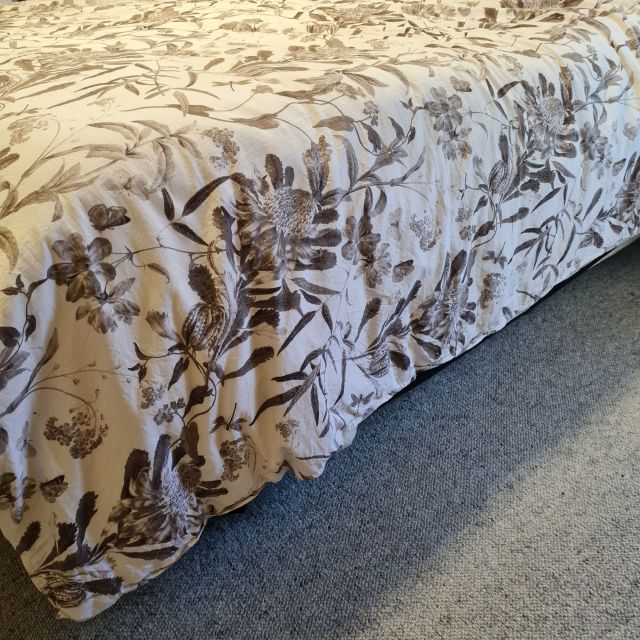
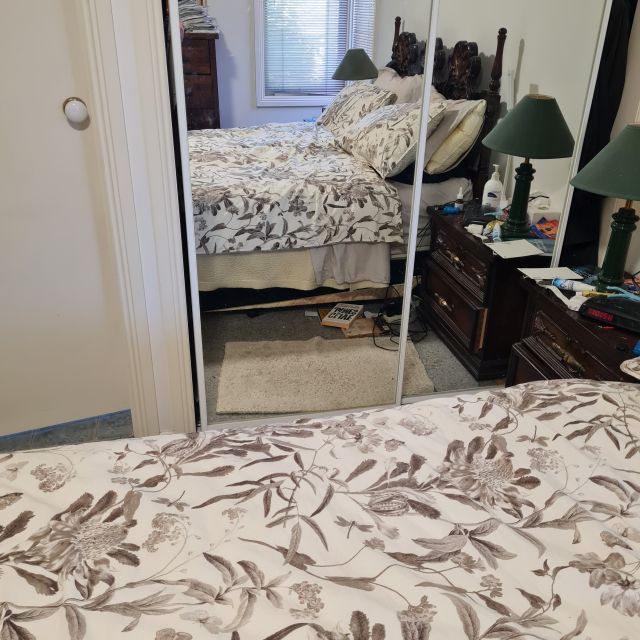
This is my bed. I loathe doonas: give me blankets any day. And don’t get me started on the absence of a top sheet in hotels. Layers, people, layers.

Anyway, we make the bed every morning: sheets (bottom and top), two blankets and a doona in a doona cover more for appearance than anything else. I tuck my blankets in, but Steve doesn’t. Worse still, you can see the blankets hanging out of the side of the bed reflected in the mirror because there’s never enough doona on his side. So every morning I spend a little while walking around the bed, making sure that the doona is even on both sides and tucking in any errant blankets on Steve’s side. I smooth out the wrinkles from the doona, and all is right with the world.

Did it matter? You bet it did. Every time I walked into the bedroom, I’d see the blankets hanging out of the side of the bed and it took every bit of self-control not to run round there, tuck them in and straighten up the doona. It put me in a bad mood for the whole day.

Then just to add insult to injury, I listened to the short reflection that went with this activity, where a man with a smooth voice rationalized his failure to wake up on time on a Saturday morning and get his kid out out of bed to go to kick-boxing by saying that it didn’t REALLY matter. Yes it did! You’re the father- show some responsibility! And if that kick-boxing instructor was a volunteer, that’s a million times worse. That’s the deal: you get your kid here on time, and I’ll teach him.

Does it matter? Yes.

Grrr. I don’t think this challenge is very good for me.

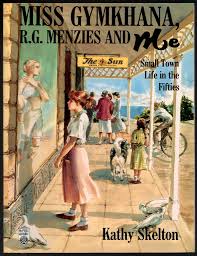
‘Miss Gymkhana, R. G. Menzies and Me’ by Kathy Skelton

1990, 153 p.

I hadn’t heard of this book, which was sent to our former CAE bookgroup as part of their mop-up operations, now that the CAE no longer runs its bookgroup program. Apparently my group read it about 25 years ago, but I hadn’t joined at that stage. I am the youngest (!!) in the bookgroup, and as the book is about ‘small town life in the Fifties’, my fellow bookgroupers probably recognized even more in the book than I did. But even for me, born in the mid-50s, there was much that was familiar but is lost now, in a world that is much more complex and hurried today.

I guess you’d classify it as a memoir, but it is more a memoir of a time rather than events. The author, Kathy Skelton, was born in 1946 and grew up in Sorrento, a sea-side town that still has its tourist season and its quiet season. It’s a strange place, Sorrento: there have always been very wealthy people there, but also just ‘ordinary’ small town people there as well. In her introduction, she reflects on the nature of memory. Reflecting on famous people that she was aware of at the time- President Nasser, Archbishop Mannix, the voice of Mr Menzies, the young Queen Elizabeth and the Petrovs- she reflects:

Have I printed their images, acquired much later, on a childhood, half grasped and half remembered? Have I overlaid fragments of memory with layers of stories, recounted by others, stories that in turn are their fragments of memory?

I have done all these things, yet still believe I know these events and people intimately, that I have remembered accurately, and that these memories are shared with others who did and did not live in our town. (p.4)

Her book is centred on Sorrento, but she takes a wider view as an observer. She has a child’s-eye view of politics. Her father’s family were Liberal voters: her mother’s family were Labor, and even Communist. The arrest of the Petrovs made an impression on her, although she thought that they looked a lot like Cec and Una Burley, who lived around the corner. Cec was the school bus driver, and Una Burley was the local gossip, and many paragraphs are prefaced with “According to Una Burley….”. Robert Gordon Menzies, the Prime Minister, seemed to be an immovable fixture of the 50s and early 60s, almost beyond politics to the eyes of child (I remember feeling the same way). As with the Queen, political figures were just there, unquestioned. The school turned out to see the Queen, catching the bus into Melbourne to line up along Toorak Road, only to see a “white-gloved hand and a pale face below a thatch of violets” (p. 98). The next Sunday it appeared that the Queen might be coming down to Sorrento to visit prominent resident M. H. Baillieu, but these ended up being put aside because the Royal Couple were resting “their shoes off, stretched out on a spare bed in Government House. Their intended visit was nothing more than a rumour started by persons unknown.” (p. 99)

Likewise, she observes but does not participate in the sectarian split that divided 1950s Australian society, played out at the political level through the ALP/DLP split, and at the personal level through family allegiances to either the Catholic or Protestant churches. As the child of a ‘mixed’ marriage, she attended both the Catholic and Anglican churches. She writes of the Billy Graham crusade at the MCG on 15 March, attended by 130,000 people, 15,000 more than had watched the Melbourne 1956 premiership. She was there: she made her decision for Christ, but “I knew already that I didn’t want to enter into correspondence about God and Jesus and whether I was leading a Christian life, with anyone” (p. 63)

Her description of school life, marching, grammar classes, the march through Australian history of Explorers and Sheep are all familiar to me: obviously school rooms didn’t change much in the 50s and 60s.

Her family was not rich, and her father was a “drinker”. She feared the Continental Hotel (still prominent on the hill in Sorrento) and wished that her father was one of the Men Who Were Not Interested in Drink.

The men who were interested were in the front bar of the Continental every evening, drinking more desperately and rapidly as six o’clock approached. I tried never to go past the Conti after five because of the frightening noise, the hot air, and the beery smoke that might rush out to engulf me as the door opened with men going in and out. But more than the small and the noise, I feared looking up through the golden letters on the window, PUBLIC BAR, into my father’s eyes. (p. 132)

They only had television for two weeks in 1958 when they borrowed another family’s television and kelpie while they were on holidays. They went to the movies, they listened to the radio. They had purchased a refrigerator on hire-purchase, but her father forgot to make the payments and a note was left warning that it would be repossessed unless the money was found. As a result, her mother never bought anything else on hire purchase, and so it took years for the wood stove to give way to the white electric stove, the Hoover to take over from the straw broom, or the wireless to give way to the television.

From her child’s eye viewpoint, she observes her mother’s anger and bitterness towards her father, his family and small town life, but it is somehow separate from her. She sees the young girls who win beauty contests, marry the local footballer, and suddenly are saddled with children and shabby cardigans, all the glamour gone from their lives.

Sex, politics and religion: she sees all these but they are not questioned or challenged. It’s a world that has been congealed in aspic, with certainties and truths, petty triumphs and small luxuries. A very different world. I think that much of the appeal of this book is the nostalgia and sense of safety that it evokes. You can understand why conservatives turn to the past to go ‘back on track’ or making America/ or whatever country you choose ‘great again’. There’s not a lot of analysis, but it’s not completely local either: Skelton has, as she said, evoked memories that are both local to Sorrento, but also common to other Australians at the time. At times I felt as if I were suffocating in mothballs and tight clothes, at other times I yearned for the simplicity and innocence of earlier times. I do wonder how someone born in the 1980s or 1990s would read this book. I suspect that it really would seem, as L.P. Hartley said, like a foreign country, where they do things differently.

My rating: 7/10

Read because: Bookgroup

Sourced from: Left-over CAE book.