Tag Archives: Book reviews

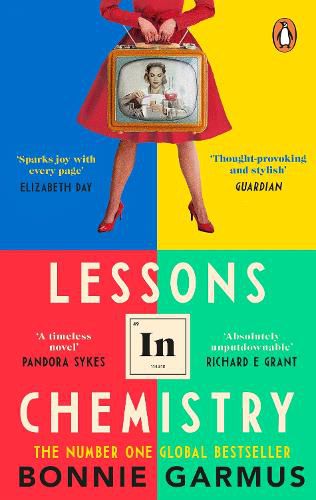
‘Lessons in Chemistry’ by Bonnie Garmus

2023, 386 p.

If I were better versed in chemistry, I would start off with drawing parallels between this book and some sort of chemical reaction where there’s a big confident beginning, petering off into a spluttering little anti-climax. Alas, although I can think of parallels in other spheres (political movements? relationships?), I don’t have the chemical knowledge to think of a chemical metaphor. But that’s how I felt about this book: it started off well, then just sagged into a gloopy sentimental mess.

Elizabeth Zott is a research chemist working at the Hastings Research Institute in the early 1960s, the only woman in an all-male working environment (except, of course, for the admin). We now know enough about the side-lining of women in science through Rosalind Franklin and movies like ‘Hidden Figures‘ to recognize the institutionalized injustices that see Elizabeth’s work appropriated and assumed to be the work of the men surrounding her. Almost against her own better judgement, she falls in love with her co-worker Calvin Evans and when her life suddenly falls apart, she finds herself unemployed, unmarried and with a fractious baby. Fiercely independent, she has to learn to accept help from an older neighbour and the father of her daughter’s school friend when he offers her a job to host a TV cooking show. She makes this job her own by introducing the chemistry that she is shut away from professionally to her viewers, housewives at home watching afternoon television. She does not talk down to her viewers and she attains a cult following.

And at this point, my own chemical reaction starts to fizzle out. Yes, we had our professor Julius Sumner Miller in the 1960s, but it stretches credulity to think about a cooking show veering into academic territory like Elizabeth’s ‘Supper at Six’ does. Then there’s the dog (yes, the dog) Six Thirty who is anthropomorphized to the point of having his own dialogue. And the precocious child. And the angelic neighbour. And the mysterious benefactor. Oh stop.

I liked the tone of this book at the start, but it seemed to get lost by the end. The narrative voice was one of those ‘Voices of God’ commentaries, slightly ironic and comforting and imbuing the book with the sense of being a morality tale, or a fairy-tale. There were many one-liners which were sharp and pointed, and certainly coming from a 21st century feminist-ish perspective. But the ending was just a sentimental ‘everything-works-out-in-the-end’ hash. Elizabeth deserved more.

My rating: 6/10

Sourced from: purchased (!) Only because there were too many holds on it at the library

Read because: Ivanhoe Reading Circle selection.

I hear with my little ear: Podcasts 25- 31 December 2023

Expanding Eyes Episode 51 The Embassy to Achilles deals with Books 9-11. The three men sent to encourage Achilles out of his man-cave all used different approaches: self-interest, guilt and just bewilderment. Achilles responded as if he had been holed up an reading existentialism: that nothing mattered anyway. The Achilles Heel story does not appear in the Iliad, although there is a prophesy of a double fate facing Achilles- either dying in glory or having a long and unremarkable life. Note that Agamennon’s list of gifts to encourage him back does not include an apology for running off with Achilles’ wife (probably the one thing Achilles wanted). Although it seems very to-and-fro, there is a pattern to the interminable fighting in Book 10. Book 11 reveals the aristeia (i.e. high point) of Agamennon’s role in the battle. By now the main people in the Achaean army had received injuries which take them out of the battle. It’s in fact Nestor who first suggests that Patroclus take Achilles’ place on the battlefield.

Episode 52 The Horrors of War and the Value of the Heroic Code There’s a speech about the Heroic Code in Book 12, but it’s hard for me to find anything to admire in it. Michael Dolzani suggests that perhaps one good thing that comes out of it is a sense of competition, but it also spurred countless thousands of British men into the meat grinder of the WWI trenches. William James once suggested that we need a moral equivalent to war. Zeus decides to “look away” and the gods intervene, helping out their favourites, but the battle is going the Trojans’ Way. Meanwhile, Hera, who favoured the Greeks, distracts Zeus with sex.

The Rest is HistoryThe Fall of the Aztecs: The Night of Tears (Part 6) This episode focuses on the night of 30th June 1520, La Noche Triste, when the Spanish tried to break out of Tenochtitlan. Montezuma had been killed and they were surrounded by angry Mexica. They made their escape at night and were successful, but it was a bloody event. The Tlaxcalans rejected the Mexica’s pleas to join forces with them to get rid of the Spanish, and instead they joined forces with the Spanish. But another enemy was stalking: smallpox which had already wiped out the Taino people in the Caribbean (necessitating the importation of Africans as a replacement labour force- but that’s another story). It was probably introduced by Narváez, rather than Cortez. The harvest collapsed because there were insufficient workers, so when more Spaniards arrived, the place was deserted. Cortez was determined to wage a European style War, but the Tlaxcalan’s sacrificed and cannibalized their Mexica captives- but Cortez was powerless to stop them. In late 1520 ships were arriving all the time. Meanwhile, in Europe, Charles V was showing off the gold that Cortez had sent to him. A shipbuilder, who had survived La Noche Triste arrived with 12 ships that he had built and had carried overland, and so Cortez was set….

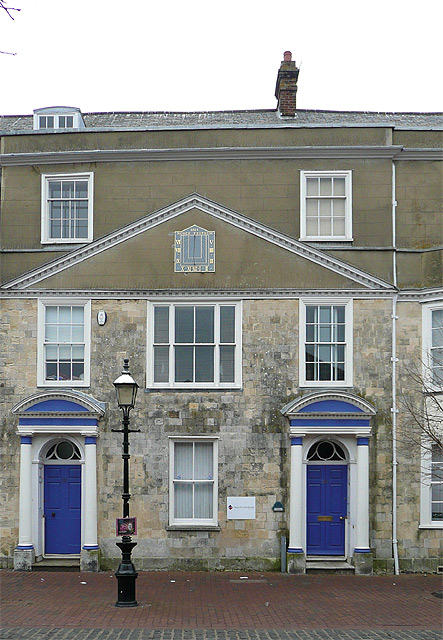
Roger Kidd Georgian House, Lewes, East Sussex https://www.geograph.org.uk/photo/1111791

History ExtraGeorgian Grand Houses: the forgotten women who built them. Featuring Amy Boyington, the author of Hidden Patrons: Women and Architectural Patronage in Georgian Britain, this episode highlights the autonomy of heiresses, mistresses and widows in directing the design and construction of houses. Although the men in their families usually paid the accounts, a different picture of women’s involvement emerges from their correspondence (often with other women) where they display their practical concerns over, for example, where the sun would be shining in a dining room on a summer’s night, or how cold a room might be in winter etc. She gives many examples of women and houses, many of which were unfamiliar to me, but would probably be well known among British listeners.

The Philosopher’s Zone (ABC). Richard Rorty and America. I don’t often listen to this program, because it’s often too heavy for me, but I was attracted to the episode on Richard Rorty. I didn’t (don’t) know much about Richard Rorty, but I had heard of him because Inga Clendinnen responded to one of his books where he omitted history from his list of genres which could encourage the growth of our imaginative capabilities. (Inga’s essay Fellow Sufferers is available here). This episode features Chris Voparil who has co-edited a recent collection of the late Rorty’s essays (he died in 2007) called What Can we Hope For: Essays on Politics. In an essay that Rorty wrote in 1996 called ‘Looking Back from 2096’, he predicted the rise of a Trumpesque strongman. He was critical of identity politics, and especially compulsory college courses to raise awareness of Black, Women’s and LGBT identities, pointing out that ‘Trailer Trash’ was never seen as a marginalized group to be championed. Nonetheless, he argued that we get our moral stance from the group that we identify with- literally a form of ‘identity politics’.

Literature and History Episode 11 Who Was Homer? looks at Books 17-24 before then addressing the question of who Homer was and if he even existed. Aeneas pops up in the battle before being whisked away by Poseidon, which went down a treat with the Romans who were to later claim Aeneas as their own. We need to remember that Hector didn’t kill Patrocalus (instead the minor character Euphorbus did), but he did steal Achilles’ armour from him and disrespected his body. The funeral games, which seem to us to be completely incongruous and which take ages are part of a set piece to break up the narrative, and such a device appears in other similar epic poems. The ending is very inconclusive, but that’s because what we know as The Iliad is part of an 8-book poetic cycle, of which we have only Books 2 and 7. From flashbacks in these two books, we know that in Book 3 Achilles is killed, in Book 4 the Trojan Horse appears, in Book 6 Agamennon and Menelaus return, Book 7 is the Odyssey and Book 8 deals with Odysseus’ later adventures. He then moves on to the question of Homer’s identity, something you might have thought he would have done at the start. He suggests that Homer was probably not one man, but the works instead spring from a collective oral tradition. There are many narratives where a band of mates sack a wealthy trading city (Cortez and Tenochitlan spring to my mind) and it is in effect the story of the collapse of the Bronze Age in miniature. Troy was probably part of the Hittite empire. There have been many attempts to date The Iliad, using archeology of weapons mentioned in the narrative; linguistic patterns and the meter of poetry. Although there might not be one Homer the writer, it’s possible that there was one Homer to reciter. Milman Parry (the so-called Darwin of Homeric studies) basing his approach on Yugoslav oral folk songs, looked to the use of formulaic descriptions, rhythm and repetition as a mnemonic aids to remember such a long oral poem.

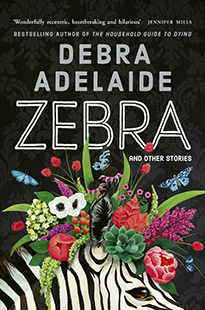
‘Zebra and other stories’ by Debra Adelaide

2019, 324 p.

I have a rather ambivalent attitude towards short stories, and I find them very hard to review beyond merely summarizing them. Finally, after many decades, I have worked out that I enjoy them most when I read just one story at a sitting, no matter how brief, and leave it to percolate overnight until moving on to the next one. They are also very good for late-night reading when you’re too tired to read anything that involves memorizing actions or characters beyond that one act of reading.

However, I do like Debra Adelaide’s short stories. Flipping through the book beside me now, I can recognize and remember nearly each story on reading a paragraph or two (my test of whether a story has ‘stuck’ or not). The stories are arranged into three parts on the basis of whether they are narrated in first, second or third person, and the final story ‘Zebra’ is more novella than short-story at 121 pages.

First Part starts with ‘Dismembering’ where we see a woman who has a vivid dream that she and her ex-husband dismembered a corpse which they buried in her back garden. She is so un-nerved by the dream that she begins divesting herself of all the possessions that she had brought to her second marriage in what seems to be a steady mental unravelling. ‘Welcome to Country’ sees another form of cleaning-out as a woman, in a near-future Australia, begins gathering together her now-absent son’s belongings from the 1990s to take to ‘Country’, a fenced off, separate outback community where a mean-spirited government holds those claiming ‘sovereignty’ or refusing to conform, in perpetual detention. ‘A Fine Day’ a woman visits her friend Alex, who is trying to get his ex-wife to return to him. His ex-wife Helen, doesn’t want to be found despite her own loneliness. The story has a very Chekhovian ending.

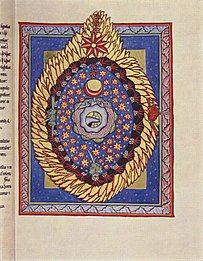
The Second Part starts with ‘Festive Food for the Whole Family’ which I very much enjoyed, given that I was reading it just before Christmas. Given in the form of advice, like a magazine article, it talks about how the successful Christmas host will prepare food to meet all the dietary requirements of demanding guests. Meanwhile, her husband is becoming increasingly familiar with his sister-in-law and so the carving knife comes in handy. ‘How to Mend a Broken Heart’ is a description of the “leaden numbing pain” that sets your body in turmoil and makes even the slightest job, like shopping, an ordeal. ‘Migraine for Beginners’ is obviously written by someone who has experienced migraines (although, for me, my migraines are more of the Hildegarde von Bingen variety- see below). ‘The Master Shavers’ Association of Paradise’ is set in an offshore refugee ‘facility’ which is certainly not Paradise, where a young boy establishes a barber shop as a way of filling in time until he can move to the mainland.

Wikipedia

The Third section starts with a lovely story ‘Carry Your Heart’ where a woman meets a man in a bookshop- what book lover could not respond to a romance in a bookshop? In ‘I am at Home Now’ Debra Adelaide writes from the perspective of Mrs Phillips, who cared for Bennelong, when he travelled to England with another indigenous man Yemmerrawanne in 1792 with Governor Phillip. ‘No Hot Drinks in the Ward’ takes us to the children’s cancer ward of a hospital, where a mother with a sick child has been tossed into a world she never wanted to be part of. ‘Nourishment’ carries on this theme, where a wife is visiting her husband in hospital, where he is fasting before surgery. In ‘The Recovery Position’ Cate is an ex-soldier, now conducting workplace training in First Aid classes. Teaching CPR triggers her memory of returning to Tarin Kowt with Trooper Brad Innes in a helicopter. ‘Wipe Away Your Tears’ starts in a plane over Istanbul as a couple visit Gallipoli. Her husband, Harry, is searching for the grave of his great-grandfather but he has not properly mourned his brother Johnny, who had died in a car accident.

‘Zebra’ is by far the longest story in the book. Set in the Lodge in Canberra, there is a female P.M. who reminds us just a little of Julia Gillard. She is unmarried, calm, unhurried and she finds herself drawn to the beauty of the gardens around the lodge where she discovers that her neighbour, Kerr, has been surreptitiously shifting the fence. Somehow she manages to float above all the political turmoil, and she finds a still point in the gift of a zebra which arrives unsolicited at the Lodge. She is lonely, and attracted to her staffer, but is fearful of being spurned. It is all a bit fey and implausible, and but then again…look at Gladys. Who would have thought that romance could haunt the corridors of power?

So, all in all, a strong selection of stories that I felt perfectly happy to pick up each night. I think that ‘Zebra’ will remain in my mind because it was so strange, and I may think of ‘Festive Food for the Whole Family’ next Christmas (and send up a silent prayer of thanks that my own Christmases are much more pleasant occasions.)

Rating: who knows. I can never rate collections of short stories.

Sourced from: Yarra Plenty Regional Library.

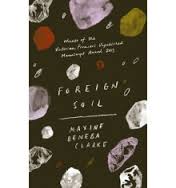
‘Foreign Soil’ by Maxine Beneba Clarke

foreignsoil

2014, 265 p.

She’s good. Very good.

Maxine Beneba Clarke is described in the afterword as a “spoken word performer” and the author of several poetry collections.  You can tell. There’s a real joy in the sound of voices in this book, and it comes through loud and clear. Voices plural because there’s multiple narrative voices here from all over the world:  a Sudanese woman in Footscray in ‘David’ ; a Jamaican school girl in suburban Australia herself fighting for acceptance being asked to “look after” a new Vietnamese student in ‘Shu Yi’ ;  Delores in New Orleans  in ‘Gaps in the Hickory’ and, most challengingly, Nathaniel speaking in Jamaican patois in ‘Big Islan’ as he gropes towards literacy and awareness of a larger world.

I sometimes find when I come to the end of a book of short stories that I can’t quite remember what happened in which book. That’s not the case here.  She uses imagery so well in ‘ The Stilt Fishermen of Kathauluwa’ that the story is unforgettable, and it is one of the most powerful stories about so-called ‘illegals’ that I’ve read.  The young girl hanging upside down from the monkey bars, paralysed with fear in ‘The Sukiyaki Book Club’ is a memorable image for the writer herself, writing on despite one rejection letter after another.  The cold fear in ‘Foreign Soil’ as an Australian woman realizes her mistake in following the man she loved to Uganda is almost palpable.  I just loved ‘Gaps in the Hickory’ even though I guessed the ending- and what a satisfying ending it is!  There’s not a single story here that falls flat. They’re all well-crafted, opening up possibilities and yet leaving you in no doubt as a reader that you’ve reached the end.  Her observations are sharp and her ear for language acute.

Blurbs often trumpet things like “the arrival of a major new voice” and the blurbs on this book are no exception.  I think, this time, they’re right.

aww-badge-2015-200x300Posted on the Australian Women Writers Challenge. And so far, my pick for the 2015 Stella Prize.

‘Heat and Light’ by Ellen Van Neerven

vanNeervenEllen-138x206

2014, 225 p.

I’ve noticed this book bobbing around on long-lists for the various literary prizes on offer, and it has been shortlisted for the Stella Prize. The young author is of mixed indigenous and Dutch heritage, and she seems to have taken to heart the aphorism “write what you know” because the stories are written about or from the perspective of a young indigenous person.

The book is divided into three parts:  Heat, Water and Light.  The first part, Heat, comprises a number of short stories about the Kresinger family which interweaves magic realism and contemporary indigenous family life.  The stories are tangentially connected, a technique I enjoy, giving them stand-alone status within something larger.

The second section, Water, contained only one story and it was probably my favourite one.  Kaden is a young Aboriginal woman employed in a scientific program engaged with research on ‘sandplants’, a marine lifeform that has been found to have almost human intelligence.  The sandplants are found around islands off the Queensland coast that are about to be reclaimed for a new Aboriginal nation (Australia2) under a bold new plan by President Tania Sparkles.  The plan which at first sounds seductive becomes increasingly sinister in this story set in the near future, and as Kaden becomes closer to Larapinta, one of the sandplants, their relationship changes.

The blurb on the back of the book tells me that in the final section ‘Light’ “familial ties are challenged and characters are caught between a desire for freedom and a sense of belonging”. Yes, but I must confess to finding this last section bitsy and insubstantial.  Having only just finished it, I can only remember two stories well- my memory of one probably reinforced by the picture on the front cover, and the final story which was very good.  For many of the others, I only knew that it had finished because there was a blank at the bottom of the page, and I found myself wondering about the point of it.  The stories seemed like fragments.

So, all in all- a bit of a curate’s egg of a book: good in places.   The writing is lyrical, but occasionally somewhat overwrought.  It’s a good debut collection but I’m not convinced that it’s prize-winning material, though.

aww-badge-2015-200x300I’ve posted this review to the Australian Women Writers Challenge site.

‘The World of Other People’ by Steven Carroll

carroll_worldotherpeople

2013, 278 p.

I recognized the author’s name and remembered that I’d read some of his books before. I was drawn in by the prospect of a book set in the Blitz in 1941, a setting that I find fascinating, so I borrowed it.  I only had to read about five pages in to remember that, yes, I have read several Steven Carroll books before and I had a love/hate relationship with every single one of them.

This book is no exception.  Steven Carroll writes in the present tense, swapping from one character to another, and alternating between second and third person.  I dislike the use of the second person  and I have mixed feelings about present tense. His books are very visual, centred on a particular image to which he keeps returning.  Like a sewing machine darning a hole, he keeps going back and forth, back and forth, embroidering and over-stitching an image or an event.

As soon as I remembered this narrative voice, I remembered how much I disliked it.  Nonetheless, I kept reading and I’m glad (I think) that I did.   It’s a beautifully written, poignant story and I felt sad to finish it.

Iris is a young Oxford Graduate and aspiring writer, employed as as a civil servant by day and aa fire-watcher by night during the Blitz. Along with a clutch of other people including the poet T. S. Eliot, she waits all night on the rooftop of the Faber and Faber building, watching for bomber planes and their fiery load, and directing the fire trucks to the conflagration.  She doesn’t know it, but the Blitz proper has already ended, but one night she and her fellow watchers see a plane swoop down low -too low- over the city buildings. Minutes later they hear a dull explosion. She catches T. S. Eliot’s eye and realizes that she is seeing Eliot at work right there, in that moment,  as writer as he grabs an experience that will later be transformed into poetry.

A year later, in the ruptured world of war-torn  London, she meets Jim, an Australian pilot in Bomber Command, who has been invalided  out of flying duties after an accident.  They meet and fall in love.  I shall say no more, lest I give the story away.

Books and writing are an important theme in the book, and T. S. Eliot and his poem ‘Little Gidding’ (which I must confess, I have never read) play an important part in the story. As a result, I think that much of the ‘cleverness’ of the book went right over my head, and so I just read it straight, completely unaware of any layers of meaning below the surface.

The book has obviously been carefully researched, but it wears it lightly.  By inhabiting at various times both Jim and Iris’s consciousness, Carroll has given us well-rounded, complex characters, and the plot pulls you to what you know is going to be a tragic end.  The ending solves a little conundrum set up in the opening pages in a very satisfying way.

This present-tense voice and habit of perseveration is obviously Carroll’s narrative ‘thing’ and it’s unfortunate for me that it grates  so harshly. I feel as if he’s almost writing to a template, where the setting and events change but the voice goes on and on.  Nonetheless,  I enjoyed the book in spite of the way it was written, which I suppose is testament to the strength of the  characters and story.  I must remind myself next time I pick up a Steven Carroll book  that I really don’t like the way he writes, and that I should just put it back onto the shelf.

Ah- another woman with her back to us.  The image has little connection with the story.

Andrew Furhmann has written a far more detailed and intellectual review (full of spoilers)  which can be read at the Sydney Review of Books. His review makes me feel rather embarrassed that I missed so much in my very surface reading of the book.

‘When We Have Wings’ by Claire Corbett

corbett

2011, 480 p.

I must confess that I’m not a great speculative-fiction reader, although my husband is.  I like the idea of it- the interplay of scenario, plot and character- but somehow one of them seems to miss out.

The scenario that underpins When We Have Wings is that medical technology and genetic manipulation has enabled those with the finances and desire to have wings grafted onto their backs. This self-selected elite is able to soar, literally, above the rather brutish and ugly city below, giving only grudging access to their beautiful architecture and affluent culture to the wingless, earth-bound masses below.  It’s not clear what country the book is set in, although the reference to RARA (Rural and Regional Areas) suggests that it’s Australia, although obviously nation is no longer important in a society so hierarchically ordered by the class and status denoted by wings.  Access to the city is limited and those without wings are relegated to service positions only, while outside the city boundaries, environmental change and the stripping out of wealth leaves a grubby and increasingly violent and deprived underclass. It’s set in the future, but it’s a future that is highly recognizable to us.

The book is told from two perspectives.  The first is that of Peri, a young girl employed as a carer for baby Hugo, although it’s a much darker arrangement than this  She is rewarded by her employers with wings, and it is with these wings that she absconds with Hugo.  She is rescued by a group of rebel flyers who, while revelling in their wings, are resisting the corruption of the flying elite. The second perspective is that of Zeke, the wingless private detective who has been employed by Hugo’s father,  to search for her.

The book has many things going for it: an engaging and rich premise; a female main character who reveals tenderness and fear; a bit of sex; a bit of a detective thread. Unfortunately, it’s also very long.  I found myself wishing that there had been a sharper editorial pen deployed here, slashing some of the description of flight mechanics in particular.  It’s 480 pages in length, and I’m just not sure that there’s enough emotional meat here- as distinct from ideas- to sustain such a long book.

aww-badge-2015-200x300I read this as part of the Australian Women Writers Challenge for 2015.

‘This House of Grief: The Story of a Murder Trial’ by Helen Garner

garner_grief

2014, 288 p.

This has been yet another of the  books  that I’ve purchased and had sitting in its little brown paper ‘Readings’ bag waiting for a self-indulgent Christmas-time read, long after everyone else seems to have read it. Helen Garner seems to evoke strong reactions in her readers. I don’t think that it’s just that she chooses controversial topics: I think that it’s Helen Garner herself that some readers object to.  As for me- I wish I knew her, although I suspect that she’d bridle against the thought that she could be claimed by a reader, and I think I’d feel a bit intimidated by her. I like the way that she puts her head on one side and considers hard…but then comes to a decided opinion.  I like her occasional tartness and her willingness to revisit her own judgments.

Any Melburnian could tell you about the Farquharson case- an appalling “accident” on Fathers Day 2005, where three young boys drowned when the car driven by their father after an access visit went off the road and ran into a dam. The father suffered a coughing fit, he said; an explanation accepted at first by his ex-wife at the first trial, but she later changed her mind. It was a convoluted legal process, involving a trial, an appeal and then a retrial and Helen Garner attended it throughout, drawn by equal parts of fascination and incredulity.

The subtitle to Garner’s book is “The Story of a Murder Trial” and the book largely consists of her observations of the theatre of the court as this performance of administering justice wends its slow, deceptively soporific way through questions that go to the heart of love, family, obsession and betrayal.  What a good observer she is-  the square faces that people pull when they’re trying not to yawn; the impatient ‘come along’ grasp of a sister pulling her adult brother through the press pack that sets itself up along the Melbourne footpath outside the court for the nightly news. Garner has her opinions: she judges.  I wonder if the witnesses who appeared in the stand have read this book and found themselves stripped bare by her eagle eye.

She’s very good.

aww-badge-2015-200x300I’ve posted this to the Australian Women Writers Challenge for 2015.

‘Restless Men: Masculinity and Robinson Crusoe 1788-1840’ by Karen Downing

downing_restlessmen

Basingstoke, Palgrave Macmillan, 2014, 175 p & notes

ISBN9781137348944 (hbk.)

Allow me to rave. I’ve just finished reading Karen Downing’ book, Restless Men and I’m in awe of its breadth, intellectual complexity and insight that has made me look again at the writings of the immigrating men who came to Australia’s shores.  I always think that’s a good sign in a history: you re-read documents and stories that you’ve encountered before with new eyes, and find yourself giving a little nod in acknowledgment to the historian as you do, wishing that you could nudge her and say “Look- there’s another example!”

History is full of restless men. Constantly active, averse to being settled, they have been explorers, traders, pirates, crusaders and invaders, the forgers of empires that have come and gone across time, heroes and villains.  Such men- if not the drivers of history, at least its colour and movement- have been so ubiquitous that constant activity seems to be part of the essential character of men themselves.  Fiction, too, is full of restless men. From the ancient Greek hero Odysseus to the crew of the Starship Enterprise, imagined men have been forced, coerced and have chosen to leave home in the name of patriotism, protection, profit and pleasure.  The most enduring of these literary figures is the protagonist of Daniel Defoe’s Robinson Crusoe, first published in 1719. (p. 1)

Again and again, Downing finds examples of young (and not so young) men braving the seas to the colonies who identify with Robinson Crusoe, a book that they had read in their childhood which had become a wider part of the contemporary consciousness of the 19th century.  Wild escaped convicts (think William Buckley) were dubbed real-life Robinson Crusoes,  William Joyce, a young mechanical engineer fired up by the letters he had received from Port Phillip from his brother declared in his memoirs that “I felt I was going to be a sort of Robinson Crusoe” (and so he brought a huge amount of luggage out with him lest he run out!); explorers called themselves Robinson Crusoe.   Defoe’s book itself did not make men restless, but it captured the tension in men’s lives of the time between material circumstance and dreams, traditions and adventures, wildness and domestication.

In structuring her book, Downing deliberately eschews a straight cause-effect relationship, and a similarly simplistic here-to-there trajectory.   Nor is she treading a well-worn path: her book is an exploration of masculinity that doesn’t engage in the question of separate spheres, or the construction of male identity vis-a-vis women.   Instead, she focusses on the ideas of manliness between men.

Chapter 1 Confined by the Gout- Perceptions of Men’s Physical Health describes the perception that civilization and industrialization were seen as a threat to men’s bodies, with the health-giving colonies often seen as a panacea.   Chapter 2 The Ecstasies and Transports of the Soul- Emotional Journeys of Self-Discovery turns to men’s letters, journals and memoirs to capture the tropes of fiction (and especially Robinson Crusoe) in describing the emotion of leaving home.

Chapter 3 My Head Filled Early with Rambling Thoughts- Raising Boys and Making Men examines the theories of boy-raising current at the time. She looks particularly at the literature they imbibed as part of their education that valourized restlessness at the same time as driving them into conformity. Chapter 4 Satisfied with Nothing But Going to Sea- Seafaring Lives and Island Hopes examines a response to this restlessness through seafaring in empire, focussing particularly on island experiences and the Bounty mutineers in particular.

Chapter 5 To Think that This Was All My Own- Land, Independence and Emigration grounds (literally) this restlessness into the promises held out for land, adventure and independence by the emigration literature and colonization proposals of the early 19th century.  Chapter 6 The Middle Station of Life- the Anxieties of Social Mobility  explores the uneasiness between the dreams held out to restless men and the confining, restricting effect of the brittle distinctions of rank and order that were replicated in the colonies.  In Chapter 7 A Surprising Change of Circumstances – Men’s Ambivalent Relationship with Authority this ambivalence is extended into an examination of the debates about crime and punishment and loss of autonomy- a particularly loaded debate in an ex-penal colony. Chapter 8 The Centre of All My Enterprises- the Paradox of Families explores the paradox that many of these restless men were, like Robinson Crusoe, torn between wanting to establish and maintain a family as much as they wanted to escape familial obligations.

As you can see, this book traverses unusual and unexpected territory.  There are themes that run across it as well – adventure, land, independence- with their different and contested meanings.  It ranges broadly across a wealth of writing, and while limiting her view to the Australian colonies, her argument works for the other settler colonies as well.

Early Port Phillip teemed with these restless men and I’ve met them during my own work on Judge Willis– the young Burchett boys, some of the financial adventurers among the Twelve Apostles, and a whole host of the first generations of Port Phillip arrivals.  They brought their restlessness with them, and it affected the nature of a new colonial society. At the same time, I’ve taken her argument and held it against the mobility of the colonial civil servant, and found it a useful counterpoint.

This is an academic text but I’m regretful that the expense of this book means that only those with university library borrowing rights are likely to read it: even the Kindle edition is prohibitive- how can that be?  It’s a shame, because it’s an enjoyable read in its own right.

aww-badge-2015-200x300I’ve reviewed this book as part of the 2015 Australian Women Writers Challenge under the history/biography/memoir category.

‘Burial Rites’ by Hannah Kent

BurialRites

2013, 352 p.

The problem with coming to a much-talked-about book after the wave of publicity and interest has broken is that there’s not really much else left to say about it.  I’ve just dabbled in some of the reviews and it’s hard to get away from the fact that Kent received a very large advance for the novel; that she’s young and doing a PhD in creative writing, and  that it has been translated into twenty languages.    Ben Etherington has written an interesting piece in the Sydney Review of Books  about the marketing context that has many links- well worth reading.

As probably everyone knows, the book is a ‘speculative biography’ of Agnes Magnusdottir, who was executed for murder in Iceland in 1829. Awaiting sentence, she is interned on a remote farm, where enforced proximity draws her into the circle of her keeper’s family.

Everything that I would want to say about the book has been said before.   Reviewers speak of the historical setting, and I’ll talk about it too. Historical documents preface each of the chapters, that not only lend verisimilitude, but also act as a fence to constrain this speculative biography.  The research is obviously deep, and  its occasional didacticism can be excused when writing about such an unfamiliar historical setting.  Just as in history-writing itself, the endpoint is known, and it’s the author’s task to make it plausible and real.

Many reviewers rave about her descriptions of settings, and I need to join with them in praise. Her descriptions of setting are so evocative that you can almost see it. It’s a very cinematic book, and of course it has been optioned for a movie.  In your head you can see the opening scenes and hear the voice-over already.

I was struck in the opening pages by the story-ness of it.  Of course, story-telling is one of the themes of the book, but I couldn’t shake the feeling that I was reading the sort of book I might have read as a teenager, where all the people and events were set out in place, then ‘action’- the story proper began.   I still can’t decide whether it’s slightly clunky and old-fashioned, or very clever and self-reflexive. The device of the priest worked to usher in a first-person story-telling narrative, but I didn’t find myself particularly interested in him as a character.

And yes, several reviewers have squirmed under the buffeting of poetic imagery, and at times I felt rather overwhelmed by it as well.  But then she’d capture an image in a couple of words so cleanly and sharply that you’d nod and forgive her everything. I enjoyed the viscerality of her descriptions as Agnes is released from her cell as she smells herself and the grunge of captivity.  I felt the smoky fug of too many people in a small cottage  that evoked  shades of Halldor Laxness’ Independent People.

Then there’s the cover. Is it trite to talk about the cover? I don’t think so- it was part of my experience of settling down with a real-life, hold-in-the-hand book to read a bit more.  You won’t detect it on screen, but the cover has a beautiful pearlescent sheen, inside and out, and I often found myself running my hand over it as a thing of beauty.

aww-badge-2015-200x300This book has already been read so many times under the Historical Fiction category in the Australian Women Writers Challenge that I feel a little redundant putting it under the 2015 reviews as well.  Never mind.  Two years on from its publication, it should be standing on its own two feet. It does.