Essay: The Settler Fantasies Woven into the Prairie Dresses

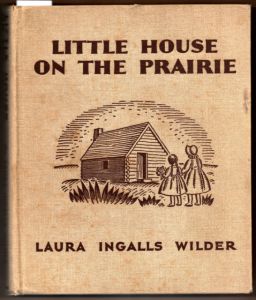
wilder_prairie

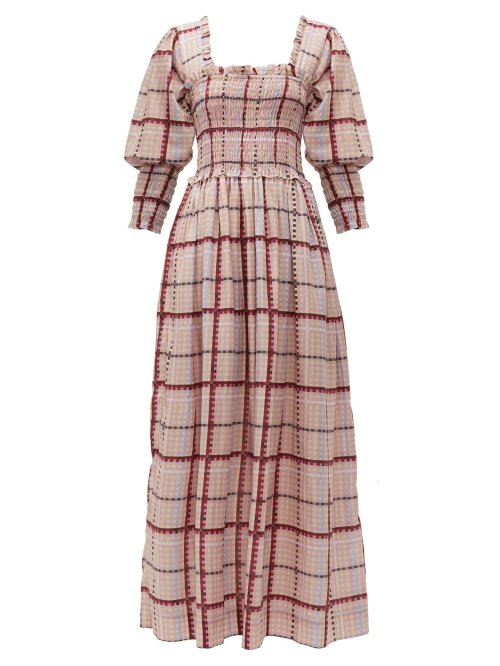
Those of you who know me personally will know that I have absolutely no interest in fashion. Apparently during the 2010s the Prairie Dress – shapeless, high-necked, ‘modest’ dresses- became a thing.

prairedress

Recently I’ve been listening to podcasts by Heather Cox Richardson, and she has referred several times to Little House on the Prairie and the Prairie Dress as a way of valorizing conservative, white, racialized, gendered American values that completely elide any consideration of Native American and African American presence in the homesteading   American past.

The Settler Fantasies Woven into the Prairie Dresses by Peggy O’Donnell, published on the Jezebel website explores the reincarnation of the prairie dress, the attitudes in Laura Ingalls Wilder’s work and questions the statements that adoption of the prairie dress make about women, femininity and gender.

Historians on the coronavirus pandemic #4: Pandemic narratives and the historian LA Review of Books

In https://lareviewofbooks.org/article/pandemic-narratives-and-the-historian/   Alex Langstaff, a PhD candidate at New York University convenes a roundtable with a number of international historians to discuss the coronavirus pandemic.

IN APRIL 2020, we interviewed an international group of leading historians of public health, epidemics, and disaster science. Alex Langstaff (A. L.) asked them to reflect on how history is being used in coverage of COVID-19, and how they themselves are responding to the virus in their research, reading, and work life. Who gets to tell the story of epidemics? And more particularly, who gets to decide when an epidemic like COVID-19 ends? Is 1918 really the best parallel? In general, what are the historian’s tools for understanding pandemics?

Each of the historians comes very much from the perspective of work that they have completed previously. The historians are listed below:

Alison Bashford is Research Professor in History at the University of New South Wales Sydney. Her work connects the history of science, global history, and environmental history. Her books include Global Population: History, Geopolitics, and Life on Earth (Columbia, 2014), Contagion, w/ Claire Hooker (2002, Routledge), and the edited volumes Quarantine (2016) and Medicine at the Border (2006).  She also wrote Imperial Hygiene: A Critique of Colonialism, Nationalism and Public Health, which is the book that I am most familiar with amongst her work.

Simukai Chigudu is associate professor of African Politics and Fellow of St Antony’s College, University of Oxford. Prior to academia, he was a medical doctor in the UK’s National Health Service. He is the author of The Political Life of an Epidemic: Cholera, Crisis and Citizenship in Zimbabwe (Cambridge, 2020).

Deborah Coen is professor in the Department of History at Yale University and chair of the Program in the History of Science and Medicine. Her research focuses on the modern physical and environmental sciences and on central European intellectual and cultural history. Her books include Climate in Motion (2018, Chicago) and The Earthquake Observers: Disaster Science from Lisbon to Richter (2013, Chicago).

Richard Keller is professor in the Department of History, and Department of Medical History and Bioethics at the University of Wisconsin-Madison. His research focuses on the history of European and colonial medicine, as well as public health and environmental history. His books include Fatal Isolation: The Devastating Paris Heat Wave of 2003 (2015, Chicago).

Julie Livingston, Silver Professor of History and Social and Cultural Analysis at New York University, was named a MacArthur Fellow in 2013. Her work is at the intersection of history, anthropology, and public health. Self-Devouring Growth: A Planetary Parable (2019, Duke) is her latest book.

Nayan Shah is professor of American Studies and Ethnicity and History at the University of Southern California. His research examines historical struggles over bodies, space and the exercise of state power from the mid-19th to the 21st century. His books include Contagious Divides: Epidemics and Race in San Francisco’s Chinatown (2001, Berkeley).

Paul Weindling is Wellcome Trust Research Professor in the History of Medicine at Oxford Brookes University. His research covers evolution and society, public health, and human experimentation post-1800. His books include Epidemics and Genocide in Eastern Europe, 1890–1945(2000, Oxford) and Victims and Survivors of Nazi Human Experiments (2014, Bloomsbury).

As you can see, they represent different perspectives, which comes through in their responses to the questions posed.

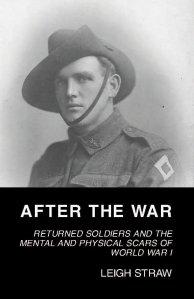
‘After the War: Returned soldiers and the mental and physical scars of World War I’ by Leigh Straw

Straw_After_the_War

2017, 205 p.

It’s a strong, handsome face that appraises us from the front cover of Leigh Straw’s After the War. When the author saw it from the front page of the muck-racking Truth newspaper, she was struck by its resemblance to her own husband. It accompanied a report of a murder-suicide in Collie in 1929 where an Andrew Straw had murdered Muriel Pope in the street by shooting her, before turning the gun on himself. Leigh Straw, a historian who is better known for work on the Sydney and Melbourne underworld from the 1920s (see one of my reviews here) had stumbled on her own real-life family crime, one that had been suppressed and altered in family lore.

Andrew Straw, returned WWI veteran, is just one of the West Australian men that Straw deals with in this book. There are fifteen main protagonists, with the brief appearances of another fourteen veterans, all of whom volunteered as members of the 1st AIF. Her book takes us through enlistment, fighting, and their return to Western Australia, with a particular focus on the difficulties they faced when returning to their families in a society limping through indifferent economic conditions towards the Depression.

Chapter 1 ‘When the Call was Given: A Nation at War’  summarizes the war experience from enlistment, Gallipoli, the Western Front and the Armistice. Here we meet many of the men who will reappear in later chapters. These are personalized further in Chapter 2 ‘Dad did his turn at the war’: War Experiences’.

Chapter 3 ‘Civilian Life’ brings them back to Western Australia. Arrangements for repatriation had been set in train right from the earliest years of the war, and injured men were being sent home long before the final demobilization at the end of the war. Of the 32000 Western Australian men who had volunteered for the war, 24,000 returned with 16,000 of them injured, invalided or incapacitated by mental or physical wounds.

Soldiers with tuberculosis faced years in and out of sanatoriums as shown in Chapter 4 ‘Isolated: Tubercular Soldiers’. Western Australian soldiers had the added complication that many of them had been miners, or lived in mining towns. At first the Repatriation Department (always keen to reduce ‘shirking’) raised questions about prior mining work and war service. However, most medical reports highlighted the war experience as a causal factor even where there was a work history in the mines.  Tuberculosis can sometimes take years to manifest itself, and gradually the policy of restricting payouts for tuberculosis to a two-year period after the war was eased to allow for later illness. The Woolooroo Sanatorium for tuberculosis patients in the general population was established 50 km outside Perth in 1915, just after Gallipoli, and it was expanded after the war with a military section.

Ch 5 ‘Unbalanced’: The ‘Mental Soldiers’ of War’ examines ‘shell-shock’, ‘war neurosis’ and what we would now call PTSD. As Marina Larsson points out in her book Shattered Anzacs (my review here),  families fought hard to have shell shock distinguished from ‘mental illness’ more generally. They advocated for separate facilities at Stromness Hospital and Kalamunda Convalescent Home to distinguish returned soldiers from the patients at Claremont Hospital for the Insane, but there was always cross-over between the two.

In Chapter 6 ”A Ruined Man’:Postwar suicide’, Straw turns to the newspapers to find details of this outcome of war that was so difficult to talk about by immediate families. West Australian government policy shamefully decreed the destruction of inquest reports after ten years, and so she needed to turn to newspaper reports when the inquest notes did not appear in the repatriation files. Using Trove, she sampled between 1915 and 1940,  after which point World War II reports made searching by keyword more difficult. She found that veteran suicides accounted for more than 10 percent of all registered male suicide deaths in the state- a number which was lower than I expected. However, as she points out, deaths reported as ‘accidental’ or through drowning allowed widows or family members to claim a war pension, when a finding of suicide did not.  Those that were reported as suicide generally (60%) involved fatal gunshot wounds, most to the head or chest. Almost one third involved poisoning. One distinguishing feature from the current-day veteran suicide statistics was the number of self-inflicted razor wounds. Nearly 40% of the suicides took place in the five years between 1925-1929, before the Great Depression, but when a large number of men reached middle age and struggled to find work. War pensions were increasingly questioned and lowered from 1925. Alcoholism featured heavily, and there were marital and family problems.

Chapter 7 ‘War’s Aftermath: Family stories’ turns to the oral histories given by family members, both to Leigh Straw herself and to earlier oral historians. For a number of these families, including Straw’s own, these stories went untold for years . ‘Conclusion: the men who came home’ summarizes the findings of the book, and a final epilogue ‘A Disordered Brain’ returns to Andrew Straw’s story – the man whose face is on the front cover, and who was the impetus for this book.

This book, written in 2017, locates itself and pays tribute to much of the work on war injury, repatriation and the effects on family which has been undertaken over recent years. There is much of it, and I found myself wondering why Straw chose to move out of her academic field of crime/social history of the early-mid 20th century when so many other historians have worked in the area of WWI repatriation before her. I’m thinking, for example,  of Marina Larsson, Joy Damousi, Stephen Garton and Alistair Thomson – all of whom have written about loss and return over the past twenty-five years.

I think that part of the answer lies in the event that prompted to her to write: the discovery of a close family relationship, that even travelled generations to manifest itself in the face of her own husband. Other books on the same topic tell individuals’ stories and use oral histories, as she has done. But in this book, she focusses on fifteen men whose stories re-appear across the various chapters of analysis, supplemented by other examples. It is an academic history, complete with footnotes and literature review, written with a family history focus.

A second aspect is its emphasis on Western Australia, rather than the more populous eastern seaboard. In this regard, it is no surprise that the book was published by  University of Western Australia Publishing. Western Australia’s commitment to the war effort was the highest in the country by proportion of population, with close to 10% of the state’s population enlisted in the war.  The state more strongly supported conscription than the other states, right throughout the war. Many of the enlistees from WA were relatively recent arrivals from Britain or Victoria attracted perhaps by the 1890s gold discoveries, with possibly shallower family connections. Schemes and plans for repatriation were implemented across the nation, but being so far distant from the other states, the Western Australian government worked largely in isolation.

This is an easy book to read, despite its difficult themes. It is an academic text, but with its grounding in the lived experience of men and their families, it wears theory and argument lightly. Beyond the photo of Andrew Straw on the front cover, it does not have any pictures, which is surprising given the co-operation the author received from many family members. But perhaps that is not the drawback it might appear.  Photographs, with their staging and smiles, do not capture the pain and struggle that is perhaps more apparent taken across the whole life span, and into further generations. That comes from stories, and this book is replete with them.

My rating: 7/10

Sourced from: Yarra Plenty Regional Library

After the War was joint winner of the 2018 Margaret Medcalf Award from the State Records Office of Western Australia.

aww2020I have included this on the database of the Australian Women Writers Challenge 2020

The Palace Letters: the next step in the saga

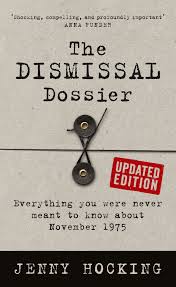
Hocking_DismissalI’m absolutely delighted that Prof. Jenny Hocking has had a victory in the High Court this morning, with the finding that the commonwealth had erred in withholding over 200 letters between the Queen and Sir John Kerr in the leadup to the dismissal of Prime Minister Gough Whitlam in 1975.

Some time ago, I reviewed her small book The Dismissal Dossier, to which I gave a 5-star rating. I’ve also been listening to the ABC Podcast The Eleventh which has rekindled my rage anew.

I hear with my little ear: Podcasts 16-23 May 2020

Heather Cox Richardson  The Politics and History podcast on 12 May spent quite a bit of time on the Supreme Court, and Attorney General Barr’s actions over Flynn and the increasing talk of ‘Obamagate’. She starts off addressing her question of liberal bias by reinforcing that she is a historian, who works from sources rather than Fox News commentators, and  notes that in the past she was accused of being conservative (that is, before the conservatives became so radical). She finishes off by discussing what a new ‘New Deal’ might look like, should the world turn that way. Meanwhile, her History Podcast on 15 May looked at the Movement Conservative takeover of the Republican party since Ronald Reagan, and its efforts to ensure that there can never be a Democrat government again by challenging voter registration under the guise of ‘voter fraud’ and by appointment of Supreme and other level court judges.

Judith Lucy Overwhelmed and Dying is more of Judith Lucy’s dry shtick, this time looking at wellness and aging. A lesson my arse taught me (after enduring four warm oil enemas) is that we should embrace what our body can do rather than what it can’t, an observation helped along by wheelchair rugby star Shae Graham.

Making History (BBC) London and the Rest from Feb 2020 comes from post-Brexit Britain: how long ago all that feels! The sense that there is a difference between London and the rest of England has a long history. The program describes the Whig/Tory distinction, the literary character of John Bull, the early development of London, and in light of the suggested shift of the House of Lords to the city of York, the alternative city centres to London

Start the Week This podcast fits in rather well with the consideration of ‘London and the Rest’ above. In Richard Ford Writing from the Edges, the program explores the idea of provincialism in American and English writing. I haven’t read any Richard Ford (I must) but his books are set in Mississippi or Montana rather than in New York. The other guest, Ruth Livesy has written a lot about George Eliot, who consciously set her novels in the ‘provinces’. She identifies the 1860s – the time of the passing of the Second Reform Bill- as the turning point when London began to dominate the other large cities in England which had previously had their own newspapers, scientific and literary ‘heroes’ etc.

The Eleventh. The final episode Episode 7 State Secrets looks at the two main theories behind what actually happened on November 11 1975. The first one looks at the American/CIA theory. I’d forgotten that the dismissal took place in the same political environment as the overthrow of Allende in Chile, and there’s certainly enough things that Whitlam did to upset the CIA. The second theory, and the one that still has legs because of the dogged persistence of historian Jenny Hocking (my review of her book here) is that Kerr and the Palace have unanswered questions. The intransigence of Sir Anthony Mason and the Palace make me all angry again. And look at the papers: Jenny Hocking has had a High Court win from the Australian side at least. We all owe this historian a debt of gratitude.

New Books in History. I didn’t realize when I downloaded it that Max Edelson’s The New Map of Empire would be about mapping in North America.  He argues that especially after the Treaty of Paris in 1763, the British Board of Trade put real effort into mapping the American and West Indian territories, using scientific wartime mapping techniques. With the French and Spanish empires as a competing pressure and with war likely to break out at any time, and with the lofty aim of peace treaties with Native Americans, they needed military-grade maps. On the part of the British government, this was an attempt to exert continent-wide (or as much of the continent as they had) influence over what had until then been different settlements. I found myself thinking about the differences with Australia, which was charted by Captain Cook at much the same time. So much of our ‘mapping’ was naval mapping, noting bays etc. suitable for naval activities during war. When surveyors in Australia did set out, it was to find navigable routes across, rather than the detail of every mountain, creek etc. and was often in the vanguard of land occupation. There were no competing European powers, and no attempt (beyond Batmans’ farce) to have treaties based on maps.  Interesting.

Rough Translation As part of the coronavirus shutdown, the Dan Panorama Hotel in Tel Aviv was turned over for recovering coronavirus patients who had been released from hospital, but still considered contagious. There were Orthodox and Secular Jews, and Muslim guests, who were all thrown together. In Hotel Corona we learn what happened.

Historians on the coronavirus pandemic #3:History and Policy Special Feature

There is just so much material on this special feature page of History and Policy. Titled ‘Pandemics, Quarantine and Public Health’, it features a number of essays written by historians about current events, with a slant towards the situation in England.  Some of them are policy papers, others are opinion pieces but either way….there’s hours of fascinating reading here!

This is what you can find on this page as of May 24 (and it seems to be updated quite frequently). Even the issues that are being raised at different times mark the arc of concern during the pandemic:

  • COVID and the UK National Debt in historical context
  • The real lessons of the Blitz for COVID 19
  • Call it what it is: supermarket rationing
  • Loosening lockdown: lessons from the blackout
  • COVID is not a Black Swan: predictable shocks need fully-funded, resilient public services
  • The need for a new National Food Policy: food supply problems during National Emergencies
  • Public Enemy Number One: terrorism, security and COVID 19
  • Soldiering a Pandemic: the threat of militarized rhetoric in addressing COVID 19
  • A matter of life and death: football, conflict and the coronavirus
  • Hospital visiting in epidemics: an old debate reopened
  • On infection parties, herd immunity and other half-truths
  • Does Coronavirus spell the end of neoliberalism?
  • COVID 19 and the 1919 Spanish ‘flu’: differences give us a measured hope
  • Epidemic control and Chinese public health: past and present
  • Epidemics and ‘essential work’ in Early Modern Europe
  • Blitz spirit wont help ‘Win the Fight’ against COVID
  • Quarantine – an Early Modern approach.


Historians on the coronavirus pandemic #2: Warwick Anderson

Australian historian Warwick Anderson has had two essays published on the Somatosphere website, which advertises itself as “A collaborative website covering the intersections of medical anthropology, science and technology studies, cultural psychiatry, psychology and bioethics.” They are running a series of essays called ‘Dispatches from the Pandemic’. Wesley Anderson, both medical doctor and PhD, is Professor of Politics, Governance, and Ethics in the Department of History and the Charles Perkins Centre, University of Sydney. He is a historian of science, medicine and public health. His book Intolerant Bodies: A Short History of Autoimmunity won the NSW Premier’s General History Prize in 2015.

In the first essay Not on the Beach, or Death in Bondi? he looks at the recent closure of ‘iconic’ Sydney beaches after a weekend of crowded sands.  He juxtaposes that scene of people crowded on the beach on a hot day with the other sight, occurring only a few short months ago, of people huddled on the Mallacoota beach under the violent red skies of bushfire. He picks up on the place of the beach in the Australian imagination  (and I find it strange that he didn’t pick up on Greg Dening’s work on beaches), and as an unstable, ambiguous space that signals freedom and yet is surrounded by prohibition in the form of flags, signs and regulations.

The second essay Epidemic Philosophy he examines the pronouncements of various present-day European philosophers (all of venerable years as he points out in parentheses) on the coronavirus pandemic. He starts with Italian philosopher Giorgio Agamben, who in February 2020 proclaimed that it was no worse than seasonal influenza and that social distancing was a deep state conspiracy. Agamben has since moderated his views. A number of his European colleagues distanced themselves from his stance, with varying degrees of optimism/pessimism over the post-COVID world. To be honest, I hadn’t heard of any of these philosophers, but I guess that philosophy is not my field of expertise. Anderson finishes his essay by observing that perhaps the habit of philosophers to sit quietly before coming to a position is the wisest course to adopt.

‘People of the Book’ by Geraldine Brooks

_brooks_people-of-the-book

2009, 496 p.

This book has been sitting on the shelf for a while. Now that my library has closed, I can no longer borrow piles of books that I return unread. Instead I’m having to turn to my shelves full of books that at some stage I felt I simply had to buy and which have remained in their paper bags ever since.  I blame the Little Free Library down in my park too, which calls to me every time I go to the station.

IMG_20150308_153232a

Geraldine Brooks’ People of the Book is a Little Free Library find. I’ve read quite a few of her books (all prior to starting this blog), Foreign Correspondent, March and Year of Wonders, which has been mentioned several times recently. I wasn’t too sure about this one. I knew that it was about a Jewish prayer book. I also knew that she had converted to Judaism, and I’m always a bit wary of people writing from a particular faith tradition.

Brooks’ book is based on the real-life story of the Sarejevo Haggadah, a brilliantly illuminated Jewish prayer book that is used at Passover.  It is on permanent display at the National Museum of Bosnia and Herzegovina in Sarajevo.  It carries a rich and traumatic history.  It was created in Spain around the year 1350 and changed owners after the expulsion of the Jews from Spain in 1492.  It ended up in Venice, where it was passed by the censor of the Inquisition. It was purchased by the National Museum in 1894 and sent to Vienna for work. It was hidden from the Nazis during WWII and was again threatened during the bombing of Sarajevo in 1992.

Using the actual history of the Haggadah, Brooks weaves her own story around the people through whose hands it might have passed during its turbulent voyage. Most of this is sheer imagination, although firmly within the historical constraints of the real-life story. The frame story is that of an Australian conservator,  Hanna, who is called in to inspect the Haggadah before undertaking conservation work on it. As part of her painstaking inspection she notices an insect’s wing, a hair, salt residue and a wine stain. Each of these fragments branches off into the historical aspect of the novel, telling the story of how they came to rest within the pages of the book, to be discovered hundreds of years later.

And so we meet a young Partisan fighter in Sarajevo in 1940; a syphilitic bookbinder in 1890s Vienna; a 17th century Venetian rabbi; a black female Muslim illuminator in Seville in 1480 and a mixed Jewish/Converso family in the same city as the Jews are expelled in 1492.

The Hanna frame story veers close to being a mystery-thriller which sits rather at odds with the historical montages of people associated with the Haggadah over time. As all contemporary stories seem to have, there is a love interest and a problematic relationship with her mother. Brooks, probably quite intentionally, features women in the historical sections, which would have required some dogged research that at times felt heavy-handed.

But what an wonderful idea to use a real-life object that has such a vibrant story, even with all its gaps and silences. Did she need the frame story at all? I’m not really convinced that she did- but then, it would be a different book.

My rating: 7.5

Sourced from: my own bookshelves, from the Little Library in the park

aww2020I have included this on the 2020 Australian Women Writers Challenge.

I hear with my little ear: Podcasts 8-15 May 2020

Heather Cox Richardson.  Once again, her Tuesday 5 May video looks at current political questions through a historic lens. In this episode she talks about the relationship between the Republican party and the Catholic Church, which only emerged in the Nixon era, when he lost the sympathies of many middle-class parents over the Kent State University shootings. She moves on to a brief history of abortion, and how it has become so politicized. A second question was over the possibility of a Constitutional Convention and her fears should one be agreed to. The final question looked at how the judicial branch of government had changed the political landscape over the last 100 years. She goes back further, to the highly conservative 1890-1908 Supreme Court which passed the pro-segregation Plessy v Ferguson case (‘Separate but equal’) and legitimized the invasion of territories and the creation of foreign nationals.  On Thursday 7 May The American Paradox Part 7 she looked at the Depression and WWII, when big government stepped in during a time of emergency.  However, That didn´t stop the forces that were trying to roll back Reconstruction by denying rights to African Americans (and Native Americans too, although the focus is not on them). She looks at the rise of Big C conservatives and their conceptualization (and demonization) of Big L liberals. Ronald Reagan emerges as a symbol of West Coast conservative, anti-government individualism, and McCarthy attacks liberals whom he links to Communism. Really good.

Dan Snow’s History Hit. The coronavirus pandemic has spared us quite a few  big expensive commemorations:the Captain Cook 250th anniversary, and V.E. day and most probably V. J. day too.  But Dan Snow marks V.E. day in his program with an interview with historian Lucy Noakes, from the University of Essex, who has been working on the early to mid 20th century, with an interest in those who experienced the First and Second World Wars, particularly from the perspective of the history of emotions.  (She did her PhD on the Mass Observation project- something that fascinates me). In this podcast, she points out that the way a war is remembered is largely framed by the current questions and issues of the moment – noting the use of the Blitz as a touchstone for the current pandemic lockdown. You can hear it at

https://play.acast.com/s/dansnowshistoryhit/howshouldwerememberww2-

Fifteen Minute History (which often goes over 15 minutes) There have been lots of parallels drawn between coronavirus and the ‘Spanish’ influenza, and this episode looks at it from an American perspective. The guest, Christopher Rose wrote his PhD on a social history of the Egyptian home front during World War One through the lens of public health, which would certainly be a different perspective. The ‘Spanish’ Influenza of 1918-1920 gives a good 15 minute summary.

Revolutionspodcast  At last- we’ve reached the 1905 Revolution.  Well, not quite, because this episode 10.32 The Union of Liberation looks at 1904 when the liberals, who had been pretty quiet for the last 20 years, called for a convention like the Third Estate had done just before the French Revolution. But Tsar Nicholas wouldn’t hear of it, so they held banquets instead in the guise of celebrating the 40th anniversary of the liberal court statues to circumvent the ban on political gatherings. But the Russo-Japanese war is getting worse, and as a calming mechanism on the part of Tsar Nicholas, it’s not going to work. And in 10.33 Bloody Sunday we finally reach the 1905 Revolution. It wasn’t the revolutionaries leading it: instead it was a priest Georgy Gapon who seemed to be playing both sides a bit, and the liberals. He had police protection, and claimed to be supporting the Tsar, but when the army attacked peaceful protesters, all went a bit pear shaped.

NPR I often read the British historian Timothy Garton Ash’s articles. In this podcast from the On Point program, What the U.S. Response to Cornoavirus Says About America’s Role on the World Stage he talks about the great sadness that he feels as an enthusiastic Atlantic historian when he looks at America during the time of coronavirus.  He’s joined by Catherine De Vries, professor of political science at Bocconi University and On Point’s political analyst Jack Beatty. Garton Ash is far more optimistic about America’s potential than the other two commentators, but all agree that if America does manage to redeem itself (after all, US leadership bounced back after Nixon) it will not return to its former prominence.

BBC The Documentary.  Wuhan: the beginnings of coronavirus COVID-19 I started listening to this at 5.30 and missed the start of it. Going back to listen to it by light of day, it was more critical of China’s initial response and coverup than I realized, but I found the description of the rapid and forceful deployment of doctors and harsh lockdown fascinating. There is a backing sound track of people blowing whistles in protest after the death of the doctor who tried to report the outbreak – quite eerie-  I found this Facebook video here but I don’t know about its provenance.


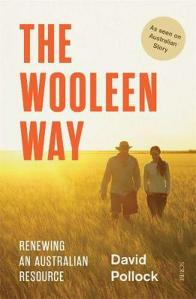
‘The Wooleen Way’ by David Pollock

pollock

2019, 362 p.

I sought out this book after reading an article in the November 2019 edition of The Monthly  (yes, I am just as, if not even more, delayed in reading The Monthly as I am in listening to podcasts.) The article was titled ‘Bait and Switch‘ about the contentious issue of dingo-baiting. At the end of the article it mentioned that one of the protaganists in the dingo/wild dog debate, David Pollock, had changed the landscape of his pastoral property in the Murchison River region, eight hours drive north of Perth. Where there had been dust, there was now grass and shrubs, and while he welcomed the dingoes, he had rid the property of kangaroos and goats, which cause the most damage to the landscape.  I was also prodded into reading this by Ross Garnaut’s recent book Superpower, where he argued that Australia could seize the opportunity to farm carbon-sequestrating plants as a deliberate agricultural and strategic choice.  It was only when I saw the ‘As seen on Australian Story‘ sticker on the front that I remembered seeing advertisements for the program about a farmer who had eschewed traditional practices and opinions of his neighbours in his quest to regenerate his land.

David Pollock is not a natural writer, and there is a self-consciousness about his writing that gives a slightly stilted and defensive tone. Nonetheless, he captured really well the experience of growing up on a remote pastoral property, where his mother’s hospitality in opening her house up to tourists meant that it teetered between profitability and ruin.  He did not necessarily intend to become a farmer, having spent much of his early adulthood travelling the world, and as the second son, it would have been more conventional for his older brother to step into his father’s shoes.  But his father, who was obviously a flexible thinker, asked both sons to spell out their vision for the property…and gave the management to David.

He then goes on to describe his decade-long experiment on returning the land to an earlier state. Unlike his neighbours, he chose to run cattle instead of sheep;  he greatly reduced the stocking rate; he embraced the return of the dingo as a sign of progress;  and he shot the kangaroos and goats that threatened to overrun the property and undo all that he had achieved. This set him up for conflict with his neighbours and with the local Land Conservation District and the Pastoral Land Board. He disdains bureaucrats and distrusts government, but is not backward in asking for welfare. Actually, he’s a pretty prickly fellow, and you can sense why he might alienate people around him.

In many ways, and as he admits, he was ‘saved’ by the publicity that he attracted from the ABC’s Australian Story program. After the screening of the program, money and interest came pouring in, and although he felt uncomfortable about it, Australian Story and the ABC returned several times. The television audience was drawn to the romance of his story, an angle that you feel he tolerates in order to get the larger story out to a larger public.

The book is repetitious in places, largely because he needs to fight the same battle over and over again. At 362 pages, it felt like a long book, and it could perhaps have done with tighter editing. On the other hand, it is his voice that booms through it. He becomes strident at times, which could be a reflection of his personality, or maybe a measure of his passion for Wooleen and his project.

My rating: 7/10

Sourced from: Yarra Plenty Regional Library