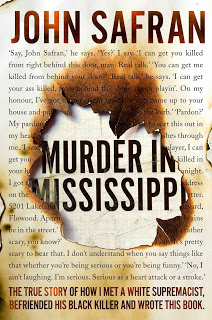
‘Murder in Mississippi’ by John Safran

safran_murder_mississippi

2013,  368 p.

I’m not really sure how this book ended up on my bookshelves, because I’m not a great fan of John Safran and nor do I particularly like True Crime as a genre. I think that I received it as part of a subscription to Crikey, which has always given John Safran a fair bit of support.

So who is John Safran, you might ask? He’s a Melbourne-based satirist, radio personality and documentary maker who has made religion and race his stalking ground. He often pranks the people that he interviews, and it was indeed one of these very stunts that set him off in the year-long pursuit of this story of murder in Mississippi, very far from Melbourne.

As part of his ABC documentary series Race Relations he cultivated a friendship with white supremacist, Richard Barrett, and found himself surprised that he actually liked him more than he thought he would. After surreptitiously obtaining Barrett’s DNA, he was invited by Barrett to say a few words at the Spirit of America rally that Barrett had organized. Microphone in hand – and completely unknown to Barrett- he announced that the DNA test results showed that Barrett had Afro-American heritage. As Safran left the meeting, exulting at his victory and with barely a twinge of conscience, he did not divulge to the startled audience or Barrett that any detailed American DNA test would show a trace of Afro-American heritage. We never got to see this episode. When Barrett threatened legal action, they pulled the show.

However, Safran’s  nose for a good story twitched when he learned that Richard Barrett had been murdered by a young Afro-American teenager. And,so he took himself off to Mississippi to chase the story.

In the early statements given by the murderer, 22 year old Vincent McGee, he did not deny the murder or the attempted arson of Barrett’s house to cover his traces. He did, however, claim that Barrett had tried to hit on him, and that in a flash of rage he had stabbed him after Barrett had gone after him. However, when the case finally came to trial, he changed his plea to guilty and was sentenced to 65 years jail. Why?

And this is what Safran is trying to find out. The trifecta of sex, race and power is a heady one, and Safran is not sure whether Barratt, McGee or both are exploiting it. He is drawn into McGee’s world, and it’s not clear just who is exploiting whom. Court files disappear; there are small deceptions that may mask larger ones; and the edges of the crime become murkier. Safran’s fantasy of being the journalistic avenger who is going to prove McGee’s innocence  soon disappears.

Reading this book was very much like listening to a podcast over about six episodes. That’s probably about how long it took me to read the book, and I’m not sure that there was any great advantage in reading it over listening to it: in fact, I think that it would be better as a podcast. There’s a lot of dialogue, and Safran’s narrative is very voice-over-ish. I didn’t really get a clear visual sense of the characters he features until I found the pictures in the middle of the book, and I often found myself trying to flip back to work out who was who (something that an index might have made easier).

I started this book just as the furore over George Floyd was spilling out into the streets across the world, including Australia. I had expected that I would be reading a book about injustice, but the book is not as clearcut as I expected it to be. It was well-received  and was awarded the Ned Kelly Award for Best True Crime in 2014. However, I think that I prefer my true-crime as a podcast.

My rating: 7/10

Sourced from: my own bookshelves.

Essay: ‘Nine lives’ by Brenda Niall

https://insidestory.org.au/nine-lives/

How fitting that I should be reading Brenda Niall’s Friends and Rivals when this essay should pop up on Inside Story.

She talks about her most recent book, but also the other biographies she has written, all in the latter part of her career with the English Department at Monash University, then in retirement. She is fond of the group biography, which she used so well with The Boyds: A Family Biography and now in her most recent book about four Australian women writers between the 1890s and 1920s: Ethel Turner, Barbara Baynton, Henry Handel Richardson and Nettie Palmer.  I admire Brenda Niall a great deal as a biographer.

I hear with my little ear: Podcasts 9-16 June 2020

Heather Cox Richardson has her own YouTube channel now.  She’s continuing with the Facebook chats (and in her History and Politics chat she explains why) and then posting them onto You Tube. Her History and Politics Chat of 26 May 2020 looks at the influence of the ‘Spanish’ flu on the November 1918 election (she doesn’t think it had that much influence); the question of whether Ford was right to pardon Nixon (she says no because it was a precedent for presidents being above the law- although she does note that Ford also pardoned ‘draft-dodgers’ who had fled to Canada, so it was supposed to be a ‘pardons for everyone’ gesture; and she finished off talking about propaganda.

The History and Politics Chat of 9 June 2020answered three questions 1. What happened to the Baby Boomers? Why didn’t they have more effect on society? (Her answer: after Goldwater’s defeat, the Movement Conservatives moved into more bread-and-butter local elected positions – school boards, text book boards etc- and exerted their influence on day-to-day life). 2. The creation of Washington D.C. (not very interesting for an Australian listener) 3. Why does Mitch McConnell have so much power in the Senate? (Because the Senate Republicans keep supporting him). And she finished off describing what a ‘doglicker’ was.

Her History Chat of 28 May is a break between her most recent book How the South Won the Civil War and her previous book about the history of the Republican Party. In this episode she looks at a letter purported to have been written by Jourdan Anderson to his former slave owner Col. P. H. Anderson on August 7, 1865. This was after Lincoln had been assassinated but before Congress reconvened. She reads the letter, then deconstructs it as a historian does. It’s a good example of historic method.

The Documentary (BBC) has been running its Lockdown series, but this is the last one. This seems strange given that the trajectory of the pandemic is still unknown. With the Lockdown series, they invite ordinary people to upload a recording via their phones, talking about how the lockdown has affected their day-to-day life. This episode Lockdown Tales from Panama and Brazil actually has input from more countries than these two, including Rwanda, Australia and America. In the American one, the caller is going to resist any further restrictions as an infringement on his constitutional rights. I wanted to kick him.

Another episode In my present isolation takes a very old-fashioned approach of asking six writers on different continents to physically write a chain letter, adding their own perspectives to what has been written previously. As you might expect, it’s beautifully expressed and it makes you regret even more that the art of letter writing has been replaced by emails and Twitter.

Start the Week (BBC) had an interesting discussion on a program called Our Coercive Politics, featuring David Runciman, presenter of a 12 part podcast series Talking Politics: History of Ideas and Ute Frevert, the author of The Politics of Humiliation: A Modern History (which sounds really interesting). The discussion  ranges across the power of the state during the covid pandemic; Hobbes, Gandhi and Fanon; the power of humiliation; and George Floyd.

Outlook (BBC World) If you’re a millionaire who has climbed the highest peak on all the continents, done Antarctica etc. etc. what’s left to do? Go in a one-man submersible to the deepest part of the five oceans. That’s why Victor did in Voyage to the bitter deep. And what did they find there? The Titanic, and plastic.

Saturday Extra with Geraldine Doogue usually has some good segments. This old one How do we view James Cook 250 years later features historians John Gascoigne (writer of many works about navigation and the Enlightenment), Mark McKenna (recent Quarterly Essay: Moment of Truth: History and Australia’s Future) and Alison Page, artist, creative, Councillor at the National Maritime Museum and Chair of the National Centre of Indigenous Excellence. They mentioned a book very much championed by the right (i.e. foreword by John Howard; praised by Keith Windschuttle; featured at the Sydney Institute) called Lying for the Admiralty by Margaret Cameron-Ash. In it, she argues that Cook didn’t miss Sydney Cove at all, but instead was following secret Admiralty orders to keep quiet about important discoveries for fear that the French would settle there  instead. I haven’t heard of this book, or any academic response to it.

Rear Vision Here I was, thinking that it was a new program-1929 Revisited– but instead it was first broadcast on 27 April 2008, after the GFC. Still, listening to the gyrations of the stock market on the news each night, inexplicably rising in the midst of Covid-19, it’s sobering to see that in the months leading up to October-November 1929, the share market was bobbing around then too.


Historians on the coronavirus pandemic #5: Stephen Davies

I read about this through the blog of economic historian Andrew Smith who works at Liverpool University. Prior to this, he worked in Canadian history which is where I came across him while I was working on my thesis. I’ve followed his blog ever since, which naturally enough leans towards economic history.

In this posting he critiques the historian Niall Ferguson’s working paper on the impact of COVID-19. I’ve become increasingly put off by the conservatism of Ferguson’s work over recent years, especially since his links with the Hoover Institute have become more public. Andrew Smith picks up on Ferguson’s contention that “we need to think of COVID-19 as one of those rare catastrophes that befall humanity at irregular intervals in history. In addition to pandemics, these include major wars, volcanic eruptions or earthquakes and extreme climatic events.  Smith criticizes Ferguson for using only the 1918 ‘Spanish’ flu as a historical analogy (possibly because he had done work on it previously) instead of also looking at the 1957 and 1968 influenza epidemics. Smith points instead to a more historically-insightful working paper by Stephen Davies Going Viral: the history and economics of pandemics, which is available online.

In summary,  Davies argues that there have been a series of pandemics, but that COVID is more serious than the 1957 or 1968 influenza outbreaks. Historical comparisons teach us that they break out after periods of increasing economic integration, generally in connected cities that are centres of trade, and generally where the human world abuts the natural. They generally come in waves, with the second wave more serious than the first. Features of contemporary society mean that pandemics are more likely with more damaging results e.g. international integration, an increasingly efficient but fragile world economy, movement of women into the workforce and a change in the way that older people are cared for.  On historical precedent, this pandemic will last for about 18 months, and that for structural reasons, it will be followed by other pandemics.

He looks at the 1968 influenza, and the reasons why if it happened today, it would be much worse. Women in the paid workforce means that school closures have a much larger economic effect, and the concentration of a larger number of old people in care homes means that workers and visitors are more likely to contract it.

He highlights that if the 1968 influenza epidemic occurred today, it would be more severe and prompt a lock-down approach similar to the one we are experiencing today because the health system is not as resilient as it was. In 1970 there were 9.3  beds per head of population in the UK, and in 2010 it was 3.1 (and has been reduced even further), spread across the country. These fewer beds are now concentrated in large cities instead.

While warning against thinking that “everything will change”, he predicts the following economic effects:

a severe hit to the supply side of the economy (not the demand side initially) which will probably lead to a severe and U-shaped recession; innovations and changes in things such as consumption and working patterns that were already underway will be accelerated; a major debt crisis (which was in line to happen anyway, sooner or later) has been triggered along with a fall in the value of many assets; there may be higher inflation in a year to two years’ time; there will be a significant pull-back from globalisation and supranational governance will come under serious strain; there will be extensive but complex social and psychological effects.


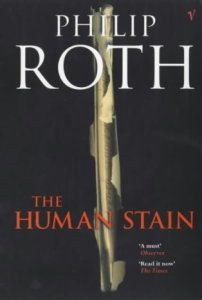
‘The Human Stain’ by Philip Roth

roth_human_stain

2000, 361p.

This book opens with two affairs. The first, that “everybody knows” about is that of Bill Clinton and Monica Lewinsky, an affair forever imprinted on my mind with the memory of his pointy, reddened face and jabbing finger as he declared that he “did not have sexual relations with that woman”. I’m glad that through her really-worth-watching TedX talk, Monica has left the blue dress and “that woman” behind. But with Trump’s “grab ‘em by the pussy” and now the accusations against Biden, it feels as if this ghastly American reality-show just keeps on going.

The second affair, the focus of this book, is between Coleman Silk, retired Classics professor and Faunia Farley, an illiterate cleaner half his age. Perhaps ‘affair’ is the wrong word: Silk is a widower, Faunia has fled a violent marriage, and they are both consenting adults. But Coleman Silk is already a disgraced man, as far as his employment at Athena College is concerned, from which he resigned in the aftermath of controversy over using the term ‘spooks’ to refer to two students who had never turned up to class. Although he was asking whether the students were invisible phantoms, ‘spooks’ had also, as a subsidiary, less-used meaning, a racist derogatory connotation as a term for African Americans. In what Silk (and Roth, for that matter) see as “political correctness gone mad”, Delphine Roux, a fellow academic in the humanities faculty, advocates for the young female student referred to as a ‘spook’, and then later for Faunia Farley whom she sees as the victim in an uneven power relatioinship.

Sex, race and religion are fracture lines in many societies, and in America in particular – and especially in its politics- they verge on being obsessions. Coleman Silk, successful, white Jewish professor, is not what he appears and in this book, the narrator Nathan Zuckerman, who appears in many of Roth’s books, decides to tell Silk’s story and reveal his secrets. Keeping secrets always has a cost, and in this book, Silk and his family carry the burden, in some cases even without knowing.

I have a love/hate relationship with Philip Roth. I can see the virtuosity of his writing but it is so wordy, so excessive. Sentences stretch on for a whole page and it is as if the narrative is being shouted at you. The fact that chapters go on at length doesn’t help. Too much, too much.

There’s a swaggering maleness about his writing, and the constant presence of sex as a prism for viewing the world makes me feel uncomfortable. In this book, Roth’s own conservatism is quite clear as, through Coleman, he fulminates against post-modernism, literary theory, education standards, affirmative action, political correctness and hypocrisy. But Roth also needles those sore points of present-day American society so acutely: the freedom to invent yourself, the American Dream, Jewishness in American society, sexuality, Vietnam and the biggest one of all, race. He’s brilliant. He’s insufferable. And somehow, he manages to do all these things in a very American, male, ‘look at me’ way that, almost despite yourself, demands that you do.

My rating: 8.5

Sourced from: CAE book groups.

I hear with my little ear: Podcasts 1-8 June 2020

Heather Cox Richardson. With all the chaos in America in recent days, I couldn’t wait to hear Heather Cox Richardson’s take on it all. In her Tuesday 2 June Politics and History talk (the link is to her You Tube site where she’s putting her talks now) she discusses whether Trump can call the army in.  She talks a lot about the Posse Comitatus Act which I had never heard of. You neither? It’s a federal statute  enacted in 1878, which forbade the use of the US Army, and through it, its offspring, the US Air Force, as a posse comitatus or for law enforcement purposes without the approval of Congress. She talks about the Insurrection Act which I had heard of, which was  created in 1807 in response to the Haitian Revolution where slaves rose up against the planters. Then of course, there and Emergency Acts post 9/11 which give the President wide latitude and which, she argues, should have been revisited before now.  She then goes on to a history of fascism, she looks at the question of why oligarchies want to get rid of the middle class, and finished up talking about Antifa. Great stuff.

Then I backtracked to her History video of 21 May, (also on YouTube) which was the final one related to her book where she took up from Reagan onwards through to Trump. Because it was more current, there was more crossover here with her Politics/History one. She ended on a cautiously optimistic note: that whenever the oligarchs had tried to take over, the American people always took back their democracy; and the widening gender gap in voting patterns suggests that women might sway the next election. Excellent stuff. Now I just have to read her book.

Reply-All (Gimlet)I’ve had The Crime Machine on the phone for ages (since October 2018) and given the Black Lives Matter protests this weekend, it seemed a particularly fitting time to listen to it. The Crime Machine is about the computerized system that the New York Police Department used which saw them targetting young, black kids for misdemeanours as a way of keeping their crime statistics up. As often happens, in the end police behaviour was changed to keep the machine happy, with the warped consequences that we have seen over the last week.

The Documentary (BBC) Again, given the recent demonstrations all across the world about policing and crime, it seemed appropriate to listen to this podcast from 17 May 2020 called Seven dead, 46 injured: One Chicago weekend. It’s not about police violence as such (in fact, it’s rather sympathetic to the police role), but about the ongoing environment of violence and shooting that takes place, weekend after weekend. The weekend of August 2019 was not particularly different to any other weekend, but this program uses newspaper reports, eyewitness and family reports to reconstruct how urban violence plays out in a society flooded with guns.


‘The Water Dreamers’ by Michael Cathcart

cathcart_waterdreamers

2009, 259p.

After seeing historians negotiating the publication marathon, I know that authors don’t always get to choose the name of their book.  Instead, it is often a decision of the marketing department of the publication company. However, if I were Michael Cathcart, I’d feel rather short-changed by the title of this book, which, even with its subtitle ‘The Remarkable History of our Dry Continent’ still doesn’t capture the nature of Cathcart’s question or approach.

The title ‘The Water Dreamers’ evokes for me poor old mad Sturt bashing around in the outback, Burke and Wills and the Dig Tree and C. Y. O’Connor suiciding before his Goldfields pipeline was pronounced a success.  All of these men- and it’s significant that they are all men- appear in this book, but it’s far more than that. Instead, Cathcart examines the way that Australia was imagined and written about in our  national consciousness and there is just as much about the ‘silence’ of the landscape as there is about ‘water’. I don’t know how you find a title that combines both these elements, but ‘water dreamers’ doesn’t do it. This is as much a book about cultural interpretation and literature as it is about engineering.

The book runs pretty much chronologically, starting off with the arrival of the First Fleet and those earliest transactions about water, a crucial concern for a ship’s crew that has arrived after months at sea and intent on forming a settlement. He features the now-invisible Tank Stream, so named because early engineering attempts imposed tanks onto its increasingly straitened flow, and the search for a better water supply which drove the the settlement towards the Parramatta and Hawkesbury Rivers. In the interests of Sydney-Melbourne balance, there is a similar chapter on the Port Phillip settlement, and the importance of the Yarra Falls as a barrier between the salt and fresh water needed by an infant settlement. He traces through the various expeditions that embarked from Sydney, Adelaide and the north western coast of W.A. in search of an inland sea or a large navigable river, and the various schemes proposed to turn the rivers inland (zombie plans that keep returning again and again). Drilling the Artesian Basin, and the construction of the Snowy River Scheme were both seen as ways of ‘solving’ the water problem. Engineering solutions have given way to market solutions, with water trading schemes abandoning Alfred Deakin’s long-standing philosophy that the water belonged to the river.

That’s one thread running through the book, and a fairly straightforward one at that. What gives nuance to Cathcart’s book is his parallel analysis of how the landscape was conceptualized. He points out that writers, from the very start, have commented on the “silence” of the Australian continent – whether it be the gibber plains or huge eucalypt forest- even though at the same time, they commented on bird calls, the crashing of timber, the howling of wild dogs, and the talk and shouts of nearby indigenous groups. Many early writers used the term “the howling wilderness”, a term from a 1662 North American poem ‘God’s Controversy in New England’, and one rather at odds with the supposed-silence that these Australian explorers deplored.

Cathcart is a pugnacious writer, and he takes on the popular view that explorers were obsessed with the idea of an ‘inland sea’.  While that is true of Sturt, Cathcart argues that explorers were instead seeking inland rivers, like the Mississippi, or the Amazon. Settlement occurred on the coast, not inland, and the first priority was to secure the coast, rather than penetrate the centre. Mitchell, Cunningham and Sturt heading off from New South Wales were looking for rivers, not seas, and they were often defeated by swampland rather than desert.

Cathcart also challenges the idea that exploring men conceptualized the land as a young virgin to be ravished and possessed. Instead, he argues, when Sturt, in particular, spoke of “lifting the veil” on Central Australia, it was the veil of mystery, not a wedding veil.

He identifies a stream of literature and reportage that he describes as ‘necronationalism’, exemplified by the disappeared Ludwig Leichhart, or Patrick White’s Voss, reaching its apogee in the public mourning and commemoration of Burke and Willis, who died beside a fresh water flow in a wet season.  ‘Hanging Rock’ and Lost Children are similar expressions of this necronationalism –  a nationalism based on death, which Cathcart argues would later be evoked in describing the ANZAC spirit.

Silence began to be conceptualized not as a sensory phenomenon, but a geographical zone that you entered and could leave, as you retreated back towards the coastline. It had a pictorial, representative aspect.  The ‘silence’ line largely followed the Goyder rainfall line in the 1860s.  Hubris in pushing beyond the Goyder line of the 1806s led to economic defeat when the seasons changed. This mapping of lines onto Australia was replicated sixty years later when the professor of geography at Sydney University, Griffith Taylor, published his own map that zoned Australia into ‘Useless’ ‘Sparse stock’ ‘Good Pastoral and ‘Fair Agricultural’ zones. This directly conflicted with the optimistic boosters of technology and engineering ‘solutions’ who looked to the construction of  dams, the reclamation of Lake Eyre and the development of irrigation schemes.

Cathcart spends quite a bit of time describing the Lemurian novels of the turn of the century, drawing on Theosophist ideas, that posited the hero Dick Hardwick as the explorer of a lost, fantastic Australia, before the time of the Aborigines. Such novels appeared across the Empire, but they were also distinctively Australian.

By now, it as clear that much of central Australia was occupied by a depressed desert, a void, an absence of nature. But the Lemurian novels held out the possibility that things had not always been thus. They invented a past based on one tantalising fact. At some unimaginably distant time, there really was an inland sea in Central Australia. Now, in the era of Victorian engineering, that sea was a blessing that the civil engineer could create. With this hope in mind, visions of this ancient inland sea swirled through the pages of the Lemurian novels. (p. 185)

And so, through literature and language, we can see the adoption of North American tropes of a ‘howling wilderness’, a ‘virgin’ land, and an empire- wide ‘lost civilization’ adventure genre all imposed onto the Australian landscape. We see the practice of drawing lines on maps to delineate arid zones disputed by the boosters of industrial and technological ‘solutions’.  Cathcart’s book is not just about explorers and schemes; it is also about literature and national consciousness, and concepts of geographical defeat and technological victory.  Does he succeed in melding the two? I’m not sure that he does, and he has the two threads running alongside each other, rather than interweaving them as a concise, integrated argument.

Nonetheless, this is a beautifully written cultural history that ranges across poetry, diaries and novels as well as nationalist stories of explorers and engineers. It tells a much more complex story about more than just water.

You can hear Michael Cathcart giving a lecture on this book (and you can read the transcript) from 2008 at https://www.abc.net.au/radionational/programs/archived/hindsight/the-water-dreamers/3255244

My rating: 8/10

Sourced from: My own copy.



Six Degrees of Separation: from ‘Normal People’ to….

normal-peopleUsually the first Saturday of the month passes me by and I miss out on the Six Degrees of Separation meme from Kate’s blog Books Are My Favourite and Best.  But I’ve caught it this time, even though I haven’t read the starting book, Sally Rooney’s Normal People.
On the first Saturday of every month, a book is chosen as a starting point and linked to six other books to form a chain. Readers and bloggers are invited to join in by creating their own ‘chain’ leading from the selected book.

taylor_bright_young_people


Rather than normal people, I start off with D.J. Taylor’s Bright Young People: The Rise and Fall of a Generation 1918-1940. This is the story of the self-absorbed generation of London that ‘came out’ at the end of the war, partied their way through the 1920s, were brought undone by the Depression, then tended either to fascism or the idealism of the Spanish Civil War and Communism.

dancing-with-empty-pockets-australias-bohemiansAustralia had its own Bright Young People too, but they generally did not have the entrenched wealth of those in Britain, and they gravitated more towards the arts and the intelligentsia. Dancing with Empty Pockets by Tony Moore explores Australia’s Bohemians, switching the focus between Melbourne and Sydney, with chapters taking in a timespan of about twenty to thirty years, with the 1920s and 1950s given chapters of their own.
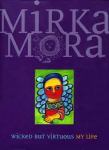
moraA real live Bohemian is the late Mirka Mora, whose biography Wicked but Virtuous takes her from WWII Europe as the daughter of a French Jewish resistance fighter through to Melbourne of the 1950s and 1960s. There she became a fixture of the contemporary art scene. More recently she became a puckish and mischievous stalwart of most documentaries of Australian cultural life.
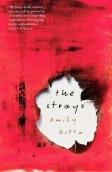
bittoEmily Bitto’s The Strays is a coming-of-age novel set within the unconventional family setting of an artistic bohemian group.  The only child of a rather boring, middle-class family, Lily is treat as one of the ‘strays’ who circulate around the loud, bold Trentham family.  It is an exploration of the heady combination of sex, alcohol and freedom, and the lure of a transgressive lifestyle.


doveyWhen I think of strays, I think of dogs which takes me to Ceridwyn Dovey’s Only the Animals, which not only has a dog but camels, tortoises, apes, parrots and dolphins as well. A series of separate short stories, these animals are each caught up in a human conflict during the twentieth century. In each case, there is a connection with a writer who paid homage in some way to an animal in her or his work.
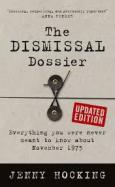
 

Hocking_DismissalDovey? Dovey? Where have I heard that name before? That’s right- Margaret Whitlam was Margaret Dovey before she married Gough. I haven’t yet got round to reading Jenny Hocking’s two-volume biography of Gough Whitlam. However I did read her The Dismissal Dossier, which should be read by those of us who think we remember the 1975 dismissal should read, as well as those who weren’t born at the time.
 

From a romance of two millenials from the same Irish town to the maelstrom of Australian politics – now that’s a journey!

I hear with my little ear: Podcasts 24-31 May 2020

Heather Cox Richardson. Her Politics and History video on 19 May looked at 1. the changing meaning of communism and socialism between 1850 and the present and the erroneous use of ‘socialism’ to decry any broadscale government initiative  2. the role of the inspector-general (did you know that there are 14,000 of them covering all facets of government?) 3. the World Health Organization.

Soul Search (ABC)  A couple of months back, I read Jill Roe’s Beyond Belief: Theosophy in Australia (my review here). With the republication of this book, Meredith Lake looks at Theosophy both historically and in its present form in a program following the name of Roe’s Book Beyond Belief. In many ways Theosophy as it is presented here is not unlike Unitarianism (which I follow) but many of its more contentious propositions are elided here, I feel. The podcast has an archived interview with Jill Roe (who died in 2017) and interviews with historian Wayne Hudson and Pedro Oliveira the Education Officer, Theosophical Society, Australia.

Rear Vision (ABC) What a weird, pugnacious guy Rudy Giuliani is. This episode Greek Tragedy or Farce: The Life and Career of Rudy Giuiliani traces through his career as a lawyer and public servant, then mayor of New York. Originally a Democrat, he shifted to the Republican party during the 1980s. The program suggests that had 9/11 not occurred, he probably would not have been re-elected as mayor of New York.

Southbank Centre (UK) On the 6 March – a lifetime ago- Hilary Mantel appeared at the Southbank Centre in London to talk about her most recent book The Mirror and the Light, the third in her Thomas Cromwell trilogy. I’ve just finished reading it (and have not yet written my review) and this program was perfect listening for someone who has read all three. She has spent 15 years on this magnificent trilogy. They had actors read from all three books, and it made me regret being a fast, non-vocalizing reader because they read aloud beautifully. So, if you’re a Mantel fan and have spent your lockdown with The Mirror and the Light, listen to this- it’s fantastic!

Dan Snow’s History Hit. I hadn’t realized that the Thames was so tidal until we were actually there, close to the Globe, walking along the banks of it. (Nor did I realize that if we picked anything up – which we didn’t- we would have needed a permit from the Port of London Authority). Picking along the banks of the Thames is called Mudlarking and in this episode Dan goes mudlarking, and talks with Lara Maiklem who has been scouring the banks for over 15 years.

The Documentary (BBC) In this program, they get listeners to record their own reports on how the coronavirus lockdown has affected their country. In Lockdown: Tales from Lebanon, Australia, Atlanta and India  from 19 May you realize (if you didn’t already) just how fortunate we have been.

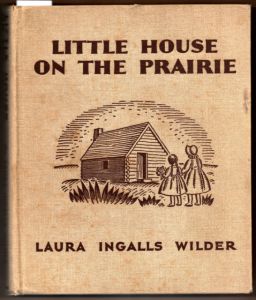
Essay: The Settler Fantasies Woven into the Prairie Dresses

wilder_prairie

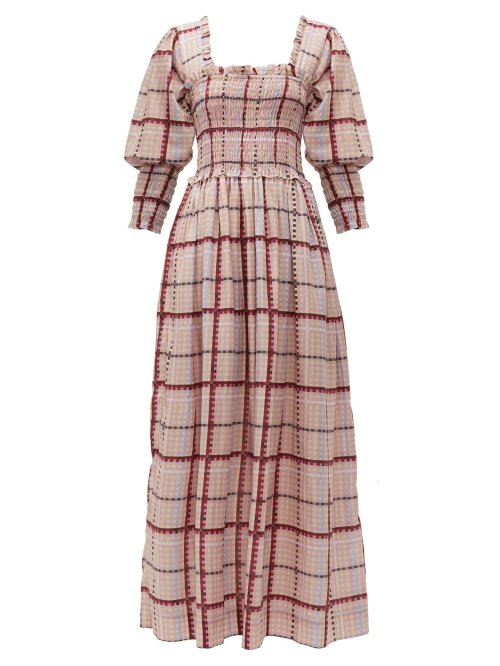
Those of you who know me personally will know that I have absolutely no interest in fashion. Apparently during the 2010s the Prairie Dress – shapeless, high-necked, ‘modest’ dresses- became a thing.

prairedress

Recently I’ve been listening to podcasts by Heather Cox Richardson, and she has referred several times to Little House on the Prairie and the Prairie Dress as a way of valorizing conservative, white, racialized, gendered American values that completely elide any consideration of Native American and African American presence in the homesteading   American past.

The Settler Fantasies Woven into the Prairie Dresses by Peggy O’Donnell, published on the Jezebel website explores the reincarnation of the prairie dress, the attitudes in Laura Ingalls Wilder’s work and questions the statements that adoption of the prairie dress make about women, femininity and gender.