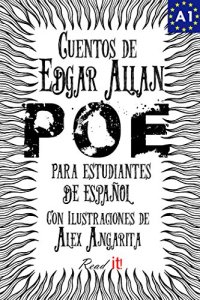
‘Cuentos de Edgar Allan Poe para estudiantes de espanol. Nivel A1’

poe

There’s a little test you can do of your language skill against the Common European Framework of Reference for Languages (CEFRL). “I’ll try that with my Spanish!” I thought, only to end up thoroughly deflated at the realization that I came out at level A1 – absolute, absolute beginner. Or as Wikipedia helpfully puts it:

He is able to understand and use daily expressions of very frequent use as well as simple phrases intended to satisfy needs of immediate type. You can introduce yourself and others, ask for and give basic personal information about your home, your belongings and the people you know. You can relate in an elementary way whenever your interlocutor speaks slowly and clearly and is willing to cooperate.

Well, on second thoughts, that’s about it.  Apparently this level takes approximately 100 hours of study and that would be just about right too.  (Actually, I’ve probably spent more time than that, so I must confess to being a laggard. I’ll blame my advanced age.)

So I downloaded Cuentos de Edgar Allan Poe for the princely sum of $2.04 AUD and found that, yes, it’s exactly the right level.  I had to look up about five words in each page, which was enough to keep me on my toes, but not so much that I felt overwhelmed.  I don’t know if the stories became simpler, or whether I improved as I went along, but it seemed that the later stories were easier to read than those at the start of the book.

It helped that I can’t remember reading any Edgar Allan Poe beyond, perhaps, in short story collections at school.  There were seven stories here: The Black Cat, Berenice, The Fall of the House of Usher, The Pit and the Pendulum, The Mask of the Red Death, The Facts in the Case of Mister Valdemar and Ligeia.  The whole book was only 68 pages in length, so each of the stories was relatively short. There were lots of deserted houses, ghostly women and glittering eyes and my favourite was probably The Pit and the Pendulum.  I did double check some of the stories in Wikipedia to make sure that I had actually understood them, and yes- they were abridged, but they captured the essence of the story with enough tension and mystery to make it worthwhile.

So, if you’re an absolute beginner too- this is $2.00 very well spent.

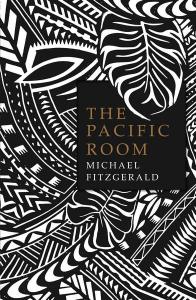
‘The Pacific Room’ by Michael Fitzgerald

the-pacific-room

2017, 237 p.

When I saw that this book was about Robert Louis Stevenson I wondered if I should just spend a little time googling around before I read it. I knew very little about him beyond ‘Treasure Island’ and a vague sense that he was in the Pacific at some stage. No, I decided. Let the book stand on its own two feet and so I launched in.

At first I was reassured, if somewhat underwhelmed, by the ‘researcher as explorer’ framing of the story. It’s a technique  which is becoming a little hackneyed, having been used by several books in the last decade or so, and replayed over and over  with all the misty-eyed emoting in the television series ‘Who Do You Think You Are?’ I don’t need to know any background here, I thought, because the fictional art historian Lewis Wakefield is obviously going to tell me, as he tracks down images in the Mitchell Library in Sydney and then travels to Samoa.  In particular, Wakefield is researching a portrait  by the long-forgotten (and real life) Italian artist Girolamo Nerli, who travelled by steamer to Apia in 1892 to capture on canvas the duality of the Jekyll and Hyde characters  through his depiction of their creator.  We don’t actually see this portrait, even though Hyde and the other characters in the book describe it. What we do see is a black-and-white photograph of Stevenson that runs the entire length of the inside cover, stretched out in a garden with two Samoans recumbent on the grass beside him, with a garland of flowers around his head and looking every bit the languorous bohemian.

The book has 36 chapters, some of which are very short. There are several threads to the story. First, there’s the present-day art historian Lewis Wakefield, orphaned as a child when his family, including his twin brother, die in an Antarctic air crash.  Then there’s Teuila, a dancer in a nightclub, grieving as she watches Henry, a Samoan who has returned from New Zealand, as he plans to marry Shema. We have Teuila’s friendship with the other dancers, and her family relationships now and in the past, most particularly her identification with her ancestor Sosimo. Then, moving back narratively to the past, there’s the household revolving around Robert Louis Stevenson, known by his ‘native’ name as Tusitala. Stevenson’s American wife and his widowed mother live with him there too, with Stevenson’s  servant boy Sosimo (Teuila’s ancestor) and the Australian Mary. The whole household is disturbed by the appearance of the painter wishing to paint the author’s portrait.  Rather confusingly, all these chapters- both in the present day and in the past- are narrated in the present tense, and each starts in a rather similar way with an unnamed character. Only gradually does it become clear which thread you are following, in an effect like a kaleidoscope gradually settling into an image.

It doesn’t surprise me that Brian Castro wrote the blurb for this book.  Castro and Fitzgerald are not dissimilar writers, who both revel in language and imagery. I found that Fitzgerald’s language evoked the riot of a jungle, sinuous and dense, and there were a couple of times when I found myself wondering if the image he was drawing even made sense.  Both writers deal with crossing borders and the exotic, and both these themes are important here.  I’ve read several Castro books (even though I’ve only reviewed one because the  others predate this blog) where, just as I felt with this book, I could follow the narrative at close-up but  wasn’t really sure whether I knew quite what was happening on the wider scale.

I’ve been thinking, too, about the technique of using a present-day researcher as a lens through which to tell the story.  I’m listening right now to Hilary Mantel’s excellent Reith Lectures (available here) . I don’t think – although I may be wrong- that Michael Fitzgerald (or I, for that matter) would describe this book as ‘historical fiction’. The present-day character tethers the book, and the perspectives that it is likely to explore, firmly in the twenty-first century.  It is a revisioning of past characters, not so much on their own historical terms, but through the sensibilities and awareness of the present day.

I chose not to read any background before reading this book, but what I have done since has enhanced my appreciation for Fitzgerald’s skill in integrating real-life characters into his narrative.  I’m still not sure that I understood it completely, which may be my failing, just as much as the book’s. It’s not a particularly easy read, but its imagery is beautiful. And, as I closed the book, I saw all sorts of things in the photograph on the inner covers that I just didn’t see before.

Sourced from:  Review copy courtesy Transit Lounge publishers


Movie: Twentieth Century Women


Set in Santa Barbara in 1979 this is a coming of age story told from the perspective of fifteen year old Jamie, whose single-mother Dorothea draws on the ‘village to raise a child’ metaphor when she feels at a loss to help her son become a ‘good man’. She turns to her 24 year old boarder Abbie, and Jamie’s best friend Julie with whom he is secretly infatuated. Sheesh woman!- give the kid some SPACE. Let him find his own way- you know he’s a good kid- just trust him.  The little historical-nerd in me enjoyed the interspersed archival film footage, but it was all a little too washed in nostalgia and saccharine for me.

My rating: 3 stars.

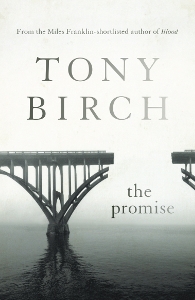
‘The Promise’ by Tony Birch

birch_promise

2014, 219 p.

I was prompted to read this book as part of Lisa’s Indigenous Literature Week at ANZLitLovers.  I’ve read several books by Tony Birch previously, one a novel Blood and the other, Shadowboxing a series of linked short stories. I think of him as a local, who can often be spotted around Melbourne and occasionally I’ve seen him down at our local shopping centre, oddly enough.  While his works are fictional, you sense that the author’s own lifestory hovers nearby. Birch’s indigenous heritage seems to be treated as just one aspect of his character, as it is in amongst the narrators in this series of short stories too. Class, education and a wounded masculinity are just as much markers of identity in his characters as their indigeneity,  where if it features at all, it is mentioned almost in passing. It’s not that it’s downplayed or ignored, but it’s interwoven through his characters’ other experiences and world-views.  (There’s an excellent reflection on Birch and his aboriginality in Eve Vincent’s review of ‘The Promise’ in SRB)

All of these twelve short stories are told in the first person, and although it is not the same character, it is pretty much the same voice. Several of the stories involve young boys, left pretty much to their own devices in the scrubby, abandoned frontiers of an urban landscape in the absence of parents: under freeways, along river banks, playing in the shadows of Housing Commission high-rise buildings  and in deserted bowling alleys. Where the narrator is a grown man, he is often standing on the edge of a loss of a relationship, scorched by grief and toeing the line of defeat or deciding to ‘move on’. His characters are not generally written about in literature. They are workers whose jobs are a means to an end, rather than their own enterprise or a profession. Some of them dance on the edge of criminality, alcoholism and addiction and  families are often absent or fractured.

My favourite amongst the stories is ‘The Money Shot’, about a trio of thieves about to do a ‘job’ only to find that one of their group has to literally mind the baby.  There’s a humour in this story that is not found in the others. In another story, ‘The Lovers’, a waiter in a restaurant speculates about a couple who come in every week.

Birch is good at capturing a moment, a dilemma, a decision and co-opting your sympathy as a reader, almost against your better judgement. However, in several of these stories I found myself turning the page, only to find that the story had ended. I don’t need a resolution, or for everything to be tied up neatly, but the incompleteness of some of these stories frustrated me.  This was more true of the early stories in the collection, and I don’t know if the later stories became more rounded, or whether I’d become accustomed to having the narrative yanked away so abruptly.  So, I think of these stories more as shards, sharp-edged and needing to be handled carefully (just as their main characters are), rather than rounded wholes in themselves.  I just can’t help thinking, though, that some of them are a ‘promise’ left unfulfilled.

My rating: 6.5

Sourced from : Yarra Plenty Regional Library

Movie: Viceroy’s House

Some may find it hard to believe, but I’ve never watched Downton Abbey, and so my credulity was not stretched in seeing Hugh Bonneville play Lord Mountbatten in this film. I would have scoffed at Gillian Anderson’s cut-glass accent too, until I remembered the sound of Queen Elizabeth’s piping and flutey voice when she first took the throne.

This is a very pro-Mountbatten film, which portrays him as the unwilling pawn of dastardly Colonial Office operators. The story of the partition of India is big enough in itself that it didn’t need the Romeo-and-Juliet story amongst the two younger characters superimposed onto it.  Still, if you stick around for the credits at the end of the film, it’s perhaps not as far-fetched as I thought.

Good, but the book Midnight’s Children was better!

My rating: 3.5 stars

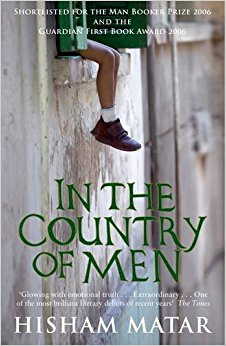
‘In the Country of Men’ by Hisham Matar

matar

2006, 245 p.

When reading this book I found myself thinking of Ian McEwan’s Atonement or L.P. Hartley’s The Go-Between.  An odd connection to make, in many ways, with their golden summers and racketty affluence.  Late 1970s Libya does not at all have the benign somnolence of Edwardian England: instead, it is edgy, tense and brutal.  However, what Matar’s book does share with these other two is the child’s-eye view  that misconstrues events and wreaks an unwitting destruction.

The narrator is nine-year-old Suleiman, the only child of his ‘Baba’ (father) Faraj el Dewani and ‘Mama’ Najwa. His father is emotionally distant and caught up in political activities, and Suleiman prefers his father’s friend Moosa, who although a fellow-activist, has a more demonstrative and affectionate relationship with the young boy.  His mother Majwa is an alcoholic (no small thing in a country where alcohol is banned).

Suleiman is an observer, not understanding the political ramifications of what he is seeing. Sulieman exists in a world of  “quiet panic, as if at any moment the rug could be pulled from beneath my feet”. In the mess that Libya has become since Gaddafi’s overthrow, it’s easy to forget the menace of his regime.

It was good to read about a country and politics that is unfamiliar to me, even though the tropes of innocence, bravery and courage are universal.  The book was shortlisted for the Booker Prize, and I enjoyed it. It was my selection for my bookgroup, and I was a little apprehensive about how it would be received, but ‘the ladies’ liked it too.  (Unfortunately I left this blogpost half-written, and I’ve forgotten the detail about the book. Sorry!)

Rating: 8.5

Read because: It was a CAE bookgroup.

Some Rare Book Week exhibitions

Melbourne has hosted Rare Book Week between 30 June and 9 July 2017 (an extended week, it seems). As is my usual practice, I missed most of it. It was a beautiful sunny winter’s day on Friday so we popped into the city to see two of the free exhibitions associated with Rare Book Week. Both exhibitions continue beyond 9th July for a few weeks.

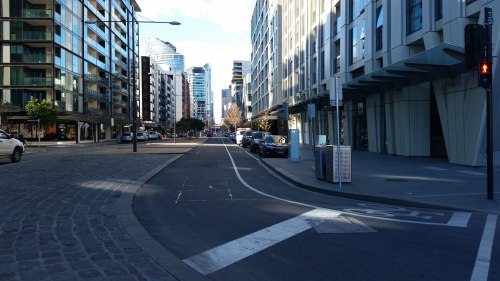
First, down to Docklands library to see By a lady: the world of Jane Austen. Docklands is a strange, strange place. It is an urban renewal project built on the site of the old Victoria Dock which itself was built on the drained West Melbourne swamp. The Docklands Authority was constituted in 1991 and several attempts were made to get development off the ground.  Although a number of large companies have moved there, it’s generally regarded as a bit of a dud and a template for what not to do in urban renewal.  I’ve only been once or twice, each time on a cloudy, cold, windy winter’s day.  So how would it shape up on a beautiful winter’s day?

20170707_142018a

Well, here we are just after lunch on a Friday afternoon, on the corner of Bourke and Collins Street.  Melburnians will howl “But how can it be on the corner of Bourke and Collins when they run parallel??” but apparently they meet in Docklands.  The city proper was heaving with people- but not a single pedestrian here.

The Docklands library opened in 2014. It’s a beautiful building but with barely a person in it. There was a conference of some sort being conducted in the community room, but other than that, it was very very quiet.

The exhibition itself combined multimedia with displays of different versions of Austen’s works. Of course, the books themselves are precious and so you can only gaze at the beautifully-crafted covers, especially of those of the early 20th century, with their Arts Nouveau influences. The multimedia renderings displayed various pages and their illustrations, which helped you get inside the books more, although one or two of the displays moved through the images too quickly to really appreciate the text and illustrations. It also highlighted for me the Austen family ‘industry’ that has coalesced around the books, with publications of her letters, unpublished works and spin-offs arranged by various Austen relatives.  The exhibition is open Monday to Friday 10.00 – 5.00 until 23 July 2017.

Then back to the real world with people in it, and up to the University of Melbourne.  The exhibition Plotting the Island is on at the Noel Shaw Gallery, Level 1 of Baillieu Library and it closes on 16 July 2017.  Drawing on books, maps and artifacts from the University of Melbourne’s rich archives and collections, it explores the idea of the ‘island’ in both an imaginative and geographical sense. Although there is a focus on Australia, as might be expected from an Australian university, the exhibition also deals with mythology, literature, geography, mapmaking, collecting and anthropology. There was a fascinating film ‘Too Many Captain Cooks’, made in 1988 which combined indigenous artwork with story-telling of the ‘first’, loved,  Captain Cook before all these other Captain Cooks came and took the land.  It’s well worth catching before it closes.

The warmth was draining from the sun as we headed back towards the tram, passing the new Arts West building. We were too close to it to be able to make any sense of the patterning on the outside of the building.  You can see it better in this rather grand video. Fair enough. It’s a stunning building.


This Month in Port Phillip 1842: June 1842 Part 2

You might remember that during May there had been the trial of the Plenty Valley Bushrangers and having been found guilty, three of the four remaining bushrangers were sentenced to hang (one was killed during capture). Even though Judge Willis urged immediate execution as a lesson to all would-be bushrangers, this was a highly improper suggestion as the Governor in Sydney had to give his approval first. So much of June 1842 was spent waiting to hear from Sydney whether the prerogative of mercy would be exercised, and if not, when the execution would take place.

It has been fifty years since there has been an execution in Australia, the last being Ronald Ryan‘s hanging on 3 February 1967. However, Australians had a taste of the detailed reporting and in my view, the sheer bloody-mindedness of state execution with the executions of Andrew Chan and Myuran Sukumaran in Indonesia in 2015. Although 173 years separate the executions, many of the narrative tropes about execution – particularly those related to penitence and religious conversion –  were just as present in 2015 as they were in Port Phillip in 1842.

In June 1842, although the excitement of the trial had abated, there were ongoing short reports about the condemned men in jail.  On 20th May the Port Phillip Herald reported that the condemned criminals were visited daily by three different clergymen, the Anglican minister Rev Thomson,  Rev James Forbes the Presbyterian minister, and Rev. Stephens, the Catholic priest. The paper reported that the culprits had not, as yet, shown the slightest sign of repentance. In fact, one was annoyed at his spiritual instructor questioning him about the number of robberies he had committed. They were confined together in a room about 10 feet square, the same as occupied by the “black murderers”recently executed in January. They were heavily ironed, with a constable in the room day and night and a guard at the door.

On 24th May, the Herald reported:

Since our last notice of these unfortunate men, we are happy to learn from the Rev.  Mr Forbes, who is unceasing in his visits at their cell, that they are shewing a marked improvement in their conduct, and attend now with much interest to their religious exercises. [PPH 24/5/42 p 3]

By June 7, they were reported as being “all truly penitent”. They sent for Mr Fowler, who had been shot through the cheek and ear during the capture of the bushrangers. They “fell on their knees and begged his forgiveness. Mr Fowler of course forgave them” [PPH 7/6/42]. Eventually the overland mail brought the news that the men were to be hanged on 28th June.

On the day of execution, the men were woken before day break by Rev Forbes, and Rev Wilkinson, the Wesleyan minister who was now included in the clerical contingent. The sacrament was administered to Jepps and Ellis by the Rev Mr Thomson. Just before 8.00 a.m. they were taken into the yard and their irons were struck off.  Jepps and Ellis undertook this with fortitude, but Fogarty wept bitterly for friends left behind rather than for despair of death.  The open cart drew up to the door, bearing the three cedar coffins. The men, who were “decently clothed” did not wear the white gowns worn by the indigenous prisoners Tunnerminnerwait and Maulboyheener who had preceded them to the gallows four months earlier. They did, however, wear white caps.  At 8.00 a.m. the order was given to ‘mark’ and the procession headed off with the military at the front and the mounted police at the rear.  Reverends Thomson, Forbes and Wilkinson walked arm-in-arm in front of the soldiers, while Rev Mr Stephens was on horseback.  The route was a mile in length, and unlike with the aboriginal prisoners who travelled in a covered wagon, the men were visible to all on the back of the cart, sitting on their own coffins, during the half-hour trip.  At the top of Lonsdale Street, the prisoners were ordered to look over their right shoulders to see “the fatal spot where their career of life was to be closed”.  Jepps and Ellis knelt on the ground with the “three reverend gentlemen” and prayed, while Fogarty was engaged with the Catholic priest at a short distance. [PPH 1/7/42]

The Rev. Mr Forbes appeared more painfully distressed than the poor victims of misdirected talents themselves; he had been led to take a great interest in the fate of Ellis, and had been unceasing in his endeavour to bring him to that sincere state of repentance which is the mainstay of the Christian creed [PPG 29/6/42].

One of the tropes of execution scenes is the ‘last dying speech’ ritual, conducted at the base of the scaffold.  In this heavily orchestrated performance, the speech was always a moment of  unpredictability because neither the clergy nor the authorities could control what the condemned prisoner was about to say.  But they need have had no fears about Jepps.

About nine o’clock, the prisoners having concluded the prayers, Jepps, taking a final adieu of his spiritual advisers, turned to the assemblage, and in a short but emphatic appeal to young men, exhorted them to take warning by his untimely end, of the fearful consequences of bad company, and the wretched end that awaits all who like him, deviate from the path of rectitude. He expressed himself resigned to his fate, and died in the belief of the Lord Jesus Christ. [PPG 29/6/42]

The Catholic Priest administered the sacrament to Fogarty on the drop, after which “he seemed more composed” while the Episcopalian minister read aloud the service for the dead. At the appointed signal the executioner pulled away the platform and the men were “ushered into eternity”. The Gazette reported that the men died in less than a minute, the scaffold having been “under the Sheriff’s directions, been constructed so as to avoid any of the extremely painful incidents which marked the last execution in the province.” [PPG 29/6/42] . However, the Patriot reported that Fogarty  suffered about three minutes after the drop fell,  in consequence of the knot of the rope shifting. [PPP 30/6/42]. According to the Patriot,

a company of the native police under the command of Messrs. Dana and Le Soeuf arrived from the station on the Merri Creek shortly after the drop fell. The men looked clean and well, and appeared to observe the awful sight before them with terror and dismay [PPP 30/6/42]

Reports of the numbers in the crowd varied between 1000 and 2000. The Patriot reported that very few women were present, while the Herald was shocked that so many females were present, although they were of the “rank of servant”. The Herald also complained that the men remained on the scaffold until the burial service had been concluded so that the crowd could see “the recumbent position of Ellis, the convulsive start of Jepps and the open and closing of the hand of Fogarty.”[PPH 1/7/42]

And so, the second batch of executions in 1842 were completed.  It was not to be long until the next execution was to occur, the last in Port Phillip for several years.

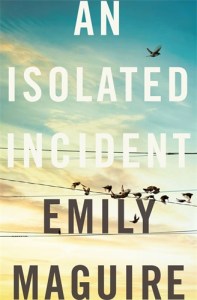
‘An Isolated Incident’ by Emily Maguire

maguire

2016, 243 p

The reviewing cycle for a much-talked-about book seems to move so quickly that, after a few months, everything seems to have been already said and people are moving onto the next new much-talked-about book. So I come- at last-  to ‘An Isolated Incident’, which was shortlisted for the Stella Prize, longlisted for the Miles Franklin and commended for the Victorian Premier’s Literary Award for Fiction.

It all makes me feel rather outgunned when I say that my response is rather lukewarm.

You probably already know that it’s about a murder of a young woman, Bella Michaels, an aged-care worker in the small country town of Strathdee.  Despite being described by the publishers as a ‘psychological thriller’, this book doesn’t really fill that description at all. Instead, it is the description of grief and the surrounding media manipulation of a murder report.  We, as readers, know as much or as little about the murder as the police do.

It is narrated from the alternating viewpoints of the murdered girl’s sister Chris, a barmaid at the local pub in Strathdee, and May, the journalist dispatched from the city to report on the crime.  The book is arranged chronologically, starting with daily entries on the 6th April, then becoming less frequent as media interest in the case wanes. Chris’s sections are written in the first person, using a conversational tone and capturing the cadences of a fairly rough, indifferently educated country woman. May’s narrative is written in the third person, interspersed with the trashy interviews and articles that she has written over this time.

For much of it,  I felt as if I were reading an article at the supermarket checkout or watching Sixty Minutes. I know that this was probably intentional on the part of the author, drawing readers into the voyeurism of crime-watching and armchair speculation.  This is just one of the things that the book does well. It also captures well the lazy, casual misogyny of everyday life, magnified further in a small town, and the juxtaposition of an active, consensual  female sexuality alongside non-consensual sexual creepiness.  Sexuality was used to manipulate by both men and women in this book.  She also puts her finger on – although does not explore further – the connections between offences that are portrayed as only “isolated incidents”

This had nothing to do with what happened to Bella and what happened to Bella had nothing to do with Tegan Miller [another woman murdered in Strathdee] and none of it had to do with the rich Sydney housewife left out to rot in the street which had nothing to do with the Nigerian girls stolen as sex slaves or the Indian woman eviscerated on a bus or the man grabbing women off the streets of Brunswick.

None of it connected, she knew, and yet, and yet, it felt like it. It felt to May, that there was a thread connecting it all, and if she could find it she could follow it back, see where it began. Rip it out and examine its source. p.343

“Rip it out and examine its source”: a noble aim, but not one achieved in this book.  Sometimes I feel as if I’ve read a book that has been consciously written for a book-group discussion or to air “an issue”.  I couldn’t quite shake this feeling when reading this book.  Don’t get me wrong- I am a member of a bookgroup myself, and know that I would happily participate in the discussions that this book is likely to generate for the next couple of years.  However, I don’t like feeling that I’ve been targeted as a market.

There’s the enjoyment that a reader has during reading, as distinct from the discussion and contemplation afterwards. I found that the book dragged and it was really only in the last 1/3 that I found myself becoming more engaged.  Until then, I was underwhelmed by the vacuity of both women, and irked by the supernatural angle that was introduced halfway through. Just as the case ambled along, with little progress, so too did this book.   Perhaps this is one of those books where its strength lies after reading it, rather than while reading it.

Sourced from: Yarra Plenty Regional Library

My rating: 7/10

aww2017-badge

I’ve added this to the Australian Women Writers Challenge 2017.

Colonial Frontier Massacres in Eastern Australia 1788-1872

The University of Newcastle has a fantastic new site showing colonial massacres on the frontier in Eastern Australia. You can access it at

https://c21ch.newcastle.edu.au/colonialmassacres/

The map shows the approximate location of massacres of both indigenous people and settlers in the eastern states. As the creators explain in the introduction, their criteria for a massacre is six people.  Why six? To lose six people (or 20%) from a  ‘hearth’ group of twenty people renders that group vulnerable to further attack and diminishes their ability to hunt for food, reproduce and carry out their ceremonial obligations. The data is drawn from a range of sources including newspapers, parliamentary reports, the memoirs and correspondence of settlers, missionaries and Protectors, and oral and visual Aboriginal accounts.  The reliability of the source is rated with a star system.

The site makes quite clear that it is a work in progress, and subject to change through ongoing research.  Fascinating, and sobering.