Category Archives: Uncategorized

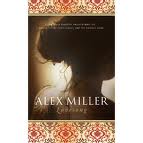
‘Lovesong’ by Alex Miller

2009, 354 p

There are spoilers here, so if you haven’t read the book you might not want to read this yet…

So what IS a lovesong, after all?  It’s a performance, a creation with words and music, written sometimes for a particular person, or sometimes as a fantasy on the experience of being in love.  Alex Miller’s book is called “Lovesong” and I think it falls into this final category.  It could just as easily have been called “Love Story” – although I think that someone already has used THAT title! – because it’s a love story in its own right, but it’s also a story about love stories.  We all have our own story about love, but we can’t all turn them into lovesongs.

The frame story has an aging writer, not unlike Miller himself, who has returned to Carlton in Melbourne after an extended stay in Venice.  Like Miller, whose last book “Landscape of Farewell” was well received, the author Ken’s last book was called “Farewell” and he expected that it would be his final book too.  But he finds himself at a loose end, and the writer in him begins observing the owners of the pastry shop that has opened up in his small Carlton strip shopping centre.  The wife is Tunisian and exotic, the husband Australian.  He watches and gradually strikes up an acquaintance, then friendship, with the husband who tells him his story.

The story of  Sahiba and John is the love song of the book.  They met in Paris where she lived and worked in her aunt’s restaurant and after the aunt’s death they worked there together.  Like all love stories, it was complicated by other desires- for home, for a child- promises and secrets.

I read this book along with others in an online reading group, and several of us had a similar response at much the same place in Sahiba and John’s story – “hold on- how does he know all this?”  I’m still not sure whether this is a failing or sheer artistry on Miller’s part.  Instead of the love story, which is tender and sad and real, you become aware of the telling of the story itself.

While Ken is drawing out and shaping John’s story, there’s his own domestic life in Carlton with his daughter who turned up after her marriage broke down five years ago, and has just continued living with him.  She has recently started a relationship with a stand-up comedian who embodies the footy-loving, commercialized parochialism of suburban Melbourne.  Where the love story of Sahiba and John is burnished and somehow sacred, his daughter’s relationship seems banal and shallow.

And so John tells his story, Ken says,

so he could understand it himself and move it on. I had no active part in it.  I was not his prompt. It was his confession and he didn’t need to be told what to say by me. (p. 208)

But Ken was listening, writing up his notes after they met, having “my own secret life of his story.”

I am aware that with my notes I am, in my own customary way, making something other of John and Sabiha’s story than they know.  Shaping it, if you like, to my own imagination.  I don’t know how not to do this. (p.209)

But he’s not the only one writing up notes: John is writing his story too, and is almost pathetically grateful to Ken for being “the perfect listener”.  There’s an imbalance in the power relationship of storyteller and writer that I find rather disconcerting and chilling. There’s also a sterility and elitism in it too.  John and Sahiba continue to live their lovesong, while Ken, unconvinced that John will ever write his own version, moves to the next story:

Sabiha’s story had come out of her and been carried to me; now after I had lived in it jealously myself for a while, I would carry it to others, and in the end would let it go and be done with it, like all the other stories I have carried. (p. 354)

I’m always pleasantly surprised by Miller’s books.  I come to them with an expectation that they’re going to be difficult- probably because in interviews he comes over as a fearsome intelligence himself- and each time he cuts through my trepidation with simple, clean prose that captures a setting or a feeling with a ‘click’, like a lens.   Miller makes many  references to Aschenbach in ‘Death in Venice’, and certainly Ken is an aging,  world-weary narrator. I feel as if he’s offering this book to us, as a lovesong to love itself.

Uplifting Quotes for the Uninspired Historian #2

From my pin-up biographer, Richard Holmes in his book Footsteps: Adventures of a Romantic Biographer. He speaks about the biographer’s feeling of being haunted by their subject as being part of  the essential process of writing biography:

As far as I can tell, this process has two main elements, or closely entwined strands. The first is the gathering of factual materials, the assembling in chronological order of a man’s “journey” through the world- the actions, the words, the recorded thoughts, the places and faces through which he moved: the “life and letters”.  The second is the creation of a fictional or imaginary relationship between the biographer and his subject; not merely a “point of view” or an “interpretation”, but a continuous living dialogue between the two as they move over the same historical ground, the same trail of events.  There is between them a ceaseless discussion, a reviewing and questioning of motives and actions and consequences, a steady if subliminal exchange of attitudes, judgments and conclusions.  It is fictional, imaginary, because of course the subject cannot really, literally, talk back; but the biographer must come to act and think of his subject as if he can. (p.66)


‘The Squatting Age in Australia 1835-1847’

1935 first edition; 1964 second edition. 358 p.

…a book dealing with the thirties and far more important than its unpretentious exterior would indicate (p.273)

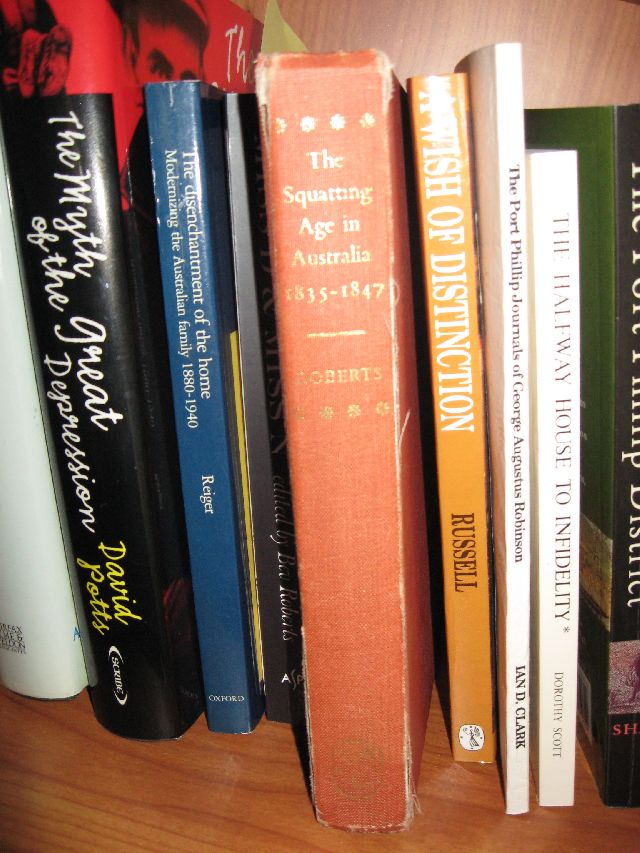
This is Stephen H. Roberts talking about another book entirely, but the same could be said of his own book “The Squatting Age in Australia 1835-1847”.  That’s it up above on the bookshelves- the rather drab burnt-sienna coloured one. It’s been around for decades and decades; it is cited in many other works, but oh- even the title induces in me a rather shrivelling distaste.  I was astounded to find a recent blogpost about the book written in November 2009 by another reader and smiled at the thought of possibly travelling on the same train and our eyes meeting (across the top of our bi-focals, I suspect) over our respective copies of ” The Squatting Age in Australia” (Nah, not likely, as he seems to be based in Armidale, NSW).  Still, a whimsical little thought.

I have to say that I was surprised by what I found inside.  Perhaps the most striking thing is the language: not at all the dry-as-stubble,  stiff and factual voice that I expected but instead a rather “purple” narrative voice written often tongue-in-cheek (or at least, I think it is) and more exclamation-marks than a Facebook page!!! Yes!!! Really!!!

Stephen Henry Roberts– that’s Sir Stephen was  Vice Chancellor of the University of Sydney and Challis Professor of History there.  His Australian Dictionary of Biography entry describes him as “empirical, research oriented, with a concern for international trends and an ability to place Australia in a wider colonial context“.   The empiricism in his work certainly comes through: there’s very detailed maps, budgets and statistics peppered throughout the book.  His first publication was  History of Australian Land Settlement 1788-1920, based on his masters thesis, and after moving to London, he moved to more international studies with publications on French colonial policy, modern British and European history and Far Eastern history before returning to Australian history with The Squatting Age written in 1935. In this book he brings his international approach to bear most powerfully in Chapter 2 ‘The Wool Trade’ which I found to be a fascinating account of how Australian wool production fed into the broader European wool industry that burgeoned and changed after the Napoleonic Wars. He also has a good analysis of the 1840s Depression in New South Wales and its context within the broader international economy.

Born of working-class origins, Roberts did not restrict his intellectual efforts to academe alone.  As a leading interational analyst, he gave public lectures, wrote for the Sydney Morning Herald and broadcast for the ABC.  In 1936 he travelled again to England on study leave, spending three months in Germany where he met with Nazi leaders and attended their rallies.  His next book The House that Hitler Built (1937) exposed the dangers of appeasement, warned of the war intentions of the Nazi regime and condemned the persecution of the Jews.  The book was translated into a dozen languages and reprinted many times.

According to the ADB, the “Sydney school” of historians that coalesced around Roberts was:

proudly a ‘hard school’, not merely because of its declared standards of data, but in its overt hostility to what it conceived as romantic or literary approaches to the past

This description surprised me.  In this book he presents a highly romantic and idealized view of the pastoral industry and the squatting project as a whole, albeit with a rather more grounded view of the boredom and dirt of the shepherd’s lot.  Like other books of its time it is interspersed with stanzas of poetry- a rather quaint stylistic touch to modern eyes.  He places strong emphasis on personality and it is here, in explaining motivations and character,  that perhaps his flights of fancy betray him.  I found the sweeping statements to support his grand rhetorical flourishes even more troubling. There appears to me to be a contradiction in his large claims: he makes much of the “quietude” in politics in the early 1840s and yet spends much time on the Great Crisis between 1841-44, and the “struggle” with Sir George Gipps.  Crisis and quietude seem to be mutually exclusive, to me.

His work has been criticized for textual errors and sloppy proof-reading and these were still evident, even in the second edition which, according to his preface had undertaken “obvious correction of misprints” and “elimination of errors”.   In a chapter in The Discovery of Australian History, edited by Stuart Macintyre and Julian Thomas, Deryck Schreuder (the author of the ADB entry) writes:

[Roberts] wrote voluminously, but also hastily.  At one stage he produced four studies (in five large volumes) in the six years between 1923 and 1928, all based in archival sources, and all covering areas where he had to pioneer a research path.  Not surprisingly, the works show signs of haste: some incorrect footnotes, faulty transcriptions, errors of fact, gaps in the documentary sources, assessments which have not always stood the test of time….Roberts never wilfully manipulated his sources to make an argument, and he did work extraordinarily hard to cover all the primary and secondary sources involved, often indeed finding the major archival source for the first time. …Whether his innovative studies, and the power of some of his studies, outweighs these defects is another matter for consideration: he is not always given the benefit of that balancing perspective. (p. 131)

The book is very much of its time, and it is too easy to deride it for its easy dismissal of aboriginal resistance and environmental heedlessness.  His use of the bland terms “dispersal” and “expansion” obscures a whole other history that took another fifty years to emerge.   That doesn’t make it any less confronting, as Geoff Page’s poem “A Classic Text”, published in Arena Magazine in April-May 1993,  remarks.  I can’t think of a way to quote the poem without producing it in its entirety- and that surely would be a breach of copyright-  so you can see it for yourself at The Great Forgetting: poems . (The link will take you to Google Books- the poem is on p.61-5.)

And yet there is a sense of humour that comes through the book- and that truly IS surprising given the worthy and rather stodgy subject manner.  I’ll leave you with a little observation he makes about the dominance of pastoral demands on Gipps’ administration-, complete with Roberts’ own exclamation mark,  and remember HE said it, not I!!

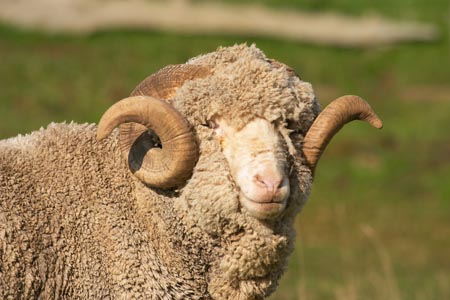
It was all the song of the sheep- money for the sheep, land for the sheep, labour for the sheep, roads for the sheep, merchants for the sheep, ships for the sheep one long ruminant refrain! (p.96)

References:

S. H. Roberts The Squatting Age in Australia 1835-1847

Deryck Schreuder ‘An Unconventional Founder: Stephen Roberts and the Professionalisation of the Historical Discipline’ in Stuart Macintyre & Julian Thomas (eds.) The Discovery of Australian History (1995)

Deryck Schreuder ‘Roberts, Sir Stephen Henry’ http://adbonline.anu.edu.au/biogs/A160125b.htm

Geoff Page and Pooaraar ‘A Classic Text’  in The Great Forgetting (1995) p. 61


The Resident Judge reckons 2/10/09

…that a “fully automated table game” in a casino is a poker machine.  It’s a poker machine if it’s in Bayswater or Box Hill or Melton, but somehow or other if it’s at Crown Casino, then it’s ta-da!! a “table game”. How convenient, seeing that Crown Casino has a limit of 2500 poker machines.  Let’s just read that again. Two thousand, five hundred poker machines.

The Resident Judge Reckons 1/10/09

Well- not reckons, but does wonder.

gony

The pre-sentence hearings are currently underway for the men accused of the bashing murder of Liep Gony.  The case is being reported in considerable detail in the newspapers.  Surely these two men could then turn around and claim that they could not get a fair trial in Melbourne.  Why are pre-sentence hearings reported anyway?

‘Talking Books: Novel History’

I found a terrific site called ‘Backdoor Broadcasting Company’, which contains a number of free podcasts from seminars, many of which seem to have been held in London.

The ‘Talking Books: Novel History’ seminar was held at Birkbeck Institute for the Humanities at the University College, London on 6th June 2009 and what a delight to hear something so current! What wonderful times we live in – I could barely be back here in Melbourne writing this now if I’d actually attended it!  The seminar was introduced by the historian Joanna Bourke who started with a quote from Sir Leslie Stephen that historical novels were either pure cram or pure fiction.  The question is, however, how can historical novelists and the historical profession more generally attempt to remain true to the core, brittle narratives and images emanating from a complex and perplexing past?  She introduced Hilary Mantel and Sarah Dunant, both of whom have recent historical fiction releases.  Hilary Mantel writes about real characters: Sarah Dunant’s characters are composites, but both approaches rely on archival research to flesh out their characters.  The best historical novelists, Bourke said,  like Mantel and Dunant can teach historians that there can be a different kind of fidelity to individuals in history, one that acknowledges the power of motives over the power of institutions, and the role of contingency as well as causality.

Hilary Mantel’s academic background is in law, not history.  Her historical fiction draws on authentic characters- her most recent book Wolf Hall centres on Thomas Cromwell; her Place of Greater Safety (which was released in  1992  but written much earlier) presents different revolutionary characters as a collage throughout the French Revolution:  Camille Desmoulins, Danton and Robespierre.  She dislikes, but grudgingly accepts the term ‘historical fiction’ because it raises expectations that its practitioners will have something in common.  She sees her writing more as contemporary thinking about past events; she writes about real people who happen to be dead.  Historical fiction, she says, is a way of re-creating what has slipped from the historical record and of seeing justice done by giving a voice to the voiceless, and representing the mis-represented.  Her work emphasizes the role of chance and contingency, where historians are more often wedded to causal links.  What she writes of could be true: she excludes impossibilities and refuses to rearrange history to suit the dramatic process.

Sarah Dunant, on the other hand, was trained as an historian at Oxford University some 30 years ago, where she was discouraged from making up what we didn’t know.  She was taught the grand narrative of big events, prior to the changes of historiography beginning with Christopher Hill that raised questions about women, the poor, the other.  This more recent historiography gives rise to the potential for a new sort of historical novel.  Her characters did not actually exist: they are composites, based on deep secondary research which has delved deeply into the primary sources.  As an historian, it is the fidelity of this research that gives her confidence to develop her characters, using her sources as a pointillist painter might in representing a larger painting.

The two historical novelists were followed by John Sutherland, the Lord Northcliffe Professor Emeritus at UCL, author of a number of works on fiction, the fiction industry and best-sellers.  In contrast to the earlier speakers, he questioned whether fiction could recover the past, and claimed that fiction dies if you overload it with too much material (something I tend to agree with).  Good historical fiction, he says, defines our relationship with the past- it tells us about where we are.

I’ve been grappling with the perils and pleasures of historical fiction for some time- some of the posts on this blog reflect this :  the 21st sensibility and unwise (and modified)  claims to better understanding debated with Kate Grenville’s The Secret River; the right to traduce a reputation of a true-life individual while disavowing a work as ‘historical’ in Richard Flanagan’s Wanting; the ‘flim-flam’ of biography in Louis Nowra’s Ice;  the hedgehogs and foxes suggested to Isaiah Berlin by Tolstoy’s War and Peace; the deceptive selectivity of Nicholas Baker’s Human Smoke;  the distinction between ‘voice’ and ‘ventriloquism’ in Rose Tremain’s Restoration.    I keep reading historical fiction because I enjoy it, but every time I’m drawn back to the questions of technique that keep arising and that I never can quite answer.

Reclaiming Anzac

I had hoped that the fetishisation of Anzac was a symptom of the Howard years, and that perhaps with a change of government, it might recede.   I think I’m about to be disappointed though: if anything it seemed just as fervent this year.

I’d been disconcerted by Rudd’s evocation of “The Anzac Spirit” at the bushfire memorial service– a characterization that was largely rejected by firefighters themselves, who under procedures revised after Ash Wednesday and the later fires in the Dandenongs,  deliberately withdraw from situations where lives are endangered- a luxury not extended to soldiers in battle.

ANZAC Day’s co-option by the AFL as a marketing opportunity is even worse. I was repulsed by the visits that AFL football teams made to the Shrine this week to soak up the ANZAC spirit to embolden them for the Anzac Day Round of football this weekend, and the pre-match images of war shown to players to gee them up for the game.  Mick Malthouse’s petulant response to Collingwood’s loss says it all:

I don’t think we played anywhere near (well enough) to capture the spirit of the Anzacs, and I think this is what makes this one of the most disappointing games I have ever been associated with…Unfortunately, I reckon we let the Anzacs down.  The whole game, not just (the final few minutes), the whole game, and Essendon showed true Anzac spirit, why we play here.

Some how, I don’t think the Anzacs themselves will be too fussed about the loss of a football game.  I’m sure that the diggers who played for Essendon before dying in war won’t feel too let down at all.  The whole solemn intoning of the sentimental nationalist pap before the ” invented tradition” of the fifteenth Collingwood/Essendon match (yep, that’s some tradition),  the marketing of the “Badge of Honour” football magazine,  and the crass slippage between “heroism in the trenches”  and “heroism in taking a mark” is manipulative and demeaning.

Thursday’s Age carried an edited version of a longer paper that Marilyn Lake delivered at Melbourne University’s free public lecture program hosted by the School of Historical studies. In this paper she challenges the funding of an ANZAC creation story provided  so generously by the Department of Veterans Affairs since 1996 that elides the controversy over involvement both during and after the war, that excludes on the basis of gender and race, and which silences other claims to Australian identity.

The comments posted to the Age website are revealing. Jack Jones, for instance, writes:

Typical academic perspective pandering to the lefty minority groups whilst ignoring the majority view and belittling past sacrifices made so she could actaualy be in a position to enjoy the opportunity to write such diatribe. Suggest you revisit your history lessons (if you had any) and go on a site visit to Gallipoli and see what it means first hand. Then come back and write an apology.

David Farmer writes:

Trust a left wing ‘academic’ to loose site of emotional reality! I’ve been to Galipoli and the sense of pride and spiritual emotion was enormous. It made me proud of our fallen hereo’s regardless of the success or idealogy that came with fighting for mother England. Time for a true blue Aussie reality check Marilyn Lake!

Yes,  Marilyn, it seems that you do have to go to Turkey to know what it means to be Australian, and learn some ‘real’ history while you’re at it, girlie.

In an otherwise worthy speech, the Governor-General has elevated our response to the ANZAC story even further beyond the call of national identity to that of  the spiritual:

We have a sacred trust to remain accountable to its legacy.

I’m not quite sure by whose authority it became “sacred”.

And all the shiny-eyed school children, brought to the Shrine breathlessly parrot that “the diggers at Gallipoli died for our freedom”.  Ah- freedom!- is that the same “Fridom” that G. W. Bush held aloft for us?  King, Country, Empire, British Liberty, Mum, my sisters, “the boys”, my house, our way of life– all these for sure, but “freedom” then didn’t necessarily mean the same as “fridom” now.

Although, having said that and to contradict myself completely – I was interested to see if “freedom” rhetoric was common during WWI. I went to the “Despatches from Gallipoli” section of the NLA site, and conducted a word search for “Freedom”  and found only a reference to press freedom in reporting the war, which seemed rather ironic.  But a word search of newspapers on the NLA website turned up this hither-to unpublished poem, written by a Mr Gilbert Crawford, a reader on the night staff of the Daily Mercury Office,  Mackay Qld- safely on home soil, but eager to encourage men to hear Freedom’s call.

I hear a voice a’calling and its note is one of pain

Don’t you hear that voice a’calling out to you?

Tis the voice of nations ravished, Freedom crushed and honor slain

Can’t you hear that voice a’calling out anew?

Chorus:

Don’t you hear that voice a’calling, calling clear as tocsin peal?

It is echoing throughout the whole world wide.

T’is the voice of Freedom calling from beneath the tyrant’s heel

The sons of Freedom calling to her side.

I hear a voice responding from the heart of sunny France

Don’t you hear her answer sent to Freedom’s call?

And the tenor of her message makes men’s pulses throb and dance

Have you no response to make to it at all?

Chorus: Don’t you hear that voice? etc…

I hear a voice responding and it sounds now loud, now low

Don’t you hear it in the shrieking Arctic wind?

T’is the Russian National Anthem, rolling o’er the fields of snow

And the might of Russia’s millions rolls behind.

Chorus: Don’t you hear that voice? etc…

I hear a voice responding by the Meditterean shore

Don’t you hear the sons of Italy reply

And ’tis swelling ever louder o’er the din and battle’s roar

As Freedom’s hymn goes mounting to the sky

Chorus: Don’t you hear that voice? etc…

I hear a voice responding from across the Atlantic waves

Don’t you hear them  as they come to play their part?

‘Tis the warsong sounding lustily of Canada’s proud braves

Don’t their warsong wake an echo in your heart?

Chorus: Don’t you hear that voice? etc…

I hear a voice come swelling o’er the burning desert sand

Do you hear the sons of Africa respond?

And a pealing echo answers it from India’s coral strand

Don’t these voices make your recreant heard despond?

Chorus: Don’t you hear that voice? etc…

Where the Southern Cross is beaming comes another voice that swells

Don’t you hear the answer of your own Home clime?

‘Tis the slogan of the Anzacs welling down the Dardenelles

And their war song echoes down the tide of Time.

Chorus: Don’t you hear that voice? etc…

And another voice comes pealing through the starry night

Don’t you hear the eager Banzai of Japan?

‘Tis the men of Nippon marshalling to battle for the right

Can’t these voices stir your soul to play the man?

Chorus: Don’t you hear that voice? etc…

Won’t you hear those voices calling, they are calling close and clear

Won’t you also take your place beside the brave?

To Freedom’s earnest pleading do you still turn a deaf ear?

Will you bear the coward’s brand into your grave?

Chorus: Don’t you hear that voice? etc…

I hear a voice that rises now supreme above them all

Don’t you hear it through the battle’s awful roar?

‘Tis the voice of Victory swelling up to Heaven’s highest hall

As the Tyrant’s ramparts fall, to rise no more.

Last chorus: Don’t you hear that voice a’calling, calling clear as tocsin bell

It is echoing through the whole world wide

‘Tis the voice of Freedom calling, and the notes of triumph swell

From the sons of Freedom rallied to her side.

NORTHERN TERRITORY TIMES AND GAZETTE 27 JULY 1916

No doubt, this is all part of the conscription debate of the time, and Freedom is depicted as a feminized  figure calling to the Allies at a national level,  even ‘the sons of Africa’ and those ‘from India’s coral strand’.   What ever it is, it’s not the personal freedom our “me-me-me” culture tells us we are entitled to.

I have been to the dawn service at the Shrine, and found it a sobering and yes, emotional experience.  In April 2003, I went with my teenaged children to a local ANZAC ceremony on the Gold Coast, where we were holidaying at the time.  With a heightened sense of being a nation contemplating war, I wanted to show my respect for older men and women who had responded- for whatever reason- to their country’s call for action.  I wanted to acknowledge the waste, the pity, the tragedy of war.  And so, it was with mounting anger that I sat as the gathering was harangued by the local RSL president about the commie hippies who were protesting Australia’s involvement in the war to find Saddam’s weapons of mass destruction that were going to destroy freedom for us all.  In the end, I stood up and left.

And I think that, for a while, I want to stand up and leave for Anzac Day generally as it is being manufactured and marketed at the moment.  I have not forgotten: I do respect.


Birthday girl

img0811

Happy birthday to me….

‘The Secret Scripture’ by Sebastian Barry

2008, 300p.

I really don’t like my chances of reading the Booker Prize shortlist before it is announced on 14 October, especially as this is the only one I have read!  I always try to read the Miles Franklin shortlist of Australian literature, and usually finish the night before it is announced! But the Booker is usually beyond me.

But I was excited about reading The Secret Scripture when I realised that it was written by Sebastian Barry. I read A Long, Long Way last year, and along with The Book Thief, these are the two books that have had me audibly sobbing whilst reading.

As with A Long, Long Way, this book is set in Ireland and takes for its main characters people, events and perspectives that are often overlooked.  Indeed, the main character of The Secret Scripture, Roseanne McNulty- or is it Roseanne Clear?- has certainly been overlooked.  She has been incarcerated in an asylum for about sixty years, and it is only at the age of 100, as the asylum is being deinstitutionalized, that questions are again raised about why exactly she came to be placed there, and by whom.   The story is told in alternating voices- Roseanne’s own testimony surreptitiously written on scrap paper and hidden under a floorboard, and that of Dr Grene, her recently-bereaved psychiatrist who has to decide on the appropriate placement for her when the asylum is closed.

Roseanne has truly been a victim of Ireland’s ‘big’ history in her own little life: all the distrust and hatred of religion and politics comes right into her most intimate and precious relationships.  She is a passive victim- perhaps to stop resisting is the ultimate defeat. Tragic things have happened to her,  often not of her own making, and yet there is a simplicity that shines through her. Or is there?  The major theme of this book is history- its evasions, its slipperiness and its unreliability.  And Dr Grene himself, who at first seems to be the anchoring ‘truth’ in the narrative becomes increasingly suspect as a narrator.  You find yourself wondering if either of these narratives- Roseanne’s and Dr Grene’s – can be trusted.

Barry has written about these characters, and their situations before.  Eneas McNulty had already appeared in his The Whereabouts of Eneas McNulty and was an officer in Thomas Dunne’s policeforce.  Dunne was a main character in Barry’s play The Steward of Christendom, and his son Willie appeared in A Long Long Way, and Willie’s sister appears in Annie Dunne.  So while each book is self contained as a narrative, there are allusions and resonances in Barry’s other work as well.  Of course, Barry is not the only author to construct an interconnected web of characters like this- Tim Winton does it too- and there’s a frisson of recognition when you make the connection.

In this case, Barry takes his characters from his own family tree.  He’s not the only writer to do that either-  Kate Grenville seems to be devoting herself to it  (her new book The Lieutenant pairs up with her earlier The Secret River) , and Peter Behrens (whose Law of Dreams I reviewed earlier)  also based his story on an ancestor.  On one level I can understand the attraction of recovering and making your own family members come alive again through your writing.  I guess that it’s a form of self-reflection, wondering whether certain characteristics have come through to you.  And there’s also the element of identification and indebtedness: that I am who I am because of them.  But all this seems very “me” oriented.  I think about the ‘celebrities’ on the increasing formulaic Who Do You Think You Are? wide-eyed with  wonder at their forebears’ lot and determined to squeeze every possible supposition out of the flimsiest of evidence- and culminating, always always always with trembling chins and tears at the injustice and hardness of other people’s lives. Ah, but they are OUR other people’s lives- hence our empathy and imagination wells up for them, when it has laid dormant for any other of the millions of other people who trod the same paths.

Not just characters- Barry also revisits his earlier work in his narrative voice too. The scene that affected me so much in A Long, Long Way was where the young boy stood up and sang Ave Maria- I don’t have the book here, but it was beautifully written with a sob of pain in each sentence.  Beautiful, beautiful writing.  And then, in The Secret Scripture, I found another lamentation which evoked the keening of his earlier work as well:

…that he hanged himself.  Oh, oh, oh, oh, oh oh, oh, oh, oh.  Do you know the grief of it? I hope not.  The grief that does not age, that does not go away with time, like most griefs and human matters.  That is the grief that is always there, swinging a little in a derelict house…..

But I have a little lamentation of my own- the ending.  Barry has unsettled us throughout the book over issues of truth and secrecy, and yet has tied up all the ends neatly and plonked it on our laps as a finished product.

So I have mixed feelings about the book.  The writing was beautiful; Roseanne was a haunting, tragic character; it is a very sad, sad book.  The ambiguity of truth, invention and forgetting keeps you wary and watchful as a reader.  But oh- the ending- (oh, oh, oh, oh, oh, oh, oh….).

For Better or For Worse? Probably worse….

Oh no! I can’t believe it! For Better and For Worse, the daily cartoon strip that I have been following for all my adult life has finished!!! I’ve had my children with this cartoon strip!! Like Elly, I despair at the changes that are happening to my body without my permission!! I hated Deanna’s mother Myra with a vengeance!! What a good wife Iris has been to Grandpa Jim, somehow leaving space for them both to honour their now-deceased first spouses!! I was so pleased for Michael getting his book published, and so distressed when their house burnt down!! Dang it, I cried when the dog died rescuing baby April from the rushing stream!!

Much as enjoy a good wedding, though, Elizabeth and Anthony’s wedding day was dragging on a bit.  I had it all worked out- Elizabeth and Anthony were going to rush from the wedding service to Grandpa Jim’s hospital bedside when they heard about his heart attack (I was right, they did); he was going to wake from his semi-coma and see her in Grandma Marion’s wedding dress ( I was right, he did that too), then he was going to cark it right then and there (he didn’t).

But finished?? Is April going to settle down and become a vet after all?  Will Deanna and Michael have another baby for their country?  Will Elizabeth have a baby with Anthony?  How will she get on with her step-daughter?  When will Grandpa Jim finally cark it then?

Wait!  hold on…. there’s a follow up page that finishes off all the stories. Lynne Johnston, the creator is going back to the beginning and starting again.  Oh no.  Bad idea. I can see a shark circling.  Somehow the thought of having it warmed over and served up again is less appetizing… time to let go, I think.