Category Archives: Uncategorized

Soft and fuzzies at the MCG.

Two years ago, I posted about the negative nagging admonitions that you are bombarded with at the MCG.  Last Friday I went off to the MCG again with the same son to see the same game (St Kilda v. Richmond) – although unfortunately with a less desirable outcome this time.   It’s a sad, sad thing when you crave a draw.

My chagrin was soothed somewhat by noting that the killjoys and straiteners responsible for the announcements on the score board have gone all soft and fuzzy on us.  Now instead of being harangued with the fines imposed for drinking outside the ground, we’re exhorted to enjoy a drink at the MCG, but just don’t take it outside. Instead of being drawn and quartered for running on the ground, we’re encouraged to be a part of the game, but just not on the turf.    It didn’t change the score, but it did make me feel as if I didn’t have to cringe from yet another telling-off.

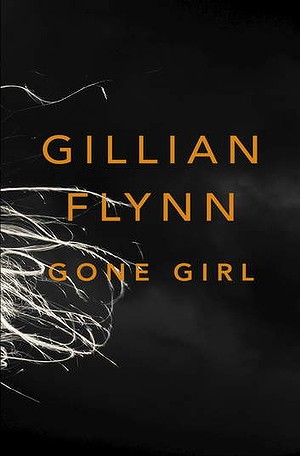
‘Gone Girl’ by Gillian Flynn

gonegirl

2012, 395 p.

I always keep a bit of an eye on the Book Scan results of bookshop sales that appears in the Saturday paper.  I’ve noticed Gone Girl bobbing around on the Independent list and –lo and behold!- last week it made it to No.1   However, I haven’t seen anyone reading it, or heard of anyone else who’s read it.  But obviously lots of people have read it, because after reading a glowing review of it in August last year, I put a hold on it at my local library.  Number 63 I was, on ten copies.  Finally, it was my turn.

And I can tell you nothing about it.  Except, perhaps, that it involves a disappearance, and that it is written in alternating chapters, all tethered chronologically back to the day of the disappearance.  Beyond that, I’ll give too much away and I don’t want to do that.  The book just teetered on the edge of implausibility, but didn’t fall over, and each time I started “Hey, but what about….” the author had anticipated my objections.  While not high literature, and probably 1/3 too long, I found it a real page-turner- and hey, we can all enjoy one of those every now and then.

If you can’t stand waiting as No 63 in line, don’t worry- apparently it’s already been optioned as a movie with Reese Witherspoon as one of the lead actors, and it’s absolutely tailor-made for Hollywood.  I’m not quite sure how they’re going to do it- lots of voiceovers, perhaps and  done well, it should be a winner.

My rating: a rather guilty 9/10. Dammit, I could barely put the thing down.

Sourced from: The long waiting list at Yarra Plenty Regional Library

Read because: It has been on the best seller list for ages.

My best reads for 2012

The end of year is the time for lists, no?  Well, here’s my list of my best  10 reads for 2012.  I only give a rating for fiction books generally, although one or two non-fictions crept in here because they were read as an escape from the thesis.

There was only one book to which I awarded a ’10’

1. ‘Good Evening Mrs Craven’ by Mollie Panter-Downes

The other nine received a score of ‘9’.  Three of these were from my CAE bookgroup- none chosen by me- which is a good reason for continuing to participate, quite apart from the friendships there.

2. ‘Drinking Coffee Elsewhere’ by Z. Z. Packer (Yes- a collection of short stories made it onto the ‘best’ list! CAE)

3. ‘Otherland’ by Maria Tumarkin

4. ‘Mateship with Birds’ by Carrie Tiffany

5. ‘Bright and Distant Shores’ by Dominic Smith

6. ‘London War Notes 1939-1945’ by Mollie Panter-Downes  (non-fiction)

7. ‘How To Live’ (A life of Montaigne)’ by Sarah Bakewell  (non-fiction)

8. ‘All That I Am’ by Anna Funder

9. ‘When Will There Be Good News’ by Kate Atkinson (CAE)

10. ‘Water Under the Bridge’ by Sumner Locke Eliot. (CAE)

Happy Christmas Resident Judge

And how did John Walpole Willis spend Christmas in Georgetown, Demerara in 1833?

Xmas Day. JWW (John Walpole Willis) and JW (Jane Willis) at Church in ye Morn’g very fine day.  Mr and Mrs Price, Messrs Harvey & Cowan called.  JWW and JW rode in ye even’g called at Mr Albany’s gave the servants their dinner Roast Beef & Plum pudding.

Happy Christmas all.

Judge Willis’ Sydney

Most of my attention has been directed toward Judge Willis’ time in Melbourne, where he was appointed as the first resident judge of the Supreme Court of New South Wales for the Port Phillip district.  But he was in Sydney for much longer than he was in Melbourne- from November 1837 to March 1841- compared with his stay of two years and three months in Melbourne.

In Sydney, he was one of three judges who formed the Supreme Court bench, and so he was not as prominent as he was in Melbourne, where he was the only Supreme Court judge.  In fact, I’ve found it hard to form a clear view of him in Sydney: he doesn’t seem to have socialized much with any of the people whose writings I’ve been able to access from Sydney at the time.  From my point of view, he seems to become much more defined once he was given virtually free rein (and reign!) in Melbourne.

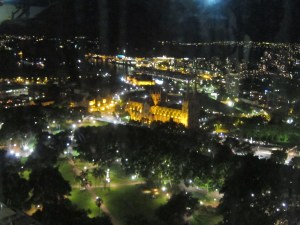
But he WAS there in Sydney and so, tramping the streets of Sydney this last week, I tried to see it through Willis’ eyes.

His Court

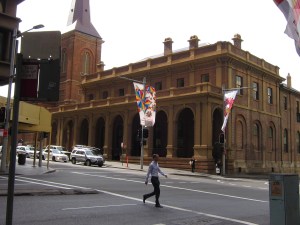
Supreme Court Sydney

Stairwell in the rotunda, Supreme Court Sydney

Stairwell in the rotunda, Supreme Court Sydney

By the time Willis arrived in Sydney in 1837, the court had abandoned its temporary premises and moved permanently into the Supreme Court buildings in King Street.  Although the appearance of the courts has been altered by later additions, inside under the rotunda it is largely unchanged.  The courts were designed by Francis Greenway, the “convict architect” who was responsible for the design of several buildings during Macquarie’s time.

His Church – maybe.

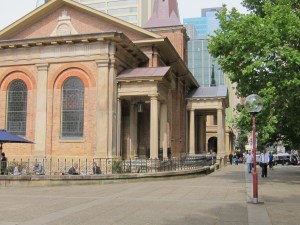
St James' Church, Sydney

St James’ Church, Sydney

Next to the court house is St James’ Church.  Actually, the building that houses the church today was originally intended to be the law courts with a larger cathedral built elsewhere, but after Commissioner Bigge criticized Macquarie’s extravagant expenditure, the planned law courts were turned into St James’ instead, and the law courts were built next door in what had been a schoolhouse (and they are still there- as you saw, further up the page!)

I don’t actually know that Willis attended this church- he may have attended St Philips instead- but I strongly suspect that he did as he aligned himself publicly with Bishop William Broughton who frequently officiated at St James.  (By the way, feeling rather downcast at some recent sad news, I attended the choral evensong there on Wednesday evening.  The choir was absolutely beautiful.) I know from his time in Upper Canada and Melbourne, and back home in England that Willis attended Anglican Churches regularly, often morning and evening on Sundays.

His library

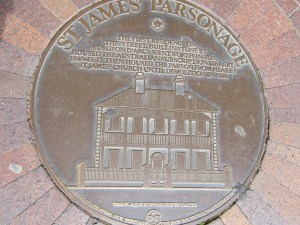
Then there’s the Australian Subscription Library. Unfortunately it survives as only a plaque in the footpath.

IMG_0126

ST JAMES’ PARSONAGE. The first residence on this street, built in stone by Surgeon D’Arcy Wentworth in 1820, housed the Australian Subscription Library 1840-3.  It then housed the parson from nearby St James’ Church until demolition in 1888.

I know that Willis belonged to this library because in early 1841 there was a brouhaha concerning a confidential cabinet document that had somehow found its way into the collection.  Heads needed to roll (figuratively) and they did: the Assistant Colonial Secretary Harrington lost his job over it.

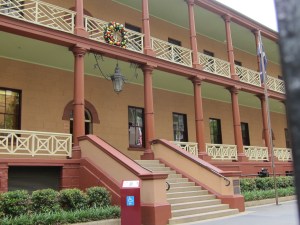
The Parliament- maybe???

State Parliament, Sydney

State Parliament, Sydney

While Willis was in Sydney, there was only one body that gave advice to the Governor, the Legislative Council.  It was appointed by the governor, and by 1829 had been enlarged to between ten and fifteen members.  It met in the ground floor rooms of what were at that time the Chief Surgeon’s rooms in the Sydney hospital.  Like the church and the court buildings, the hospital was also designed by Francis Greenway, and funded by an early form of public/private partnership, based on the monopoly of spirits imports- hence the name ‘Rum Hospital’ that has been attached to the building ever since.  I have no evidence that he ever attended Parliament,  but it was open to the public from 1838 onwards.

Government House- certainly

Model of the original Government House, Museum of Sydney

Model of the original Government House, Museum of Sydney

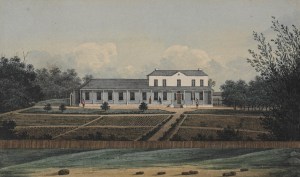
As puisne Judge, Willis most certainly did attend levees and functions at Government House.  The building that is now Government House was commenced but not completed during his time in Sydney, so he would have attended  the old Government House. In 1809 it looked like this:

Government House Sydney 1809

Government House Sydney 1809

It fell into disrepair- in fact, it sounds a rather shoddy building from the outset, and was demolished in 1846.  There is a ghost of the original house in the stencilled outline in  the forecourt of the Museum of Sydney, where it originally stood.  If you go up to the corner, you can catch a glimpse of Circular Quay down below, and imagine the early Port Jackson shoreline.

So….

Actually, despite the heavy building activity in Sydney over recent decades, and a cavalier attitude towards heritage buildings during the 1960s (thank you Jack Mundey!) there’s more to find of Willis in Sydney than there is in Melbourne.

The ANZLHS conference at Sydney

I’ve been up in Sydney for the last couple of days for the Australian and New Zealand Law and History Society conference.  You’ll note that the name of the organization  is ‘Law and History Society’ and not ‘Legal History Society’.  It’s an important distinction: it’s not just lawyers exploring historical cases but historians wading into legal waters as well. The conference reflects this dual focus, as I now realize even more clearly after attending the British Legal History conference last year which is far more lawyer-oriented.

IMG_0105

It probably reflects my membership within the historian camp, but the presentations that have remained most clearly with me are those involving people rather than principles.  So, just off the top of my head: terrific papers on the wardens watching Jimmy Governor before his execution; taking Nat Turner’s profession of faith seriously, a South Sea Islander petitioning for a lease on an island in the middle of a river in Northern Queensland,  and the fascinating case of Eugenia Falleni (the topic of a recent book).

But good papers on historical legal issues as well: vagrancy legislation in NZ and Australia during the 19th century; 18th trials of slave traders in Sierra Leone, and 19th century factory legislation that dared not speak its name in limiting the employment of women and children.

Some sessions I attended just for fun, like the “Literary Traces” panel, which ranged across Rousseau, Dickens, and the concept of “the reasonable man”.  Then there were the issues which spilled out of historical straitjackets into current issues: the historical trajectory of international human rights, the concept of marital rape immunity, and immigration law.

Did I give a paper? Yes I did, based on a case that arose out of the abolition of slavery in 1834 in British Guiana featuring Judge Willis (of course).  I’m not quite sure what I’ll do with it yet.

Lots to think about and I learned much.  Well worth going.

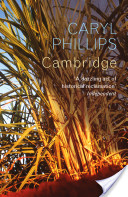
‘Cambridge’ by Caryl Phillips

cambridge

1991, 184 p.

A funny thing happened while I was reading this book.  I’m in the habit of reading in bed before I go to sleep, but I never read ‘work’ (i.e. thesis) books that I think I might need to really concentrate on.  Novels, yes; diaries, yes; arcane books from Google books yes.  Occasionally I find something in these books that I might jot down, but it’s all pretty low key.

So here I was, reading Cambridge by Caryl Phillips.  I’d heard about it on one of the lists that I subscribe to,  in response to a question regarding novels set on Caribbean sugar plantations. It is, indeed, set in the West Indies.  Now, I’ve read quite a few books about the West Indies by now for my thesis,  including travel books to the West Indies as in Mrs Carmichael’s jolly tracts review here and here, and diaries.  The first section of Cambridge is told from the perspective  of a young Englishwoman sent out to check on her father’s plantation before returning home to marry an older man her father had chosen for her.  So utterly convinced was I by the narrative voice  that I picked up a pen ready to make a note until I thought- hold on: it’s fiction.

The first section, told in the first person by Emily Cartwright is written as a journal-type narrative (although not divided by dates or other chronological markers) and in the immediate past tense.  When Emily arrives at an unnamed West Indian island, at an unspecified time (somewhere between 1807 and 1834) she finds that the manager, Mr Wilson, has disappeared and been replaced by Mr Brown.   Mr Brown is a surly, uncouth man but Emily falls in love with him gradually, and all of a sudden he is no longer ‘Mr Brown’ but Arnold.  Emily is troubled by Mr Brown’s black mistress, a woman called Christiane, whom all the other slaves fear to be an obeah (witch) woman.  Cambridge, a large well-built negro worker, is set to keep watch over her at night.  The first part of the book is by far the longest – 122 of the book’s 184 p.  It is told at a leisurely pace- hence, I think, my being lulled into thinking of it as an authentic diary, and it shares the one-dimension perspective of the diary genre.

The second section is told by Cambridge- a slave whose travels have taken him on his own Atlantic triangle- Africa, England, West Indies.  He is a man of many identities and many names- Cambridge,  David Henderson, Olumide. His voice is the formal, stilted witness of the evangelical convert, and he retells many of the same events as Emily does, but brings another truth to them.

In an interview with the New York Times, Caryl Phillips said:

To begin a book I must first find characters who allow me access to their lives and who trust me to tell their stories….I began by reading period novels. That wasn’t enough, so I turned to diaries and collections of letters. I found that a considerable number of personal narratives existed, written by English travelers to the Caribbean. All of that helped me to understand the language of the period, the attitudes that it shaped and reflected and the subtlety of statement common to the period.

I think that it was this capturing of nuance so authentically  that I responded to: so much so that I was disappointed by a third short narrative, in the form of a newspaper story, that somehow missed the mark.  It starts as a report such as you might find in the ‘criminal’ section of a colonial newspaper, but it then segues into the florid prose of a story-telling also common to the colonial press of the time,  complete with improving verses and sunrises and sunsets.  But in reality, you’d find these two separate sorts of writing in different parts of the newspaper as two completely different articles.   For something that had felt so authentic up to this point, this was disappointing.

This is the third  Caryl Phillips book I have read: I reviewed his Crossing the River  and Dancing in the Dark some time back.  Both Crossing the River  and Cambridge are similar with their multiple narrators, but I think that this book has a much better unity.  It is a pastiche, of course, but a very well researched one (and I know this because I’ve read the same primary sources!) that wears the research lightly.

I suspect from the rather dismissive reviews on Google that it has been assigned as school reading.  I acknowledge that the first part is very slow, and events unfurl as they do in life.  It’s a much more complex book than these disgruntled young readers realize. It also supports an academic response as well, all steeped in postcolonial theory (see here and here and here as well) .

My rating: 9/10

Read because: It was suggested on a list of fiction works addressing plantation life

Sourced from: The Annexe at La Trobe University.  Obviously not enough people borrowed it.  They should.

Nurse??!!

Ever since the Black Saturday fires some years back, 774ABC radio is the designated emergency ratio station for Melbourne.  As a result, if there’s fire, flood, funny smells- then 774ABC goes onto ’emergency’ footing with frequent warnings and advice interspersed with its normal programs (unless of course it’s a REAL emergency, at which time usual programming is suspended).

There was a fire at a recycling centre in suburban Melbourne this morning, and this triggered  774ABC emergency warnings right in the midst of “Making Christmas Gifts with Craft”- quite a surreal juxtaposition!  I was interested that at the end of the warning about toxic smoke, keeping your windows shut, turning off the airconditioner and staying inside etc, there was advice to call Nurse- On-Call if you had any concerns.

Nurse-on-Call is a telephone service that provides 24 hour a day advice from a registered nurse. I’ve never used it.  From what I have heard from people who have used it, they’re normally told to go to hospital.  This may reflect the demographic of my sample- i.e. old codgers primed for heart attacks, and perhaps it’s different when people ring with a baby or young child.  But I can’t help thinking that in these litigious times, it would be unwise to advise to “just wait and see”.

Perhaps in a situation like this though, when people are wanting reassurance as much as anything else, there might be a role for nurse-on-call as a way of deflecting unnecessary panic.  But it did make me wonder about the statistics on Nurse-on-Call: is my perception that they always advise ‘go to hospital’ valid? Has it saved hospital visits or increased them?  I did actually go to the Dept. of Health webpage where they had their annual report, but it would have taken 8 minutes to download and I thought…..nah.

On to The Conversation website and blow me down….there’s a report on telephone medical advice lines. In a Medical Journal of Australia article, researchers looked at the difference in  ‘appropriate referrals’ from GPs, a telephone medical advice line, and self-referral.  I’m a bit disconcerted by their definition of ‘appropriate referral’ which ranged from  admission to hospital, referral in an inpatient or outpatient clinic, transfer to another hospital, performance of radiological or laboratory investigations- or death in the Emergency Department. (I’m hearing echoes of Monty Python’s ‘I told you I was sick!”)  As might be expected, GPs scored the highest in ‘appropriate referrals’ but interestingly telephone-line and self-referrals were ranked much the same- in fact, the self-referrals scored slightly higher.

Moreover, the study found that people when do receive advice to seek medical advice in a non-Emergency Department (so there goes my theory),  50% of people ignored the advice and turned up anyway. The conclusion of the study? The MJA editorialized:

It is not clear that, if offered an informed choice, the community would choose to pay for telephone advice that makes little difference to their behaviour over other health service priorities. In relation to whether an ED visit is required, it appears that a phone call will not answer the question.

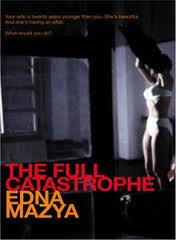
‘The Full Catastrophe’ by Edna Mazya

2005, 334 p.

It’s a commonplace but true that one of the best things about being in a bookgroup- apart from the friendships you make with fellow readers- is that you read books that you wouldn’t normally read.  Come to think of it, one of the worst things about being in a bookgroup is, too, that you read books you wouldn’t normally read-  and often for very good reason.

But in this case, I simply hadn’t heard of this book or the writer. Edna Mayza, apparently, is a well-known Israeli playwright. The narrator of the story is Ilan Ben Nathan, a 48-year-old astrophysicist who works at the Technion (university)  in Haifa.  His wife, Naomi is twenty years younger  and he is besotted, possessive and obsessive about this wife that he can scarcely believe he has landed.  So insecure is he that he becomes (quite rightly) convinced that she is having an affair and it dominates his every word and action with her.  You know that it’s not going to end well when he tracks down her lover, who is, perversely, an older man like he is, and he confronts him.  I shall say no more.  Think Woody Allen, think of suffocation and close-up, minute scrutiny and that’s Ilan: nerd on the outside, screaming heap of obsessions and fears on the inside.

It is striking that this book written by a playwright has such a distinctive, breathless present-tense narrative style where the dialogue is reported as part of very long, run-on sentences that extend sometimes even over pages.  It’s just as anxiety-provoking and suffocating as Ilan is, and it works brilliantly once you get used to it.  Here’s an example:

When I get home in the evening I find Naomi sitting at her desk…Her movements seem jumpy, I can’t get her to meet my eyes, she immediately offers to make me supper and I say that I’ve already eaten at the Technion.  She asks with a glassy look, what do you want to eat, I say again, more slowly, I’ve already eaten Naomi, and she asks, should I defrost a steak for you?  I stand there and wait for her to come back to me, and after moving restlessly to and fro she pulls herself together, faces me without looking at me, and asks, is anything wrong, and I repeat in the same tone, is anything wrong, and now she almost looks at me and asks in a different tone, is anything wrong, and I saw, nothing’s wrong, why should anything be wrong, I’m simply trying to explain to you that I’ve already eaten, and now that I’ve finally caught her attention she understands, and she kisses me lightly and says that in that case she’ll carry on working…

As I said, the writing does take a bit of getting used to, but it also draws you completely into Ilan’s world view.   I was interested to see that the book has been made recently into an Israeli film called Naomi . At first I wondered how such an interior form of narrative would translate onto the screen, but when I think about it, for the reader, Ilan’s narrative makes you an observer only- his consciousness does all the work for you. Often watching a film is a receptive act too, because you are not participating in the conversation yourself, but watching and listening to it from the outside.  So perhaps it’s not so strange that a playwright would create such a text after all.

I can’t remember having read any books set in present-day Israel.  There’s no writing for an international audience here at all: it is as local as a Helen Garner book is for Melburnians. I found myself curious about the position of Arabic people in Israel (are they the same as Palestinians?) and was rather surprised to find that Galilee was a desert spot with weekend rentals (wasn’t there a Sea of Galilee?)  There were lots of restaurants and apartments, and I never did quite make a mental picture of where Naomi’s lover lived- there is mention of a red plastic curtain and I summoned up a picture of a red curtain covering a makeshift shack in a slum against a cliff face, whereas my fellow-bookgroupers saw abandoned tenement buildings.  I guess I’ll just have to wait for the movie.

And I’ll make a point of hunting it down  too, because this is a terrific book: suffocatingly, insistently compelling and shot through with black humour.

My rating: 8.5/10  (maybe even a 9!)

Sourced from: Council of Adult Education

Read because: it was the November book for my bookgroup.

And as an aside, it’s called Love Burns in America. Can’t really see why the name change, I must admit.


Judge Willis and Mabo

Australia is celebrating this week the twentieth anniversary of the Mabo decision that rejected the doctrine of terra nullius and recognized native title. The ‘Mabo Case’ findings did not mention Judge Willis by name, but it would have been entirely appropriate to have done so because in many ways, he anticipated Mabo by 151 years in a case called R. v Bonjon.  However, for a number of different reasons, the Bonjon case remains a mere footnote in history.

In 2010 I gave a paper at the Australian and New Zealand Law and History Conference about the Bonjon case, and you can read it here.