Category Archives: Uncategorized

A day in Sydney

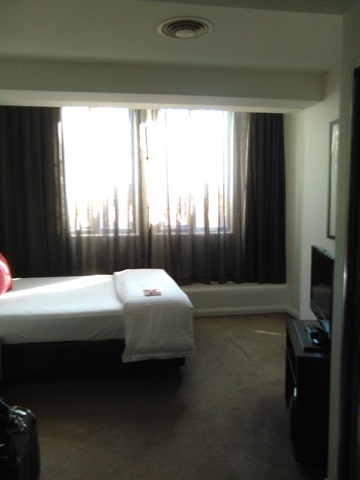
I’m up in Sydney for the rest of the week, attending the Australian Historical Society conference being held at the University of Sydney. A frugal little soul, I had booked the cheapest room in my 4.5 star hotel (indeed, it was cheaper than many more humble lodgings) and was expecting a cupboard-sized room but it’s fine.  I’m located close to Central railway station with a bus station at the doorstep and about a 20 minute walk from the uni.  The building was previously used as a post office, and prior to that was the site for the Sydney Benevolent Asylum.

IMG_20150706_123208

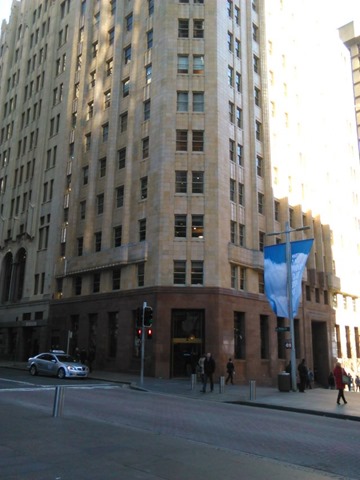
I was able to check in early, then headed off for the Art Galley of New South Wales.  I passed the Lindt cafe. Even though journalists emphasized how central the location was, and the proximity of the Channel Seven building, I hadn’t really registered it.

IMG_20150706_130034a

Of course, as a historian of colonial New South Wales, I made a little pilgrimage to the Domain and the early buildings that surround it, and paid my respects to the statues of Lachlan Macquarie, a man I admired back in 1973 when I did Australian history for my VCE and who, more than forty years later and approaching a Ph D, I still admire.

Then off to the Art Gallery.  You know, I don’t think that I’ve ever been to the Art Gallery here- I keep getting it mixed up with the State Library, which of course I have frequented on several occasions.

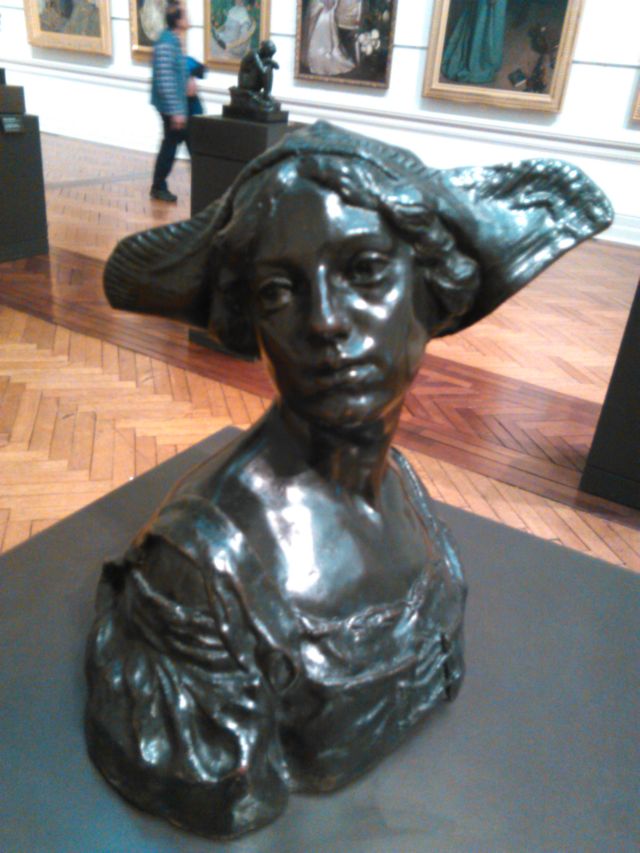
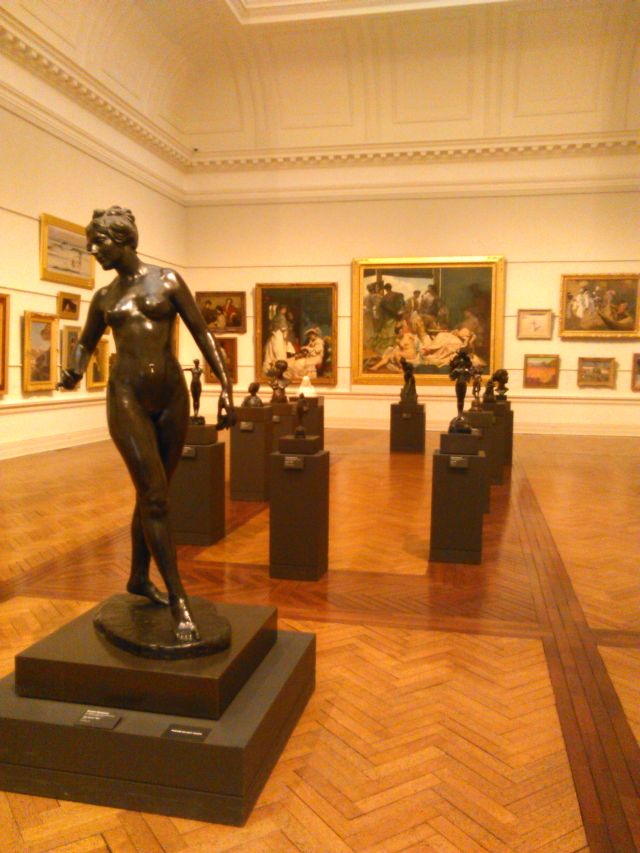
There’s usually a  statue created by Mr Resident Judge’s grandfather  in the major Australian galleries: the sculptor Charles Web Gilbert.  The Art Gallery of NSW  had a cluster of bronzes- a positive swarm of nine Mackennals, with just one Web Gilbert and an Eva Benson.

'The Dutch Cap' by Charles Web Gilbert. An unfortunate name for a sculpture, perhaps.

‘The Dutch Cap’ by Charles Web Gilbert. An unfortunate name for a sculpture, perhaps.

Plenty of Mackennals.

Plenty of Mackennals.

Quite a few of the pieces had resonances with books I’ve read.

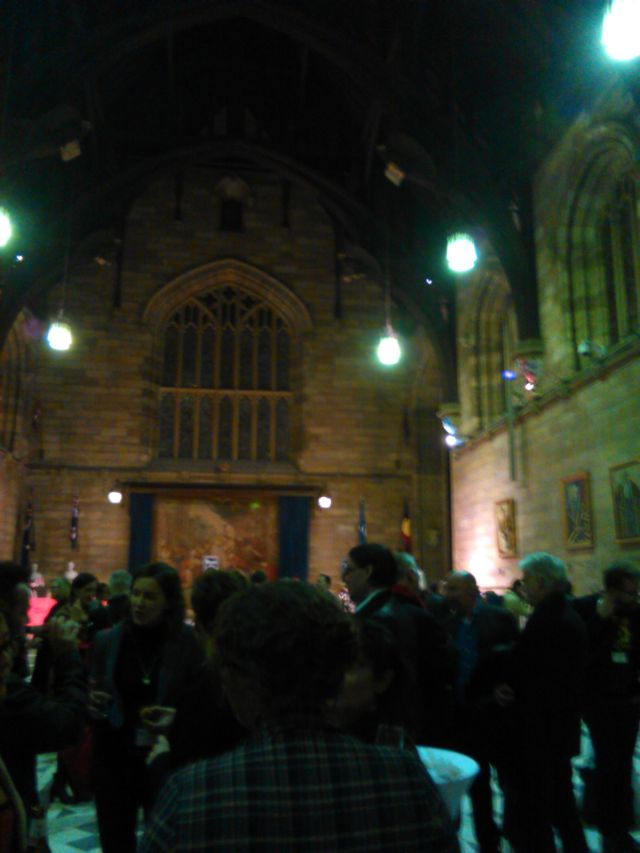
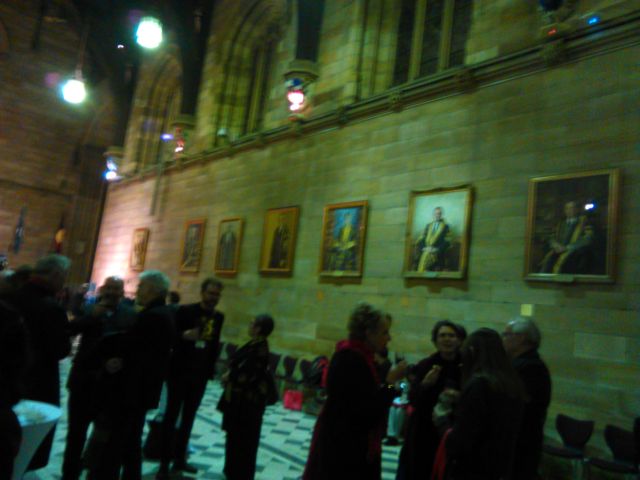
It was getting late- I need to find a bus to get to Sydney University. Thousands of buses, but where was the bus stop? I must admit that the whooshing, belching buses gave me a new appreciation for Melbourne trams. The opening reception was held at the Great Hall, a sandstone building resonant of pomp and tradition, with portraits of Great Male Chancellors (and as far as I could see, two Great Women Chancellors) on the walls.

IMG_20150706_183402a IMG_20150706_183408a

So let the conference begin!

A Medieval Modern Symposium

I’ve just spent a delightful two days at the National Gallery of Victoria at a symposium to support the current exhibition Medieval Moderns- the Pre-Raphaelite Brotherhood, which closes on 12 July 2015. If you haven’t seen the exhibition- do!

Alison Inglis from the University of Melbourne, the convenor of the symposium opened with ‘An Introduction to Pre-Raphaelitism in Australia’. She highlighted the depth and breadth of the NGV collection, which was bolstered initially by post-Gold Rush and Marvellous Melbourne prosperity, but continually enriched and supplemented by recent acquisitions. She emphasized the familial, commercial and institutional networks between artists and collectors in Australia and Britain.

These familial networks were demonstrated in Isobel Crombie’s presentation on the photographer Julia Margaret Cameron. She lived close by to Tennyson, whose work was so influential on the Pre-Raphaelites, and on occasion she consciously modelled her own photographs on the paintings of the period. Her use of blurring in her photographs was perceived as a means by which the emotional ‘essence’ of the subject was captured. Amanda Dunsmore followed with a presentation on William Morris and his influence on art and design, with a particular emphasis of ceramics- several of which have been deaccessioned from the NGV’s collection over the years. Shane Carmody, now at the University of Melbourne took a slightly different direction, speaking on Sydney Carlyle Cockerell , the London advisor to the Felton Bequest between 1936-9 who clashed with the Menzies govt appointee over his attempt to procure the Holy Grail Tapestries designed by Burne-Jones.

The second session focussed on Pre-Raphaelite artists in Australia. Although Thomas Woolner is best known for his work in England, he first came to attention when he emigrated to the Victorian gold-fields with Edward La Trobe Bateman and Bernhard Smith. Caroline Clemente’s paper emphasized the artistic networks that revolved around the Howitt family and their connections with the gold-rush elite. This was followed by two papers on Edward La Trobe Bateman, and particularly his work on Plenty Station, Yallambie. There’s an excellent blog written by the current owner of Yallambie homestead, which is sited on the original Plenty Station. Lucy Ellem’s paper looked particularly at Bateman’s treatment of the garden, and the evidence of acclimatization techniques revealed through these sketches

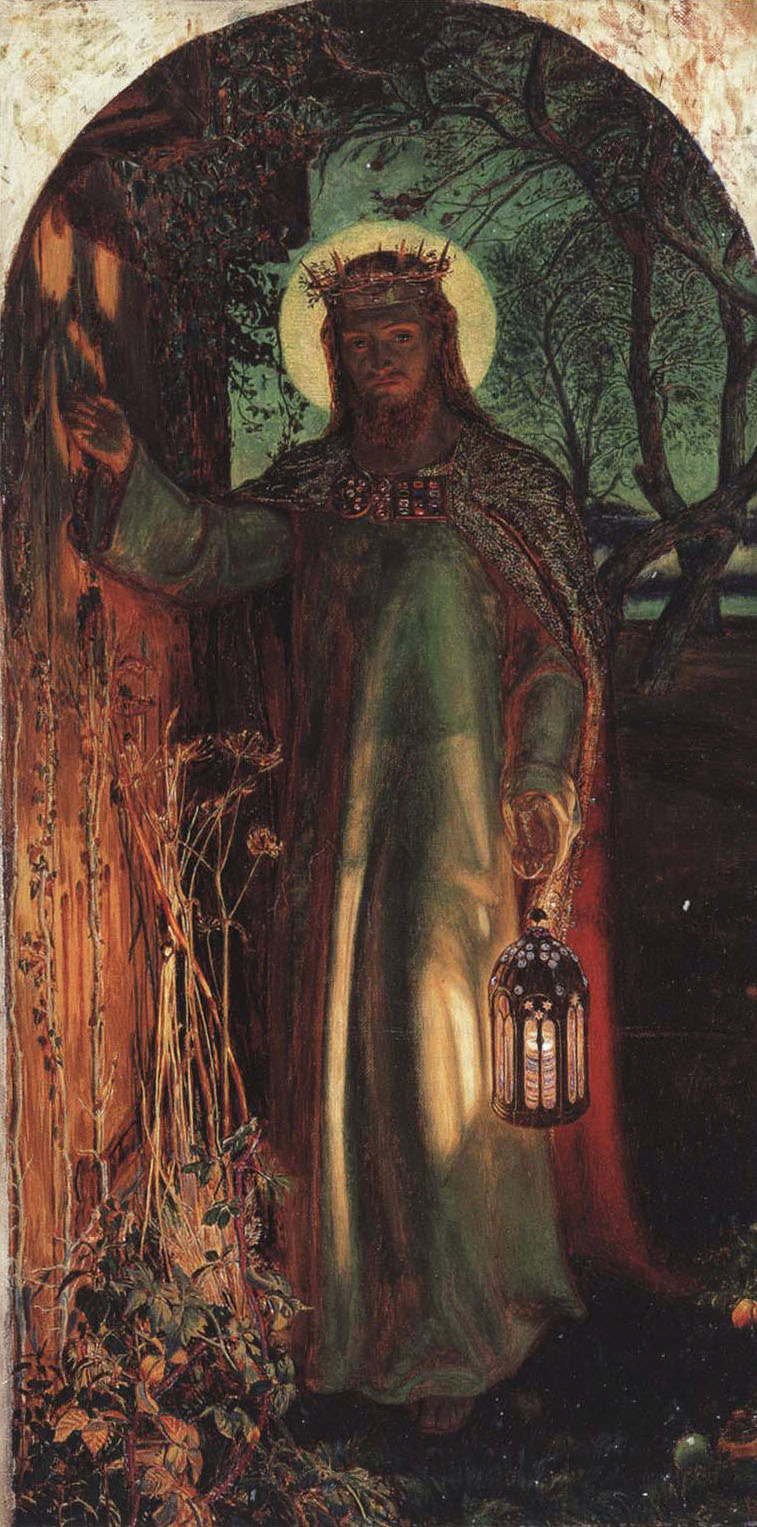
I really enjoyed Bronwyn Hughes’ paper on William Holman Hunt’s famous picture ‘The Light of the World’.

Hunt_Light_of_the_World

The painting was an imperial exhibition phenomenon, which spawned thousands of reproductions and, in Australia, two hundred stained glass representations. John Payne from the NGV directed our attention to the frames used by the Pre-Raphaelite Brotherhood which eschewed the fashion for attempting to replicate metal frames and instead used gilded wood, often in a very simple design.

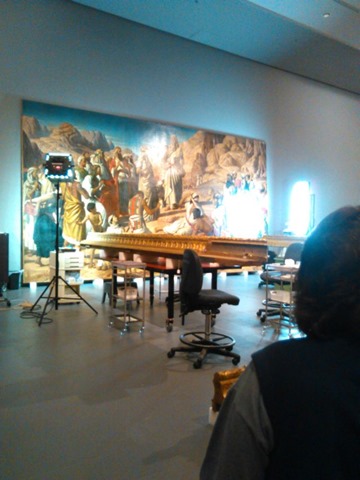
Day Two of the symposium required some rejigging, and commenced with an enthusiastic young scholar, Nancy Langham Hooper, who presented on John Rogers Herbert, the RA artist who specialized in biblical (and particularly Old Testament) works- a large example of which (Moses Bringing Down the Tables of the Law) is undergoing conservation treatment at the NGV currently. She made a convincing case for the links between Herbert and the Pre-Raphaelite Brotherhood, even though the connections are not at first apparent.

IMG_20150704_125507a

Conservation work currently being conducted in public view on the Moses painting, second floor NGV.

The rescheduled second session saw Juliet Peers speaking on Bernhard Smith, who travelled to Victoria with Woolner and Bateman, but is rarely associated with PRB influence in Australia. Unlike many of the other artists, Smith had to work for a living as a gold fields commissioner and judge and he took his sketchbook with him on his travels. Vivien Gaston followed with a presentation on William Dyce’s sketch of Prince Albert the Prince of Wales as a young child for his mother, Queen Victoria, and the detective work in tracking down the other sketches made as part of this series.

The session after lunch examined two paintings that are hung in the current exhibition: Princeps’ painting The Flight of Jane Shore, the royal mistress to Edward IV who was publicly shamed by Richard III, and Burne-Jones’ portrait of Baronne Madeleine Deslandes, a pensive and quiet portrait that in no way reflected this wild and flamboyant leader of a salon that attracted artists, poets, writers (including Oscar Wilde) and composers in Paris.

The final papers of the symposium examined Rupert Bunny , particularly his work on female saints which has been eclipsed by his Parisian-themed work, and Christian Waller. This final paper was again of particular interest to me, living as close as I do to Fairy Hills where the Wallers lived (in Dr Blake’s house from the television series no less!) and Grace Carroll’s paper focussed on the house as an expression of Pre-Raphaelite sensibilities that also came through in the artwork of both Christian and Napier Waller.

So, all in all a wonderful well-organized symposium, with excellent speakers and a wealth of information and insight. Even better, it was free: an act of generosity from both the NGV and University of Melbourne and the speakers themselves.

A day at Trades Hall

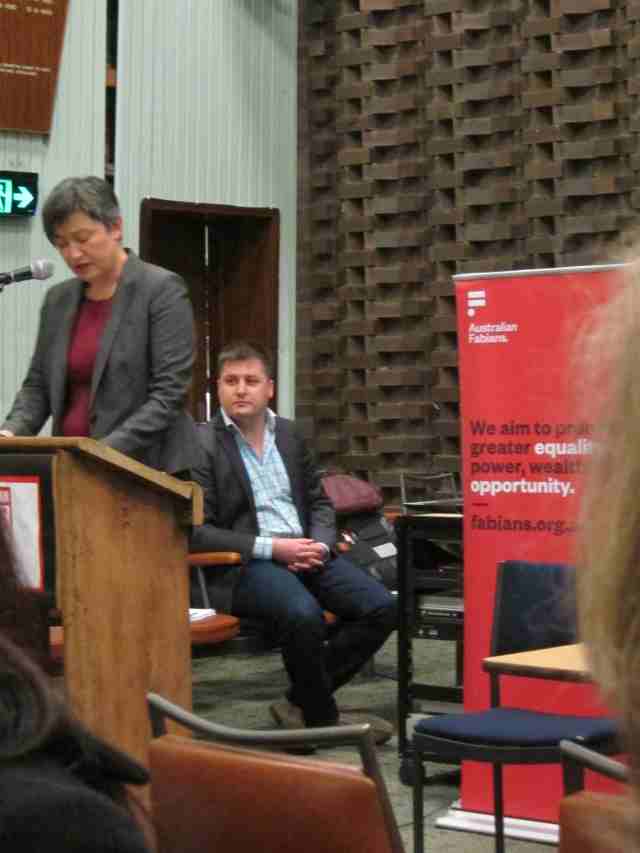
I’ve been at Trades Hall in Melbourne today, attending the Australian Fabians public forum “Progressive Reform Ideas for Labor’s 2015 National Conference”. There’s an article about Penny Wong’s opening address here (I’m not sure that I totally agree with her- I’m very, very wary of TPP, the influence of US corporations on the ‘agreement’, and the secrecy with which it is being drawn up).

IMG_1658a

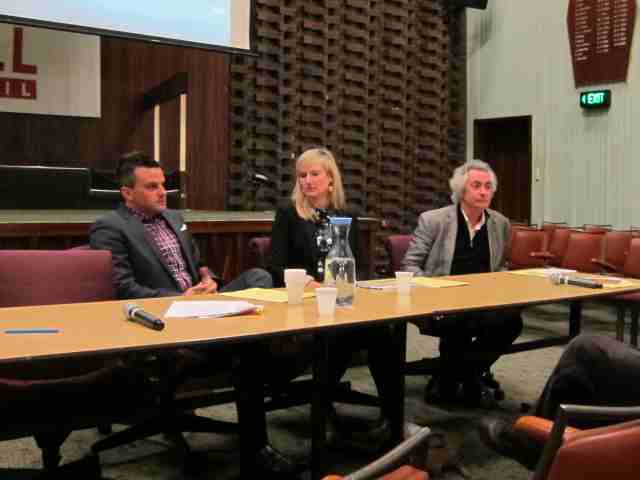
Very good speakers. The first session dealt with Economics and Inequality with two MPs  Claire O’Neil and Andrew Leigh MPs, John Daley from the Grattan Institute (hmmm) and Peter Malinauskas from the SDA (another even longer hmmm over their sell-out of casual retail workers in their latest enterprise agreement with the big supermarkets.)  A very tasty lunch catered by the Asylum Seeker Resource Centre, then a session on Social Democracy. Andrew Scott, who wrote Northern Lights (which I shall review when I’ve read it) spoke about social democracy in Scandinavian countries; Nick Dyrenfurth was controversial about the future of the ALP, Senator Jenny McAllister (outgoing President of the ALP)  gave one of the best thumbnail sketches of social democracy that I’ve ever heard  and Luke Hilakari (Secretary of Trades Hall Council) gave a spirited and rousing presentation about unions and election campaigns. A quick afternoon tea, then the final session on Refugee Policy with Robert Manne, Serina McDuff from the Asylum Seekers Resource Centre, and Brad Chilcott from Welcome to Australia.  Oh what a fraught, toxic policy problem it all is.

Brad Chilcott (Welcome to Australia), Serina McDuff (Asylum Seekers Resource Centre) and Robert Manne (La Trobe University)

Brad Chilcott (Welcome to Australia), Serina McDuff (Asylum Seekers Resource Centre) and Robert Manne (La Trobe University)

Anyway, the other highlight of the day for me was the opportunity to have a poke around Trades Hall.  It’s a grand building on the corner of Lygon Streets and Victoria Streets, consciously constructed as a “Worker’s Parliament”  to respond to Parliament House not far away.  Wikipedia says that it’s the oldest trade union building in the world, and it’s certainly Australia’s oldest.  The first Trades Hall building was constructed on the northern end of the site in 1859, just three years after the successful Eight Hour Day campaign of 1856.  It was a modest timber structure with a galvanized-iron roof, with the distinction of being the first building in the world to be constructed specifically for trade union business. This original structure was removed around 1917 to make way for extensions to the current building.

The current Trades Hall was constructed in ten stages between 1875 and 1925.  There’s a picture of Trades Hall from the early 20th century which really emphasizes its dominance here.

In the foyer there are beautifully painted frescoes marking the appointment of various union members to different philanthropic bodies (e.g. Eye and Ear Hospital, Children’s Hospital, Homeopathic Hospital ) on the Anniversary of The Eight Hour Day.  I suspect that it was the fiftieth anniversary.  The foyer was restored a number of years ago, but it’s starting to look a little faded.

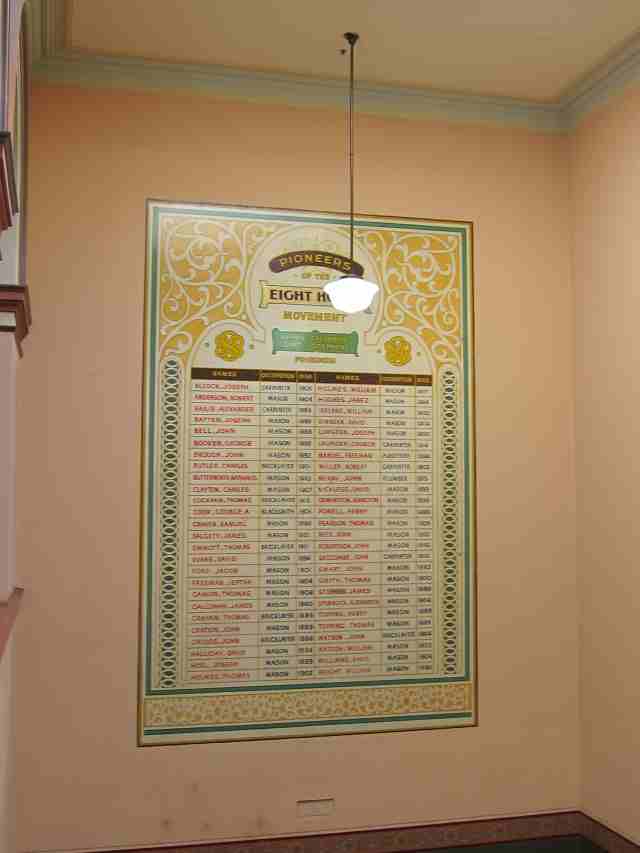
As you go up the well-worn granite stairs, there’s an honour board commemorating the men who worked on the Eight Hour Day campaign, led by stonemasons working on Melbourne University in 1856.

IMG_1661a

Upstairs there are the Old Council Room and the New Council Room.  The Old Council room is in very poor condition but scheduled for restoration when funds are available.  You can almost hear the shouting voices and smell the clouds of tobacco smoke.

This slideshow requires JavaScript.

The ‘New’ Council Rooms need about fifty years to become worthy of preservation. At the moment, they’re just tacky.  Give it time.

This slideshow requires JavaScript.

There are interesting little snippets of earlier days and old bitternesses still scattered around the place.

This slideshow requires JavaScript.

They’re raising money for the restoration appeal here.

Farewell, The Wuzzle

IMG_0889small

Fourteen years ago we saw ‘young Wuzz’ take her very first breath, the first-born of a second litter of puppies, and tonight we held her as she breathed her last.  We didn’t really intend to keep her, but somehow she was the last puppy left of the litter and she just tagged along.  She always loved her ‘dolly’, a chewed toy meerkat from the Zoo (they’re expensive but last forever) and was prepared to fight her Aunt Ellie for it.  Always a good-natured, simple little dog.  Goodbye little Wuzzle.

#TBR20

I can feel new carpet coming on. Our carpet is sixteen years old and, as we live in a smallish unit, it suffers a fair bit of wear-and-tear.  Moreover, our three miniature foxies  (two aged 16, one aged 14) are entering the twilight of their lives: one in particular is very poorly and another is likely to follow that moonlit pathway quite soon. The third (and my favourite, I confess) is blind and deaf with terrible teeth and she, too, is not long for this world I’m afraid.  “After the dogs!!” I have promised myself as I grimly vaccuum the threadbare steps and the doggy stains that I hate so much.  And if we’re going to carpet, then we may as well paint while all the furniture is taken up…and all this means I NEED TO DO SOMETHING ABOUT THE BOOKS.

I don’t actually buy a lot of books because I use my library a great deal.  I love receiving books as a present but  I’m too miserly to spend $30.00 on a weekly basis when I know that the chances of reading a book for a second time are not high.  I am, however, a sucker for the book stall at the Uniting Church fete, the new op-shop down the road, the new Little Free Library installed in the park and the Bargains table at Readings bookshop.  Then there’s Mr Judge, whose appalling library borrowing record and love of second-hand books compels him to bring home several books a week that pile up in his study, many of which I’d like to read one day (although I’ll give all the science fiction a miss).

But I really do need to READ some of these looming piles of books so that, when the new carpet beckons, I can sort out what I really do want to keep and dispense with two of the bookshelves in my cluttered and thoroughly unsatisfactory lounge room.  The TBR20 Reading Challenge sounds like a good idea to me.

Started by Eva Stalker in Glasgow, the TBR Challenge involves reading twenty books in a year from your own shelf before buying or borrowing any more. Well, eschewing the buying part should be fairly easy for me, but the borrowing not so much. As a result, I’ll blithely ignore that part of the challenge and just undertake to read twenty books that I already own by 30th June 2016. You’re supposed to sign up on Twitter with the hashtag #tbr20 but I must confess that I don’t think I know how to work Twitter. I need a young person to help me.

I’m quite looking forward to it. As far as the brand new un-read books are concerned, I obviously thought that these books were so desirable that I shelled out the money for them at some stage. As for the second-hand books, well I must have brought them home for a reason too.

Some people do several reading challenges, but I only until now have signed up for one: the Australian Women Writers Challenge.  I do try to catch up on the books that are short-listed for the major prizes, which involves reading a certain quota of new work.  The TBR challenge, however, is going to plunge me into some retro reading, I suspect. Prepare for lots of reviews of  early-twentyfirst-century books.  Doesn’t matter! I’m looking forward to it!

What would Willis do? #3

Well, the presentation of Queensland Chief Justice Tim Carmody to a legal conference on Hamilton Island has been cancelled.

The Guardian has more.

We’ll have to continue to wait and watch.

What would Willis do? #2

A few weeks ago I made reference to the controversy swirling around the Chief Justice in Queensland, Tim Carmody.  I’m particularly interested in this, having spent the last eight years of my life working on a judge who was dismissed from his position twice, John Walpole Willis.  Willis’ dismissal was initiated by the local governor  (rather than at the initiative of the Colonial Office) and, even though the principle of judicial independence was (and is)  tenaciously held amongst judges, none of his brother judges who actually presided alongside him lifted a finger in his defence.

Before I become too excited about parallels between Willis and Carmody, a few qualifications are in order. The Tim Carmody situation is fundamentally different to that of Willis, because the complaint is that Carmody is too close to government (or at least, the recently departed LNP government), rather than too antagonistic towards government as in Willis’ case. And we need to remember that even though judges (then and now)  might put great store on judicial independence, this sentiment was not shared by the 19th century British government and the Colonial Office, who expected judges to act as a component of colonial administration rather than hold themselves separate from it.  As a colonial judge, Willis was appointed “at pleasure” which meant that the government could dismiss him at will.  British judges, on the other hand,  were appointed  “during good behaviour” which meant that there had to be cause for the dismissal (which is the case today). However, there are similarities between the Carmody and Willis situation in that here we can witness a public discussion about judicial fitness played out through the media, and that judicial peers and the Bar are  openly critical of the Chief Justice.

So, I’m watching this with great interest, finding many parallels.

When Carmody was first appointed by the Newman government in July 2014, there was already disquiet.  After a career in the Family Court (from where he had the backing of former judge Alistair Nicholson QC) he had served as Chief Magistrate for only nine months before being appointed Chief Justice. Several current and former judges and senior lawyers criticized his inappropriate closeness to the Newman government, his inexperience and the lack of support within the legal profession for his appointment.   The Saturday Paper of  5 July 2014    notes  Carmody’s open support as Chief Magistrate for the Vicious Lawless Disestablishment Act of 1213 (i.e. the VLAD anti-bikie legislation) and his announcement that judges should not use the  “weight of their office to engage in the public debate or make comments about the comparative morality or fairness” of the government’s legislation. He was strongly supported by the local Murdoch paper and the police union.  The article is critical of his track record in the Family Court and as Chief Magistrate and raises doubts over the selection process.

Stephen Kein SC and Alex McKean (National President of the Australian Lawyers for Human Rights and defence counsel for Dr Mohamed Haneef) and Alex McKean (Past Co-convenor  of the Queensland chapter of Australian Lawyers for Human Rights, barrister and lecturer at the University of the Sunshine Coast) have written a series of blogposts on the Justinian site regarding the Carmody appointment.  They criticized his appointment from the start in A Matter of Principle written on 15 September 2014. They too discussed Carmody’s inappropriate closeness with the government, quoting the former Solicitor-General Water Sofronoff QC. They note the perceived lack of eminence amongst his peers. and  criticisms about Carmody’s frequent declarations of independence in the media.  In relation to Carmody’s insistence that judges should keep quiet about government legislation, they cite both Tony Fitzgerald QC and Geoffrey Robertson QC, who take an opposing stance.  They then go on to discuss the stance of Christopher Dore, editor of the Courier-Mail, who wrote several editorials in support of Carmody.

On 30 March 2015 they returned to the issue with  Chief Justice of Queensland-Addressing the Dilemma. They noted  Judge Margaret McMurdo also faced criticisms of lack of experience when she was elevated to the second highest judicial position in Queensland, the President of the Court of Appeal. She, however, has become widely respected.  Justice Wilson’s speech (that I wrote about here) is also discussed, and especially his accusation that Carmody had questioned  the roster system  used for allocating judges to the court of disputed returns, and then tried to influence the randomly appointed judge.  As Graham Orr explains in an article in the Brisbane Times of 28 March 2015 , this was a particularly delicate matter when it appeared that the electoral seat of Ferny Grove might be decided in the courts after the Queensland election where the LNP government was turfed out after one term.

The next day (31 March) they addressed the issue again with their blogpost Queensland CJ leaps to his own defence.  They noted criticisms that Carmody had been too often absent from the bench, they turned again to the Court of Disputed Returns, and briefly mentioned the position of the senior judge administrator, whom Carmody had sacked.

Since then, there has been controversy over contact between Carmody and Bravehearts campaigner Hetty Johnson in regard to the appeal case of the murderer of  Daniel Morcombe  discussed in the Guardian article http://www.theguardian.com/australia-news/2015/may/07/tim-carmody-recuses-himself-from-appeal-by-daniel-morecombe-killer on 7 May 2015. In late April, Hetty Johnson accused Carmody’s critics of being “petulant“.

The Chief Justice is currently on sick leave for a back condition, but on 25th May he announced to the Australian newspaper that he had offered to resign on condition that a judicial commission be established.  However, an article by Mark Bahnisch in the Guardian on 26 May asserts that Tim Carmody can’t demand reform as part of his severance package. Meanwhile, the Chief Justice will be giving the opening address at the North Queensland Law Association Conference this coming Friday 29 May where he will lay out his “vision” for the courts and, according to a Brisbane Times article, “expand on his issues with the judiciary and particular members of it”.

I’ll be very interested to read what he says.

Banyule Homestead sold

Banyule Homestead went up for auction on Saturday 16th May 2015 and sold for $5.2 million.  Unfortunately only registered bidders could gain access to the interior of the homestead on the day, leaving lesser mortals to mill on the lawns outside.

The auction was held at the rear of the property. Bidding started at $4 million, initially at $100,000 increments, then smaller.  Progress was boosted considerably by a $500,000 bid that took it from $4.5 million to $5 million.  It was purchased by a very young-looking couple for $5.2 million.

The view from the back is spectacular.  There’s nowhere else that you can get this outlook which makes the loss of this property from public ownership and access even more regrettable.

The Age has a good article on the auction, complete with video.

Writers and Readers: Books that Shaped and Subverted the British Empire Conference 8-9 May 2015

I’ve just spent a fascinating two days at a conference held at Melbourne University that explored the impact of books and writing on and in the British Empire. Held to support the launch of Ten Books that Shaped the British Empire: Creating an Imperial Commons, this was an interdisciplinary conference that brought together academics from history, anthropology, English and museum studies to examine the writing, reading and distribution of books that both shaped and subverted the British Empire.

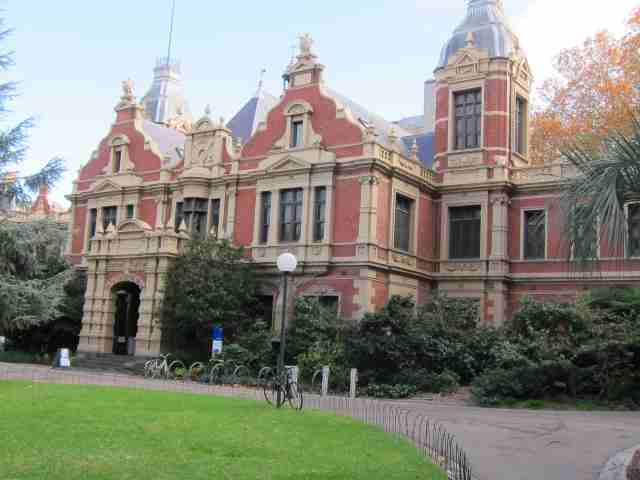
1888 Building, University of Melbourne

1888 Building, University of Melbourne

The keynote address was by Elleke Boehme, Professor of World Liberature in English from Oxford University (and one of the judges for the 2015 Man Booker International Prize).  She compared autobiographical texts written by Jawaharlal Nehru (Autobiography and The Discovery of India) and Nelson Mandela’s Long Walk to Freedom.   Both texts were written by outstanding leaders, both were fostered during long periods of imprisonment, and they even drew on similar themes, tropes and imagery. However, Mandela’s text departed from Nehru’s narrative in that he projected a more confident view of the future beyond the nation.

It was followed by a session that explored religious texts in empire. Troy Heffernan from USQ discussed the King James Bible and the Book of Common Prayer- two Anglican texts that accompanied the expansion of the British Empire.  I hadn’t realized that the Book of Common Prayer had undergone major revisions, most particularly in relation to the daily obligations that had shaped earlier Anglican religious expression. Then Samia Khatun from the University of Melbourne explored the global circulation of the Quran, and the Ahmadiyyan prophesies that emerged from British India at the end of the nineteenth century.  The prophesies of Mirza Ghulam Ahmad, were regularly published in Australian newspapers, and his predictions of the defeat, rise and then collapse of Turkey were interpreted, of course, in the light of World War I. Dr Khatun then shifted her attention from these public prophesies to the private stories of prophesies and dreams that were circulated through women’s stories, drawing on stories from her own family.

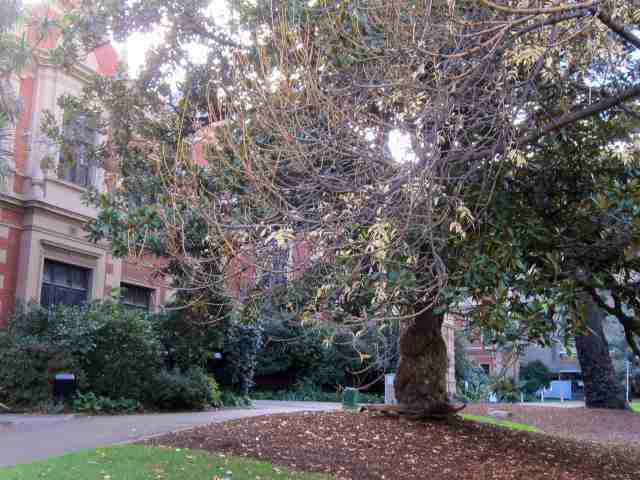
Large magnolia tree outside 1888 building

Large magnolia tree outside 1888 building

The next panel, Texts of Dispossession, explored three texts of empire.  Tracey Banivanua Mar discussed Edward Gibbon Wakefield’s work over the length of his career, noting in particular the feedback about Indigenous landownership that Wakefield received from his brother Felix, a surveyor in Tasmania, and Arthur, a settler with the New Zealand Company who was killed by Ngati Toa over stolen land.  Lucy Davies (fellow PhD candidate from La Trobe) took Beatrice Grimshaw’s 1911 novel When the Red Gods Call, set in New Guinea, which addressed fantasies and anxieties about masculinity, sex and gender when the main character, Stephanie Hammond, learns that her husband had once married a ‘native’ woman.  Finally, Tom Rogers from the University of Melbourne explored William Westgarth’s writings published between the 1840s and 1860s- “booster” literature that lauded Port Phillip’s progress and encouraged emigration to the colony. He traced the change in Westgarth’s attitudes towards the Indigenous population over time, with  increasingly heightened claims about infanticide and cannibalism as a way of justifying the settler-colonial project.

Two papers on Jane Eyre followed: one by Charlotte Macdonald, the other by Bryonny Goodwin-Hawkins, an anthropologist.  Both these papers were carefully written and beautifully presented.  The first explored ideas of possession and re-possession, picking up that very first scene in the opening chapter with Jane defiantly rebuffing Master Reed who bullied her when she crept behind the curtains in the drawing room to read.  The second paper ‘placed’ the image of the deserted, lonely Haworth Parsonage into the industrial context of cotton bales and looms of the Pennines region.  These were two really special papers (probably my favourites of the whole conference), quite different in construction and delivery to the more history-based papers to which  I’m accustomed.

The fourth session examined the book trade.  You only have to look at any of the early Australian newspapers on Trove to note that the final page of each four-page edition was made up of articles extracted from newspapers from across the empire. In fact, it has often struck me that these little local newspapers had probably as much international  (or at least inter-empire) focus proportionally as our newspapers do today- if not more.  Isobel Hofmeyr from the University of the Witwatersrand explored the role of the ‘exchange editor’ whose job it was to scour the newspapers as they arrived from overseas and literally cut-and-past articles into the local papers. When the concept of copyright arose- and it did not do so for some time-  it became tied up with Customs and Excise, and an exercise in sorting out the desirable from the undesirable.  David Carter from the University of Queensland discussed the transatlantic book trade which, although it restricted the development of local printing houses, did provide a means by which Australian books were offered to American and European markets (even though they were seen as ‘British’).  Australian books were reduced from three volumes to one, and often circulated in cheap libraries and as pirate copies – although at a time when copyright was unknown, a cheap knock-off was seen as a legitimate way of broadening the audience.

Christina Twomey explored Emily Hobhouse’s 1902 book The Brunt of the War and Where It Fell which demonstrated the impact of the Boer War on white women and children, but what struck me about her presentation was her sensitive portrayal of Hobhouse as the frustrated youngest daughter, confined for years in caring for her ailing father. [And I must confess that at this point, I had to leave and missed the next two papers and the book launch]

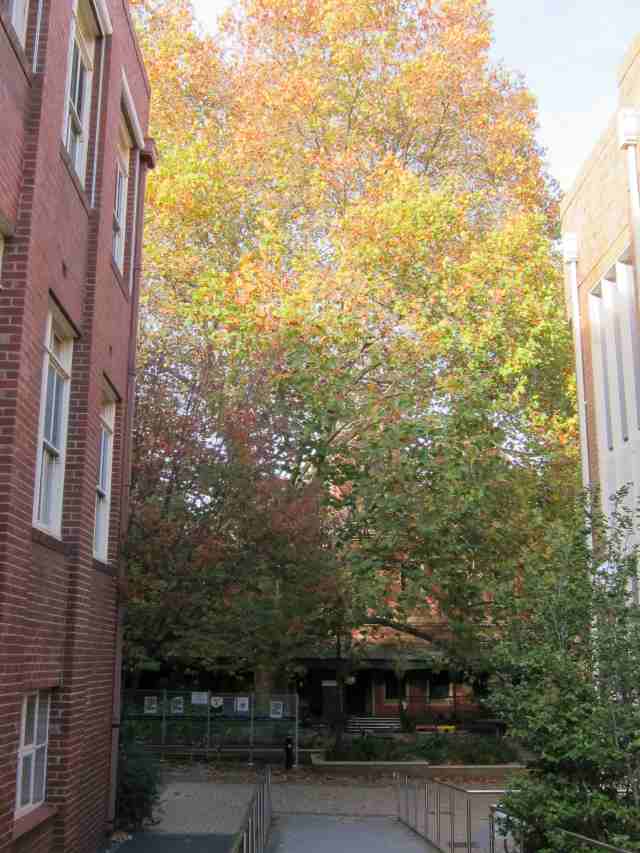
The beautiful (plane?) tree at the rear of the 1888 building. When I attended, the creche was located in the building and this tree dominated the children's playground.

The beautiful (plane?) tree at the rear of the 1888 building. When I attended, the creche was located in the building and this tree dominated the children’s playground.

But I was back bright and early this morning for the second day.  The first session ‘The Caribbean’ explored three texts- two of which were unfamiliar to me, the other more well-known.  Trevor Burnard from University of Melbourne discussed Edward Long’s History of Jamaica, published in 1774 by a wealthy and influential British absentee planter, who was resident in Jamaica between 1757-1769. This three-volume book is more often dipped into for its facts rather than read as as a text in its own right, and although it is a racist rant, it is also a critique of the short-termism of English policy compared with French planning, perseverance and expenditure.  Aaron Kamugisha from the University of the West Indies followed, with a presentation on C.L.R. James’ The Black Jacobins: Toussaint L’Ouverture and the San Domingo Revolution, published in 1938, and hugely influential in shaping the views of three generations of radical activists and intellectuals.  The text was originally a stage-play starring Paul Robeson before James reworked it as a history, and appearing as it did just as World War II broke out, the first edition is difficult to find.  It was translated into French in 1949 and promptly banned, and it is the second edition of 1963 that had such a profound effect in bringing the Haiti Revolution to audiences throughout the world.  The final paper of the session was by Sue Thomas from La Trobe University who discussed Jean Rhys’ Wide Sargasso Sea (which of course links with the Jane Eyre papers of the previous day) and the biographical influences of Rhys’ own family that are echoed in the novel.  She quoted from a cache of financial letters from Rhys’ great-grandparents, their son, and their creditors, that highlighted the indebtedness and sense of financial injury that form the background to Rhys’ own family and which inform the context of Wide Sargasso Sea.

The next panel ‘The Colonial Writing World’ started with Ken Gelder’s discussion of colonial Australian detective fiction- especially the world’s first detective novel, John Lang’s The Forger’s Wife (1853).  George Flower, the detective, was himself an emancipated convict, and was probably based on Israel Chapman.  He went on to Mary Fortune’s detective stories, especially Dandy Art’s Diary where one detective undercover watched another detective undercover.   The detective held an uneasy social position, just below respectable, and as in Fergus Hume’s Mystery of a Hansom Cab, there were many others who competed with the detective to solve the crime.   Bruce Knox then followed with a paper on Edward Bulwer Lyttton, who was a novelist, MP and eventually Secretary of State for the Colonies.  He wrote what sounds like a very strange science fiction/satire The Coming Race where a subterranean people, possessing the awesome power of ‘Vril’ practiced colonization  and planned to eventually ascend to the upper world and displace the existing inhabitants.  It was a satire and critique on Utopianism, Equality and Democracy (and was also the source of name of the ‘Bovril’ drink [Bo as an abbreviation of bovine or beef, and ‘vril’ from The Coming Race])

240px-Bovril_250g

Helen Bones rounded off the session with a discussion of Antipodean writers who span the Australian/New Zealand nexus, in particular Arthur H. Adam and Edith Lyttleton (who wrote as G. B. Lancaster).  Lyttleton’s books are ‘Dominion’ novels, set in Australia, Canada and New Zealand. Both these writers are often overlooked because they are in-between the two countries, and fall outside nationalistic approaches to literature with their emphasis on identification with landscape.

The final session that I stayed for (because I again left early) was ‘The Imperial Formation of Australian National Identities’.  Karen Downing who wrote Restless Men (reviewed here) gave a beautifully constructed paper that picked up on the argument in her book for the importance of Robinson Crusoe as an inspiration and point of identification for men in the emerging British colonies. Melanie Nolan, the General Editor of the Australian Dictionary of Biography, followed, with a discussion of Coral Lansbury (Malcolm Turnbull’s mother) and her book Arcady in Australia which argued that the egalitarian, Arcadian view of Australia was not formed in the bush in the 1890s as Russel Ward argued, but was instead imported to Australia by English writers of the 1850s – Samuel Sidney, Charles Dickens and Edward Bulwer Lytton (who we met in an earlier session).  She suggested that Lansbury and her book Arcady in Australia  has been largely overlooked because she was an expatriate, died early, went into English Departments rather History (as Russel Ward did), and she didn’t write about women beyond an article in Meanjin.  I have a copy of Lansbury on my shelf, and I’ll be reading it soon.  And, for me, the last paper of the day was by Kate Darian-Smith who discussed two post-war books, Henrietta Drake-Brockman’s The Fatal Days (1847) set in Ballarat and a thinly disguised book on Australian nationalism, and Florence James and Dymphna Cusack’s controversial Come in Spinner, which had a long and stormy gestation after winning a prize as an unpublished manuscript and then had to be cut and censored for its raciness and anti-Americanism.

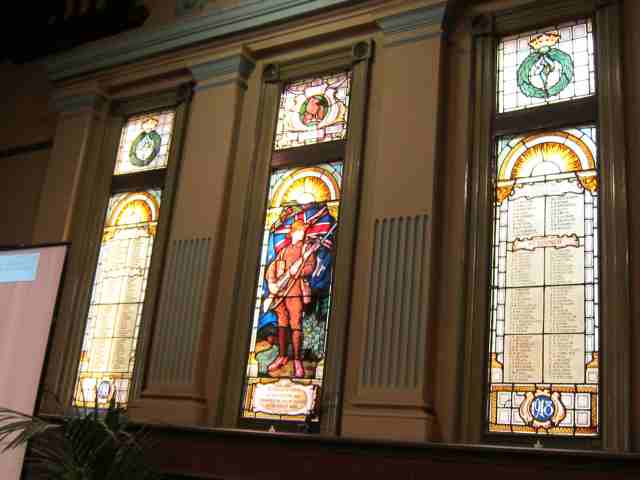
The beautiful stained glass windows in the Gryphon Gallery (where the conference was held), commemorating members of the Melbourne Teachers College (whose building this originally was) who died and served in World War I

The beautiful stained glass windows in the Gryphon Gallery (where the conference was held), commemorating members of the Melbourne Teachers College (whose building this originally was) who died and served in World War I

As you can gather, this was a wide-ranging conference that discussed many books and ideas.  The panels were well-organized by theme, and I enjoyed being exposed to the different presentation styles from other disciplines.  And so, what WERE  the Ten Books That Shaped the British Empire? I don’t know: I wasn’t there for the launch and there were no copies on sale today. So I guess I’ll just have to read it to find out!

[If I’ve made any errors or misrepresentations here, please contact me at my email address in the ‘About’ section]

‘From Botantical Illustration to Research’ Baillieu Library- until 28 June 2015

I’ve been going into Melbourne Uni over the last couple of weeks to read a thesis in their Special Collections room and I noticed this small exhibition on the first floor of the library.  I could see what looked like some large sponges in the display cases, but when I looked more closely, they were old mushrooms. I’ve got to say, there’s not many things that look deader than a dead fungus.  And that’s why, if you want to see its real colours and structure, you either need a photograph or a botanical drawing.

Howie

Source: National Museum of Australia

The illustrations in this collection were drawn by Malcolm Howie. There was a photograph of him on the wall, and he seemed a very young man, sitting rather awkwardly on the grass.  He died at the age of 36, a victim of spinal muscular atrophy that rendered him unable to walk by the age of sixteen. Towards the end of his life, he could only make small movements of his wrist when painting.

His brother-in-law was Jim Willis, a botanist with the National Herbarium of Victoria with a strong interest in fungi.   Willis published a booklet Victorian Fungi in 1941 that featured Howie’s illustrations, which went through several editions right through until 1962. Howie had died by this time.

It is likely that Willis sourced the fungi for him to paint, and all of Howie’s paintings have annotated details on them in Willis’ handwriting.  Howie painted 200 life-sized species in total, and Ethel McLennan at the School of Botany at Melbourne University commissioned a series of 80 illustrations.  These illustrations form the heart of this display.

There are specimens beside some of the paintings- and rather dessicated and shrivelled specimens they are too- and other botantical illustrations of fungi from rare books in the library’s collection.

It’s a small, rather weird but nonetheless beautiful collection of illustrations, tinged with sadness at the death of the artist at such a young age.  The exhibition is on show until 28th June, with a series of talks about the illustrations running through May.  The website is here, complete with a slideshow of some of his illustrations.

From Botanical Illustration to Research, Noel Shaw Gallery, University of Melbourne 27 March -28 June 2015