Category Archives: Uncategorized

This Week in Port Phillip 1841: 16-23 March 1841

HAPPY ST PATRICK’S DAY!

March 17, of course, was St Patrick’s Day. As Ken Inglis points out in Australian Colonists, recognition of the day in Sydney dated from 1810 when Governor Macquarie provided entertainment for convicts employed by the government, and the annual St Patrick’s Day dinner at a Sydney hotel was a fixture on the social calendar attended by the most respectable Irishmen- both Catholic and Protestant (p.103). Melbourne in 1841 was not yet so organized, and the occasion passed quietly.

We are glad to be enabled to state that Patrick’s Day passed over without the least infringement upon the public peace. We are almost sorry to have to record the fact that scarcely an additional glass was drained or shillelagh flourished in commemoration of the anniversary of Ireland’s general jubilee, as such might have been done without offence to the Powers that be, a little licence being always conceded on such occasions and a miniature representation of Donnybrook fair would have minded many of what they seem here to forget, that they are Irishmen. Perhaps, however, it is better that the dull monotony of money gathering should have remained uninterrupted than that occasion should have been given Ireland’s enemies to say that her sons in every quarter of the globe are fond of a “row”. Patrick’s Day has now passed over in peace and unmarked by any national display and so much the greater shame for Irishmen say we.  (PPH 19/3/41 p.3)

The day did not go completely unrecognized, though, as twenty to thirty of the men of the Port Phillip Club sat down that night to “a most sumptuous collation”. (PPH 19/3/41 p.3)

SHIPPING NEWS

Perhaps it’s because I’ve only recently finished reading Roslyn Russell’s High Teas and High Seas (review here) but I find myself reading the Shipping News on page 2 of the Port Phillip papers with a little more interest than previously.  Not only does the Shipping News detail the ships that have arrived and departed from Port Phillip and Sydney, but it conveys the communications that were conveyed between ships as they passed each other.  For example, the Port Phillip Herald of March 20 reported the arrival of the Christina  from Sydney. The Christina “spoke” the ship Victoria from Salem (USA) which it encountered off Bateman’s Bay, describing her as “deeply laden” (possibly with its whale catch?). The next day she “spoke” the barque Susan, sailed by Captain Neatby , off Ram Head (which I assume is Rame Head near Croajingalong National Park). The Susan was 92 days out from Plymouth, taking emigrants to Sydney. (PPH 20/3/41 p.2)

Recent emigrants, with their own voyage still vivid in their memories, might have taken a “there but for the grace of God” interest in hearing of other ships following in their wakes. The Port Phillip Herald  of 19 March carried a report from  Lisbon dated October 15 (i.e. nearly six months earlier) that the English ship John Cooper, bound from Greenock to NSW with a general cargo of 98 emigrant passengers, had arrived at Lisbon after being struck by lightning. A passing merchant vessel reported that he had seen her trying to reach Lisbon but, “owing to her crippled state, she appeared to make very little way”. On hearing this, Her Majestys ship Trimlemo was dispatched to go to her assistance, but returned the same day to report that although the John Cooper was close to the bar, she was in such a poor condition that a steamer should tow her into port. Even then, her troubles were not over, as when towed into port at the cost of £350 sterling, it was “found unprovided with a bill of health” and put under four days quarantine. [The John Cooper finally arrived in Port Phillip on 4th April via Adelaide. She left again for Sydney on 3rd May with a passenger list that included 1 corporal, 3 privates, 28th Regiment, 1 constable, 17 male and 2 female convicts. http://www.oocities.org/vic1840/41/jc41.html]

Melbourne itself was still in a state of excitement about the arrival of the Argyle in early March with its load of bounty emigrants, ready for the picking as employees.  The enterprising auctioneer and commission agent  Mr J. C.King established an agency office for Servants at his premises in Elizabeth Street, offering – for a trifling remuneration- to board the emigrant ships immediately after the official inspection of the emigrants and to engage servants for settlers who were unable to get to the ships to do so personally. (PPH 12/3/41).

By 16 March Mr King was able to issue a weekly list of unemployed servants:

WEEKLY LIST OF UNEMPLOYED SERVANTS AT MR KING’S AGENCY OFFICE: Overseers of sheep stations 3; shophands 3; woolsorters 1; hutkeepers 1; watchman 2; overseers of cattle stations 3; stockkeepers 2; bullock drivers 1; overseers of forming establishments 2; ploughmen 2; farm servants 4; Groom and inside servants 1; Gardeners 1; Bricklayers 1; House carpenters 2; Hut builders and fencers 4; female servants 3; Wet nurse 1 (PPH 16/3/41 p.3)

However, a small article in the Port Phillip Herald of 19 March headed ‘DROWNING’ reminds us that the journey to Port Phillip was not necessarily the bright new start that emigrants may have anticipated.  A body was observed floating on the water by the watermen of Williams Town. The body was salvaged. He was very young, dressed in a blue coat and striped cloth trousers and found to have needles and pins in parts of his dress, a few papers and a smelling bottle. He was later identified as a Mr. Macfarlane, who had arrived in the Argyle just a few weeks earlier.

He had been employed by Mr Rucker as a farm servant, and resided on his estate, about two miles from town, but since his arrival he appeared greatly depressed in spirits, and it is supposed that in a fit of temporary insanity the wretched man put a period to his existence. The deceased was a native of the county Tyrone, Ireland, and was respectably connected.

VERY EXCITING NEWS!

The Christina came bearing the London newspapers which carried detailed reports of the birth of Queen Victoria’s first child, Victoria Adelaid Mary, the Princess Royal on November 21 1840.  It was such momentous news that the Port Phillip Herald published a special edition on 20th March, to follow the issue that had appeared on 19th.  Even though this is, strictly speaking, not Port Phillip news, it strikes me as strange that Her Majesty’s subjects, so far away on the other side of the globe, would be reading a report of a birth that seems so intrusive to modern eyes.

On Friday her Majesty and Prince Albert walked in the garden of the Palace and again did her Majesty take her seat at the dinner table, and continued apparently in her usual health till eleven o’clock, when she retired to rest, no suspicion being then entertained of the near approach of those sufferings, which providentially have terminated in a manner so satisfactory to every branch of her august family as well as to the delight of her loyal and devoted servants. At two o’clock yesterday morning the first symptoms of uneasiness were indicated, and at four her Majesty with great firmness directed that her attendants should be summoned; among these was Mrs Lilly, who, we have heard, was formerly nurse to the Duchess of Sutherland, and whose experience at once forewarned her of the propriety of immediately summoning her Majesty’s professional advisers. Sir James Clarke, Dr Locock, Mr R Ferguson and Mr R Blagden were instantly sent for and were quickly on the spot. No doubt now existed that Her Majesty was in labour, although certainly some days sooner than had been anticipated, as the impression was that she would have remained convalescent till early in December.

Once labour had been established, all the protocol of a royal birth swung into place. Good grief- ding!dong! the gang’s all here!!

Such preparations as the suddenness of the emergency would permit were made without delay; and by command of Prince Albert, whose conduct was distinguished by the most affectionate solicitude, combined with firmness, the Hon. W. Murray, the comptroller of the household, roused the inmates of the Palace and special messengers were dispatched to her Royal Highness the Duchess of Kent, the Archbishop of Canterbury, the Bishop of London, the Lord Chancellor, Lord Melbourne, Lord Palmerston, Lord Errol, Lord Albemarle, Lord John Russell and other Privy Councillors, whose constitutional duty it was to be present at the birth of an heir to the throne…. In her Majesty’s chamber were the Duchess of Kent, Prince Albert and the medical men with Mrs Lilly and some of the ladies of the bedchamber; while in an adjoining apartment, the door of which was open, were the other distinguished individuals mentioned. As the day advanced the Palace was kept in perfect quietness, while all noise from without from the passing of bands or otherwise was interdicted. From those who had the best means of information, we learn that her Majesty evinced a firmness and composure almost incredible- at intervals exhibiting a cheerfulness and patient submission to her sufferings, in all respects consistent with the well-known attributes of her character. The near approach of that interesting moment which was to give to these realms an heir to the throne at last arrived and precisely at ten minutes before two o’clock Mrs Lilly entered the room where the Privy Councillors were assembled, with the “Young Stranger”, a beautiful, plump and healthful Princess, wrapped in flannel in her arms. She was attended by Sir James Clarke, who announced the fact of its being a female. Her Royal Highness was for a moment laid upon the table for the observation of the assembled authorities; but the loud tones in which she indicated her displeasure at such an exposure, while they proved the soundness of her lungs and the maturity of her frame, rendered it advisable that she should be returned to her chamber to receive her first attire. PPH 20/3/41

Apparently, ministers and privy councillors and ladies-in-waiting continued to attend royal births until 1894 when Queen Victoria decided that for the birth of her great- grandson, the future Edward VIII, the home secretary would be enough. Home Secretaries attended until the birth of Prince Charles in 1948, when it was announced that the practice would be discontinued.  Jolly good thing too.


1916 Irish Rising: Australian Impact

EasterRising

On this Easter Sunday, I’m going to be at the Melbourne Unitarian Peace Memorial Church to hear Dr. Val Noone speak on ‘1916 Irish Rising: Australian Impact’. It starts at 11.00 am. on Sunday 27th March, 2016.

This year is the centenary of the Rising, and the University of Melbourne is conducting a two-day international conference on 7th and 8th April to commemorate and interrogate the event. There’s details about the conference here– it looks excellent.

A Capital Idea Day 1

Many people I know have had good things to say about the Tom Roberts Exhibition currently on at the National Gallery of Australia, and after finding that it is only on until 28 March, we made the snap  (– well, snap for us-) decision to come up to Canberra for a couple of days.

Tom Roberts was well worth seeing. There’s the iconic pictures of course- Shearing the Rams; The Breakaway; the big Federation picture- but I hadn’t really appreciated Roberts’ versatility until I saw the portraits, narrative pictures, Impressionist pictures all together in one exhibition. 

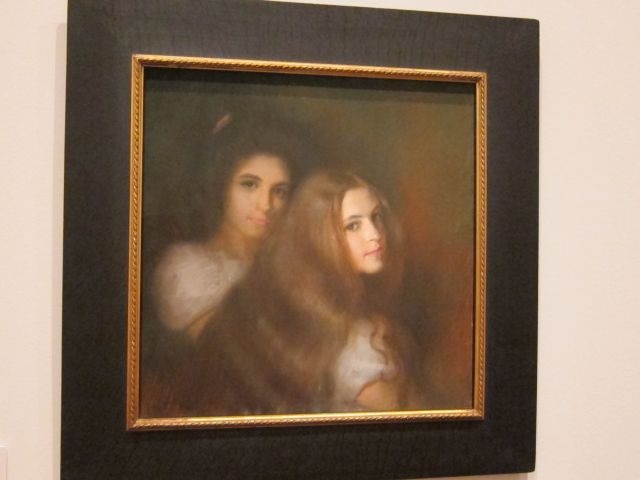
IMG_2222a

I was surprised by this portrait, executed in 1900, which had quite a Bill-Hensonesque feel about it.

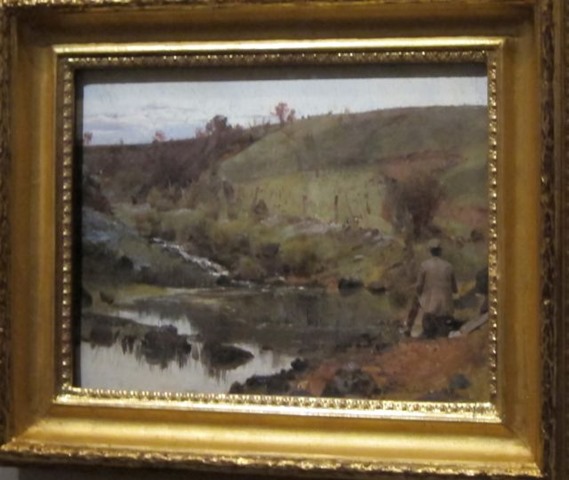
The exhibition was at pains, I thought, to distance itself from any mention of ‘Heidelberg School’, making only slight reference to ‘Eaglemont’ where it had to, and highlighting that Roberts, Streeton, Conder et al painted at ‘camps’ in various locations in Victoria and New South Wales.  But, as a Heidelberg girl, I instantly recognized the Darebin Creek in this small painting which featured in the exhibition and also appeared as a prop on an artist’s easel outside the entrance to the exhibition.

IMG_2223a

The Australian art section has been relocated in the gallery and now is prominently displayed as soon as you come up the escalator.  On the ground floor there is a sobering display of 200 painted traditional burial poles to mark the bicentenary and there are several rooms of indigenous artwork.

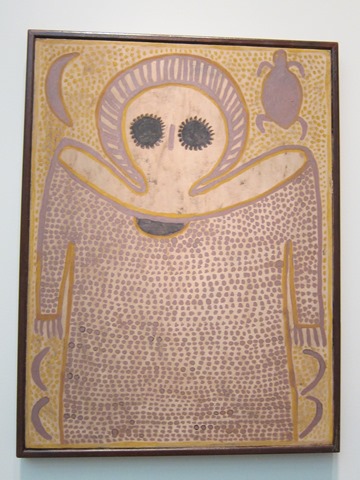
 IMG_2225

Remember Erik von Daniken’s Chariots of the Gods and how he tried to convince us that indigenous artists were really painting astronauts?  Haven’t heard much of that hypothesis since….

The Australian art exhibition is beautifully done, with interesting themes and a really broad exhibition of major Australian artists.  It did, however, reinforce my awareness of how rich the National Gallery of Victoria’s collection is, too.

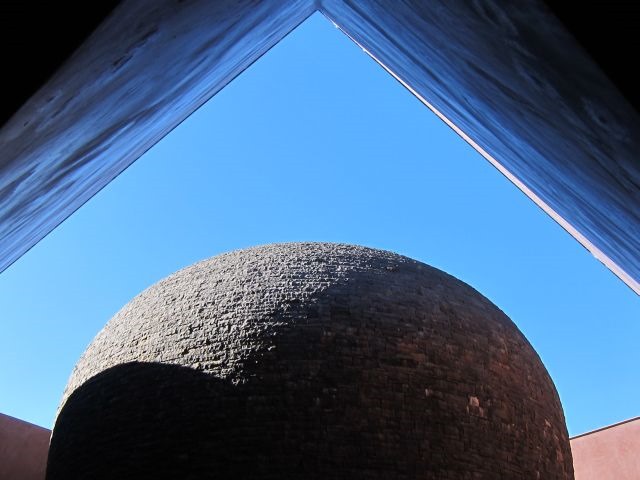
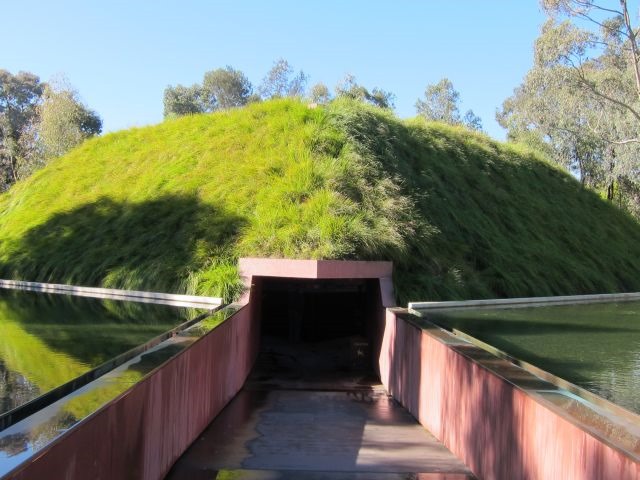
In the gardens outside was a striking sculpture Skyspace Within without. Externally it was a grass covered dome, but inside was a stone stupa  suspended on a sheet of water, open to the sky. It reminded us of the Kaaba in Saudi Arabia, but instead of a swirling, chaotic mass of people surrounding the monolith, it stood silently with the water falling over the edges of an infinity pool.  You could then enter the stupa itself, a cool, round, resonant room with a hole in the ceiling through which you could see the sky.  I wish my pictures did it justice, but they don’t. You’ll just have to come see it for yourself.

IMG_2220a IMG_2221a


Here’s a video walk-through

https://www.youtube.com/watch?v=icTo8j02rx0

Then off to the War Memorial.  As you might have gathered from other blog posts, I am rather ambivalent about the commemoration of war and its tendency to tip into celebration.  The War Memorial is absolutely brimming with expensively mounted displays- it must be the best funded museum in the country, I think- but almost to the point of overwhelming you.   The memorial is divided into  First and Second World War wings, and the World War I section is excellent, as you might expect in these centenary years.

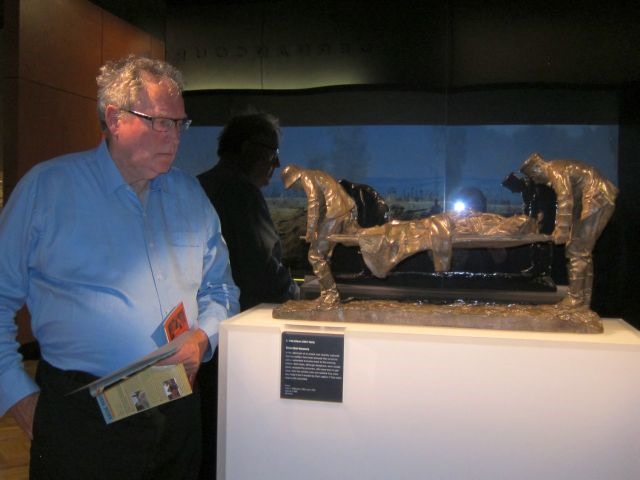
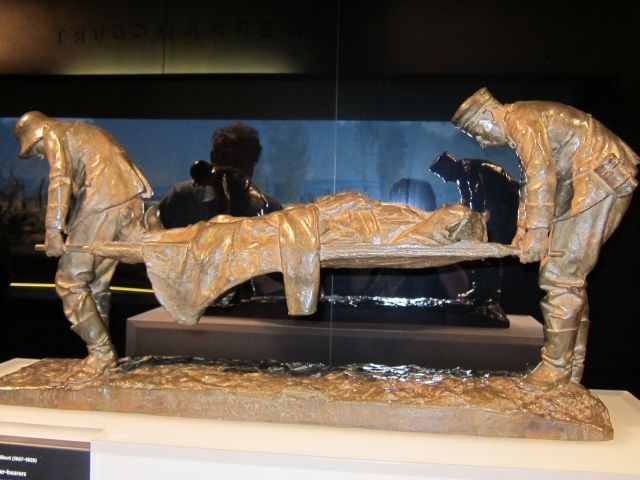
Our main reason for going was to find the works done by Steve’s grandfather, Charles Web Gilbert, who worked as a War Artist immediately after WWI.   He created some of the dioramas that are displayed to such good effect, now supplemented by sound effects and multimedia photographs and film clips.  The names of the war artists are not displayed on the dioramas, but we did find a small named sculpture of stretcher-bearers.

IMG_2233a IMG_2234a

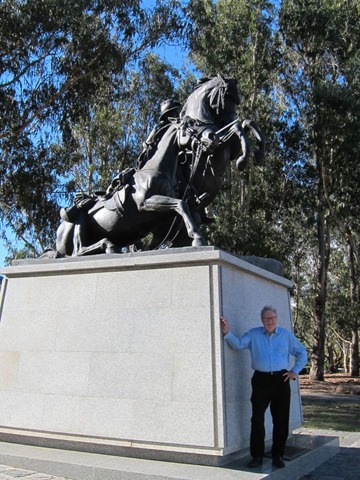
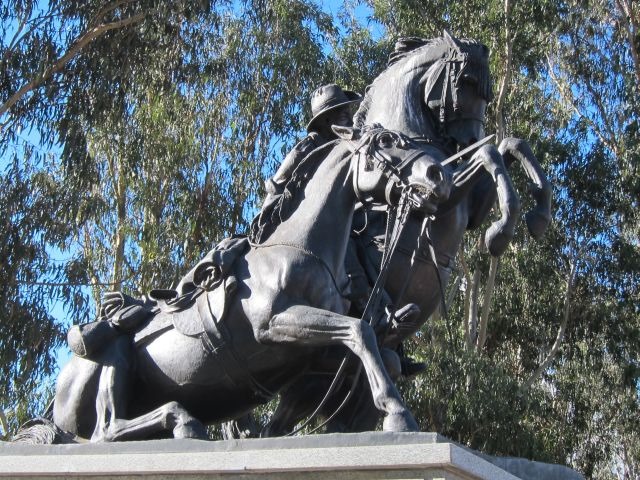
We were surprised to find that the large sculpture, previously called ‘The Memorial to the Light Horse’ had been shifted from its position close to the War Memorial to further down ANZAC avenue.  This is not its only shift: the original was erected in Port Said in 1932 (several years after C.Web Gilbert died) and was severely damaged during World War II. The remnants were brought back to Australia and reconstituted in the statue that now stands along ANZAC avenue.  Not a whisper of the artist for this one, either.

IMG_2238a IMG_2239a

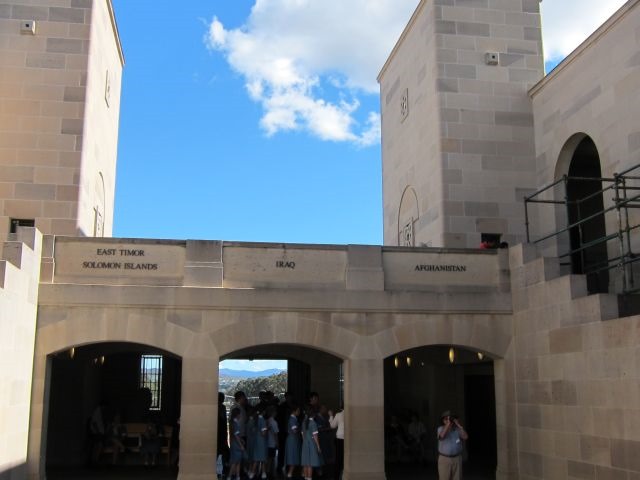
I very much liked the Hall of Memory, with its beautiful Waller stained glass windows.  Looking out across the commemorative flame, I noticed that all of the tablets naming the wars that Australia has been involved in have now been filled on every surface of the rectangular space at the heart of the Memorial.

IMG_2237a

Oh that it could stop now.

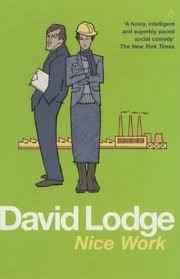
‘Nice Work’ by David Lodge

lodge

1988, 277 p.

I often find that my response to a book is largely influenced by the book that I read immediately before.  For example, I found myself quite unable to pick up another fiction book for some time after reading War and Peace, and sometimes I want to get my teeth into something really meaty after reading some self-indulgent fluff.  In this case, I came to David Lodge’s Nice Work as a face-to-face bookgroup read after just finishing the challenging (on all levels) A Girl is a Half-Formed Thing.  I must confess that much of the joy in reading this book was Lodge’s masterful, urbane and instantly comprehensible prose.  In comparison with the book that I read immediately preceding it, this one just flew off the page.

David Lodge, as a former Professor of English Literature at the University of Birmingham, is well placed to turn his wry, satirical eye to red-brick university life in his ‘Campus Trilogy’ comprising Changing Places: A Tale of Two Campuses (1975), Small World: An Academic Romance (1984), and this book  Nice Work (1988).  In this book, flame-haired feminist academic Robyn Penrose, trying hard to get a tenured position at the University of Rummidge (a thinly disguised Birmingham), agrees to be involved in a job-shadowing scheme as part of improving links between the university and the workplace.  She is allocated to Vic Wilcox, the manager of an engineering firm. I think that you can guess what happens….

And it does, and to a certain extent there’s a reassuring predictability about the plot. What I really enjoyed about this book, though, is Lodge’s satirical but penetrating analysis of his characters.  He’s not kind about either of them, but he does not lack affection for them either.  Robyn is immured in the postmodernist sludge served up by Derrida and Kristeva that makes me shrivel up inside, while Vic Wilcox is one of those buttoned-up, slightly pathetic middle-aged men who might be driving his small company car next to you at the traffic lights at 8.00 a.m.

Not content with mere waspishness, Lodge has literary fun in the book as well. The epigraphs that separate the multiple parts of this book are sprinkled with quotes from 19th English novels, most particularly Elizabeth Gaskell’s North and South, and there’s quite a bit of North and South in this book as well.  It’s enjoyable without knowing any of this, but for those in on the joke, it adds another layer as well.


This Week in Port Phillip 1841: 1-7 March 1841

This first week of March 1841 was marked by comings and goings.

COMINGS

The arrival of the 700 ton barque Argyle from London via Plymouth after a journey of 120 days was big news. In reality, the ship had a rather inglorious entrance, limping into Hobsons Bay after becoming stranded near Swan Island near Queenscliff.  I’m perhaps particularly attuned to the experience of emigration after reading Roslyn Russell’s book High Seas and High Teas but this particular journey has been well-described, largely because of the presence of a number of notable female first-class passengers whose writings and work have added substantially to our knowledge of early Port Phillip society. Foremost amongst these was Georgiana McCrae and her four children. Brenda Niall has given an evocative account of the journey in her excellent biography Georgiana, drawing on Georgiana’s journal of the voyage. Also present on the journey was Susanna (Sarah) Bunbury, accompanying her husband Capt Bunbury with her two year old son, and she also conveys a lively picture of Port Phillip through her correspondence. (There’s a fantastic article by Trudie Fraser on the Bunburys and their time in Fitzroy ‘The Bunbury Letters from New Town’ available online through the Fitzroy Historical Society’s webpage at http://www.fitzroyhistorysociety.org.au/publications.php.)

As well as’ Captain Bunbury, Lady and Child’ and ‘Mrs McCrae and Four Children’, there were eight ‘intermediate’ passengers and 228 bounty emigrants (PPH 2/3/41). For a full list of the passengers, see http://www.oocities.org/vic1840/41/am41.html The bounty emigrants, selected and accompanied by Mr John Marshall, were particularly welcome.   Anne Drysdale’s journal in Bev Roberts’ book Miss D and Miss N refers often to the difficulties in obtaining labour during these early years of the 1840s. A list published in the Port Phillip Herald on 5 March listed the skills of the labour available, inviting parties desirous of engaging their services to apply to the Surgeon:

MARRIED Labourers 23; Carpenters 83; Brickmaker 1; Shepherd 2; Painter, Gardener, Butler, Stonemason, Stockman, Sawyer, Groom 1 each

SINGLE MEN Labourers 36, Shepherds, 10, Carpenters, Ploughmen and Gardeners 2 each.

SINGLE WOMEN Housemaids 23; cooks 2; farm servants 19; dressmakers 2, laundresses 2 and ladies’ maids 3.

GOINGS

Although most emphasis is placed on the people who are arriving in Port Phillip, there was a steady trickle of people leaving Port Phillip as well. Some went back to England permanently, others shuttled between ‘home’ and the colonies depending on family circumstances, while others moved to other colonies and settlements within Australia. Willian Henry Yaldwyn was one of the latter. He differed from many of the other settlers at Port Phillip in that he was an English landowner in his own right who emigrated to the colonies with his family. He was a leading member of Port Phillip Society in its earliest years and prominent as a magistrate, member of the Melbourne Club, committee man for the Melbourne Fire and Marine Insurance , the Proprietary College and the Melbourne and Port Phillip Bank. He was on the organizing committee for regattas and the Committee to Welcome Lady Franklin in 1839- a journey described by Penny Russell in This Errant Lady (which I reviewed here)

William_Henry_Yaldwyn_-_Queensland_Politician

https://en.wikipedia.org/wiki/William_Henry_Yaldwyn

In March 1841 he left for NSW and Queensland, where he ended up a member of the Queensland Legislative Council. The people of Port Phillip gave him a good send-off from Melbourne:

DINNER TO MR YALDWYN. “On Friday evening the farewell dinner to Mr Yaldwyn came off with great éclat at the Adephi Hotel. The public room was laid out tastefully and redounded much to the honor of ‘mine host’. About a quarter to eight o’clock dinner was announced and fifty-three sat down to a sumptuous feast, consisting of all the delicacies the season could afford. After the cloth was removed Mr Powlett was called to the chair, when, after the health of the Queen the Royal Family &c had been drunk, and responded to with the innate loyalty of Britons, the chairman rose and proposed the health of their respected guest Mr Yaldwyn, which was drunk with the customary honours, and one cheer more. Mr Yaldwyn returned thanks in a suitable speech in which he expressed deep regret at his departure from among them. After several minor toasts had been drunk, the party broke up about two o’clock when every one present seemed pleased with their evening’s entertainment.” (PPH 2 March 1841 p. 2)

SCHOOL DAYS

Education at this stage was not controlled by government regulation and was delivered through sectarian schools and private enterprise. There were frequent advertisements in the papers for schools, many of which opened and closed almost without trace. Mr James Smith advertised that term would begin on 8th March at his school which would be conducted in connection with the Independent or Congregational denomination of Christians in Melbourne. The curriculum would consist of English, Reading, Spellng, Writing, mental and slate Arithmetic, English Grammar, History, Georgraphy, Elements of Geometry &c.

The pupils will be instructed as far as practicable according to the system of the British and Foreign School Society, Mr S. being thoroughly acquainted with that system, having been regularly trained at the Normal Institution, Borough Road, London. Hours of teaching from 9 till 12, and from 2 till 4.30 p.m (PPH 5/3/41)

Meanwhile, Mrs Williams and Miss Casey advertised their establishment for the young ladies of Melbourne:

Mrs Williams and Miss Casey beg to announce to the inhabitants of Melbourne that they intend opening a Seminary for the instruction of young Ladies. The course of Education will comprehend French and English in all its branches, including Writing and Arithmetic. Mrs W. And Miss C in soliciting the patronage of the public, rest their claim for support on their determination to pay the most unremitting attention to the religious and moral instruction of those pupils who may be entrusted to their care, as well as on the experience they have already acquired, while engaged in many respectable Schools and Families in the south of Ireland, where they have had opportunities of studying and adopting the several improvements in the modern system of education. (PPH 5 March)

FIRE AND FIREWOOD

In the early years of Port Phillip, much of the area surrounding Melbourne was quickly combed by timber-gatherers. By 1841 they were having to range further afield:

FIREWOOD. In consequence of the extension of the town and the great increase of inhabitants, this necessary article has lately become very scarce and the price has risen in proportion. The persons who procure a livelihood by supplying the town with fuel have now to go out some distance into the bush before they can get wood of a proper description for burning- the clearances in the immediate vicinity of the town are in many places converted into pleasure gardens which though devoid of the sublimity attendant upon the “mighty monarchs of the forest” yet carrying a feeling more homely, remind us of the chastened features of our native land. (PPH 2 March p. 3)

But where there’s firewood, there’s fire:

FIRE “We have often observed with alarm the idiocy of some persons in lighting large fires in close proximity to their habitations and this too, regardless of the weather and the calamitous consequences that may ensure, and we have perused with astonishment the annals of Melbourne without finding, as the negligence of the inhabitants would lead us to expect, more than one conflagration since the foundation. On Saturday evening a fire broke out in the chimney of a house situation in the rear of Mr Rushton, Little Collins-Street. The strong wind at the time accelerated the power of the flames which rose to an alarming height; fortunately the rain during the day had left an abundance of water on the [stove? stone?] which some men present assisted to draw, and the fire was soon got under. It appeared it owed its origin to the usual carelessness, a large fire had been piled on the hearth, which coming in contact with the charred timber in the chimney soon ignited, and spread through the entire: had not assistance been at hand and the flames permitted to increase, the consequences might have been serious, as the house is situated amidst a cluster of others built in the same frail manner and situated immediately behind the principal thoroughfare of the town, Collins Street. (PPH 2 March p. 3)

WATER

Meanwhile, there were increasing complaints about the quality of the drinking water that was being drawn from the Yarra. A small natural waterfall at about the site of the present Queens St Bridge separated the fresh water of the Yarra from the salt water coming up from the bay. Water carters drew from the Yarra and delivered it to householders at a cost of 6 or 7 shillings per load. On 2 March, the Port Phillip Herald published a letter written Dr Clutterbuck to Superintendent La Trobe, complaining about the brackish state of the water. La Trobe responded:

I beg leave to assure you and the gentlemen who have added their signatures, that having been subjected during the whole summer to the same inconvenience as my neighbours, and believing, moreover, that the brackish water is one cause (though not the only one) of the sickness which has prevailed of late, especially among new comers, I could neither be indifferent as an individual or as a public officer.” (PPH 2/3/41 p.3)

It was popularly believed that the poor water and drains had contributed to the illnesses suffered by many of the recent immigrants who had arrived on board the Argyle. The Port Phillip Herald pointed out that it was the duty of government to apportion some of the general revenue

to the formation of sewers with drains through the marsh into the Yarra, below the fall, to carry off the filth and excretions, which are daily collecting in the lower parts of the town, putrefying and exhaling pestiferous miasmata in a climate where it is actually requisite to fight against nature to render it unwholesome…[Recently arrived immigrants] instead of recovering from any lurking symptoms of disease they might have contracted on board ship, immediately on landing and exchanging the pure breeze of the ocean for the stagnant currents of the back slums of Flinders-lane, were attacked with what has been emphatically termed the “Yarra fever”, for the results of which we refer to the destitute widows and orphans, whose husbands’ and fathers’ remains lay mouldering in our churchyard. (PPH 5/3/41)

AND THE WEATHER?

The weather for the week was generally fine, with light winds freshening occasionally. The highest temperature for the week was 86 degrees (30C) on 5 March, with a little rain the following day.


This Week in Port Phillip 1841: 24 to 28 February 1841

There were complaints about the muddy state of Elizabeth Street right from the start.

During the past week we have received several communications from our fellow townsmen relative to street nuisances which at the present time, when disease and death are enacting their part among our population, would be too flagrant for us to leave unnoticed. We might refer to several which our attention has been drawn to, but we will confine ourselves to some which have come under our own immediate notice. In the principle thoroughfare of Melbourne (Collins Street) close to the Edinburgh tavern, a drain in a site of putrescence is allowed to flow into the street, from whence it shapes its course into Elizabeth Street, and after flowing for some distance through the centre of a crowded population, it finally falls into the Yarra. We would ask our man, must not the pestiferous exhalations arising from it be prejudicial to the health of the inhabitants residing in its immediate vicinity; assuredly it must, even the most apathetical would acknowledge the truth of our statement. Another crying evil is the stagnant water which is suffered to remain in the streets, and which, in the course of few days through the warm weather is in a state of decomposition- this latter evil will in time be remedied by the entire macadamizing the streets- but the former should be immediately looked to, or the consequences that may arise may be most serious. We are positive that our indefatigable police magistrate will now allow such a nuisance to exist one day when this attention is once attracted to it. (PPH 23/2/41 p.2)

Not only were the streets in poor condition, but they were infested with urchins setting off crackers. Fireworks are becoming an increasing problem in Melbourne today, after being banned for many years, but it seems that they were available in Melbourne as early as 1841. I wonder where they got them?

On Wednesday evening parts of Collins and Elizabeth streets were annoyed by the vagaries of several urchins, who to the manifest detriment of horse and foot passengers were giving vent to their love of mischief by the firing of crackers in the streets. This disagreeable nuisance some time since attracted the attention of the constables who very wisely put a stop to it. We trust that a recurrence of the evil will meet with their prompt attention. Whilst on the subject of nuisances, a short-sighted friend has requested us to give a hint to the different tradesmen on the impropriety of leaving boxes in the street opposite their respective houses at night, the result generally being some wounded limbs. We hope the practice will be discontinued. ( PPH 26/2/41 p.2)

Meanwhile, the good ladies of the Episcopal parish had complaints about dust on the pews. It seems odd that ‘drift sand’ would be a problem, especially when the beach was so far distant.

The attention of the churchwardens is particularly requested to the state of the pews or seats in the Episcopalian Church. Oceans of drift sand cover the benches to the infinite annoyance and inconvenience of the fair sex. A hint to the sexton from those in authority in church matters would no doubt have the desired effect. (PPH 23/2/41 p.2)

THE WEATHER

It sounds as if they were pleased to have a cool change:

THE WEATHER. During the past week an evident change has been observed in the temperature of the weather, the hot and scorching days have been succeeded by mild and pleasant weather, very similar to the autumn at home, the [?wind?] is free and healthy and the nerves properly braced. We are happy to understand that notwithstanding the past warmth of the season the hopes of the agriculturalist have been crowned with success.(PPH 26/2/41 p.2)

And indeed, the Government Gazette shows that the week 22-28 February was cloudy, with the highest temperature on 25th (85 degrees or 29.4 celsius) but heavy rain on the 26th and following days.  It records the rain for the week as 5.145 but I don’t know what this refers to (surely not inches??). Nonetheless, given that the rainfall. total for the month was 6.778, most of it fell in this last week of February.  Does anyone else know what these figures would be measuring?


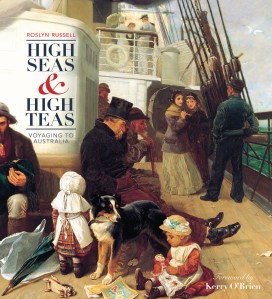
‘High Seas and High Teas’ by Roslyn Russell

9780642278852.jpg

High Seas & High Teas: Voyaging to Australia

213 P & notes, 2016, NLA Publishing

With the recent emphasis on ‘illegal boat arrivals’ in Australia in recent years, it has often been pointed out that, with the exception of indigenous Australians and families who arrived within the last sixty years, all Australians come from ‘boat people’ stock. Rustle the branches of most family trees and there they are: the names of ships, the point and date of departure and the point and date of arrival. Turn to page 2 of the Port Phillip newspapers during the 1840s and there’s the shipping news, identifying the first class passengers by name, numbering the second class passengers, and dispensing with the rest as an undifferentiated group of ‘bounty migrants’ or ‘steerage passengers’.

The inside blurb of this book exhorts family historians to “get a sense of your ancestors’ shipboard experience”, and the foreword by Kerry O’Brien centres on his own family lineage reflecting somewhat of a  ‘Who Do You Think You Are?’ emphasis.  Family historians often have little more than the name of the ship and its departure and arrival dates of their forebears. Sometimes they are fortunate enough to have a diary or letters penned on the journey, or on occasion, a particular trip may be so notorious that it was subjected to the scrutiny of the authorities afterwards. In all these cases,though, there are broader questions in moving from the particular to the general: how typical was this one trip? Is there a commonality of experience that linked all sea journeys to Australia?

Roslyn Russell fleshes out and contextualizes the voyage between embarkation and arrival in her book High Seas & High Teas by drawing on thirty-three diaries penned by passengers and crew during the nineteenth century.  These diaries, chosen from among the 100 accounts of voyages to Australia held in the Manuscripts Collection of the National Library of Australia, are not necessarily an accurate reflection of the demographic makeup of ships’ passengers. As she points out both in her introduction and at other places in the text, most of the diaries are written by men (roughly three to one) and fourteen of the thirty-three diaries were written by first class passengers. The voices of mothers of young children, in particular, are missing. This imbalance, she suggests, may be explained by social factors, but it could also reflect the collecting interests of the enigmatic Rex Nan Kivell and Sir John Ferguson, whose collections formed the basis of the NLA holdings (p.2).

In her brief introduction, she explains that, over time, three main routes were established between Great Britain and Australia. Most early 19th journeys took the High Seas route down to the coast of South America, sometimes stopping at Rio de Janeiro, then across to Africa and down to the south of the Cape of Good Hope and on to Western Australia, Adelaide, Melbourne or Sydney.  From the 1830s an alternative route opened up when passengers travelled across the Mediterranean by steamship to Cairo; by camel and cart to Suez, and by steamship again to Bombay. There they connected with sailing ships that brought them down through Torres Strait. By the 1850s a third, more dangerous route was developed when clipper ships passed far to the south of the Cape of Good Hope to pick up the Roaring Forties, the strong winds that blew between 40-50 degrees S latitude, which yielded a shorter journey but also risked storms and icebergs. Steamships were introduced to the route from the 1850s onwards, and the opening of the Suez Canal in 1869 cut the length of the journey from more than 100 days in the early 19th century to 40-50 days by the 1890s.

Despite these technological and itinerary changes, there was a commonality to the experience of the sea-voyage, just as there is a basic underlying sameness about air travel today.  This commonality even extended to the convict ships which plied the oceans until the 1860s.  Russell has devoted the first chapter to ‘Sailing Under Servitude’, where the surgeon-superintendent played an ambiguous role encompassing both solicitude and discipline. Diary entries in this chapter from crew and surgeons underscore the isolation and fear of insubordination that ran as an undertone throughout the journey, but as her references to convict ships in the later thematic chapters of the book demonstrate, even convict ships  experienced the same combination of boredom, fear, discomfort and self-made amusement that marked the journeys of later passengers of all classes for the next century.

Chapters 2-12 follow the trajectory of the journey from embarkation at port and the often lengthy bureaucratic and nautical delays before actually setting sail (Ch.2); the provisioning and accommodation on board (Ch. 3-5); passing the time (Ch.6-9); misfortunes at sea (Ch. 10-11), and the final arrival at their destination (Ch.12) which could, once again, be delayed by bureaucracy and quarantine requirements.   I was surprised to learn of the emigration depots back in England which acted as a sort of on-land simulation of the steerage experience, with emigrants forced to sleep in dormitories and comply with Royal Navy regulations as a way of familiarizing them with the life that faced them for the next four or five months.  I had seen printed newspapers purporting to be written on board ship and wondered at how they were published. Russell explains that they were hand-written on board ship and, after a subscription was collected from the passengers, the funds were put towards publishing the newspaper on land, after arrival, as a memento. Like Russell, I had wondered about sanitary arrangements- a topic which, unfortunately, few diary-writers explored in much detail.

But the real heart and soul of this book is the diaries.  Each chapter commences with a potted biography and then a transcript of one person’s diary that illustrates the theme of the chapter, followed by a beautifully clear, double-paged image of that page of the diary.  As readers, we encounter the diary writers again in several places, and I came to look forward to Annie Gratton’s (1858) and Edith Gedge’s (1888) vivacious entries, and confess to a twinge of schadenfreude at the sour William Bethell’s whinges and complaints. Some diarists reappear often, while others have a fleeting presence, making highly pertinent observations, then disappearing into the throng of passengers again.

The book is lavishly illustrated with the small sketches that the diary-writers used to embellish their pages and the chapters are enhanced by artworks of the day described as ‘background features’ in the reference section at the back.  It really is a beautiful book to just dip into, with large, full colour illustrations on nearly every page.

I’m not aware that the book is part of any museum exhibition, but as a reader, I felt as if I were viewing a mounted display.  The trajectory of the journey provided a narrative spine, branching off into small sub-themes of just two pages in length, just as a museum display might do.  Overall, the book does not have a historical argument as such- except, perhaps, for the commonality of the voyage experience across time and class- but instead brings the journey to life through images and the voices of the diary-writers.

It was probably because I had become comfortable with the chatter of those voices that the ending seemed so abrupt. Mr W. Barringer, with whom she closes, moves into permanent accommodation and the book ends. I would have welcomed Russell onto the stage herself as author or researcher perhaps, or would have liked the book rounded off with a birds-eye view of the voyage experience more generally, or even just a fonder farewell to Mr Barringer.   I felt as if I were standing on the wharf, and that the passengers I’d met along the way had ridden away from me to their new lives without bidding farewell. We had, after all, been on a long journey together.

Source: Review copy courtesy National Library of Australia publishing.

aww2016

I have posted this review to the Australian Women Writers Challenge 2016.

 

Farewell Ellie McPelly Belly: a tribute to a little black and white dog

You were the biggest puppy in our first litter  and you were (as far as we know) the last one standing. You were always good natured except when fighting with your sister over the meerkat dolly purchased from Melbourne Zoo. When you wagged your tail, it hit both sides of your not-inconsiderable girth.  As soon as you saw the dog-lead , you would begin yipping with joy, especially when I was trying to smuggle you out for a walk without taking your mother, brother and sister as well.


img273

Born in 1999, we could always tell you apart by the small dot on your back

img272

What a little sweetie. With your brothers Axel and Franklin No-Name 1999

img271

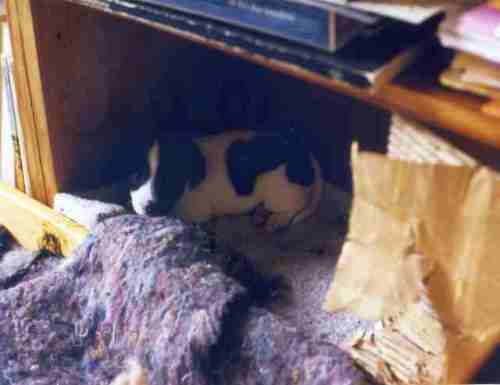
You loved finding hidey-holes

IMG_4878

Serves you right. One of your less endearing habits was to ‘find’ things in the bathroom rubbish bin and hide them in your outside basket treasure trove.

Dec2010 021

You were always a well-built girl

July2009 055

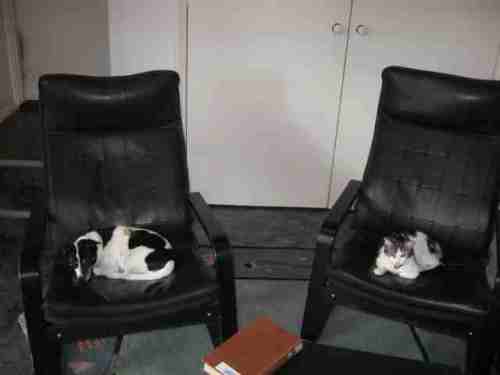
You even tolerated the cat. Or was it that she tolerated you?

IMG_5789

You’re getting old.

IMG_2035

Ellie Mac, Ellie Mac last Christmas 2015

IMG_2219

Her last night. Goodbye little girl.

You always loved your food. You invariably knew when it was 5.30 and would jump annoyingly at us until we fed you.  You would sit in your too-small basket, waiting to be told ‘okay’ before hoovering up your dinner within seconds.  You were well known for eating a kilo of frozen chicken fillets and having to lie exhausted, stuffed and shivering with your belly ice-cold and distended, until you digested it.  You survived a Christmas packet of Celebrations chocolates which you hid all around the house for later snacks. In fact, anything special went into your little wicker treasure-trove on the back porch: tissues, dog food cans, bones and lolly wrappers.

Eventually it was just you and the cat. By now aged 17, you were blind and deaf but still managed to negotiate the house, the stairs and the garden- as long as nothing was shifted. But it’s been too long since your tail wagged and once you stopped eating – always your greatest pleasure- it was time to go.  Goodbye Ellie McPelly Belly, my little love. I never did finish the last line of your song, sung to the Postman Pat theme-song, while waltzing around the kitchen with you in my arms.

Ellie Mac, Ellie Mac

Ellie Mac is white and black.

You’ve got a big fat tummy

And you love your mummy

Perhaps the last line should be

And I loved you very, very much

This Week in Port Phillip 16-23 February

THE POST OFFICE

Perhaps the approval of the new post office was conferred too readily, because complaints began to be voiced about the ‘penny wise pound foolish’ approach being undertaken in building the first post office. In particular, there were criticisms that the office was only a small room 12 feet square, and that the delivery and receipt of mail would be carried out at a window that did not have protection against bad weather.

 We would suggest either the erection or the hiring of a suitable building on the part of government for the purposes of a Post Office, sufficiently capacious to admit of a receiving and sorting room, a private office for the Postmaster, and a delivery room which should have a window opening into a passage, lobby or verandah, for it will not be denied that the comfort of the public should not altogether be lost sight of in these arrangements

You can see an image of the old Post Office here.  The clock shown in the picture was not part of the original building.

JUDGE WILLIS

The Sydney correspondent for the Port Phillip Herald reported that Judge Willis was due to arrive in Melbourne soon.  He gave a hint of the trouble that was to arise during Willis’ time in Port Phillip

Mr Justice Willis has been appointed Judge at Port Phillip, and expects to be in time to hold a court in March. His Honor has been on bad terms with his learned brethren for some time; and probably wishes to have a court of his own, where he cannot be overruled. Mr Willis is a very learned, very clever, and above all a very conscientious man, but it must be admitted that he is rather eccentric; as an equity lawyer he is not equaled in the colony (PPH 19 Feb 1841)

MR NATHAN’S CONCERT

On 18 February, Melbourne was treated to a concert given by Mr Nathan at the Caledonian Hotel.The next day, the Port Phillip Herald reported that:

A vocal Concert was given at the Caledonian Hotel last evening by Mr Nathan and his talented Family. We have only time to notice that it was exceedingly well attended, and passed off with the greatest eclat. His Honor the Superintendent, J. Simpson and W. H. Yaldwyn Esquires, with their Ladies were amongst the company present.

Nathan
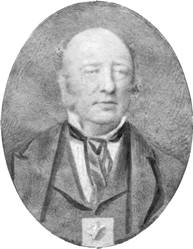
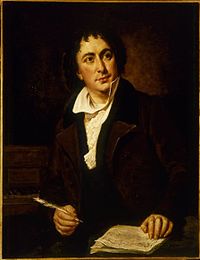
Isaac Nathan was born in England in 1790, the son of a hazzan (Jewish cantor) and was so musically precocious that he was apprenticed to the famous London Maestro Domenico Corri to learn singing and composition.  Like all musical artists, he cultivated patronage links to further his career.  One such patron was Princess Charlotte (who had taken music lessons with him); another was Lord Byron, who Nathan urged to write words for the melodies of the synagogue service that Nathan was so familiar with.  The result was Byron’s Hebrew Melodies, which remained in print, along with Nathan’s settings, for the rest of the century.

Nathan’s career declined, however, with the death of both Lord Byron and Princess Charlotte and he was forced to diversify into writing newspaper articles on boxing and music and he penned popular operettas to cover his gambling debts.  He published a history of music in 1823 but with little prospect of rehabilitating his career, he and his family emigrated to New South Wales.

His concert in Melbourne consisted of eighteen items, five of which were his own composition.  A review of the concert noted that:

He appears, with an egotism perhaps in this case pardonable, to have selected several of his own compositions for performance.

He was not to stay in Melbourne for long. On his arrival in Sydney in April 1841 he established an academy of singing, became the choir master of St Mary’s Cathedral and organized the largest concert of sacred music ever heard in the colony. Later dubbed ‘the father of Australian music’, he composed Australia The Wide and Free, with words by W. A. Duncan, for the inaugural dinner of Sydney’s first council in 1842 and two other ‘choral odes’ Long Live Victoria (the Queen, not the state) and Hail Star of the South. He commemorated the 58th anniversary of the founding of Sydney with Currency Lasses in 1846  and wrote two works related to the explorer Ludwig Leichardt- the first mourning his disappearance; the second celebrating his imagined return.  His opera Don John of Austria (not Australia) was the first opera wholly composed and produced in Australia and it was performed at the Victoria Theatre in Sydney.  He also wrote  a strange miscellany of called The Southern Euphrosyne,  where he attempted to transcribe traditional Aboriginal music, the first serious attempt to do so.  He died in Sydney in 1864 after being hit while alighting from a city horse-tram.

The ABC Lateline program screened a segment on him in 2003, featuring his biographer Dr. Graham Pont. You can read the transcript here.

His Wikipedia entry summarizes his significance thus:

Nathan’s Hebrew Melodies must rank as a real achievement. Nathan’s music for them was in print in England at least until the 1850s and was known across Europe.

Moreover, Nathan can claim some credit as inspiring Byron’s texts. These not only in themselves diffused a spirit of philosemitism in cultured circles (indeed they became perhaps Byron’s most genuinely popular work); but they were used as the basis for settings by many other composers in the nineteenth century, both Jewish (Felix and Fanny Mendelssohn, Joachim) and gentile (Schumann, Loewe, Mussorgsky, Balakirev, and others).

Nathan’s writings on music had little direct influence, small sales, and received no serious reviews in the press. In isolation, he struck upon and highlighted a theme which was at the time a major concern of the Jewish intellectual movement in Germany; the delineation and promotion of a genuine Jewish culture. The same spirit seems to have motivated his pioneering work with the music of the indigenous Australians.

Finally, Nathan’s indomitable refusal to admit defeat in life in exile – he undoubtedly paralleled himself with his hero Byron – has enabled him, from his concertising and writings on Aboriginal music, to be justly remembered by antipodean musicologists as “the father of Australian music

Isaac Nathan may have lived and worked in Sydney, but he came to Melbourne first!

AND THE WEATHER…

The weather was typical Melbourne summer weather- hot, followed by a cool change. On 16th and 17th February the weather was in the low 80s (28 degrees), but a cool change on 18th was followed by five days of temperatures below 70 (about 20) degrees.


Movie: Carol

This is a beautifully shot, slow movie, based on Patricia Highsmith’s long-ago novel.

lt seems as if I’ve been seeing trailers at the Nova advertising Carol for months and I felt as if I knew what the story was going to be before I sat down to watch it at last.   So I was rather surprised to find that Rooney Mara’s character Therese was an observer as well as a protagonist for events faced by Cate Blanchett’s character Carol.  It was a quieter, more detached movie than I expected and I (dare I say it?), I felt that it was a little slow.