Category Archives: Uncategorized

AHA Conference 7 July 2016

Another early start on a morning that seemed to promise warmer temperatures but by Ballan the fog had closed in, presaging yet another gloomy, cold day.

 Australia at War

What’s happening to me? After railing all through 2015 at the Gallipoli Centenary Extravaganza, I’ve found myself drawn to several sessions looking at WWI. Once again, I arrived too late to catch the first paper. In this case, Ian Willis spoke on “The Red Cross and ANZACs at Home”. I wish I’d caught more of it, alert as I am now to the industriousness and civic pride engendered through middle-class suburban Red Cross branches, as a result of writing my Hundred Years Ago column for the Heidelberg Historian. Unfortunately, though, I just caught the end of the paper.

The second speaker, who was to give a paper on the Australian Nursing Corps and Conscription, did not appear, which was disappointing.

The final paper for the session was Effie Karageorgos who spoke on “War in a ‘White Man’s Country’: Australian Perceptions of Blackness on the South African Battlefield 1899-1902”. Australian men volunteered to fight in the Boer War when it commenced in 1899, fired up by press columns syndicated from England which characterized the Boers as “dirty Dutch” and “uncivilized”. In Karageorgos’ study of 126 letters and diaries of Australian Boer War soldiers, she notes that soldiers often replicated such comments when they first arrived, but over time began identifying more with the enemy than the British. Meanwhile, the British Army began using (black) Africans as manservants, support workers and even soldiers, roles that the Africans embraced because they had no great love for the Boer settlers and they needed the money and supplies that accompanied military service. This threw up an interesting situation for Australian soldiers who were imbued with the Social Darwinist and Protectionist views towards race relations with indigeous people at home.   Yet here they were, fighting a ‘white’ enemy, alongside African soldiers and assistants.  She notes that many of the Australian volunteers were rural workers, who may well have worked alongside Aboriginal stockmen, but in their letters and diaries,  where the African workers were mentioned at all, it was often (but not always) in a rather infantalizing mode, reflective of the particular Protectionist model in play in Australia at the time.

PLENARY: Robert Anderson “The Changing Nature of Museums: Booming, Busting or what?”

This plenary was rather a surprise. Robert Anderson has worked in National Museums in UK for the past 32 years, the last ten years of which was spent as director of the British Museum. Many of his observations, taken singly, I agree with: the emphasis on blockbusters and getting numbers through the door and the resultant triumphalism of attendance statistics; the dominance of publicity and fundraising and the incorporation of museums into the mass tourism circuit; the discordant architectural design of museum extensions and annexes; the brevity and simplicity of labels (both in language and conceptually) and the increasing governmental managerialism of museum administration.  These are all things that I have thought about at various times, but not all together. It was when he began defending the British Museum’s inflexibility over repatriation that I became uncomfortable, and his observations cohered into very much a ‘in the good old days’ lament.  Should a curator be in charge of a particular collection for thirty years? I wondered when he praised the work of such a person. Does his assertion that, legally, objects belong to the British Museum and his attitude that therefore no correspondence can be entered into, still stand in a post-colonial world? Is the ‘best’ place for an artefact only in London, Paris, Berlin or New York?  When questions were raised, for example, about the Gweagal shield that I saw in the temporary exhibition in Canberra recently, his answers were forthright, obviously well rehearsed and completely immovable.  It’s an attitude that could only come from a position of plenty. All of a sudden the world didn’t seem quite so post-colonial after all.

Launches

There’s been a couple of book launches while I’ve been here.  The first one, at morning tea on Tuesday, was for Kate Auty and Lynette Russell’s monograph ‘Hunt Them , Hang Them ‘ about Tunnerminnerwait and Maulboyheener, the two ‘Van Diemens Land Blacks’ sentenced to death by Judge Willis. Naturally, I bought the book and no doubt sometime soon I’ll review it.  The second launch, today after lunch, was of Tom Griffiths’ ‘The Art of Time Travel’, a book about Australian historians which sits on my bookshelf. Katie Holmes gave a beautiful speech in launching the book, which I know will be written with Griffiths’ usual grace and perspicacity. I’m looking forward to it.

 Marginal Living and Dying

And so, to the final session of the day for me, because I needed to leave early. This conference is being held in conjunction with the Australian Victorian Studies Association, and this was the first of their streams.

Caitlin Mahar’s paper “On Life’s Margins: Procuring a Good Death in Nineteenth Century Britain looked at the medical management of the dying in Britain. Until about the middle of the nineteenth century, suffering was seen as an emulation of Christ, and a spiritual as much as physical phenomenon. The clergy were at the heart of the death scene, and it was felt that pain relief might numb the expression of faith that characterized the “good”death. However, during the nineteenth century the doctor became a more prominent figure at the death bed, and the family became more important. For some time doctors had caused more suffering amongst ill people with their ‘cures’ (cupping, bleeding, amputation), but with the rising use of pain relief, it was thought that instead of distracting the dying patient from the faith element of death, analgesics could make them more able to concentrate on it and facilitate, rather than hinder, a ‘good’ death. Almost immediately the problem of hastening death through overuse of analgesia was raised, and definitively rejected, but today doctors are actively encouraged to relieve suffering even if it shortens life. As for enabling the patient to make this decision…well, as we know, it’s an argument that still rages

The second paper “Outcasts of Melbourne: Representations of the ‘Underclass’ in Late 19th Century Melbourne” was delivered by Jenny Sinclair, who has published two books related to this topic and Melbourne generally. She looked at three authors: Marcus Clarke, J. S. James and ‘John Freeman’ who published sensational accounts of the less salubrious inhabitants of ‘Marvellous Melbourne’. All three authors focussed on the city rather than the suburbs; they conflated poverty and crime, and they maintained the point of view of the respectable reader.  They were often highly judgmental, although sometimes they turned their judgment back onto their readers. Yet, Sinclair argues, each of the writers had an agenda of social reform that can be traced back to their own origins.  Marcus Clarke had been sent as an impecunious orphan to the colonies by his family; James was an activist who worked in church organizations and institutions, writing in what we’d call ‘gonzo’ journalism today; and ‘John Freeman’ was in fact Edward Oxford, who had been incarcerated in asylums after an unsuccessful assassination attempt on Queen Victoria no less.

In the final paper, Shale Preston took up an analysis of ‘John Freeman’ (Edward Oxford) in a beautifully written paper called “Bedlam and Beyond: John Freeman’s Lights and Shadows of Melbourne Life.” Starting with the assassination attempt, she traced through Oxford’s twenty-seven years in Bethlem (Bedlam) and Broadmoor lunatic asylums, where he learned languages, became the in-house painter and generally kept himself aloof from his fellow inmates. He was released in 1867 on condition that he come to Australia and never return, and was given money by a philanthropist in order to do so. His book ‘Lights and Shadows of Melbourne Life’ was not received well, with critics complaining that his sketches of the underclass could have been written in London rather than Melbourne. There is a remarkable lack of empathy or fellow-feeling in his writing, especially given his background. But, Preston suggests, perhaps it is symptomatic of his egotistical and jaundiced world-view that may have shaped his whole life. What a fascinating story- I’m going to follow this up!

And so ends Thursday- and what good timing, as the train is just drawing in to Southern Cross station!

AHA Conference 6th July 2016

Left bright and early for the second day at the AHA conference in Ballarat. Strictly speaking, I left in the drizzly dark at 6.30 a.m.  I don’t think that I’ve ever caught a train quite that early in the morning. The carriage was much quieter than it is later in the morning or in the evening, and there is an odd intimacy when you looking at your fellow passengers, knowing that just an hour before they were all asleep in bed, lying curled up and vulnerable.

The rain set in at about Bacchus Marsh and so the train drew into a Ballarat that was just as dismal as the preceding day.

 Remembering ANZAC

Over recent months I’ve taken over writing a column in the Heidelberg Historical Society’s newsletter which makes a summary of Heidelberg events one hundred years ago. Of course 1916 was in the midst of WWI and so I’ve developed an interest in the WWI homefront that I didn’t know that I had before. I missed the first paper in this session because I just couldn’t face the idea of a 5.30 a.m train but very much enjoyed the next two papers, especially as they intersected with my interested in the warfront at a very local level.

The first paper by Claire Greer was titled ‘Between a Rock and a Hard Place: Exploring Homefront Hardship Through the Lens of the Great War’. In a work in progress, she is taking the Perth suburb of Subiaco and mapping out the enlistment and casualty information at a community, street by street and individual level. In particular she focusses on married men who enlisted at Subiaco at a higher level (32%) than elsewhere in Australia. Part of her work has involved identifying where and how often individual soldiers were memorialized on honour boards and through other acts of commemoration. How and why did a community claim particular soldiers as ‘theirs’? What were the networks that made that soldier part of the community? Moving down to street level, she mapped the enlistments in a particular street (Olive Street) and from there focussed on a particular family- that of John Monson. (????I’m having trouble reading my own writing!) In tracing through his story, the high level of married enlistment perhaps becomes clearer as we see the Monson family thriving in the goldrush town of Kookynie only to lose everything as the gold boom subsides.  The marriage founders, so when John enlists he puts down his son as next-of-kin rather than his wife.  I really liked this fine-grained use of the deluge of data generated by the ANZAC centenary to investigate the homefront rather than the warfront.

The next paper of the session was Bryce Abraham’s “An Affront to British Chivalry: Colonial Thought and the Cultural Clash at Surafend 1918”. I had heard of the Wasser Riots in the red light district of Cairo in 1915, but I had not heard of Surafend at all. On December 1918, after the war had finished, a detachment of the ANZAC Mounted Division converged at the then-Palestinian village of Surafend where, in order to avenge the death of a New Zealand soldier, they separated the women and children and massacred the men (there are no firm figures of the number of deaths) and torched the village. They then moved on to a nearby Bedouin village.  The Commander-in-Chief of the ANZACS, Edmund Allenby was furious and cancelled end of the war recommendations for the whole group. At investigations into the incident, the soldiers were uncooperative, finding themselves mysteriously unable to identify anyone who was responsible (although the NZ soldiers intimated that the Australians were responsible while the Australians suggested the opposite). The massacre took place beyond the war arena, in the transition to peace, to people they were supposed to be protecting.  Abraham notes that there had been incidents before, but that this was the pinnacle of racial conflict between the Palestinians and the ANZACS and was another manifestation of the racialized White Australia mindset that dominated turn of the century Australian political life.

Boom and bust in Australian and New Zealand History

As it happened, the WWI theme continued into the next session as well in what seems a bit of a grab-bag title. The third speakers didn’t turn up, and the two papers that were given fitted together quite well

Martin Crotty spoke on the poorly planned pilgrimage to WWI sites organized by the RSL in his paper ‘The RSL’s 1965 Gallipoli Pilgrimage: Botching it Up Again’. This was not the first pilgrimage back to the Peninsular organized by the RSL: there had been others in 1955 and 1960. But those pilgrimages were small, exclusive and expensive excursions, often involving people who had not even made the landing. This 1965 pilgrimage to mark the 50th anniversary was larger, shorter at 3 weeks, and with the injection of some funding from the government, cheaper (although it was still a sizeable 4000 pounds per head). The pilgrimage had two aims: first, to provide these Gallipoli diggers with a positive pilgrimage experience and second, to provide good publicity for the RSL which at the time feared that the ANZAC story would be forgotten. The historian Ken Inglis accompanied the pilgrimage, and Crotty has consulted Inglis’ exhaustive (if often illegible) archives which include the documentation on the pilgrimage. It was a debacle. The three hundred elderly men were flown over to the Middle East, put on a sparsely equipped Turkish ship, and rushed from one celebration to another when all they wanted was to be able to walk around the places they’d been and pay their respects to their fallen comrades. Three men died; others were sick for months afterwards.  But even if they didn’t achieve a positive pilgrimage experience, the RSL did get its good publicity, with many newspaper articles that said little of the dissatisfaction of the pilgrims. And, as we know, the RSL’s fears about ANZAC being forgotten were well and truly misplaced.

This paper was followed by Joanna Leahy’s paper “‘Knitting with a Will, Knitting for their Empire’: the World War One Knitting Boom.”  One of the things that I’ve noticed in compiling my Hundred Years Ago column for the newsletter is the mountains and mountains of socks that are being knitted by the good women and girls of Fairfield, Alphington, Ivanhoe and Heidelberg. As part of her study of domestic knitting and crochet in Australia 1840-1940, Leahy has examined these World War I  socks – all 1.3 million (at least) pairs of them.  There’s one in the Australian War Memorial, abandoned half-way through and still on the needles when Nellie Blain heard of the death of her older brother, for whom she was knitting.  The patterns for these socks were readily available in the newspapers and special pamphlets.  While acknowledging this huge effort, however, she notes that is it part of a longer tradition of domestic and charitable knitting.

 PLENARY SESSION: THE CITY

This was the first plenary session that I have attended at this conference, having arrived too late for yesterday’s one. Each of the speakers adopted a different stance toward the topic. “Centering the City: Spaces of Practice in Australian Urban and Regional History. Louise Prowse’s paper wasn’t about the city at all- instead she looked at regional towns at how they have framed their identities. In the late 19th and early 20th centuries, they positioned themselves as separate settlements, in the fresh air far from the city, with their own local families and industries. This changed from the middle of the 20th century when, instead, regional towns prided themselves on their replication of city leisure facilities- the swimming pools, parks, shops etc. In this way, regional towns became more generic.  However, from the 1960s there was an explosion in the number of historical societies (in the city, but even more in country areas) which began marking and memorializing their own local and  particular history. Towns began reconfiguring their streetscapes to enhance their heritage features- although which particular era did they privilege?  She pointed to the recent phenomenon of local food-based regional tourism which, unlike the 1960s tourism, does not draw a distinction between visitors and locals.

Andrew May started his contribution quoting from a travel diary written by a Welsh tourist who visited North America, Australia and New Zealand (I can’t quite remember when- I assume late 19th/early 20th century). She was dismissive of Melbourne and its sanitation problems, but warmed immediately to Ballarat. A visitor to a city assesses a new place in terms of their storehouse expectations and experience, and this differs for us all.  Yet, he noted, the major national histories of Australia tend to disregard urban histories despite the oft-repeated claim that Australia is the most urbanized country in the world and not withstanding Graeme Davison’s hugely influential article ‘Sydney and the Bush: An Urban Context for the Australian Legend’ which highlighted the urban origin of the ‘bush’ stories and poets in the Bulletin.  He emphasized the international dimensions of the municipal movement of the 1840s which saw the Incorporation of both Melbourne and Sydney (pipped by Adelaide) and noted the significance and longevity of Town Clerks.

Lisa Murray is the young, very enthusiastic (and active!) City Historian employed by the City of Sydney. In a rather corporate presentation, she outlined the objectives of the City Historian position, the projects it had been involved in and its relationship with other individuals and groups in Sydney who might want to adopt a ‘history’ approach in their production of civic, artistic and planning endeavours. The program makes use of digital and multimedia platforms, and is not so much into marking memorials through plaques as in making  memories through oral histories and drawing on shared public memories. An interesting conundrum though- a mural in a park created in the 1980s had spawned a popular history of carnivals, elephants and balloons supposedly found on the site in the past, but the carnival was only there for six months and there was no elephant, and no balloon. A piece of artwork had in effect implanted false memories for the local residents.

Finally, Simon Sleight started his presentation with a picture of the Burke and Wills statue in Collins Street, before it started its peregrinations around different Melbourne sites until ending up in its present location on the corner of Swanston and Collins Streets. His interest was not so much the statue as the people loitering around it, which led to a discussion of walking and loitering around Melbourne during its years as a ‘walking city’ between 1860-1920 when people walked by choice, not necessity. There was walking The Block for respectable people; meeting under the clocks at Flinders Street, and the increasing perception of danger on Princes Bridge.  He noted parallels with other cities- the Monkey Parades in UK or New York’s Bowery.

Transnational Celebrity in the Twentieth Century: Australia, New Zealand, North America and Britain.

My final session for the day was a panel discussion of four celebrity women who visited Australia during the twentieth century.

Desley Deacon started with her paper “Celebrity, Empire and American Morals in 1927: Australia Rejects the Young Judith Anderson.” Judith Anderson (originally Francie Anderson) returned to Australia in December 1926, eight years after she had left Australia as a 21 year old. While in America, she had had great success on Broadway, and when she first arrived back in Australia, the press greeted her enthusiastically. However,  her performance in ‘The Green Hat’ was absolutely slated in reviews, so viciously that her eight-month tour ended in a physical and mental breakdown. She was hospitalized for six weeks, and left Australia quietly.  But perhaps it was not her, or her performance that caused the offence: instead, there was a strong rejection at the time of the Americanization of film and a suspicion of American culture as usurping British and Australian culture- and The Green Hat, with its ‘sordid’ plotline fed right into that hostility.

There was no hostility, however, for Guide Rangi (more properly, Rangitiaria Dennan), a 57 year old Maori guide from Rotorua, who arrived in Australia in 1954, just after she had shown Queen Elizabeth around the thermal area of New Zealand.  She was a household name in New Zealand, and exemplified the Maori guide in the public imagination. The guide was now the celebrity, and the press followed her visits to the Shrine of Remembrance, photographed her hugging a koala, and conducted meet-and-greets at the Tourism Agency. The press continued to lionize her, even when she made critical comments about the treatment of aborigines, at a time when few indigenous people in Australia had the same public recognition.

Finally, Cecilia Morgan spoke about ‘The Theatrical Tours of Two Canadian Margarets: Transnational Celebrity in Early Twentieth-Century Australia and New Zealand’. The two Margarets were Margaret Anglin, who visited beteen 1908-9 and Margaret Bannerman who followed her twenty years later.  Both women were Canadian, even though Margaret Anglin performed on the American stage, and Margaret Bannerman had a successful career in London’s West End.  Where Judith Anderson suffered from the hostility towards Americanization of stage and screen twenty years later, Margaret Anglin did not.  Both women were publicized for their stylish clothes; both were described as friendly and approachable, and unlike Judith Anderson, they both starred in plays and displayed a celebrity identity which emphasized cultural dominion affinities.

And by now, I had a bus to catch so I had to leave….


Several of today’s sessions were held at Federation Uni’s School of Mines campus. I’d seen it from the outside, but didn’t realize how lovely it is inside.  Actually, Federation Uni has a real presence right in the centre of town which it didn’t some years ago.


AHA Conference 5 July 2016

It’s July, so that means AHA conference time and this year it’s some 100 kms away in chilly Ballarat- ye Gods, could there possibly be a more dismal place than Ballarat on a wet, rainy Tuesday in July?  The theme of the conference is “From Boom to Bust” – a fitting theme for a gold-rush town- and some papers have taken it up in their titles.

Medical histories

Now that the thesis no longer looms over me, I have the luxury of just going to whatever takes my fancy. As it happens, for the first session for the day it was ‘Medical Histories’. The first paper, by Kate Irving was titled “American ‘Schools for Idiotic Children’: Eugenic Asylums and the Limits of ‘Boom to Bust’ Narratives. The ‘Boom to Bust’ narrative arc is often used by medical disability historians to describe the trajectory of institutionalization. Up until the mid 19th century, there was a view that the catch-all term  ‘idiocy’ was a permanent condition, manifested through physical appearance with an emphasis on speech. There was a change mid-century, particularly through the work of Seguin, who saw such children as educable, their condition caused by “arrested development of the will”, amenable to physiological education and carefully structured instruction. However, by the end of the century, separate schools were used for predominantly custodial purposes of keeping ‘dangerous’ young people locked away from society, with the smaller education-based schools taken over by large, more segregated institutions with more of an emphasis on science.  While  not rejecting this ‘boom-to-bust’ characterization completely, Irving noted that there is no neat dichotomy between the three phases, and argued that local, social and personal  factors also played a part in the construction of medical categories over time. Her work looked at the clinical notes about the children written by staff at Elm Hill Private Institution for Feeble Minded Youth in Massachusetts, a private institution patronized by wealthy families. Her presentation was illustrated by the studio photographs taken of the children in Elm Hill’s care, which were not at all the custodial-type pictures you might have expected to see.

Next up was ‘The World May See your Trade in your Faces: Labour and the Face in Early Modern Medicine’ by Emily Cock as part of her postdoc work funded by the Wellcome Trust called ‘Effaced from History: The Disfigured and their Stories from Antiquity to the Present Day’. Her paper looked at a publication by Bernardo Ramazzini published in 1700 that classified the diseases and injuries common amongst particular trades e.g. the bleary features of the sweaty blacksmith; the disfigured mercury miner suffering from the fumes; the weedy academic reading too much!  The book was organized by trade, with men’s and women’s work intermingled.  She noted the facial slashes meted out to prostitutes and adulterers as punishment, and the role of facial injuries as evidence of military service and the ‘safety’ denoted by the smallpocked nursemaid who could no longer transmit the disease to children.  An amazingly early example of what would become occupational health and safety consciousness in the early 18th century!

Finally, Yorick Smaal spoke on ‘Boys and Institutional Sexual Abuse’- a topic that is being aired by the current Royal Commission. His paper drew on four cases studies from Australia, New Zealand and the United Kingdom from the early 1900s. His paper started with the Stoke Industrial School Inquiry in New Zealand in the 1890s where the Marist Brothers were investigated. Although the Inquiry found that there was no case to answer, criminal charges were laid against the brothers the following year. Although they were all acquitted, it showed that the state could (however rarely) intervene, and in fact there were 15000 cases over 50 years where parents took up the complaints of their children. For institutionalized children without adult advocates however, there was less opportunity for redress.  Often the internal inquiries set up by the institutions themselves were more concerned with protecting the reputation of the organization (sounds familiar?)

Frontier Encounters

After lunch I returned to  more familiar ground of frontier encounters.  In a room too small for the numbers Mark Dunn started with ‘Civilised or Savage: the Colonial Legacy of Robert and Helenus Scott.’ These two brothers, who arrived in NSW in 1823, were left fatherless when their father died on the voyage but their family’s networks ensured that they soon met with the Governor, befriended John Macarthur and were the recipients of adjacent land grants on the Hunter River that they combined to establish Glendon, which still stands today.  Robert Scott (who seems to have been the more dominant of the pair) engaged aboriginal guides to locate their grant, assist in collecting artefacts for dispatch to patrons and friends overseas, and to work on their station.  Yet Robert Scott also led a posse of settlers to search for indigenous groups accused of attacking stations, and was highly visible in defending the settlers in the Myall Creek massacre- so visible that he was dropped as a magistrate afterwards. Working with the extensive archive of Scott family correspondence, Dunn is hoping to explore the complexity of the Scott families relationship with indigenous people.

Next was Leonie Stevens with her fascinating work on the Flinders Island Chronicle,a handwritten newspaper created by two Van Diemen’s Land indigenous youths, Thomas Brune and Walter George Arthur during the exile on Flinders Island between 1836-7.  The Chronicle has been dismissed as being of little interest or merely a Christianizing propaganda tool under the control of George Augustus Robinson. However, in her paper ‘The Contaminated Gaze: Misrepresenting and Re-Presenting the Flinders Island Chronicle’,  Stevens returns to the source document and, in Greg Dening’s words, gives the past back its present tense. She points out that Christianity is only part of what was written about and that the Chronicle also wrote about present events, people and what people were doing. Instead of a passive, ‘weeping in silence’, the Chronicle was a cacophony of action, part of a longer campaign of writing amongst the Van Diemens Land people.

The final paper for this session was Imogen Wegman, who gave a lively presentation about surveyors in Tasmania – surely a documentary program will soon snap up such an engaging young historian?  The first surveys were conducted in Tasmania in 1803 by Harris, who was accused of corruption and incompetence, especially when the land was re-surveyed some years later by professional surveyors.  The anomalies, however, were not rectified.  Her methodology uses big data and the Historical Geographic Information Systems  to give a spatial reference- a different type of analysis to the close-up use of land grant documents previously used.  It interested me that, in spite of the wealth of information and ‘grunt’ that such methodologies offer, she is still not absolutely sure how the surveying was done: did the settler go with them when they surveyed? Did the settler use a sketch and say ‘I want that land’?  Yet another example where often the sources are silent on processes that were self-evident at the time and completely opaque today.

Panel: ‘The Fortunes of women?’: life, death and loss in reproduction in Australia 1850-1970

The final session for the day ran chronologically, tracing through women, childbirth and loss in three papers.

Madonna Grehan’s paper was “‘A piteous tale of human suffering: having a baby at home in nineteenth century Australia 1850-1880”. As became clear in the questions after her presentation, the parallels she draws between 19th century maternal deaths and the current push for ‘physiological’ home-births are quite deliberately politically targeted. She is a historian, nurse and midwife and the issue is of more than academic interest to her. Drawing on 300 maternal death investigations, the poignant reports of women  ‘In articulo mortis’ (in the jaws of death) or ‘Angor Animi’ ( convinced that they are about to die) was starkly illustrated by the testimony of husbands, families and others, unable to help these women who died giving birth at home. Sixty-one percent of the women she studied died from haemorrhage either during or after birth.  There’s an interesting article in Provenance that picks up on many of the themes in her presentation and I also very much enjoyed her A.G.L. Shaw lecture on birth and death statistics that you can hear as a podcast.

Next, Dot Wickham examined the local Ballarat Female Refuge in her paper ‘Fallen Doves: Single Women and Their Babies 1891-1921′. As with Grehan’s paper before her, she started with a story- in this case, that of Rhoda Shute who knocked on the door of the Ballarat Female Refuge, had her child, and remained there for two years suffering most probably from what we would now called PND,  before being committed to the lunatic asylum, with her child taken from her. The refuge was established in 1867 by a group of 26 women, located 5 km from the lying-in hospital at the Ballarat Benevolent Asylum- a journey that the women had to walk themselves in labour when cab trips were curtailed. Her work is an analysis of the admissions registers and doctor’s books over 30 years from 1890 to 1920. The doctors’ notes are sometimes terse and judgmental, but there are other entries that are sympathetic and overwhelming concerned with the welfare of the child. She finished her paper by returning to Rhoda Shute, who returned to live with her brothers and never married.

The final paper for the session, and for the day, was Judith Godden’s paper “Boom to Bust in Adoption: The Case of Crown Street Women’s Hospital” which looked at forced adoptions at Crown Street (Sydney) between 1950s and 1970s.  The hospital was founded in 1893 with a strong social conscience, but soon became known as an overcrowded baby factory.  Her statistical work on the records note a slippage between the wide definition of ‘single mother’ which included widows, women who had a child through adultery or women from asylums, and a narrow definition of a ‘single mother’ as a never-married, unsupported woman. She highlighted the significance of the Supporting Mothers Benefit in 1971 which led in a decrease of  children ‘given up’ from 48% in 1971 to 7% in 1980.  Her presentation highlighted the cruelty of forced adoption: the pillow held up to obscure the view, the belief that if a mother did not hold her child then she would not grieve it, and the heavy drug schedule given to mothers (although she pointed out that all women received drugs during and after birth). And at that point, I had to leave to come home…….

[These summaries are written from my scribbled notes and the abstracts in the conference handbook.  If I’ve misrepresented your presentation, please let me know. [residentjudge at gmail]


Movie: Chasing Asylum

Even if you accept Malcolm Turnbull’s argument that offshore detention is necessary to stop deaths at sea, I think that all Australians need to see what is being done on behalf of “the Australian people” and take responsibility for it.  Brave people speaking out  in this documentary risk jail under the Border Force Act, in order that we can see these camps that are so rigorously hidden from our view.

Missing in Action

Oh dear, my blog is falling apart.  I haven’t written a ‘This Week in Port Phillip 1841’ entry in weeks; I have half-finished reviews languishing in the ‘drafts’ folder for so long that I can barely remember the book and the 1000-post milestone came and went without fanfare.

Why? you may ask. This is why.

IMG_2359a

IMG_2356a

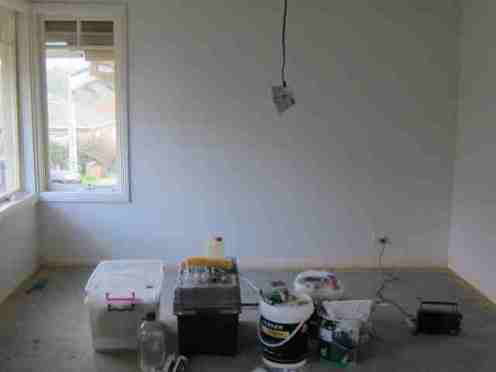
After the last little doggie died we decided to replace the carpet. We had had four little doggies in the house and the little gentleman dog (who- believe me- was NO gentleman!) had made his presence smelt.  To replace the carpet, we had to move all the bookshelves and if we were going to do that then we may as well have the house painted at the same time.  And get new downlights.  And buy  new blinds to replace the verticals leading out to the deck. And clean the other curtains. And wash the windows properly. And buy a new couch.

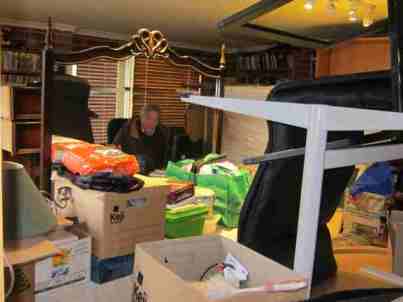
My father, who lives in our back unit, is away on a cruise so it seemed an ideal time to  get all this done. So we’ve moved into Dad’s unit temporarily and piled up all our furniture and books in the rumpus room in the middle.

IMG_2355a

Steve is looking a bit startled, working on his computer in the freezing cold, reflected in the dressing table mirror

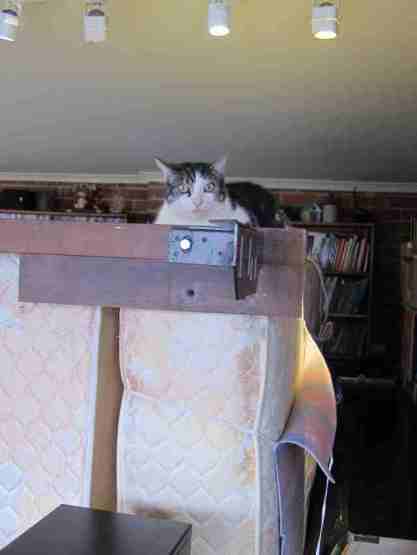
And the cat is not impressed one little bit.

IMG_2344a

I think I might join her, actually.

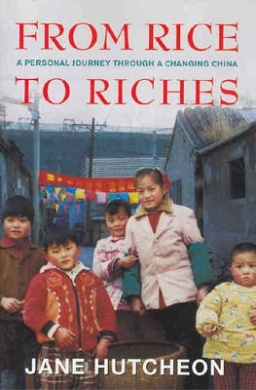
‘From Rice to Riches’ by Jane Hutcheon

Hutcheon

2003, 355 p

It’s odd how companionable one comes to feel with an ABC foreign correspondent who has been chatting to you from the television over many years. ‘Jane Hutcheon, ABC, Beijing’ sounds very familiar, as does ‘Barbara Miller, ABC, London’ or ‘Martin Cuddihy, ABC, Nairobi’ (and will I ever forgive my son for not introducing me to him when he was right there? Probably not.) I can remember feeling quite upset for Eric Campbell, seeing him so visibly distraught after the death of his camera man in Iraq in 2003.

Jane Hutcheon, with her cheeky smile, and respectful curiosity (on full display at the moment in her current program One Plus One) has long been one of my favourite foreign correspondents. I’ve been aware that this book was available some years ago, and I’m surprised (and rather disconcerted) to find that it was published thirteen years ago!

Jane was born and grew up in Hong Kong, the daughter of a Eurasian mother and an Anglo-Celtic father whose family had been involved in colonial trade in Asia since 1851. Both parents were journalists. As a young Asia Television (Hong Kong) reporter, she covered the handover of a captured Taiwanese China Airlines crew in 1986 and the first visit of a British sovereign to China later in 1986. By the mid 1990s she was the Australian Broadcasting Corporation’s China Correspondent, covering the return of Hong Kong to China, the rise of Falun Gong and the Tenth Anniversary of the Tiananmen Massacre.

Her appointment as the China Correspondent for the ABC, then, combined personal and professional curiosity and in the early chapters of the book she combs over her family history ties as a way of integrating her own family story with the larger narrative of Chinese history from the mid 19th century on.  As she says near the end of the book:

When I went to China as a correspondent I hoped to discover what the essence of ‘being Chinese’ was all about, to understand why my ancestors had been drawn to its shores more than one hundred and fifty years ago…Though the world is now a different, much more convenient place, I tried to live the adventures of my ancestors.  Eventually, I began to love living in china for less deep-rooted reasons. It was like discovering a rare, antique carpet. The first time you look at it, it appears old and dusty. But after brushing off some of the dust, you notice amid the wear-and-tear the incredible colours that have stayed vibrant, despite the passage of time. After admiring the colours, you notice intricate patterns that tell a story about where the carpet was made, the life of its owner, and how it came to survive to the present day.  Soon, the carpet doesn’t look so old and dusty anymore; it becomes intriguing. (p. 354)

Hutcheon has organized her book by food: Pig’s Face, Slippery Noodles, Shanghai Stir-Fry. The names are a (very) little pun on the more serious theme of each chapter. For example, she deals with her own family history, the Opium Wars and the history of Hong Kong in her chapter ‘Colonial Chop Suey’. She deals with China’s strained relationship with both Taiwan and Tibet in the ‘Renegade Dumplings’. In ‘Spiritual Dim Sim’ she examines Christianity, the Zhao Tianjun temple, Falun Gong and Qigong, while the ‘Big River, Little Fish’ chapter deals with the Three Gorges Dam and its influence on the villagers who used to live on its boundaries.

Each chapter introduces us to many informants, just as an extended ‘Foreign Correspondent’ episode might do.  Interviewing people who have a different perspective to the ‘official’ line often involves deceit and disobedience,  and recent events with Peter Greste and the emergence of Reporters Without Borders and PEN remind us that writing and reporting can be dangerous in a way that might not have been so much the case in 2003.  She is often tailed by not-very-intelligent intelligence, and the Cultural Revolution and  Tienanmen Square are palpable presences in the background amongst her interview subjects.  She speaks to many people, and in this regard the book has the feeling of being an extended documentary feature, with people speaking their piece before the interviewer moves onto the next angle.  Fortunately, where she refers back to a character she has mentioned before, she explicitly names the chapter where the character previously appeared.   There’s also an index, a generous and unexpected feature in a book of this type.

Overwhelmingly, though, I found myself wishing that I was reading it thirteen months after it had been written rather than thirteen years later.  She foreshadows the insistence on ‘one China’ which is still asserted today and writes of the burgeoning and aspirational Chinese middle class that fueled the resources boom here in Australia in the decade after the book was published.  Less visible to her then was the military assertiveness of 21st century China, Muslim unrest in China in the context of a terrorist-nervous world, and the recent slowdown of growth in China that Australia seemed so blithely oblivious to.   None of this is Hutcheon’s fault, of course, but it does toss the ball back into my own court to find out what happened next.

aww2016 I have counted this towards my tally for the Australian Women Writers’ Challenge.
An interesting dedication

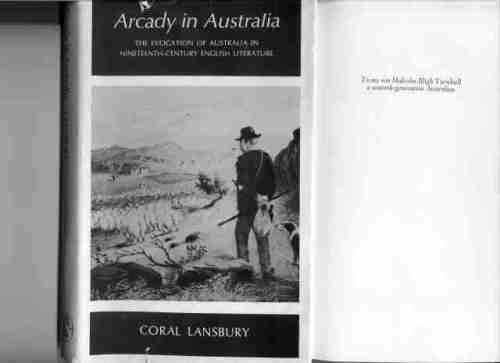
There’s been talk over the last couple of weeks about Malcolm Turnbull’s personal story. I was interested to see the dedication in his mother Carol Lansbury’s book Arcady in Australia, published in 1970 after she had married John Salmon in New Zealand.Lansbury_Turnbull

“To my son Malcolm Bligh Turnbull a seventh-generation Australian”.

This Week in Port Phillip in 1841: May 16-23 1841

WARNING: Aboriginal and Torres Strait Islander readers are warned that the following post contains names and images of deceased persons.

There are three indigenous deaths that were mentioned in the news this week, each demonstrating a different aspect of frontier clashes between indigenous Australians and settlers.

DEATH OF ‘JACK’

Well, I think that we all knew that this wasn’t going to end well.  In the last posting of This Week in Port Phillip 1841  dated May 8-15, we read the report of the surgical amputation of the leg of ‘Jack’, an indigenous prisoner brought down to Melbourne to face murder charges over the death of a convict overseer. Such drastic surgery, and not unexpectedly….

On Sunday at about noon, the Aborigine named “Jack” upon whom amputation was performed a few days since, died in the Hospital. Ever since the operation was performed “Jack” has exhibited considerable symptoms of restlessness, tearing off the bandage, and continually getting out of bed, thereby injuring the stump and causing inflammation, which terminated in death. (PPH 18/5/41)

AN ATTACK UNPUNISHED

An extraordinary edition of the Port Phillip Herald on 19 May reported the Supreme Case of R v Jenkins and ors. In this case William Jenkins, William Martin, John Pennington, Edward Collins and Robert Morrison were jointly indicted for shooting at an aborigine, with intent to maim, disfigure and disable him, at Cumberland Creek. They were also charged with a second count of intent to do grievous bodily harm.

In a detailed breakdown of the case, Paul Mullaly explains that the ‘disturbance’ took place in early February 1841 on the Boral Creek outstation of the Lodden River station owned by Messrs Dutton, Darlot and Simson. There had been rumours from the local aborigines that the ‘Goulburn blacks’ were coming to kill shepherds and steal sheep, and so the accused men, all assigned servants (i.e. convicts) went to the outstation one evening, followed by Henry Darlot the next morning.  The next afternoon, there was a confrontation between the assigned servants, some of whom were armed, and two Aborigines known as Tommy (otherwise Goudu-urmin) and Abraham (or Jemmy- named in the PPH article as  Manharger-bun).  Morrison was grabbed around the neck by Abraham, who tried to take his pistol, while other aborigines were nearby, stealing items from around the outstation.  The white men claimed that spears were thrown at them and that they fired in response. Abraham and Tommy were wounded and Morrison was released without injury.  It is likely that Tommy died (although there is no mention of a body)  but Abraham did survive.

The matter came to the attention of Assistant Aboriginal Protector Edward Stone Parker who was responsible for the Loddon District. He instituted an enquiry, and took depositions from the men involved. And that was the problem.  According to the practice at the time, the accused could not give evidence on oath, only a statement about the evidence already collected.  The common law maxim “no one is bound to accuse himself” (or nemo tenebatur prodere sipsum for the Latin-readers amongst us) applied, and in Blackstone’s words the fault of the accused was ‘not to be wrung out of himself, but rather to be discovered by other means, and other men’.  But what if the only people present were all accused, with the only other witnesses excluded from giving evidence because they were Aboriginal?

Parker submitted the case to the Crown Prosecutor, James Croke, who chided Parker for taking depositions from men who were alleged to have committed the offences. Parker replied that there was another witness, Joseph Maddox, who rode up after the shots had been fired.  During the case, which Judge Willis recorded in his casebook, Joseph Maddox was the only witness.  At this point the Crown Prosecutor ‘relinquished the proceedings’ and Willis directed the jury that the “prisoners were perfectly justified in shooting in self defence”. The prisoners were acquitted.  Willis upbraided Parker for taking improper depositions- a theme which the Port Phillip Herald took up with glee in an editorial on 21 May headed “THE BLACK PROTECTORS

If anything be calculated to arouse the indignation of a free, and besides, a British people, to a sense of the wrongs they have suffered, and the awful dangers to which they are exposed by the tyranny of the Protectorate, and the attempted subversion of the principles of the British constitution by its ignorant officials; and if there be any thing that will come home to the feelings or address the reason of a should-be protecting Government, it is the case to which we have now adverted.  The whole system of the Protectorate is rotten at the core; reform cannot be introduced; its constituent elements are subversive of every principle of equity, or justice, and being thus radically bad, must be wholly extirpated from the province.  The Protectors as a body, instead of a blessing, have proved a curse to the community at large, and as such we will not lose sight of them until they are removed from place and power.  (PPH 21/5/41 p.2)

A DEATH IN CUSTODY

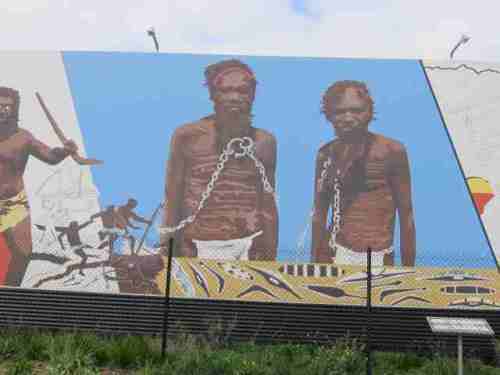
Along St Georges Road in Northcote, in front of the oval that abuts the Aboriginal Advancement League, there is a large mural.  It was originally erected in a temporary car-park on Ruckers Hill in 1983, but was shifted to its current location in 1988. It became increasingly dilapidated and in 2013 it was dismantled, digitally photographed, updated and re-erected and stands proud and confronting again.


Probably the most disturbing section of all shows two indigenous men chained together around the neck.  The image came from Western Australia in the early twentieth century, but in May 1841 a similar case came before the Supreme Court in Port Phillip.

IMG_2316a

On December 6 1840 mounted constables Michael Goodwin and Thomas Connock arrived in Melbourne with an indigenous prisoner, Jag.ger.rog.rer, known as ‘Harlequin’. He was about 19 years of age, and had been arrested on warrant near Yackandandah and brought to Melbourne for trial. He was delivered at the watchhouse in poor health, with a chain around his neck and died on 8 December. It had been a eight day journey of 153 miles, with Jag.ger.rog.rer chained and on foot for all but 14 miles.

The Aboriginal Protector, George Augustus Robinson wrote a long report on ‘Harlequin’s’ death in his journal on 10 December 1840. There was quite a bit of official discomfort about this death in custody.  James Croke wrote to La Trobe that

I must candidly confess that the disease of which Harlequin died was superinduced by the manner in which he was made to travel (and that there is evidence of that fact I am quite satisfied) the escort are as guilty of his death as if they had shot him without justifiable cause. (Croke to La Trobe 12 Feb 1841 VPRS 19 41/232)

In a later letter Croke said that he thought that not just the final two escorts, but all constables responsible for Harlequin’s custody should be examined. This was carried out, after some skirmishing between Police Magistrate Simpson and Protector Robinson over responsibilities for conducting inquests and taking depositions. The case came before Willis in the Supreme Court on 17 May 1841 when Goodwin and Connock were charged with manslaughter. A report of the case from the Port Phillip Gazette can be found here and Willis’ notes from his Case Books with a commentary from His Honor Paul Mullaly can be found here.

The journey that ended so tragically for Jag.ger.rog.rer went like this:

On 29th November 1840 Sergeant Rose of the Mounted Police took Jag.ger.rog.rer into custody from Ewing’s station. At this time he reported him to be in good health and able to work well. He was marched 14 miles to the barracks on the Hume, a seven-hour journey. On arrival,  the handcuffs were removed and replaced with a small horse chain, weighing from half a pound to a pound, and a padlock weighing a quarter of a pound. This was done, the court heard, because the chain “was considered the easiest way of securing the black, so that he could travel without pain”. Sergeant Rose then handed him over to the charge of Troopers Byers and Rowley who took him the ten miles to Barber’s station, at the rate of about three miles and a half per hour. They slept the night there, with the prisoner secured by handcuffs on his wrist, a pair on his legs and a chain passed through and secured on the outside.

The next day they set off at 7o’clock, with Jag.ger.rog.rer reported to be in good health, eating his bread, meat and tea well. It took all day to reach Mr Reed’s on the Ovens River, a distance of 35 miles. He was handcuffed the whole way, with the chain held by one of the troopers. “Harlequin spoke so much English as to make himself understood, but made no complaint of being tired, or that he wished to stop.”

On 1 December they departed Reed’s station at 7.30 and arrived at Broken River, 30 miles distant, at sundown where he was given into the custody of Corporal Kershaw. The corporal started off the following morning with Jag.ger.rog.rer secured by a collar chain, the leather around his neck and the strap through a link of the chain, with a padlock. They travelled 28 miles along a bushy road that was not easily travelled.  Harlequin rode two miles, and they stopped at one of the Seven Creeks.

On 2nd December they proceeded to the Goulburn, about 29 miles. About twelve miles before arriving, Jag.ger.rog.rer complained of a pain in his side after eating heartily. He was permitted to rest for two hours and travelled the rest of the journey on horseback.  He was handed over to Sergeant Keely who was told that the prisoner had complained of a pain in his side. They stopped here for a couple of days

On 4th December it was reported that Jag.ger.rog.rer (Harlequin) was sick, that he coughed and appeared very ill. On 5th December he was given into the charge of  Goodwin and Connock to take him to Melbourne as quickly as they could. A chain, four feet in length, weighing about two pounds and covered with cloth was placed around his neck. It was reported that the chain was not a noose, and could not tighten around the neck.  The prisoners, who were not ordered to stop at any particular place, travelled about 35 miles that day, stopping at Mr Green’s station.

They arrived in Melbourne at about 4.00 o’clock on the 6th December and he was taken to the Watch-house. By this time he had a ‘dog chain’ around his neck and the chain was so tight that it was not possible to pass a ringer between the chain and Jag.ger.rog.rer’s neck.  His face was swollen, he had difficulty breathing and when the chain was removed, he threw himself down on his back.  Dr Cussen was called and when he attended he found Jagger-Rogger sitting on the floor of his cell, rather hot and feverish, but Cussen conclused that “he had all the symptoms of a man who was excessively fatigued”. However, the next morning, the fever was worse and he was removed to the hospital where he was administered a mild purgative.  On the 8th he was given more active medicine but died either that night or early the next morning.

The doctor considered

the fever to have been caused in this  case both from fatigue and mental depression. …[He] did not think that travelling 75 miles in two days in the month of December in Australia Felix, with chains on the hands and neck would be sufficient to cause death, providing there was no undue pressure on the neck.  The pain in Harlequin’s side must have been spasmodic or muscular; if it had been inflammatory, it would have gone on so rapidly as to have impeded the journey in a very short time. Never saw a case where mental anxiety caused a fever so rapid in its effects as to cut off life in two or three days. (PPH 18/5/41 p.3)

This was the end of the Crown case. At this point, Willis told the jury that, on hearing the evidence, he was duty-bound to instruct that there was no culpable excesses by the prisoners; that Dr Cussen’s evidence showed that the pain in the side was not caused by the manacles, and that he had been treated kindly and given provision whenever he had stopped.  The jury immediately returned a verdict of not guilty “deeply regretting the loss of life occasioned by the neglect of some parties”.

[I haven’t been able to find any information about the distance usually travelled when escorting prisoners.  The speed of 3 miles per hour seems to be a generally acceptable walking pace today, but I cannot imagine that this speed could be sustained over rough country. The only image that I have been able to find of a prisoner escort dates from 1855 where S.T. Gill sketches five prisoners being transported in a cart. It is not clear whether they are chained by the neck or not]

References:

Paul Mullaly Crime in the Port Phillip District 1835-51 (Hybrid, Melbourne, 2008)    pp.  61-62; 353-357; 365-369

Judge Willis Casebooks  http://www.historyvictoria.org.au/willis/index.html


.


Exhibition: Somewhere in France

SWIF_eventbrite-top-banner-01

Baillieu Library’s current exhibition ‘Somewhere in France: Australians on the Western Front’ is on show until 26 June 2016.

Our commemorative attention has been directed towards the Western front this year,  now that the Gallipoli commemorative caravan has moved on. This exhibition is not, as you might expect, mired in the trenches but instead looks at life away from the front, as young soldiers, nurses and volunteers explored villages, attended theatre performances and encountered new food and culture.  There’s a particularly chilling gas mask on display in one of the cases which reminds us that the front was always present, and the mention of listening to a gramophone while in the trenches highlights the paradox of a war fought along such a small ribbon of contested land.

The exhibition displays contemporary diaries and letters, photographs and ephemera drawn from the University’s collection of material donated by former students, most particularly Ray Jones and Alfred Rowden White. Current day students have researched the material and created two short video presentations based on the stories of Melbourne soldiers and Red Cross workers who ended up ‘Somewhere in France’.

For more information see here.


And so…

Who IS this ridiculously happy person?

S160525LA002-PA138a