You might remember that in January of 2018 I was involved in a street opera ‘Serenading Adela’, which commemorated the centenary of Adela Pankhurst’s imprisonment in Pentridge Prison, and the night when women marched to the prison to ‘serenade’ her with socialist and anti-conscription songs. A full video of the performance will be made, and this short promotional film has been released to attract potential funders. You’ll be hard-pressed to find me, although occasionally I can be glimpsed. Anyway, enjoy the performance…. it was great fun.
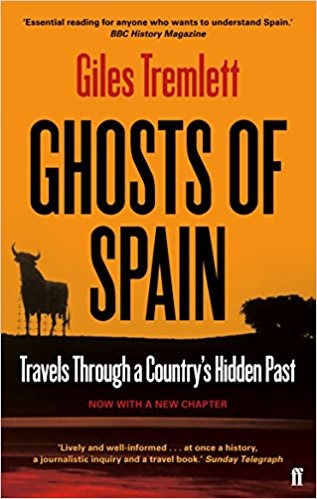
I’m not a particularly keen reader of travel books, but as I’m going to be in Spain in the next few days, I decided to read this book which has gathered pretty good reviews. It’s written by a journalist who has lived in Spain for over twenty years, making him enough of an insider to understand what he is seeing, but enough of an outsider to have his attention attracted by the unfamiliar.
Throughout the book he refers to the ‘two Spains’ – the conservative, religious Spain and the outward-looking, liberal if not socialistic Spain – that still exist in Spain today. The first three chapters are about Franco and the Spanish Civil War and the general agreement to look the other way and leave well enough alone. After these first chapters I thought that the book was going to continue in this vein, but it became more journalistic and digressive. He moves around different regions of Spain (the Basque Region, Catalan district and Gallacia), as well as discussing childrearing practices and death rituals. There’s a good map and a good index, so it acts well as reference book. It’s fairly current, with a good discussion of the Madrid terrorist bombings, immigration and the economic recession following the global financial crisis that particularly affected Spain and Greece.
I won’t know until I’ve been there how useful any of this is going to be, and whether there will be resonances in what I see. Quite apart from the anticipation that the book has aroused, it was an interesting and entertaining read with a narrator that you feel you’d like to know.
2017, 308 p. Translated from the Spanish by Camilo A Ramirez
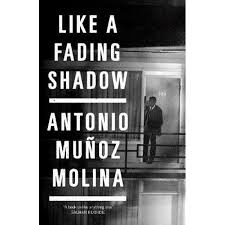
This book takes as its starting point the little-known fact that after the assassination of Martin Luther King, the chief suspect James Earl Ray spent ten days in Lisbon, trying to obtain an Angolan visa. When this did not succeed, he went to London, where he was arrested.
This thread of the story, based on true facts, is interwoven with the author’s own narrative of the act of writing. This itself is split into two further threads: in 1987 when, as a young writer, the first-person author went to Lisbon to write another story (which we never get to read) set in Lisbon, and then a return journey in 2012, when the author returns to Lisbon, then travels to Memphis to research the James Earl Ray story for, presumably, the book you are reading.
This all sounds rather complex, but it’s not really while you’re reading it, once you realize that there are two separate author narratives in play. In a way, it is almost a relief to break away from the increasingly fevered, paranoid world of James Earl Ray which, left unmediated, would be suffocating. As his money runs out, he is becoming encircled by his own fears and distrust as much as anything else. When the end comes – as we know it does – Molina jumps ahead to James Earl Ray in prison years later, writing his own narrative that centres on ‘Raoul’, the man Ray claimed to have been behind the assassination. Molina reports this, but sceptically.
Separated by twenty-five years, the older author ‘I’ is a more balanced, reflective man than the younger author, who left his wife with a newborn second baby in order to follow his passion in writing his novel. As an older man, he is by now reflective about the act of writing, the role of novelization and the narrative imagination.
The last part of the book takes us almost minute-by-minute to Martin Luther King, hanging over the balcony of the Lorraine Motel. We know exactly what is going to happen, yet Molina manages to wind up the tension as we wait for the finger to press the trigger.
The time shifts in this book are complex, but Molina keeps good control of them. It’s a taut, controlled book that draws you on, even though you know how it’s going to end.
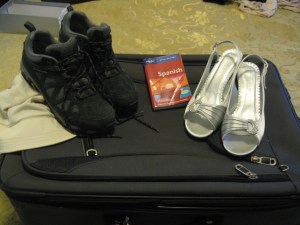
Guess where I’m going this time? Some wedding shoes; a hiking hat and boots; a Spanish phrase book. Yep. I’m going to David’s wedding in Nairobi, I’m going to look at gorillas in Rwanda/Uganda then I’m off to the south of Spain.
When I saw that this book was my bookgroup’s selection for May, I wondered how I would cope with it, as Dad died at home in January this year. My qualms might seem rather paradoxical, given that I chose to read Pat Jalland’s Australian Ways of Death right in the midst of Dad’s passing. Somehow that seemed different. I wanted to read Jalland to contextualize what I was feeling within a historical frame of distant times and foreign mindsets – a comfortable and comforting exercise for me- whereas these were contemporary, personal stories told from my own city. I felt that I could trust Jalland’s distance and span as a historian, but I didn’t feel the same way about a journalist with an eye to the good story. As it turned out, the book wasn’t as confronting as I feared it might be, but my misgivings were not assuaged by the time I finished it.
Lisa Birnie was a writer-in-residence who spent several weeks at McCulloch House, a palliative care centre attached to Monash Medical Centre. There she spoke with patients, families and staff members while seeking the answer to her question: “Is euthanasia desirable or necessary or could accessible palliative care supplant the need for it?” As the weeks went on, and as she met more patients, her question changed to “Should a rigidly circumscribed law be drafted that permits patient-requested euthanasia in cases where all palliative care practices to control pain have been unable to do so?”
The fraught question of euthanasia was one that she had grappled with in her earlier book Uncommon Will: The Death and Life of Sue Rodriguez (1994), where she followed the legal battles of a young woman with Motor Neurone Disease to commit suicide with a doctor’s assistance. She came away from that case concerned that euthanasia would inevitably be used against people who did not want it, and that it would pre-empt further research and provision of good palliative care. Moreover, by her own admission, Birnie acknowledges being ‘spiritual’, and I think that both these dispositions drove her to explore and frame her questions as she did.
The book is divided into eleven chapters, each fronted with an epigraph and a short title: Hope, Denial, Searching for Meaning, Pain, Living Fully Until Death, Attitude, the Caregiver, Faith, Last Rites, Grief and Love, The End and the Beginning. Each chapter is similar in structure, starting first with the story of a particular individual, their illness and their family, followed by an interview with a staff member. I felt just a little voyeuristic, prying into this most intimate and physical of events, but there was much to think about too. There was young Michael, aged 30, dying with melanoma shortly after his second child was delivered by caesarean so that he could see him before he died; or Adrian, also in his thirties, whose mother clung to the hope of a miracle. There were people who kept having more and more surgery; a woman who wanted her daughter and friend to be part of her death; a man with sarcoma of the mouth who drew from the strength of his brother; and most memorably a driven business-man whose anger at his illness was an extension of his need to control his family and business as well.
Her approach is anecdotal, not analytic. Only in one chapter did she venture beyond the walls of McCulloch House to consider palliative care in the home (as we did with Dad). I feel that she was somewhat ‘captured’ by McCulloch House and her feelings about palliative care in the home are equivocal. She did not ever come to a definitive view. She was more conscious of the limitations of pain relief for a small percentage of people and her concerns about euthanasia becoming normalized still stood.
This book was written twenty years ago. I wonder how she would feel about the Assisted Dying legislation passed in Victoria last year. She alluded to negative experience from the Netherlands, which does not tally with my perception of the overseas data presented to the enquiry and legislation last year. Most particularly, her book deals only with patients dying with cancer. She does not deal with patients with dementia, or MND and other degenerative diseases (not that the Victorian legislation gives any comfort to dementia sufferers and their families.) By the end of the book, I was left feeling that she had not really shifted all that far in her attitudes from where she was at the start i.e. a spiritual woman concerned about the ‘slippery slope’. On the other hand, I was pleased that the question was still left open in her own mind. I do wonder, too, if she’s still alive (she was born in 1928, although still very actively writing in 2014) and whether she still feels the same way.
It was interesting (and somewhat sobering) to listen to our book group discussion, amongst a group women aged mid-60s to mid-80s. I was a bit surprised at the strength of feeling against assisted dying held by some of our members, reflecting the strength of my own feelings to the contrary, I suspect.
Read because: CAE bookgroup
My rating: 8? It’s difficult to separate my own feelings about her conclusions, from my feelings about the book
I have added this to the Australian Women Writers Challenge database. To be honest, I hadn’t heard of her before and I didn’t realize that she was Australian. She was born in Australia and started her career at the Warrnambool Standard, then the Hobart Mercury and Argus before travelling to London to cover royal events. She then travelled to San Francisco, and later lived in Vancouver.
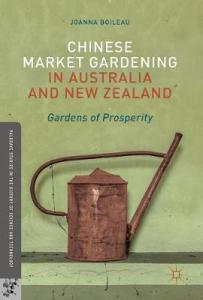
Most Victorian country towns and suburbs that had access to a river with a floodplain tended, at one stage or another, to have a Chinese market garden. Not just in Victoria either- there were Chinese market gardens right along the eastern coast of Australia, in Western Australia too, and in New Zealand. They’re largely forgotten now, as most had disappeared by World War II. However, for about 50 years between about 1880 and 1930 the Chinese market gardens fulfilled an important role in providing fresh vegetables to urban markets.
Joanna Boileau’s book takes a transnational approach, locating these gardeners not just in sites across Australia and New Zealand, but back in China as well. The majority of Chinese immigrants to Australia and the Pacific from the mid19th century onwards came from a restricted area of Southern China, the Pearl River Delta region of Guandong Province. There, a highly developed agricultural economy had reached the limits of its cultivable land in 1850, leading to mass emigration where single men travelled overseas to earn money to send home to their families. They had little capital, and indeed indebted themselves to family and labour agents in order to make the journey, but they took with them their labour and agricultural skills.
In Australia, the dominance of large scale pastoralism and agriculture for export or mixed farming meant that small scale, intensive market gardening as the sole source of income was considered of low status. This opened up an economic niche that Chinese labourers filled, lured by the gold rush, but aware of the high prices for vegetables. They also started up businesses in laundries and furniture making, but discriminatory legislation introduced in Victoria to curtail Chinese business opportunities left them few options other than market gardening and restaurants.
The gardens were run by profit-sharing syndicates of almost exclusively single men. They tended to live beside the gardens in small sheds in poor conditions, where they were often robbed. With time, these syndicates integrated the various occupations involved in food supply: gardening, hawking, running fruit and vegetable stores, and the wholesale fruit and vegetable distribution network. Between 1910-1920 in Victoria, they attained a virtual monopoly of the business at the time.
But they worked hard. The Chinese market garden was highly labour intensive. The soil was prepared, straight furrows were dug, seedlings were transplanted from their own seeds, they were watered by bucket over the shoulders two rows at a time, hoed, harvested, and prepared for sale. They were manured with fermented human excrement and urine, that was collected in large stone urns. This technique was admired by some, and abhorred by others. Unlike European market gardeners, who tended to plant whole paddocks with the one crop, they mixed together different vegetables with differing harvesting times. They dealt with plants individually, rather than as a bulk crop. Their intent was to have a steady supply of produce, cropped and earning monetary return as soon as possible.
However, the number of Chinese market gardens began declining after 1910 and by WWII most of them had disappeared. With the enforcement of the Immigration Restriction Act of 1901, there was not a steady influx of new generations, and so the existing market gardeners became older and older. New Italian, Greek and Maltese arrivals were moving into market gardening from the 1920s and 1930s e.g. at Werribee in Victoria, and landowners now subdivided their land instead of leasing it for market gardening.
I suspect that this book has probably emerged from a PhD thesis, with its rather theoretical opening chapter that deals with diaspora, technology transfer, material culture studies and transnationalism. The book covers the eastern states of Australia, and New Zealand, so it really provides a good survey of Chinese market gardening. I found her account of the relationship between Chinese and Maori gardeners fascinating, and it marked a real difference between Australia and New Zealand in terms of the relationship between indigenous people and the Chinese. Despite the broad scope of its analysis, she also identified individual market gardeners by name, something that the housewives on their back doorstep could do too, because of their familiarity with these men who called weekly with their vegetables. The subject matter of this book may be rather specialized, but it reads very easily and really fleshes out with individuals a stereotype that has largely disappeared.
Sourced from: State Library of Victoria e-book (did you know that you can borrow them at home?)
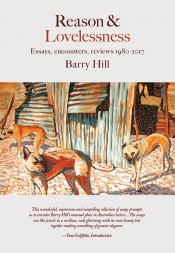
This is a big book and it took a long time to read. ‘Big’ because it’s pushing 500 pages in length, and ‘big’ because it spans 37 years – a whole career. But it wasn’t just the size that made it such a drawn-out reading experience. It’s also because the essays are dense with ideas, and I found myself only able to read one at a time. They were mentally chewy and I wanted to let each one sit for a while.
Barry Hill has hovered on the edge of my consciousness without ever really breaking through. I was aware that he won plaudits for Broken Song, his biography of Ted Strehlow, and I’ve been vaguely aware of him through the Australian Book Review. Looking through the long list of publications at the beginning of the book, he’s been writing novels and poems since the 1970s. However, I haven’t read any of them.
I like reading essays, largely because they allow me to meet the author half-way: to sit in on a conversation, if you like. The essays that I enjoyed most in this collection were where he wrote as a son, writing about his father – an old union man and peace activist- in ‘Letter to My Father’; or about his mother in ‘Brecht’s Song’.
But many of other essays were more cerebral than emotional. After an excellent introduction by Tom Griffiths, the book is divided into four parts: Close to Bones; Inland; Naked Art Making, and Reason and Lovelessness, from which the collection takes its name. Part II (Inland) can be fairly easily characterized as being explorations of colonialism, with reviews and commentaries on W. E. H. Stanner, Greg Dening and elaborations on his own work on Ted Strehlow. He has really enticed me into moving Broken Song up from ‘one day’ to ‘soon’ as far as my own reading is concerned. He really does not like Bruce Chatwin’s Songlines at all (I haven’t read that one, either). In Part III (Naked Art Making) there are several essays on Lucien Freud, John Wolseley and the Australian artist Rod Moss whose work is on the front cover. Parts I and IV are more diverse, several of them based on interviews with poets, writers and artists. In Part IV in particular there are steps of logic that seem to link the essays together.
But I must confess that for many of these essays, I felt left behind. I hadn’t read the work or the author he was discussing, and on the few occasions when I had, I realized the richness of what I was missing. (e.g. his essays on Greg Dening and Robert Manne; his excellent essay about William Buckley who lived with the Port Phillip Wathaurong people after escaping from the convict settlement at Sorrento in 1803, his essay on George Orwell). Reading through his essay on Ezra Pound, I asked my very-widely-and idiosyncratically-read husband “Have you ever read any Ezra Pound?”. He had (of course), and then went on to talk about several of the things that Hill discussed. ” Well, have you heard of Rabindranth Tagore?” I asked him. Again, yes he had, and again mentioned things that Hill had also covered. “YOU should be reading this book!” I told my husband, and I meant it. There’s a conversation going on here, but I’m not part of it.
Should that matter? I found myself thinking of Montesquieu of all people, and the beguiling ease with which he draws you into his conversation. I rarely felt that same ease with Hill’s essays, beyond the more personal ones about his own family. Perhaps that’s because in many of these essays, he’s writing as a critic. Summarizing the content of a work is not part of the role of the critic, and there’s an implicit assumption that the reader is familiar with the work under discussion. That is the reader that Hill is writing for; not someone on the outside looking in. Several of the essays are reflections on interviews and conversations he has conducted with writers – Christina Stead and Rai Gaita – underlining that he is part of their milieu. As a poet, he writes about other poets – Fay Zwicky, Shonagon (the author of The Pillow Book)- and he shares in own poetry in several of the essay.
Given that these essays were written over thirty-five years, they have probably been selected to resonate with the 2018 political climate. ‘The Mood We’re In: circa Australia Day 2004’ was given as an Overland lecture, and it captures that strange era of Latham-esque politics. He still rages over the Bush/Blair/Howard invasions of Iraq and Afghanistan, and his feeling of impotence when protests across the world were futile permeates his essays ‘The Uses and Abuses of Humiliation’, ‘Poems that Kill’ and ‘Human Smoke, Bared Throats”. There is not – mercifully- even a breath of Trump. I suspect that he would find Trump almost beyond words.
This is not an easy book, written by “a truly learned man” as Tom Griffiths notes in his introduction. It demands intellectual chops and familiarity with an eclectic and erudite reading and artistic menu that strays far beyond my knowledge. I felt a bit intimidated by it, frankly.
Sourced from: a review copy from Monash University Publishing.
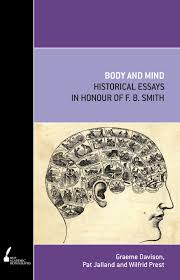
What an unexpected delight! I borrowed this book when I was working on Catherine Helen Spence a few months back, because I wanted to read Susan Magarey’s chapter about Spence’s domestic life. In addition to Margarey’s chapter, I found a collection of fascinating essays written by academics who worked alongside or as graduate students of ANU historian Francis Barrymore (F.B) Smith, a historian of whom I’d largely been unaware, I thought.
Smith, who was born in Hughesdale, was a history of British and Australian history: indeed, he believed that Australian history should be studied as part of the British world. His own publications straddled both British and Australian contexts on themes of political action, freethought religion, medicine and public health. These interests can be seen in the chapters of this book, which arose from a festschrift by his former students and colleagues to which he reluctantly agreed. He died in 2015 and one of his former students and one of the editors of this collection, Graeme Davison, wrote this obituary. Several of the essays allude to his grumpiness and scepticism but also to his enthusiasm and encouragement. Without fail, each of the chapters testifies to his contribution to the intellectual development of the various authors. And what a list of authors! At the back of the book are listed the PhD students he supervised including among many others, Graeme Davison, David Walker, Janet McCalman, Susan Magarey (nee Eade), Joy Damousi, Frank Bongiorno, Michael Roberts, Craig Wilcox, Malcolm Wood, Janet Doust and Barbara Dawson, nearly all of whom I have read at some stage and many of whom have appeared in this blog.
So- what of the chapters? Graeme Davison’s chapter looks at James Kay, whom I didn’t recognize until I remembered Kay-Shuttleworth the public health reformer (who I must confess I thought were two separate people). His chapter ‘Sociology and Self-Knowledge’ combines an analysis of Kay’s reform work alongside his love interest in Helen Kennedy, the daughter of one of his most influential patrons. It is followed by Michael Roberts’ chapter ‘Politics and Public Health in the Age of Palmerston’ which explores political action and reform and the role of research and philanthropy. I really enjoyed Alex Tyrell’s chapter ‘A ‘Cold Water Bubble’? The Mid-Nineteenth Century British Water Cure and its Adherents’ which examines hydropathy, the cold water treatment, and its relationship with mysticism, quackery, alternative medicine and public health. Joanna Burke, from Birkbeck College UCL, author of An Intimate History of Killing, presents ‘The Malingers’ Craft: Mind Over Body in Twentieth Century Britain and America’ which takes as its launching point Edward Casey, a young Cockney soldier who, once caught up in WWI, feigned mental illness to avoid battle. The chapter goes on to consider the development of psychology during wartime.
Geoffrey Best moves to a more autobiographical approach in his chapter ‘Education, Empire and Class: Growing Up in a New London Suburb in the 1930s’, reflecting on his own childhood in Osterley, a ‘middle-classes’ suburb. This chapter ends where the next one begins, when Pat Jalland complicates the ‘stiff-upper-lip’ response to the Blitz in her chapter ‘The Peoples War: Death in the Blitz’. By taking several biographical accounts of the grief and emotional shut-down that followed the sustained bombing, she compares this with the present-day emotional response to public tragedy.
The chapters then shift geographically from Britain to Australia – or, as is made clear in Phillipa Mein Smith’s chapter Australasia – incorporating New Zealand and Australia. Her chapter ‘Retracing Australia: The History of a British Idea’ roves across public health, military and trade in looking sideways between Australia and New Zealand. It seems a particularly relevant chapter given New Zealand’s only-slightly-tongue-in-cheek campaign to ensure that they are not dropped off the map, starring Prime Minister Jacinda Adern.
I just loved Janet McCalman’s chapter ‘To Die without Friends: Solitaries, Drifters and Failures in a New World Society’ which examined demographic and epidemiological data that arose from the charity files of the Lying In Hospital in Melbourne, tracing the health and life outcomes of babies born in straitened circumstances from 1857-1900 up to the end of the open period for death certificates in 1985. As she points out, the information provided in Victoria’s very detailed death certificates required the presence of an informant who knew the names and birthplaces of family members in the past. For men and women estranged from their families, or at the end of a life of marginality and mobility, it is likely that this information remained unknown. She also, in half a page, proposes a pithy analysis of the trajectory of the ‘underclass’ cohort from the gold rushes through to the 1950s.
Then there’s Magarey’s excellent chapter on ‘The Private Life of Catherine Helen Spence 1825-1910’ which had drawn me to the book in the first place, followed by the only chapter that actually speaks about F.B. Smith as a historian. Written by military historian Peter Edwards, ‘A Tangle of Decency and Folly, Courage and Chicanery but above All, Waste’: The Case of Agent Orange and Australia’s Vietnam Veterans’ describes Smith’s own work as a historian in contributing a chapter to the official history of the Vietnam War. Smith reviewed the evidence arising from various commissions and enquiries into the effect of Agent Orange and, despite his own sympathies and convictions about war, concluded that Agent Orange was not the cause of veterans’ suffering – a conclusion, reached also by others, but completely imbued with politics.
And it was reading this last chapter that I remembered that I had read F. B. Smith after all. Last year I read his small booklet on the conscription debates in 1916 and 1917. It was barely more than a pamphlet, aimed at school students (in fact, I’m sure that I used it back in 1972 when I did HSC) but it combined policy, political and moral questions succinctly. Ah- so it was that F. B. Smith!
Looking back at these various chapters, each self-contained and accessible, written by top-notch historians, they are all a reflection of Smith’s own work and influence. They also demonstrate the ripple effect of research: that others pick up one academic’s ideas and interests and make them their own, adding to and deepening the conversation and taking it forward.
I’m such a hypocrite. “Never let the facts get in the way of a good story!” I say, when I’m spinning up some dross into narrative gold. But “Fidelity!” I demand when I’m reading an imagined biography – not necessarily fidelity to the facts, mind you, but faithfulness to the time, dialogue and worldview of the characters.
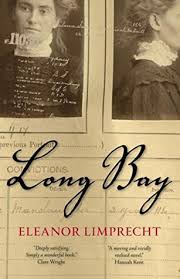
In this case, Eleanor Limprecht has allowed the facts to get in the way of a damned good story by very conscientiously citing verbatim a letter from the Long Bay Women’s Reformatory as the frontispiece to her book. I didn’t realize it at the time, but once I reached that point in the narrative, the suspense that she had sustained so well about her character’s fate broke down and I wished that I hadn’t read the frontispiece. But other than this, I think that Limprecht has pulled off the feat of combining research into a real character with a fictionalized narrative that is true to the evidence.
Rebecca Sinclair, as you can tell from the title and front cover, ended up an inmate of the Long Bay Women’s prison. She had a hard childhood and adolescence, working as an outworker seamstress alongside her mother in the inner suburbs of Sydney in the 1880s. Largely to escape this straitened life, she married Don, who is largely under the control of his mother, and is a liar and wastrel. In Limprecht’s telling, it is largely because of Don’s influence that Rebecca ended up in jail. I’ll leave her to explain how and why.
The story is told in the present tense, a tense which (as I have said often before) I find uncomfortable to read (and even though I’m using it myself as I write this!) There are some infelicities in the dialogue which at times sounds too late 20th century, but by tethering her book in authentic legal documents, she doesn’t stray too far. Her depiction of Rebecca Sinclair is fleshed-out and human, and if at times the research bones become apparent, Limprecht’s character is convincing enough to stay in your mind after you’ve finished the book.
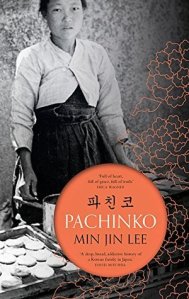
Back in the early 1970s, at the age of 18, I went to Japan with a Rotary group. It was a very wholesome tour, but I do recall seeing two things which perplexed me at the time, but I understand better now. They were both in the same building, as I recall: a largish building, similar to an RSL. There was a large, dimly lit bar, with drunken men in white shirts and ties, crooning along off-key to an instrumental soundtrack that I now recognize as karaoke. At the time- and indeed now over forty years later – I couldn’t work out why male office workers (and they were entirely male) would want to make a fool of themselves in this way. On another floor was what I was told was a pachinko parlour, likewise windowless and dimly lit except for the carnival lights around the pachinko machines. I couldn’t really make sense of the machines, which seemed like a mixture of pokie and pinball machine. But when I saw the title of this book, I knew exactly what pachinko was.
I came to read the book solely on the say-so of Whispering Gums Sue’s reading group who selected this book as one of their favourites for the year. When I put it on hold at the library late last year , I found that almost eighty people were ahead of me. Three months later I picked it up, read the back blurbs and my heart sank. “Oh no!” I thought as memories of Falling Leaves and Amy Tan sprang to mind, dreading another three-generation Asian family saga mired in the author’s own autobiography that ends up in America with a self-entitled middle-class, middle-aged woman alternately intrigued and repelled by the lives of her grandmother and mother.
But I need not have worried. In her acknowledgments at the back of the book, the author notes that the story originated in a lecture she heard about Koreans in Japan, where a boy bullied by his classmates in his year book, jumped from a building and died. Fascinated by the failure of Japanese-born Koreans to be recognized as Japanese, and the scant prospect of this changing in the future, she researched further and conducted interviews. These people may be historical victims, she conceded, “but when I met them in person, none of them were as simple as that”. I think that the origins of this book in historical situation, rather than genealogy, is what lifts it right out of the pack of Amy-Tam-clones.
The book is divided into three parts: ‘Gohyang/Hometown 1910-1933’, ‘Motherland 1939-1962’ and ‘Pachinko 1962-1989’. Within these parts, the narrative is told chronologically, with jumps of perhaps three or four years, shifting between Korea, which Sunja leaves permanently, and Nagano, Osaka, Yokohama and Tokyo in Japan where she raises her family. The story starts in 1910, the year of Japan’s annexation of Korea, when Hoonie, a good man hampered by his cleft palate and club foot, marries a poor young rural girl, Yangjin. They have a single surviving daughter, Sunja. When Sunja falls pregnant to a married man, Hansu, her situation is relieved by another good man, the Christian preacher Isak, who marries her and takes her to live with his childless brother Yoseb and sister-in-law Kyunhee in Japan. Sunja’s first-born son, Noa, grows up believing that Isak is his father, while his real father, Hansu, by now a gangland leader, is an ever-present, watching presence.
The tumultuous events of the second half of the twentieth century (comfort women, Japan during WWII, the communists in North Korea, the US involvement in the Korean war, the American acceptance of Christianized South Koreans as immigrants) all occur off-stage. They are not unimportant, because they form the background to the family’s situation as ongoing outsiders, too frightened to return to the silence of North Korea, accruing wealth and remaining distrusted by the Japanese. The pachinko industry is mired in the Korean underworld, but it lures the family as the only means of progress when education – held up as the path of responsibility – has its limitations. The pachinko game stands as a metaphor for life, where the game is tweaked and manipulated, but it draws its players on for just one more play, in the hope that this time, there will be a win. Life, like a pachinko game, “looked fixed but … also left room for randomness and hope.”
I really enjoyed this book. It’s long, and not for nothing does Lee cite Dickens in her epigram to Part 1 of the book (“Home is a name, a word, it is a strong one; stronger than magician ever spoke, or spirit answered to, in strongest conjuration”). The book evoked Dickens in its sweep and length, and I found it entirely engrossing, luxuriating in a whole Easter Sunday to sit and finish it in one big gulp.

 The Resident Judge of Port Phillip