Category Archives: Uncategorized

Update: Serenading Adela

The best-laid plans of mice and men….

The full length version of Serenading Adela will not be shown after all, because of technical difficulties. They’ll still be showing the other short film, and the cut-down version of Serenading Adela that had already been released online.…and there will still  be cake.

Serenading Adela: The Film Launch

adela

Update: The full-length film of the performance will not be available for the event. They will still show ‘Against the Odds’ and the shorter version of the film already released online.

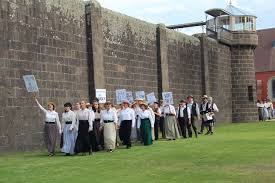
You might remember that earlier this year I was involved in the ‘Serenading Adela’ project. It commemorated the night, one hundred years earlier, when women marched up Sydney Rd to Pentridge Prison to ‘serenade’ Adela Pankhurst, who was incarcerated there under the War Precautions Act.  They made a film of our performance, and they’re launching it tomorrow Friday 28th September at the Brunswick Scout Hall, 213a Weston St Brunswick at 2.30 p.m.  As well as the film of the performance, there will be a short feature ”Against the Odds: The Victory over Conscription in World War I’

Surely that’s better than watching two footy teams that we don’t care about – indeed, may even actively dislike- marching in the city!

See the Facebook event at

https://www.facebook.com/events/299952080796125/?active_tab=about

Or if you’re boycotting Facebook, here’s the blurb:

Did you love “Serenading Adela, A Street Opera” and want to watch it again? Or were you one of the many who were too late for tickets?

Please join us to launch our new full-length archival video of the Centenary Performance of Serenading Adela, a Street Opera. It’s being edited from footage of four cameras there on the day, by Jeannie Marsh and Bernard Peasley.

In the best matinee tradition, we’ll show a short first: ‘Against the Odds: The Victory over Conscription in World War I’ tells how diverse groups and individuals collectively defeated conscription and left a lasting legacy for Australia. From the Living Peace Museum, with a Brunswick focus.

We’ll be serving a delicious afternoon tea to follow the film.

FREE ENTRY but donations towards film costs and future projects will be enthusiastically solicited.

The Scout Hall is 213A Weston Street Brunswick. Note as this is the Grand Final Public Holiday, crossing the city by tram may be a challenge – a train to Parliament, then the 96 tram to Miller Street, recommended (or check PTV for updates).

Six Degrees of Separation: From ‘Where Am I Now?’ to ‘Sex and Suffering’

A few of the blogs that I follow join in with the Six Degrees of Separation meme, hosted by Booksaremyfavouriteandbest .  I gather, if I’ve read it correctly, that everyone starts off with the same book. Participants then make mental leaps to name six other books that they’ve reviewed on their blog. [See Sue’s comment below – it doesn’t have to be reviewed on your blog]. This time the meme starts off with Mara Wilson’s Where Am I Now?

Well, I hadn’t even heard of the starting book, or of Mara Wilson. But the little girl on the front looked familiar- and of course! It’s Matilda!

Her surname is Wilson, and she shares it with Rohan Wilson whose book The Roving Party fictionalizes John Batman, the putative founder of Melbourne as he bashes his way through the Van Diemen’s Land bush to ‘conciliate’ the remnants of the Plindermairhemener people in 1829.

A non-fictional approach to that same John Batman (and yes, that really is his name) is taken in Bain Attwood’s Possession, which closely examines Batman’s ‘treaty’ with the indigenous people of Port Phillip, and the uses to which the Batman/Fawkner ‘discovery’ story has been put in Melbourne historiography.

A more famous book called Possession, written by A. S. Byatt won the Booker Prize in 1990.  I’ve read it, of course, but that was before I started writing this blog. Hilary Mantel was one of the judges and so naturally we mentally leap to Bring up the Bodies, her not-yet-completed trilogy about Thomas Cromwell.

The topic of bodies is linked to death, but death seems to evade the old colonel in Gabriel Garcia Marquez’s The Autumn of the Patriarch, as he wanders his decrepit palace, wanting to die but somehow waking up again the next morning to start all over again.

Two other patriarchs, on different sides of the American ideological chasm over abortion in present-day America are found in Joyce Carol Oates’ A Book of American Martyrs.  Dr Gus Voorhees is shot for his pro-choice activities, and Luther Dunphy, an evangelical Christian, is the man who shot him.

The Royal Women’s Hospital in Melbourne delivered babies, but it also tried to save the lives of women whose abortions had been botched or incomplete. Janet McCalman’s Sex and Suffering is a history of the hospital, from its earliest days in Melbourne.

What an odd place to finish up! That was rather fun.

Movie: Mary Shelley

It’s the 200th anniversary of the publication of Mary Shelley’s Frankenstein and so there’s been quite a bit about both the book and its author around this year.  This film, directed by Saudi filmmaker Haifaa al-Mansour looks at Mary Shelley as daughter, sister and partner as well as writer. I liked the way that it emphasized the importance of Shelley’s impoverished father William Godwin and mother Mary Wollstonecraft as intellectuals, although their radicalism was downplayed. The film finishes on rather a high note with the publication of the second edition, although it could have extended even further where the loss and poverty of Shelley’s life became even more tragic.  However, while mentally cheering inside, I don’t know that I actually buy the suggestion that the book was written as Shelley’s jab at the two monstrous men in her life, Percy Bysshe Shelley and Lord Byron (who is particularly creepy in the this film.) Elle Fanning is luminous, and it’s beautifully staged.

My rating: 3.5 stars (of 5)

The Statement from the Heart

The Garma festival, held each year in Arnhem Land, took place last week. In its own words,

Garma attracts an exclusive gathering of 2,500 political and business leaders from across the globe. YYF is committed to improving the state of Indigenous disadvantage by engaging business, political, academic, and other leaders of society to shape global, regional, and industry agendas.

This year the theme was “Truth Telling”.  A number of speakers made reference to the ‘Uluru Statement’, a beautifully written, important report from the Referendum Council, which had been appointed by the government and comprising indigenous and non-indigenous representatives. You can read the Final Report of the Referendum Council here. Even if you don’t read the whole report, read the Uluru Statement from the Heart.

It was delivered to government in May 2018 and almost immediately quashed.  The speed and apparent finality of its dismissal by the government was damning. The Great Australian Silence descends again.

But there’s talk. Noel Pearson  spoke. And Richard Flanagan wrote.  Read it.


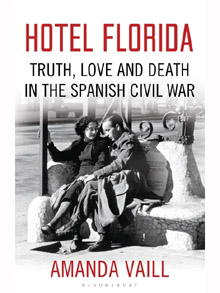
‘Hotel Florida’ by Amanda Vaill

Hotel Florida by Amanda Vaill.jpg

2014, 464 p.

I read this book solely because I was going to Spain. Beyond what I’d read in Ghosts of Spain, I knew very little about the Spanish Civil War beyond Guernica, the idea of it being a dress-rehearsal for WWII and the participation of writers and intellectuals who went there to fight. So I have no opinion either way about the completeness of Vaill’s account, her felicity to the sources and the robustness of her argument.  I leave all that to historians of the Spanish Civil War. I read it just “because”.

In her author’s note, she notes “Hotel Florida is a narrative, not an academic analysis”. However, as the lengthy notes at the end of the book show, this is a heavily researched book, steeped in the sources. The linchpin of her narrative is the once-deluxe Hotel Florida, a hotel in Madrid, frequented by government figures and journalists.  The six main ‘characters’ of her book all stay there at one time or another: writer Ernest Hemingway and journalist Martha Gellhorn, war photographer Robert Capa and Gerda Taro (you can see some of their photographs here) , and press officers/censors/propagandists Arturo Barea and Isla Kulscar. These three couples are all real-life people (even though I confess only to being familiar with Hemingway and Gellhorn). She draws on diaries, letters and the published works of her characters, and you sense her picking the gems from other people’s words.

The book proceeds chronologically, from the first uprisings of Franco and his troops against the republican government, and traces through the departure of the republican government to Valencia, and the eventual overrun of Franco’s forces.  It moves its focus from one character to the other, as they shift between Spain and Europe and America. There’s a shifting cast of other writers and celebrities, drawn to Spain as well, including Eric Blair (George Orwell), Dorothy Parker, Antoine de Saint-Exupéry, – why, even ‘our’ Errol Flynn turns up.

I don’t think that at any time I ever lost an awareness that this was a non-fiction book. She is not just relating facts: she shapes an argument as well. She emphasizes the Soviet influence on the republican government, she is suspicious of the veracity of Gellhorn’s reportage and she doesn’t have much time for Hemingway. Her sympathies are overwhelmingly with the loyalist republicans. She looks at the relationships between the couples as well.  Hemingway dangles Gellhorn as his ‘bit on the side’, relishing the scandal but afraid of his wife; the Capa/Taro story is probably the most affecting of the whole book; while Barea and Kulscar are buffetted by the political winds that make commitment to any side dangerous.  Although she focuses on these three couples, who to a certain extent sweep across the fighting as observers rather than participants, Vaill does not let the reader forget that this is an actual war with bombings and many, many deaths.

I don’t know whether this book is ‘good’ history or not. A review in the Guardian by Paul Preston criticizes its Cold War tone and reliance on suspect sources.  While ‘narrative’ in tone, it is not novelistic as such, but more a group biography told through a kaleidoscopic lens. I feel that I came away with a much better understanding of the Spanish Civil War- at least, from the republican side. As for whether her analysis of the Soviet influence is correct or not- I leave that to others. I just read it “because”.

Sourced from: e-book from Yarra Plenty Regional Library

My rating: 7.5

Friday essay: the ‘great Australian silence’ 50 years on by Anna Clark

https://theconversation.com/friday-essay-the-great-australian-silence-50-years-on-100737

An excellent essay in The Conversation by historian Anna Clark reflecting on WEH Stanner’s 1968 Boyer Lectures where he coined the term ‘the great Australian silence’ to describe the occlusion of indigenous people from narratives of Australian history. Her essay comes fifty years after those essays, but also in the contemporary context of the political response to the Uluru statement and  Lyndall Ryan and others’ work on the massacre map.

I encourage you to read it.

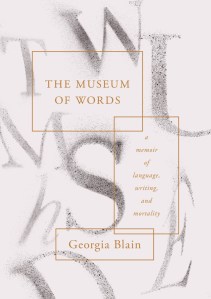
‘The Museum of Words’ by Georgia Blain

blain_museumofwords

2017, 176 p.

Packing up an elderly parent’s house is hard. You are sorting, packing, throwing all those familiar markers of a life, acknowledging that they are worth nothing and yet knowing that they were treasured. You feel sad and guilty.

In her book ‘The Museum of Words’, Georgia Blain tells of packing up her mother’s house for sale. Her mother, author and journalist Anne Deveson, was still alive, but in care and oblivious to the practical financial arrangements that were being made around her.  The personal stuff had been largely cleared away, and the  house was being prepared for the open inspection, that odd state where a house has to be curated to look lived in , but not too lived in. In Anne’s study, there was a corkboard left on the wall, stripped bare when they were repainting. Georgia hastily found a pile of photos in a cupboard and began to decorate the board.  Dogs, grandchildren, holiday photos, children’s photos, Georgia pinned them up. “I felt as if I was creating a museum of happiness” she told her daughter and husband.(p.48)

Blain has called this last book ‘The Museum of Words’, and in reading it you can’t help but think that this is Blain’s own act of pinning up her life. Dying with brain cancer, with a glioblastoma the size of a golf ball, she writes of the experience of her illness, threaded by perverse coincidence with the illnesses of her mentor, friend and human rights activist Rosie Scott, who was dying with exactly the same condition, and her mother who was dying with Alzheimers.  She writes of herself as daughter to Anne and in turn, as mother to her daughter Odette. Men do not play a large part in the story. This book is in many ways a love letter to all three of these women, to the act of writing, and in her final paragraph, an assertion of gratitude for life itself.

The book is interspersed with photographs, which act as a way of telling when the words don’t come.  There are spaces on the page, which I didn’t recognize as quickly as I might have in an e-book instead of a printed edition

In the foreword, written by her husband Andrew after her death, and in Blain’s book itself, there are several references to the increasing difficulty with writing that Blain experienced.  You can sense that the flow is disrupted and that the sentences are perhaps less complex than they might otherwise have been. But most of all, I was left with my eyes brimming at the thought of her actually finishing the writing of this book and her decision as an author writing her own life to round it off and to write the final sentence before turning to the task of editing.  Too young, too soon, too much left unwritten.

Sourced from : YPRL e-book

My rating: too hard to rate.  In terms of emotional punch, though, 10/10
AWW-2018-badge-rose-199x300 I have registered this review with the Australian Women Writers Challenge.

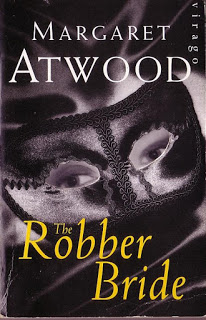
‘The Robber Bride’ by Margaret Atwood

robberbride

1993, 576 p.

Set in Toronto, this book was published in 1993. Three female friends, Tony (Antoinette), Charis and Roz are having lunch together when another woman enters the restaurant: Zenia, a mutual ‘friend’ who was supposed to have died several years earlier. Each of these women has her own history with Zenia, a charismatic woman who variously lied, cajoled, blackmailed and bullied her friends.  The title comes from a Grimm Brothers fairytale ‘The Robber Bridegroom’ where a young woman was threatened by her betrothed and his gang of men.  In an inversion of the fairytale, Zenia steals the husbands and partners of her friends.

After a too-long opening section which places the three women at the restaurant, the book then turns to each of the friends in turn. Tony is a military historian, a rare woman in a male-heavy academic field, who sees the world through her historical consciousness of memory, chance, inevitability and choice. Charis (formerly Karen) is a floaty-hippy type woman with a gruelling family background. Roz is a successful business woman whose own family background is shadowy.  Zenia finds her way into each woman’s vulnerability and uses it against them. While doing so, she engineers the break-up of their relationships with their men.

The real skill of this novel is Atwood’s full-blood rendering of each of these women in turn. In effect, it could be three books in one. They are all equally well-developed as characters, and their relationship with Zenia is plausible. The same cannot be said of Zenia, who remains enigmatic and depicted, in a rather over-wrought style, as the personification of evil. That’s the only truth about her: all the rest is lies and deception.

I was satisfied with neither the beginning nor ending of this book.  For the first fifty pages I kept thinking “Oh, just get on with it” and the ending was too quick and not entirely believable.  But the middle part – and that is where the crux of the book lies- is really well written.

It’s hard not to see this book in the context of The Handmaid’s Tale (1985) and Cat’s Eye (1988), both of which also deal with women’s cruelty to other women, although the cruelty here is at an individual, personal level rather than social or institutional.  It raises good questions about how feminine aggression is manifested, and how other women respond to it. It’s interesting to consider how the story would differ if a man preyed on the wives of his male friends, and how they would respond to his perfidy.

Sourced from CAE bookgroup

My rating: 8/10

Serenading Adela: the short movie!

You might remember that in January of 2018 I was involved in a street opera ‘Serenading Adela’, which commemorated the centenary of Adela Pankhurst’s imprisonment in Pentridge Prison, and the night when women marched to the prison to ‘serenade’ her with socialist and anti-conscription songs.  A full video of the performance will be made, and this short promotional film has been released to attract potential funders.  You’ll be hard-pressed to find me, although occasionally I can be glimpsed.  Anyway, enjoy the performance…. it was great fun.