Category Archives: This Week in Port Phillip District 1841

This Week in Port Phillip in 1841: 8-15 June 1841

Oh dear, I’ve fallen so far behind with all of these. House renovations and conferences seemed to get in the way and I’m quite embarrassed by my tardiness. Apologies.

THE ‘DIGNITY’ BALL

And we’ve all been waiting so long for the Dignity Ball- and here it is! As you might remember, the Patriot and Gazette railed against the elitism displayed by the ‘gentlemen’ of Port Phillip wanting to distance themselves from the ‘common’ (sniff) Queens Birthday Ball.  But apparently the stewards had a change of heart, and decided to include some people who had been previously excluded.

The Ball is in preparation to come off on the 8th instant. The Stewards may be congratulated upon the wisdom they have shewn in acting after the suggestions of the press, by modifying their senseless exclusionism, and extended the issue of their tickets. This policy, which we learn from the Stewards has been thus tardily adopted , will certainly bring the fete off with greater credit to themselves and the character of the population.  (Port Phillip Gazette 5 June 1841)

Notwithstanding this change of policy, the Port Phillip Patriot predicted a poor turnout:

The famous ‘Dignity Ball’ postponed in the first instance till the races, then till Her Majesty’s Birth day, then till the 4th June and then till the 8th instant, will eventually, it is expected, come off tomorrow night, but the attendance it is expected will be as poor as unpopularity can make it.  A bold manoeuvre was made by the Stewards at the eleventh hour to retrieve their original blunder by issuing invitations to the parties previously passed over as unfit for admission, but it has very properly failed.  Our contemporary, the Gazette has, we regret to observe, taken this manifestation of a defeat as an evidence that the stewards have had the good sense to modify their “senseless exclusionism” but we know them better.  Nevertheless we are sorry that it is so, for it is not in our nature to war either against the men or the amusement, though we have warred, and will war to the death against them, or any other set of men who, like them, attempt to set themselves up to decide automatically as to the eligibility or non-eligibility of their fellow-colonists for admission to society(PPP,June 7) p. 2

And sure enough, its report of the ball portrayed it as a drab affair:

The far famed  and long expected “Dignity Ball” came off on Tuesday night, and a very dull affair it proved.  The attendance was but thin and few of the ladies of Melbourne honoured the assemblage with their presence in consequence of certain doubts which had got about touching the reputation of one or two fair dames expected to be present.  The only really good part of the evening’s entertainments was the supper, which , as we are told, did great credit to Mr Meek’s knowledge of the science of gastronomy. (PPP June 10)

And so we need to turn to the Port Phillip Herald, regarded as the newspaper of choice for ‘better’ society to give us a more positive report

THE BALL- This private entertainment took place at Mr Davies’ long room, on Tuesday evening, and went off with much spirit.  There were forty-four ladies and sixty-seven gentlemen present, His Honor, Mr La Trobe and Lady, amongst the number, who seemed highly delighted with the evening’s festivities.  The Stewards had provided a most magnificent supper, which was done ample justice by the guess. The party did not finally separate till five o’clock. (Port Phillip Herald 11 June 1841)

It is the presence of Superintendent La Trobe and his wife Sofie, that marks this Ball out as ‘respectable’, in a way that the earlier Queen’s Birthday Ball was not.  And the stamina- kicking up their heels until 5.00 a.m. (and we thought all-night dance parties were a new phenomenon!)  And was Judge Willis there? No!   Fourteen years ago in Upper Canada he had been a bit of a socialite with his first wife, but there’s little evidence of party-going antics in British Guiana or New South Wales.  Perhaps he’d learned his lesson in Upper Canada; or maybe his second wife (who was expecting a baby in September) was reluctant to go. One way or another, he wasn’t there.

PROGRESS IN PORT PHILLIP

Things were really starting to move in Port Phillip. Early buildings of canvas and wood were giving way to more substantial constructions as a very physical demonstration of progress in the District.

PUBLIC BUILDINGS: We feel a pleasure in recording the fact, that the public buildings in Melbourne, in the progress of erection, are going ahead in a steady and praiseworthy manner, when the limited mechanical force employed is taken into consideration. The Custom House “where merchants most do congregate”, a building in all extensive mercantile communities of the utmost importance, is now ready for slating, that description of covering being preferred to shingles.  The Bonded Store beneath may be found too small for its legitimate purpose, if so the plan of licensing stores, belonging to private individuals in the town, may be continued as an present.  The Post Office, at the junction of Bourke and Elizabeth-streets, is progressing rapidly, and in a couple of months, if nothing intervenes, may be in possession of the proper officers, “a consummation devoutly to be wished.” The New Watch-house, on the Eastern Hill, has been completed, and taken possession of within the last few days.  It is a stone building, conveniently designed, and well executed, and will be appropriated to the reception of the idle and disorderly in the vicinity of New Town, instead of their being dragged upwards of a mile to the Melbourne receiving house, as heretofore.  The foundation of the Jail has been excavated, and one wing of the building already commenced, which will be completed before any further portion of the building is proceeded with. This wing will be appropriated solely to the reception of convicts, or parties committed for trial.  The plan of the building is that of the wings of the new Sydney Jail, and will contain forty-two cells upon the ground floor, and in the upper stories it is to be three in height, rooms 12 by 6, for the purpose of classification.  The second wing is for a House of Correction, and Debtor’s Prison. When completed, the whole building will consist of two wings, facing Swanston Street, in a line with the Caledonian Hotel, having the Jailer’s house etc. in the centre.

The Customs House mentioned here is not the one that stands in Flinders Street today. The picture below, by Robert Russell in 1844, shows the brownstone Customs House described here. It is, nonetheless, one of the most impressive buildings in Melbourne.  It was replaced by a second Customs House from 1858 onwards.
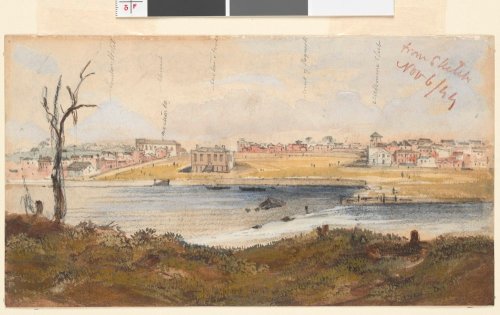
Melbourne from the falls 1844

Melbourne From the Falls, Robert Russell 1844, SLV

http://handle.slv.vic.gov.au/10381/56125

The jail mentioned here is the Old Melbourne Jail, but it is not the bluestone cellblock that still stands today, which was commenced in 1853. Earlier buildings were demolished in the 1930s, so presumably the buildings described here would have been removed at that time.  The Eastern Hill watch-house described here, according to Robyn Annear’s Bearbrass was on the corner of what we know as Exhibition and Little Collins Street.  Its proximity to ‘Newtown’ (i.e. Fitzroy) would be along Exhibition Street.

AN EARTHQUAKE!

Actually, this occurred on 6th June, but wasn’t reported for a few days.

EARTHQUAKE: An Sunday last, during the hours of divine service, a rumbling noise was heard in the earth, supposed to be the fore-runner of an earthquake. In the Church it was distinctly heard, and the congregation alarmed; also, in several parts of the town, giving rise to various speculations. (PPH June 11)

It often strikes me that, for these early settlers, everything was still new.  Were earthquakes common?  They didn’t know.

AND THE WEATHER?

A high of 18 (64F) and a low of 4 (40) for the week. Fresh breezes on 9th, 10 and 12th. Weather mostly dry but cloudy.


This Week in Port Phillip 1841″ 1-7 June 1841

THE ‘DIGNITY’ BALL

Are you all on the edges of your seats, waiting for the Dignity Ball scheduled for 4th June? Well, you’ll need to wait another week because it was rescheduled from Friday 4th to Tuesday 8th June at the request of several Presbyterian families who would not otherwise have been able to attend.  Stay tuned.

THE MULTICULTURAL SUPREME COURT

Two small snippets in the Port Phillip Herald during this week allude to the multicultural nature of early Port Phillip, an aspect often overlooked in the emphasis on Scots, Irish and English immigration to the colony.

On 4 June mention was made of a Muslim (or ‘Mahometan’) witness who was unable to swear on the Koran, because one was not available.   Redmond Barry, who had called the witness, suggested that in future a Koran should be available for that purpose. Judge Willis told him that it would be counsel’s responsibility to ensure that one was provided.

A few days earlier on 1 June, a light-hearted article reported on an interchange in the court between a Chinese witness, his hastily-improvised interpreter and the court. Historian Nadia Rhook has written about Charles Powell Hodges who was appointed the Chief Chinese Interpreter in 1871 (library login required) but this case arose during the earliest sittings of the Supreme Court in Port Phillip, long before the influx of Chinese  during the Gold Rush of the 1850s.

CHINESE LANGUAGE- At the last Criminal Court it was necessary that an interpreter should be sworn to elucidate the language of a native of the Celestial Empire who talked Chinese. After a little stir in the court, a gentleman who had resided both in Penang and Canton, was installed, when the following amusing dialogue ensued, being a very novel specimen of oral Chinese:

Gentleman:- How ya, how can do; what you see?

Chinaman:- Me see him sun, him moon, him star

Gentleman:- You see many use bayonet?

Chinaman:- No me see man use pin; ‘tick woman in him breast, like one turkey.

Gentleman: Hi ya. What for ‘tick him in the breast?

Chinaman:- Just like tickle; all over funny

Gentleman:- When woman die?

Chinaman:- Six- eight moon ago- she nice woman, make he so so – all one dress like not’ing

Gentleman:- You good witness

Chinaman:- He yaw

Here ended the scene.

The case during which this interchange occurred was the murder trial of Thomas Leahy on 15 May, who plead not guilty to the charge of murder of his wife.  In Paul Mullaly’s analysis of the case found on the RHSV Judge Willis site, the Chinese witness was John Horn, a ‘Chinaman’ who lived at Portland, where the murder occurred. Prior to accepting Horn’s evidence, Willis tested his competence as a witness by asking whether he was a Christian and whether he understood the difference between truth and a lie. Willis then asked how Horn would have been examined in his own country. Horn replied that he would break a saucer to represent what would be his fate if he did not tell the truth.  As the Port Phillip Herald of 25 May had reported it:

A CHINAMAN’S OATH: A Chinaman named Horne [sic] having to be sworn in the Supreme Court the other day, was handed a blue and white earthernware soup plate, which having looked on with becoming reverence he dashed to pieces upon the floor of the witness box, the the astonishment of the uninitiated in such matters. Upon being called upon to explain how that ceremony was binding upon his conscience, he exclaimed “Me no speakee truth, then me fall pieces all like one plate.” (PPH 25/5/41 p.3)

The case continued. Leahy was not represented by counsel, and so Willis asked barrister Edward Brewster to act for him. When Brewster complained that the Crown Prosecutor, James Croke, was leading the witness, it was decided that an interpreter was needed.  The Justice of the Peace Robert Martin, who had lived in Penang and Canton, was called upon to act as a makeshift interpreter, leading to the interchange reported above.

In the end, Leahy was found guilty and sentenced to death. However, when the case was sent up to Sydney, doubts were raised about whether the Supreme Court could sit in both Sydney and Melbourne simultaneously.  By the time it was decided that it could, Willis and La Trobe had sent up a recommendation for mercy, and Leahy’s sentence was commuted to transportation for life.

THE MANTON BROTHERS’ MILL

In the entry for May 1-7, I noted the opening of John Dight’s mill on what is now known as Dight’s Falls.  Dight’s Falls may well have come to be known as Manton’s Falls instead, as three brothers Frederick, Charles and John Manton had planned to build a water mill there as well. However, when they were denied permission to do so, they built a steam saw and flour mill on land that they had purchased previously in Flinders Street. (See a summary of a speech ‘Give Us This Day our Daily Bread’ given to the Port Phillip Pioneers by Margaret Kaan in February 2012)

Charles and Frederick Manton 1872. Photographer: Thomas Charles Chuck. State Library of Victoria http://www.slv.vic.gov.au

Located opposite the wharf, it may well have been in a more advantageous location, and Manton Brothers established themselves as both mill proprietors and merchants. It was a short-lived enterprise, though, as the company was dissolved in 1843 in the wake of the economic depression.  There was no sign of this in June 1841, however…

MR MANTON’S STEAM MILLS. The Steam Mills on the Wharf are nearly completed.  The chimney has raised …to a height of seventy feet, and [shows?] much credit on the builder, for a more elegant structure is seldom seen at [home as?] the one alluded to presents. ..the sawing department is completed and will commence work immediately, and is capable of cutting up four thousand feet of timber in twelve hours.  The corn mill is being roofed in and will be at work in [?] weeks, grinding two hundred and fifty bushels of wheat per day. The whole of the machinery in these mills is of [?] order, and when in operation will be well worthy of inspection. (PPH 4/6/41 p. 2)

ENTREPRENEURIAL AGILITY

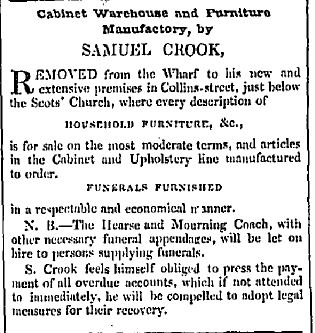
Our 21st century entrepreneurs had nothing on the 1841 entrepreneurs of Port Phillip, who managed to combine surprising, but quaintly logical, commercial endeavours within the one enterprise.  Take Mr Crook, for instance:

Crook

(PPH 4/6/41 p.1)

SOME POETRY

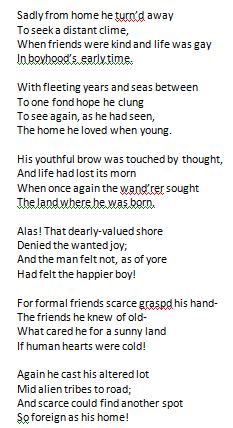
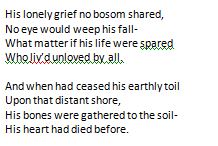
In a settlement with many newcomers, and where  financially-stable early settlers and their families were travelling back ‘home’ for a visit, this poem offers a salutary warning:

THE EXILE’S RETURN

poem1

poem2

HOW’S THE WEATHER?

Not too bad, actually. The weather was “fine and clear” with the warmest day on 4th June when it reached 65 (18.3C), and a low for the week of 45 (7.2). There was no rain and the wind was generally light, although fresh on 1st and 2nd June.

This Week in Port Phillip 1841: May 24-31

“Melbourne” the Port Phillip Gazette announced grandly at one stage “boils over like a bush cauldron with the scum of fierce disputes.”  Of course, the Port Phillip Herald was often completely complicit in adding to the fire of disputes, but during this week in May, and the following weeks in June, we see the small colonial outpost of Port Phillip at full boil.

As I described in an earlier post, the King’s or Queen’s Birth-Day was (and still is) celebrated across the empire on different days at different times. In 1841 Victoria was on the throne, and her birthday was 24 May. The length of her reign really embedded that date on the colonial calendar.

According to the Port Phillip Gazette (PPG 8/5/41 p.3) the idea of holding a Birth-Day ball for the first time in Melbourne was mooted at the Caledonian Hotel, where a number of squatters decided that there should be a Race Ball to close the race carnival.  The stewards, however, decided that it should be held on the Queen’s Birth-Day instead, and that it should be a Private Ball rather than a Public Ball. Expenditure of 500 pounds was approved and 180 tickets put aside.

However, as the Port Phillip Patriot reported, when Mr G. G. Sullivan R. N. approached Redmond Barry and asked to be put onto the list of subscribers, he was referred to one of the stewards, William Meek.  Meek, who did not want such people to lower the tone of the gathering,  told him that the list was already full, which Sullivan disputed as he named several people who were going whose names were not yet on the list. Meek agreed to put Mr Sullivan’s complaint before the Stewards, who noted his letter but said that there was no need to comment further on it.

In the resulting furore it was decided that ball planned for the 24th May at Yarra Yarra House  would be opened up to a more ‘general’ admission with new Stewards appointed (Messrs Abrahams, Langhorne, Kerr, Connolly, Sullivan and Urquhart). The original Stewards ( Messrs Simpson, Powlett, Meek, James McArthur, Lyon Campbell, Verner, Major St John) would conduct a Private Ball instead (sneeringly characterized by the Port Phillip Patriot as the ‘Dignity’ Ball) at Mr Davis’ Exchange Rooms at a later date.

Underpinning the clash of these two Balls lay the question of colonial respectability.  Quaint as it might seem to us today, it was a question of fundamental importance to a large social stratum within Port Phillip Society, as historians Kirsten McKenzie and Penny Russell have so clearly shown. As ‘Perpateicus’ wrote to the Port Phillip Patriot on May 17

It is impossible, indeed, that society should long exist without distinctions; a line must be drawn somewhere; where choice is afforded, men will be guided by some rule in their selection.  In the colonies more especially, circumspection is needful, from the obscurity which surrounds private individuals, not to mention that many came abroad expressly for the purpose of taking up new characters, alien alike to their birth and their former habits.  In this point of view, colonial life is a grand masquerade, in which some assume stations to which they have no pretensions, while others sink those to which they justly entitled.  In such a medley, who is to judge? The members of the Club very naturally conclude that all beyond their pale are unworthy of regard.  The country settler repudiates the friendship of the Melbourne merchant. The nouveau riche derides the pretensions of his less fortunate neighbour. Latterly we have seen even the Bench itself reviving obsolete statutes for the purpose of distinctions which might better have been left to the judgment of society….[For]any man to submit his pretensions to a clique of individual who, besides being self-constituted and blessed by Club notions, have committed themselves to the egregious sentiment that gold is the correlative of gentility, would be an act of sheer folly, and a downright dereliction of self-respect. Though favourable to the distinction of society, it is important that such distinctions should be founded on some merit real or presumable. (PPP 17/5/41)

Others, like George Arden in the Port Phillip Gazette (who was highly critical of the ‘Dignity’ Ball) embraced the opportunities to do things differently in a new land:

In a new world as we may term Australia, one of the first and most important steps to greatness, is to shake off the prejudices that have so long fettered society in the father land, and in assigning any member his relative position with the mass, to be guided by character, either past or present. Birth and rank if inherited are enhanced by merit, without it these possessions are desecrated.( PPG 8/5/41)

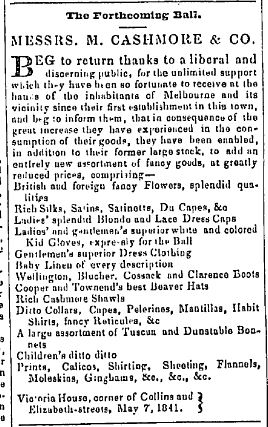
Of course, a ball was a good opportunity to frock up with new clothes and Michael Cashmore the grocer was quick to capitalize on it as this advertisement from the Port Phillip Herald of 14 May shows:

Cashmore

And so how did it go? According to the Port Phillip Gazette

Her Majesty’s Birth Day was celebrated on Monday by a Public Ball held at Yarra House, which had been given up to the Stewards by the proprietor for the occasion.  The rooms, which are admirably adapted for a large party of this description, were arranged with every consideration to the comforts and convenience of the assembly.  The two drawing rooms were set apart for dancing, and the band being placed in the hall, enabled the votaries of Terpsichore to form separate sets in each room, whilst the suite of apartments in the left wing of the building was retained for cards.  The large room in the rear was appropriated to refreshments, which were supplied in the profusion throughout the whole evening. The unfavourable state of the weather precluded a great number from attending, especially those in the country; a dark night and the almost impassable state of the roads and streets, being sufficient to deter any but the most loyal from making the sacrifice necessary to evidence those feelings of respect to Her Majesty. Those, however, who set those considerations at nought, seemed to meet a recompense in the general hilarity of the assembly nor suffered their spirits to droop until the approach of morning warned them of the period for departure. (PPG 26/5/41)

The pastoralist-oriented  Port Phillip Herald, which was derisive of the spurious and jumped-up ‘respectability’ of the Stewards of the Public Ball, did not describe the Ball in its columns (probably because they didn’t attend). Instead, it reported on the appearance of some worse-for-wear attendees in the Police Court.  The writing style with short phrases joined together with a dash was often used by all three papers in writing comedy. Unfortunately, it’s one of those narrative styles that doesn’t travel across time well: perhaps you just had to be there.

POLICE  INTELLIGENCE John Berry, a confoundedly rakish-looking youth, whiskers awry; hair matted with damp and brickdust; neckerchief disorganized and out of set; waistcoat denuded of primitive virginity and spotted with negus; Newmarket green coat, rent to the collar; pantaloons, “a world too wide for his shrunk shanks”; speckled socks cased in patent leather; an astounding display of Mosaic jewellery; and a crushed hat and opera cane, was ushered to the bar, charged with retiring to rest that morning in one of the lakes opposite Yarra House.

Bench- Were you drunk?

Berry- To be sure I was; but permit me to elucidate. But first let me invoke (here he turned up his eyes to the ceiling and ejaculated in a falsetto voice) “Muse of the many twinkling fee Terpsichore”. Now for the elucidation. Last evening, in honor of Victoria I did forty-two shillings’ worth of Yarra House, and found it a bad bargain.  Remarkably grand display- lights glittered- eyes flashed- [?] twinkled- soft music- strong negus- foolish- stewards- Health to the Queen- three cheers- one for piccaninny-Caterer “John” slaughtered ham and beef – no poultry- plenty cigars- plenty “FANCY FAIR”- Mohawks from bush – hobnailed boots – [?infutine?] elegance- young elephant – Tartan – highly approved – blacklegs chucked – dice rattled – cards shuffled – Goat in boots – talked Bob Short – devil of uproar – lady insulted – insulter floored- black eyes- bloody noses – tumble down stairs – evaporated – talk of duel – no apology – all smoke – negus operating – dancing unsteady – dozens in corners – napping – kissing &c – all up – room, lights, fiddlers, twist round – bid adieu- there I am – damn that Charley, too bed – score worse – tipped Traps, did it snug- “that’s ALL”.

Having finished his harangue, he was ordered to pay 5s. which having complied with, this sample of the Birthday Ball mob flourished his cane and departed, vowing it to be the dearest two guineas’ worth he had ever purchased.

AND THE WEATHER?

Winter had really set in with gales and strong winds on 28th, 29th and 30th.  It rained on the 23rd (hence the wet roads on the night of the ball) and there were dense fogs on 24th, 25th and 26th.  The highest temperature for the period 22nd-31 May was 64 degrees (17C) and the lowest was 37 (2.7)


This Week in Port Phillip 1841: May 8-15

NO A BETTER TIME TO BE….A PARTY ANIMAL

It seems that May was Party Time in Melbourne, with intimations of balls to be held later in the month, and news of the Tradesmen’s Union Benefit Society annual knees-up at the Builders Arms Hotel in Little Collins Street.  This Society, comprised of “independent, honest tradesmen and mechanics to whose exertion and expertise this town chiefly owes it original structure and present stability” was formed in May 1839 under the patronage of Captain Lonsdale, with Dr Cussen as the Medical Officer (PPG 29/5/39). Its regulations, which closely followed those of a similar Sydney-based organization, emphasized that it was “based on humanity and charity…and characterized by real utility, and defended by morality and religion”. On payment of a weekly subscription, members were eligible for sickness benefits and surgical and medical aid, based on the length of membership and the availability of Society funds.  Soon after its formation it boasted 100 members. [See: Sullivan Men and Women of Port Phillip p. 236-8]

So what happens at a Tradesmen’s Union Benefit Society Dinner?

Yesterday the annual dinner of this Society was held at the ‘Builders Arms’ Little Collins-street, when about thirty of its members sat down to a most respectable feed, both before and after which, they walked in procession accompanied by a band. (PPH 11/5/41)

A GOOD TIME TO BE… AN ATTORNEY

As long as you were a respectable attorney, that is. On the last day of Easter Term Judge Willis  heard applications for the admission of attorneys (or what we would call solicitors today) to practice in the Port Phillip court. Judge Willis took this very seriously as while he was in Sydney he was responsible for establishing the procedure by which local attorneys were admitted. This included 5 years service under articles of clerkship, an  interview, and examination by practitioner examiners who issued  certificates testifying to the applicants’ fitness and capacity. Applicants needed to demonstrate their ‘Classical proficiency’  which included translation of   Aeneid of Virgil in Latin,  St John’s Gospel in the Greek,  and a competent knowledge of Arithmetic and Euclid.(See: Simon Smith ‘The Shaping of the Legal Profession’ in Judging for the People p. 73)

Several of the attorneys who applied had already been accepted for practice in the Sydney courts but Willis wanted to ascertain their fitness for his own court by himself.  He baulked at the admission of John Duerdin (sometimes spelled ‘Duerden’) who had a question mark over his fitness because, although he had been admitted as an attorney 10 years earlier ‘at home’,  he had been lately carrying on a business in Melbourne as an Ironmonger, Bookseller and General Dealer.  When it was urged that he had “left off business a long time ago”, it eventuated that it had only been since March and Willis rejected the argument that he should be admitted on account of the “peculiar circumstances of the Colony”.  Willis asserted

The peculiar circumstances is the very reason why I am more strict.  If parties are not respectable I will not admit them.  A person who has been carrying on a trade is not a proper nor safe person in whose hands to entrust the legal affairs of others.  I will not permit a person to step from behind a counter to practice in this court… He did not think that he could admit a party who had been a retail dealer in the town only two months since, with that degree of security which was due to the public and the members of that Court. (PPH 11/5/41)

[You’ll be pleased to know, though, that Mr Duerdin went off to refresh his knowledge and was admitted in November and went on to have a long and happy legal career]

GOOD TIME TO SELL REAL ESTATE

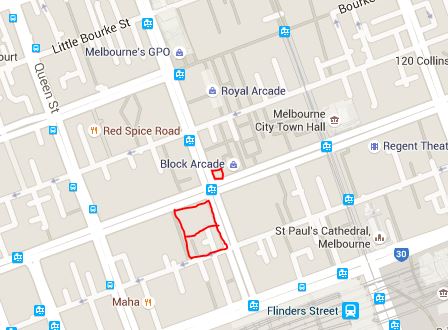
The Port Phillip Herald of 11 May had an advertisement for the sale- that very day- of the town lots held by George Coulstock fronting Collins, Elizabeth and Flinders Lane, including property in what is now Staughton Lane, running behind Elizabeth Street. They were known as Number 10 and 11 of Block 4. George Coulstock bundled them up for sale with an additional property on the corner of Elizabeth and Collins known variously as Townend’s or Cashmore’s corner (so named for the grocers who had their shops on that corner). There’s a map from the time available here and my own very dodgy map below:

coulstock


Although they had been surveyed as Numbers 10 and 11 in 1837, they had already been subdivided into smaller allotments. They are, of course, prime central city real estate today but I was interested to see what sort of business were located there in 1841.  All the lots sold at auction on May 11 1841, and I’ve put the price per foot reached in brackets but the results (in PPH 14/5/41) became too confused to follow near the end.  We know, as they didn’t at the time, that the bottom was just about to fall out of the real estate market.

Lot 1: 40 ft frontage to Collins Street; 120 ft depth. Commodious dwelling house with workshop and backyards, sublet to Mr Richardson for his ironmongery establishment  [14 pounds sterling, 14 s.per foot]

Lot 2: 36 ft frontage to Collins Street, 70 ft depth. Mr Davis’ Auction Rooms sublet to Messrs Hunter Summerville & Co.[12 pounds sterling per foot]

Lot 3: 26 ft frontage to Collins Street,  60 ft depth. Messrs Dugan and Donelly “one of the most lucrative eating house establishments in Melbourne” [25 pounds sterling 4 s per foot]

Lot 4: 30 ft frontage to Collins Street, 52 depth. Mr Townend the Grocer [13 pounds sterling 13 s. per foot] (the small separate allotment on the other corner of Collins and Elizabeth)

Lot 5: 50 ft frontage to Elizabeth St, 52 ft depth leased to Mr Leadman pointer and glazier [unfettered, 15 pounds sterling 15s per foot]

Lot 6: 30 ft frontage to Elizabeth Street – vacant  [the report of prices received is confused at this point]

Lot 7: 74 ft frontage to Elizabeth St, 108 ft depth. “Upon this allotment is erected the Melbourne Tavern…it contains 9 bedrooms, three sitting rooms, a tap room or bar with cellar, an excellent kitchen and a ten stall stable with all necessary conveniences”. [immediate entry 2600 guineas]

Lot 8: 41 ft frontage to Elizabeth Street,ditto  – vacant [14 pound stirling 14s per foot]

Lot 9: 24 ft frontage to Elizabeth Street, ditto. Dwelling house containing two rooms and a shop [619 pounds stirling]

Lot 10: 24 ft frontage to Elizabeth Street, ditto. Dwelling house and shop containing 3 rooms each 24X12 ft let to Mr Harrison the Hair Dresser and Perfumer. [525 pounds stirling]

Lot 11: 30 ft frontage to Elizabeth Street – let to Mr Woodward the Fish Monger

Lot 12: Corner allotment 28 ft frontage to Flinders Lane- let to Blacksmith

Lot 13  40 ft frontage to Flinders Lane- dwelling let to Mr McGuiness

Lot 14: 34 ft frontage to a lane leading from Flinders Lane- stables containing accommodation at the back of the Melbourne Tavern for 30 horses

Lot 15: 74 ft frontage to a lane leading from Flinders Lane- stabling for 10 horses and a garden as a convenience to the Melbourne Tavern

When the magistrates were awarding liquor licenses two weeks earlier, they mentioned the need for accommodation in the town and I was interested to see that the Melbourne Tavern had nine bedrooms.  In what was probably their version of today’s car parking, the Melbourne Tavern provided stabling for fifty horses, right in the centre of town.

SURGICAL OPERATION  [Could be distressing]

On Tuesday a splendid Surgical operation was performed at the public Hospital in amputating the leg and a portion of the thigh of the Aborigine named “Jack” at present in custody, charged with the murder of Slattery, a Shepperd [sic], who was in the employ of Mr Bennett, near Campaspy [sic] Plains. “Jack” it is supposed received the wound which rendered the amputation necessary from the musket of the Shepperd, who must have fired as the last resource.  Dr Cussen, belonging to the Government Medical Department, was the operator, assisted by Drs Walsome [?], Baylie and Wilmot. “Jack” was fully aware of the operation to be performed, having been made sensible through one of his country-women and a man divested of a leg having been paraded before him. Prior to Tuesday, he had been kept in a tent outside the Hospital, from which at the time appointed he was removed to the Surgery; being placed in a suitable position upon a table, resting in the arms of two men, but without being tied, the tourniquet was applied midway up the thigh: the knife was then brought to bear and the skin (which was found to the astonishment of the medical gentlemen to be as thick as a bullock’s hide!) was severed by a circular incision about four inches above the knee, and the upper portion being severed from the skin to the length of two inches, as a covering to the stump, the knife was passed round to the bone, which the saw soon separated, and the leg was laid upon the floor.  “Jack” bore the unpleasant dismemberment with considerable firmness only interrupting the operation by an occasional interjection of oh! and ah!  The operation occupied the short space of four minutes and a half, reflecting much credit on Dr Cussen, who conducted the whole business with considerable nerve and surgical tact. (PPG 14/5/41)

Some observations: I note that the name “Jack” is in inverted commas, which is unusual. Normally an Anglicized name was given without inverted commas, or there was an attempt to render the aboriginal name phonetically.  I can only imagine that “Jack” was brought to Melbourne and operated on with a view to putting him to trial for murder of the shepherd. He was obviously in a bad way if he was kept in a tent outside the hospital and made no attempt to escape. His ‘countrywoman’ was called upon to explain the situation to him, an unusual example of an indigenous woman being used as a translator.  How did she explain what was to happen to him, I wonder, and what sense did he make of seeing another patient with his leg amputated?  It was a four-minute operation, without anaesthetic, which was not to appear in Australia until 1847.  Not a lot of surgical finesse there, although obviously there was curiosity about his physiology.

THE BURIAL GROUND

There has been recent discussion about the fate of the bodies buried under the carpark at Victoria Market. The first cemetery in Melbourne was located on ‘Burial Hill’, which we now know as Flagstaff Hill in Flagstaff Gardens, but within a year it was recognized that a new position would need to be found. Crown Land was set aside between Franklin, Queen and Peel streets. The northern boundary was Fulton Street, which has since been absorbed into the Queen Victoria Market area. An article from The Age May 8, 2014  describing the history of the old cemetery, has a fascinating picture of the gravestones against the wall of the existing market, before their removal in the 1920s. The Melbourne General Cemetery opened in 1853 and became the major cemetery for Melbourne, although a small number of burials occurred at the site until 1917.

But in 1841 the concern was not so much that the cemetery was becoming crowded, or inappropriately close to other facilities, but that it was being used for grazing:

This place set apart as the receptacle of the remains of frail mortality, it may be naturally supposed would have been held sacred; instead of which, however, it is used as a mere grazing paddock for horses and other cattle (by those who consider themselves entitled to the entre) the herbage being abundant arising from the ground being fenced in. This desecration should be put an end to. (PPH 14/5/41)

AND THE WEATHER….

Quite a bit cooler than the preceding week, with the highest temperature 64 (17.8C) and lowest 40 (4.4 C). There were fresh breezes on 9th, 19th and 12th May.


This Week in Port Phillip 1841: April 23 -30 1841

SUPREME COURT

Now that all the excitement of the Supreme Court opening was over, the court settled down into its daily routine.  Well, not quite.  Even though the inconvenience of not having a Supreme Court for civil cases was cited as a major reason for sending a Resident Judge to Port Phillip, there were no civil cases reported until 30th April, and even then they were rather minor matters.

The Criminal side of the Supreme Court was more active, though. The Port Phillip Herald of 27 April reported two assault cases: one involving an ‘unnatural offence’ (i.e. homosexuality), and the other domestic assault, albeit with a twist.  The first case involved ‘assault with intent to commit an unnatural offence’ when William Gemmil (or Gemmel), whose status was ‘free by servitude’, came before the court for an assault on hut keeper Richard Bell. The offence allegedly occurred in a sentry box at Roadnight’s pastoral station near Geelong. Bell swore at the committal hearing that Gemmil

put his hand on my privates; I told him I would not allow that and he said “never mind no one else will know except you and me” He then got on top of me and did the same as if I was a woman, he had his trowsers off and put his privates between my thighs in front and remained about five minutes resting upon my person…The defendant came to me every night until the following Sunday and did the same to me, he held me…I complained to my master when he came to the station. (VPRS109 Unit 1 p.537) cited in Paul Mullaly Crime in the Port Phillip District p. 482

Willis jailed Gemmil for two years with hard labour, “being the utmost sentence which His Honor could inflict upon him”.

The second case was described as “as flagrant as one as ever came before a Court of Justice.” Henry (or Harry) Agnew, a former Van Diemen’s Land convict who was ‘free by servitude’ kept a brothel in the Little Bourke Street area. He induced Sarah Chant, who had recently emigrated on the Fergusson, to come to his house as a servant, stating that she would find it the best service in the Colony.

In about a fortnight he produced an agreement and wished her to sign it, thereby binding herself to remain for three months, upon her refusal the unmanly brute knocked her down, kicked her in the side, face, breast and various other parts of her body. This course of treatment was repeated several times, the discolouration arising from the kick in the face was visible at the time of her giving evidence. (PPH 27/4/41)

In her testimony, Sarah swore that:

I left about the beginning of this month from ill-usage- because I would not sign a paper to live there- I would not live there because it was an improper house- he knocked me down and kicked me in the face and side- I got out into the street. http://www.historyvictoria.org.au/willis/book%2011.html#11

Doctor Cussen testified that he saw Chant at the watchhouse and described her injuries, but swore that “I think she exaggerated her case“. Willis underlined these words in his Case Book, which indicates that he considered the information important. Agnew was found guilty.

His Honor, who designated the assault brutal and unmanly, sentenced the fellow to be imprisoned for six months, to pay a fine of £59 and be further imprisoned until the fine be paid. (PPH 27/4/41)

POLICE COURT HAPPENINGS

There was always much more mirth to be found at the Police Court than at the Supreme Court, although of course the stakes were higher for any case that found itself in the superior court.  More properly known as the Court of Petty Sessions, this court was overseen by honorary and police magistrates and dealt with summary offence and minor civil cases up to 20 pounds.  A seemingly unending stream of minor robberies, drunkenness offences and assaults found its way into this court.  Two of the cases that wound up before the court on Wednesday 21st arose from the Races the previous week:

Geo Dogherty, an old fool, was charged with ramming-down “Bullet” an Aboriginal native upon the Race Course on Wednesday until the Bullet was ready to go off without the aid of gunpowder.  The Bullet appeared mild and forgiving before the Bench, and said that Doghery was a murry, budggery-fellow. The Bench dismissed the case.  There is no doubt Bullet had been tipped, as he took the thing in such good part.

Henry McDonald, who appeared well charged with Parkins’ compound essence of steam, was charged by Mr Michael David with calling him a Jew and then incontinently flooring him upon the Race Course, at the time there were a number of persons around Mr D, one of whom made a pull at his watch-guard but without effect.  While Mr D. was lying on the ground the fellow again struck him. The Bench sentenced him to pay a fine of £5 or be imprisoned two months.  (PPH 23/4/41)

Then followed a pig case. Ah- pigs! Not a week would go by without a mention of pigs in the newspaper and this week was no exception:

Robert Oman was fined five shillings for permitting a pig to walk about and breathe fresh air and look upon the scene in the town of Melbourne. Mr O said that the pig was of the feminine gender and shortly previous had a charming litter, which as soon as he could conveniently manage he removed to a neighbour’s, who was in the habit of luxuriating upon a sucking pig nicely browned. The mother of the pigs, having a presentiment that her progeny was to be tickled in the throat by the relentless butcher, spurned all soothing and buckets of choice mash, and with a perseverance worth a better cause, burrowed her way into the street and finding her little ones undergoing the operation of fattening in an adjacent yard, to which access was denied her, she set up a wail in that peculiar shrill key which can be only drawn forth from the Pigean bagpipes, which drew the attention of the informer.  The bench, however much they admired the maternal feelings of the pig, must inflict the fine.  (PPH 23/4/41)

ANNUAL LICENSING DAY

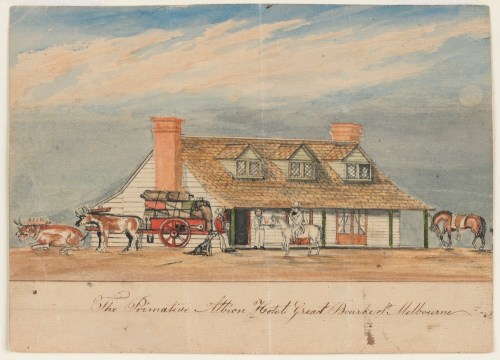
The primative i.e. primitive Albion Hotel Great Bourke St. Melbourne

The Primative Albion Hotel Great Bourke St Melbourne by William Liardet. Source: State Library of Victoria.

http://handle.slv.vic.gov.au/10381/151500

A bench of magistrates and worthies assembled to hear the applications for Publicans’ Licences. Headed by James Simpson, the Police Magistrate, the bench included James McArthur, F. A. Powlett, G. D. Mercer, E. Brewster, W. Verner, A. Furlong and Doctors McCrae and Martin.  Here’s a list of existing licenses they approved:

COLLINS STREET Thomas Halfpenny ‘William Tell’ (conditional);  Thomas Anderson ‘The Lamb’; John Davis ‘Imperial’; Thomas Graham ‘Edinburgh Castle’.

LITTLE COLLINS STREET Benjamin Hancock ‘Freemasons’ Arms’; William Evans ‘Builders Arms’; John Bullivant ‘Waterloo’ (conditional); John O’Shaugnessy ‘Australasian Hotel’.

BOURKE STREET  James Dobson ‘Albion’; James Jamieson ‘Eagle’; William Sidebottom ‘Golden Fleece’

ELIZABETH STREET Francis Henry ‘Irish Harp’; (conditional); James Coulstock ‘Melbourne Tavern’; R. A. Roberts ‘Union’

QUEEN STREET  John Byng ‘Victoria’; John Shanks ‘Royal Highlander’

FLINDERS STREET William Coulson ‘Melbourne Hotel’; A Greaves ‘Yarra Hotel’

LITTLE FLINDERS STREET James Shaw ‘Shaw’s Hotel’; Robert Brottargh ‘Adelphi’, Lewis Pedranna ‘Dundee Arms’ (conditionally)

MARKET PLACE  William Harper ‘British Hotel’

LONSDALE STREET William Mortimer ‘Crown’, Robert Omond ‘Caledonia Hotel’

BEACH A Lingham ‘Marine Hotel’, W.F.E Liardet, ‘Pier Hotel’

They didn’t necessarily approve all existing licence-holders.  They knocked some people back if they were persons of bad character, or if their hotels were frequented by people of bad character or, as in one case, if the applicant was living “in a disreputable state”.

They approved new licences too, just to add to the proliferation of hotels

QUEENS STREET – W. Seymour

BOURKE STREET J. S. Johnstone, John Stevens (conditional)

ELIZABETH STREET Matthew Molony; E. Matthysons (Wine and Beer only)

LITTLE FLINDERS STREET. John Grant; Francis Hobson

COLLINS STREET  Philip Anderson; Henry Davis

LITTLE COLLINS STREET Jeremiah Coffee

LITTLE BOURKE STREET William Athorne; Matthew Cantling

ELIZABETH STREET William Smith (conditional)

SWANSTON STREET Michael Lambert

They didn’t approve any licences for New Town (Fitzroy). It seems like the NIMBY (Not In My Back Yard) forces were already mustering in 1841:

There were three applications for New Town but these were strenuously opposed by Mr Montgomery, the Crown Solicitor as an inhabitant of the place, backed by a memorial signed by the most respectable of the inhabitants.  The Bench would willingly grant one Licence at New Town as they thought it hard that the labouring class, many of whom reside there, should be compelled to come into Melbourne to procure their beer but… there is no constabulary force to overlook, much less look after a publican at New Town. (PPH 23/4/41)

SLOW TRAVELLING

Although there were boats buzzing backwards and forwards along the coastal ports between Sydney, Melbourne, Adelaide, Launceston and Hobart, occasionally we are reminded that for some unlucky passengers, it could take a very long time to make the journey.

The Gem, for example, left Launceston on 4th April but did not arrive until 26th April. It was sighted by the Lady Emma on 17th April about 40 miles of Cape Liptrap, under gib and storm stay-sails.   Meanwhile, the Augustus, described as a “very dull sailer” took three weeks to sail from Sydney- so long that it had to be supplied with fresh water by the Australian Packet which ‘spoke’ it on the journey.

AND THE WEATHER?

Well, in 2016 we’ve just had an unseasonably warm last week in April with three consecutive days over 25 degrees.  In April 1841 the highest temperature for the period 22-30th was 72 (22.2) and the lowest 49 (9.8). The wind was generally light. It was dull and wet on 22-24 April, with fine weather afterwards.

This Week in Port Phillip 1841: April 15-22 1841

OFF TO THE RACES

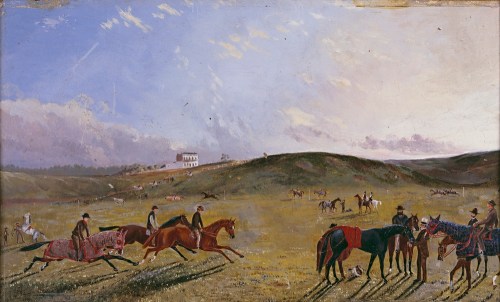
While the serious work of opening the Supreme Court was under way, there was another more lighthearted occasion unfolding during the post-Easter week in Port Phillip: the District Races!  The three-day racing carnival, held under the auspices of the Port Phillip Turf Club was held on 13th, 14th and 15th April “on the same course as last year”, ie. along the banks of the Maribyrnong River in what would come to be known as Flemington.  This was the fourth time the autumn races had been run, after initially being conducted on the swampy ground at the base of Batman’s hill in what is now Southern Cross Railway station. In 1840 ‘The Melbourne Racecourse’ shifted to what would become Flemington, which continues as a racecourse to this day.

Flemington racecourse 1867

Flemington Race Course 1867 Artist: Thomas Hamilton Lyttleton. (Note that this painting depicts the raceourse 25 years on). Source: State Library of Victoria [http://slv.vic.gov.au]

http://handle.slv.vic.gov.au/10381/298477

The Melbourne newspapers (and most especially The Port Phillip Herald) and that wellspring of all things Port Phillipian,  The Chronicles of Early Melbourne (available online here) by ‘Garryowen’ devoted many paragraphs to the races.  We tend to forget that until about 20 years ago television newscasts did too, before yielding the racing time-spot to financial news instead when we all found ourselves to be investors instead (another form of punting, perhaps?)  I won’t bore you with the details of the race, but the report of the weather on the first day is rather poetic:

Day broke on Tuesday, the Fourth Anniversary of the Melbourne Races in a remarkably ‘skittish’ humour, a strong north-wester scoured the streets at a ‘hard gallop’ while a heavy fall of rain completed the unpromising aspect.  As the day advanced, Sol drew his curtains, and plucking off his night cap, inbued himself in his most gorgeous robes, and mounting his car, smiled propitiously as he touched up his steads. This change of affairs caused sundry of the good folks of Melbourne to rub their hands, look very knowing, and giving their collars the extreme altitude, sagely remark there was a prospect of a very fine day’. PPH 16 April 1841

It seems that a good day was held by all, particularly on the more numerous attended first Tuesday of the racing carnival:

The course exhibited a gay appearance from the numerous pennants fluttering from the booths lining one side of the course, while cheering strains poured forth at intervals from two band, one at the grand stand, and the other in the William Tell booth, all of these receptacles of good cheer contained the usual quantum of viands and fluids, the latter of which must have been poured forth copiously, judging from events towards the end of the day. (ibid)

Well, yes. Obviously the ritual of finding oneself tired and emotional at the racetrack has a long history and this 1841 racing carnival was no exception.  One of the Border Police became drunk and “drawing on his butchering knife, [cut] one person through the hat to the skull, until the blood flowed in torrents”.  One unfortunate man was trampled and later died.

RETURN OF THE GIPPS’ LAND OVERLANDERS

You might remember that after the wreck of the Clonmel in January 1841, a number of men returned to Gipps’ Land to scope out the potential. In late March   three of the men returned by sea, bringing early positive reports, leaving the others to return overland. The Port Phillip Herald of 16 April 1841 carries news of their return in a day-by-day description of their journey.

They started off on March 23rd , where they encountered a tree marked by Mr Macmillan in his expedition, before camping the night at a swamp in extremely barren land. On 24th they followed the treeline to a hill where they could see Wilson’s Promontory and a portion of 90 Mile Beach. On 25th they reached a peak from which they could see the fertile plains forming the interior of Gipps’ Land before travelling to the La Trobe River. They followed the La Trobe on 26th where they found yet another marked tree and a carved message “this is the Ross River, a north-east course will bring you to the plain”. From here they could see the peaks of the Snowy Mountains, before reaching the Maconochie River. On 28th (was 27th a day of rest?) they crossed the Maconochie and reached Count Strezlesci’s encampment on the Barney River, which they crossed, later arriving at the Dunlop river where they camped. On 29th they perceived Lake Wellington,  a large inland lake which received the waters of the La Trobe, Maconochie, Barney, Dunlop and Perry Rivers. On the 30th they began their journey to Melbourne, tracing back and encountering the same rivers, encountering the Kirsopp River on 3rd, and finally arriving home in Melbourne on 13th April.

Their summary of what they found was:

The general character of the new country which the party explored is, that it is well watered, the banks of the rivers are lined with the finest of every description of timber, and the intermediate land either gently undulating or quite level plains of rich alluvial soil, supposed to be in consequence of the deposits of the numerous rivers from the ranges of the Snowy Mountains. Throughout the whole of Gipps’ Land scarcely a rock was visible.

THE ‘RULES’

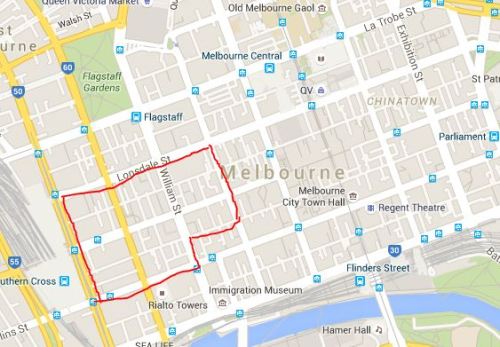
One of the early tasks that Judge Willis undertook was defining the ‘rules of the debtors’ prison’. In a small town with severely limited prison facilities, it was not practical to lock up all debtors,and it became even less feasible as the District plunged into widespread insolvency over the next few months. Instead, people were ‘confined to the rules’ by being restricted to a defined part of town. They were not allowed to visit any hotels or houses of ill-repute that might be in that area.  Willis defined the Rules as follows:

The rules of the debtors’ prison in Melbourne shall be comprised within the bounds following, that is to say, all that part of Collins’street which lies between Spencer-street and the north east side of William’s street, so much of William’s Street as lies between Collins Street and the north west side of Little Collins street, so much of Little Collins street as lies between Williams street and the north east side of Queen street, so much of Queen street as lies between Little Collins street and the north west side of Lonsdale street, so much of Lonsdale street as lies between Queen street and the south west side Spencer Street, and that part of Spencer street which lies between Lonsdale street and the south east side of Collins street, together with the area comprised within and bounded by the portions of streets aforesaid; and all the houses (except as hereafter is excepted) on each side thereof.  Provided that all taverns, victualling houses, ale houses, or houses licensed to sell spirituous liquors, houses of public entertainment and also all disorderly houses, and houses of ill fame shall be excluded out of, and form no part of the said rules.- JOHN WALPOLE WILLIS, Resident Judge, March 31st 1841.

Here’s a rather wonky diagram drawn onto a present-day map:

Rules

Although today this area is dominated by offices, at the time most of the settlement was located in this area so it was not necessarily a hardship to be ‘confined to the rules’.

A CHILD ABUSE CASE

With our present-day attention drawn to the Royal Commission on Institutional Responses to child abuse, it is interesting and sad to read of a child abuse case in 1841. In this first week of Supreme Court hearings, Henry Watson was indicted for an assault with intent on seven-year old Imogene Liardet, the daughter of the publican and artist W.F.E. Liardet, whose illustration heads this blog.In hearing the case, Willis, like all other judges, had to determine the fitness of the child to take the oath, a decision based on the child’s understanding of God and truth.  In this case, Willis decided that the case could not proceed. The papers reported the case delicately:

There can be little doubt but for the tender age of the child, who could not understand the nature of the offence brought forward, that the charge would have been brought home to the miscreant, and that an exemplary punishment would have followed. His Honor himself felt morally certain of the fellow’s guilt.  We cannot pollute our columns with details so disgusting.  The prisoner was acquitted and discharged. (PPH 16 April)

Judge Willis’ casebooks, available at the RHSV Judge Willis site, give more information. http://www.historyvictoria.org.au/willis/book%2011.html#4

Her description of the offence is poignant in her innocent retelling:

The Pris’r took me into the Stable after the time of the Regatta & pulled up my Petticoats, put his in mine – his – Cockadoodle – he lay on my person – he was long on me ab’t half an hour – after that he took me out of the Stable I told Mama wh’t had happened – When I went out I told Mama directly –

On 30th April the Port Phillip Herald reported that Henry Watson was captured again “endeavouring to commit a similar assault on a woman at the wharf”.

EARTH-SHAKING NEWS!

Quite literally. An earthquake was reported at about 3.00 a.m. on 21 April. It’s an interesting thought that in these early years of white settlement, people wouldn’t really know what could be expected in terms of earthquakes, floods, droughts etc.

AND SPEAKING OF THE WEATHER…

During the week there was a light wind, freshening at times with generally dull weather and occasional rain. The top temperature for the week was 74degrees (23.3C)

Other references:

Lemon, Andrew ‘Inventing the Melbourne Cup’ La Trobe Journal 88, Dec 2011

Macdonald, Judy, ‘James Watson and ‘Flemington’: a Gentleman’s Estate’, pp.1-25. Latrobeana Vol 8, No 3 November 2009

This Week in Port Phillip 1841: April 8-14 1841

BIG NEWS! THE OPENING OF THE SUPREME COURT 12 APRIL 1841

The opening of the Supreme Court in Melbourne WAS big news- not just for this blog (which is named for the First Resident Judge of the District of Port Phillip) but for Port Phillip itself. The creation of a permanent branch of the Supreme Court of New South Wales in Melbourne (as distinct from a regular circuit court) was both a way of marking the significance of the district, and also solving a personnel problem for Governor Gipps who was having to deal with conflict amongst the judges on the bench when they were all together. In a practical sense, it meant that substantial civil cases could be heard in Melbourne rather than the parties travelling up to Sydney, and that criminal cases no longer had to wait in jail until there was a sufficiently large number of prisoners to be escorted by ship to the Supreme Court in Sydney.  From a community and social point of view, it meant that barristers and other professionals would be attracted to the Port Phillip district, and that there was a focus for public and political discourse.

I hadn’t realized previously that Good Friday was on April 9 in 1841 and that therefore the court opened immediately after Easter. Devout Melbournians could have had a glimpse of their new judge in all his regalia on the preceding Sunday, because he and Edward Brewster had attended church at St James’ Church of England in their legal robes. The other ‘gentlemen of the long robe’ must have wished that they were wearing theirs too, but they were not.

The court opened at 10.00 a.m. on what we would know as Easter Monday in the small building that had been repurposed from its former incarnation as a Works building.

courthouse

William Liardet, ‘The Opening of the Supreme Court’. State Library of Victoria (www.slv.vic.gov.au)

The Clerk of the Court read the Queen’s Proclamation for the Suppression of Vice to open the court. He then read the Queen’s Commission appointing Willis as a judge, followed by Governor Gipps’ proclamation appointing a judge to the Port Phillip District, then finally Willis’ commission from Gipps that appointed him to the position.  After taking the oath, Willis then swore in James Raymond as Sheriff and James Croke as Crown Prosecutor. He then admitted five gentlemen to the bar: Croke, Brewster, Barry, Holme and Cunningham.

I’ve written about the opening of the Supreme Court previously, so I won’t repeat it here. But, I will give you a little taste of Judge Willis’ opening speech, which both captured the essence of his in-court persona and also foreshadowed his dismissal just over two-and-a-half years later:

I am well aware, however, of the peculiar position of a sole presiding judge, and more especially of his liability to the suspicion of local prejudices and partialities. I have always been of opinion with a learned writer “that the less local connexion a judge may have with the place in which he exercises his jurisdiction, the more he will be exempt from the unconscious and danger influence of any collateral motives; and that even being a stranger in a particular set of advocates, otherwise than by the general intercourse of the profession, has a favourable influence on the administration of justice. Particular partialities may exist, and are much more frequently imputed, among those with whom there is a regular and constant intercourse; and although no person worthy of a judicial appointment, will purposely and knowingly act in opposition to his duty, it is certain that habits are said to have arisen of some individual with greater attention and complacency than others, and thus to have induced a feeling of freedom, and even dictatorial familiarity in the one case, and of oppression and embarrassment detrimental to the interests of justice on the other.” (See letter from Sir. W. D. Evans, late Recorder of Bombay to Lord Redesdale, anno 1812).

Lord Brougham in his speech in the House of Commons in 1823, on the administration of the law in Ireland, thus addressed himself “that if a judge be bound at all times to maintain the dignity of his exalted office; if partiality be the very essence of judicial duty, and without which no judge can be worthy of the name- any mixture in party dissensions- any partnership in religious or political disputes- anything like entering into the detail of class difference and arrangements- anything approaching, however distantly, the tool of a particular faction would be a sort of stain from which above all others the Ermine ought most immediately be purged and cleaned.  For 1st; such interference touches a judge’s dignity; 2ndly, it renders his impartiality suspicious; and 3rdly, it goes to shake that respect which is due to every just and dignified magistrate, that respect, which if a magistrate forfeit by his misconduct, the sooner he vacates his office the better; the sooner the balance is wrested from him which he can no longer be expected to hold fairly- the sooner he drops the sword, which none will give him credit for wielding usefully- the better for the community and the law.  When once he has rendered it impossible for the public to view him with confidence and respect, he cannot too soon lay down an authority the mere insignia of which are entitled to veneration.”

I thus candidly avow my knowledge of the dangers to which a Resident Judge is exposed, and I do so, trusting that this knowledge will enable me to avoid them.  But should the Resident Judge of this district ever afford just cause of suspicion, or complaint, the act whence he derives his authority by enabling his Excellency the Governor from time to time to appoint one of the judges of New South Wales to reside within this district provides an effectual remedy for any of the evils incident in this office.


The speechifying and swearing-in over, the court began hearing cases.  In this inaugural sitting, there were three cases: two of stealing and one of embezzlement.  All were found guilty.

And so this year (2016), the Supreme Court in Victoria is celebrating its Dodransbicentenary (now there’s a term to conjure with!)  Strictly speaking, it was still the Supreme Court of New South Wales, but it was the start of the Supreme Court in what was to become Victoria.  It was  such a big occasion that I’ll just let it sit here, dominating the events of the week 8-14th April.  Happy Dodransbicentenary, Supreme Court!

This Week in Port Phillip 1841: April 1-7 1841

AGILITY AND DISRUPTION ON THE RIVER

Even in these days of international jet travel, we always tend to under-estimate the time that it takes to get from the point of disembarkation to our actual home or hotel.  Sometimes it takes almost as long to traverse the last thirty kilometres as it did the previous thousand.


Sandridge from Hobsons Bay

Sandridge from Hobsons Bay 1852, Painter unknown, State Library of Victoria , http://www.slv.vic.gov.au [http://handle.slv.vic.gov.au/10381/78418]

Emigrants and travellers to Port Phillip found a similar problem, although no doubt after the weeks spent on board ship from Britain, the messiness of the final leg of the trip was less noticeable and frustrating. Nonetheless, it was not possible to gaily trip down the gangplank of an incoming ship onto the streets of Melbourne.  Ocean-going ships could not navigate the shallow tidal Yarra River and so they moored out in the Bay or at Point Gellibrand near Williamstown. From there, there were several options. Passengers and their cargo could be brought to Williamstown by boatmen, or could be ferried across directly to Sandridge (later Port Melbourne).  From Williamstown they could catch a ferry to Geelong, Melbourne or Sandridge, or could travel by road up through Footscray to Melbourne.  If they took the Sandridge option, they could take a shallow-hulled steamship up the Yarra, or could walk or drive across the drained swamps along St Kilda Road.  The steamships and lighters would tie up at the wharves at Queens or Coles Wharf at Queens Street, where access further up the Yarra was blocked by a rocky outcrop generously called ‘The Falls’.

The early settlers of Port Phillip didn’t need Prime Ministerial encouragement to be ‘agile’ or ‘disruptive’ : anyone who had a small boat could see the opportunities to be had in offering their services to take weary travellers straight up the river to the wharf. The Yarra River was lit by beacons and stakes that marked the deepest channels in the river.  The larger steamships relied on them to navigate the river but smaller ‘agile’ boats steered by water-men had little need of them. The Port Phillip Herald fulminated at the pushiness and competitive trickery of the water-men, calling for the Water Police to control the Uber-Taxis of the day.

As respects the beacons in the river and on the bar at its mouth, self interest on the part of the lighter and barge men often operates seriously upon the trading vessels which have to proceed to the Queen’s Wharf.  Scarcely a vessel comes up the river that does not experience detention owing to the destruction or removal of the stakes which have been inserted to mark out the proper channels and although it is well known that there is a heavy penalty for the offence, yet interested motives and the uncertainty of detection and conviction encourage the continuation of the practice.  If it be known by masters or agents that these beacons are either removed or misplaced they will not run the risk of bringing up their vessels, and the small craft trading between the Queen’s Wharf and the shipping in the bay will consequently reap the advantage; or should masters venture up and get aground, a thing of almost daily occurrence, they must perhaps have to the discharge part of their cargo, and thus in all probability pay the very men who were the cause of their misfortune, thus holding out a bribe to treachery. (PPH 2 April 1841)

IMPOSITION: CAUTION

This article was issued as a caution to unwary benefactors, but it serves just as well as a caution not to approach the church for charity:

For the last few days a female representing herself as the wife of a man called Boucher, now confined in the Gaol for sly grog selling, has been travelling through the town and extorting sums of money from our generous fellow townsmen, on the plea of extreme destitution.  She yesterday morning called on the Rev Mr Thomson, who immediately had her taken before the Police Magistrate, who severely reprimanded her, and cautioned her how she followed such courses in future. To add to the grossness of her offence, it was proved that the wretched woman was Boucher’s concubine, and not his wife. (PPH 2 April 1841)

THE FIRST CORONER


Dr. B. Wilmot.

Dr. W. B. Wilmot. State Library of Victoria, [http://handle.slv.vic.gov.au/10381/261616

One of the very first things that Justice John Walpole did in his legal capacity was to officially swear William Byam Wilmot as Coroner. Wilmot, who had a small dispensary in Collins Street called the Melbourne Medical Hall, had applied for the position in 1840, and was appointed, on La Trobe’s recommendation to Gipps, on 1 February 1841. The position of coroner combines both legal and medical aspects, and so Willis swore Wilmot in as Coroner immediately, even before Willis’ own court was open.  For that momentous occasion, we’ll have to wait for the following week.

AND THE WEATHER…

A wet week, with 4.7 inches of rain. The total for April was 5.8, so it seems that nearly all the rain for the month fell in this first week. The 1st April was the hottest day for the week at 78 degrees (or 25.6 C)


This Week in Port Phillip 1841: 23 March-31 March 1841

You might remember than in January  the Clonmel was wrecked along the Gippsland coast, necessitating a 65 hour rescue mission as D.C. Simson and Mr Edwards and some unnamed ‘men’sailed to Melbourne to raise the alarm.  Captain Lewis, who travelled to Gippsland to rescue the unhappy passengers, reported that he had observed what could be access to an inland sea.  On 3rd February the Singapore cleared out, bearing Dr Steward, Messrs Kinghorne, Orr, Rank, Brodribb, McLeod, Kirsopp and McFarlane to investigate this rumoured waterway and to assess  the pastoral potential of the country, which had already been designated ‘Gippsland’ by Count Streslecki in his overland explorations.

The Port Phillip Herald of 23 March 1841 carried a lengthy report of taken from Mr Orr’s notes on his return to Melbourne. John Orr was employed with the firm of Turnbull, Orr and Co, and exemplified the entrepreneurial spirit that drove these heady, pastoral boom days of the early 1840s.  He reported that it took seven days to get there (much longer than the 65 hours that Simson and Edwards had taken to return by small boat to raise the alarm), a reminder should we need it of the difficulty of negotiating the Heads and Bass Strait. Their first efforts were directed towards finding an entrance to Gipps’ Land (which was how it was written) from the north-west side of Corner Inlet, but they soon abandoned this plan.  By travelling along the beach they located the wreck of the Clonmel and noted and named two rivers: the Tarra River (named after their indigenous guide) and the Albert River (after Prince Albert). They erected a storehouse on the beach, and ensured that it was guarded at all times with a ‘sufficient’ number of men.

Then unfolds one of those beach-side encounters,  that liminal space so evocatively described by historian Greg Dening, that could have gone either way and for which we have only the settlers’ side of the story.

During these operations a tribe of natives approached the encampment, when only two of the men and Mr Orr were present, and commenced seizing upon the various articles landed.  Mr Orr, however, and the two men succeeded in driving them off by discharging their guns loaded only with powder.  While riding in the vicinity a few days afterwards, Charlie, the black native lately in Melbourne with Count Strezlecki, discovered the recent footmarks of a large party of natives in the direction of the encampment.  The party immediately galloped back but found that they had not then arrived. In the afternoon, however, two of the gentlemen perceived a spear moving at a short distance, when it was resolved to advance and ascertain their intentions.  To avoid creating unnecessary alarm, only one half of the party proceeded to meet them, and they were discovered to the number of about thirty drawn up ready to receive the advancing party with their spears, which they flourished in the manner customary upon such occasions. Charlie approached them, making at the same time all manner of signs of peaceful intentions, and inviting them to advance.

After a very noisy interchange of salutations they laid down their spears and accompanied the party to the encampment, at a short distance from which they kindled a fire and held a coorobora [sic]. They departed the following morning with a few trifling presents, and were not again seen or heard of until the day the Singapore sailed, when nine of them in three canoes again made their appearance seemingly anxious to get on board.  The ship, however, being then under way, they were obliged to return, but the party despatched a boat after them to their camp, and gave them a few articles of different descriptions at which they were highly pleased. (PPH 23/3/41 p.2)

Messrs  Stewart, Rankin and Orr returned by ship, while the other five gentlemen, accompanied by Charlie, returned home overland in an exploratory journey that took over a month. Highly enthused by the potential of the land, John Orr applied to purchase land on the west bank of the Tarra River in April 1841 under special survey, while John Reeve, a recent arrival in the colony, made an application for a special survey on the east bank.  You might remember that Henry Dendy had recently arrived in Port Phillip from England, bearing a special survey entitlement arranged from London. Not only was the local government fearful that special surveys would pre-empt the best land in the colony, but Gipps was concerned about the cost of administering (and more importantly, policing) settlement in such a remote area.  It was to take the local administration two years to gazette the special survey.

It was not a particularly successful undertaking and Gipps and La Trobe’s fears about the remoteness of the region were justified. By 1843 there were about 200 people in the region, living in five small scattered settlements.  On Orr’s survey, there were 17 men, 6 women and 13 children, while there were 29 men, 14 women and 23 children on Reeve’s survey at Tarraville.  The area did not prosper as much as they hoped. Five years later, there were only an extra hundred settlers, bringing the total to 300 and 75,000 animals.  (Shaw, A History of the Port Phillip District  p. 162)

STATISTICS

The Port Phillip Herald of 25 March had some interesting statistics about the free settlers arriving in Sydney and Port Phillip respectively.  I’m not sure how they compile the figures or how heavily they can be relied upon.  Perhaps more significant is the sentence at the bottom of the table that indicates that almost as many bounty immigrants had arrived in Port Phillip in the months 1 Jan-25 March 1841 as had arrived during the whole of 1840.

Government ships
  Men Women Children Total
Sydney 444 412 481 1367
Port Phillip  58  51  44  153
Bounty Ships (i.e. commercial emigration schemes)
Sydney 1471 1611 826 3908
Port Phillip  541 628  99 1268
Unassisted (i.e. self-funded)
Sydney 824 285 188 1297
Port Phillip 299 114 130 543
TOTAL
Sydney 2739 2338 1495 6572
Port Phillip  898 793  273 1961

P.S. There have already arrived in Port Phillip since 1 Jan 1841, 1847 immigrants on bounty in addition to a large number who arrived on their own resources. [PPH March 25, 1841]

HOW’S THE WEATHER?

The highest temperature for the period was 86 degrees (30C) on 23rd and the lowest was 43 (6C). There were strong winds on 23rd and 26th, and the weather was dry but mostly dull and cloudy. The coldest days of the month were between the 27th and 30th March.

This Week in Port Phillip 1841: 16-23 March 1841

HAPPY ST PATRICK’S DAY!

March 17, of course, was St Patrick’s Day. As Ken Inglis points out in Australian Colonists, recognition of the day in Sydney dated from 1810 when Governor Macquarie provided entertainment for convicts employed by the government, and the annual St Patrick’s Day dinner at a Sydney hotel was a fixture on the social calendar attended by the most respectable Irishmen- both Catholic and Protestant (p.103). Melbourne in 1841 was not yet so organized, and the occasion passed quietly.

We are glad to be enabled to state that Patrick’s Day passed over without the least infringement upon the public peace. We are almost sorry to have to record the fact that scarcely an additional glass was drained or shillelagh flourished in commemoration of the anniversary of Ireland’s general jubilee, as such might have been done without offence to the Powers that be, a little licence being always conceded on such occasions and a miniature representation of Donnybrook fair would have minded many of what they seem here to forget, that they are Irishmen. Perhaps, however, it is better that the dull monotony of money gathering should have remained uninterrupted than that occasion should have been given Ireland’s enemies to say that her sons in every quarter of the globe are fond of a “row”. Patrick’s Day has now passed over in peace and unmarked by any national display and so much the greater shame for Irishmen say we.  (PPH 19/3/41 p.3)

The day did not go completely unrecognized, though, as twenty to thirty of the men of the Port Phillip Club sat down that night to “a most sumptuous collation”. (PPH 19/3/41 p.3)

SHIPPING NEWS

Perhaps it’s because I’ve only recently finished reading Roslyn Russell’s High Teas and High Seas (review here) but I find myself reading the Shipping News on page 2 of the Port Phillip papers with a little more interest than previously.  Not only does the Shipping News detail the ships that have arrived and departed from Port Phillip and Sydney, but it conveys the communications that were conveyed between ships as they passed each other.  For example, the Port Phillip Herald of March 20 reported the arrival of the Christina  from Sydney. The Christina “spoke” the ship Victoria from Salem (USA) which it encountered off Bateman’s Bay, describing her as “deeply laden” (possibly with its whale catch?). The next day she “spoke” the barque Susan, sailed by Captain Neatby , off Ram Head (which I assume is Rame Head near Croajingalong National Park). The Susan was 92 days out from Plymouth, taking emigrants to Sydney. (PPH 20/3/41 p.2)

Recent emigrants, with their own voyage still vivid in their memories, might have taken a “there but for the grace of God” interest in hearing of other ships following in their wakes. The Port Phillip Herald  of 19 March carried a report from  Lisbon dated October 15 (i.e. nearly six months earlier) that the English ship John Cooper, bound from Greenock to NSW with a general cargo of 98 emigrant passengers, had arrived at Lisbon after being struck by lightning. A passing merchant vessel reported that he had seen her trying to reach Lisbon but, “owing to her crippled state, she appeared to make very little way”. On hearing this, Her Majestys ship Trimlemo was dispatched to go to her assistance, but returned the same day to report that although the John Cooper was close to the bar, she was in such a poor condition that a steamer should tow her into port. Even then, her troubles were not over, as when towed into port at the cost of £350 sterling, it was “found unprovided with a bill of health” and put under four days quarantine. [The John Cooper finally arrived in Port Phillip on 4th April via Adelaide. She left again for Sydney on 3rd May with a passenger list that included 1 corporal, 3 privates, 28th Regiment, 1 constable, 17 male and 2 female convicts. http://www.oocities.org/vic1840/41/jc41.html]

Melbourne itself was still in a state of excitement about the arrival of the Argyle in early March with its load of bounty emigrants, ready for the picking as employees.  The enterprising auctioneer and commission agent  Mr J. C.King established an agency office for Servants at his premises in Elizabeth Street, offering – for a trifling remuneration- to board the emigrant ships immediately after the official inspection of the emigrants and to engage servants for settlers who were unable to get to the ships to do so personally. (PPH 12/3/41).

By 16 March Mr King was able to issue a weekly list of unemployed servants:

WEEKLY LIST OF UNEMPLOYED SERVANTS AT MR KING’S AGENCY OFFICE: Overseers of sheep stations 3; shophands 3; woolsorters 1; hutkeepers 1; watchman 2; overseers of cattle stations 3; stockkeepers 2; bullock drivers 1; overseers of forming establishments 2; ploughmen 2; farm servants 4; Groom and inside servants 1; Gardeners 1; Bricklayers 1; House carpenters 2; Hut builders and fencers 4; female servants 3; Wet nurse 1 (PPH 16/3/41 p.3)

However, a small article in the Port Phillip Herald of 19 March headed ‘DROWNING’ reminds us that the journey to Port Phillip was not necessarily the bright new start that emigrants may have anticipated.  A body was observed floating on the water by the watermen of Williams Town. The body was salvaged. He was very young, dressed in a blue coat and striped cloth trousers and found to have needles and pins in parts of his dress, a few papers and a smelling bottle. He was later identified as a Mr. Macfarlane, who had arrived in the Argyle just a few weeks earlier.

He had been employed by Mr Rucker as a farm servant, and resided on his estate, about two miles from town, but since his arrival he appeared greatly depressed in spirits, and it is supposed that in a fit of temporary insanity the wretched man put a period to his existence. The deceased was a native of the county Tyrone, Ireland, and was respectably connected.

VERY EXCITING NEWS!

The Christina came bearing the London newspapers which carried detailed reports of the birth of Queen Victoria’s first child, Victoria Adelaid Mary, the Princess Royal on November 21 1840.  It was such momentous news that the Port Phillip Herald published a special edition on 20th March, to follow the issue that had appeared on 19th.  Even though this is, strictly speaking, not Port Phillip news, it strikes me as strange that Her Majesty’s subjects, so far away on the other side of the globe, would be reading a report of a birth that seems so intrusive to modern eyes.

On Friday her Majesty and Prince Albert walked in the garden of the Palace and again did her Majesty take her seat at the dinner table, and continued apparently in her usual health till eleven o’clock, when she retired to rest, no suspicion being then entertained of the near approach of those sufferings, which providentially have terminated in a manner so satisfactory to every branch of her august family as well as to the delight of her loyal and devoted servants. At two o’clock yesterday morning the first symptoms of uneasiness were indicated, and at four her Majesty with great firmness directed that her attendants should be summoned; among these was Mrs Lilly, who, we have heard, was formerly nurse to the Duchess of Sutherland, and whose experience at once forewarned her of the propriety of immediately summoning her Majesty’s professional advisers. Sir James Clarke, Dr Locock, Mr R Ferguson and Mr R Blagden were instantly sent for and were quickly on the spot. No doubt now existed that Her Majesty was in labour, although certainly some days sooner than had been anticipated, as the impression was that she would have remained convalescent till early in December.

Once labour had been established, all the protocol of a royal birth swung into place. Good grief- ding!dong! the gang’s all here!!

Such preparations as the suddenness of the emergency would permit were made without delay; and by command of Prince Albert, whose conduct was distinguished by the most affectionate solicitude, combined with firmness, the Hon. W. Murray, the comptroller of the household, roused the inmates of the Palace and special messengers were dispatched to her Royal Highness the Duchess of Kent, the Archbishop of Canterbury, the Bishop of London, the Lord Chancellor, Lord Melbourne, Lord Palmerston, Lord Errol, Lord Albemarle, Lord John Russell and other Privy Councillors, whose constitutional duty it was to be present at the birth of an heir to the throne…. In her Majesty’s chamber were the Duchess of Kent, Prince Albert and the medical men with Mrs Lilly and some of the ladies of the bedchamber; while in an adjoining apartment, the door of which was open, were the other distinguished individuals mentioned. As the day advanced the Palace was kept in perfect quietness, while all noise from without from the passing of bands or otherwise was interdicted. From those who had the best means of information, we learn that her Majesty evinced a firmness and composure almost incredible- at intervals exhibiting a cheerfulness and patient submission to her sufferings, in all respects consistent with the well-known attributes of her character. The near approach of that interesting moment which was to give to these realms an heir to the throne at last arrived and precisely at ten minutes before two o’clock Mrs Lilly entered the room where the Privy Councillors were assembled, with the “Young Stranger”, a beautiful, plump and healthful Princess, wrapped in flannel in her arms. She was attended by Sir James Clarke, who announced the fact of its being a female. Her Royal Highness was for a moment laid upon the table for the observation of the assembled authorities; but the loud tones in which she indicated her displeasure at such an exposure, while they proved the soundness of her lungs and the maturity of her frame, rendered it advisable that she should be returned to her chamber to receive her first attire. PPH 20/3/41

Apparently, ministers and privy councillors and ladies-in-waiting continued to attend royal births until 1894 when Queen Victoria decided that for the birth of her great- grandson, the future Edward VIII, the home secretary would be enough. Home Secretaries attended until the birth of Prince Charles in 1948, when it was announced that the practice would be discontinued.  Jolly good thing too.