Category Archives: Life in Melbourne

Census

2016 Update: I have rather cheekily linked to this post as part of the National Family History Month Blogging Challenge which, during Week 1, asked for a post about things people had learned about their ancestors through the Census.  Well, as you’ll see, this posting isn’t really about a family at all, but rather it looks at the controversy over one of the questions in the 1841 census. So, here’s my posting from 2011:

15 August 2011.

My census paper is all filled in, waiting to be collected.  I quite enjoy filling in surveys and doing interviews.  I note that several of my Facebook friends with young babies were amused at the inappropriateness of many of the questions to their babies (“How well does the person speak English?” “Does the person ever need someone to help with self care activities?”).  At the other end of the parenting spectrum, I found myself feeling rather furtively curious at the replies given by adult children (Hmmm- so that’s how much they earn?! How did they answer the unpaid domestic work for the household question?)

My son was rather keen that I answer ‘No religion’ in the optional religious question.  It’s obviously a touchy subject because it, alone among the questions, is optional.  Thinking back to the rigid, unyielding sectarian prejudices of my 1950s-60s childhood, this would have always been a hot question but for different reasons.  What’s a Good Unitarian Girl to do?  Yes- I know that identifying as Unitarian will be collapsed into a bald statistic showing the increasing religiosity/atheism of modern society.  Do I want my creedless religion collapsed into a category along with fundamentalists of all shades? How religious is a creed-less religion?  Such deep questions, all for a census.

Then there’s the marriage question.  It’s when there’s such a stark choice- married/divorced/widowed/never married – that I feel uncomfortable about the many shades of grey that are blurred by such harsh distinctions.  The long term same-sex relationship that would dearly love to be a marriage but is forbidden?

And the either/or nature of language spoken at home.

Radio National’s Rear Vision program had an excellent feature recently called Who Counts? A History of the Census (podcast and transcript available).  The program highlighted that censuses (censi?) differ in their questions, format and intent in different countries at different times.  The British census of the mid-19th century, for instance,  reflected the public health concerns over ‘the household’ as an economic unit, particularly in the wake of the widespread mobility of the Industrial Revolution.  The American census was framed by a mindset of growth, particularly on the frontier.

The Australian census, first conducted in 1828, emerged out of an earlier tradition of the convict muster.   As shown on the Historical Census and Colonial Data Archive site, there were censuses in New South Wales in 1833, 1836 and 1841.  The Census Act of 1840 spelled out the process for collecting the information, and the magistrates were at the heart of it:
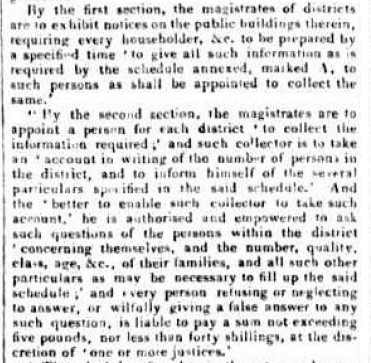
[Australasian Chronicle 5 December 1840]

During the 1840 debate over the Census Bill, the process was not controversial, but one of the questions in particular was:

whether he was born in the colony, arrived free, or obtained freedom by pardon or servitude?

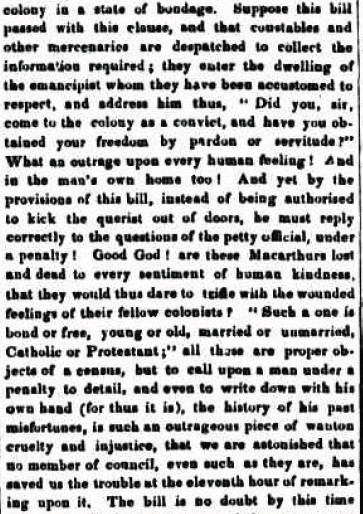
The original census of 1828 provided several “class” categories: CF meant ‘came free’; BC meant ‘born in colony’; CP denoted ‘conditional pardon’;  FS meant’ free by servitude’ and TL stood for ‘ticket of leave’.  But by 1840 New South Wales was distancing itself ever further from its convict origins – a process which John Hirst in Convict Society and its Enemies argues began right from the start of settlement.  This question was now highly sensitive.  As the Australian Chronicle argued:

[Australian Chronicle 20 October 1840]

And into the fray steps- yes, you guessed it!- Judge Willis.  Justices Dowling and Stephen, the two other judges of the Supreme Court of NSW declared the bill to be repugnant to British Justice on the grounds that, as a witness under oath in court did not have to degrade his character by identifying himself as an ex-convict, he should not be required to do so before a census collector.  Justice Willis, as was his right, issued a dissenting opinion, arguing that the benefit of the question for the government outweighed this consideration (although he did not specify what these benefits were to be).   As was often the case with Willis’ interventions into political questions, at issue was not his dissent per se but the way in which he expressed it (although in this case, it highlighted tensions between the ‘exclusives’ and the ’emancipists’). In court he observed:
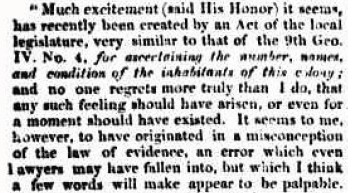
With this subtle, but nonetheless public put-down of his fellow judges, he then went on to discuss the laws of evidence in the courts and concluded:

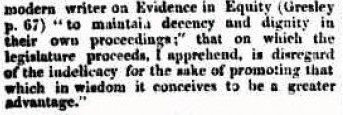
This public jousting on a question of law was one of several issues between Willis and his brother judges, most especially Chief Justice Dowling, at the time. Along with other similar considerations,  it led to Gipps’ decision to place Willis as the resident judge of the Supreme Court of New South Wales in the district of Port Phillip, well away from his colleagues.

So, I can hand over my completed census form- minus any questions about my convict status or lack thereof- safe in the knowledge that yet again, I have operated on the principle of six degrees of separation between Judge Willis and any topic you may choose to name, and managed to bring Judge Willis into 2011, no matter how tenuous the link.
Bishopscourt

It was Melbourne Open House on Sunday, and on such a magnificent winter day, I just had to call into one of the locations while I was in the area.  We had come across Toronto’s Open House while we were there, and London’s too for that matter, but I think that Open House days are meant for the residents of a city rather than visitors.  Some of the sites are open year round so there was no great appeal there (unless you went to parts of the building not normally accessible), but I was more drawn to places that are not normally open to the public.  I was walking past Bishopscourt and had always been intrigued by it- so Bishopscourt it was!

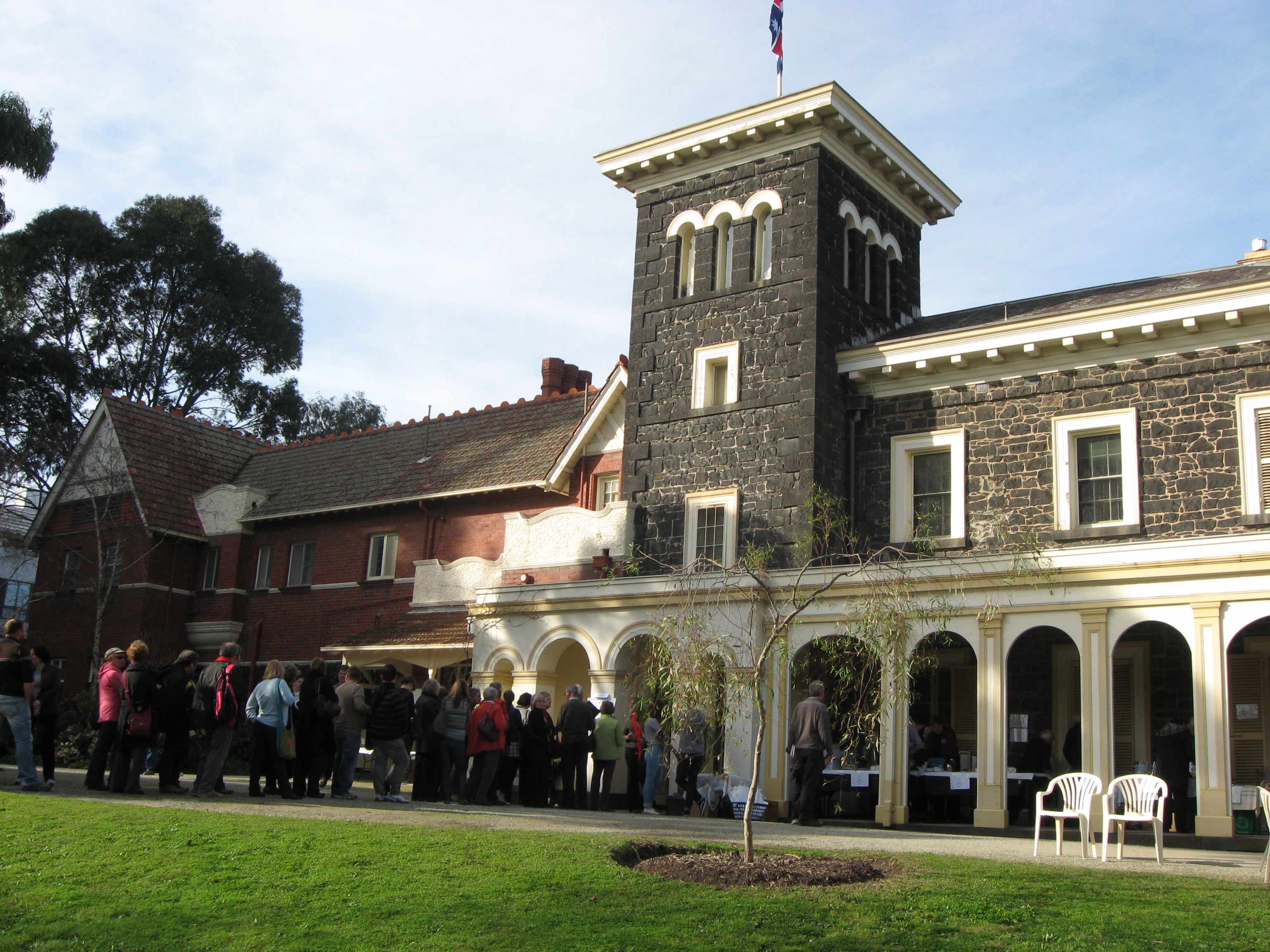
Bishopscourt is located in Clarendon Street, opposite the Fitzroy Gardens.  It has been the family home of the Anglican Bishop and later Archbishop of Melbourne since it was built in 1853.

If it looks a bit of a hodge-podge, that’s because it is.  The first Bishop of Melbourne, Bishop Perry, selected the location so that he could walk into Melbourne itself, while being close to the site that was originally considered for the Cathedral between Hotham and George Streets in East Melbourne .  It was later decided to construct the Cathedral in its present location on the corner of Swanston and Flinders Streets. Construction of  Bishopscourt began in 1851 but because of the shortage of building labourers in these goldrush years, the house was not completed until 1853.  Sixty years later it was decided that a grander house was required. One of the bluestone wings was demolished in 1903 and replaced with the rather discordant red-brick wing, resulting in its rather schizophrenic  appearance.

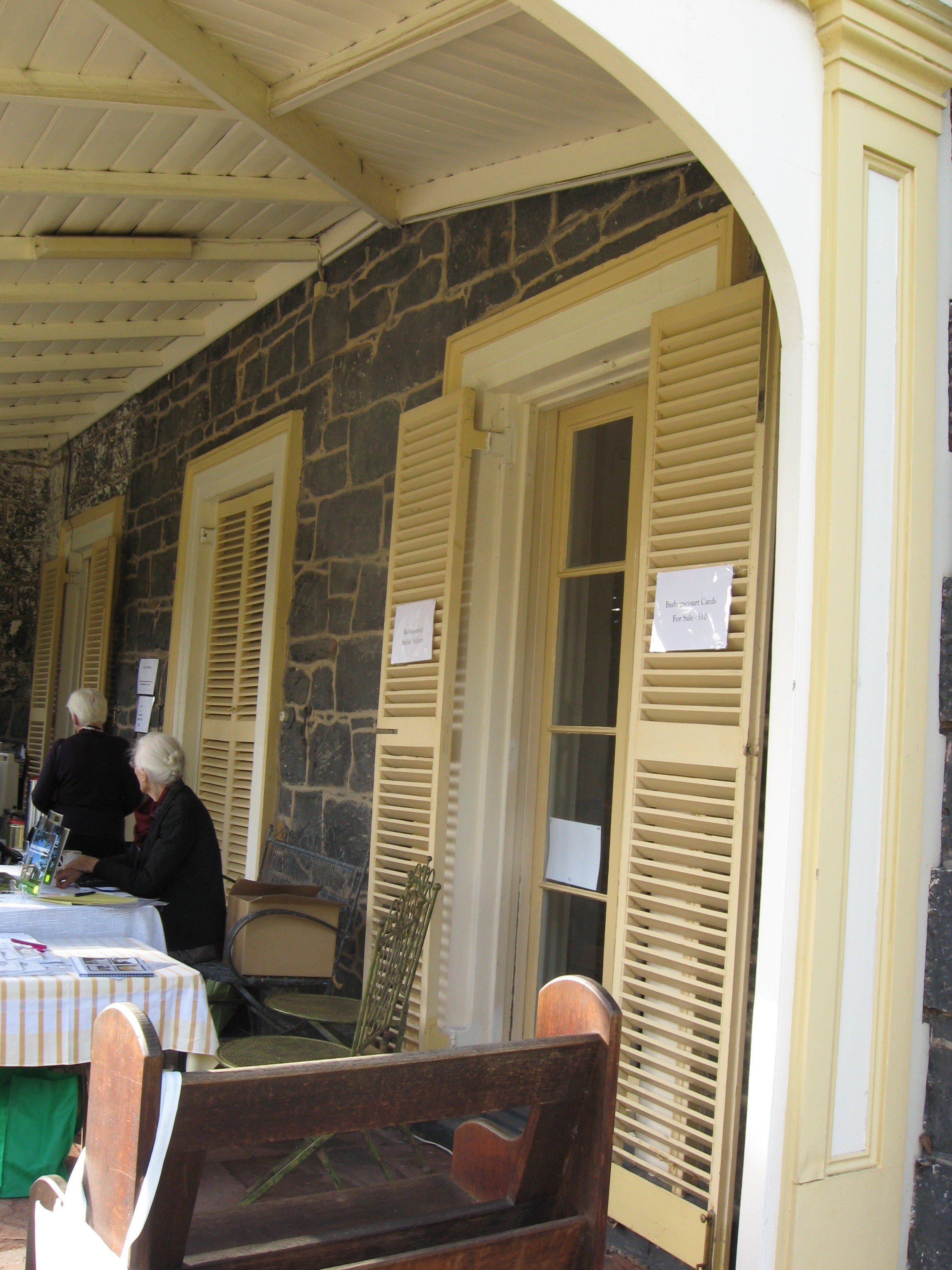
Although constructed in wealthier gold-rush days,  the design of the bluestone section evokes an earlier, more Georgian influence with its French windows and shutters, wide doors and simple architecture.

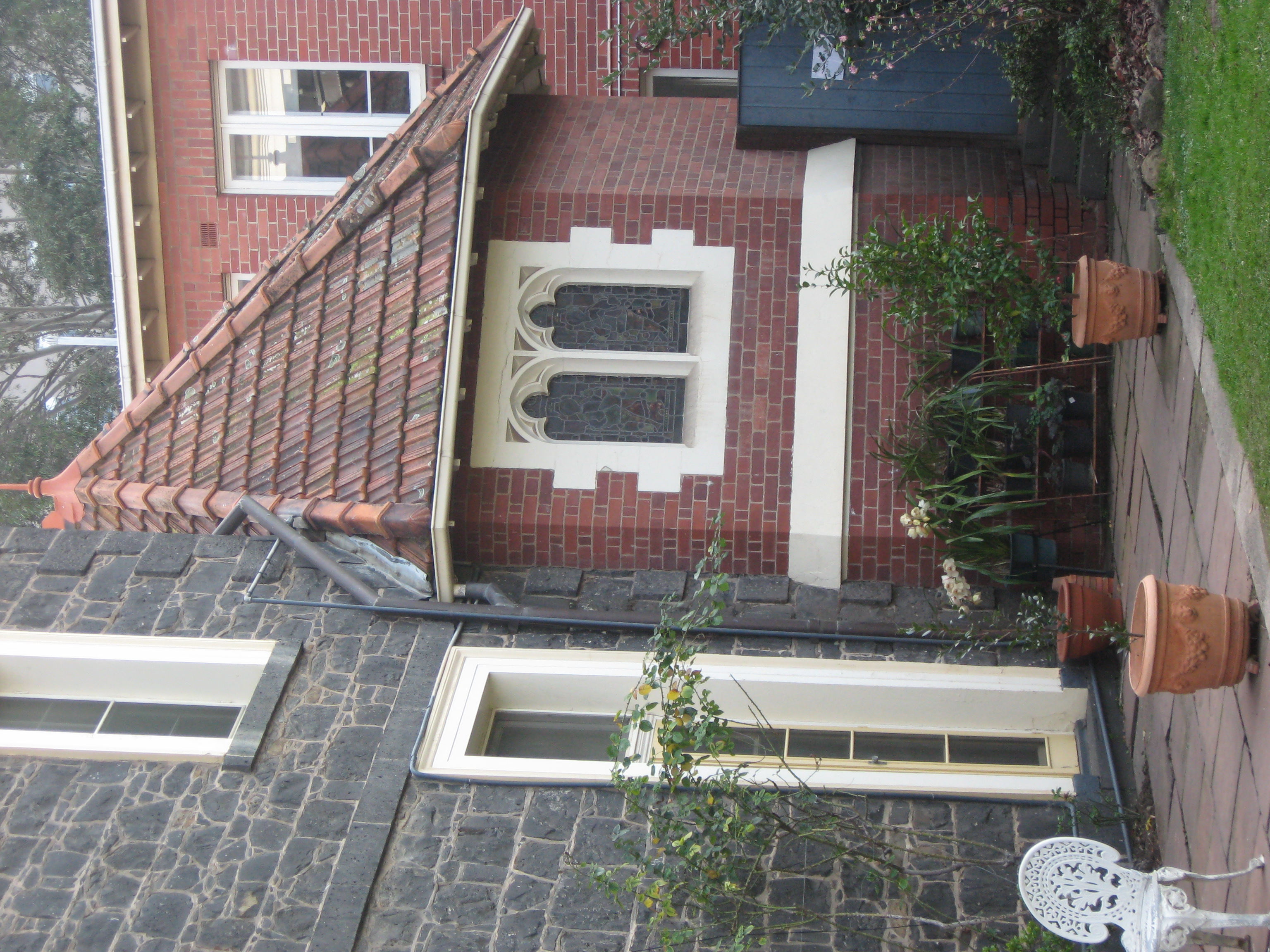
The bluestone is rather roughly laid on the front and side of the house, and it has been suggested that perhaps it was intended that the facade be stuccoed at a later time.  The new red-brick section included a large dining room and a private chapel which was a warm, intimate space that might hold perhaps twenty people.  I wish they had let us take photographs, because the chapel was very special place, with many of the furnishings and decorations donated by previous occupants.

The chapel from the outside

Tours ran approximately every half hour and you were ushered from one room to another, where someone who had previously lived at Bishopscourt spoke about their memories of the room as part of their family home.  The Archbishop of Melbourne was there in the drawing room, decked out in his purpleness, and the daughters and daughter-in-law of the former Archbishop Frank Woods spoke in the morning room, dining room and chapel.  Unfortunately we were restricted to the ground floor- I was intrigued by the staircase which was carved with silhouettes of bishops’ mitres- but I suppose that some privacy was in order as the house continues to be used as a family home: the only pre-gold rush estate still to be used for its original purpose.

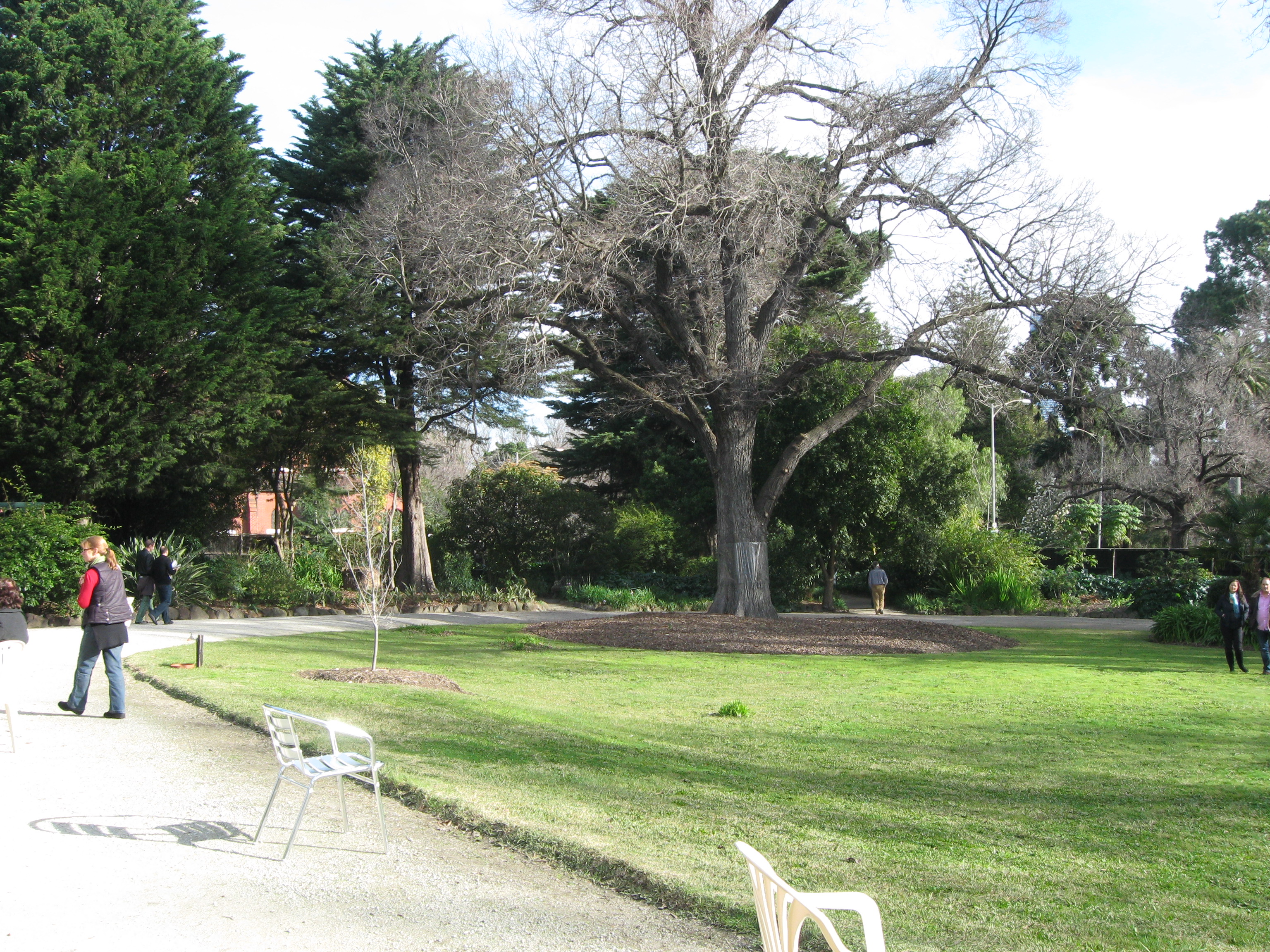
The gardens have been rescued from disrepair by a dedicated band of volunteers and they were in beautiful condition.

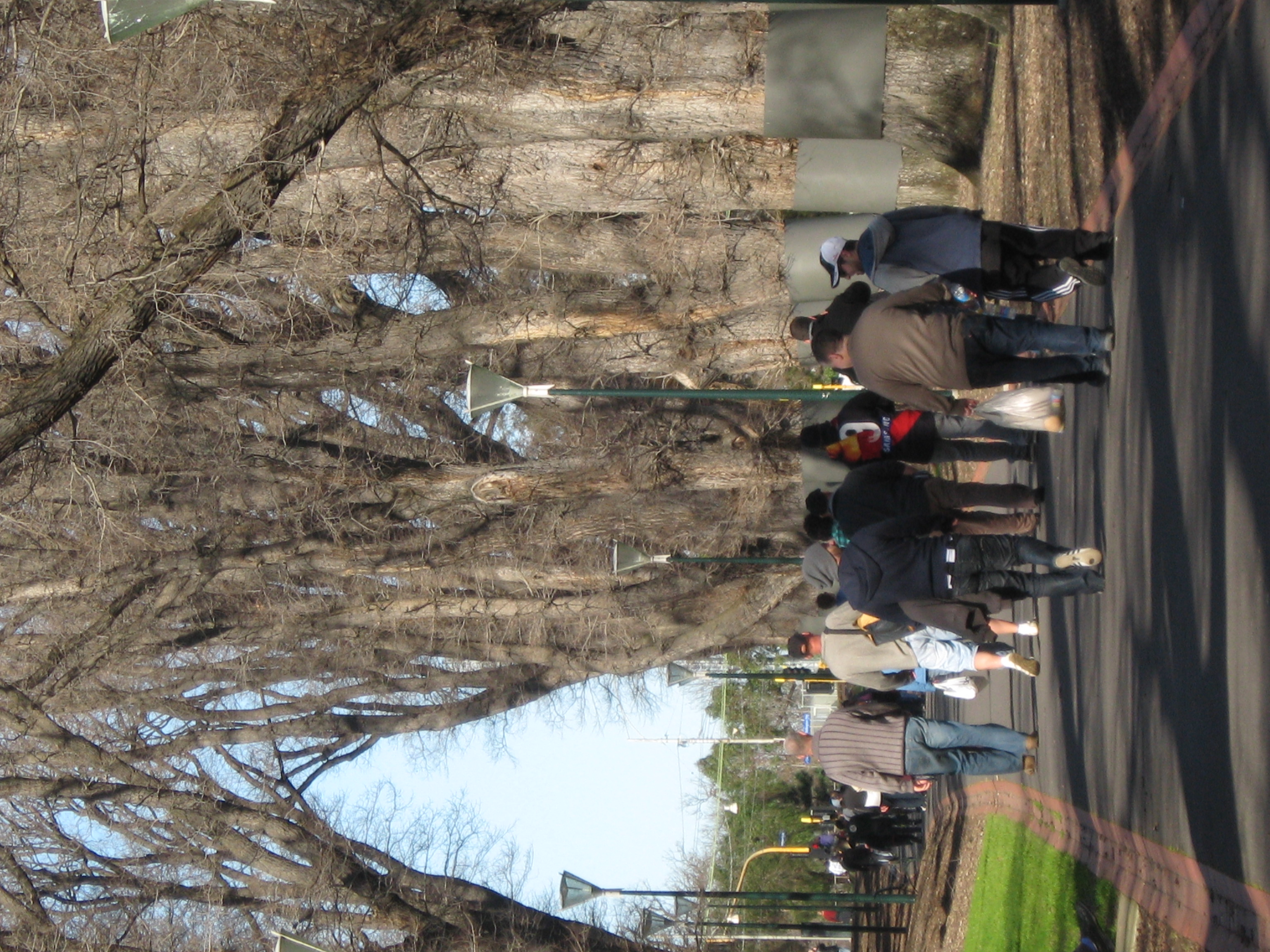
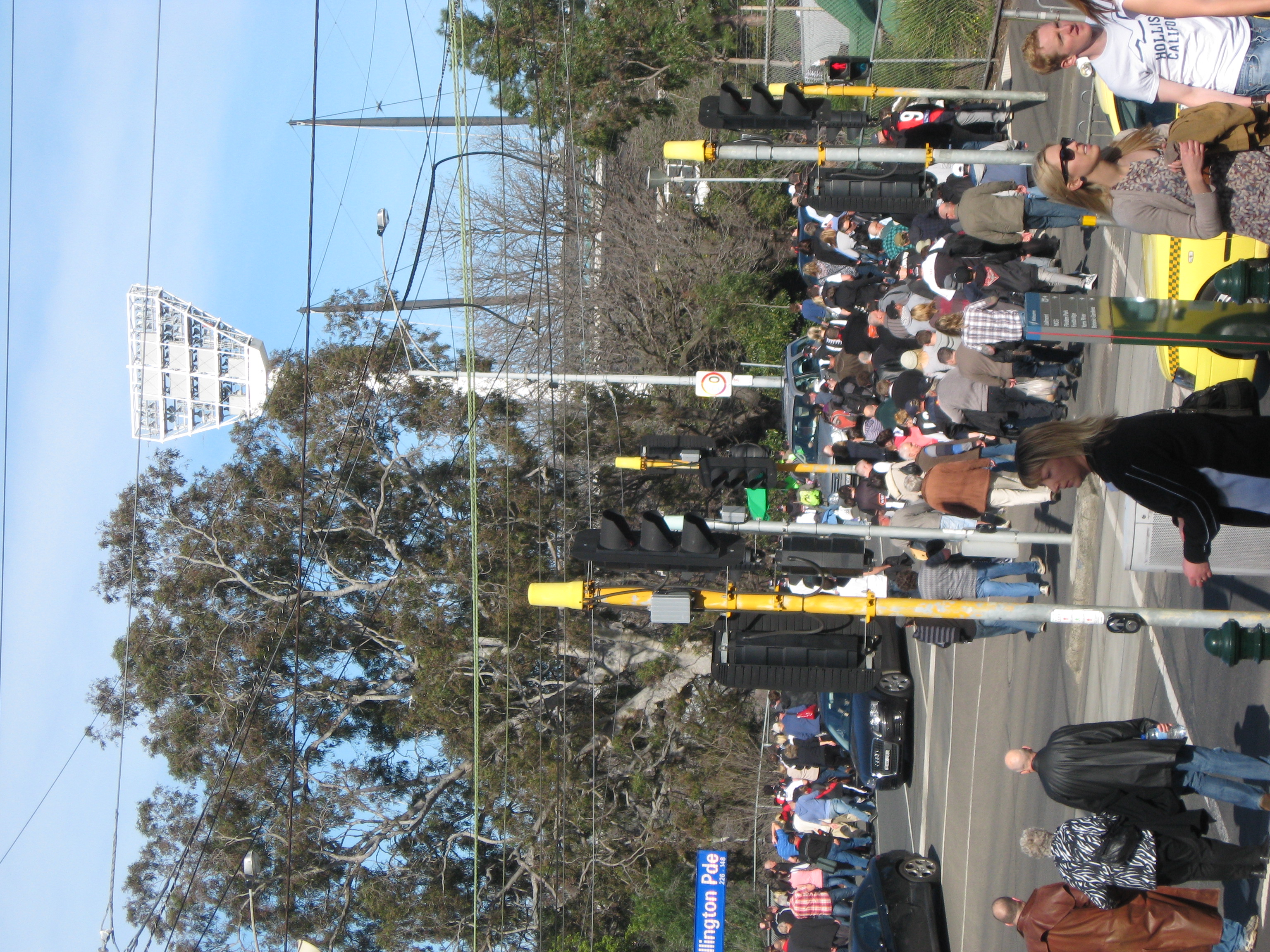
As I left, there was a religious pilgrimage of a different type through the Fitzroy Gardens as the crowds headed towards the MCG for the Collingwood/Essendon match.

The processional to the 'G

Ah- the footy and the MCG on a sunny winter afternoon- hot pies (unfortunately), seagulls, the Footy Record and Jolimont railway station. Who could want for more?

By the way, I wasn’t the only one checking out Melbourne Open House.  Andrew at High Riser had a very busy day and more success photographing than I did.

Seeing my city with new eyes

One of the things about being away for any considerable length of time is the way that you view your own home once you return.  I came home to a house that was cleaner than I left it (ah, the joy of adult children!) and a recently-planted garden that is not only still alive but growing like topsy! But today was the first time that I’ve been into Melbourne itself, and I felt as if I were seeing it after a long absence.

It’s a beautiful clear, sunny but cold winter day today, and the city absolutely sparkled.  I don’t know if I just fluked it, but the trains both to and from the city were clean, warm and with little graffiti.  I had been opposed to the proposal to remove seats from the trains to provide more standing room, but having now used public transport in Toronto, Boston, New York and London, the carriages did seem particularly cluttered with seats.  There was little rubbish on the stations- in fact, our streets generally seem clean in comparison with streets in the cities above.   The underground stations in particular seemed light and modern. The trains were on time, the trams were predictable only in their unpredictability.

It’s the infrequency of our public transport that’s the sticking point.  Other cities do not have the same emphasis on time- in fact, you were often hardpressed to find a clock- because trains arrived so often that it didn’t really matter if you missed this one, because the next would soon arrive.  Not so for us here in Melbourne- 20 minutes is too long between day time services.  It seems that every tram and bus stop has a disconsolate little clutch of would-be passengers, stepping out onto the street, craning to see if something -anything- is coming.

And Melbourne itself: look- the Darebin and Merri creeks are running high! That sparse and artificial planting on the banks of the Merri, beside the over-engineered bike path, is looking a little better.  People have moved into the high-rise opposite Heidelberg station (although I’m still cross that it dominates the hill as much as it does).

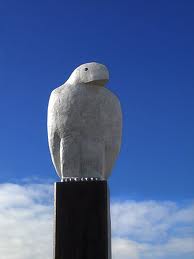
I read in this morning’s paper that they’re thinking of moving the statue of  Bunjil the eagle in order to, no doubt, build yet another high-rise in Docklands. Other than Colonial/Telstra/Etihad stadium (which I always make a point of calling ‘Docklands Stadium’ on principle) I’ve only been down to Docklands once, and it seemed a particularly godforsaken place.

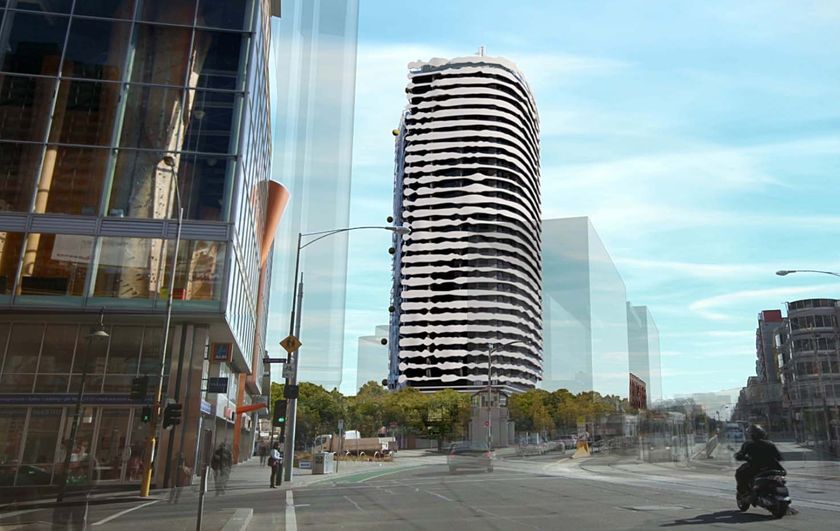
I noticed, too, that the building on the old CUB site is finally going up as well. This is the one that is planned to have an image of William Barak on it.

Artists impression of the finished building

I really don’t know quite what to think of these modern representations of aboriginal presence.  Appropriation? Acknowledgment? Tacky? Reverential? Is the CUB building a fitting juxtaposition to the Shrine of Remembrance at the other end of Swanston St/St. Kilda Rd?  Or an ironic one?

Most of all today, I noticed our beautiful, big bowl of sky.  Yes, I know that it’s the same sky,but somehow it seems bigger here. I think that I must be glad to be home.

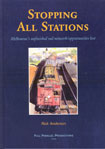
‘Stopping All Stations’ by Rick Anderson

2010, 155 p plus 59 pages fascinating notes!

I have some news for you next time you’re sitting on the Eastern Freeway with a long ribbon of red brake lights ahead of you.  Or perhaps if you’re stopping and starting, stopping and starting behind one of those grey and orange Smart Buses travelling -why! from Altona to Mordialloc- shucks, the journey only takes four hours.  And here’s the news- Melbourne almost had the makings of an inner circle railway that would delivered efficient east-west rail travel – and we ditched it!

I like trains, actually.  I live close to a station and on quiet nights if the wind is blowing the right direction, you can even hear the beep of the train doors closing and the station announcements.  I’ve always enjoyed looking at the inner-city backyards as you speed over Collingwood and Richmond on the limited express between Jolimont and Clifton Hill. They’ve changed over the decades: the outside dunnies have all disappeared and backyard living-room extensions leave just a small courtyard with enough room for an outdoor dining table and that’s it.

Stopping All Stations is a history of Melbourne’s trains, written by a suburban train driver.  He starts with the early private railways of the 1850s, bubbling along with the riches of gold-rush Melbourne.  There’s a string of acronyms here: The Melbourne and Hobson’s Bay Railway (MHBR) , our first, that ran to Sandridge (Port Melbourne) which had been so inconveniently distant from the settlement on the Yarra;  the Melbourne, Mt Alexander and Murray River Railway Company (MMA&MRR) that never really got off the ground;  the Geelong and Melbourne Railway Company (G&MR) that only lasted four years before being taken over; the Melbourne and Suburban Railway (M&SR)  that operated between Flinders St and CremorneAfter myriad re-combinations of their acronyms, they, along with later railways to St Kilda and Brighton, and Essendon had all been swallowed up by the  Victorian Railways  by the early 1880s..

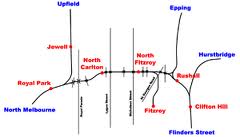
The book is subtitled (rather clumsily) “Melbourne’s unfinished transport work/opportunities lost” and this was the most fascinating part for me- the little railways and circuits that emerged and then disappeared.  There was the Outer Circle Railway that in 1892 ran between Fairfield Park and Oakleigh (map here) and an Inner Circle that existed between  1901-1942, on paper at least, that connected Rushall, North Fitzroy, North Carlton and Royal Park.

You can just detect the remnants of these lines at Fairfield, near the paper mills; and along the bike track in North Fitzroy.

Closer to home, there’s the Mont Park rail spur that connected to Macleod station, battling manfully up the hill to what is now a new housing estate. Lost opportunities indeed- LaTrobe University, which opened within a year or two of the Mont Park spur closing, would have provided the patronage that the small line lacked. Our three 1960s universities- Melbourne, Monash and La Trobe, have all been poorly served by train services, and I note that there are plans for a Melbourne University station under yet another grand transport scheme that will probably never see the light of day.

One of the real joys of this book are the little hand-drawn maps that show these now-you-see-it, now-you-don’t lines.  There’s a terrific graphic of the boa-constrictor nature of Victoria Railways as it swallowed up smaller private lines, and the text is sprinkled with the author’s own paintings of trains, signals and stations.  The book is a real labour of love, and Melburnians- even those not enamoured of trains per se- can find plenty to regret when considering the public transport that could have been.

I bet you thought that I couldn’t find a connection between Judge Willis and Melbourne’s train system which, after all, was not even thought of until some ten years after he left.  But in the spirit of Six Degrees of Separation between Judge Willis and the Railways,  the house that Willis leased while in Melbourne (which, incidentally was next door to my childhood home- hence my initial interest in him)was owned by Malcolm Macleod.  Macleod provided land to the railways on condition that the station was named after him- hence Macleod station.

Read because: I wanted to learn more about the Mont Park spur line. And because I really do like trains.

Just say No at the MCG

Off to the MCG last night with my son, a long-time and long-suffering Tigers supporter to watch Richmond v St Kilda.  A draw- hah! I say.  At least a draw in Aussie Rules is not one of those dour nil-all matches in the other codes, and everyone, whether black/yellow or black/red/white left saying “That was a good game!”

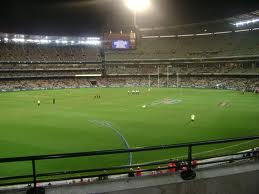
Now, I don’t think that I’m turning into a gun-toting libertarian (yet) and perhaps it’s just my Grumpy Old Lady stirring, but one comes away from the MCG feeling put-upon and nagged.  Apart from the live-betting scores that flash up on the screen to enrage me at the ubiquity of corporatized gambling,  there is also a string of prohibitions and admonitions all aimed, no doubt, at lessening the MCG’s  public liability and protecting their assets. Here, according to the messages on the scoreboard, is  what you can’t do at the MCG

1. Smoke

2. Run onto the ground during a match

3. Go onto the ground after the game for a bit of kick to kick (a time-honoured tradition and the only way that a lot of us would ever get onto the MCG turf)

4. Take alcohol out of the stadium (or bring it in for that matter. Or drink full strength beer)

5. Stand on the seats

6. Put up an umbrella (flashed onto the screen the very minute a gust of virga eddied onto the MCG in its own little micro-climate)

7. Fall on the steps because it’s wet (ditto)

8. Be anti-social, and they gave a handy dob-a-hoon SMS number so that you could report them – quite a good idea actually.

I’m sure that there were more, and I’ll add them as I think of them (and you suggest them).  I was surprised that there wasn’t one about racial vilification  and they’ve obviously given up on people photographing, filming etc.  But my goodness, do we really need to be harangued and nagged the whole way through a match?  Do I dare say the words ‘nanny state’?


Ah, footy!

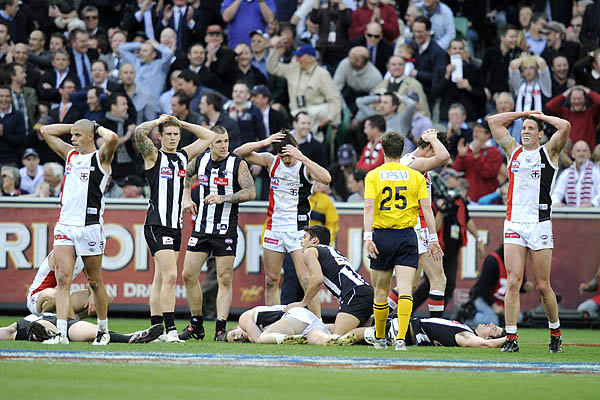
Simon says “Hands on Heads!”

What a beautiful game! We didn’t lose! And we get to do it all again next week!

Melbourne Day? 30 August

Poor Melbourne.  She’s been thrashing about for years, looking for a day to celebrate herself.  At the moment the good burghers of the town have settled on Melbourne Day on 30 August, the day that the landing party of the Enterprize went onshore.  The cynics amongst us might see the nomination of 30 August as another step in the Batman/Fawkner controversy over the founding of Melbourne that I’ve alluded to previously here and here.   And just look at all the things you can do today on the Melbourne Day website

Being a daughter of the land of the long weekend, a day’s not worth celebrating unless it’s a day off, and I can’t see that happening in a hurry.

But this yearning for a Big Day is not just a rush of blood to the collective heads of the City of Melbourne Public Relations Committee. Tom Griffiths in Hunters and Collectors goes through some of the other attempts to have a Melbourne Big Day- attempts that were as unsuccessful as I strongly suspect Melbourne Day will be.

There was, of course, Foundation Day or ANA day on 26th January but -damn it- school holidays were longer then and the little tackers were still on holiday. Besides, it’s always been a bit Sydney-centric, and there’s the problem of all those convicts…

Separation Day on 1 July, to celebrate the separation of Victoria from New South Wales in 1851 was Victoria’s first day of commemoration, but it faded away quickly.  It was inaugurated only a couple of days before the discovery of gold.  With the influx of newcomers with the gold rush, it meant little and soon fizzled out.   The recent ringbarking of the Separation Tree in the Botanic Gardens provoked regret but not outrage, and I suspect that Separation’s not about to capture the public imagination anymore.

In 1911 the Victorian  Education Department declared 19th April to be “Discovery Day” because on that day Lieutenant Hicks sighted Victoria from Cook’s Endeavour (and sailed right on past….).  But then Anzac Day was inconsiderate enough to happen on 25 April so that was the end of a perfectly good date because the children and their teachers had quite enough to do with Simpson and Last Posts etc.

What about November 19 then?  It became “Pioneers Day” to commemorate the day that Edward Henty landed at Portland and became, so it was said, Victoria’s first permanent settler, complete with ploughs and sheep.  I don’t know when this day fell off the calendar.

We tend to have days for good causes, but particularly around the turn of the twentieth century,  “nature” days were all the go.  There was Arbor Day, (picked up from the United States) now known as National Tree Day, and held at different times around Australia.  I remember this one- being given a little tree in a tube to plant in the rock-hard, clayey school garden.  I also remember planting trees down by the Yarra River- the plantations are still there- but I’m not sure if that was for Arbor Day or not.  It may have just been a tree-planting scheme.

Then there was Bird Day, which was first held in Victoria in 1909 by the Gould League.  It was their centenary in 2009-  look here at their gallery of memorabilia.  I was a proud member of the Gould League with their tasteful little badge (I wonder if I still have it somewhere?); I loved the smell of their glossy magazines, and I had their sketch book with the magpie on the front. I entered a picture of an ibis (execrable creatures) for one of their competitions.   To be honest, there’s a twitcher in me that threatens to escape sometimes.

Wattle Day? 1st September apparently. It’s their centenary this year. They’ve got some fun suggestions for celebrating it.  Or not.  I remember someone bringing wattle to my fourth grade teacher -do children still take flowers to class? I suspect not.  Poor old Mrs Kenny was allergic to it, and was away from school for a fortnight.   Would bursting into “bwah-ha-ha” lower the tone of my blog?

Why not? I’m feeling so festive on our putative 175th Anniversary… Happy Melbourne Day to you too.

Election Day

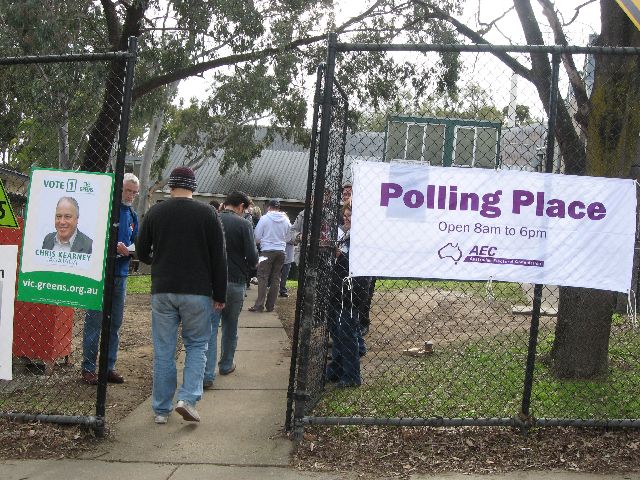
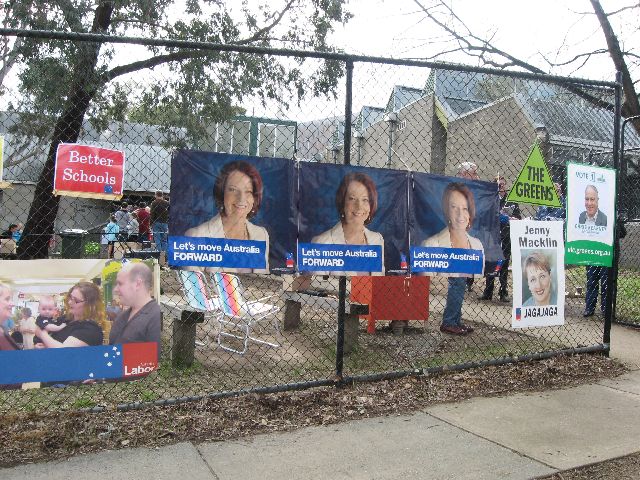
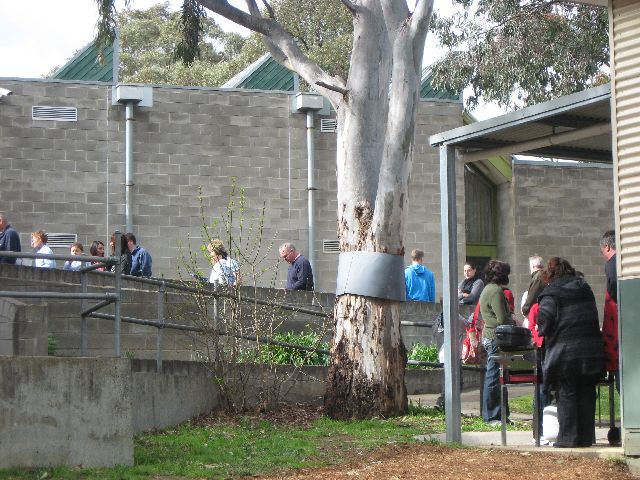
I’ve just returned from doing my democratic duty up at the local school.  It’s election day here in Australia, and one that I feel rather pessimistic about.  Elections are always held on a Saturday and voting is compulsory- something that I have absolutely no problem with.  I think of the bravery of people in other parts of the world who carry around their ink-dipped fingers (how dangerous could that be in some situations!) and I am grateful that I can vote in a country that expects and requires me to do so as a citizen in a well-organized and fully-financed electoral system.   My gratitude and trust in the system stands, no matter what the outcome tonight, tomorrow or maybe weeks down the track.

Yes, the sausages are sizzling as the good people of Macleod line up to vote

So what about elections in Judge Willis’ time? Of course, the whole concept of a Federal Election in Melbourne had to wait until 30 March 1901 but the first colony-wide election for NSW was held in 1843.  Until the passing of the 1842 New South Wales Act, the Legislative Council had been nominated by the governor, but the 1842 Act allowed for 36 members, twelve appointed and the rest elected.  The relative lateness of elected representation reflects the penal origins of the colony: Upper Canada had been awarded representative government nearly fifty years early with the Constitutional Act of 1791.

Port Phillip was still part of New South Wales at this stage.  Six members in total would be elected from the Port Phillip district, five from the district as a whole, with one from Melbourne.  There was not exactly a rush: the Council sat in Sydney, six hundred miles away, and few Port Phillip citizens were prepared to travel and stay in Sydney for council sessions.  As a result, of the five district members who were elected, only two – Charles Ebden and Dr Thomson from Geelong- were from Port Phillip.  The rest were Sydney-siders: Dr Charles Nicholson; the merchant Thomas Walker (who did have extensive holdings in Port Phillip and particularly in Heidelberg but was based in Sydney); and Rev John Dunmore Lang.  Two other Sydney residents- Thomas Mitchell, the Surveyor General, and James Macarthur Jnr, the son of Hannibal Macarthur also stood, but Mitchell was not successful and Macarthur withdrew his nomination before election day.  There had been talk earlier that Joseph Hawdon, the wealthy cattler overseer and  builder of Banyule homestead in Heidelberg, would stand but this did not eventuate and he, too, was  Sydney-based.

Certainly the election did not have the immediacy of the Town Council elections which had been conducted some six months earlier. Edward Curr, who had previously been a member of the Van Diemens Land Legislative Council, accepted candidacy for the Melbourne seat.  He was a prickly, forthright character who clashed strongly with Willis, along with many others in Port Phillip, it must be said.  It was his strong Catholicism that prompted the equally prickly and forthright Presbyterian candidate Rev J.D. Lang to cast about for a contending candidate for the Melbourne seat, lest Curr the Catholic be elected unopposed.  Lang and Kerr, the editor of Fawkner’s Port Phillip Patriot (with whom Lang was staying while campaigning in Port Phillip) decided to approach Henry Condell, the Mayor, asking him to stand.  They promised to organize a petition of 200 Melbourne electors by 4.00 pm the next day and Lang offered to write all of Condell’s speeches for him.

Once Condell had been persuaded to stand,  an element of sectarianism was introduced  into the campaign in a town which had, until that point, seen the denominations generally co-operating with each other, although this was being affected also by the changing demographic makeup of immigrants into the colony.  Curr and his letter-writing supporter Alexander McKillop certainly saw the contest in these terms, as did Lang himself. And it is into this contest between Condell and Curr that we see Willis intervening in a way that even today raises eyebrows, just as it did at the time:

Alston's corner, cnr. Elizabeth St and Collins St today, the site of Willis' shop-bench encounter over the Curr/Condell contest

As a climax to these indecencies, the Resident Judge (Willis) dishonoured the ermine of his high office by requesting the retailers, with whom he did business, to vote for Condell; and one day, whilst on a vote-touting expedition Willis and Curr met face to face in the shop of Mr Charles Williamson, a Collins Street draper (lately Alston and Brown’s) where the Judge waxed so personally offensive that Curr’s forbearance only prevented the public scandal of a pugilistic encounter between the judicial canvasser and the candidate.” p. 333

The election was conducted in four locations. Voting for the district seats took place in Portland, Geelong and Melbourne, while the voting for the Melbourne seat took place in the Gipps ward of Melbourne.  In many regards they were typical English-style elections:  the votes themselves were announced (no secret voting here!), there were placards and ribbons, and the alcohol flowed freely.

The voting went off well enough until the polls closed at about 4.00 pm.  Once it was clear that Curr had been defeated, his Irish Catholic supporters moved to the Golden Fleece Hotel where they hoped to find Condell, then to the main polling site at the Mechanics Institute in Collins Street where the results were to be announced.  The Chief Magistrate Major St John and Dana, Chief of the Native Police arrived on horseback , and in the midst of brawling, the Riot Act was read.  Forming groups of 50-100, the crowds broke up and raged through Little Collins, Collins and Elizabeth Streets with stones and brickbats.  The military arrived, charged the mob with bayonets; hotels were closed and the mounted police patrolled the town.   However, unlike Sydney where similar riots occurred resulting in the death of one man, there was no loss of life. A couple of days later, once the results had been collected from Portland and Geelong, the successful candidates were announced. The Port Phillip Herald 27/06/43 reported:

At the close of the ceremony, Mr Ebden’s horses were taken from his carriage, which containing Mr Ebden, his brother Mr Alfred Ebden, Mr Curr and Mr Foster, was dragged through the town.  The town band paraded the streets from an early hour in the morning til late in the afternoon, but little interest was manifested in the proceedings, the dismissal of the judge having evidently taken possession of the public mind.

And here two of the anxieties that La Trobe dreaded coincided: the unruliness of the election, and the excitement over Willis’ dismissal.  But that’s a post for another day (maybe).

It’s hard to tell how many people were eligible to vote.  The franchise was for males over 21 who owned freehold property worth 200 pound or rented a property worth 20 pounds per annum,  a natural born (British) subject or naturalized.  Those who had committed “treason, felony or infamous offence” could not vote unless they had been pardoned or undergone their sentence- an issue of controversy in regard to the applicability of English law in a former penal colony.  As far as the ‘district’ elections were concerned, the Port Phillip Herald a few days later published full details of the results. The names of the voters were given, the booth they voted at, the time that they attended, and the candidates to whom they gave their votes – no privacy here! The final results were: Ebden 228, Walker 217, Nicholson 205, Thomson 1843, Lang 165 and Mitchell 157 .  In Melbourne, Condell received 205 votes to Curr’s 174 but the names of the voters were not given.  I’m not sure how many votes people had, given that many men owned multiple properties,  and how the practice of ‘plumping’ (i.e. giving all your votes to one candidate)  applied here.  Either way- we’re not looking at a huge electorate.

For myself, I would gladly drag a carriage with my first female prime minister through the town with the town band playing but I don’t know if that’s going to happen…

References:

M. M. H. Thompson The Seeds of Democracy, NSW, The Federation Press, 2006

A. G. L. Shaw  A History of the Port Phillip District: Victoria before Separation Carlton Vic., Melbourne University Press, 2003

Jennifer Gerrand  ‘The Multicultural Values of the Melbourne 1843 Rioting Irish Catholic AustraliansJournal of Historical and European Studies, Vol 1 Dec 2007

Walking backwards for climate change

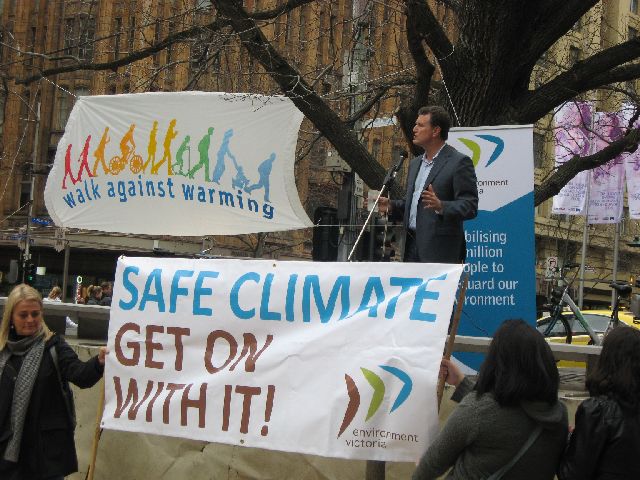
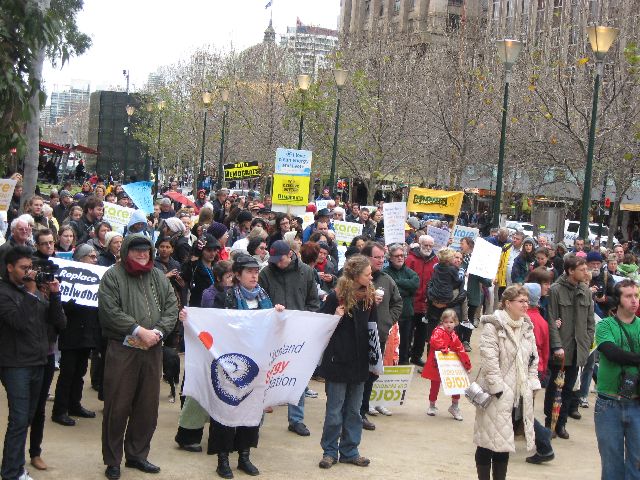
When my presumably yet-unconceived grandchildren say to me “Nanna, what did you do about climate change?” I shall say to them “Well, I bought strange light globes and I walked backwards in the City Square on the weekend before the 2010 election.”

Yes, there we were on a day that seemed particularly un-globally warm, with our hands on the shoulders of the person in front of us, walking back wards along the length of the City Square.

Walk with the people, not the polluters! Climate action now! (Ouch, ouch!)

as the person in front of me (aka Mr Judge) stepped on my toes as we were were “moving backwards” for climate change, as distinct from “moving forward” as we all were at the start of this election campaign a very l-o-n-g five weeks ago.

(There’s Mr Judge looking all rugged up for global warming to the left of the woman holding the white banner).  Back, back we shuffled, “walk with the people…” etc. until I could feel the crowd pressing behind me.  Was there about to be a dreadful crush? “Tree, tree” hissed someone behind me, and sure enough I turned round to find myself pressed up against one of the few spotted gums that survive the blasted heath of our so-called City Square.

Yes, grandchildren of mine (one day), when the planet was there to be saved, your Nanna was there.

Later postscript:

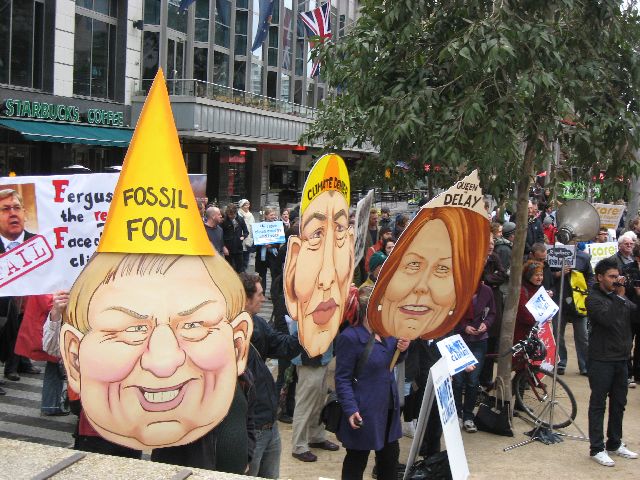
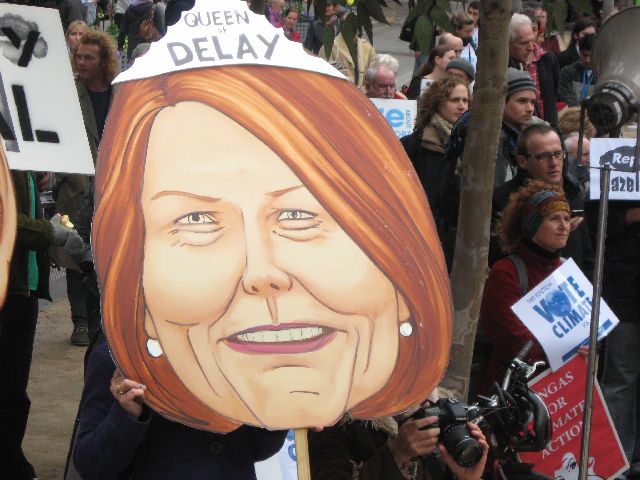
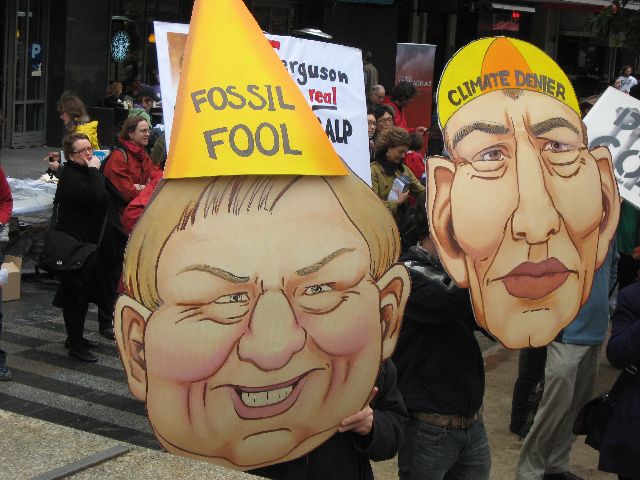
And for those of you who may have arrived at this site through other links, I do want to make it clear that I am deeply concerned about the lack of leadership and mealy-mouthed response to climate change from our major parties- the Labor Party in particular.  I feel disempowered as a citizen by the money and influence of the fossil-fuel and mining corporations.  This was a quirky and in many ways incongruous public event, and I’m glad that I attended it.

An Invitation to the Ball

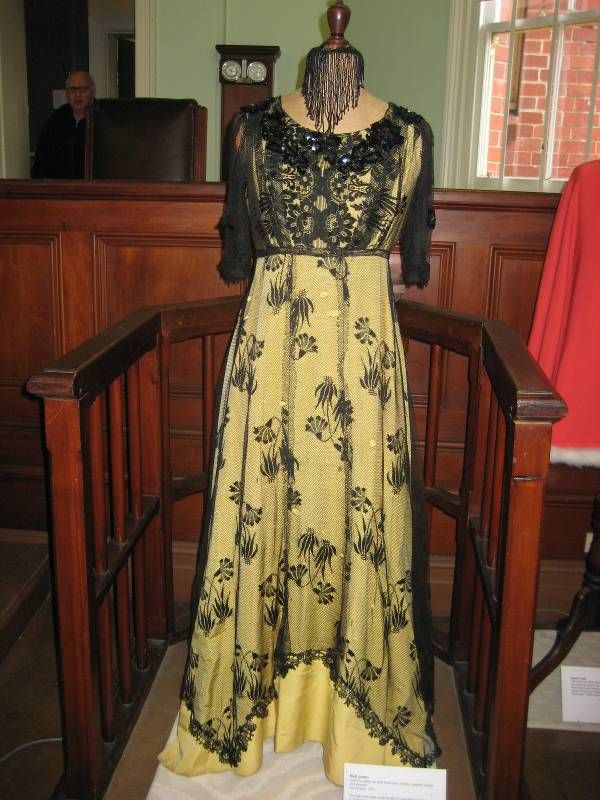
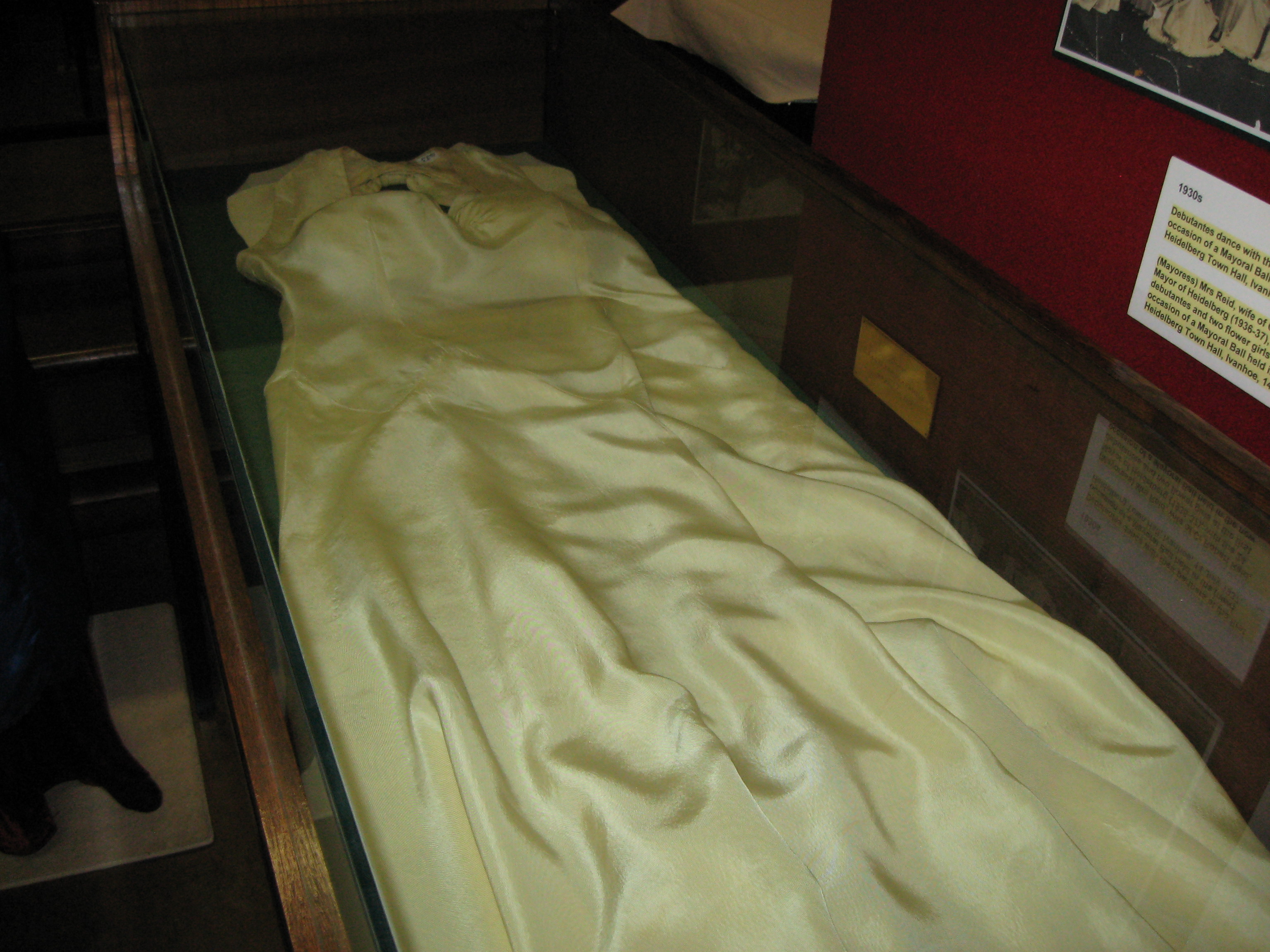
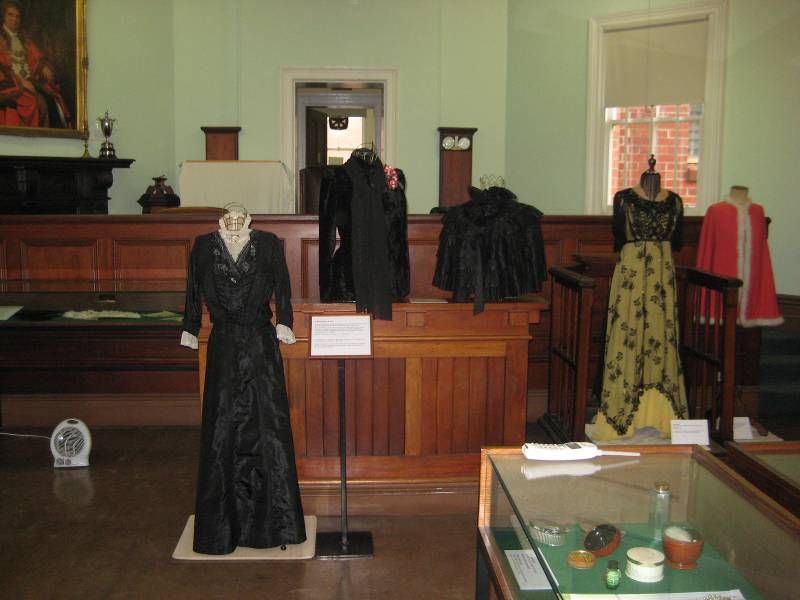
And now for a bit of shameless advertising. My local historical society has been hard at work recently putting together an exhibition called “An Invitation to the Ball”.  The inspiration for the exhibition arose when the curators were transferring our textiles collection into new textile archive boxes.  Many of the items had been donated forty years ago when the Society was in its infancy, and surveyed as a whole, we realized that we had a collection of beautiful objects.

There is, of course, the much more extensive costume exhibition on at the NGV at the moment, but what I really love about this exhibition is that the displays are interwoven into a broader history of the Heidelberg/Ivanhoe area.  The focus is on women’s formal wear between 1850 and 1950, and there are many connections between formal occasions and the nearby Heidelberg Town Hall, the site of many mayoral occasions, debutante balls, concerts – to say nothing of regular Saturday night dances.

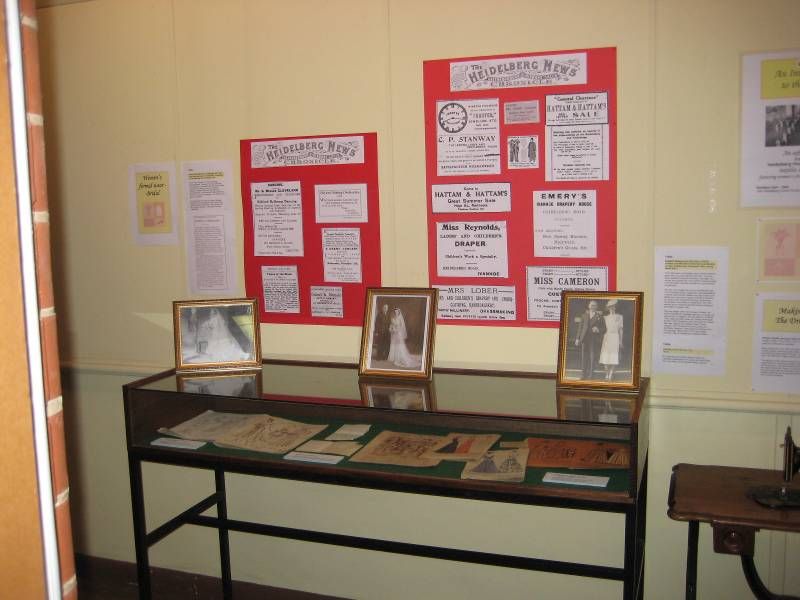
Because these are garments worn locally, we were able to trace through the original wearers and the occasions on which they were worn.  A search through our records and photographs found studio photographs and invitations for a debut ball held in the 1930s which, supplemented by an oral history memoir, are displayed beside the dress itself.  We were able to identify the lady mayoresses who wore particular gowns, and we found records of a number of formal occasions held in nearby facilities including “Sunday afternoons”, concerts and sporting festivals.

We were also able to locate, through our holdings of local newspapers,  advertisements for the web of haberdashers, drapers, outfitters and shoe shops in the local shopping centres- particularly the women dressmakers, all coyly named Miss or Mrs, and often formerly of Collins Street or other addresses.

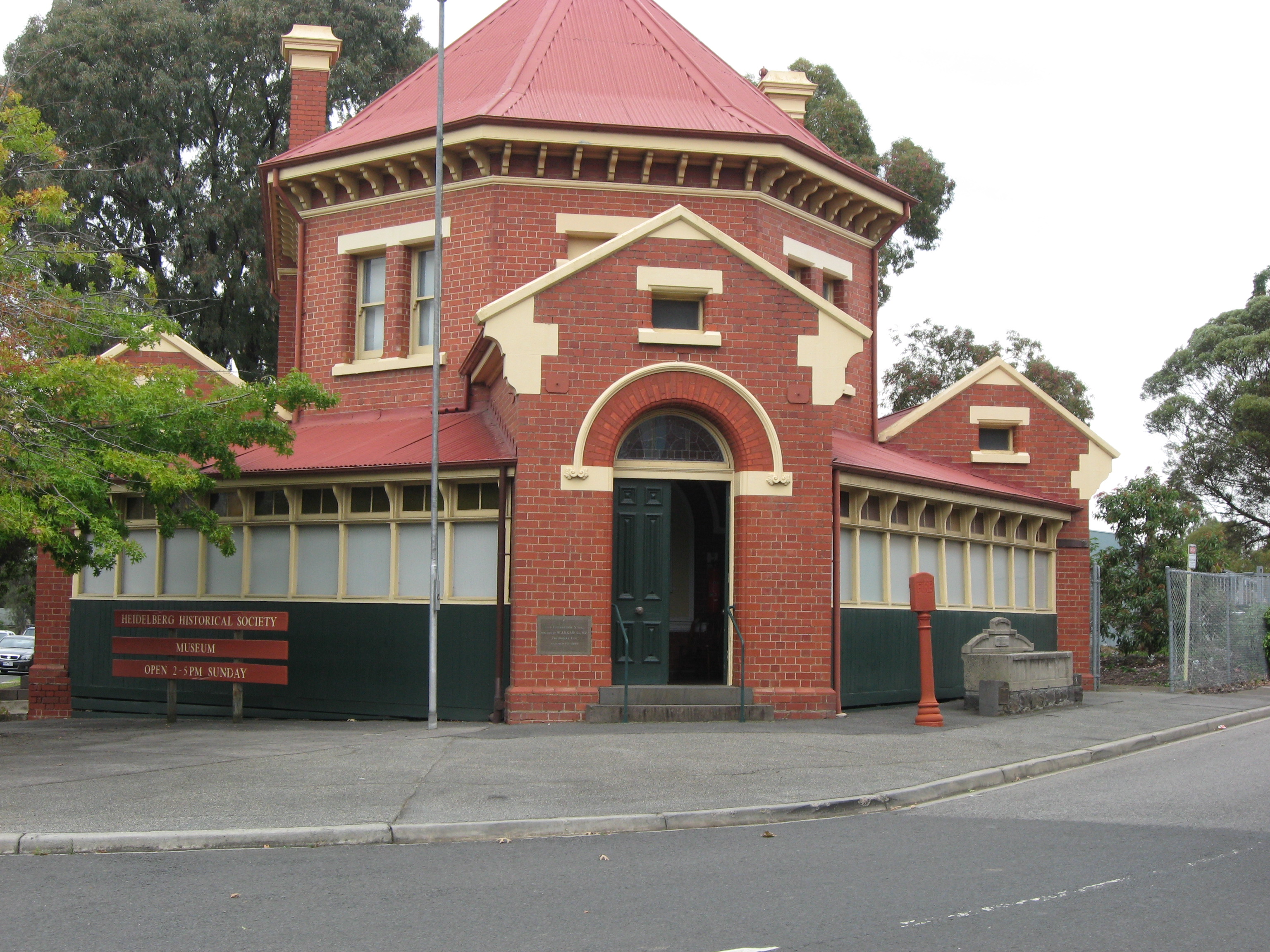
The exhibition is open on Sundays 2-5 and will run until November 2010, so unlike most events that I write about here, it’s not closing soon!  Entry is $5.00 for adults, $2.00 for children under 16.  The Heidelberg Historical Society Museum is on the corner of Jika Street and Park Lane, Heidelberg. If you live in the northern suburbs you’ve probably driven past it dozens of times on the way to Burke Road. And who knows,  you may just even see me there!