Category Archives: Book reviews

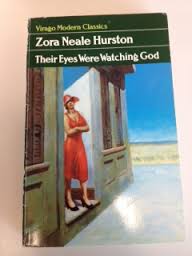
‘Their Eyes Were Watching God’ by Zora Neale Hurston

hurston

(1937), 1987 reprint, 286p.

One of my resolutions this year is to read more of the books I already have on my shelf (I even committed to the TBR challenge!). So far, I have failed miserably because this is, I think, the first book I’ve read from the groaning shelves.  I must have bought it secondhand at some stage because I’d heard of Zora Neale Hurston, although I was under the mistaken impression that she was a historian in the 1960s.

So the first surprise was  that Their Eyes Were Watching God was a novel. The second surprise was that it was written in 1937 and not in the 1960s as I had supposed.  The third surprise- and the one that discomfited me most- was the use of dialect in the dialogue. Let me give you an example, drawn at random:

“Ah often wonder how dat lil wife uh hisn makes out wid him, ’cause he’s uh man dat changes everything, but nothin’ don’t change him”

“You know man’s de time Ah done thought about dat mahself. He gits on her ever now and then when she makes mistakes round de store.”

“Whut make her keep her head tied up lak some ole ‘oman round de store? Nobody couldn’t git me tuh tie no rag on mah head if Ah had hair lak dat.” (p.79)

The book is very dialogue heavy, and it’s all like this. How, at a time when ‘black-face’ is now unacceptable, should a modern reader react to this? Actually, not just a modern reader: many African-American activists at the time found it confronting too.  Here’s Richard Wright reviewing her in 1937:

Miss Hurston voluntarily continues in her novel the tradition which was forced upon the Negro in the theatre, that is, the minstrel technique that makes the “white folks” laugh. Her characters eat and laugh and cry and work and hill; they swing like a pendulum eternally in that safe and narrow orbit in which America likes to see the Negro live: between laughter and tears…In the main, her novel is not addressed to the Negro, but to a white audience whose chauvinistic tastes she knows how to satisfy.  She exploits that phase of Negro life which is “quaint”, the phase which evokes a piteous smile on the lips of the “superior” race.  (http://people.virginia.edu/~sfr/enam358/wrightrev.html)


However, Hurston, as an anthropologist, rejected this characterization of her work. She was intent on documenting and celebrating black culture through its language, humour and speech patterns, and some thirty years after its publication,  it is this aspect of the book that has inspired feminist and Afro-American women writers in particular. For myself, I found that I could let go of my misgivings about the way the dialogue was depicted once I ‘heard’ it in my head like a film soundtrack, rather than reading the words on the page.

Janie, the main character of the novel, has three husbands. She was encouraged to marry the much-older Logan Killicks by her grandmother, who as a former slave feared for a grand-daughter unprotected by a man. In a flush of infatuation, she leaves him for Jody Starks, a pushy entrepreneur, intent on developing a black community under his own leadership as mayor. But when Jody belittles her, she leaves him too for Tea Cakes, a younger man who she sees as the love of her life and soulmate, although he draws her into a peripatetic life far below that she had enjoyed as the mayor’s wife. Over time, though, this relationship also becomes an emotional rollercoaster, but she does not waver in her love for him.

I can see why writers like Toni Morrison and Maya Angelou have been influenced by Hurston’s writing, because Janie is a full-realized, nuanced female character, far beyond the stereotype that the dialogue evokes in my mind.  The book is strong in its structure, with a frame story within which the plot moves confidently.  It is a book entirely within a black and female consciousness, with hints of magical realism.  No wonder it has been designated a ‘modern classic’ and well worth taking off the bookshelf.

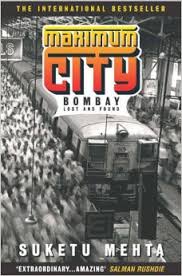
‘Maximum City: Bombay Lost and Found’ by Seketu Mehta

maximumcity

2004, 497 p.

Good grief.  What on earth was my son thinking when he suggested that I (a middle-aged, inexperienced world traveller) read this book before visiting Mumbai?

The author Sekutu Mehta was born in Calcutta, and moved to Bombay where he lived for nine years. He left Bombay to move with his parents to America in 1977 at the age of fourteen. In the intervening twenty one years, he lived in New York, Paris, London, Iowa City, New Brunswick and New Jersey.  He  returned in 1998 with his wife and two young children to find that he was viewed as American rather than Indian. After struggling to find accommodation and to have services connected and after an altercation with his neighbours over his parking space he explodes:

This f*cking city. The sea should rush in over these islands in one great tidal wave and obliterate it, cover it under water…Every morning I get angry. It is the only way to get anything done; people here respond to anger, are afraid of it…Any nostalgia I felt about my childhood has been erased.  Given the chance to live again in the territory of childhood, I am coming to detest it. Why do I put myself through this? I was comfortable and happy and praised in New York… I have given all that up for this fool’s errand, looking for silhouettes in the mist of the ghost time. Now I can’t wait to go back, to the place I once longed to get away from: New York…I am an adulterous resident: when I am in one city, I am dreaming of the other.  I am an exile, citizen of the country of longing.  (p. 28-9)

A working journalist, he is drawn to the Muslim/Hindu riots of 1992-3 that followed the destruction of the Babri Masjid mosque in Ayodhya, leading to over 2000 deaths, 900 of which occurred during the gang-led Bombay riots.It is this event, and the networks of power that spread web-like from it, that are explored in the first two-thirds of this lengthy book. In  Part I, ‘Power’, he talks with both members of Shiv Sena, the far-right Hindu political party, and with members of D-Company led by gangmaster Dawood Ibrahim, who orchestrated a series of  retaliatory bombings on March 21 1993.  He interviews Ayay Lal, the policeman charged with solving the 1993 bombings who walks (and perhaps falls over) a very fine line between justice and criminality himself.  This is nasty, violent stuff that made me ashamed to feel compelled to keep reading. In Part II, ‘Pleasure’ he explores the world of bar-girls and Bollywood, transvestism and prostitution.  It, too, is a nasty,  violent, squalid world.  It is only in Part III ‘Passages’ where he focuses on individuals who skirt these worlds without being swallowed into them, that I felt somewhat less voyeuristic and complicit.

This is a very long book of nearly 500 pages. Its journalistic structure means that it could, theoretically, be any length by adding or culling yet another interview.  Despite its three parts and 500-odd pages, I found it hard to find any particular argument in it, except perhaps the rather limp view that

A city is only as thriving or sickly as your place in it. Each Bombayite inhabits his own Bombay. (p. 493)

For a good 2/3 of the book, I felt annoyed by the book’s bagginess and self-indulgence. I resented the time it was taking to read it, but I couldn’t stop doing so either. Yet while in Mumbai I found myself constantly citing this book and small things that I had learned through it. My travelling companion Jesse must have inwardly sighed as I started “In that book I was reading…” because I did so, often.

But I didn’t want to see the Mumbai (Bombay- his choice of ‘Bombay’ in the title is significant) described in this book. It frightened me.  To use a bland local example, it was like advising a visitor to Melbourne to watch the full series of Underbelly.  Yes, you would learn quite a bit about the Melbourne criminal culture, but you might view the Victoria Market, St Kilda and the Western Suburbs quite differently.  I doubt if it would add to your enjoyment of Melbourne.

So my recommendation? Yes, read Maximum City but do it long before you go there, or soon after- but just don’t read it while you’re there!

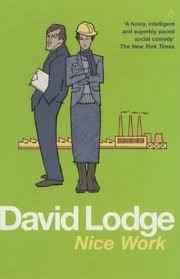
‘Nice Work’ by David Lodge

lodge

1988, 277 p.

I often find that my response to a book is largely influenced by the book that I read immediately before.  For example, I found myself quite unable to pick up another fiction book for some time after reading War and Peace, and sometimes I want to get my teeth into something really meaty after reading some self-indulgent fluff.  In this case, I came to David Lodge’s Nice Work as a face-to-face bookgroup read after just finishing the challenging (on all levels) A Girl is a Half-Formed Thing.  I must confess that much of the joy in reading this book was Lodge’s masterful, urbane and instantly comprehensible prose.  In comparison with the book that I read immediately preceding it, this one just flew off the page.

David Lodge, as a former Professor of English Literature at the University of Birmingham, is well placed to turn his wry, satirical eye to red-brick university life in his ‘Campus Trilogy’ comprising Changing Places: A Tale of Two Campuses (1975), Small World: An Academic Romance (1984), and this book  Nice Work (1988).  In this book, flame-haired feminist academic Robyn Penrose, trying hard to get a tenured position at the University of Rummidge (a thinly disguised Birmingham), agrees to be involved in a job-shadowing scheme as part of improving links between the university and the workplace.  She is allocated to Vic Wilcox, the manager of an engineering firm. I think that you can guess what happens….

And it does, and to a certain extent there’s a reassuring predictability about the plot. What I really enjoyed about this book, though, is Lodge’s satirical but penetrating analysis of his characters.  He’s not kind about either of them, but he does not lack affection for them either.  Robyn is immured in the postmodernist sludge served up by Derrida and Kristeva that makes me shrivel up inside, while Vic Wilcox is one of those buttoned-up, slightly pathetic middle-aged men who might be driving his small company car next to you at the traffic lights at 8.00 a.m.

Not content with mere waspishness, Lodge has literary fun in the book as well. The epigraphs that separate the multiple parts of this book are sprinkled with quotes from 19th English novels, most particularly Elizabeth Gaskell’s North and South, and there’s quite a bit of North and South in this book as well.  It’s enjoyable without knowing any of this, but for those in on the joke, it adds another layer as well.


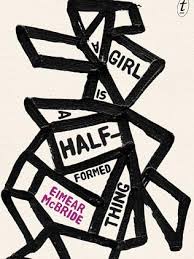
‘ A Girl is a Half-Formed Thing’ by Eimar McBride

agirlisahalfformed

2013, 227 p.

I find myself quite at a loss to know how to talk about this book.  It was raw and intensely sad, and also one of the most frustrating reading experiences that I have had in my life. The book is written in short, disjointed sentence with words missing and phrases left unfinished.  It amazes me that, somehow, despite the difficulty in actually reading the words, the story is so powerfully conveyed in all its squirming discomfort and sorrow.

The story is told chronologically by a young, unnamed girl whose older brother suffered brain damage and behavioural difficulties after a childhood brain tumour. For a number of reasons, she embarks on her own spiral of degradation and self-defilement while her brother subsides into unemployment and depression before the brain tumour returns.  It is a book steeped in guilt- oldfashioned, Catholic, rural Irish guilt- which reminded me of the equally gruelling Lars von Trier film Breaking the Waves.   But at the points where the emotion is rawest and almost beyond words, the gasped, incoherent text is at its strongest in its inability to speak.

The language is a staccato  stream-of-consciousness, largely composed of snippets of conversation and fleeting images and thoughts.  It is a child’s voice, but it persists into adulthood, the tortured syntax a reflection of the tortured narrator:

Howl winter all through the night that year in the trees where we climbed on and the hedges on the road.  No cars here. No one comes.  Things crying in the fields for me. Say they want me and coming down the walls for. She’s coming Mammy. Who? The banshee. Don’t be silly. Sure isn’t your brother here? Won’t he mind you if anything comes along.  Should I close the door or leave it open? I don’t know. Shut bad out or shut it in. Worse you. And said They are coming. For you and me. Stop it. Coming for us and we’re without the knife. What knife? The one that goes with the magic machine. What is it? Makes the noise for killing bad things. A big dark tunnel bangs. How do you know? That’s what I had, me shouting it burns awful ahhh. The doctor said fire come out my eyes. He didn’t. He did and these aren’t mind. They are so. Mine melted. These are goats. Goat eyes and the devil wants them back. My throat’s closing. Shut up. Ugh shut up. Mammy? But wakes me in the night. Goat eyes riding off into the sky.

It’s a very demanding book but it gives much. It teaches you to read it. (I found when I copied out this quote from near the start of the book, that having finished, I could understand it instantly. I struggled to make sense of it on first reading.)  Like A Clockwork Orange and Ulysses , which likewise use their own idiosyncatic language, you need to almost stop reading with your eyes and just give over to your inner ear.  There’s absolutely no skim reading here: you have to stop fighting against the text and just go with it.  It is one of the most powerful books I have ever read.

In her review in the Guardian, fellow Irish writer Anne Enright ventured the suggestion that McBride might be a genius. I don’t know if McBride has other books to come – it took nine years to find a publisher for this one- but I will be bitterly disappointed if it’s a rehash or continuation of this one.  I reserve my judgment about whether McBride is a genius herself but  I think that this book is a work of genius. I hope it becomes and remains a completely unique classic.

AND, I’m counting this towards my Reading the World International Reading challenge as a book from Ireland. How appropriate on St Patrick’s Day!


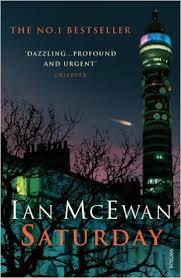
‘Saturday’ by Ian McEwan

Mcewan_saturday

2005, 308 p.

This is a re-read for my bookgroup, but I read it in 2007 and quite frankly could not really remember much about the book. What I did remember, however – and what strikes me anew on re-reading it- is how well it captures the post-9/11 anxiety about international news, and the interior conversations we tend to have about our own personal security in the face of international insecurity.

In the opening pages, successful neurosugeon Henry Perowne wakes early on Saturday 15 February 2003 to see a plane engulfed in flames streaking across the London skyline. Surely this news will saturate the media and yet, as he goes about his affairs on a normal Saturday – playing squash with a friend; buying fish for a family dinner that night- what he expected to be another 9/11 dwindles into insignificance as news. Securely ensconced in his upper-middle class, educated existence, he is thrust into a different form of terrorism when and where he least expects it.

The book has parallels with Virginia Woolf’s Mrs Dalloway, or James Joyce’s Ulysses. All three books are contained within a 24 hour period, describing the interior thoughts that bubble underneath an ordinary day.

Saturday is written in the present tense, which is a tense that I generally dislike because it makes me feel unsettled and anxious.  But in this case, that is exactly the feeling that McEwan wants to convey, and it works well.  Master writer that he is, he handles shifts in time well. Much of the book is steeped in banality, but as a reader you are fearful, expecting disaster with the turn of each page.

It is this fear of imminent disaster, both personally and globally, that captures living in a internet-connected, news-saturated post 9/11 world. I identify with this. Part of my awakened interest in world events has been driven in equal part by a desire to understand but also a fear that momentous. terrifying, world-changing things are happening right now somewhere in the world, and that I don’t yet know it.  Henry Perowne feels it too:

 He takes a step towards the CD player, then changes his mind for he’s feeling the pull, like gravity of the approaching TV news.  It’s a condition of the times, this compulsion to hear how it stands with the world, and be joined to the generality, to a community of anxiety.  The habit’s grown stronger these past two years; a different scale of news value has been set by monstrous and spectacular scenes.  The possibility of their recurrence is one thread that binds the day…  Everyone fears it, but there’s also a darker longing in the collective mind, a sickening for self-punishment and a blasphemous curiosity… Bigger, grosser, next time. Please don’t let it happen. But let me see it all the same, as it’s happening and from every angle, and let me be among the first to know. (p 176)

I share his response:

It’s an illusion, to believe himself active in the story. Does he think he’s contributing something, watching news programmes, or lying on his back on the sofa on Sunday afternoons, reading more opinion columns of ungrounded certainties, more long articles about what really lies behind this or that development, or about what is most surely going to happen next, predictions forgotten as soon as they are read, well before events disprove them?…His nerves, like tautened strings, vibrate obediently with each news ‘release’. He’s lost the habits of scepticism, he’s becoming dim with contradictory opinion, he isn’t thinking clearly, and just as bad he senses he isn’t thinking independently. (p.180)

I very much like Ian McEwan as a writer and this book is no exception. It’s a pleasure to read such smooth, masterful prose.

My rating: 9/10

Source: CAE bookgroup.


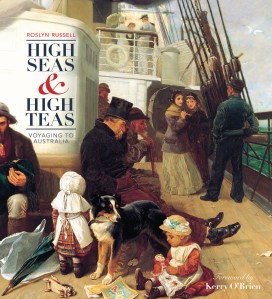
‘High Seas and High Teas’ by Roslyn Russell

9780642278852.jpg

High Seas & High Teas: Voyaging to Australia

213 P & notes, 2016, NLA Publishing

With the recent emphasis on ‘illegal boat arrivals’ in Australia in recent years, it has often been pointed out that, with the exception of indigenous Australians and families who arrived within the last sixty years, all Australians come from ‘boat people’ stock. Rustle the branches of most family trees and there they are: the names of ships, the point and date of departure and the point and date of arrival. Turn to page 2 of the Port Phillip newspapers during the 1840s and there’s the shipping news, identifying the first class passengers by name, numbering the second class passengers, and dispensing with the rest as an undifferentiated group of ‘bounty migrants’ or ‘steerage passengers’.

The inside blurb of this book exhorts family historians to “get a sense of your ancestors’ shipboard experience”, and the foreword by Kerry O’Brien centres on his own family lineage reflecting somewhat of a  ‘Who Do You Think You Are?’ emphasis.  Family historians often have little more than the name of the ship and its departure and arrival dates of their forebears. Sometimes they are fortunate enough to have a diary or letters penned on the journey, or on occasion, a particular trip may be so notorious that it was subjected to the scrutiny of the authorities afterwards. In all these cases,though, there are broader questions in moving from the particular to the general: how typical was this one trip? Is there a commonality of experience that linked all sea journeys to Australia?

Roslyn Russell fleshes out and contextualizes the voyage between embarkation and arrival in her book High Seas & High Teas by drawing on thirty-three diaries penned by passengers and crew during the nineteenth century.  These diaries, chosen from among the 100 accounts of voyages to Australia held in the Manuscripts Collection of the National Library of Australia, are not necessarily an accurate reflection of the demographic makeup of ships’ passengers. As she points out both in her introduction and at other places in the text, most of the diaries are written by men (roughly three to one) and fourteen of the thirty-three diaries were written by first class passengers. The voices of mothers of young children, in particular, are missing. This imbalance, she suggests, may be explained by social factors, but it could also reflect the collecting interests of the enigmatic Rex Nan Kivell and Sir John Ferguson, whose collections formed the basis of the NLA holdings (p.2).

In her brief introduction, she explains that, over time, three main routes were established between Great Britain and Australia. Most early 19th journeys took the High Seas route down to the coast of South America, sometimes stopping at Rio de Janeiro, then across to Africa and down to the south of the Cape of Good Hope and on to Western Australia, Adelaide, Melbourne or Sydney.  From the 1830s an alternative route opened up when passengers travelled across the Mediterranean by steamship to Cairo; by camel and cart to Suez, and by steamship again to Bombay. There they connected with sailing ships that brought them down through Torres Strait. By the 1850s a third, more dangerous route was developed when clipper ships passed far to the south of the Cape of Good Hope to pick up the Roaring Forties, the strong winds that blew between 40-50 degrees S latitude, which yielded a shorter journey but also risked storms and icebergs. Steamships were introduced to the route from the 1850s onwards, and the opening of the Suez Canal in 1869 cut the length of the journey from more than 100 days in the early 19th century to 40-50 days by the 1890s.

Despite these technological and itinerary changes, there was a commonality to the experience of the sea-voyage, just as there is a basic underlying sameness about air travel today.  This commonality even extended to the convict ships which plied the oceans until the 1860s.  Russell has devoted the first chapter to ‘Sailing Under Servitude’, where the surgeon-superintendent played an ambiguous role encompassing both solicitude and discipline. Diary entries in this chapter from crew and surgeons underscore the isolation and fear of insubordination that ran as an undertone throughout the journey, but as her references to convict ships in the later thematic chapters of the book demonstrate, even convict ships  experienced the same combination of boredom, fear, discomfort and self-made amusement that marked the journeys of later passengers of all classes for the next century.

Chapters 2-12 follow the trajectory of the journey from embarkation at port and the often lengthy bureaucratic and nautical delays before actually setting sail (Ch.2); the provisioning and accommodation on board (Ch. 3-5); passing the time (Ch.6-9); misfortunes at sea (Ch. 10-11), and the final arrival at their destination (Ch.12) which could, once again, be delayed by bureaucracy and quarantine requirements.   I was surprised to learn of the emigration depots back in England which acted as a sort of on-land simulation of the steerage experience, with emigrants forced to sleep in dormitories and comply with Royal Navy regulations as a way of familiarizing them with the life that faced them for the next four or five months.  I had seen printed newspapers purporting to be written on board ship and wondered at how they were published. Russell explains that they were hand-written on board ship and, after a subscription was collected from the passengers, the funds were put towards publishing the newspaper on land, after arrival, as a memento. Like Russell, I had wondered about sanitary arrangements- a topic which, unfortunately, few diary-writers explored in much detail.

But the real heart and soul of this book is the diaries.  Each chapter commences with a potted biography and then a transcript of one person’s diary that illustrates the theme of the chapter, followed by a beautifully clear, double-paged image of that page of the diary.  As readers, we encounter the diary writers again in several places, and I came to look forward to Annie Gratton’s (1858) and Edith Gedge’s (1888) vivacious entries, and confess to a twinge of schadenfreude at the sour William Bethell’s whinges and complaints. Some diarists reappear often, while others have a fleeting presence, making highly pertinent observations, then disappearing into the throng of passengers again.

The book is lavishly illustrated with the small sketches that the diary-writers used to embellish their pages and the chapters are enhanced by artworks of the day described as ‘background features’ in the reference section at the back.  It really is a beautiful book to just dip into, with large, full colour illustrations on nearly every page.

I’m not aware that the book is part of any museum exhibition, but as a reader, I felt as if I were viewing a mounted display.  The trajectory of the journey provided a narrative spine, branching off into small sub-themes of just two pages in length, just as a museum display might do.  Overall, the book does not have a historical argument as such- except, perhaps, for the commonality of the voyage experience across time and class- but instead brings the journey to life through images and the voices of the diary-writers.

It was probably because I had become comfortable with the chatter of those voices that the ending seemed so abrupt. Mr W. Barringer, with whom she closes, moves into permanent accommodation and the book ends. I would have welcomed Russell onto the stage herself as author or researcher perhaps, or would have liked the book rounded off with a birds-eye view of the voyage experience more generally, or even just a fonder farewell to Mr Barringer.   I felt as if I were standing on the wharf, and that the passengers I’d met along the way had ridden away from me to their new lives without bidding farewell. We had, after all, been on a long journey together.

Source: Review copy courtesy National Library of Australia publishing.

aww2016

I have posted this review to the Australian Women Writers Challenge 2016.

 

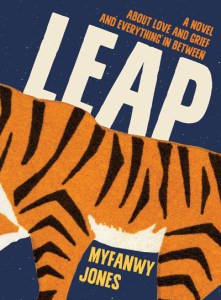
‘Leap’ by Myfanwy Jones

Leap

2015, 324 p.

There are two epigraphs to this book. The first is from Emily Dickenson on the weariness of grief. The second is from Parkourpedia the online encyclopedia of parkour, the practice of running and leaping on urban structures. Running, Climbing, Jumping are the three parts of this book, as two people make the leap from crippling grief to living again.

Joe lives in a share house in the northern suburbs of Melbourne and works multiple jobs in cafes in High Street (Northcote?) at night. Much of his time is spent in the darkness, either working or barrelling along bridges and streets as he practices his parkour moves.  His girlfriend has died some little time earlier and he blames himself.

Elise, on the other side of town, is a middle-class, middle-aged graphic designer and she too is grappling with grief.  Her daughter has died; her husband Adam has left her. She goes to the zoo weekly and paints the tigers.  They are beautiful, but they are powerful too, and it is her awareness of their coiled savagery that attracts her.

The narrative alternates between the two characters and gradually enlarges its focus, just as the two characters do also.  Joe embarks on a crepuscular relationship with a nurse who has joined their share house, referred to only as ‘she’ or ‘the nurse’, and his friendship deepens with Lena, a workmate at one of the restaurants.  Elise reaches out to her friend Jill after the breakup of her marriage (as women often do) and begins to make plans for travel while her ex-husband Adam, increasingly vulnerable as the reality of the separation sinks in, begins to share with Elise the grief he had suppressed after their daughter’s death.

‘The Leap’ is the image that gives this book its title and acts as the metaphor that ties  the two stories together for much of the narrative.  Joe plans a carefully-executed leap from a bridge as a skilled parkour manoeuvre, while Elise contemplates the power of the leap of a tiger.  They are both obsessed by the thought of the leap, and there is page after page of detail of either parkour or tigers.  I soon found myself just skipping over it, which mounted up to quite a bit of missed text by the end of the book.  I could have put the book down at any point, really, but what kept me reading was my curiosity over whether the two characters would actually bring the two ‘leaps’ into reality and whether the author would do it with finesse.

The book was listed as one of the ‘Summer Reads’, set in Victoria and suggested by the State Library of Victoria, and it is a light enough read.  I generally soak up books set in my own home town but in this case, the Melbourne setting was not enough to quell my impatience with a book that seemed, paradoxically, both over-egged and yet thin.


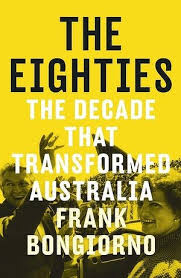
‘The Eighties’ by Frank Bongiorno

Bongiorno

The Eighties: The Decade That Transformed Australia

2015, 368 p.

I’m kicking myself that I didn’t write this review earlier- or if I did, I can’t find it. I must confess to a sense of deja vu with every sentence I write, so perhaps my computer has eaten it. I read this book some weeks ago and have since returned it to the library, so I’m having to write from memory. I suppose if my review lacks detail, it does at least sketch out the lasting impressions I gained from the book.

It’s rather challenging to read a ‘history’ of a time that you remember well, especially when it’s written by someone who is younger than you.  I suppose that people older than I encounter this phenomenon all the time.  Bongiorno is playful enough to put his own photograph of himself in 1983 on the inside rear dustjacket- a free-faced young lad, aged perhaps 14.  I was in my thirties during the ’80s, caught up in the whirl of parenthood with young babies, living in suburban Bundoora, on parental leave from teaching but inching back to work on a casual basis in TAFE.  I was not as politically aware then as I am now- no doubt a reflection of the person I was then, and the stage of life that I was at. But without the deluge of information, opinion and so-called news on the internet, perhaps we were all less politically fevered then.

When a historian is writing a chronology, there is always the issue of periodization: when do you start and when do you finish?  It has become acceptable to fiddle with the boundaries of decades and centuries (the long 18th century; the long 19th century), and indeed part of the intellectual challenge in a narrative chronology is to identify the themes that give a period or phenomenon its unity beyond the mere elapse of time.  Bongiorno starts his 1980s in 1983, with the Ash Wednesday fires swirling around Victoria and South Australia, while in Sydney Bob Hawke was giving an address at the Sydney Opera House as Opposition Leader and basking in the adulation and anticipation of an election victory just weeks away.  He finishes his 1980s in 1991 when Paul Keating replaced Hawke as Prime Minister.

The most memorable impression that the book conveys is the sheer brashness, crassness, and odiousness of the politics of the decade with a seemingly-neverending succession of shysters and spivs.  Christopher Skase, Alan Bond, Joh Bjelke-Petersen, Brian Burke, WA Inc, the white shoe brigade- all larger than life and breathtaking in their audacity and shamelessness. Bongiorno’s perspective is largely Political (with a capital P) and economic as he examines the Accord and the disruption of what Paul Kelly calls ‘The Australian Settlement’ that followed in its wake. There’s the excess in consumption, the excess in nationalist mawkishness (think Hawkie and the Americas Cup celebrations) and the excess of pain in exorbitant interest rates and the ‘recession we had to have’.

It is also a very male-dominated book. It comes as a surprise to realize that Susan Ryan was only the Minister Assisting the Prime Minister for the Status of Women, and not Minister for Women in her own right. (Wikipedia has an interesting table showing the shifts in title for this role over the past 40 years- who would have thought that Judy Moylan would be the first Minister for the Status of Women, appointed by Howard? or that Turnbull appointed the first Minister for Women outright with no mention of ‘issues’ or ‘status’?)  Bongiorno paints on a broad canvas, examining both high and low culture, although I found myself remembering events and thinking ‘Ah, so that’s what that was about!’, rather than recognizing my own suburban experience in the narrative he provides.

In his final chapter, he becomes more personal as he steps out from the wings in what has seemed, until now, something like a television documentary.  He is more reflective and analytic in this chapter, admitting to his own reservations about the decade and the overall value of the changes it wrought.  But perhaps it’s too soon to do this? When the overwhelming response is embarrassment- as in this book- at the music, the clothes (Princess Di’s wedding dress, for instance), the behaviour, the Multi-Function Polis, the sheer bizarreness, perhaps there’s not enough distance to judge yet.  It’s often been said that journalism is the first rough draft of history, and I feel, despite the footnotes and the access to cabinet documents, that this book teeters on the cusp between the two.   Nonetheless, it’s an engaging read, told briskly and with humour.

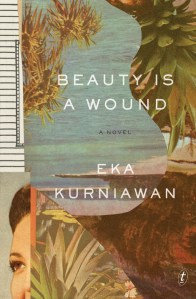
‘Beauty is a Wound’ by Eka Kurniawan

kurniawan

2002, (released in translation 2015),498 P.  Translator: Annie Tucker

Publisher’s site: https://www.textpublishing.com.au/books/beauty-is-a-wound

Well, the opening sentence gives you a pretty good sense of how this book is going to go:

One afternoon on a weekend in March, Dewi Ayu rolse from her grave after being dead for twenty one years.

I have not been the only reader to recognize the resonances with Gabriel Garcia Marquez’ One Hundred Years of Solitude,  and just as when I read that book for the first of what turned out to be many, many times, I just didn’t want to leave this magical world.  I didn’t understand what was going on, but I just loved it.

Dewi Aya was descended from Dutch Indonesian stock. That side of her heritage was not particularly important to her, and when the colonists left after WWII, she stayed on working as a prostitute, by choice this time, after being forced into prostitution by the occupying Japanese soldiers. She gave birth to four daughters, all with different and unknown fathers: Alamanda, Adinda, Maya Dewi and Beauty.  The first three daughters were beautiful, but their beauty entangled them into strained and strange relationships with powerful men.  When Dewi Aya fell pregnant for the final time, she wished for an ugly child, and her wish was fulfilled.  This, then, is the story of these four daughters and the men who love them, within the small fictional village of Halimunda. At the same time, it is a bawdy and funny satirical critique of colonialism and repression.

There is a fairy tale quality to this book, where women marry dogs, men can meditate themselves into atoms, and the dead live on as both ghosts and physical presences.  One story unfolds into another, and there is an Arabian Nights quality that runs throughout.  In interviews the author, Eka Kurniawan has noted the influence of Indonesian puppet-play and folk tales, and it’s detectable in its ‘once upon a time’ quality,  and the picaresque good-and-evil dilemmas and retributions that play through the lives of the main characters.

At the same time, there’s a very clear historical narrative that underpins the story as the Dutch, Japanese, Communists and anti-Communists pass through. The massacre of the communists drenches the middle part of the book, and there is mention of the Indonesian military involvement in East Timor.  There are few dates, and I’m certain that the historical commentary and allusions to actual characters would be far more meaningful to someone with a good understanding of Indonesian history (and to my shame, that’s not me).  In fact, that was one of the strongest feelings that I came away with: my embarrassment that I had never read an Indonesian book before, or known of an Indonesian author in this huge, populous country to our north. Apparently the translator received a PEN grant for the translation, and it highlighted for me that translation is so important in stretching our literary imaginations.  It’s a good translation too, with a light lyricism and humour that seemed part of the work itself.

I had to quell my uneasiness that I was missing the metaphors and allusions that would be woven into this book for its Indonesian audience. Even in my ignorance, I was drawn into the stories of each of the daughters, delighted in the unpredictability of a magical world, and felt satisfied by the the ending which came full circle and drew it all together.

My rating: 10/10

Sourced from : Yarra Plenty Regional Library


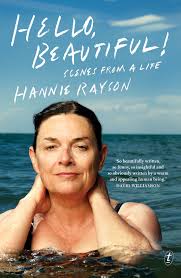
‘Hello Beautiful! Scenes from a Life’ by Hannie Rayson

rayson

2015, 255p.

“Why on earth did they choose THAT cover?  Or that name? It’s awful!” said my son.  I looked at it more closely.  Even though the title whispers ‘self-help’ book for women of a certain age, that picture was too honest. What I saw was a confident, clearly middle-aged woman, actually getting her hair wet, swimming at the beach.  I can hardly bear to think of what my son saw: it obviously didn’t attract a thirty-one year old male reader. Never mind- this book clearly isn’t aimed at that demographic.  The book and its cover are directly aimed at another demographic: that of the middle-aged, Australian, RN-listening female reader who would constitute, I should imagine, a fairly healthy slice of the book-buying public.  The author, playwright Hannie Rayson admits as much:

I just have to imagine you, tucked up in bed, wanting something companionable and consoling. Irish Murdoch said literature should never console. I think that’s bollocks.

My women friends have big jobs. They have families. At night when they climb into bed they read two pages of the novel on the bedside table and fall asleep. The next night they have to reread those two pages. They creep forwards slowly, page by page, until Saturday. Then, because they are optimists, they buy another novel.

An idea began to take shape.  I could write those two pages. Three would be manageable. But once I started, I found I had more to say.

Some of these stories began their lives as articles in the Age or HQ magazine.  All of them have been reworked with a simple rule: everything has to be true. More or less. (p. 2)

And that’s pretty much it. As promised, the chapters are short and all have the ring of authenticity. It’s just the sort of book you want to read when you can’t handle anything too heavy before you fall asleep, or when you’re stretched out in the shade on a summer’s day.  Like Crabbe/Sales’ podcast Chat10Looks3, it’s a bit like sitting alongside friends who are full of gossip.  In this case, it’s writerly, arts world gossip with her husband Michael Cathcart (or MC as she often calls him) in a droll walk-in, walk-off role, and snippets of Helen Garner and Carrie Tiffany- a world that her readership peers through the window at, somewhat enviously.

The chapters are arranged more or less chronologically, starting with her childhood in a rented house in East Brighton (and hence, not the other Brightons) in the 1960s, with her real-estate agent father and home duties mother.  She kept an adolescent diary, and while cringing at the person she finds in its pages, she uses it to good effect.  She attends the Victorian College of the Arts and discovers that she’s not an actress and finds herself as a playwright instead.  She walks straight into a full-time acting job with TheatreWorks, a community theatre company with a mandate “to create theatre for the people of the eastern suburbs”. So there she is, driving with her colleagues to the outer reaches of Burwood from centre-of-the-universe Fitzroy; playing Storming Mont Albert by Tram, a piece of location theatre on the Number 42 tram.  There are large, unexplained gaps and jumps in the chronology taken as a whole, but each chapter is neatly self-contained, and there is a refreshing humility and down-to-earthness about success that could have turned into pretension and name-dropping in other hands.  We leapfrog from first marriage, to childbirth, to amicable breakup, to repartnering, to waving off an adult child as he heads of overseas, to settling into mature professionalism- all with humour and humanity.

No, dear son, that picture on the front of the book is just right.  It’s self-assured with a healthy tinge of anxiety and a dollop of self-depredation. This is a book that knows what it’s doing and who it’s doing it for, and it does it well.

aww2016


I’ve posted this review for the 2016 Australian Women Writers Challenge.