Category Archives: Book reviews

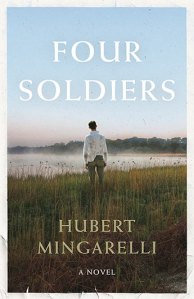
‘Four Soldiers’ by Hubert Mingarelli

Mingarelli_FourSoldiers

2018 (English translation), 155 p. Translated from Italian by Sam Taylor.

I must confess that I borrowed this book solely because of Hilary Mantel’s blurb ‘A small miracle’ on the front cover. I’m not so sure about the ‘miraculousness’ of the book, but it certainly is small at only 155 pages and could probably be better described as a novella than a novel.

It is set in 1919 in the Russian Civil War. As winter sets in, the Red Army commanders break up their regiment, turning them out into the winter landscape to fend for themselves until the weather improves and the fighting commences again. Four soldiers – Benia, Pavel, Kyabine and Sifra – set off with their tent (a rather poor defence against the ravages of winter) and establish a camp near a lake. Here they live day-by-day, a quiet self-contained peaceful existence in the midst of war, with the prospect of returning to battle hanging over them.

Benia, the narrator, is closest to Pavel, with whom he often walks at night when Pavel is disturbed by nightmares. Kyabine is a large, not very bright Ukrainian, whom they brought along soley for his brute strength in a harsh environment. The title is a misnomer, because there are in fact five soldiers when they are joined by Kouzma Evdokim, a young peasant recruit. He says that he is going to write their story in his notebook, and they are anxious that his words capture the truth of their experience.

The story is very simply told, with short sentences. The translation feels very clean and precise. The chapters last only a couple of pages, almost like a film script. Very little happens, even though the narrative is infused with a sense of dread.  Its simplicity and precariousness makes it a more memorable read than it would be otherwise.

My rating: 7.5

Sourced from: Yarra Plenty Regional Library


‘How Australia led the way: Dora Meeson Coates and British Suffrage’ by Myra Scott

Scott_how_australia_led

2018 reprint (original 2003 Commonwealth Office of the Status of Women), 120 p.

This book was originally launched in December 2003 at a ceremony in Parliament House Canberra where two crucial documents of Australia’s democracy were put on public display. The first was the Australian Constitution and the second was the Commonwealth Franchise Act of 1902, which gave the vote at Federal elections and the right to stand for Parliament to white Australian women on the same terms as men. Placed adjacent was the “Trust the Women” banner, made by Dora Meeson Coates in 1911 (which can be seen here) which, 77 years after its creation, was purchased from the Fawcett Library, London by the National Women’s Consultative Council as a Bicentennial Gift to the Women of Australia in 1988. In 2002 it was donated to the Parliament House Gift Collection for permanent display (although it sometimes travels to other museums).

This small book tells the story of the banner, its creator Dora Meeson Coates, and the context in which the banner was produced. Its author, art historian Myra Scott, had already written a thesis in 1992 on George James Coates and his wife Dora Meeson Coates where she described their role in founding a group of expatriate Australian artists in London, which became the base for successive generations of Australian artists seeking to establish themselves internationally. She was well placed, then, to write on Dora Meeson’s activities amongst the suffragists and suffragettes in England, where parliamentary approval for women’s suffrage lagged behind New Zealand and Australia’s pioneering legislation. The book has the British political system as its setting and focus and describes how, after the success of the Australian suffrage campaigns (even in laggardly Victoria) Australians travelled to ‘the mother country’ to encourage the British Parliament to pass similar legislation.

The creator of the banner, Dora Meeson was born in Melbourne in 1869. Her father, the founder and headmaster of the now defunct Hawthorn Grammar School, returned to London when Dora was ten years old in order to study law. The family then migrated to New Zealand, and in 1895 moved to Melbourne where Dora studied art at the National Gallery School. There she met fellow artist George Coates, and when he won a scholarship to study art in Paris, Meeson and her family also travelled to Paris. George and Dora married in 1903 and, leaving behind the comfortable economic milieu of her parents, they struggled to become part of the art world in London. After the death of her parents, she became increasing involved in the suffrage movement, most particularly through the Women’s Freedom League where she was founder-member.

Legislation for female suffrage had been presented to the British Parliament several times, but each time was blocked after the second reading. After one of these failures in 1908, they were advised by Home Secretary Herbert Gladstone that the success of the other Reform Bills in 1832, 1867 and 1884 had only occurred after large rallies forced the government’s hand.  It was here that Dora Meeson stepped up.  She was highly active in the Artisans Suffrage League, producing banners, postcards, booklets for womens suffrage – including her “Trust the Women” banner, which featured in the 1911 Women’s Suffrage Coronation Procession.

What surprised me in this book that it was not just Australian suffragists who lent their support to their British sisters, but (male) Australian politicians also very publicly supported the campaign as well. Prime Minister Andrew Fisher spoke in support at the International Women’s Franchise Club and at an all-male Labour banquet.   The Australian Senate sent a ‘resolution’ praising the influence of women’s suffrage to the British Parliament in 1910, but it was promptly buried by the British Prime Minister who did not want to publicize it. The proponents of suffrage reform could point to evidence from the Australian experience: women had not been turned into harridans; instead they had influenced important social legislation to benefit women and children. And even though the British Parliament might sniff at the presumption of the colonies to comment on the composition and suffrage of the House of Commons, the colonies and dominions had skin in the game. The proposed Naturalization Bill, whereby a woman’s nationality on marriage would change to match that of her husband’s (even if they were divorced or if the husband had died) was originally planned to extend across the empire, affecting Australia as well. (In the end, the dominions were allowed to grant local nationality under their own terms of qualification.)

The Women’s Suffrage Coronation Procession of 1911 was held to coincide with the Coronation of King George V. At the same time the Imperial Conference was held,  bringing politicians from across the empire to London. Margaret Fisher, the Prime Minister’s wife and Emily McGowen, the wife of the New South Wales Premier attended the Women’s Suffrage Coronation Procession, which took three hours to pass by, with 40,000 women marching five abreast, representing 28 women’s organizations. It was a highly visible march with music, floats and banners. Differences between the varied women’s groups, some of which focussed on parliamentary lobbying while others turned to direct action, were put aside for the march.

Dora Meeson’s banner representing Australia was big, requiring four people to carry it. Unlike other embroidered banners, this one was painted on an olive green background. The image, Scott suggests, references one of the paintings on the walls of the Exhibition Building in Melbourne, created for the Federation ceremony conducted there ten years earlier, which depicted Britannia as Minerva. In what could be- and was- interpreted as ‘colonial upstartness’, the banner depicted a younger woman beseeching a highly unamused Mother England to ‘Trust the Women’ who had received the suffrage in Australia. Far from the ‘aggressive rabble’ as suffragists/suffragettes were often depicted, these are ‘womanly women’, and the image appealed to statesmanship at the highest level.

But none of this agitation, or the urgings of Australian and New Zealand personalities and politicians, swayed the British Government. When war broke out, the campaign for suffrage was suspended and Dora Meeson joined Nina Boyle of the Women’s Freedom League in forming the Women’s Police Force to fill the positions of men who were at the front.  She continued to be a member of the Australian and New Zealand Women’s Voters Association, whose members promoted themselves as the only enfranchised women in Britain. After the provision of  partial suffrage in 1918, it was not until 1928 that Britain finally granted the full suffrage to women.

This book was re-released in 2018. During 2018 another book about the influence of Australian suffragists on the British campaign was also released – that of You Daughters of Freedom by Clare Wright. From my brief perusal of Wright’s book (which I have not yet read), they are two very different propositions. Wright’s book is large, at over 500 pages and weaves a tapestry of many women, told in a warm and colloquial tone. Scott’s book is much smaller, with an emphasis on the banner and its creator, in a more restrained narrative tone.

The story of Australia’s early 20th century progressivism is a good one, and it bears retelling many times, especially in today’s context of increasing conservatism. The actions of Australian women on the international stage, and the willingness of Australian male politicians to champion female suffrage once they found that there was nothing to fear, show Australia as a new nation, bristling with confidence and action.  There’s room enough for many stories celebrating this.

Sourced from: review copy from Australian Scholarly Publishing.
AWW2019 I have added this book to my tally in the Australian Women Writers Challenge 2019.

‘On Identity’ by Stan Grant

grant_on_identity

2019, 95 p.

This essay is published as one of Melbourne University Press’ Little Books on Big Ideas  series. The essays, all of which are titled with “On….” have stellar authors, sometimes writing in their areas of expertise (e.g. former Race Discrimination Commissioner Tim Soutphommasane ‘On Hate’ or Germaine Greer ‘On Rape), sometimes not (e.g. David Malouf ‘On Experience’, Anne Summers ‘On Luck’).

Stan Grant, journalist and commentator, has dealt with the themes on this ‘On Identity’ essay through his other recent publications as well with Talking to My Country in 2016 and Australia Day in 2019. The biographical outline at the start of the book (which I assume he approved) describes him as a “self-identified Indigenous Australian who counts himself among the Wiradjuri, Kamilaroi, Dharrawal and Irish.”

In this book, Grant pushes back against being asked to tick the box which appears on so many forms asking ‘Are you Aboriginal or Torres Strait Islander?” By ticking the box, he writes, he is forced to deny the other parts of his identity- most particularly his white grandmother who was exposed to the virulence of the racism of the 1940s when she married his indigenous grandfather.

It is so simple I can say it in plain English and in one sentence: I will not be anything that does not include my grandmother. I don’t wish to be anything that sets me apart from my wife, or any of my ancestors, long lost to history, but whose blood still flows somewhere in me.  I will not put a mark in a box that someone has decided contains me. That box shrinks the endless mystery and possibility of the universe. I will always choose the side of love. (p.83)

As he points out, the question ‘Are you Aboriginal or Torres Strait Islander’ is one that the nation pushes back onto the individual (p. 16).  John McCorquodale, the legal historian counted sixty-seven definitions, and Grant cites a series of statements from the High Court of Australia in the 1980s and 1990s that tried to definite Indigenous identity. He writes of the author Kim Scott, whose book Kayang and Me traced his own search for Noongar identity.  While claiming to be captivated by Scott’s work, Grant admits that he reads him now “with both eyes open and I realize that we are worlds apart” (p. 40)  Grant writes he has been long troubled about identity:

…how easily it morphs into tyranny. Scott is being asked if he is black or white, he can’t be both…It comes with the same assumptions of power: we will tell you who you are and whether you belong; we will determine your identity; you will answer to us. (p 26)

Instead, he claims love and freedom- something that he doesn’t find in Scott’s work.

This is a very poetic book, woven through with allusions to various writers and philosophers – none of whom are cited directly or referenced, so you just have to take his word for it. There is certainly the resonance of The Preacher in his writing, which I find rather off-putting.  Paradoxically, I read this book because I was preparing a talk to my Unitarian-Universalist fellowship on the theme of ‘identity’, a topic that I’m even more confused about now than when I started.  The book reads out loud beautifully (particularly for a spiritually-inclined gathering), but then I found myself wondering “but what does that actually mean?”

None of us likes to be defined by one thing only, and we are all aware of our own complexity and contradictions. Perhaps identity, and its attractions at various stages of the life cycle, is a malleable thing that is useful in different senses at different times. It has a personal meaning, but at certain junctures its political and historical uses are more pertinent.  Sometimes identity has a ‘conversion’ aspect, as when someone ‘comes out’, ‘comes to Jesus’  or discovers an indigenous heritage of which they had been previously unaware.  At such times, it is understandable that one aspect of identity overshadows the rest. Moreover, often the simplistic tick-the-box questions of indigenous identity or having a disability have funding and political implications that have been hard won.

As you can possibly tell, I found myself confused by knowing what to do with this book. Janna Thompson in ‘The Identity Trap’, at Inside Story, has done a much better job than I could ever do of grappling with this small, slippery volume.

My rating: 7/10 ?

Sourced from: Purchased at Readings.


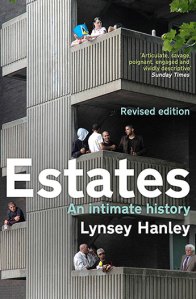
‘Estates: An Intimate History’ by Lynsey Hanley

hanley_estates

2007 1st edition; revised edition 2017, 247 p.

It seems that somehow every British police drama you watch ends up in a council estate. To antipodean eyes, they look terrible places: bleak, cold-looking and bare against a leaden sky. Growing up in a country that provides little state-owned housing – and then, generally only for the poorest – it seems strange that local governments in Britain would have (or more correctly, used to have) such large holdings of housing, and  that it had such popular, cross-class support. Interwar housing  did not have the stigma that we attach to it here in Australia, and the Blitz gave state-owned housing added emphasis. But by the second half of the twentieth century, all that had changed in Britain too, and this is the story that Lynsey Hanley tells from her own personal experience.

She grew up in Chelmsley Wood, an overflow scheme built in the mid-1960s in what had been woodland and farmland in Birmingham’s greenbelt,  when post-war demand for housing soared. It combined low-rise housing with tower blocks, in an estate largely isolated from the city centre. You can see a gallery of pictures of Chelmsley Wood in the 60s, 70s and 80s here. By this time, living in a council housing estate meant that children grew up with a “wall in the head” that separated them out from the aspirations and experiences of children living in the central city, and as a bright girl from the estate, she had to consciously work at scaling that mental wall to fit in with her university friends.

But it hadn’t always been that way. Between the two World Wars, there was a concerted effort to clear the privately-owned slums from British cities, and “…to be given a council house in the 1930s, was in many ways, comparable to winning the lottery.” (p.65) Influenced by the Garden City movement, council housing was protected by what was known as the Tudor Walters standards, which mandated minimum room sizes, the number of windows and density.

It is hard to overstate the importance of the Tudor Walters standards: backed by the state, they expressed a commitment to building mass council housing of the highest quality. They did not extend to the two million private homes built by speculative builders between the wars, meaning that council houses built around this time were likely to be larger and of a higher quality than many of the suburban homes you could buy (p. 66)

Aneurin (‘Nye’) Bevan, of the British Labour Party, was most famous as Minister for Health, who introduced the NHS. But he was also responsible for housing policy, and he insisted on good quality public housing. Even the Conservatives, when they defeated Labour in 1951  continued, and indeed increased, the construction progress that Bevan had instituted. But the emphasis on quality was sidelined, and private building was encouraged.

And even though council housing tenants were insistent that they did not want to live in high-rise flats, that’s exactly what they received, with the building industry pressuring the government to adopt pre-fab high-rise designs citing a shortage of tradespeople (who, ironically were the very workers sidelined by the emphasis on factory-created prefabs). Corners were cut, leading to the actual collapse of a high-rise at Ronan Point in 1968, just two months after it was opened, due to construction faults. (The television series ‘Endeavour’ worked this into one of their plot lines recently).

Ronan_Point_collapse_closeup

Ronan Point Collapse  1968 Photo: Derek Voller Creative Commons Wikipedia

Council housing was further decimated by Thatcher’s ‘Right to Buy’ scheme, where tenants were encouraged to buy their house, but councils were not allowed to replace the now-purchased housing with new rental stock. As a result, the existing estates became increasingly run-down, and like Australian public housing, became stigmatized as ‘social’ housing for people unable to be housed elsewhere.

Like much non-fiction at the moment, this book combines the political and the personal. The notes in the back, more in the form of further reading than footnotes, show that the author has read widely, rather than academically. It is also interwoven with the author’s own story, but not just as memoir but also from a present perspective. At the time of writing the book, she was living again in what had been an estate, in a house she had purchased as part of the ownership push. But under the Housing Choice program,  being rolled out across the country, there were plans (with which she concurred) to demolish her house and redevelop the estate.  Her afterword, written in 2017 and ten years after the book’s first publication saw a decline in the number of home owners, an increase in homelessness and a sustained attack on  the housing security of non-owners. Her afterword was written too soon for the Grenfell Tower fire.

I enjoyed this book, particularly the first 3/4 which took a more historical approach. I liked the way that she drew on her own experience, and interwove the personal and political. I admit that the present-day politics of the last chapters of the book largely went over my head, but I could find parallels with our own government’s drive for public/private development of former housing estates which somehow always seems to be short-changing the public system. I wish that there was some way of recapturing the idea that public housing was not a stigma, but a right, and part of being in a good society.

My rating: 8/10

Sourced from: purchased

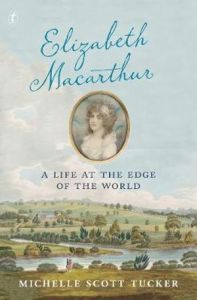
‘Elizabeth Macarthur: A Life at the Edge of the World’ by Michelle Scott Tucker

elizabeth-macarthur

2018, 339 p.

I am old enough to remember when Australia’s wool trade was a source of national pride. Primary school children would send off to the Wool Board (or whatever it was called at the time) to receive a project pack that included samples of wool at different stages of processing: straight off the sheep’s back, washed, combed, and carded, right through to a piece of woven material, all in a big envelope. John Macarthur was on our $2.00 notes, with a whopping great merino beside him, with William Farrer on the other side with his wheat, symbols of the importance of the pastoral industry and agriculture to Australia’s history and economy.

But it was all very male-dominated. I first heard of Elizabeth Macarthur when I visited Elizabeth Farm in Parramatta about twenty years ago. It struck me then, listening to the guide, that much of the glory that attached to John Macarthur more rightly should be shared with her, given that he spent so many years overseas. In this book Michelle Scott Tucker brings Elizabeth Macarthur to centre stage as businesswoman, wife and mother, dealing with a difficult and eventually mentally ill husband.

The book opens with a premature childbirth at sea on a convicts’ ship, where Elizabeth Macarthur, a gentleman’s daughter, is the only woman on board.  She, her husband John  and her infant son were sailing as part of the Second Fleet to Sydney Cove where he would take up his position as a commissioned officer in the New South Wales Corps.  As was common right up to the 20th century, Elizabeth kept a ship board journal, and Tucker contextualizes this journal well in explaining what shipboard life was like in the Second Fleet, and the social distinctions and rigidities within the hierarchy of the passengers. There were tensions, slights and confrontations and even here we see John Macarthur’s hair-trigger sense of honour which was to blight and shape the social life of his family within the colony.

I must confess that even though I’ve read about the early days in Sydney Cove, I didn’t realize the significance of the navy/army distinction as the basis of much of the dissatisfaction at the elite level within the colony (and come to think of it, probably in the other colonies I have read about as well).  Macarthur quickly moved into the centre of the social life of ‘good society’ and was deeply implicated in the Rum Rebellion against (Navy) Governor Bligh led by the (Army) New South Wales Corps. Macarthur’s involvement in local politics at a time when official power was exercised through the Colonial Office meant that he spent many years overseas, clearing his name and honour, and then in a sort of political exile that in effect split the family. As was common at the time, young boys were sent ‘home’ for their education, and for many years Elizabeth kept the properties going, soothed the local politics as much as she could and built up the family enterprise on this ‘edge of the world’, while her husband and a number of sons did the same back in England. When a son went off ‘home’ as a seven year old schoolboy, sometimes he never returned to Australia. Instead, opportunities brought about through extended family connections and marriages kept him back in the’ old country’.

Colonial histories in the past, tended to focus on the world of men. In recent years there has been more attention on the networks of influence, opinion and behavioural constraints that operated in colonial societies. While John Macarthur had his own political involvements, so too did Elizabeth Macarthur within the women’s networks of early Sydney. His behaviour directly impacted on her own friendships and status, and Tucker describes this well.  Although aimed at a popular, as distinct from academic audience, the bibliography at the back of the book shows that she has read widely on early Sydney, although I’m surprised that she doesn’t reference Kirsten McKenzie’s Scandal in the Colonies which would have fitted in so well here.

The family correspondence has been kept, and it is through this lens that Tucker shapes her reading of Elizabeth Macarthur. Family correspondence has its limitations, of course, and these were exacerbated by distance and slow communications.  For letters to  friends, who had never -and would never- see Australia, there is an ‘other-worldliness’ to her situation. In letters to her sons, who did not need to have things explained, the maternal relationship still held. In letters to and from her husband John, beyond reporting events and business, the politics of their relationship was interwoven with the family mores of the time.

In several places, Tucker notes that Elizabeth Macarthur has not commented on particular events or people. This is always frustrating, perplexing and yet these silences often reflect something of the personality and times of the writer. Sometimes Tucker surmises “she must have….” which I found myself resisting. One of the questions of biography,  is how much we can claim a common worldview at the emotional level with people of the past, especially in the light of recent work in this field.

In this regard, the book reminded me of another biography of a ‘colonial wife’: that of Anna Murray Powell, wife of the Chief Justice in Upper Canada in the 1820s in Katherine McKenna’s A Life of Propriety: Anna Murray Powell and her family 1755-1849 (my review here).  A more academic text than this one, McKenna uses the family correspondence of the Powell family to examine how as matriarch and wife, Anna Murray Powell grappled with a young daughter whose very public and unseemly infatuation with the future attorney-general was the talk of the community.  As with Elizabeth Macarthur, there are silences and omissions about the things we are most curious about as 21st century readers, particularly when dealing with a socially unacceptable situation – for Anna Powell, the behaviour of her daughter, and for Elizabeth Macarthur, her husband’s mental illness.

Elizabeth Macarthur was a mother, with her love stretched between ‘home’ and this new life very much on the edge of the world. She was a wife, displaying affection, but also exasperation and diffidence when dealing with a difficult husband. Within her own family relationships, she dealt with distance and madness.  She was an astute businesswoman, handling a large enterprise in the colonies while her husband had all the financial power. Tucker has given us a rounded picture of Elizabeth Macarthur, one that is faithful to the times and also to the sources.

My rating: 8.5

AWW2019I have included this review on the Australian Women Writers challenge

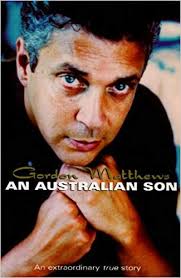
‘An Australian Son’ by Gordon Matthews

matthews_australianson

1996, 230 p.

There are spoilers in this review

In his short disclaimer about” changed names to protect identity etc.” at the start of this book, Gordon Matthews writes:

This book was an act of catharsis. I wrote it to make peace with myself.

The motivations for writing a memoir are many and varied, and I suspect that ‘catharsis’ is quite a common one. However, I’m not sure that all catharsis needs to be put into print. I closed this book feeling complicit and somewhat sullied, and I wondered why Gordon Matthews published this book.

At one level, I can understand it. Identity, or the search for it, is one of the touchstones of modern life. In Australia,  there is heightened awareness of the Stolen Generations of indigenous children after years of Royal Commissions. In this book, with the small black and white photograph on the back cover of a cheeky, curly-haired boy who certainly looks aboriginal, we think that we are reading the story of an adopted child who learns later in life that he is part of the Stolen Generation. But that’s not what happens (and here’s the spoiler, so look away now!). Adopted by a middle-class white family; teased by his private school ‘friends’ who call him ‘Abo’; conscious always of his difference, he is encouraged by an Aboriginal Liaison Officer to apply for a university scholarship and eventually gains a designated position as Australia’s first indigenous diplomat. Then he finds out the truth: that his father is Sri Lankan, not Aboriginal, and his whole identity falls apart. Although his Aboriginality was not a deliberate hoax, he knows that he cannot continue to claim an indigenous identity that he does not hold.

I was slightly surprised by his telling of how he came to embrace  and be embraced in what he thought was his own Aboriginality.  It seems at one remove from the broader Aboriginal community, seeming to be based mainly within the university and bureaucracy. Is this because he is in Canberra, perhaps? I’m not sure quite when the actions in this book took place, and maybe things have changed. As I understand it, indigenous identity involves both family connections and genetics (rather ironic given how ‘blood’ ratios have historically been used as such a weapon) and acceptance by the community. It is only near the end of the book, when he has admitted that he is not indigenous, that his relationships with the community come into sharper focus.

Secure and happy enough with his adopted parents, it is his search for racial identity in particular that impels his search to find his birth parents. He is curious about them, but not as individuals in their own right, but as the key to his racial understanding of himself. He eventually finds them in America. After giving him up for adoption, they married and went on to have other children. Gordon finds  not only both parents grieving their relinquished first child, but also blood siblings who have been completely unaware of his existence.

The relationship with his birth mother was tense, despite his parents’ joy at finding him and embracing him as part of their family. Contact between him and his family cooled. His birth parents did not want him to publish this book, and it was at this point that I felt I wanted to drop the book from my hands. This was such a fragile relationship, and he was asserting his right over his own story at the risk, I suspect, of alienating and losing this new family that he had found on the way to discovering his racial identity. Pigheaded? Self-sabotaging? Selfish?

The book raises complex questions about identity, race and family. There is a distance in the telling, both at an emotional level and in the slightly stilted language. Whatever he might have been as a diplomat, Matthews is not a ‘natural’ writer.

I can find nothing on the internet about what happened next to Gordon Matthews, or his family.  The silence is a little unnerving. I have no idea how the publication of this book was received by his family at the time, and I wonder if, more than 20 years later, he would say that it was worth it. I guess I will never know.

My rating: 7

Sourced from: Council of Adult Education. It was the June book for my bookgroup.


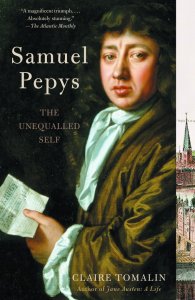
‘Samuel Pepys: The Unequalled Self’ by Claire Tomalin

Tomalin_Pepys

2002, 380 P plus notes

There are some biographies where you think that there’s no point in anyone else even picking up their pen to write another one. Claire Tomalin’s biography of Samuel Pepys falls into that category.  This isn’t the first time I have read this book, because I read it in 2005- certainly long enough to have forgotten much of the details. That was before I had been to London myself, and before I had started my own academic work in biography. I very much enjoyed it in 2005 and enjoyed it even more fourteen years later.

I think that I first became aware of Samuel Pepys in a school reader, where his eyewitness report of the Great Fire of London was reproduced. I’d always associated him more with the events that he wrote about (the fire, the plague etc) rather than as a person in his own right. But as Claire Tomalin points out, perhaps his most striking and original achievement was to see himself, his actions and his motivations, as a topic in themselves. One of the most opaque things over time and culture is to sense how people saw themselves, especially when such a question was so often overlaid with religious language. In Pepys we have a man holding himself up to his own scrutiny, laughing at himself, and at times writing what he knew could be used against him politically.

Pepys’ diaries covered only nine of his seventy years. It’s not really clear why he started writing them, but it was a very deliberate act when he purchased a notebook and carefully ruled up each page – all 280 of them- and drew 20-30 evenly spaced lines on which to write. He wrote in shorthand, with some proper nouns written in English, and breaking into pidgin Spanish when he wanted to describe some of his (all too frequent) amatory adventures.

Although Pepys’ diaries of course provide the richest source for Tomalin’s work (and indeed, the work of any Pepys scholar), this biography devotes about 1/3 of its length to the 1660-1669 period of the diaries. The other 2/3 deals with his life before beginning the diaries, and then after the diaries. This seems a judicious weighting, and one which placed the journals, important though they are, into the context of his whole life.

The book starts with a lengthy list of ‘who’s who’ which I found myself turning to frequently. As Tomalin highlights, when Pepys was starting out on his career, contacts were everything in making it possible for this son of a tailor to end up as a high-level civil servant and Member of Parliament. Even though I’m not in the habit of taking my history from Academy Award winning films, the recent film The Favourite exemplified the trails of patronage that could bring distant cousins into orbits far beyond their expectations.

What struck me particularly on this second reading, and particularly in days when watching the so-far unsuccessful attempts at political change in Venezuela, is just how dangerous it is when a country undertakes a huge political change. I’m not talking about elections, which in our case are just variations on the same, but the big political about-faces. Pepys experienced a number of such changes, at an uncomfortably close quarter to royal power, but without the means or patronage to have any influence at all on events. He saw the execution of Charles I; he supported Oliver Cromwell when he was a young man; he managed to switch to Charles II in time; he escaped suspicion (just) after the Popish plots; and he acquiesced when William took the throne. The people he aligned himself with survived, and so he did too.

Although the book is largely chronologically arranged into 3 parts (Part I pre-diaries; Part II 1660-1669 diary entries; Part III 1670-1703), its chapters are thematic as well e.g. work, marriage, science. She does not cite at length from the journals themselves, choosing to comment on them instead of reproducing them.

At times Pepys seems like us: at other times, not. His infidelities and what now reads like rank sexual harassment are uncomfortable reading; his domestic violence to his wife and servants is not endearing. But I found myself laughing when his enraged wife threatened his manhood with red-hot fire tools when she found out about his affair with the maid, and his own awareness of his hypocrisy, failings and weakness keeps him human.  Tomalin has given us a fully rounded man, and I just can’t imagine anyone else doing it better.

By the way, the first time I read this book, I was fascinated by the Pepys Diary page, which is still going. Each day an entry from the diaries is posted in full and people, who have a wealth of information about Pepys and London, annotate the entries.  Another site which I’ve enjoyed, although it’s aimed at children is an interactive site  fireoflondon.org.uk

My rating: 9.5/10  This is biography at its best

Sourced from: CAE bookgroups.

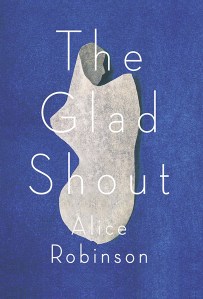
‘The Glad Shout’ by Alice Robinson

The-Glad-Shout-Alice-Robinson

2019, 310 p

This book opens right in the middle of the action, with Isobel clutching onto the arm of her husband Shaun, with her daughter Matilda clamped to her hip. They are in what reads like the MCG in Melbourne, which has been turned into an emergency evacuation centre after Melbourne has been lashed by a destructive storm. Set in a near future, encroaching sea levels have poisoned bayside gardens and lap the boulevards along the bay, and with storm damage making places uninsurable, the suburbs have become increasingly derelict and dangerous.  We have seen flashes of this in our news already: the Louisiana Superdome stadium after Hurricane Katrina, the huge waves crashing onto the Malecon in Havana Cuba, people sitting on their roofs in Queensland floods, awaiting rescue. In The Glad Shout, Robinson sets her story after the consequences of climate change have come crashing, literally, into Melbourne. Tasmania, which has heeded the perils of climate change, is still safe; Western Australia has finally seceded, and the other states are closing their borders against the climate refugees who want to join family members interstate and escape this climate nightmare.

The book has two narratives, told in alternating chapters. The present-day chapters, written in the present tense, have Isobel having to fend for herself in the stadium and finally making the decision to leave, putting her own life and that of her daughter into the hands of people-smugglers. We’ve seen this scenario too: people crammed onto dinghies with insufficient food and water, the lifejackets and the oil slick of dysfunctional engines.

The other narrative is flashback to Isobel’s tense relationship with her mother Luna, her sometimes ambivalent love for her husband Shaun, her guilt over her own mothering of Matilda. Her mother Luna, who had purchased the house that was swamped by floodwaters, was a real-estate agent and property investor. She placed great store on possessions and wealth, and she grieved intensely when Isobel’s brother, Josh, left home. Much of the flashback sections is involved with the nuances and Isobel’s sense of grievance over the people who surround her, and her conflicted relationship with motherhood, both as daughter and mother herself.

There’s always a risk in having double narratives running through a novel. Too often, as in this case, one is more compelling than the other, and so the reader feels a sense of impatience at having to wade through this section before reaching the next. I tired of the flashbacks, which bordered on the banal, and rather implausibly, they increasingly found their way into the present-day-disaster section as well. I suspect that the author herself has young children, and perhaps its my middle-agedness that makes me impatient of her obsession with her birth-experience with Matilda: something that is only a small part of the relationship between mother and child, in the long run. I wouldn’t presume to know what those exhausted, bedraggled mothers we see on television stumbling ashore from refugee boats had been thinking on the journey. But I suspect that they haven’t been mentally rehashing the slights and annoyances of their relationship with their mother, or castigating themselves for their ambivalence over their own motherhood.

On the other hand, I liked her celebration of  women’s strength in an emergency. I liked the politics of climate change and refugee policy being brought into the personal realm, and her exploration of the instincts of maternity, survival and communality in the midst of disaster.  I think that these will be the things that I take away from the novel, and that will keep it memorable. I just wish that there had been less of the emotional angst over relationships and human frailty.

My rating: 8/10

Sourced from: Yarra Plenty Regional Library.

AWW2019I have included this on the Australian Women Writers Challenge database


‘ Lost Children Archive’ by Valeria Luiselli

Lost+Children+Archive

2019, 400 p.

Hailed as “a vital work for the Trump era”, Lost Children Archive is a thinly-veiled fictionalization of Valeria Luiselli’s non-fiction essay Tell Me How It Ends. In both her essay and this novel, there is a road-trip across the states of America: a genre familiar to Australian readers through American film and television and explored in our own films (think Mad Max, Priscilla Queen of the Desert) and literature (think perhaps Rabbit Proof Fence, and most recently Carrie Tiffany’s Exploded View). Both Luiselli’s essay and the novel are concerned with the fate of unaccompanied children crossing the Mexican border into America, an issue thrown into the author’s own personal spotlight after volunteering to act as an interpreter for young Central American migrants seeking entry to the U.S. and writ large by Trump’s mantra of Building the Wall.  The essay Tell Me How It Ends was named for her daughter’s pleading to know how the story of these unaccompanied children ends, and already the crossover between the fictional and nonfictional works is blurred. It combines the personal and the political, and among other things, is about story-telling and story tellers.

The Lost Children Archive has resonances of W. E. Sebald’s work, with its integration of photographs and documents. The narrative is structured as an archive in itself. The book is divided into four parts. Its chapters reflect seven archive boxes that stowed in the boot of a car that is carrying an unnamed woman and her husband, and their two children, across the southern border of the US. The two children are not related by blood, each coming from their parent’s previous relationship, but they are considered “our” children and despite (and perhaps because of?) the difference of five years in their ages (10 and 5) they are very close. Sitting in the back seat of the car, day after day, the older boy in particular is aware of the tension between his father and his step-sister’s mother. They had met during a project to document the soundscapes of New York, he as a sound engineer and she as a journalist/producer, or as they distinguish it, one a documentarian, the other a documentarist.  The father wants to embark on a project capturing the lost sounds of the removal of Geronimo and the Apaches, while the mother has been drawn into looking for two little girls sent across the border with only a phone-number written onto the collar of their dresses. The son is aware, without being told, that this will be their last trip together as a family and he and his stepsister decide to run away and become like the lost children that Mama is so driven to find.

The first half of the book is narrated by the mother, and it comes as a surprise to have the narration taken over by her son half way through, and to revisit events and conversations from his perspective. Each section starts with an inventory of one of the boxes, listing  the books and articles, maps and CDs that have been gathered together, and the book itself ends with a series of Polaroid photographs that have – supposedly?- been taken on the trip.

This is a very clever, self-aware book that echoes influences as diverse as Virginia Woolf, Cormac McCarthy’s The Road,  Golding’s Lord of the Flies, and David Bowie’ Space Oddity. There is a long, twenty-page sentence near the end of the book that echoes Molly Bloom in Ulysses. A type of bibliography at the end references the resonances in the book, not direct quotations, many of which are translations of translations. Such reflexivity could be clunky and derivative in clumsier hands, but it’s not: it’s confident and deliberate, and a book of the heart and head.  All of my mental contortions that I’ve had  about a narrator inserting herself into the text dissolve here, with her very clear sense of what she is doing as a creator in a piece of autofiction , as distinct from memoir. As soon as I started reading it, I knew that I was in the hands of a very talented, intelligent writer. It’s been ages since I enjoyed a book as much.

My rating: 10/10

Sourced from: Yarra Plenty Regional Library

‘Exploded View’ by Carrie Tiffany

Tiffany_ExplodedView

2019, 191 p.

Carrie Tiffany seems to be writing about times at twenty year intervals. Everyman’s Rules for Scientific Living was set in the 1930s, Mateship with Birds was set in the 1950s and here now with Exploded View we find ourselves in the outer suburbs in the late 1970s. As with her other books, this most recent book is made up of fragments and set in the present tense, with short sentences and a slow rhythm.  This time, however, Tiffany gives us a nameless adolescent narrator, who is fragile, dissociative and in trauma.

The title comes from the type of diagram that one finds in a car repair manual or instruction book, where an action or object is pulled apart, with the separate components shown separately.

example_exploded_view

Wikipedia

Our narrator knows cars well. Her stepfather (‘father man’) repairs cars in an unlicensed repair shop at the back of the block, but she is not his willing assistant. Instead, she sabotages his work, taking the cars out at night and damaging their motors. She does not speak and she reads the Holden workshop manual, not for what it says but for its depiction of what she cannot say.

If you had never touched an engine, if it were only a matter of looking in the manual, you would think it was a miracle, that it couldn’t have been made by a man…In the manual you can choose to look at the parts, or the air in between them. The air in between isn’t nothing; it isn’t blank. If you make yourself look for what’s not there the empty spaces become parts themselves. (p. 27)

The narrator avoids naming the trauma, but she tells it in “the air between” the parts. Father man is violent and abusive, and her impotent mother turns a blind eye. Her brother is irrelevant. The longest part of the book is taken up with a rather pointless road trip taken across the country where they drive, drive, drive and sleep in the car at night. At night, the darkness comes.

Threaded through the book is a sense of menace, but there is no plot or climax as such. It reminded me of Sonia Hartnett’s disquieting work with which it shares an adolescent narrator, quivering tension and long silences.

I loved Carrie Tiffany’s earlier books, but I was disappointed in this book. Tension held for a length of time becomes excruciating, and I felt that way about this book.  It would have been better as a short story.

AWW2019I have added this book to the Australian Women Writer’s database.