Category Archives: Australian history

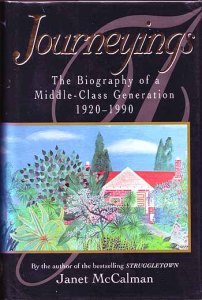
‘Journeyings: The Biography of a Middle-Class Generation 1920-1990’ by Janet McCalman

Journeyings

1993, 301p. & notes

This book opens with the No. 69 tram travelling from Carlisle Street St. Kilda to Cotham Rd Kew on the first day of school, 1934. The tram wends its way “along the spine of Melbourne’s middle-class heartland”, with an ebb and flow of private school students who peel off as they pass the major private schools in Melbourne. Being 1934, these are the children of WWI parents and unless they have scholarships, their parents are paying for their private school education during the Depression.

The No. 69 tram in February 1934 is the opening chapter and linchpin of Janet McCalman’s book,  which explores both the antecedents and consequences of that daily commute.  Starting in the years 1850-1919, her second chapter titled ‘Inheritances’ examines the social and economic origins of what was to become the Melbourne middle class of the 1930s, starting with the ‘Seekers and Saints’ who emigrated between 1850-1870 and embedded themselves as ‘The Greedy and the Good’ between 1879-1890. Chapter 3, ‘The Lessons of Innocence 1920-1939’ explores the inter-war years in which these young school children catch their tram in 1934, oblivious to the second ‘war to end all wars’ that faced them.

McCalman then follows through with this generation, examining their war-time experience in Chapter 4 ‘Coming of Age 1939-1945’ and their post-war family and work lives in ‘The Trials of Experience 1946-1966.’ Her chapter ‘Mid-Life Crisis 1967-1975’ captures the mid-career mindset of her middle-class informants in the midst of the world-wide disruption of 1968 and the political ferment of the ascension and dismissal of the Labor Party in Australia. Her final chapter ‘The Age of Wisdom 1976-1990’ takes her right up to the ‘Journeyings’ survey conducted in 1990 amongst the former students (pre 1950) of four private schools  that were passed by the No 69 tram.

I must declare my own colours here. Even though in 1934 my father lived one block down from Glenferrie Rd, along which the No 69 tram rattled (i.e.the very years that McCalman uses in her opening image), I am proudly the product of a government school, as were my parents. I strongly oppose the social and educational distortions brought about by John Howard’s funding of private schools that no government seems to have the courage to dismantle. So I read this book with a jaundiced eye and certainly no sense of identification.

However , McCalman complicates my easy prejudices through her research. It is largely based on a 1990 survey that she conducted with Mark Peel that yielded 633 responses from pre-1950 school leavers from Scotch and Trinity, (both boys’ schools), Methodist Ladies College and Genazzano convent. There were 1235 surveys distributed, yielding a hefty 42% response rate. McCalman’s methodology combines prosopography,  survey responses, oral history interviews with 80 respondents, the judicious use of fiction and memoir, her own literature review, and statistics.

Although solidly middle-class, the financial and social backgrounds were more varied than I expected for this 1934 cohort, based on statistics drawn from Scotch senior students in 1934 and MLC students born in 1919 and 1920. Going to a private school did not guarantee a high education level:  43% of the Trinity 1919-20 boys cohort left without the Intermediate Certificate (i.e. Yr 10), while 65% of the MLC cohort left without their Intermediate.  In a rather anecdotal experiment, McCalman asked a group of retired senior teachers (who were themselves at secondary school in the 1930s and 1940s) to compare papers set for the external Intermediate, Leaving and Leaving Honours papers for 1935 and the examinations set for the  Higher School Certificate (superseded in 1992). Their consensus was that in 1935 the emphasis was on clean and accurate work, which penalized misspellings, grammatical flaws and arithmetical slips. French and German was much more difficult in the 1930s but “in most of the other humanities, the intellectual demands of the 1930s papers were lower than would be acceptable by the 1960s.” (p. 123).

As McCalman traces through this 1930s cohort, she contextualizes them within Australia’s history. Because these four schools were denominational, there is an emphasis on spirituality. I was well aware of the Split of 1955 and the influence of the Movement within the Catholic church, but completely unaware of progressive Catholic activism (which was featured recently in History Workshop). Long before History of the Emotions became a historical ‘turn’, she focuses on hearts, souls, masculinity and femininity, minds and manners.

I like her discussion of fiction and history in her preface:

…because this is a group biography, a collection of stories of actual lives, it needs to unfold in the way real lives do- which is that none of us knows what lies ahead. Perhaps one of the most important functions of fiction is to permit us to escape that existential plight – it is a rehearsal for life; in writing history, however, we need to feel life’s dreadful unpredictability, its untidiness, its ordinariness, its splendours. Art is under our control; history, like life, is not. And yet history is but our reconstructions, is but an artefact of the mind, conceived of differently by all of us, and differently by all of us at different times in our lives… We are incorrigibly historical beings; our inner histories of ourselves- private history- constitute our ever-evolving sense of identity- we are our own stories. But in constructing histories – whether private or public-  we are torn between what we would like the story to be and what the evidence insists that it really is. The novelist enjoys a licence; the historian a responsibility (p.viii)

Before writing Journeyings, McCalman had received acclaim for Struggletown: Public and Private Life in Richmond 1900-1965 which used a similar methodology in the working-class (although now gentrified) inner Melbourne suburb of Richmond.  I have read Struggletown, but did not record my response to it at the time. The two books work well as a pair. Journeyings also complements Judith Brett’s Robert Menzies’ Forgotten People, which is cited often.

By the final chapter (1976-1990) her informants were mature retirees, with a remarkably low divorce rate and generally (but not exclusively) politically conservative.  Perhaps it was my government-school-streak coming out here, but I found myself bridling at the smug moral superiority that came through many of their responses, the noblesse oblige and the disavowal of ‘old school tie’ networks when there was clear statistical evidence of its significance in ‘elite’ circles.  What was McCalman going to do with this? Did she feel the same way as I do?

I think she did. Citing Sir Robert Menzies’ ‘The Forgotten People’ speech and Judith Brett’s analysis of it, McCalman writes:

Children who are educated apart behind high walls can find it difficult in later life to become at one with those on the other side. Children who are told endlessly by their parents and teachers that they are fortunate, privileged, special, inheritors and examples of excellence, will find it difficult to be good democrats.  Even if they are imbued with a sense of service and care ‘for those less fortunate than themselves’, they can still find it difficult to feel simply as fellow Australians.  (p.301)

This is an excellent book. It’s beautifully written, it is nuanced and yet broad. The No. 69 trope works so well.

And look at this: the Public Education Campaign has just released a video that answers back to that last chapter, too.

Sourced from: my very own bookshelves, where it has sat patiently for decades.

My rating: 9/10
AWW-2018-badge-rose-199x300

I have recorded this review at the Australian Women Writers Challenge 2018
Website: Colonial Frontier Massacres in Central and Eastern Australia 1788-1930

There has been a recent updating of the Centre for 21st Century Humanities’ website Colonial Frontier Massacres in Central and Eastern Australia 1788-1930

Take the time to read the Introduction to the website. Here the researchers explain that their criteria of a ‘massacre’ arises” from the indiscriminate killing of six or more undefended people”.  Six people, they explain, from a hearth group of twenty leaves those remaining vulnerable to attack, with a diminished ability to hunt, reproduce or carry out ceremonial obligations.

It is still a work in progress, with information from Western Australia and after 1930 yet to be added.

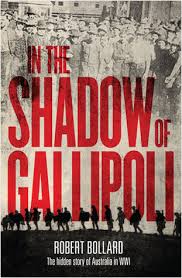
‘In the Shadow of Gallipoli’ by Robert Bollard

bollard

2013, 224 p.

I know that historians often get railroaded into a title for their book by marketing-oriented publishers, and I can’t help thinking that the title of this 2013 book was chosen with one eye on the then-upcoming centenary of Gallipoli in April 2015. There is, in fact, very little about Gallipoli in it at all. The content is far better conveyed by the sub-title ‘The hidden history of Australia in World War I’.  Although even that isn’t particularly accurate either, because much of what is written in this book is not ‘hidden’ at all: Jauncey covered much of it in 1935 and Ernest Scott (available online) covered the rest the following year in his Volume 11 of the Official History of Australia in the War of 1914-1918.

Nonetheless, given the hoopla which surrounded Gallipoli in 2015,  it was important that there be a corrective to the view that the whole of Australia wanted to rush off to fight on foreign fields and the equally erroneous idea that Gallipoli was the ‘birth of a nation’.  This book is an eminently readable counter-balance, aimed at a general audience, that examines the division and acrimony at home in Australia during the war.

There are eight chapters, titled with a quote and descriptor.

  1. ‘To the last man and the last shilling’: Patriotism triumphant
  2. ‘If you want the 44-hour week, take it!’: The strike wave begins
  3. ‘Wherever green is worn’: Irish discontent
  4. ‘I will curse the British Empire with my dying breath’: The first conscription referendum
  5. ‘Fifteen years for fifteen words’: The empire strikes back
  6. ‘Solidarity for ever’: The Great Strike of 1917
  7. ‘We’ll burn the town down!’: The second referendum
  8. ‘Plunge this city into darkness’: The peace turns ugly.

It seems to me that historians write about Australia during the war through a prism which, while recognizing other contemporaneous influences, hones in on one particular focus.  Judith Smart focuses on women; Jauncey focuses on pacifists; McKernan on mainstream churches, and here Bollard picks up on the unions in particular. Chapter 2 takes readers back to the ‘working man’s paradise’, the Harvester judgment and arbitration. He refers in many places to the Broken Hill – or as he terms it the ‘Barrier’ -miners, and his chapter on the Great Strike is probably the strongest in the book. I liked the final chapter, too, where he examines the role of returned soldiers in the strikes that exploded during the wars immediately following the war.

With the focus on unions and resistance, this is a very political book, with few individuals (other than politicians) stepping forward to centre stage.  It is a book of organizations more than people, drawn from newspaper reports and government files.  His reference list is fairly dated, and women don’t get that much of a look-in here, other than as part of a crowd, and there are no families.

But what he does really well is tell a good story. The narrative is chronological, it is very clearly written, and it’s a seductively easy read. It’s a good antidote to the hefty, celebratory WWI books with big single-word titles that have burdened the nation’s bookshelves over the past few years.

Sourced from: Yarra Plenty Regional Library (e-book)

Read because: in preparation for my talk to Heidelberg Historical Society on the conscription referendums of 1916 and 1917.


Listening to the pollies

One of the funniest clips I’ve seen this year was Bob Katter talking about marriage equality and crocodiles. In the same sentence.

Quite apart from the absurdity of what Katter is saying, I was struck by the broadness of his Australian accent, particularly once he started on crocodiles.

I was fascinated by this blog-post from the Museum of Australian Democracy, which provides sound clips of early Prime Ministers.

https://www.moadoph.gov.au/blog/what-did-our-early-prime-ministers-sound-like/

[I had to use Chrome to get all the sound files to work]

I was surprised that although some of the Prime Ministers featured had quite humble backgrounds, they used Received Pronunciation here. I wonder if they were ‘bunging it on’ for the microphone?

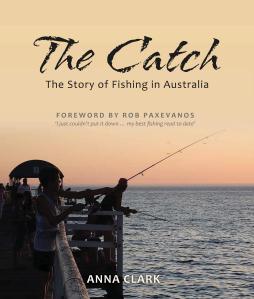
‘The Catch: The Story of Fishing in Australia’ by Anna Clark

clark_thecatch

2017, NLA Publishing, 145 p.

In a beautifully presented book, the “story” (but really, the “history”) of Australian fishing is told by historian and fellow fishing enthusiast, Anna Clark. This shared love of fishing permeates the text of this  book, not just in the “we” language that Clark deploys, but also in the carefully crafted ‘fisher’s-eye’ paragraphs that commence each chapter. Here, for example, is the start to the chapter ‘Early Industry’ that takes us right into the boat with a single fisherman in his small boat:

The boat glides out of Albany and sails across the sheltered waters of Princess Royal Harbour. A breeze skims across the bay and fills the sails- just enough to push the little boat along into the incoming tide to set the nets.  There’s plenty to catch here, and the fisherman fills his woven baskets with herring, whiting and bream, with a few skipjack and pike thrown in for good measure.  But there’s not much point chasing the big hauls, since the fish go putrid after a day or two ashore- and anything left over has to be buried. (p 49)

Or here we are on a modern commercial fleet ship:

The engine’s running and its gentle throb can be felt through the humming deck. Filleting knives are neatly lined up by the cutting boards near the ship’s bow, someone’s hosing off the blood from this morning’s catch and there’s a constant and slightly unpleasant smell of fish.  In the centre of the deck is a little hatch with a lid. Inside, a steel ladder drops down to the icy hold below. It’s dark and filled to the brim with neatly stacked ten-kilogram boxes of fish fillets, snap frozen by the boat’s powerful compressor. They sit waiting to be unloaded and taken away by refrigerated truck to the city’s markets. (p.97)

As well as capturing the tone of the narrative, these two opening paragraphs encapsulate many of the themes of the book: the joy of fishing, the deceptive abundance of fish, the problem of wastage and storage and the effects of technological change.

Published by the National Library of Australia, this lavishly illustrated book shares the high production values of its other volumes, and draws generously on the holdings of the library in photographs, maps and diagrams.

The book starts with indigenous fishing, which was described at length by Cook and Banks to illustrate the abundance of the eastern coast, and which was captured in many of the early drawings and paintings of New South Wales.  The amputation of the pinky finger on Eora fishergirls made it easier to use a line for fishing. It attracted the attention of these early commentators and was clearly shown in convict artist Thomas Watling’s drawing of Dirr-a-goa in the 1790s, while the term for the amputation, “Mal-gun”, was noted in William Dawes’ notebook of translations of Eora words.   However, as Clark notes:

While early colonial sketches and paintings give wonderful snapshots of Indigenous fishers, they do so from a distinctly European perspective.  Written accounts are similarly revealing – and we should be grateful for the faithful record of fishing practices and winning catches they’ve produced- but we can’t forget that these early settlers viewed Indigenous society through a distinctly colonial lens. (p. 17)

Indigenous perspectives on fishing come through the presence of scar trees where bark has been excised to build canoes, the remnant fish traps in rivers, shell middens and through indigenous carvings and paintings of fish.  This indigenous perspective is not relegated to the obligatory opening chapter, but instead continues through the book, with the continuation of fishing at riverside and coastal Aboriginal missions and Traditional Owners claims on traditional fisheries.  As she points out, fishing participation rates among in the Indigenous population sit as high as 92% in some communities, and it is an integral part of connection to country and cultural knowledge. (p. 132)

The abundance of fishing was reported by Captain Cook, and the First Fleet was well equipped to take advantage of it. However, Governor Phillip was less effusive, reporting that some days the fish were there- other days not. The photographs in the book – taken specifically to celebrate the size  of the catch – highlight abundance, but the text tells another story as fishing grounds are fished out and one species of fish collapses after another.

Another theme is the ongoing contest between competing interests. Colonial gentlemen craved the manly sport of fly-fishing and introduced European species into Australians waters with sometimes catastrophic results. (I knew about the European carp, but to be honest, I didn’t realize that the trout was an introduced fish- shows how little I know!) The government supported the establishment of commercial fisheries and the storage and infrastructure requirements to transport fish to lucrative markets, but in response to political pressure, it has more recently championed recreational fishing and set aside no-go zones to increase stock numbers. The emergence of Senators representing recreational fishing interests is likely to keep this political contest alive.

I did find myself wondering who this book is aimed at.  Its appearance just prior to Christmas is, I’m sure, well-planned. Its copious and beautiful illustrations mark it out as a coffee-table book, but the text ranges beyond the ‘whoa! look at that!’ response to a photograph of a big fish. Its author, Anna Clark, is well known in academic circles for her work on public history and history teaching and she brings to the book an awareness of sources and a keen sense of finding history in the everyday.  Most importantly, she brings her own love of fishing to the text, and I think that this is what fishers will respond most to in this book.

Sourced from: Review copy from Quikmark Media and N.L.A.

aww2017-badge

I’ve included this book in the Australian Women Writers Challenge.

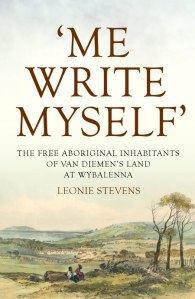
‘Me Write Myself’ by Leonie Stevens

MeWRiteMyself

2017, 331 p.

It’s not often that I close up a history book with a “Well done!”, but I did with Leonie Stevens’ beautifully written Me Write Myself. Right from its quietly restrained front cover, through to its ending which rounds off and yet expands and invites further conversation, this is a exquisitely crafted book.  It works on so many levels: as narrative, as critique and as history.

Stevens mounts her argument right from the subtitle on the cover:  ‘The Free Aboriginal Inhabitants of Van Diemen’s Land at Wybalenna’.  “Wybalenna?” you may ask. It’s more commonly known as Flinders Island, most often characterized as the doomed settlement off the coast of Tasmania, where the remnants of the Tasmanian Aboriginal tribes were shunted to be forgotten in silence by colonists and colonial officials alike, in the 1830s and 1840s.  And “free inhabitants?” Wasn’t this a form of concentration camp, on the way to what was seen to be an inevitable extinction? In Stevens’ hands, we see that  these are not victims but “free aboriginal inhabitants” and not silent, even though historians may silenced them, often while bemoaning their fate.

Flinders Island, for a place so small, has attracted the attention of historians, right from James Bonwick in 1870 through to Henry Reynolds.  The publication in 1987 of N.J.B. Plomley’s gigantic Weep in Silence,  with its 1034 pages, might have been thought to have exhausted all there is to say on Wybalenna. Not so.

Stevens starts her book in a crowded, metaphorical baggage-room where we ‘check-in’ our assumptions, narratives and language.  First there’s the question of names, often Europeanized and of slippery orthography. Then there’s scientific racism, underpinning the rationale of colonialism and assuaging guilt, and seeping through much of the historiography of Wybalenna, right up to recent writing, which sees it as a narrative of tragic and helpless death. Then there’s the question of credibility of sources and this is where Stevens steps right up. She takes historian Ann Laura Stoler’s term “the hierarchy of credibility” and turns it upside down to give priority to the VDL texts over European texts.  This is where Stevens’ approach is new.  She depicts the texts relating to Wybalenna as a pyramid.  The deluge of government reports, memoirs, newspaper reports and journals from which other historians have drawn their work form the large base of the triangle. Up from them are the texts recorded by Europeans where VDL First Nations people ‘speak’ as their words are transcribed and collected. Right at the apex are the texts written by VDL First Nations people themselves: texts that have been largely sidelined by historians and dismissed as ventriloquistic curiosities, parroting the views of white chaplains and superintendents, and of little worth in themselves. By placing them at the top of the hierarchy of credibility, “the VDL word takes on an urgency and new level of insight, revealing a more nuanced, personal, human story.”(p. xxx)  Finally, the metaphorical baggage-room is full of historians, especially white historians, who have either “made such fervent use of the extinction myth” or “fetishised frontier violence under the guise of critiquing it.” (p.xxxi). Stevens is only too aware that she is “a white 21st century mainland writer studying VDL history” and she is “mindful of her position on the metaphorical dance card” (p. xxxii)

This history, on which we now embark, is one constructed, wherever possible, from VDL sources. The mantra will be We do not need yet another European history of VDL people. It is the simplest way of keeping the baggage in check. ( p.xliii)

The organization of the book is basically chronological, but the VDL texts lend a thematic approach. The first two chapters set the scene, with the short Chapter 1 placing VDL within the 45,000+ years of pre-contact history, and briefly sketching the Black War of 1830 and its aftermath. Chapter 2 deals with the establishment of Wybalenna and its place within the wider humanitarian response across the empire. From this point on, the chapters become longer, focussing around the texts generated by the free inhabitants of Wybalenna.

Chapter 3 ‘The Promise of Wybalenna’ draws on hand-written newspaper The Flinders Island Chronicle, written between September 1836 and December 1837 by two teenaged boys, Walter George Arthur and Thomas Brune, who had received a brief education at the Orphan School outside Hobart, before returning to Wybalenna.  The forty-two editions and drafts of the Chronicle have only been partially published, and generally dismissed by historians as an obvious and clumsy attempt at Christian indoctrination and control. But, as Stevens shows

In fact, the Chronicle is much more than a mouthpiece for the Commandant. Those editions dominated by religious indoctrination actually contain a great deal of information, if effort is invested in peeling back the layers of meaning. (p. xxxvii)

We learn from these two boys, falling over each other to publish their own separate edition of the ‘weekly’ paper (which often appeared more often than weekly) that the Commandant was never really in ‘control’ of the settlement, most particularly the women. Wybalenna was part of archipelago of islands visited by sealers and whalers, and news and rumour swirled around amongst officials, convicts, traders and the free aboriginal inhabitants. We see the ‘Protector’ and Superintendent, George Augustus Robinson carefully painting house numbers on the doors of the cottages, in anticipation of a visit from Governor Franklin which turns out to be a fleeting affair. We see games being played, deaths being mourned, changes in relationships.

Chapter 4 draws on the school room examinations and written and spoken sermons generated as part of the Christianizing mission. In them, Stevens finds insights into language diversity, the persistence of ritual and the balancing of original and introduced spiritual beliefs. (p. xxxix).  She has to work harder here, as the texts are so heavily overlaid with the interpretations of Christianity that are being used as a form of control: keep your house clean, the insubordination of the women, the promise of God’s good country.  It is during this chapter that Stevens integrates the journey across Bass Strait to Melbourne in 1841 undertaken by George Augustus Robinson and the ‘family’ he took with him,  including the two former newspaper writers, Walter George Arthur and Thomas Brune. Two of the group are noted for being the first men hanged in Melbourne – Tunnerminnerwait and Maulboyheener.  I’ve read much about them in my own work on Port Phillip, but they always seemed (and were) men out of place, a disembodied group brought into the colony and then sent away again. Through the picture that Stevens has built up of Wybalenna, we see this ‘family’ and their importance, and why Robinson chose them, in particular, to take across to Port Phillip. They become distinct people, not just the ‘VDL Blacks’.

One of the things that I like most about Steven’s approach is that Wybalenna changes, in response to the people living there and those appointed there. It’s not a passive, inert place. Events unfold, relationships form and breakdown, alliances shift. In Chapter 5, the revolving door administration since Superintendent Robinson’s departure throws up Doctor Henry Jeanneret as new Superintendent, a ‘problematic individual’ who is dismissed, challenges his dismissal back in England, then is reappointed to Wybalenna again.

It is the dissatisfaction with Jeanneret’s reappointment, and desire to shift to a different model of living, that leads the Wyballena inhabitants – most particularly through Walter George Arthur- to write again in Chapter 6. This time they adopt the petitioning and epistolary form of colonial bureaucratese, as they write to the Governor on the Tasmanian mainland, making their complaints against Jeanneret, and asking the Queen’s intervention.  The authorship and authenticity of the letters was challenged by Jeanneret at the time, leading to the appointment of a one-man commission of inquiry which itself generated its own paper trail. The way that later historians, most particularly Plomley in Weep in Silence, have dealt with these letters, reflects the ‘taking sides’ amongst the white characters that historians are wont to do.

This assessment, naturally, gives no credit whatsoever to VDL activism or agency, besides Walter Arthur. Weep in Silence is essentially a European history, about Europeans running a European settlement, with a few inconsequential VDL faces thrown in (p. 321)

Through her careful reading, Stevens embodies these “inconsequential VDL faces” into living, active, resisting people. Naming is important, and the footnotes at the bottom of the page give a small biography for each one so that Wybalenna is literally ‘peopled’. How blessed she has been as an author, too, with a publisher that respects footnotes on the page (and not squirrelled away at the back of the book), letting the historian acknowledge sources and accuracy right then and there.

This is an absolutely beautifully written book. Stevens engages and challenges other historians, but more with urgency and invitation to share, rather than oneupmanship.  The chapters are long (possibly a little too long?), but the narrative flows, capturing shift and change.  It moves, as Wybalenna moves. This is academic history written with head and heart, and with eyes and ears open.  I hope and expect to see it shortlisted for history and non-fiction prizes over the next year. Read it.

Source: Purchased from Readings

My rating: 10.

aww2017-badge I have linked this to the Australian Women Writers Challenge 2017

Colonial Frontier Massacres in Eastern Australia 1788-1872

The University of Newcastle has a fantastic new site showing colonial massacres on the frontier in Eastern Australia. You can access it at

https://c21ch.newcastle.edu.au/colonialmassacres/

The map shows the approximate location of massacres of both indigenous people and settlers in the eastern states. As the creators explain in the introduction, their criteria for a massacre is six people.  Why six? To lose six people (or 20%) from a  ‘hearth’ group of twenty people renders that group vulnerable to further attack and diminishes their ability to hunt for food, reproduce and carry out their ceremonial obligations. The data is drawn from a range of sources including newspapers, parliamentary reports, the memoirs and correspondence of settlers, missionaries and Protectors, and oral and visual Aboriginal accounts.  The reliability of the source is rated with a star system.

The site makes quite clear that it is a work in progress, and subject to change through ongoing research.  Fascinating, and sobering.

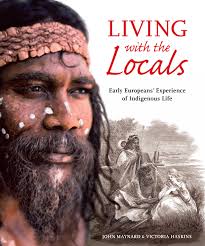
‘Living with the Locals’ by John Maynard and Victoria Haskins

maynardhaskins

2016, 223 p plus notes

Living with the Locals: Early Europeans’ Experience of Indigenous Life by John Maynard and Victoria Haskins, NLA publishing, Canberra, 2016

One of the few Australian expressions to make it into Brewer’s Dictionary of Phrase and Fable is the saying “You’ve got Buckley’s” -a little Australianism that I myself use quite frequently to mean “you’ve got no chance”.  Although its origin probably lies in a reference to the Buckleys and Nunn department store (“you’ve got Buckley’s chance or Nunn (non)”), for Melburnians it has another layer of meaning . William Buckley was a tall escaped convict who emerged from the bush, startling the early settlers of Melbourne, having lived with the  Wathaurong people for thirty-two years after escaping from the short-lived convict settlement at Sorrento in 1803.  He was not, however, the only white person to be accepted into an indigenous group, as John Maynard and Victoria Haskins show in this book. The information that these Europeans brought back into white society when they were ‘discovered’ or ‘saved’ can, read sensitively, provide a different perspective on pre-invasion or invasion-era indigenous life to counter the settler or missionary narratives which then (and to a large extent, now) largely framed knowledge of indigenous practices.

Our main focus and concern has been on trying to recapture what living with the locals was really like for these European individuals. The fact is that, in the main, they were treated with great kindness, compassion and care by their Indigenous hosts.  And therein lies a great tragedy of the Australian historical experience.  The wild white men and women were witness to the beauty and richness of Indigenous culture in this country that no other outsiders would ever see.  For us, these men and women are our eyes into another world on the cusp on an incredible upheaval. (p. 8)

The fold-out front cover of the book serves both as map and chapter outline as it plots the examples discussed in each chapter against the coastline of eastern Australia.  Early white settlements clung to the edge of the continent, with the sea the main source of communication and commerce.  The chapters of this book proceed chronologically, and the first two examples deal with Sydney and Melbourne.  All the other examples, however, are plotted from Brisbane northwards, where the Great Barrier Reef spelled the end of many ships and where the ‘frontier’ was shifting inexorably up the coast.

Of course, the authors could only deal with those Europeans who actually returned. Maynard and Haskins occasionally mention that the tribes were aware of other Europeans who were among them, or sometimes the escapee/survivors themselves report catching sight of them, but they do not break into the European historiography at all.  Maynard and Haskins only draw on the cases where there is sufficient  written documentation or oral testimony- flawed and incomplete though it may be- but there could be countless other similar scenarios that went unreported or even unknown. Continue reading

Contesting Australian History: A Festschrift for Marilyn Lake

lake

Strictly speaking, a  ‘festschrift‘ is a book of essays written by colleagues and students that is presented to an honorable person, generally an academic, during their lifetime. Well in this case, the collection of essays may come later in the form of a special edition of History Australia, because the main event here was a two-day celebration of Marilyn Lake’s career and writing at the beautiful 1888 building at the University of Melbourne. What a line-up! Even though I’ve only read a few of Lake’s works, and she wouldn’t recognize me at all, I couldn’t resist hearing such eminent historians responding to the wide range of issues upon which Marilyn Lake has written, held over two days in my own home town!

Marilyn Lake is an Australian historian whose work has spanned the homefront response to WWI (both at the time and recently), feminism and gender, and the White Australia Policy. Her book Drawing the Global Colour Line, co-written with Henry Reynolds, is a major contribution to transnational history internationally and here in Australia. She is a fearless public intellectual, most notably after the Age published an abridged version of the public lecture ‘The Myth of ANZAC’ that she delivered in 2009.  In the bitter and highly personalized response to her book, one angry male writer asked her “What have you ever done for Australia?” Well, this festschrift was a resounding answer – even if he wasn’t there to hear it.

Different speakers took various approaches to the festschrift task.  Some spoke about Marilyn herself and their own relationship with her.  Others engaged with her main academic interests and publications. Some spoke about their own research, and Marilyn’s influence on their own work. Others paid tribute to her as public historian, course convenor, research partner and supervisor. Continue reading

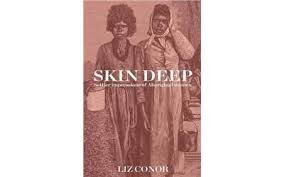
‘Skin Deep: Settler impressions of Aboriginal women’ by Liz Conor

conor

375 p & notes, 2016

On the first page of the introduction to this book, there is a picture of a young aboriginal woman, staring directly at the camera.  It comes from a book by Alice Duncan-Kemp called Where Strange Paths Go Down, published in 1964 and written in the tradition of Mrs Aeneas Gunn, Daisy Bates or Mary Durack.   Liz Conor, the author of Skin Deep does not know who the young girl is, despite searching for almost a decade for clues to her identity in order to repatriate the woman in the image to her descendants and to seek their permission and cultural clearance.  Conor uses her image nonetheless, and in this- as in much of the material in this book- she is conscious that in historicizing and interrogating the use of settler impressions of aboriginal women, she is also resuscitating tropes and assertions that might best be forgotten. As she says:

Focusing at times on unnamed women, that is, women already subjected to this very appropriation, creates a dilemma: should such images be left outside the historical account, when they have played a significant role in shaping ongoing imaginings of Aboriginal women? (p35)

She decides to proceed, however, after consulting with women in several communities in Queensland, South Australia and Victoria. The book does not concentrate on photographs alone: there are lithographs, cartoons and prose descriptions as well, often twisted with racism and misogyny and deeply offensive.  She warns readers that the material will be found repugnant, and it is.

The book starts with the earliest descriptions and depictions of Aboriginal women by the first European explorers who, deeply imbued with Enlightenment thinking, categorized Aboriginal people as either ‘noble savages’ or ‘native belles’. Images were engraved, reproduced and co-opted again and again through the new print medium. This chapter lays the basis for the central argument of the book:

…that colonial racism and gender relations hinge in particular ways and depended on the facility of print to reiterate and thereby entrench meaning as truth. (p. 38)

The second chapter reiterates this argument in a different way through the ‘bride capture’ trope, whereby white men could conveniently overlook their own sexual atrocities to deplore what they described as the kidnapping and enslavement of aboriginal women by aboriginal men.  Just as with the lithographs described in Chapter One, these assertions were repeated again and again by explorers, protectors and anthropologists. It took some time for a degree of nuance to emerge, whereby the women could be seen as not just victims but participants in a tightly regulated pre-elopement  marriage ritualized performance. What was left largely unsaid was the perilous position of Aboriginal women on the white/black frontier where white men accused of violence towards Aboriginal women were exonerated, or able to deflect blame onto the native police.

A similar process of repetition attached to the trope of infanticide and infant cannibalism explored in Chapter 3, although this is a more complex area. Unlike the bride capture assertion, which was spelled out in lurid detail, claims of infanticide and infant cannibalism were not actually witnessed by white writers, but drawn from Aboriginal testimony.  Weight does have to be given to some  writers on infanticide and cannibalism who had ongoing and generally trusted contact with their Aboriginal informants. However, it is very possible that in the midst of complex inter-tribal indigenous politics, informants to a trusted white settler or ethnographer were disparaging other tribes by accusing them of cannibalism, to distinguish them from their own tribe (which did not indulge in such practices). At the same time, too, white mothers were sometimes charged with committing infanticide, and it is possible that the  atrocity of cannibalism was  added to differentiate white and aboriginal female criminality.

These initial three chapters reinforce the power of repetition in embedding a particular impression of Aboriginal women into the settler and metropolitan consciousness, even when there was little or conflicting evidence. Print culture in particular facilitated this easy re-use and reproduction.  However, as a reader, while I know that the whole point that she is emphasizing is that repetition was a powerful tool, the chapters felt rather repetitious themselves. There is a chronological progress through the reports and depictions that she describes, but because they themselves were derivative and recursive, it felt as if you were reading the same thing again and again, without little new knowledge or insight being gained.  Her research is exhaustive here (and indeed, at the end of the book she exclaims that there are reams of such material), but it is exhausting reading as well.

So it was with some relief that from Chapter 4 onwards, she takes up a slightly different approach by following through the depictions of Aboriginal womanhood from domestic servant to sexual partner to old woman.  Chapter 4 ‘Footfall over Thresholds’ explores the descriptions of Aboriginal women’s gait, either as a sashaying, silent, dignified ‘native belle’ or as a  ‘felt-footed house lubra’ (p.261).  Certainly, Conor has been able to identify and reproduce many pictures of thresholds, with the white woman on one side of the doorstep, and the disheveled or sneaky  black woman on the other, and her point about the depiction of large flat feet is well-made with several derogatory cartoons found in twentieth-century ‘humorous’ publications like the Bulletin or Aussie.

In Chapter 5 she takes as an illustrative episode the moral panic that was provoked in 1936 over the prostitution of Aboriginal women and girls to Japanese pearlers, with accusations that they were being pimped by Aboriginal men.  This was a double outrage: not only did it reference the ‘bride capture’ trope of Chapter 2 but these were Japanese pearlers (i.e. non-white; increasingly suspect) who were pillaging Australia’s fisheries and natural resources in the leadup to World War II. Again, indigenous women were seen to be passive against the power of their men, without agency. It was only with the contribution of Aboriginal men to the defence of the Australian coastline during the war that they were reinstated as defenders, rather than purveyors, of their women.  Within the deluge of newsprint prompted by the prostitution scandal,the suggestive term ‘black velvet’ (a reference to Aboriginal women’s genitalia) was never used to describe the attraction of Aboriginal women to the Japanese.  Instead it was a coded phrase for white man/aboriginal women sexual relations. I was rather startled to learn that ‘Black Velvet’ was the original name for Xavier Herbert’s Capricornia.

However, there is nothing titillating or alluring about Chapter 6 ”Absolute frights’: appearance and elders.’  It was as if newcomers felt compelled to record and publish their disgust at the appearance of elderly, emaciated Aboriginal women, and they did- with derision and at length. This chapter really is offensive, and is well placed at the end of the book, after the reader has already been exposed to less offensive (but no less corrosive) nineteenth and early twentieth century commentary.

This book has been written for an academic audience and UWA publishing have not stinted on scholarly conventions and tools.  There are lengthy footnotes, a full bibliography and a good index which includes references to historians.  What luxury it is to be able to look up a historian’s name in the bibliography instead of having to track back through footnotes to find the original reference!  The book does draw heavily on theoretical work, and I really appreciated that Conor was not forced (in the cause of ‘attracting a general readership’) to strip out all references to other historians with the vague term “some historians say….” but was able to name the historian, and quote directly from her/him.  It’s a form of academic sociability: because Conor has been able to quote and summarize the key findings of other historians, you know the argument that she is embedding her work within. You’ve read that work too, or if you haven’t then it distills the argument so that you can see how Conor has integrated it into her own work. It’s an academic pleasure that is so often being withheld from us in the cross-over between academic and ‘popular’ history.

It sometimes happens that the argument of a book becomes known by a sort of  short-hand reference.  For example, you only have to say ‘Blainey’ and you think either ‘distance’ or ‘black-arm band’; you say ‘Reynolds’ and you think ‘frontier’. I think that Conor’s work here will spring to mind as a short-hand reference to the abhorrent and self-perpetuating use of imagery, especially in relation to indigenous women.

I finished reading this book in a week when Bill Leak published a cartoon in the Australian not too far removed from the late19th-mid 20th century cartoons reproduced in these books. ( In The Conversation, there’s a good article about the cartoon, which I will not dignify with reproducing or linking in this blog). In the face of Leak’s repetition of past injustices (and not-so past, in view of the Don Dale video) the last paragraph of Conor’s book, which encapsulates her argument, comes to life:

Construing Aboriginal women as infertile, infanticidal, infirm and thereby as embodying their people’s terminus, rather than generation, was an alibi for the violence they endured on the frontier and in its aftermath and through the interventions of state administrations.  The recursion of these effacing yet exposed constructs of Aboriginal women was advanced through print and its syndications on a global scale.  Once aware of how such racial distortions become entrenched, a renewed impetus to resist them at every iteration ought to become part of a nationwide apology and commitment to recognizing the dignity of Aboriginal women.  By extension, whenever and wherever we hear a misrepresentation advanced in public about a people that contrives to mark them off with exaggerated disparity or disregard, we need to call it out then and there. (p. 370)

aww2016


I have linked this review to the Australian Women Writer’s site.


Further reading: You might be interested in this article that Liz Conor wrote in New Matilda that draws on the book.  The article, as with the book itself, warns of the offensive content.