Category Archives: Australian history

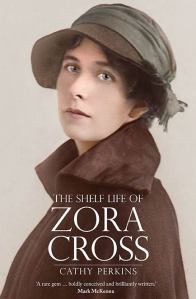
‘The Shelf Life of Zora Cross’ by Cathy Perkins

perkins_zora_cross

2019, 243 p & notes.

“Twenty pounds and you shall have her” and thus were the publishing rights for Songs of Love and Life transferred from a small self-publishing bookshop to that of the publishing behemoth, Angus and Robertson in 1917.  This book of sixty erotic love-sonnets was to become a literary sensation, going through three reprints and selling a respectable 4000 copies. Its author,  27 year old Zora Cross, wrote about love and sensuality from a woman’s perspective – something shocking in 1917.  Norman Lindsay, the artist whose own work abounds with nudes,  refused to illustrate the book, saying that women couldn’t write erotic poetry because their ‘spinal column’ was not connected to their ‘productive apparatus’. He did, however, condescend to provide a mythologized front cover which, to my eye, has nothing like the impact of an alternative cover design of  a bedroom scene with a present-day man talking off his coat, with his lover covering him with kisses.

But the sale of the publishing rights, and the choice of front cover and illustrator were not in the hands of this young, barely-published author. This book, which is a biography of the now-forgotten Zora Cross, is also an exploration of the Australian writing and publishing scene of the first half of the twentieth century, particularly in Sydney and Melbourne. I had flutters of half-formed recognition of many of the names in this book, and the author has used them as anchors in each of the chapters that move roughly chronologically through Zora Cross’ life.  As Cathy Perkins writes:

I set out to write a conventional biography, but I was drawn to an idea of a life that was made of up relationships. Each of Zora’s relationships shows a different side of her personality and each has its own tensions. (p. xii)

The opening chapter, then, is subtitled Ethel Turner, who as well as the author of the much-loved (by me!) Seven Little Australians, also wrote the children’s page in The Australian Town and Country Journal. Children would send in their contributions and letters (I remember doing the same to ‘Corinella’ in the Sun during the 1960s) and ‘Zora Cross of Pie Creek Road Gympie’ was a frequent contributor. When she grew too old for the children’s page, she finally met her mentor in person.

Ethel Turner suggested that she try her luck with the Lone Hand, the sister publication to the Bulletin, and thus Cross started up a rather fervent correspondence with the editor, Bertram Stevens, who features in Chapter 2. In this chapter we learn of Cross’s employment as a school teacher and her strange, short marriage to fellow-student Stuart Smith, with whom she had a child who died soon after birth.  Pregnant again to an unnamed father in 1913, Cross travelled northern Queensland with a theatre company, and became editor to the small Bohemian newspaper of arts and social news.

She also wrote poetry for the Bulletin, and it was through this connection that Norman Lindsay, for whom Chapter 3 is titled, was asked to provide the artwork for Songs of Love and Life.  It was published by George Robertson, who features in Chapter 4, who carefully oversaw the sales and  reviews of the books under his imprint.  She wrote copious letters to him, too, and on the walls of his office he had a copy of the beautiful portrait that graces the front cover of this book. However, despite his success with Songs of Love and Life, he declined to publish other manuscripts of Cross’, along with the manuscripts of many other women writers who were to go to fame including Katherine Susannah Prichard, M. Barnard Eldershaw and Christina Stead.

She achieved success writing about the losses incurred in WWI, in Elegy on an Australian Schoolboy written in tribute to her brother John Skyring Cross (Jack), who is explored in Chapter 5. He died of illness after being injured on the Western Front.  In 1919, George Robertson asked his assistant, Rebecca Wiley, to go on a month’s holiday with Zora, who was feeling run-down. Chapter 6, named for Rebecca Wiley, explores the often tense relationship between these two women, especially once Zora had shifted to Glenbrook in the Blue Mountains with her partner, Bulletin editor David McKee Wright, who features in Chapter 7. They never married because David was still married to his previous wife, and she was pregnant to another man when they partnered. They had two daughters together, and David legally adopted her son. He died suddenly in 1928.

Now widowed, Cross continued to write, especially for the Australian Woman’s Mirror, an offshoot of the Bulletin which predated the still-extant Australian Women’s Weekly. Chapter 8, subtitled ‘Bernice May’ refers to her pen-name in much of the writing she did for ‘women’s pages’ . After falling out with George Robertson, she embarked on a series of interviews with fellow women poets and novelists for the Mirror, including Jean Devanny, Eleanor Dark, Dulcie Deamer, and Mary Gilmore.  A long-standing presence in Cross’s life was John Le Gay Brereton, Chapter 9, a friend of Henry Lawson, chief librarian and later professor of literature at the University of Sydney. His access to resources assisted her to write a series of books about Classical Rome, which were not well received (and sound pretty dire). As president of the Fellowship of Australian Writers, Brereton was a constant source of support when Cross made frequent, and generally successful applications, for Commonwealth Literary Fund pensions and grants.   Another longstanding friend was Mary Gilmore (Chapter 10) who was punctilious in overseeing her bequest of papers to the Mitchell Library. She died in 1963 and a year later, Zora Cross died of a heart attack.

This is a very skillfully written biography, maintaining its chronological trajectory while using various friends and colleagues as a prism through which to explore Zora Cross’s personality and writing.  Cathy Perkins, the author,  who is the editor of SL magazine and other publications at the State Library of NSW inserts herself several times into the narrative, in her research and  advocacy for Zora Cross.  As well as a biography, the book explores the literary industry and the whole issue of literary presence after death. Perkins’ decision to use relationships as an organizing device emphasizes the interconnections between writers and publishers, something that is often invisible to the reader.

She captures well the breadth of Cross’ writing, and quotes generously from her unpublished works, without necessarily championing its sometimes rather dubious quality, leaving it instead up to the reader to decide.  She portrays Cross as a fully rounded character: unconventional mother and partner, hard-working, flirtatious, sometimes needy, mother, grandmother and community member. But most importantly, as a prolific and life-long writer, even if she has been -until this biography- completely unknown today.

My rating: 9/10 A really accomplished biography

Sourced from: Yarra Plenty Regional Library.
aww2020

This is my first read for the Australian Women Writers Challenge 2020
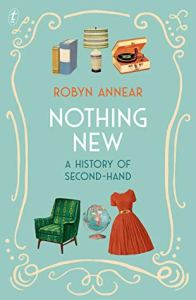
 

‘Nothing New: A History of Second-Hand’ by Robyn Annear

annear_nothing_new

2019, 273 p.

In Australia at the moment, as in other economies in the world, Treasurers and bankers are wringing their hands at consumers’ “failure to spend”. Different causes are attributed: low wage growth, underemployment, the China/U.S. trade war. I wonder, though, if there’s something else going on. Perhaps, as Greta Thunberg suggested, people are beginning to see that the obsession with continual growth blinds us to the changes needed to keep our planet habitable. Perhaps we are tiring of poor-quality tat that is purchased with the intention of throwing it away. Perhaps we are yearning for a Marie Kondo make-over and just to have less stuff.  For what-ever reason, we’re just not buying new merchandise in the way that we used to.

Historian Robyn Annear is a long-time afficionado of second-hand.  Right up front she admits that “Other people’s detritus calls to me. And from that siren song this book was born.” (3). Her opening chapter is titled ‘Nothing New’ and her closing chapter is titled ‘…Under the Sun’. In the intervening chapters, she embarks on a digressive history of second-hand, told with her trade-mark giggle in the narrative voice.  The book is roughly chronological from 1700s to the present day, and it jumps around the Anglosphere, with Australia considered quite naturally and unselfconsciously among Britain and America, with occasional additional reference to France and Africa.

As she explains, before the 1700s, clothes had long lives, passed on from class to class, generation to generation, mended and remade. During the late 18th century, increased consumerism and the influx of Jewish immigrants led to a commercial market in old clothes, collected by the Ol’ Clo’ man, and ending up in markets where they were revived and remodelled. An international market existed as old clothes were circulated between different countries. In this regard, Australia during the 1850s stood out, as people tended to buy new clothes on arrival in the colony, and there was a post-convict sensitivity over Australia being seen as a dumping-ground for old clothes, as well as old lags.

Once clothes really had got beyond the point of being remodelled, there were other markets for rags.  Before paper was made from wood products, rags were used for paper, with old linen kept aside intentionally to make up-market linen weave paper. Rags could be shredded to make ‘shoddy’, a reconstituted fabric which could then be resewn for new, cheap garments. They could be melted down and mixed with horses hooves and horse blood, ashes and scrap iron to make Prussian Blue dye.  The dust created in the manufacture of shoddy could be used to make ‘flock’ wall paper, and rags could be used to stuff mattresses.

However, by the 1850s there was a change, when direct donation of clothes came to be seen as “charity”, rather than as a market. As is often the case “charity” existed side-by-side with a fear of being ripped-off, so only dirty clothes, beyond repair tended to be donated for distribution to only the “deserving” poor.

With the rise of ‘rummage sales’ in America in the 1850s, and their gradual extension to London in the 1890s, the stigma of “charity” was assuaged by the charging of a cheap price for goods that were given free.  The Salvation Army created its Household Salvage Brigade, which provided a waste collection service, with the collected goods sorted into sale items, and unsellable material directed towards recycling. When the Household Salvage Brigade went into recess during WW I, St Vinnies (St Vincent de Paul) started up the Waste Collection Bureau.

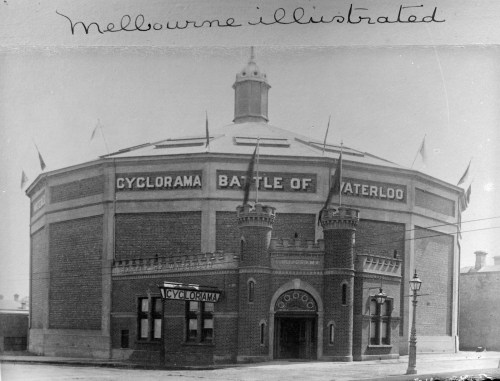
In Melbourne, the first “Opportunity” shop was located in the Cyclorama in Victoria Street in 1925, near the present St Vincents Hospital. Named by Lady Millie Tallis, who had witnessed the success of second-hand shops runs on charitable lines overseas, it was intended to raise money for St Vincent’s Hospital (unrelated to St Vinnies). The Cyclorama had been built in 1889 to house a 360 degree panorama of events like the Battle of Waterloo, the Eureka Stockade or the Siege of Paris, but by 1925 it had been rendered obsolete by the new craze for moving pictures. What better use to put a clapped out, round building?

cyclorama

Creator: Allan C. Green, State Library of Victoria http://handle.slv.vic.gov.au/10381/31352

The ‘opportunity shop’ spread to other suburbs, but it died out during the Depression, only to reappear after World War II when the years of “mend and make do” were past, and consumer spending – and, as a result, disposal of  no-longer-wanted goods-  sprinted ahead.

Second hand came to be distributed through a variety of forms: Lost Property Auctions (as Annear points out, why isn’t it Found Property Auctions?), Exchange and Marts in newspapers, antiquarian collections, charity shops as a business, the Trading Post, garage sales, Trash and Treasure markets, hard rubbish collections on the footpath, and e-bay.

Finally, there’s a whole market that is invisible to us in First World countries, whereby second-quality, secondhand goods are baled up and sent to Africa. I visited Toi market in Nairobi, the largest second-hand market, which burnt to the ground this year after being slated for demolition (hmmmmm…)  If you’re not prone to sea-sickness, this rather jerky video takes you on a bus to Toi Market- it really captures what you see in Nairobi well.

When I visited Rwanda, I was horrified to learn that Donald Trump had pressured Kenya, Tanzania and Uganda into dropping their plans to ban the import of second-hand clothes from America, in order to protect their own clothing industries.Only Rwanda persevered. However, as Annear points out, the Chinese government has stepped into the gap, and is now importing second-hand, and  increasingly, new cheap clothing from China into Rwanda.

Written in a quirky conversational tone, ‘Nothing New’ wears its scholarship lightly, but the references at the back reveal the research that has gone into the book. Where footnotes appear at the bottom of the page, they are jokes and comments, rather than references. Robyn Annear also has a podcast called Nothing on TV,  based on her Trove research, which deals with similar material and the very Australian delivery is similar to the narrative voice of the book. It’s a quick, fascinating read that will have you looking up and saying to anyone listening “Hey, did you know?…….)

My rating: 8, based largely on its enjoyment factor

Sourced from: Yarra Plenty Regional Library.

AWW2019

This will almost certainly be the final book that I add to the 2019 Australian Women Writers Challenge!

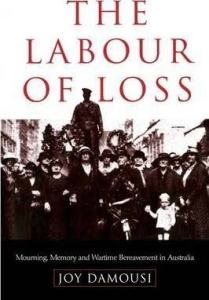
‘The Labour of Loss’ by Joy Damousi

damousi_labour_loss

1999, 163 p & notes

It really wouldn’t have surprised me if this book had been reissued in the last five years, but it wasn’t. It would have done very well in the deluge of books about WWI between 2014 and 2018, and dealing as it does with loss experienced during and resulting from World Wars, it fits very neatly into the  ‘history of the emotions’ school of historical enquiry, which has high prominence at the moment.  But it wasn’t reprinted, and so it remains a fore-runner to much work that has been completed in its wake.

As Damousi says in her introduction

This book examines the stories of those for whom loss in war remained the experience through which they understood themselves, and through which they shaped their lives. After the wars ended, their lives had been irrevocably changed through continuing grief, for the burden of memory would remain with them as they attempted to rebuild an internal and external world without those to whom they had been so fundamentally attached. (p. 6)

Damousi is very conscious that she is dealing with ‘white’ soldiers and the experiences of their families, and mentions in several places that the burden of memory was often disregarded for indigenous soldiers.  A strong gender theme runs through her analysis.

The book is divided into two parts. The first deals with the First World War, the second part deals with the Second World War.

Part I : The First World War

1. Theatres of Grief, Theatres of Loss

2. The Sacrificial Mother

3. A Fathers Loss

4. The War Widow and the Cost of Memory

5. Returned Limbless Soldiers: Identity through Loss

Part II The Second World War

6. Absence as Loss on the Homefront and the Battlefront

7. Grieving Mothers

8. A War Widow’s Mourning.

Conclusion

The themes of the grieving mother and wife are dealt with in both sections, while other themes e.g. soldiers writing to bereaved families, the return of limbless soldiers, or absence from home are dealt with in one section only. I’m not sure that there is a qualitative difference between these emotions and events between the two world wars, and perhaps the decision to locate a topic in one war rather than the other depended on the sources that Damousi uses.

As Damousi points out in Chapter 1, when a soldier died at the front, it was quite common for his friends in the battalion to write to his grieving family themselves. Sometimes bereaved families ‘at home’ drew their son’s friends to themselves like adopted sons. While writing these letters to other families at home, the soldiers were almost rehearsing their own possible death.  Meanwhile, back on the homefront, delayed letters continued to arrive from sons who had been killed , and bereaved families forged their own links with each other.

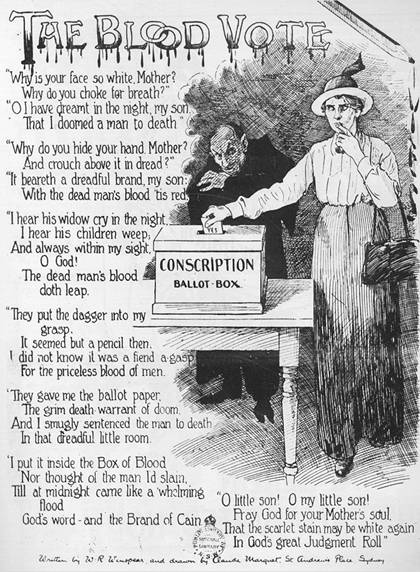
Blood_vote

Wikimedia


Chapter 2 and Chapter 7 both deal with grieving mothers, but in World War I the mother figure had a political as well as familial role. Not only was the mother lauded for “giving up her son” but the Conscription debates drew heavily on the image of the mother both as  the one who sacrificed, but also the one who determined, men’s fates.  ‘The Blood Vote’, for instance, placed the burden of decision onto mothers, rather than fathers or sisters.

Yet when it came to financial support for widowed mothers who lost their sole breadwinner, mothers soon found the limits to compassion for their sacrifice. After being giving a prominent role in the immediate post-WWI period, by the 1930s mothers found themselves shunted to the side of parades and their pensions became increasingly inadequate over time, especially when additional payments were granted to widows but not mothers.

In the World War II section on mothers, Damousi makes similar observations, drawing on the diary of Una Falkiner, whose son died in a plane accident in September 1942, and Hedwige Williams whose son  Charles Rowland Williams died in Germany in May 1943. This chapter -, shaped perhaps by the sources available? – seemed to me to have a deeper emotional timbre than the corresponding WWI chapter.

Chapters 4 and 8 deal with war widows. What is common to the experience in both wars was that the war widow tended to become public property as her lifestyle and life choices were judged by others to determine whether she qualified for a widow’s pension. It became rather unedifying as neighbours, other widows and mothers informed on those who they felt were ‘undeserving’. Again, in relation to the Second World War section, the same themes recur in the experience of women in the two wars, but in Damousi’s account she draws more heavily on a particular source – in this case, Jessie Vasey, the widow of General George Vasey who died in an Australian plane crash when he and several other high-ranking defence officers died near Cairns. She channelled her grief into political and charitable action for war widows but, once again, after the immediate post-war years, women found themselves and their sacrifices pushed aside.

The correspondence between the Vaseys also features strongly in Chapter 6  ‘Absence as Loss’ where Damousi  draws on Vasey’s letters back home to illustrate the yearning for domesticity expressed in much wartime correspondence. Interestingly, I have just finished listening to an excellent podcast series called Letters of Love in World War II, where a British couple range over philosophy, yearning and domestic trivia in their 1000-letter correspondence. Again, it is perhaps not so much a qualitative difference between the two wars, as a question of sources.

The depth of sources has possibly also influenced Damousi’s decision to deal with fathers’ grief in World War I, and not in World War II. In Chapter 3, ‘A Father’s Loss’ she examines the extensive archive of John Roberts, an accountant with the Melbourne Tramways Board, who lost his son Frank on 1 September 1918 at Mont St Quentin. Perhaps there was a particular plangency in losing a son so close to the Armistice; or perhaps the almost-obsessive pursuit of every possible way of documenting and making contact with those who may have seen, or been with, his now-departed son reflected Roberts’ own personal approach to traumatic events. In either case, Roberts’ correspondence is a rich and complex archive of grief for the historian.  More generally, however, fathers maintained a more prominent public part than mothers and widows in commemorating their sons through political organizations and they leveraged their ability to influence policies.  In the Second World War, however, fathers (many of whom had served themselves in World War I) found that the reactivation of war challenged their ideas of patriotism and their own earlier sacrifice. They often found themselves harking back to their lost pre-WWI world, which they had been unable to secure.

Of course, World War I and World War II was interspersed by the experience of the Depression. It forced hard decisions about sacrifice and worth in finding and holding scarce employment. As Damousi points out in Chapter 5, initially there was strong pressure for governments, councils and private employees to offer jobs to returned WWI soldiers, and particularly soldiers who had been injured. However, when jobs became scarce,  returned men without injuries were preferred employees, and war widows were expected to yield their jobs to returned soldiers.

I’ve been thinking a lot about the title of this book.  I’m not sure if the loss that she mentions here involves “labour” as such, although it certainly was a life-changing event for those who were left. But then I find myself thinking of the title of Shakespeare’s play “Love’s Labour Lost” which to me has its echoes in this title. For, without actually spelling it out in her title,  what comes through in Damousi’s examination of memory and grief, is “love”.

AWW2019I have included this on the Australian Womens Writers Challenge database for 2019.

Source: La Trobe University Library


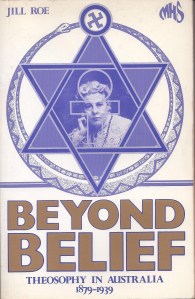
‘Beyond Belief: Theosophy in Australia 1879-1939’ by Jill Roe

Roe_theosophy

1986, 388 P.

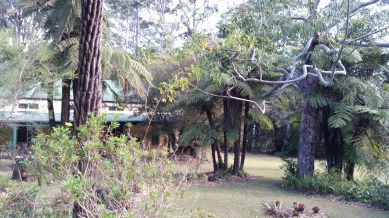
20190823_150525A couple of months back, I went with my Unitarian fellowship to a retreat near Springbrook in south-east Queensland, owned by the Queensland Theosophical Society. Curious about theosophy and wondering if it has any parallels with Unitarianism, I decided to read Jill Roe’s book Beyond Belief. (Thank you for asking: no, Unitarianism  is completely different in terms of philosophy although maybe it does have similarities in terms of public profile). Roe herself was not a Theosophist, so this book is no ‘insider story’ – in fact, it is written with a dry, dispassionate but not hostile air of curiosity. And curious the history of Theosophy in Australia certainly is, but given its attraction to politicians, judges and some academics in the first decades of the 20th century, it can’t be discounted either.
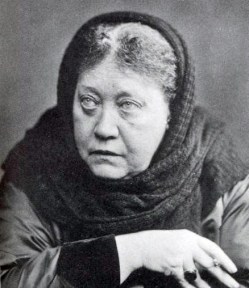
Blavatsky.010

Mme. Blavatsky, Wikimedia Commons

Roe’s book covers the years 1879-1939. Its starting point is 1879 when the Theosophical Society, an international organization, enrolled its first Australian member.

Established in  America in 1875 and eventually based in India, with the so-called psychic Mme Helena Blavatsky as its founder, people joined the central Society as individuals rather than joining a local satellite.  When Mme. Blavatsky was pronounced a fraud for manipulating her seances, she fled to Europe and never returned to India,  and the Theosophical Society continued on without her.

Between 1891-1894 Theosophy gained an effective foothold in Australia with small groups established in various states. Success was mixed. Melbourne, with its solid network of liberals and secularists might have seemed a fertile ground for Theosophy: think Alfred Deakin, Henry Bourne Higgins, Vida Goldstein etc. However, in Melbourne the experimental spiritual space was already occupied by Charles Strong’s Australian Church, the Melbourne Unitarian Church and the Victorian Association of Progressive Spiritualists.  Sydney was a more fractious place, with either hardline churches or frankly ‘nutters’ (have things changed?) and a “freer market for heterodoxy”. The surprising thing to me was that Brisbane became a stronghold for Theosophy (evidenced perhaps by the continuing presence of the retreat I visited in Springbrook?), and it attracted professional and commercial people like judges, doctors, lawyers etc.

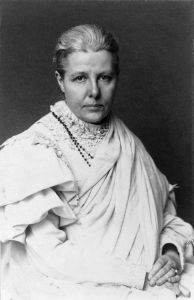
Annie_Besant,_LoC

Annie Besant, Wikimedia Commons

The real international “catch” for Theosophy world-wide was the recruitment of Annie Besant (did you know that it should be pronounced to rhyme with ‘pleasant’?), already well-known for her activism on contraception and championing the cause of the British Match-Girls. (I’m still haunted by a picture I saw in primary school fifty years ago of a girl my then-age, suffering phossy jaw).  She visited Australia quite often in her role as President of the Theosophical Society and was well received as an excellent public speaker. There was a personal connection too: her daughter had married English journalist Ernest Scott, who ended up the first Professor of History at Melbourne University. He had eschewed both Theosophy and his double-barrelled surname Besant-Scott by the time he received his university appointment , and the marriage had broken up.

Now, for me as a non-Theosophist, this all gets pretty weird. Not only the clairvoyance, but also a belief in Lemuria- an Atlantis-like mega-continent encompassing the Himalayas, Madagascar, Tasmania, Greenland and Siberia before sinking into the sea because of volcanic activity. Then there’s the onward evolutionary cycle of rise and fall of dominant civilizations, with the Aryan world in decay, waiting for the sixth cycle which would be presaged by the arrival of the Coming Christ, the World Teacher. There was the connection with Co-Masonry;  the esoteric offshoot ‘The Order of the Star in the East’; and the takeover of the Old Catholic Church, renamed the Liberal Catholic Church complete with Bishops, mitres and ‘mysteries’.

Then there was the World Teacher himself, whom the Theosophical Society identified as Jiddu Krishnamurti born around 1895 in India and adopted by Annie Besant and fellow Theosophist Charles Leadbeater (no relation to the possum). Expectations of the arrival of the messiah reached their zenith in the 1920s, which was also the high point of Theosophy in Australia. The Star Ampitheatre was built on prime harbourside Balmoral Beach in Sydney for the World Teacher “when he comes” (see image here), but not for Jesus walking through Sydney Heads as the legend goes.  The land cost £7000 and the ampitheatre building itself cost £20,000.  It was demolished in 1951.

During the heady 1920s Theosophy was strongest in Sydney (despite schism) and prominent real estate was purchased in all the capital cities.  It owned and controlled 2GB (home of Alan Jones -HUH!). It moved into education, particularly kindergarten education, with a later offshoot into Anthroposophy and Rudolf Steiner education. It encouraged art (particularly the Arts and Crafts movement) and dance (especially eurhythmics). Despite claims to being ‘progressive’, it was a rather straitened progressivism by today’s standards: vegetarian, teetotal, dislike of ‘luxury’, anti-vaccination, proponents of ‘racial hygiene’ and attracted to some of  Mussolini’s ideas.

By the 1930s Theosophy was in decline, and has remained that way. Anthroposophy attracted many of its leading lights; the World Teacher Krishnamurti rejected Theosophy himself and went off in a different spiritual direction; the Society lost 2GB and people drifted into other religions or apathy. It had become an anachronism. Theosophy is, as Roe says “best understood as an alternative religious position dating from the age of imperialism. The ground it stood was undermined by the crises of the early twentieth century” (p. 378)

Quite apart from my curiosity about this esoteric (and in my opinion eccentric) philosophy, the book highlights three interesting themes.  First- here is a church where the major figures are women (Mme Blavatsky and Annie Besant) although, as Roe points out, women only held 1/3 of the officebearing positions in the organization.  Second, this is an imperial endeavour, with India at its heart. The frequent communications and visits between Australia (particularly Brisbane) and India are a different way of looking at empire, largely ignoring the metropole. Finally, there are those rich intersections between Australian intellectual life in the early 20th century and Theosophy- a veritable Who’s Who of connections.

This book was published in 1986 as part of the NSW University Press ‘Modern History Series’. It has the look and feel of a typed manuscript or thesis, with very dense text and footnotes at the end of each chapter (as used to always be the case). Apparently Wakefield Press are crowd-sourcing for a revised edition edited by Marion Quartly  (I wonder how they’ll get around the problem that Wakefield already have another book under their imprint called ‘Beyond Belief’?)

This is an academic text, and it is more an institutional history than a bottom-up, personalized history.  However, in our increasingly rabid religious world, perhaps there will be a readership for this strange history which has so many intersections with early 20th century intellectual history. After all, in an interview with the Australian Humanities Review in 2004, Roe said

if you want to understand the norm, you should look at what isn’t the standard. It’s very illuminating to look at those who have taken a position to the edge, it casts a different light on what really is in general.

AWW2019I have read this book as part of the 2019 Australian Women Writers Challenge.

Article: ‘The Snub:Robert Menzies and the Melbourne Club’ by Sybil Nolan

I enjoy reading essays and articles and so I’ve decided to briefly review them here. My criteria for selection is that they are available online, either freely or through membership of one of our State Libraries (in my case, the State Library of Victoria). Membership of a State Library is free, and it often gives you access to online journals that you would not otherwise have. Not the most recent edition, admittedly, but free nonetheless.


‘The Snub: Robert Menzies and the Melbourne Club’ by Sybil Nolan Australian Historical Studies, 2017, Vol 48, Issue 1 pp.3-18  (Available for Victorians through SLV)

MelbourneClub

Commander Keane: Melbourne Club 2012 Source: Wikimedia

I’d always assumed that Robert Menzies, founder of the modern Liberal Party and Prime Minister for what felt like all of my childhood, was a member of the Melbourne Club. It’s a very august institution in Collins Street Melbourne, to which Establishment men belonged (and indeed, may well still do so). However, as Sybil Nolan’s essay shows, Menzies was never a member of the Melbourne Club, even though he belonged to other clubs like the Savage, Australian, Atheneum clubs etc. both in Melbourne and in ‘the mother country’. But why not the Melbourne Club?

Ah- don’t mention the war! Because, even though Menzies’ name was put forward as a “clubbable” chap in 1939 after he became Prime Minister, he demurred. In the invitation letter, one of the club’s oldest members said that Menzies should have been invited years earlier “but three or four returned soldiers kept up the always stupid yowl and I couldn’t propose to a man in your position to take a sporting risk.” Menzies had not served in WWI (he was at university, and two older brothers went to war) and in the post-war years, the Melbourne Club did not admit men who had ‘shirked’.

But as Nolan points out, there are other forces at work too. A number of Melbourne Club men, along with the Argus newspaper, had campaigned to clear the way for anyone but Menzies – favouring instead Richard Casey- to rise to the position of Prime Minister. Menzies had been at the head of a group of conservatives called the Young Nationalists, and many Melbourne Club men disapproved of his thrusting political style and his appeal to the middle class. The fact that he had not served in WWI was yet another reason to spurn him, even though in popular memory today Menzies seems to typify Empire Loyalty.

Still, perhaps it was just as well. As Nolan points out, being a member of the Melbourne Club would have sat at odds with Menzies’ ‘Forgotten People’ speech, which appealed to the middle class and is still cited by members of the Liberal Party today. And Richard Casey didn’t miss out- he ended up being Governor General.

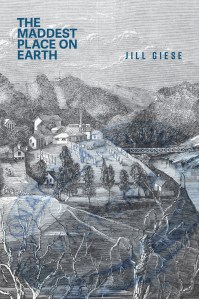
‘The Maddest Place on Earth’ by Jill Giese

Giese_The-Maddest-Place-on-Earth

2018, 220 p.

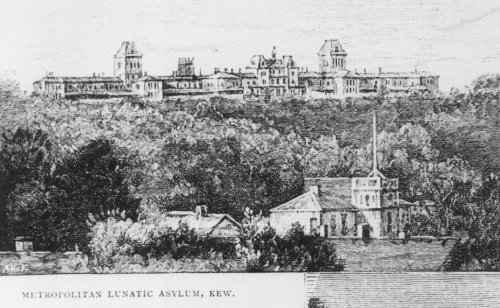
In the Epilogue of this book, clinical psychologist and author Jill Giese  writes that she jumped at the rare opportunity of an Open Day at Willsmere, the site of the old Kew Asylum. A little girl asked in that unfettered way that children do, ” If they were all crazy, why did they build them such a nice place to live?” As Giese notes, the most (and increasingly) visible sign of mental illness today is people lying on the streets of Melbourne, wrapped in blankets, begging for small change. Interestingly, it was the urge to give mentally ill people a shelter – an asylum- from the homelessness and penury of living in a blanket, that led to the construction of first the Yarra Bend Lunatic Asylum, and within six years, the construction of Kew Asylum, the first purpose-built asylum in Victoria. Both institutions – though plagued with overcrowding – were not established as the ‘Bedlam’-type places of horror that we might assume them to be.

KEWdraw

English: Engraving of the Metropolitan Lunatic Asylum, Kew. Buildings of Yarra Bend Asylum are seen in the foreground. c 1880. Source: Wikipedia

Victoria had what was perceived to be the highest level of mental illness in the world, hence the title “The Maddest Place on Earth”. In fact, at one of the numerous Royal Commissions held into asylums in Victoria during the 19th century, it was predicted that by 2050 every inhabitant of Victoria would be mad. A number of reasons were put forward: our meat-rich diet, the climate, the effect of the Gold Rush, excessive masturbation (although why Victorians would be especially prone to this was not explained) and the success of the Salvation Army in turning people’s minds to God.  Perhaps a better explanation was the “imported insanity” that arose from families ‘back home’ shipping their mentally-ill family members off to the colonies to avoid the scandal of madness. The Gold Rush could have both attracted and elicited madness in men who threw in everything to travel to the other side of the world, with failure more likely than success.

Giese tells the story of the Yarra Bend Asylum and the Kew Asylum but this is not your usual institutional history. Instead of taking a top-down approach, she uses  two main characters as the lens through which to view the asylum system in Victoria. Her first character, George Foley, was the son of an eminent artistic family in England. He suffered his first episode of mental illness while in art school, and suddenly “found himself” on a ship headed for Melbourne. He moved in and out of Yarra Bend and Kew Asylums, continuing to draw while incarcerated, and trying to hold together a precarious artistic existence when he was “outside”. The second character was journalist  Julian Thomas who, working under-cover as a ward attendant, wrote a series of columns for the Argus under the pen-name of “The Vagabond”.  He writes vividly and with humour, every bit the equal of a Mark Twain, or a nineteenth-century Louis Theroux.  Julian Thomas is well-known to historians of Australian (and particularly Victorian) history, but I hadn’t read his work before, and obviously Giese herself – a psychologist herself, rather than a historian-  was delighted to discover him for the first time.

Through George Foley, we catch a glimpse of the sharp edges of the itinerant artist’s life, even for a man clutching the slender thread of family reputation. At a time when there was no treatment for mental illness, he would be housed, fed and given meaningful work while in the asylum, only to flounder once he was released to his own resources again. He drew portraits of personnel within the asylum, including ‘The Vagabond’, who used a touched-up version of the portrait when he finally revealed his identity.  Through ‘The Vagabond’ we learn of meal-times with poorly cooked food, the dissonant music of the asylum band at the fortnightly balls held for inmates and staff, and the brutalizing effects of institutional life on the Kew Asylum attendants in particular.

Right from the establishment of Port Phillip, the presence of mentally ill people on the unmade streets of Melbourne was noted. Until the changes in asylum practice encouraged by the Quakers in the early 19th century in England, asylums had been dire places. Based on the new philosophy that asylums for the mentally ill should be built out of town, on hills in the fresh air, Yarra Bend quickly outgrew its construction in 1848 and was soon surrounded by a mosaic of cottages and even tents. The nearby Kew Asylum was opened in 1872 in a much grander E-shaped Italianate building,  Within five years Kew was the subject of a Royal Commission, which found overcrowding, disease and mistreatment. This was largely caused by a change in the criteria by which patients could be admitted to a ‘lunatic asylum’, which swelled the numbers of mentally ill patients with chronic patients with intellectual disabilities or dementia.  Despite the grandness of Kew Asylum, Yarra Bend stayed largely unchanged with its small cottage structure and more domestic, less institutionalized approach.  As Giese points out, Yarra Bend (despite its age and comparative neglect) came to be seen as the better model for dealing with mental illness with features like shelter, home-cooked food and meaningful, routinized work, that our mental health system could well emulate today.

Giese’s decision to use Foley and the Vagabond as her focus – one a patient, the other a staff member- is inspired. It would have been easy to have taken a patchwork approach, with small stories and vignettes stitched together into a fairly conventional institutional history, but for most of the book she avoids this methodology.  While she also traces through the career of Edward Paley, Inspector of Asylums, and recounts the numerous commissions of enquiry that, as too often happens today, masqueraded as action in themselves, she maintains her gaze on two individuals.  As a reader, you become invested in these two men. You read with a sinking heart of Foley’s struggle for mental stability and you see through the eyes of The Vagabond, in lengthy italized extracts from his columns.  Moreover, The Vagabond, too, has his secrets as Giese discovers at the end of the book.

This book won the Victorian Premier’s History Award for this book, and it fully deserves it. It is beautifully written, although perhaps a little fervent at times, and it is a deeply compassionate book. By foregrounding the long-term experience of George as patient, the Vagabond as attendant and journalist, and to a lesser extent Dr Paley as administrator, she gives a human face to mental illness as a lived experience. It’s a wonderful read.

My rating: 10/10.

Source: review copy from Australian Scholarly Publishing

AWW2019 I have included this book in the Australian Women Writers Challenge.

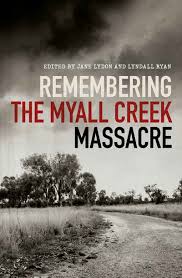
‘Remembering the Myall Creek Massacre’ ed. by Jane Lydon and Lyndall Ryan

myallcreek

167 p. & notes, 2018

The name should have been a give-away. “Myall” was an old term for “aboriginal” and it was to be expected that any outback station called “Myall Creek” would have – or used to have- a noticeable indigenous presence. Late in the afternoon of Sunday 10 June 1838, eleven armed stockmen, most of whom were expired or convict labourers, rode into Henry Danger’s Myall Creek station near Invernell in north-east New South Wales. Henry Dangar himself was absent; as were the overseer and senior stockmen. The stockmen dismounted and entered a hut where they brought out about thirty Wirrayaraay old people, women and children who had sought refuge there on hearing the stockmen ride in. They led them out, tied with a leather strap, and took them away. Shots rang out; then the stockmen rode away. They returned the next day to burn twenty-eight bodies.

It was an appalling crime, and we know about it because the perpetrators actually faced court, and seven white men were hanged. The massacre itself was not exceptional: massacres had occurred prior to Myall Creek, and they continued afterwards. But the case was marked with controversy,  both from observers appalled by it, and squatters and settlers outraged by its legal consequences. It was the last time in the nineteenth century  that  white perpetrators of frontier massacres were convicted and hanged.

In 2000 a permanent memorial was erected at Myall Creek. Eight years later the Myall Creek Massacre and Memorial Site were added to the National Heritage List. This book, comprising a number of essays by both indigenous and non-indigenous authors, was published for the 180th anniversary. The academic historians represented here – Lyndall Ryan, Jane Lydon, Anna Johnston and John Maynard –  are all well-respected within the academy. The earlier chapters focus on the massacre event itself.  The final three chapters focus on Myall Creek within the songlines and trading networks of indigenous groups the length of the east coast of Australia and tease out issues of memorialization and reconciliation. The book evokes the harshness of distance and the impunity it confers in Warwick Thornton’s film Sweet Country, even though that was set in a different place some eighty years later.

If you’re not familiar with the Myall Creek massacre, you will be by the time you finish this book, which gives a clear account of the event and the men involved. I did know about it – my own Judge Willis was bobbing around in the background as one of the members of the NSW Supreme Court, but I have been guilty of the “failure of imagination” that Paul Keating spoke of in his Redfern Speech.  This book shows that it was all there: unarmed, defenseless, frightened old women and children; white onlookers too intimidated to intervene; wide distances adding a sense of menace, and averted eyes that cloaked these stockmen with the arrogance of impunity.

In Chapter 1 Lyndall Ryan focuses on Henry Dangar, the absentee owner of the Myall Creek station, who chose not to support his employees who reported the crime. In Chapter 2, Patsy Withycombe points out that the ringleader, John Fleming, was the only one of the eleven stockmen who was not a serving or former convict, and he escaped punishment altogether, protected by local squatters. In Chapter 3, Jane Lydon places the international and humanitarian response within the anti-slavery context of the 1830s, focussing particularly on the widely circulated engraving of the prologue to the massacre titled ‘Australian Aborigines Slaughtered by Convicts’ by ‘Phiz’, better known for his illustrations of Dickens’ Pickwick Papers. Chapter 4 looks at the more local response where Anna Johnston examines Eliza Hamilton Dunlop’s poem ‘The Aboriginal Mother’ published in December 1838 and later put to music by Isaac Nathan in 1842. In Chapter 5 Lyndall Ryan asks of the massacre “Was it typical of the time?”. Building on her work on the Massacre Map, she points out that it was. All the perpetrators had been involved in other massacres. It was not unusual for incidents to take place in daylight, or be led by a settler. It was not unusual to tie the victims together and lead them to the site where they would be slaughtered, or burn their bodies afterwards. Such atrocities have their own sickening rhythm and recurrences.  Chapter 5, which has multiple authors, links the Myall Creek massacre with another massacre at the Wonomo waterhole, and argues that trade networks and songlines made it possible for different aboriginal groups along the eastern coast of Australia to be forewarned of the struggle which would soon extend to their area too. Chapter 6 ‘Myall Creek Memories’ is a reflection by John Maynard on being asked to give the commemorative address- the first by a non-indigenous historian – in 2015. Chapter 8 co-written by Jessica Neath and Brook Andrew is a compilation of interviews with advisors, architects, academics and scholars of cultural memory, over the question of how Myall Creek should be memorialized (if, indeed it should be) and its relation with other memory-sites related the Holocaust and Genocide. The book is framed by a prologue by Sue Blacklock and John Brown who worked on a reconciliation and covenant relationship between the Uniting Church and ATSI people in 1992. It closes with Mark Tedeschi’s QC’s address delivered in 2017, both as Chief Crown Prosecutor for NSW and the author of his own more legally-oriented account of the massacre and its legal aftermath.

This is an excellent book. The chapters are engagingly written, and if the chapter by Jessica Neath was perhaps a bit tedious in its format, it raised some interesting questions. It makes me wonder: will I live long enough for Australians and their governments to have the maturity and humility to look at the white settler past, and actually do something about an honest recognition and reconciliation that must come one day?

AWW2019

I have included this book in the Australian Women Writers Challenge 2019 database.

‘The Presbyterian Church of Victoria: Growth in Fifty Years 1859-1909’ by D. Macrae Stewart

PresJubilee

1909, 129 p.

This book was written to celebrate the golden anniversary of the creation of the Presbyterian Church of Victoria in 1859, combining the Synod of Victoria, the Synod of the Free Presbyterian Church of Victoria and the Synod of the United Presbyterian Church of Victoria. There was one section of the United Presbyterians who didn’t join until after 1870, but in terms of golden jubilees, 1859 was the date. (Mind you, the earlier book I read about Presbyterianism in Victoria dated the coming together of different strands of Presbyterianism to 1867 instead.)

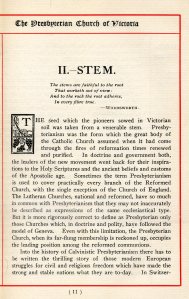
Written as a celebration publication, the text is laid out quite beautifully, with red margins and decorated inhabited initials to mark the start of each chapter. Stewart has used a planting metaphor to organize his chapters, which are titled ‘Seed’ ‘Stem’ ‘Branching’ ‘Pruning and Grafting’ etc.

As this book goes up to 1909, it covers the Charles Strong controversy of the 1880s, which of course had not occurred when Sutherland published his earlier history of the Presbyterian Church in 1877. Charles Strong, who had been the pastor of Scot’s Church in Melbourne (probably the premier Presbyterian church in Melbourne)became the first minister of  the Australian Church in 1885 after being charged with  promulgating unsound and heretical doctrine and resigning his position from Scots Church.  I think that if I’d been alive at the time, I would have been attracted to the Australian Church.

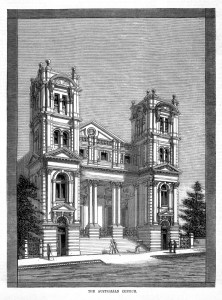
the australian church.

The Australian Church at the eastern end of Flinders Street (near Spring Street). It seated 1200 and opened in 1887 but the Church shifted to more economical premises in 1922. The Australian Church was finally dissolved in 1957. From the Australasian Sketcher. SLV http://handle.slv.vic.gov.au/10381/258170

The book has several plates showing prominent churchmen, mainly of the past but with some contemporary men (in 1909) as well. So many beards!  There are few mentions of women, but there is a section on the Presbyterian Mission Womens Union, famous for its cookbook. I only now realize that I always called it the PWMU rather than PMWU.

The book is curiously silent about the 1890s depression. Perhaps in 1909 it was too soon to discuss such things.

Putting a price on dispossession

highcourt

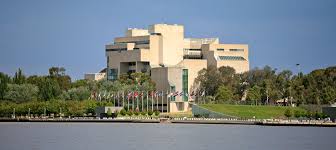
Today the High Court of Australia will begin hearing a case that will consider the question of compensation for the loss of traditional land rights. This article in The Conversation explains it well.  According to the article, it’s an appeal case following two earlier decisions made by the Federal Court on the first compensation claim since the passing of the Native Title Act.  In the first of these decisions (the first Timber Creek decision) Federal Court Justice John Mansfield developed a methodology for working out how much money should be awarded as compensation for loss of native title rights. It had three steps:

  1. The value of land rights in plain economic terms, discounted by 20% because native title often brings constraints on how the land can be used economically
  2. How to compensate for the loss of  non-economic aspects of the land’s value e.g. spiritual and cultural harm (What a question! Where would you start?)
  3. Interest to award the passage of time (in this case back to the 1980s when the Northern Territory government granted land and undertook public works near Timber Creek)

The decision was appealed and the amount of compensation reduced, but the methodology for working out compensation was not challenged. But will the High Court follow the same methodology? It’s an interesting article- well worth a read, with good links.

Friday essay: the ‘great Australian silence’ 50 years on by Anna Clark

https://theconversation.com/friday-essay-the-great-australian-silence-50-years-on-100737

An excellent essay in The Conversation by historian Anna Clark reflecting on WEH Stanner’s 1968 Boyer Lectures where he coined the term ‘the great Australian silence’ to describe the occlusion of indigenous people from narratives of Australian history. Her essay comes fifty years after those essays, but also in the contemporary context of the political response to the Uluru statement and  Lyndall Ryan and others’ work on the massacre map.

I encourage you to read it.