Author Archives: residentjudge

‘Lawless Harvests’ by Alex Castles

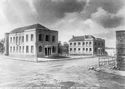
hobart-jail

2003, 209 p.

As a primary school child in the 1960s, there were certain stationery items that your parents had to buy for you each year.  They always had to buy two HB pencils and a red-lead pencil that would kill you if you sucked the end of it (surely not?).  There was the 12-pack of Cumberland pencils that always looked insipid and cheap against the 24-pack Derwent pencils that the luckier kids had, with that brilliant aqua and lush bright green that even now gives me pleasure.   There was the pack of Greyhound Dry Pastels that went unopened all year until they crumbled to dust in your desk.  And then there was the plastic stencil map of Australia, with the states marked out with a thin line except for Victoria, where the boundary with NSW seemed to inexplicably dribble out into a series of dots on the right hand side.

It must have been a source of much chagrin for school children on the Apple Isle (Tasmania) to realize that their own state was left off the map.  No doubt having the little island dangling below Victoria added a level of complexity and expense to the manufacturing task that was not worth the effort.  And so, if you remembered Tasmania at all, you had to hand-draw it, down below Victoria somewhere.

Yet when looking at Port Phillip in the 1840s, one is struck by the dominance of Van Diemens Land on the new settlement.  George Town at the mouth of the Tamar River was much closer to Port Phillip than Sydney, 600 miles away.  Trade was frequent between Hobart, George Town and Port Phillip, and it was largely the scarcity of  available land after a heavy bout of land-grant activity in the late 1820s/early 1830s that drew men’s eyes northwards across Bass Strait.  Just as men and stock meandered down from the settled districts of New South Wales, so too did ship after ship from Van Diemens Land disgorge sheep that moved into farms throughout the Port Phillip district.

New South Wales dominates our awareness of early colonial Australia, but Van Diemens Land runs alongside it as a parallel but separate colonial entity.  Although the NSW Governor was officially Governor-in-Chief,  from 1825 onwards he played no active role in the administration of Van Diemens Land. The Van Diemens Land Lieutenant-Governor styled himself “His Excellency” (suggesting that there was no immediate superior) rather than the “His Honor” title that he had used up until this date, and the Tasmanian Supreme Court, officially proclaimed on 31 March 1824 was a separate entity in its own right rather than an arm of the Supreme Court of New South Wales as Judge Willis’ Port Phillip court was.

Alex Castle’s book, published posthumously in 2003 tells the story of the Van Diemens Land legal system.   The book had its genesis in a plan by the Law Society of Tasmania in 1985 to commission a history of the legal profession in Tasmania.  Professor Alex Castles from Adelaide University offered to write it, with a view to publication during the Law Society’s centenary year in 1988.  But only 3 chapters were written at that stage, and focus shifted to the 28th Australian Legal Convention to be held in September 1993.  By May of that year, twelve chapters had been completed and the final chapter was in draft form.  However it was never editted sufficiently for publication and the manuscript remained unpublished in a filing cabinet.  In 2003, after the death of Professor Alex Castles, the Law Society remembered the part-completed manuscript, and engaged its librarian to retrieve the text, and Dr Stefan Petrow to edit it, write an introduction and epilogue and compile a bibliography, as the text itself does not have footnotes.

In his introduction, Stefan Petrow discusses this book in relation to Castles’ other work, particularly his pioneering textbook 1971  ‘Introduction to Legal History’.  In this textbook, Castles concentrated on the English influences on the Australian legal System but Petrow detects  a movement in Castles’ work in later years that acknowledged local variation, particularly in frontier legal environments.  I wonder if Castles had written the introduction himself,  how he would have addressed himself to this question.

This book traces through the earliest legal steps in Van Diemens Land, which are hard to recover because the papers were burnt on the evening of  Lieutenant Governor Collins’ death- possibly to obscure legal decisions made during his time of office.   Collins’ successor Davey was completely out of his depth, and it was William Sorell, the next Lieutenant- Governor who reordered local affairs.  But the main focus of the book is on Lieutenant George Arthur and his devolution of power to himself, with the acquiescence of his fellow-Tory Supreme Court judge Pedder.   Castles credits Sir John Franklin (yes,  the villain of Richard Flanagan’s Wanting) with introducing the legal changes resisted for so many years by Arthur.  He traces through the amoval of the puisne judge Algernon Montagu and the attempted amoval of Pedder by Franklin’s successor Denison over the taxation-like nature of the Dog Act-  the same process of amoval (but for different reasons) which finished off Judge Willis’ career.

One thing that I very much appreciated in this book was the way that each chapter started anew with a little vignette or anecdote that piqued the reader’s interest anew.  He finished each chapter a similar way too, often returning to the episode with which he opened the chapter.  In between things got a little turgid, with a very ‘top-down’ perspective running throughout, but the openings and closings of each chapter remedied this.  I’m not sure that Castles himself would have finished the book with the what-happened-next epilogue that Petrow wrote-  the book suffers from the lack of a strong, argumentative final chapter.  However, it would have been beyond the ethical and editorial demands on Petrow to have written anything beyond what he has done.
‘Human Smoke’ by Nicholson Baker

nicholson

2008, 474 p + 53 p notes

I hadn’t heard anything about this book, or its author for that matter, until I heard an interview with Nicholson Baker on Radio National’s Book Show.  It was quite clear that he was speaking as a novelist rather than an historian, and yet he said a couple of things in the interview that resonated with my own research and narrative problems that I’m grappling with.

I wish the interview were still available or a transcript saved, but neither of these is available. From the brief notes I took during the interview, he said something like the following:

1. Find the hero in your story.  This is something that I’ve been struggling with.   I don’t consider the subject of my story- Judge Willis- to be a hero: in fact,  I don’t think I like him much at all.  So who is my hero?  Whose voice and worldview  do I trust?  Of the colourful cast of players on the Port Phillip stage in 1841-3, I’d go for  Superintendent La Trobe, I think, in spite of (or is it because of ? ) his insecurity, his anxiety, his concern not to be hasty or judgemental.

Or is the endeavour to find a hero anti-historical in itself?  In our search for a ‘hero’, are we only responding to those from the past who display elements of a 21 century sensibility that we recognize as kindred spirits.  What about the men of their time who are thoroughly imbued with attitudes of deference or unruffability that we find unacceptable today?  Or are we looking for a common humanity beyond this?   Inga Clendinnen, in her Dancing with Strangers introduces the writers of the First Fleet journals she is basing her work on, and shares with us her own emotional responses to her informants’ writing:

Jane Austen exclaimed that her naval-officer brothers ‘write so even, so clear, both in style and penmanship, so much to the point, and give so much intelligence, that it is enough to kill one’. In her novels she allowed herself to become positively girlish in her effusions of admiration for naval men like Fanny’s brother William or Anne Elliot’s Captain Wentworth, and quite lost her characteristic irony when she considered the nobility of their profession.

I confess that as I read John Hunter’s journal I felt something of the same flutter.  I liked what he said and I liked his silences too.  (p 37)

and in relation to Watkin Tench:

He is one of the handful of writers who are an unshadowed pleasure to meet on the page.  Through that familiar miracle of literacy where pothooks transform into personality, it is not so much his information as his presence which delights us.  His parents are said to have run a dancing academy, and it is tempting to think that their son’s grace on the page has something to do with a melodious, light-footed upbringing.  He has the kind of charm which reaches easily across centuries.  If he lacks Montaigne’s intellectual sophistication and unwavering moral clarity, he shares with him the even rarer quality of sunny self irony. (p. 57)

I think that a historian does adopt a stance towards her informants.  It’s not that you suspend criticism or disbelief, but there are some informants who have you rolling your eyes and inwardly groaning “Here we go again“; or conversely who make you sit up and think “Now what makes you say that?”

2. Sometimes what’s written in the papers is more true than what you’ll find in “secret” archives. Leaving aside the whole issue of “truth”, I’ve been thinking about the issue of temporal change and temporal persistence for some time.  And I’ve also been reading newspapers very, very closely, watching how a controversy builds, subsides, lingers, re-emergences- a sort of time-lapse examination that is elided when taking a purely thematic approach.  In my own research into Judge Willis, there were issues that  niggled month after month; there were personality clashes that played out in different contexts over time.  There were false rumours, there was bombast and exaggeration- and as Nicholson Baker pointed out, the actors themselves were reading (and contributing) to this media construction of events each morning too.

So what has Nicholson Baker done in this book?

I was interested to note that the book was catalogued with a 940 Dewey number in the university library, and lists its subjects heading on the edition notice page as” 1. World War, 1939-45- Causes  2. Jews- Persecutions- Europe-History.”  Yet the book starts abruptly in August 1892 and ends on New Years Eve 1941.  It is a series of snippets, many taken from the  New York Times,or diaries or memoirs arranged chronologically, each one a page or less in length,  separate and disembodied from the preceding one and  surrounded by much white space on the page.  There are no chapters, no commentary, no debate, no authorial interjection.  There is a long series of  sources at the end of the book.  And that’s all.

And yet the author is very much there.  His selection of the closing days of 1941 (immediately post-Pearl Harbour) reflects his American worldview, and there is a degree of artifice in treating newspaper articles written in real-time with memoirs written after the event.  He has found his heroes: Gandhi, pacifists, Stefan Zwieg, Victor Klemperer.   He’s found his villains too, and you can almost hear his sharpening his knife. He selects his events without a stated rationale, but with solid intent:  the anti-semitism and blood-lust of Churchill, Britain’s food blockade of Europe,  the testing of chemical weapons in the Middle East,  America’s refusal to take Jewish refugees, the insistent voices of pacifists throughout the war, the commercial entanglement of America in the war through supply of technology, planes and arms,  America’s goading of Japan to enter the war.  Even though he presents these as snippets,  there is an argument here: an argument that debunks especially Churchill but also Roosevelt; that blurs the line between the “good guys” and the “bad guys”;  that has a whiff of moral superiority in relation to the pacifists.  You are very much aware that it is written with a  post-9/11, post-Iraq sensibility.

Inga Clendinnen also had this to say in Dancing with Strangers:

It is a commonplace rediscovered every decade or so that individuals see what they see from their own particular perspective, and that perspectives change through time.  These disenchanted days we know that there are no I-am-a-camera  observers, and we also know that even cameras lie.  This recognition has not stopped would-be historians from piecing together snippets derived from a range of narratives, perspectives and sensibilities in chronological order, and  calling the resulting ribbon patchwork ‘objective history’. (p. 12)

Nicholson Baker has done exactly this- pieced together snippets derived from a range of narratives- and has reworked them into an almost formulaic vignette, often ending with the date “It was 15 March 2009”.  There’s a flatness of tone, a disembodiment that is unnerving and yet oddly compelling too.

Many historians and academics hated this book.   John Lukacs (who has written several books on Churchill) didn’t hold back : “This book is bad”.  Louis Menand (who wrote The Metaphysical Club) writes:

Baker is trying to eliminate the historian’s interpretive gloss in the interests of respecting the rawness of the primary experience. He seems to think that the facts speak for themselves. But facts never speak for themselves. We speak for them. The historian’s gloss matters (not to mention all the facts that are left out): it provides the reader with intellectual traction, an ability to weigh the claims being put forward to justify the selection of facts. Baker’s presentation may seem empirical—these things happened, you can look them up, no varnish has been applied—but the effect is entirely emotional, because there is no nesting argument, no narrative, to give events a context. It’s a tabloid technique: a six-word quotation or a single image is all you need to understand any issue. The pretense of no manipulation is completely manipulative.

A. C. Grayling was less critical, largely because he agrees with Baker’s intention and argument, rather than his methods.  Dominic Sandbrook likewise, approved the endeavour  but excoriated the methodology

In the end, then, its unorthodox style cannot compensate for the basic mendaciousness, even fraudulence, of this extraordinarily self-righteous book. In my student days, I was taught that a historian should aim to represent the past as fairly and honestly as possible. Of course opinions matter; there is nothing duller than a history book without an argument. But by presenting us with such skewed and partial material, Baker gives us a book that cheapens the serious moral arguments he tries to make. Whatever its merits as a work of literature, as a work of history it is virtually worthless.

So, among such exalted and vociferous opinion, what do I think?  I’m not a WWII historian, so I cannot dispute the facts as, say, Lukacs does.  This book has a broad sweep- not unlike a searchlight scanning the skies- lighting up India, Iraq, even Bob Menzies has his moment in the spotlight.   It represents a slow unfurling of events, rather than a shaped and honed argument.  I found it more compelling than I would have expected- we do, after all, know how it all ended.

But I am wary of something that purports to be “just the facts” and there is a dishonesty about the deliberate absence of the author- he’s there alright, it’s just that he’s pretending not to be.

Some figures

The other day I was reading through the Votes and Proceedings of the Legislative Council for the 1840s (as one does) , and looking at the Statistical Returns for 1834-43, which were printed in June 1844.

There I found a table of the official figures of whites killed by Aborigines, and conversely, Aborigines killed by whites for the district of Port Phillip.  These are, of course, the ridgy-didge “official” figures- the sort that Keith Windschuttle in his Fabrication of Aboriginal History upheld-  with all that entails.

WHITES KILLED BY ABORIGINES PORT PHILLIP.

1836 2
1838 12 10 + 1 +1
1839 3
1840 11
1841 6 + 2 The two were murdered by the Van Diemen’s Land blacks
1842 4
1843 1
1844 1

Total: 40

NATIVES KILLED BY WHITES.

1836 1
1838 16
1839 8
1840 67 30 by the Whyte Brothers- rests on Aboriginal evidence. 10 in Grampians by Messrs Wedge, depends partly on Aboriginal evidence
1841 10 Based on statements by Aborigines
1842 6 4 at Smith and Osbrey’s station – great investigation and 3 persons tried and acquitted
1843 3 In one event at Mr Rickett’s
1844 2

TOTAL 113

I’m surprised that the figures are so low on the white side.  Given the heightened anxiety and dread expressed by settlers on the frontier, I’m surprised that there are not more white deaths.  However, many attacks involved property loss- particularly the hacking and killing of sheep- and given that stock (rather than the ownership of land) formed the basis of wealth in this pastoral squatting society, these attacks were property crimes that struck at the heart of the settlers’ financial viability.   The low figures on the aboriginal side are more to be expected. The figures for black deaths had to be corroborated by white evidence.  There was little to be gained in reporting an aboriginal death.  If  an aboriginal was  “said to be” killed, on aboriginal evidence only, then it was not counted.  You’ll note the qualification of  “based on statements by Aborigines” in the third column.

The statistics for whites killed show that overwhelmingly these deaths occured among hutkeepers, shepherds and servants.  These men were isolated, often far from the homestead (such as it was),  far from surveillance and likewise far from assistance.  They were also often assigned servants or ex-convicts.  Only four of the 40 were designated as “Mr —“, and only one was categorized as a settler.

The large spike in both white and native deaths in 1838 was because of the six-hour pitched battle that took place on Faithful’s station near Benalla, in retaliation for the massacre of 10-14 of Faithful’s workers (the official figure shows 10; Faithful claims 14).  I quoted Faithful’s description of the retaliatory battle  in my post on Letters from Victorian Pioneers.

I find it interesting that the Whyte brothers are named so openly here, and in the Letters from Victorian Pioneers.    The aboriginal deaths in 1840 around Whyte’s station in Coleraine came to be known as the Fighting Hills Massacre.  The Whyte brothers reported the attack themselves.  No charges were ever laid.

The trial of the men charged with the aboriginal deaths at Smith and Osbrey’s station occurred right at the point when Judge Willis was dismissed as Resident Judge.  The murders had occurred in February 1842 and a 50 pound reward was offered, later increased to 100 pounds with a free pardon and a free passage to England if the informant was a transported convict.  Nothing was heard, until a transported ‘bush carpenter’ employed at the station reported a number of men for the murder in May 1843.  Three men- Hill, Beswicke and Betts were committed to trial and it was, in fact, this case that Judge Willis was hearing when the court was interrupted by the serving of the Executive Order for Willis’ amoval.  Justice Jeffcott, who was Judge Willis’ replacement, took over the trial and the men were acquitted.  Gipps privately wrote to La Trobe that if he had been on the jury, he would have committed at least two of the three men, but Jeffcott was “not dissatisfied with the verdict”.

References:

Richard Broome Aboriginal Australians pp.40-48

A. G. L. Shaw The History of the Port Phillip District p.  114,130,138

Paul R Mullaly Crime in the Port Phillip District p.290-297

Museum Victoria: Encounters  http://museumvictoria.com.au/encounters/journeys/Robinson/Fighting_Hills.htm

Bride Letters from Victorian Pioneers

Votes and Proceedings of the NSW Legislative Council

Letters from Victorian Pioneers (or “It wasn’t me Guv’nor, it was him”)

victorian_pioneers

When Lieutenant-Governor La Trobe sailed home  for England on 6 May 1854, he carried with him a series of letters which he hoped to use when writing a history of the Port Phillip district in his retirement.  He had officially approached a number of the early pastoral pioneers and asked them a number of questions, and as you might expect, they answered his survey letter fairly promptly.  I’m not sure what the official letter said-  one of his respondents referred to a section that asked  “If preceded, accompanied or immediately followed, by whom and when, and the general state of the district around and in advance of me at that period.”  He obviously also specifically asked about encounters they had had with aborigines in their area, and their opinion of the future facing the aboriginal tribes.

He had big plans for these letters.  He intended his book to start with Captain Cook’s discovery of the Gippsland coast, then move to the early futile attempts at settlement.  It would then go on to record the effective colonization of the region by pastoralists, ending with the discovery of gold in 1851.  Part II would deal with the geology, botanty and zoology of the land; the aborigines and the human aspects of the spread of settlement.  He would then pass on to separation and the consequences of gold discovery, where he would rebut the criticisms that had been levelled against him for his administration of the gold fields.  He would then finish with ‘My Australian Home, a walk around my garden’.  (Gross, p. 131)

It was not to be.  He was increasingly afflicted with blindness, and realizing that he would never write this book, he returned the letters to Victoria in 1872 , where they were preserved in the public library.  Times had moved on: people were ‘moving forward’ then too, and not all that interested in the preceding generation. It was not until 1898 that the 58  letters were published by the Trustees of the Library under the name ‘Letters from Victorian Pioneers’.

Because they were responding to an official request with guiding questions, there is a sameness about the responses of his correspondents.  But there’s also quite a bit of similarity in their experiences as well, which is what I expected.  In fact, my impetus for reading this book was the suggestion in Robert Redfield’s book that people living in a small community often held a common biography.  Even though Redfield specifically states that his approach does not hold for frontier communities (which of course Port Phillip was), I was interested to see if the early pastoral settlers of Port Phillip could be said to have a common life story.

And yes, they could.  All his respondents were male, and many of them were young when they settled in Port Phillip- usually in their early to mid 20s.  Many of them came over from Van Diemens Land  from where they had initially emigrated (none admits to convict origins).  Many of them had brothers with them.  And they held in common sheep and cattle– hundreds and hundreds of them, trotting along, being slaughtered by marauding natives (and  what a dispiriting and expensive loss of life that must have been), moving from run to run.  Some time ago I read Roger McDonald’s book  The Ballad of Desmond Kale, and was frustrated by the sheep-sheep-sheep  emphasis of it, but sheep-fever is amply demonstrated here too.  It’s not as exotic and alluring as gold, but the sheep-rush  obviously drove the early settlers of Port Phillip.

They all mention the 1840s depression- although one canny Scotsman seems to have escaped it because he had savings still in Van Diemens Land.  There are names of landholders that spring up again and again- obviously big stockholders held land in several districts.  Many of them moved from station to station.

Some of them were quite observant about the changes wrought on the land after settlement.  Several mentioned that it was very dry when the area was first opened up, and that the rainfall had  improved in the last few years of the 1840s, drawing later settlers to land that had seemed uninviting when the first settlers passed it initially.  One or two mentioned changes in the grasslands, and some were quite nostalgic for the beauty of the unsettled areas.

Most fascinating of all was the range of responses to the question about aborigines.   Most of them knew of “other people” who had gone on shooting reprisals- as perhaps might be expected when the Lieutenant-Governor asked you such a question.  Several of them mentioned the Whyte brothers by name as being particularly responsible for aboriginal deaths, one respondent attributing 51 deaths to them compared with the official count of 30 aboriginal deaths.  A couple of respondents mentioned that they had shot aborigines in reprisal-  just one or two, mind you, and always because the aborigines started it first.   Another settler was named as responsible for several deaths, but he protested (too much?) his innocence. George Faithful of Wangaratta, however, reported quite openly his actions after suffering several attacks from surrounding natives:

At last, it so happened that I was the means of putting an end to this warfare.  Riding with two of my stockmen one day quietly along the banks of the river, we passed between the anabranch of the river itself by a narrow neck of land, and, after proceeding half a mile, we were all at once met by some hundreds of painted warriors with the most dreadful yells I had ever heard.  Had they sprung from the regions below we could have hardly been more taken by surprise.  Our horses bounded and neighed with fear- old brutes, which in other respects required an immense deal of persuasion in the way of spurs to make them go along.  Our first impulse was to retreat, but we found the narrow way blocked up by natives two and three deep, and we were at once saluted with a shower of spears.  My horse bounded and fell into an immense hole.  A spear just then passed over the pummel of my saddle.  This was the signal for a general onset.  The natives rushed on us like furies, with shouts and savage yells; it was no time for delay.  I ordered my men to take deliberate aim, and to fire only with certainty of destruction to the individual aimed at.  Unfortunately, the first shot from one of my men’s carbines did not take effect; in a moment we were surrounded on all sides by the savages boldly coming up to us.  It was my time now to endeavour to repel them.  I fired my double-barrel right and left, and two of the most forward fell; this stopped the impetuosity of their career.  I had time to reload, and the war thus continued from about ten o’clock in the morning until four in the afternoon.  We were slow to fire, and I trust and believe that many of the bravest of the savage warriors bit the dust.  (p. 220)

Several of the respondents noted that they had taken young aboriginal girls and boys to live with them, but that once they reached adulthood, their tribes came and took them away.   One settler commented that  he gave a baby back to its mother after he had taken it because the servant wasn’t prepared to look after it, and  seemed rather put out that she refused to give it to him a second time.  Several reported infanticide, especially where there was a white father and a black mother.  There were several allegations of cannibalism, although interestingly one settler reported that the aborigines thought that the whites were cannibals!

Where aboriginal deaths had occured, several claimed, it was because the blacks had become over-familiar.   White men didn’t take lubras, they claimed- the black men offered their wives to them freely.

Even amongst those who were most positive about the aborigines working for them on their stations, or their quickness and willingness to forgive, there was overall a deep sense that influenza, smallpox, VD or alcohol would decimate their numbers.  They all reported that there weren’t as many aborigines on their stations as there had been years earlier- strange that.

References

‘Letters from Victorian Pioneers: being a series of papers on the early occupation of the colony, the aborigines etc addressed by Victorian pioneers to His Excellency Charles Joseph La Trobe Esq. Lieutenant-Governor of the Colony of Victoria’. Edited with an introduction and notes by C. E. Sayers from the original edition edited for the Trustees of the Public Library by Thomas Francis Bride L.L.D during his period of office as Librarian of the Public Library of Victoria. (Phew!), 1969.

Alan Gross ‘Charles Joseph La Trobe, Superintendent of the Port Phillip District 1839-1851 Lieutenant-Governor of Victoria 1851-1854’. Melbourne, Melbourne University Press, 1956.

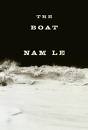
‘The Boat’ by Nam Le

theboat

2008,  313 p.

I guess when you’ve won a swag of awards and you’re working as fiction editor with the Harvard Review, then you’re no slouch.  And Nam Le is not.

This stories in this collection have been published before, in a range of different publications- Overland;  The Best Australian Stories; The Best American Nonrequired Reading 2007;  Harvard Review etc etc.  He’s had support from many places- The Iowa Writers’ Workshop; James Michener and the Copernicus Society of America (!) etc. etc.   He’s pretty much a product of the writing-as-career environment with its courses, its fellowships and  its prizes, I guess.

But boy, can he write!  I am not particularly fond of the short story as a genre- by the time I’ve relaxed enough to trust (or distrust) my narrator, the story comes to an abrupt end and I’m left dissatisfied.   But he so effortlessly  draws you into accepting the world view of the narrator than within a page or two I was hooked, with nearly every story in this book.  Not all, mind you, but enough to know that I’ve been in the hands of a master.

Normally I would say that if I’m aware of technique, then I haven’t been completely engaged.  But with him, even though I was thoroughly engrossed in the story itself, I’d find myself thinking “Gee he did that well”.  His dialogue always rang true; his descriptions captured a moment in time exactly; he handled time shifts effortlessly.

Even though I know that these stories were written at different times and published in different places, the first story acts as a background to them as a whole.   “..I don’t mind your work, Nam ” a fellow writing-student tells him, ” Because you could just write about Vietnamese boat people all the time.  Like in your third story…You could totally exploit the Vietnamese thing.  But instead, you choose to write about lesbian vampires and Colombian assassins, and Hiroshima orphans- and New York painters with haemmorrhoids.”

And so, he’s off: I didn’t find any lesbian vampires, but the rest are all there.  The first story sets up the idea of “ethnic story” (and I thought of Amy Tan here) and it’s as if he has decided to consciously smash that straitjacket.  The first and final stories are the “Vietnamese boat people” stories he has consciously avoided, but in between he channels Tim Winton’s surf and adolescent boys in the story  ‘Halflead Bay’ and perhaps even Kazuo Ishiguro in ‘A Pale View of Hills’  in  the story ‘Hiroshima’.   But this is not mere ventriloquism or homage:  each of these stories is his alone.  It’s as if he’s breaking out and saying- “there is no ethnic story- just story” and then he explores, plays with and moulds his story within yet another time, setting and context.

Is he as good as everyone says he is? You betcha.

1851 Black Thursday

The Royal Historical Society of Victoria is having its centenary this year.  One of the aims of the founders of the society was to capture the stories of the early colonists of Port Phillip before they died.  I was flipping through some of the earliest volumes of its journal, and it is impressive to see papers given by people at their meetings who had been here (albeit as children) right from the start of Victoria’s settlement- just think of it: they would have seen and met these people of Port Phillip that I’ve read so much about.

At the 25th June and 3rd September meetings of the society in 1923,  a paper was read called “Reminiscences from 1841 of William Kyle- a pioneer. Communicated to and transcribed by Chas Daley”.    I hadn’t heard of William Kyle and I know nothing more about the paper than just this.  William Kyle was born in Greenock, Scotland in 1832 and came out to Port Phillip as a child with his father.  The paper extended over two editions of the Victorian Historical Magazine and traced through his arrival, life in the country and in Melbourne pre-gold rush with some fascinating descriptions of Aboriginal life on the edges of what are now the inner-city suburbs of Melbourne, then right through to the latter years of the century (I’ll admit that I didn’t read the whole thing).

I was drawn to this description of Black Thursday of 1851, and perhaps to get yourself in the mood you should visit the State Library of Victoria page and have a good look at William Strutt’s painting.

And here’s how William Kyle remembered Black Thursday of 1851:

The floods of 1849, which were the result of a general rainfall throughout the colony, caused an excessively dense growth of vegetation, and much grass.  Little clearing had been done in the forests, and ring-barking trees was not yet in vogue, so that, after a very hot summer, the outbreaks of fire which swept throughout the land under the stimulus of a fierce hot wind caused the conflagration known as Black Thursday.  The fire spread with amazing rapidity.  Three-quarters of the colony was in a blaze.  The flames were so intense that trees two or three hundred yards away from the advancing wall of flame were shrivelled before the flames reached them.  In the unsettled districts there was little loss, but thousands of sheep and cattle succumbed.  The native game was almost annihilated.  The fire was so near Melbourne that the sky seemed to be a mass of floating fragments of bark and leaves ablaze with the intense heat.  Many people thought the Day of Judgment had surely come.  We could hardly breathe the stifling air.  The floating embers even set on fire some of the ships in the bay.

After the conflagration had exhausted itself the scene was one of intense desolation.  Nothing was visible but charred stumps and blackened smoking trees, bereft of all foliage.  No sound of bird, insect or animal was to be heard.  It was years before game was plentiful, and it was never so again near the settled districts after Black Thursday.  Fortunately, although there were the most wonderful escapes from death, there were not many human lives lost, owing to the sparseness of the population.

Sounds very, very familiar.

Reference:

Reminiscences from 1841 of William Kyle, a pioneer’ Victorian Historical Magazine, Vol X, Dec 1925 No 4.

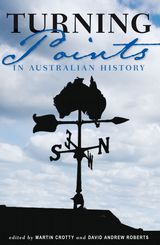
‘Turning Points in Australian History’ ed. Martin Crotty and David Andrew Roberts

turningpoints

2009, 254 p plus notes.

I would have loved to have been a fly on the wall for some of the concept discussions for this book, published by the University of New South Wales press.   It takes a similar format to a preceding volume by the same editors which looked at Great Mistakes of Australian history. I find myself wondering whether the editors themselves pitched the idea, or whether it sprang from a marketing initiative of UNSW Press.  For there is certainly an ambivalence about the whole endeavour as even the back cover  blurb indicates:

This exciting and stimulating book examines turning points and crucial moments in Australian history.  Rather than arguing that there have been forks on a pre-determined road, the book challenges us to think about other paths or better paths that might have led to different outcomes.  It shows that a decisive event often only becomes so only in retrospect and that what seemed like a major turning point at the time often had no real impact at all.

I’m not sure that the book is as conditional and ‘if only’ or ‘what if’ as the blurb suggests.  Instead, its chapters are structured as fairly straight narratives on a particular event with, except for two chapters (Chs. 1 and 13) , a specific month and year identified as the ‘turning point’.

1. 14000 BP. On Being Alone: The isolation of the Tasmanians by Iain Davidson and David Andrew Roberts

2. 26th January 1788: The Arrival of the First Fleet and the ‘Foundation of Australia’ by David Andrew Roberts

3. 19 June 1822: Creating ‘an Object of Real Terror’: The tabling of the first Bigge Report by Raymond Evans

4. 15 July 1851: Hargreaves Discovers Gold at Ophir: Australia’s ‘golden age’ by Keir Reeves

5. 16 August 1890: The Maritime Strike Begins: On upotia and ‘class war’ by Melissa Bellanta

6. 1 January 1901: Australia Federates, Australia Celebrates by Erin Ihde

7. 25 April 1915: Australian Troops Land at Gallipoli: Trial, trauma and the ‘birth of the nation’ by Martin Crotty

8. 10 June 1931: The Premiers’ Plan and the Great Depression: High politics and everyday life in an economic crisis by Erik Eklund

9. 27th December 1941: Prime Minister Curtin’s New Year Message: Australia ‘looks to America’ by David Day

10. 16 September 1956: ‘It’s here, at last!’ The introduction of television in Australia by Michelle Arrow

11. January 1961: The Release of the Pill: Contraceptive technology and the ‘sexual revolution’ by Frank Bongiorno

12. 27 May 1967: The 1967 Referendum: An uncertain consensus by Russell McGregor

13. 1970: When it Changed: The beginnings of women’s liberation in Australia by Susan Magarey

14. 26 January 1981 The Opening of the Australian Institute of Sport: The Government takes control of the national pastime by Brett Hutchins

15. I July 1983 Saving the Franklin River: The environment takes centre stage by Melissa Harper

16. 14 May 1986 Paul Keating’s ‘Banana Statement’ and the End of the ‘Golden Age’ by Ray Broomhill.

17. 26 August -11 September 2001: From Tampa to 9/11: Seventeen days that changed Australia by Robert Manne.

There’s some very familiar names amongst the historians here- they have been chosen well.  But in several of the chapters you sense a real ambivalence with the whole project.  The concept being written about often spills out of a chronological strait-jacket, and the selection of an arbitrary date obviously leaves several of the authors feeling quite uncomfortable.  More than one author questions whether it’s really a turning point at all, or whether the concept of a turning point is even valid or useful.   The editors themselves raise this question in the introduction, and in this radio segment about the book.

The chapters are fairly uniform in length, and while not formulaic, tend to follow a pattern of ‘what happened’ then some analysis of the aptness of the designation ‘turning point’ for the event in question.  With the exception perhaps, of Susan Magarey’s chapter, you don’t really get a sense of the distinctive writing style or methodology of the authors’ other work.  The frequent use of inverted commas (‘golden age’ ,’class war’, ‘sexual revolution’)  in many of the chapter titles reflects the rebuttal of popularly-received myths, images and understandings of the events described.

The particular selection of ‘turning points’ (or not) tells us just as much about 2009 as it does about the events under consideration.  I wonder if a similar book, written 50 years hence will feature the same events- I suspect not.  Many of the chapters discuss parallels between current events and the ‘turning point’, which of course adds to its appeal today and its quaintness tomorrow.

I find myself wondering who the intended audience is for this book- well, me for a start, I suppose.  The tenor of the book seems to have been written simultaneously to feed on, and yet resist, the ‘just stick to what happened’ continuous narrative genre that has become associated with John Howard’s attempt to rewrite the history curriculum for schools.  I enjoyed it in small grabs, a chapter here and a chapter there, much as I might read essays in a magazine.  I learnt things I didn’t know; I found myself curling a skeptical lip over the inclusion of some events at times (for example, on the Australian Institute of Sport chapter which, while making an interesting link with the Cold War, didn’t make a very convincing case for its inclusion as a ‘turning point’. ) It’s a bit like eavesdropping on an interesting conversation with informed, thinking people who have considered a phenomenon more deeply than you have, and are able to place an issue into a broader historical context.   The research is sound; the arguments are well-put but it is a book of its time, so read it now, while it’s still fresh!

Before the storm

Like millions of other Victorians, today I received a text message from the police.  It read:

Extreme weather in Vic expected Mon night & Tues.  High wind & fire risk.  Listen to  Local ABC Radio for emergency updates. Do not reply to this msg. End.

It is a very still evening, just as it was before the Saturday of the bushfires a few weeks ago. It’s hard to believe that the wind is going to spring up at about midnight tonight, and blow all day tomorrow until it changes direction at about 5.00 p.m.  There are large bushfires still burning from three weeks ago which, although contained, could well jump containment lines and take off again- to say nothing of any new fires that might spring up.  I think of my parklands, the plantings along our watercourses and rivers – we are all so very, very dry.

A friend of mine at choir tonight lives in Hurstbridge, surrounded by bush, with only one road in and out.  “Keep safe” we say as she leaves, knowing that she could be plunged into a nightmare tomorrow- or maybe not.  Leave early; activate your bushfire plans we are warned; prepare for gale force winds we are advised.

We are uneasy.

You know it’s dry when…

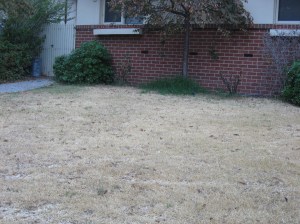
This is not actually a complaint.  There has been so much loss and sadness with the bushfires, and so much hardship with the drought that south-eastern Australia has suffered over the past decade, that it would be churlish to complain about lack of water in the suburbs.  This is more to document how everyday life has changed in Melbourne,  where the rainfall total for February has been 3.0 mm against against an average of 47.6 mm, with our overall rainfall for 2009 a mere 3.9 mm.

So, you know it’s dry when…

march2009-011

Your agapanthus-es (agapanthi?) look sick

march2009-020

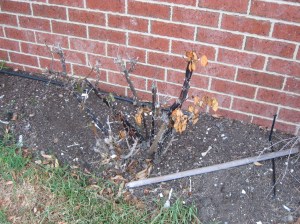
Your rose-bush is deadybones…

march2009-012

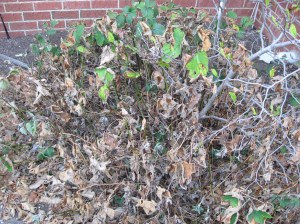
and your Japanese windflowers look decidedly worse for wear.

march2009-015

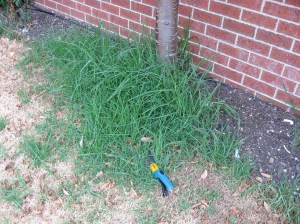
Instead of getting the lawnmower out, you cut the only bit of green grass with grass shears. The only reason this has grown is because it is under the weeping cherry…

march2009-021

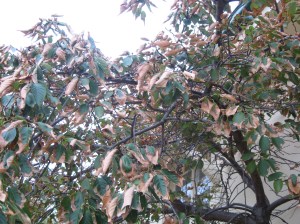
which has been burnt by the hot weather and is lovingly watered by…

march2009-022

the water collected in a bucket in the shower, while waiting for the hot water to come through. You will note the careful arrangement of this photograph in a vain attempt to avoid revealing the shower scurf on the tiles, lest you think my housekeeping is slovenly.

march2009-016

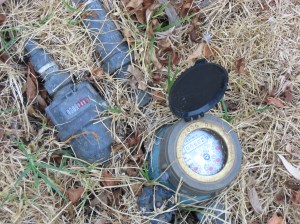
Reading the water meter on a Sunday morning has become a bit of a ritual…

march2009-023

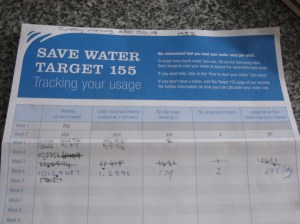
and the tension builds as the intricate computations show whether we have met the target of 155 litres per person per day.  We have!! with some to spare!!  Only 89 litres per day this week! Welcome home, daughter: your presence (and water entitlement)  makes my water consumption look respectable.

But is any of this water-dripping conservation really doing anything?  In a year or two will the government be happy for me to splosh around with their public/private desalination plant water to my heart’s content, with great expenditure of electricity, and my bank balance’s chagrin?

march2009-018

I have become truly pathetic, peeping through the blinds and skulking in what’s left of the shrubbery to catch and chastise the postman for running over my “lawn” with his motorbike, leaving trackmarks through the “grass”.

This is what I have come to.

Brigid Brereton ‘Law, Justice and Empire: The Colonial Career of John Gorrie 1829-1892″

brereton

1997

I’ve  often found, when I shut the covers after reading yet another colonial judicial biography, that however much I may have enlarged my understanding of a particular colonial official, there is still an opaque screen of inscrutibility about him.  There’s the judicial mindset that sees nuances and distinctions across all aspects of human interaction, and then it’s overlaid with the expectations and restrictions of the worldview of the early Victorian colonial gentleman.  Whatever humanity or common feeling the biography may have evoked, I’m left with the knowledge that the past is, indeed, as L.P. Hartley famously announced, a different country, and the people who lived there were of a different kind too.

However, this biography by Brigid Brereton, is different.  It came to me well recommended as an excellent example of judicial biography, and it is.   Perhaps it’s the choice of subject.  John Gorrie, the son of a dissenting United Presbyterian Church minister, took from his Scottish education and bar training an emphasis on philosophy, and working from first principles rather than the English reliance on case law- and indeed, though he worked for the Colonial Office all his professional life, was was not ever admitted to the English Bar.  This meant that he was well-placed for those colonies of the Empire where England took over from another European colonial power, where a pre-existing Continental system of justice  was already in place.  Hence his initial placement at Mauritius, the former Ile-de-France, which passed to Britain by conquest in 1810.  Here he worked under Governor Arthur Gordon,  who became confidante, friend and patron, and who was largely responsible for his second posting to  the newly-acquired British colony of  Fiji.  His experience with multi-racial colonies led to his final posting to Trinidad, which was enlarged to include Tobago.

Gorrie was not particularly interested in a judicial career, even though that is what he ended up with.  He had a deep commitment to political action as a way of bringing about change, and was heavily involved with the Aborigines Protection Society.  This led him to involvement with the Governor Eyre case on the part of the mutineers, and a lifelong interest in protecting the imported and native labourers in plantation colonies.   In his youth he had contact with the English radicals, especially Cobden and Bright, stood for parliament himself, and worked as a journalist on their  Morning Star newspaper.

It is in his correspondence with Governor Gordon that we see a man who is more recognizably modern than many of the other 19th century judges I’ve read about.  There’s a intimacy and affection in his relationship with Governor Gordon, and his writing, informed perhaps by his journalistic experience, has more colour and flow than similar correspondence I’ve read. He lived life fully: he enjoyed balls and social occasions, supported different philanthropic bodies, and enjoyed sports with his family.  And, when the political causes he espouses resonate with twentieth century liberal democratic thinking, then he comes over as one of the “good guys”.

But, of course, he was not a democrat as such, and much of his temperament and courtroom interaction is strongly reminiscent of that of Judge Willis.  He rubbed up badly against the entrenched elites in the colonial societies he moved between.  And, as is often the way, they got him in the end, although he died before he had a chance to contest his dismissal properly back in Britain.

This is a wonderfully contextualized biography.  The details of the social, political and historical mileui of each of his postings make each one seem quite distinct, even though there were many commonalities between them.  Gorrie himself comes over as a complete, coherent man who acted  consistently within a moral and political framework.  I wonder if this lies in the teller, or the tale?