Author Archives: residentjudge

Uplifting Quotes for the Uninspired Historian #8

Ged Martin, in Past Futures:  The Impossible Necessity of History, Toronto, Toronto University of Press, 2004

The original  lectures from which this book derives were delivered as part of the  1996 Joanne Goodman Lecture series, conducted annually at the University of Western Ontario. However, the closing chapter of the book  reflects on September 11, which indicates that this written version is far more recent.

One of the themes that runs throughout the book is the nature of decision making in history and the historian’s task in reconstructing it at a distance:

...historians must not simply embrace with gratitude whatever survives from the past. Rather, the whole process of historical reconstruction is one of dialogue, between our questions and their answers.   Sometimes that dialogue requires some sharp interrogation on our part, since there is often a mismatch between our concerns and their evidence…

A related problem, especially for those studying the activities of government, is that while historians ask questions about ‘why?’, most official records were designed to apply answers about ‘how?’. (p.22)

In fact, ‘why?’ is not the right question:

Unlike computers, people do not face an infinity of choices , but are usually obliged to select from a finite range of available options.  The real task for historians is to locate that moment in time and account for the range of options on offer- in short, to ask ‘why when?’ and ‘why what?’.   (p. 85)

Every decision is a double decision, requiring us to ask first, ‘why when?’ and only then ‘why what?’. The operative second part is the action of saying ‘yes’ or ‘no’ to the available options.  The historical core is to be found in that crucial first part, the decision to take a decision.  We should begin by seeking to understand not simply why a decision was taken but when it was taken.  This helps us to appreciate why, at that time, some options but not others were available to those making the decision. (p. 93)

Far too often, historical analysis begins by pressing the pause button on a videotape of the past.  The historian traps the characters to be studied in the awkward attitudes of the moment, and proceeds to explain how they had come to relate to one another in that frozen past present.  We need rather to ask which of the characters captured on the screen contemplated some form of future, in the hope of recovering how they shaped their actions in the moment of their past present to meet those futures.  Were their perceived futures short-term or long-term in scope, optimistic or pessimistic in character.  Were they adjusting to the collapse of previous assumptions about the road ahead or coping with the sudden arrival of a destiny that had previously been perceived as only a distant possibility….

Such an approach means that historians must place less emphasis on explaining static moments in the past, an exercise that is in any case impossible, and more upon locating those events in a longer sweep of time.  In other words, we must approach the study of history by seeing past, present and future as a single continuum.  Only thus can we enter into the world view of the people we study, to recapture how they reached their yes/no decisions in response to the propositions that confronted them at that ephemeral instant when they too stood on the moving frontier between their own past and a future that they could rarely foresee but never ignore. (p. 147)
Possessions

I  bought a netbook this week- a very cheap, basic one that I will not mourn too much should I lose it – purchased from the home of the interesting junk-mail catalogue, Aldi.  This is the…let’s see…sixth computer I have bought.  The first was a hulking monster that my father bought me for $1000 second hand with two 5.5 inch floppy disks, running on DOS.  Then I replaced it with another desktop which took 3 inch floppies (that were by then no longer floppy) and may have even had a CD perhaps.  I had a laptop in between- an enormous thing that made you go all lopsided and walk in circles when you hefted it over your shoulder.  It was later replaced by a smaller Compaq which still works but doesn’t have a single USB port.  Then an ASUS laptop that I paid close to $2500 for because I wanted a light model with an 80gb hard drive ( which I’ve just noticed is almost full) and really does need to be replaced sometime very soon.  And now my very el-cheapo Netbook with a 250gb hard drive, purchased very much as a second computer.  And all this within the last twenty years, I’d say.

I’ve been particularly struck by this  cavalier obsolescence  having just finished reading Behind Closed Doors. The purchases that she describes there were carefully considered, repaired when broken,  and often handed down from generation to generation.  Vickery points out that there were fashions in things, and people were quite specific in describing their orders.  Her chapter on wallpaper focuses on fashion and the language for describing it. Wallpaper was valued because it provided a quick and relatively inexpensive decorative effect, sometimes used to decorate rooms that had been leased  for ‘the season’ amongst the aristocracy in fashionable locations.  She particularly mentions women’s handicrafts and challenges the dismissive perception that they were merely inconsequential and a way of keeping women quiet by having them sitting, stitching away at their embroidery.  Instead, she notes that the handicrafts were often handed on, so much so that modern Georgians complained about the heavy embroideries of the previous century with which their houses were decorated.  They did replace them with something lighter and more fashionable, but the fact that 17th century hand-worked decorations were still being used during the 18th century suggests that they certainly didn’t have the “ditch it” mentality we do.

She also notes that renovations (as distinct from just wallpapering a room)  took decades and decades, especially to country houses when Gothic architecture was modified and extended for a more Palladian appearance. There was a strong familial imperative but often the generation that had initiated the renovation died before seeing it completed.  It brought to mind our penchant for renovation “blitz” television shows, where everything is tacked up over a weekend.  I think that with our demands for immediacy, especially when we are paying for other people to perform the work,  we would wilt under a renovation that might take years, let alone decade after decade.

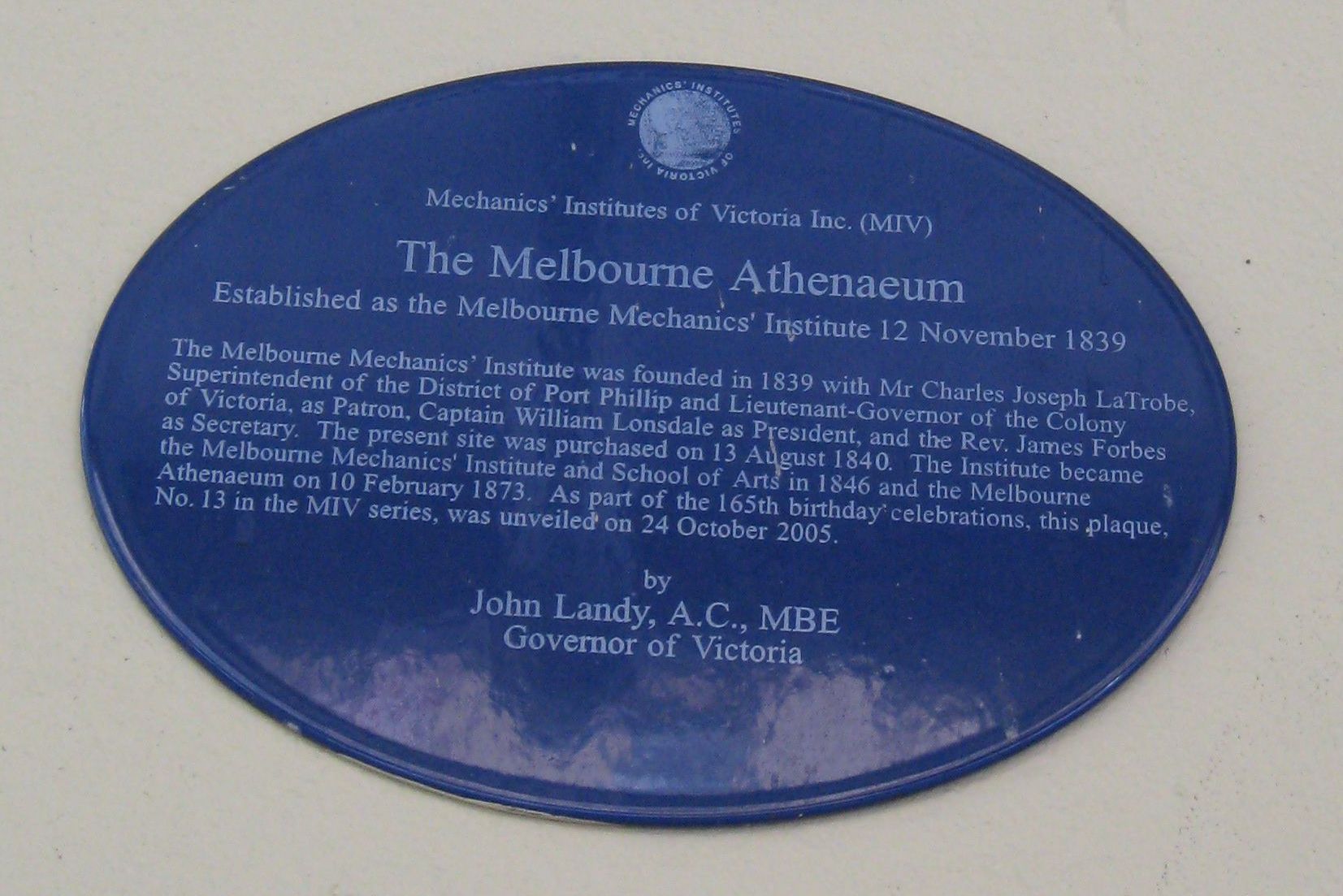
Mechanics Institution

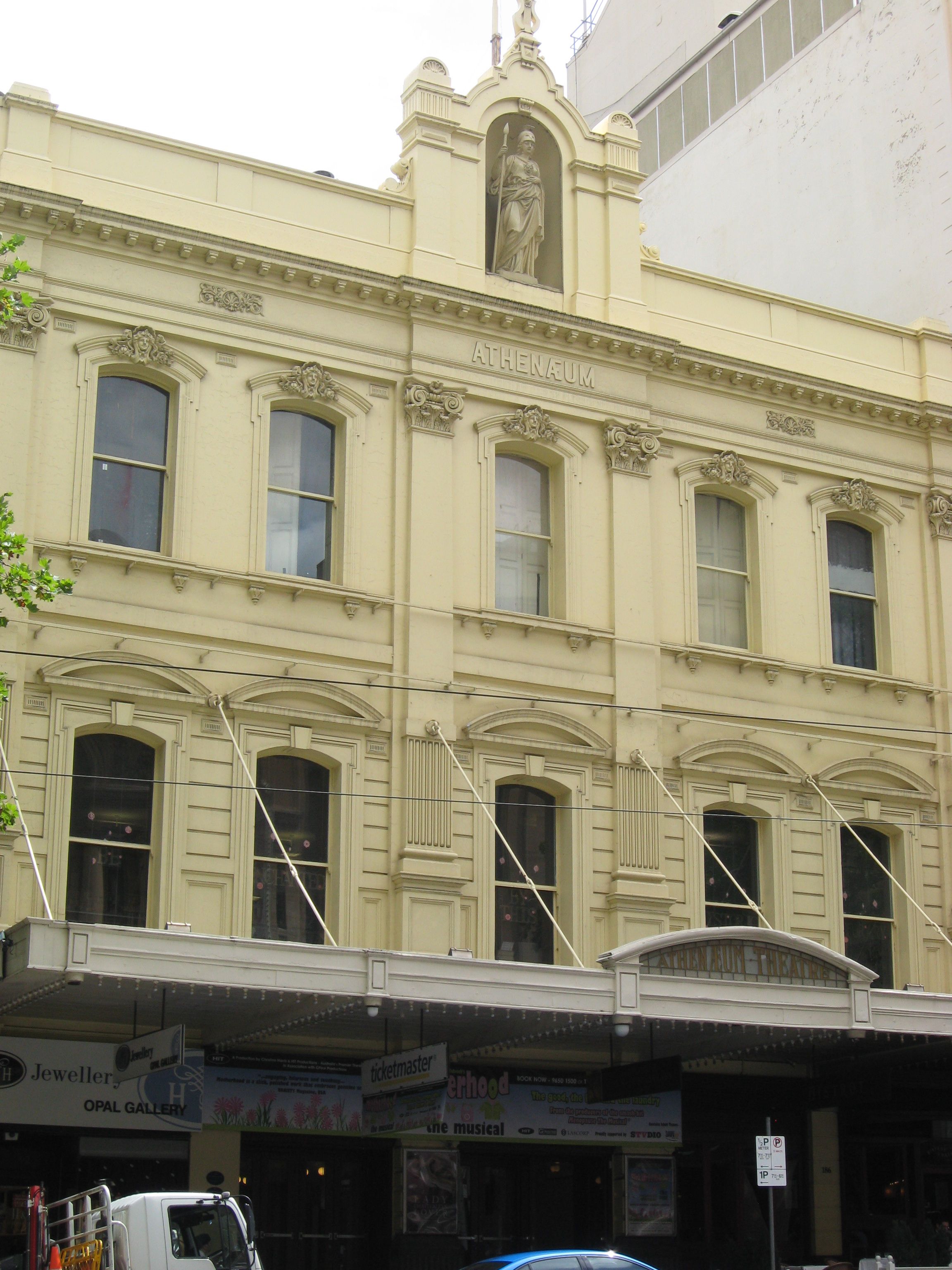
Melbourne Mechanics Institution, Collins St near Swanston St.

Next to the Melbourne Town Hall in Collins Street is the original site of the Mechanics Institution. This is one where a little bit of imagination is required.  The Melbourne Mechanics Institution was established in 1839 with the police magistrate and later sub-treasurer William Lonsdale as its first President and the Superintendent of Port Phillip, Charles La Trobe as its first Patron.  Willis himself does not seem to have had anything to do with it, which is a little surprising.  In a nascent civic community, as early Port Phillip was, this is precisely the sort of organization in which a resident Judge could express his philanthropy and civic presence.  As it was, many of the men who were to become his vocal opponents were involved, and perhaps this explains his distance?

The building now on the site is the much-loved Atheneum theatre and library.

Edmund Finn (writing as Garryowen) describes the original building:

The edifice, early in 1843, was occupied by the members.  It was a substantial two-story brick building, some feet from and above the street level.  It was reached by several steps, and during the winter season the footway and street approaches were in a terrible state of mud and puddle.  Yet in those primitive times the progress of the erection was regarded with much interest, and not only the people, but the newspapers actually felt a pride in it as one of the coming constructive wonders of the Antipodes.  One of the later thus gushingly referred to it: “The Hall of Arts is nearly complete, and will be ready for occupation in the course of a few days; the size, arrangements, and architectural proportions of the building will make it, when finished, the noblest edifice in the Province.”  On the ground-floor were the Library and Reading-room, and for years the Town Clerk had his official quarters in another portion of the building.  The meeting place for the Town Council was upstairs in the large room.  This larger apartment or “hall” as it used to be grandiloquently styled, was one of the most historical places in Early Melbourne, for here were held some of the most important gatherings in Port Phillip- social, charitable, and political.

You can see a picture of the original Mechanics Institution  here.

There’s plenty more information on the website of the Melbourne Athenaeum Archives– well worth a look!

A pilgrimage around Willis’ Melbourne

Richard Holmes, one of my favourite biographers, once wrote:

The past does retain a physical presence for the biographer- in landscapes, buildings, photographs, and above all the actual trace of handwriting on original letters or journals.  Anything a hand has touched is for some reason peculiarly charged with personality… (Footsteps of a Romantic Biographer p. 67)

He describes a sort of ‘haunting’

an act of deliberate psychological trespass, an invasion or encroachment of the present upon the past, and in some sense the past upon the present.  And in this experience of haunting I first encountered- without then realizing it- what I now think of as the essential process of biography.” P. 66

As I walk around the streets of Melbourne, I find myself trying to reimagine the town that Willis would have seen.   Probably more so than in other cities, much of it was engulfed by the gold rush and its associated prosperity that followed some seven years after Willis left to return home to England.  Nonetheless, it’s a haunting that often accompanies me as I walk around my home town, and I’d like to share it with you.

Because so much has disappeared, I’m having to interpret “Willis’ Melbourne” very, very broadly and creatively.  Basically, if there is any connection with Willis and the years 1841-3 at all- an acquaintanceship in earlier years, an event in Willis’ time that occurred there, an earlier building that once stood there- then I’ll accept it as a glimpse of Willis.  It’s my own particular and rather idiosyncratic haunting.

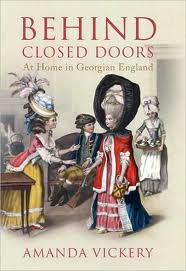
‘Behind Closed Doors: At Home in Georgian England’ by Amanda Vickery

2009,  307 p & 84 p. notes, bibliography and index

At a stretch I could say that this is ‘work’ reading, but the reality is that I just wanted to read it after reading The Gentleman’s Daughter last year.  I can, however, justify this little excursion.  As I  move away from researching my Judge Willis’ time in Port Phillip back into his earlier postings and life, I’m having to look at him in a domestic sense as well as father, brother and patriarch.  I’m aware that he is a Victorian man in that he died in the 1870s, but particularly in the 1820s and throughout breakup of his first marriage, he’s operating within the values of the ‘long 18th century’ which stretched up to Waterloo and even the Reform Bills of 1832.  But to be honest, I read this book just because I wanted to.

In her introduction, Vickery describes her intent:

This book takes the experience of interiors as its subject, staking claim to an uncharted space between architectural history, family and gender history and economic history.  It brings hazy background to the fore to examine the determining role of house and home in power and emotion, status and choices. (p.3)

In many ways this book is an extension of the arguments Vickery mounted in The Gentleman’s Daughter, grounded in domestic artefacts and consumer choices.  She reprises her arguments here: that the separation of domestic and public spheres for men and women is not as hard and fast as has been suggested; ideas tend not to emerge suddenly but instead evolve over time; that ‘turning points’ are often misleading and that

More helpful in my view is to disentangle the persistent and the newly emergent in the jurisdictions of both men and women. (p. 301)

This book explores the concept of ‘home’ in Georgian England- not necessarily the ‘house’ but ‘home’ in a psychological as well as physical sense. It  covers much the same chronological and social territory of her earlier book with a focus on the lesser gentry and the family members who slip between the more clearly defined roles: the widows, the unmarried daughters and sisters and the bachelors.  In a way, she is bringing the masculine back into the domestic.  She argues that although structurally and legally women were subject to their husband’s authority, within the home and domestic arrangements there was a more co-operative arrangement.

She uses a fascinating and exhaustive array of sources: the diaries and letters as you might expect, fiction (especially Austen and Gaskell) ,  but also court records, business letters and  account books.  These latter were an important find.   She could locate only three examples where she had the account books that documented the spending of both husband and wife, and although at first glance they appear to be just a list of outgoings, she draws so much more out of them.  It was the women (in this admittedly very small sample) who paid the servants’ wages, food, paid the children’s clothing and schooling expenses and especially paid for the linen, while the husbands paid rates, taxes and especially horse tackle- a huge expense which she likens more to the upkeep of a helicopter than a car today.  This differentiation in finance reflected a larger bifurcation in responsibilities and interests: masculinity was allied with formal grandeur, landscaping, silver and mahogany while femininity expressed itself through flower beds, ornamentation, textiles and ceramics.  Although women were often derided as spendthrifts, it was often men who indulged the big luxury purchases. But it was not a clearly defined ‘his’ and ‘hers’ at play: creating a home was often a shared endeavour and one that men, by themselves, felt quite at a loss to perform alone and they craved domesticity rather than feeling stifled by it.

She makes the interesting point that in a time of written orders, people had a vocabulary for describing exactly what they wanted.  (Ironically, with the rise of internet shopping we’ve returned to depersonalized shopping where we no longer finger and weigh the goods we buy but depend on image and words again.)  This was particularly well illustrated on her chapter on wallpaper, where again, she uses an unusual archive with flair and imagination- in this case, an otherwise rather boring archive of business correspondence to a wall-paper company in London.  She combs over these outwardly functional letters, noting language like ‘neat’ and ‘pretty’  and how it captured aesthetic judgments and charting, over time,  the way that wallpaper styles became more gendered.  But, she emphasizes, the decision making over purchases was shared- even where letters were written by men, their women’s input was clear.

She starts her book with the almost stifling claustrophobia of so many people living within the Georgian house- the maiden aunts, the boarders, the servants- and the practice of the householder in going round at night, locking people into their rooms as well as securing the front door and windows.  There is not much privacy here- physical or psychological.  Her chapter on bachelors acts almost as a counterpoint to her earlier work on the Gentleman’s Daughter.

This is a beautifully illustrated book, with very well chosen illustrations that are signalled well and clearly in the text, and which really add to the reading experience.  Vickery often starts the chapter with a little vignette that perks up the interest anew, and she has key characters that she returns to in different chapters.  I had felt in The Gentleman’s Daughter than I hadn’t been introduced well enough to her main informants: in this book, she draws on a wider cast but I felt more comfortable with them all, probably because she introduced the specific exemplars at the beginning of each chapter and didn’t relying on them so much to carry the argument of the book as a whole but just that chapter.  When you meet them again in a later chapter, it is an unexpected surprise.

There’s a podcast with Amanda Vickery here on the publisher’s site and a Guardian review of the book and one from the New York Times as well.  Reviews in History has a perceptive review, along with Vickery’s response. It would seem that I’m not alone in my admiration for the book.

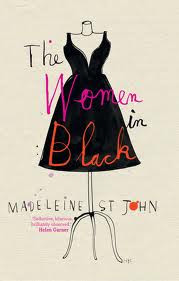
‘The Women in Black’ by Madeleine St John

1993,  228 p.

(4/5)

The further I get from the right side of fifty years of age, the more I am drawn to writers who don’t get published until they themselves are over fifty. What in my younger days I may have perceived as to be rather pathetic (the idea of someone scribbling away secretly for years, the mounting rejection slips, or life just slipping away with ambitions unfulfilled) I now see as an affirmation of the strength of maturity, a victory for persistence and dedication, the triumph of character and a validation of life experience!  Methinks I do protest too much.

Madeleine St John’s first book The Women in Black was written in 1993 when she was fifty-two years old.  She’d been working odd jobs in bookshops in London for years and, convinced that she could do as well as the authors of the books she was selling, she wrote this book and three succeeding books, one of which was shortlisted for the Booker Prize.  From the preface ‘Madeleine and Me’ written by Bruce Beresford and the obituary at the end by Christopher Potter, she seems to be a rather reclusive expatriate who lived her life in London, seeking various kinds of spirituality and with rather brittle friendships and little contact with her family back in Sydney.  She was an undergraduate at Sydney University in the early 1960s, alongside Clive James, Germaine Greer, Robert Hughes, John Bell and Bruce Beresford: were university students more brilliant then in the rarified air of fees and Commonwealth Scholarships, or arriving early on the cultural scene,  have they just promoted themselves better?

The Women in Black relates a sliver in the life of the main character, Lesley who has adopted the name Lisa instead, who is I suspect rather biographical. Lisa has taken a job in the Ladies Cocktail Dress department of F.G. Goode in Sydney- a thinly disguised David Jones.  I say ‘a sliver’ because Lisa is  in that hiatus between completing her Leaving Certificate results and finding out whether she has been accepted for University.  She is the young casual, working alongside older permanent women as one of the “women in black”, changing from their street clothes into the black uniform of F. G. Goode before starting work. She just works the one Christmas/New Year period, then she moves on.

The narrative shifts in successive small chapters (often only 2 pages in length) between the lives of the women who work in the department store.  I’m starting to make “being able to build a sustained narrative over 20 pages” as one of my criteria for good writing: I am tiring of these short, jumpy snatches that seem to be common in recent writing.  It seems ridiculous that a novel  of only 228 pages should have 55 chapters.

The front cover of the book suggests chick-lit, and it IS an easy read.  But I think that St John has captured the early 1960s  well here: the wariness and yet curiosity about ‘New Australians’ who seem cultured and exotic with their strange food, coffee and wine;  the stifling embarrassment about sexuality even among married couples, and the world of promise opening up with universities that is stretching the expectations of women for their lives. It is an intellectual coming-of-age book too, in a way, as Lisa finds herself feeling embarrassed about her home-made clothes and dipping her toes into adult social life.  Her father is gruff but grudging: her mother is out of her depth both socially and educationally but she is encouraging her daughter to move into this world that she knows nothing of.

It is certainly a well-blurbed book  with Clive James, Bruce Beresford and Barry Humphries (Helen Garner???)  as contemporaries, and with younger women writers Toni Jordan, Joan London, Kaz Cooke and Deborah Robertson as well.   They refer to the warmth, wit, wistfulness and sharp observation of the book, and they’re right.  It’s a small nugget of a book, affectionate, nostalgic and optimistic.  And yes, I did laugh during this book- at force 2 level (breaking into a smile with a little chuckle). It’s only short- you could almost knock it over at a reading- but it was a satisfying, happy read.

Sue at Whispering Gums and Lisa at ANZLitLovers have both reviewed this book.  It’s not a coincidence that Sue and I have read this together: it was the January selection for the online Australian Literature group we’re both in.

Laugh?

At our bookgroup (i.e. the Ladies Who Say Oooh)  last month we were talking about comedy in books.  The book we were reading, “Two Caravans”,  was billed as humourous, but I really didn’t find it very funny at all.  I commented that there are very few books that I have actually laughed out loud at.  Two that do come to mind are Clive James’ “Unreliable Memoirs” and Denise Scott’s “All that Happened at Number 26“- both of which had me laughing out loud, almost to the point of tears. We dourly vowed that we’d monitor our laughing at books for the rest of the year- a resolution that’s almost certain to deaden any mirth at all for the remainder of 2011!

I don’t think of myself as a humourless person, but I just don’t seem to do it very often when I’m reading.  Perhaps I do- it will be interesting to see.  I laugh at television and in movies, although come to think of it,  I rarely choose to go to a ‘funny movie’.  I think that I often laugh during conversations, and I quite enjoy listening to radio comedy.  I’m really looking forward to seeing Tim Minchin in a fortnight or so, but I think he’s one of the few comedians that I’ve actually seen live.  Of course, there’s laughing and laughing- can I categorize it?  Surely this is a truly kill-joy endeavour…

1.The little sub-vocalized ‘hmmph’ with a raising of the shoulders

2. Breaking into a smile with a little chuckle

3. Laughing out loud- head thrown back, shoulders shaking

4. Extended laughing out loud, perhaps with tears! or perish the thought- a little snort!- subsiding into chuckles then bursting out again.

And I often laugh at watching other people laugh.


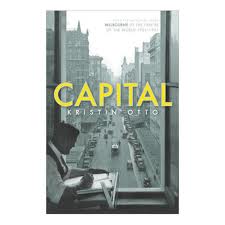
‘Capital’ by Kristin Otto

364 p.  2009

I’m not really sure how to review this- as a reader or as an historian- and I’m not even certain that it’s possible to have a clearcut distinction between the two.  This is Kristin Otto’s second book after releasing Yarra: A Diverting History of Melbourne’s Murky River (and how odd- the small biographical sentence in Capital calls the first book Yarra: A Meandering History of Melbourne’s Murky River. I wonder if the name has changed? I suspect that this is an error.  If so, not a good start given that the same publisher released both books!)

The two books have much in common: both published by Text Publishing,  generous use of black and white photographs, no footnotes, a diverse bibliography and a rather chatty tone that ties together many small details into a clearly identified theme.  It is popular history, aimed largely at a local audience.  The research for this book was funded through a Redmond Barry Fellowship that encourages its recipients to use the collections of the State Library of Victoria and the University of Melbourne (institutions that both have links to Redmond Barry).  She has certainly mined these collections well, and the book is a mass of small details stitched together into a broader fabric.

The book opens with a dictionary definition of ‘capital’ which includes its political, economic and evaluative dimensions- capital city; capital wealth, and excellence.  We could also include human capital here and this, in effect, sums up the spirit of the book.

Otto takes as her focus the years 1901-1927, when the new Federal Parliament sat in Melbourne prior to shifting to the newly-constructed Canberra as national capital.  It takes a basically chronological approach, starting from the Federation Celebrations in 1901 and moving in two or three year steps through to 1927.  Superimposed onto this chronological skeleton is a theme for each time slice: celebrations 1901-3; amusements 1904- 1907, social laboratory 1908-10  etc.  It’s worth looking at the table of contents here.   This double-themed approach groans a bit under its own weight here because concepts like “amusements” or “social laboratory” or “style” were not restricted solely to the three-year period she has pegged them to alone.

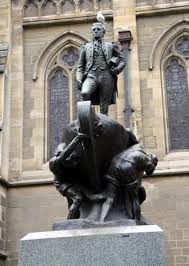
Then she explores these themes through a number of pivotal and fairly well known Melbourne characters including Alfred Deakin, Nellie Melba, John Monash, Tom Roberts, Macpherson Robertson,  Helena Rubenstein, Vance and Netty Palmer,   Janet Lady Clarke and Charles Web Gilbert.  This last name may not be immediately familiar, but it is to me as he is my husband’s grandfather. You may know him by this statue

One of the emphases in this book is on the interconnectedness of people within Melbourne at this time and the author can barely suppress her glee at finding connections and coincidences which she notes in quirky little footnotes.  Although it was obviously a pleasurable hunt for her,  it is no real surprise to me that if you choose to focus on an elite in a community then almost by definition there will be connections between them.  Her linchpin characters are fairly well-mined biographical subjects, although Web Gilbert and Annie Bon, a patron of the Coranderrk Aboriginal settlement in Healesville, less so.   She did attempt to draw in some less noted personalities- Albert Mullett, an Aboriginal man living on Coranderrk, Harold Clapp the Commissioner of Railways- but largely the narrative draws on a strong “aha!” factor amongst a largely Melbourne readership which would recognize familiar names and buildings even today.

The book is generously sprinkled with black and white photographs and was shortlisted by the Galley Club of Australia under the ‘Webfed- Mono/duotonebook/4c, limp bound, no price limit’ category (who would have known that there are so many categories of books?).   Among the images in the book there is a double-page reproduction of both the Tom Roberts and the Charles Nuttall depictions of the opening of Parliament which she discusses exhaustively in the first chapter, but I found myself craving an identification key to the people she describes.  Otherwise the photographs are well chosen, well placed and fascinating.

The book, both in narrative voice and conceptualization,  is similar to that adopted by Robyn Annear in her books Bearbrass and A City Lost and Found and I am sure that it would attract a similar readership.  Otto provides her sources at the end of the book, and they are exhaustive and largely of a biographical or local history bent.  I mourned the absence of footnotes- there were several times when I wondered where she’d gleaned her information- but footnotes are an acquired taste I suspect and I’m sure that many other readers would not notice their absence at all.

I enjoyed the book and the strong recognition factor that it evoked in me, but I do wonder if the complexity of its structure,  with its chronological slices, themes, then biographical linchpins was rather too heavy for it.  And at the risk of being labelled a grumpy old woman, I do find myself wondering if “young people these days” would have the same recognition response to, say, C.J. Dennis or AM band radio stations and the many small details that make up this book.  Who knows- perhaps a book like this is a way of alerting them, but I suspect instead that its readership will be drawn more from people already familiar with them.  The blurb at the front suggests that

For anyone who knows Melbourne, ‘Capital’ will be a fascinating conversation with an old friend.  For others it will be a compelling introduction to a new one.

I suspect that the former will outnumber the latter.


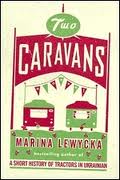
‘Two Caravans’ by Marina Lewycka

309 p. 2007 p.

(2.5/5)

That’s it.  I’m over Marina Lewycka.  I really enjoyed A Short History of Tractors in Ukranian but I loathed We Are All Made of GlueTwo Caravans, which is her second book, comes in between, so perhaps my esteem for her declines with each publication.  I do not intend reading any more of her work: I wouldn’t have read this one, except that it was a selection by The Ladies Who Say Oooh (aka bookgroup).

The title refers to the two caravans that house a motley group of itinerant workers drawn from various countries: Irina and Andriy are both Ukrainian but from very different political and cultural backgrounds; Tomasc,  Vitaly, the middle-aged Yola and her daughter Marta are Polish; there are two Chinese girls, Emanuel from Africa, then the dog.  The dog was probably the last straw for me.  They are swimming in the slimy waters of the pits of the British economy working as fruit pickers on strawberry farms, processors on a chicken-farm assembly line, kitchen hands and waitresses.  Some of the others disappear as sex workers, or reappear as spivs.

They fit every stereotype and I felt uncomfortable reading it and somehow colluding in it. Yes, I know that Lewycka herself is Ukrainian, and that there is a whole vein of humour that can be generated and voiced within a minority group that could not and should not be voice elsewhere-  I’m thinking the string of “Wog” comedies created by Nick Giannopoulous and suchlike.  But it’s a sharp and dangerous humour that feeds on stereotypes, and while some might be challenged by it, others draw a perverse pleasure from having all their prejudices confirmed.

It is touted as a comedy, but I found little to laugh about. I suppose that the book worked in that the amorphous umbrella term “immigrant worker” was broken down into individual people from a range of backgrounds, and it was not an ‘us versus them’ scenario as there were shysters, grubbers and exploiters among the English and the immigrants alike.

Obviously some reviewers liked it- The Sunday Times, The Telegraph and The Guardian.  Reviews from Australia are rather less glowing- The Australian was equivocal and The Age rather dismissive.  I’m wondering if it’s a cultural thing perhaps?  As we well know, there’s a strong streak of prejudice and intolerance that runs through Australia, and probably every other country as well, but what struck me in England in particular was the assumption, from people you’d just met, that you would unquestionably share their barely-disguised contempt for people from the eastern EU countries.  I didn’t want to buy into it then, and I don’t now- even if it does come from ‘inside’.

Summer

From a time when summers were more innocent and less menacing…

I think all of Australia is holding its breath.