Author Archives: residentjudge

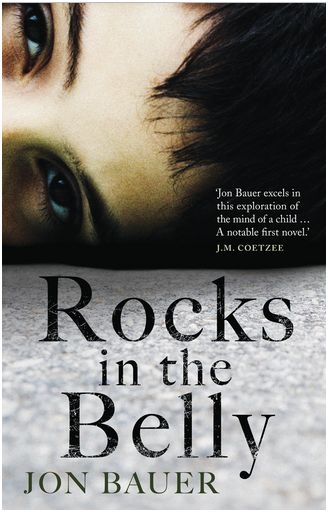
‘Rocks in the Belly’ by Jon Bauer

2010,  296 p

I’m not going to give this book a star rating (something I’ve only started doing recently anyway).  I really don’t know what I’d give it.  I very nearly didn’t finish reading it, and that is unusual for me: I usually hang on to the bitter end once I’ve started a book.  But I found this book very disturbing and unrelievedly painful and I did not enjoy the experience of reading it at all.  Is that powerful writing? Probably.  Did I want it to go on for even one page longer? Definitely not.

The story is written in two strands.  One is in the voice of eight-year old boy, an only child, whose family fosters other children as well.  They have been recently joined by Robert, an older boy.  The second voice is that of the same boy, now twenty-eight, returned from Canada because his mother is dying of brain cancer.  Significantly, we don’t ever learn what the narrator’s name is, and although the voice of the child and the man are distinctive, the pain, injury and jealousy throbs through both narrative strands equally.  A damaged and damaging child: a damaged and damaging man.

In the acknowledgments at the back of the book Bauer mentions that the book had an earlier incarnation as a short story.   Maybe a book so lacerating  should remain in a small format- a 190 page novella perhaps.  I did not want to keep reading, and I just wanted the pain, all round,  to stop. I tired of the scatological references to wee, the poo and doodles by the young boy and I shuffled uncomfortably at the violence and warped thinking of the man.  I didn’t want to be with any of these people.

I see that it has been long-listed for the Miles Franklin.  I’m not sure.  In fact, I was quite positive that it was set in England- to me it had all the hallmarks of the archetypal ‘gritty BBC mini-series’- and I was surprised flipping through the book later to find that there is no real indication of where it is set.  Its oppressiveness, the hedged garden, the upstairs bedrooms, all signalled England to me.  I don’t think that the Miles Franklin is the right award for this book.

I am sure, as Lisa at ANZLitlovers point out, that this book would spark a lively discussion in book groups.  However, thinking of my bookgroup ladies, I suspect that if I, not usually so disturbed by a book, found it difficult to continue then they even more would baulk at such unmitigated pain.
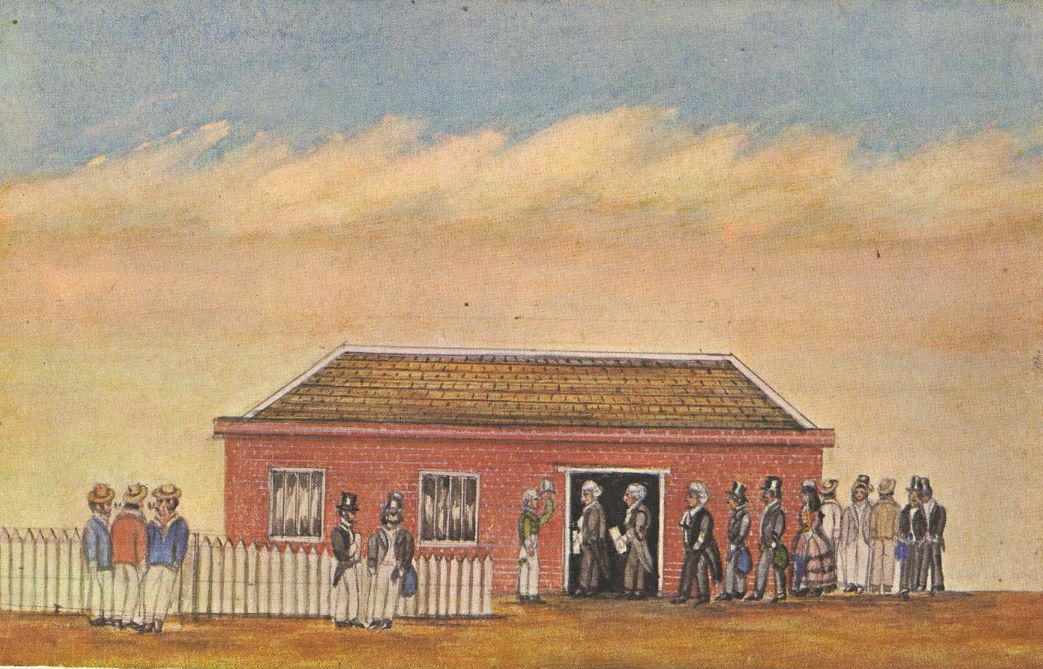
Opening of the Supreme Court in Melbourne 12 April

I see that the The Honorable Marilyn Warren AC, Chief Justice of Victoria  is to speak at the RHSV on the 28th April about the opening of the Supreme Court in Melbourne 170 years ago this month.  Look at the header on this blog- this is Liardet’s rendering of the occasion, many years later.  Here’s the uncropped picture:

By all accounts, the first Supreme Court occupied a rather unprepossessing temporary building that was blazing hot in summer and cold in winter.  Here’s what Garryowen (Edmund Finn) had to say about it:

At the south-west corner of King and Bourke Streets there was, in early days, erected a plain-looking, store-like, brick-walled, shingle-covered building, and therein the small business of the Crown Lands Department (controlled by Commissioners) was disposed of.  The entrance at one end faced Bourke Street, and nothing could be less pretentious, less comfortable, or uglier.  In the beginning of 1841, when it was known that a branch of the Supreme Court was to be established in the district, the ruling powers were at their wits’ end as to how, and where, an apartment could be procured for the temporary accommodation of the Resident Judge and his judicial following.  After a good deal of casting about, it was finally resolved to convert this place into a legal “make-shift” and the Crown Lands Commissioners, with their troopers and bailiffs, were hurried off to a wattle-and-daub shed, a rearward appurtenance of the Superintendent’s establishment on Batman’s Hill.  So the barn underwent a partial process of fitting up; and the single-roomed cottage referred to in a previous chapter as a Clerk of Works’ Office behind, was transformed into “Chambers”.  p. 179 This “rookery” then became the Supreme Court, and here it was that the willful and wayward Judge Willis “ruled the roost”. (p. 179)

It certainly had none of the grandeur and visual power of the later, purpose-designed courthouse erected where the Old City Court building now stands in Russell Street.  Instead, it was rather gently derided by the Port Phillip inhabitants:

THE COURT HOUSE:- Some steps should be taken to render this place tenantable.  In winter, parties compelled to attend undergo the operation of freezing, which is materially aided by the chilling draught of air which circulates freely in the building, obtaining ingress and egress through the roof, windows and door.  In the summer, the N.W. Sirocco will scorch the auditory, while the gentlemen of the press will require neither pounce (1) nor blotting paper to absorb the moisture of their hieroglyphics.  Lath and plaster might go a great way to remove this cause of complaint; while the expense would be trifling, the convenience would be great, and prevent many of “the ills which flesh is heir to”. During the present cold weather a machine has been erected on the platform of the Bench, out of sight, bearing a strong resemblance to the tin establishment of an itinerant vendor of roasted potatoes; but whatever heat emanates therefrom must be appropriated to the peculiar cherishment of His Honor’s legs- “Reform it altogether.” Port Phillip Herald, 22 June 1841

You’re hard pressed to find any hint of that first, small Supreme Court building now.

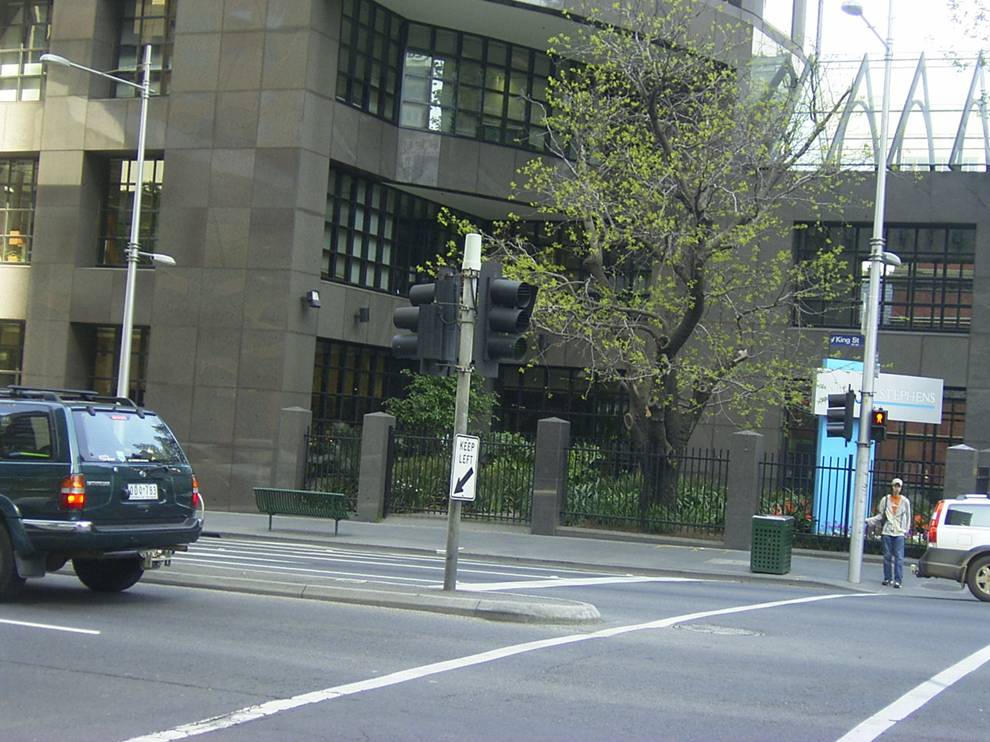
South -west corner King and Bourke Streets, Melbourne, site of the first Supreme Court

Here’s the Port Phillip Gazette report of the occasion of the opening of the court:

SUPREME COURT-

The first sitting of this tribunal took place   at the temporary Court House in King street on Monday the 12th instant. As might have been expected on such a momentous occasion, there was a large attendance of the inhabitants drawn together by the importance and the novelty of the scene. After the reading of the Act for the   prevention of ” vice and immorality” the proclamation of the authority of the Court, and the commission of His Honor Judge Willis, and  after he had submitted to the ceremony of  being sworn in, in a full and clear voice the learned judge delivered himself of the following   opening address, which for the legal acumen displayed in its production, and the good feeling manifested in its tone and delivery cannot be too highly spoken of.-

And then he launched into his opening address which you can read through Trove (Sydney Herald, 26th April 1841). Knowing as we do that Judge Willis was to dismissed just over two years later on pretty much the grounds he identifies here,  the speech is steeped in irony for us as readers.  No doubt people at the time heard it differently.

All very stirring, uplifting stuff.  But even at this earliest stage of Willis’ time in Melbourne, the Port Phillip Herald raised a sceptical eyebrow and reserved its judgment about the speeches  for the time being:

The Port Phillip Bar.- Upon the induction of the bar on Monday last, the supply of wig and gown was most promising-white neck- cloths were at a premium-and there was that cheerful diversity of nose and whisker surrounding the table, for which the English bar is so eminently celebrated. Touching the Demosthenian or Ciceronian orations delivered on the   occasion, we say nothing, but pause until time shall have mellowed down those fiery exhibitions usually accompanying maiden efforts.

Notes:

[1] Pounce, apparently, was a powder used to prevent ink from spreading and blot up excess ink.

‘The Kite Runner’ by Khaled Hosseini

2003, 324 p.

(3.5/5)

I think that I must be the only person in the planet not to have read this book or seen the movie- and maybe that’s why I hadn’t.  It topped the bestseller lists in many places in the world, and it seems to be a book that people have taken to their hearts.

And why not?  I’m not going to summarize the plot- it’s been done exhaustively here. For the first two-thirds of the book, it was so authentic that I was beguiled into treating it as autobiography–and yes, yes I know that first person narrator does not necessarily mean autobiography, but it was imbued with an authenticity that swept me along and made me forget that.   And then, all of a sudden, at the point when the narrator receives a cut on his lip that mirrored the repaired cleft lip of his companion Hassan, the bones on the plot started to jut out.  With the literary equivalent of ‘jumping the shark‘, it seemed to me that all the coincidences warped into absurdity and the attempts at parallels collapsed into contrived and heavy-handed plot manipulation.  To his credit, the author resisted the temptation of an unequivocal happily-ever-after.

I can see why so many people have embraced the book, though.  It is story-telling, pure and simple.  I’m satisfied in a narrative sense when things ‘click’ as the chronology of the book catches up with something foreshadowed, and when events vibrate in a careful balance. There’s something emotionally filling about the goodies being recognized even if they’re not vindicated; the baddies being punished; redemption and the fulfillment of destiny.     The book is a fable, well told.  I’m only sorry that by overplaying the plotting, it became all too obvious that there was a plotter behind it- a literary Wizard of Oz, so to speak.

This book joins a group of best-sellers about Islamic countries that have been embraced by a Western mainstream audience, primed and curious perhaps by the ‘Coalition of the Willing’ (and isn’t that a term to make us squirm now) and the mess in Iraq and Afghanistan.  Because of the audience they attract, such books have much weight placed upon them.  And so I am uncomfortable with the piling of stereotype upon stereotype onto the Taliban villain here- Nazism, child abuse, hypocrisy, corruption.  Let fanaticism be evil enough.

One last thing, though.  As a person with a cleft lip herself, I was gratified to find that the depiction of Hassan’s cleft was probably the most accepting and matter-of-fact that I have read (despite the fact that it was called a ‘harelip’ throughout). I sometimes wonder if I’ve been targeted through internet data trawling, but I have seen more pictures  of older children with unrepaired clefts on the internet through Smile Train advertisements than any first-world inhabitant would ever see in real life.   By the time I reached the end of the book I had inured myself against the tear-jerking moments that seemed just a little too  obviously crafted, but I will admit that I cried like a baby when Hassan looked into the mirror after his surgery and gently touched the stitches on his swollen lip. I’ve been there myself, and as a mother, and I know what a big, wonderful thing that is.   I don’t know why, as author,  Hosseini gave him the cleft – being a Hazara in Afghanistan, undersized, in a menial position in a rich household, bullied, degraded and betrayed as he is,  would surely be enough.  But the cleft was there, it just was, and that’s probably the way it should be.

So- a mixed response.


Uplifting Quotes for the Uninspired Historian #9

Not a historian this time but one of my favourite fiction writers, and not so much uplifting as interesting.  It’s the late Carol Shields from a short story I read last night called Collision. She’s talking about biography, not as a genre or literary construct, but as the live experience that we all accumulate around ourselves just through the act of being and living:

The only law of biography is that everything, every particle, must be saved.  The earth is alight with it, awash with it, scoured by it, made clumsy and burnished by its steady accretion… That’s the worst of it: there’s nothing selective about biography’s raw data, no sorting machine, no briny episodes underlined in yellow pencil or provided with bristling asterisks- it’s all here, the sweepings and the leavings, the most trivial personal events encoded with history.  Biography- it sniffs it out, snorts it up… (p. 315)

…Written biography, that’s another matter, quite another matter! Memoirs, journals, diaries. Works of the biog-imagination are as biodegradable as orange peels.  Out they go. Pssst- they blast themselves to vapor, cleaner and blonder than the steam from a spotless kettle.  Nothing sticks but the impulse to get it down. (p.316)

From ‘Collision’, Carol Shields The Collected Stories


‘Life in Seven Mistakes: A Novel’ by Susan Johnson

2008,  344 p.

(4.5 out of 5)

One of the two epigraphs that grace the opening pages of this book quotes Shakespeare’s As you Like It

All the world’s a stage,

And all the men and women merely players;

They have their exits and their entrances’

And one man in his time plays many parts,

His act being seven ages.

I’m not sure that it was a particularly apposite quote, and it complicated rather than illuminated the title of this book, which for the life of me I can’t quite make fit with the story itself.    Doesn’t matter really: I enjoyed it anyway.

There are two intertwined narratives in the book.  The first, written in the present tense, is told from the perspective of Elizabeth, a middle-aged ceramicist on the verge of her first international exhibition. She has travelled up to Surfers Paradise with her third husband Neil and her children to spend Christmas, and to celebrate her parents’ 50th wedding anniversary four days later. Her  brother and his wife and  children have done the same.     Ah- families- you’ve gotta love them, don’t you- with all that jealousy and love and rawness and spite mixed in together.  There they are, in their parents’ large air-conditioned penthouse at the top of a Gold Coast hi-rise: Bob the patriarch a boorish, loud bully; Nancy his tense, controlling,  hyper-critical wife; Robbo the younger brother who just rolls with the punches and his rather intrusive and opinionated wife, and a brood of disengaged, self-absorbed grandchildren.  Then there’s  Elizabeth, our entree into this family,  who despite her own status as mother, artist and adult woman feels as if she turns into a little girl again around her parents.  Her brother Robbo is spot on about her:

You’re pathetic.  Still bleating about what Mummy and Daddy did to you when you’re almost old enough to retire.  Next year you’ll qualify for one of those over-fifty retirement places.  Are you still going to be blaming your parents when you’re seventy? Life’s too short, Liz (p. 108)

Then there’s the missing youngest brother, Nick who is in jail after a long history of drug use with all the betrayal, defiance and hurt that this brings.  He’s barely spoken of, only briefly encountered in the book,  and yet a presence nonetheless.

How did this family get to be like this?  The other narrative strand takes the young Bobby and Nancy as they meet in the 1950s, begin courting, marry, have children, become increasingly affluent as Bob (who drops the ‘Bobby’) moves up the corporate ladder  into private schools, prestige cars, Surfers Paradise penthouses etc.  But all of this comes at a price- expectations of gratitude and performance- and Bob becomes angrier at the world and the sense of entitlement that he himself has fostered for himself and his family; Nancy tries to make herself and her children smaller targets;  and the three children in their own ways negotiate this spreading emotional mine-field.

Both narrative threads were strong and well-made, and I didn’t find myself regretting when I turned the page to find that the narrative was about to switch again.  The dialogue was particularly good, and the author obviously has a sharp, observant eye.   The ending had an emotional authenticity, at least for this middle-aged reader at the time I am in my own life, although other readers may judge it a cop-out.  The book had the groundedness and edge of Christos Tsiolkas’ The Slap, and felt a little like Jonathan Franzen’s The Corrections down under.  This is perhaps a little flippant: all three of these books have a truth at their core about loyalties, judgment and the emotional mess of just living.  All three are more than the “human comedies” that their blurb writers have pigeon-holed them as.

Oh, but that title- it’s turning me into a numerologist.  There’s seven main characters- is that it?  Or is it, on p. 106 when Elizabeth lists all the things that people tell her not to be take too seriously: love, art, university, jobs, children, her parents, life itself–  there’s seven of them too.  I wish I hadn’t been so hung up on looking for a reference to the title while reading, and I wish I could let it go now too, but Elizabeth-like, I can’t.  Perhaps that’s the mark of a good book- that it turns YOU into its protagonist??!! ( now that’s  a dangerous thought….)

Some other blog reviews:

Kimbofo at Reading Matters

Lisa at ANZLitLovers

Reeling and Writhing

And other reviews:

The Sydney Morning Herald review by Louise Swinn

The transcript of Jo Case’s review on RN’s Book Show

Felicity Plunkett’s review in The Age

The Australian review by Jennifer Levasseur

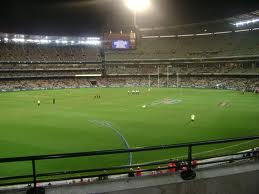
Just say No at the MCG

Off to the MCG last night with my son, a long-time and long-suffering Tigers supporter to watch Richmond v St Kilda.  A draw- hah! I say.  At least a draw in Aussie Rules is not one of those dour nil-all matches in the other codes, and everyone, whether black/yellow or black/red/white left saying “That was a good game!”

Now, I don’t think that I’m turning into a gun-toting libertarian (yet) and perhaps it’s just my Grumpy Old Lady stirring, but one comes away from the MCG feeling put-upon and nagged.  Apart from the live-betting scores that flash up on the screen to enrage me at the ubiquity of corporatized gambling,  there is also a string of prohibitions and admonitions all aimed, no doubt, at lessening the MCG’s  public liability and protecting their assets. Here, according to the messages on the scoreboard, is  what you can’t do at the MCG

1. Smoke

2. Run onto the ground during a match

3. Go onto the ground after the game for a bit of kick to kick (a time-honoured tradition and the only way that a lot of us would ever get onto the MCG turf)

4. Take alcohol out of the stadium (or bring it in for that matter. Or drink full strength beer)

5. Stand on the seats

6. Put up an umbrella (flashed onto the screen the very minute a gust of virga eddied onto the MCG in its own little micro-climate)

7. Fall on the steps because it’s wet (ditto)

8. Be anti-social, and they gave a handy dob-a-hoon SMS number so that you could report them – quite a good idea actually.

I’m sure that there were more, and I’ll add them as I think of them (and you suggest them).  I was surprised that there wasn’t one about racial vilification  and they’ve obviously given up on people photographing, filming etc.  But my goodness, do we really need to be harangued and nagged the whole way through a match?  Do I dare say the words ‘nanny state’?


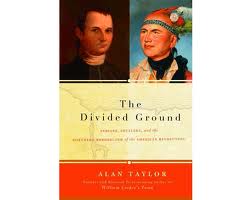
‘The Divided Ground’ by Alan Taylor

2006,  395 p. & 128 p notes

I’m not quite sure how it happened, but one way or another I managed to get through 12 years of schooling and three years of undergraduate university education without doing any American history.  We were supposed to do it in Form II but somehow Henry VIII seemed to stretch on forever, and we only got to those funny men in hats and Thanksgiving before the year ended. By Form V obviously the attraction of Henry had won out because I selected 19th Century British over American history.  At university in the mid-1970s we were all protesting US imperialists and the Vietnam War, so I wasn’t going to do any of that culturally imperialist history (why, no, I’d do British history instead…no cultural imperialism there!!)  I’ve  kept a record of my reading over the last ten years or so, and I’ve only read eight books about American history in that time, from popular history to rather more erudite works.  Among them there’s been more of a focus on colonial and early 19th century America with a smattering of “people’s histories”.  Hence, I continue to feel on pretty shaky ground as far as my knowledge of American history goes.

So to Divided Ground. I came to read this book through a suggestion from Andrew Smith’s blog, who cautioned that in order to understand Upper Canada, I needed to look to America as well.  Point taken.

The title mirrors Richard White’s The Middle Ground which dealt with the Algonquian people of Great Lakes and Ohio Valley in the century before the American revolution. But this book speaks instead of divided ground: divided between the land to the north still controlled by the British empire and the land south of the American states.  There was an east/west boundary as well, separating the settled states on the eastern seaboard from the Indian territory further inland.  These were the borders of land hungry settlers, patriots and politicians. Then there was a borderland as well, at least in Indian consciousness, where the Indian tribes would live as an autonomous people, between the British and Americans.  But this borderland would not survive the determination of speculators and politicians, and it was overlaid by a third type of boundary: the boundary of private property as landholdings were carved out and subdivided, turnpikes created, taverns built and forests cleared.

Taylor tethers this story in two men, Joseph Brant and Samuel Kirkland, who met at a boarding school run by Rev Eleazar Wheelock in Connecticut in 1761. Brant’s sister Molly was the Indian mistress of Sir William Johnson, the most famous and powerful colonist on the American frontier.  His patronage extended to her brother Joseph of the Mohawk tribe. Samuel Kirkland, on the other hand, was the son of an impoverished white Minister, taken on as a charity student who, as a missionary later on, became highly influential with the Oneida.  These two men appear throughout the narrative as they rise to prominence in  different Indian tribes that take different pathways.  Brant moves his tribe into Upper Canada and diffidently sides with the British while the tribe that associates with Kirkland sides with the Americans.  But neither man, nor their tribe, could ultimately withstand the appropriation and double-dealing that ran through the dealings of settlers and Indians and the broader agendas of politicians and policy makers.  There is a great deal of detail in this book- some reviews have suggested rather too much detail- but I found that having these two men as anchors helped keep a clear narrative thread throughout the book.  It’s a technique that I like, and I’m wondering if I could do something similar in my own writing.

It is often pointed out that in the settlement of Australia, treaties were not even offered to the Aborigines, beyond Batman’s rapidly over-turned attempt in Port Phillip.  I do not in any way deny the brute power and arrogance that the wholesale appropriation of Australian land displays, but having read this book I’m not sure that these treaties denote a very much higher moral ground.  Untrammelled power is at least transparent in its intentions.  The dripping hypocrisy of declarations to Indian “brothers” mouthed in honeyed language and proffering false generosity is ruthless, too.

Sills Bend 2011

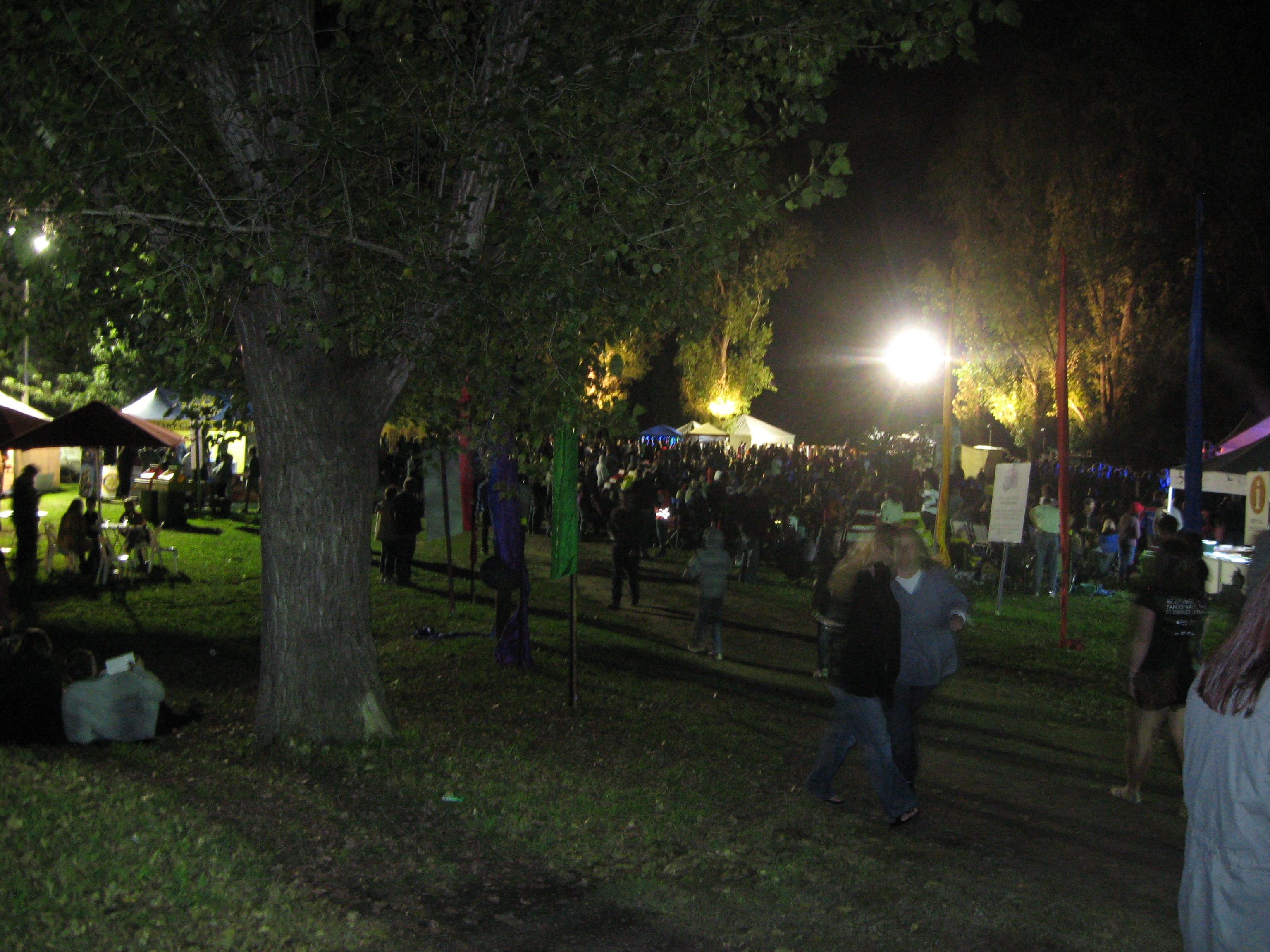
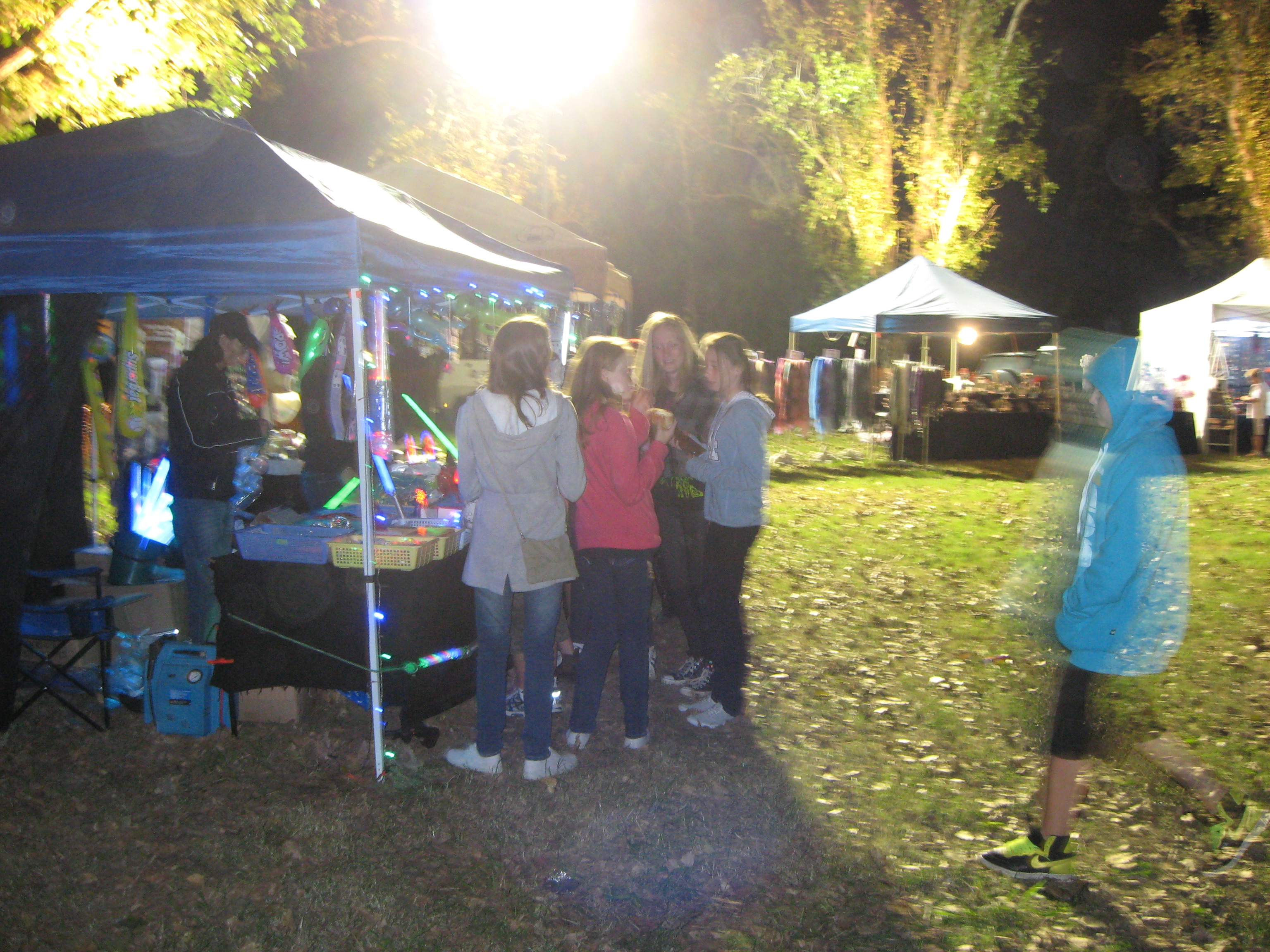
It’s March so it’s Banyule Festival time again, and off to Twilight Sounds at Sills Bend for another year.  I think we’ve been lulled into winter-think because it was a much smaller crowd this year- very easy to park right next to Sills Bend and none of the long snaking lines for food.

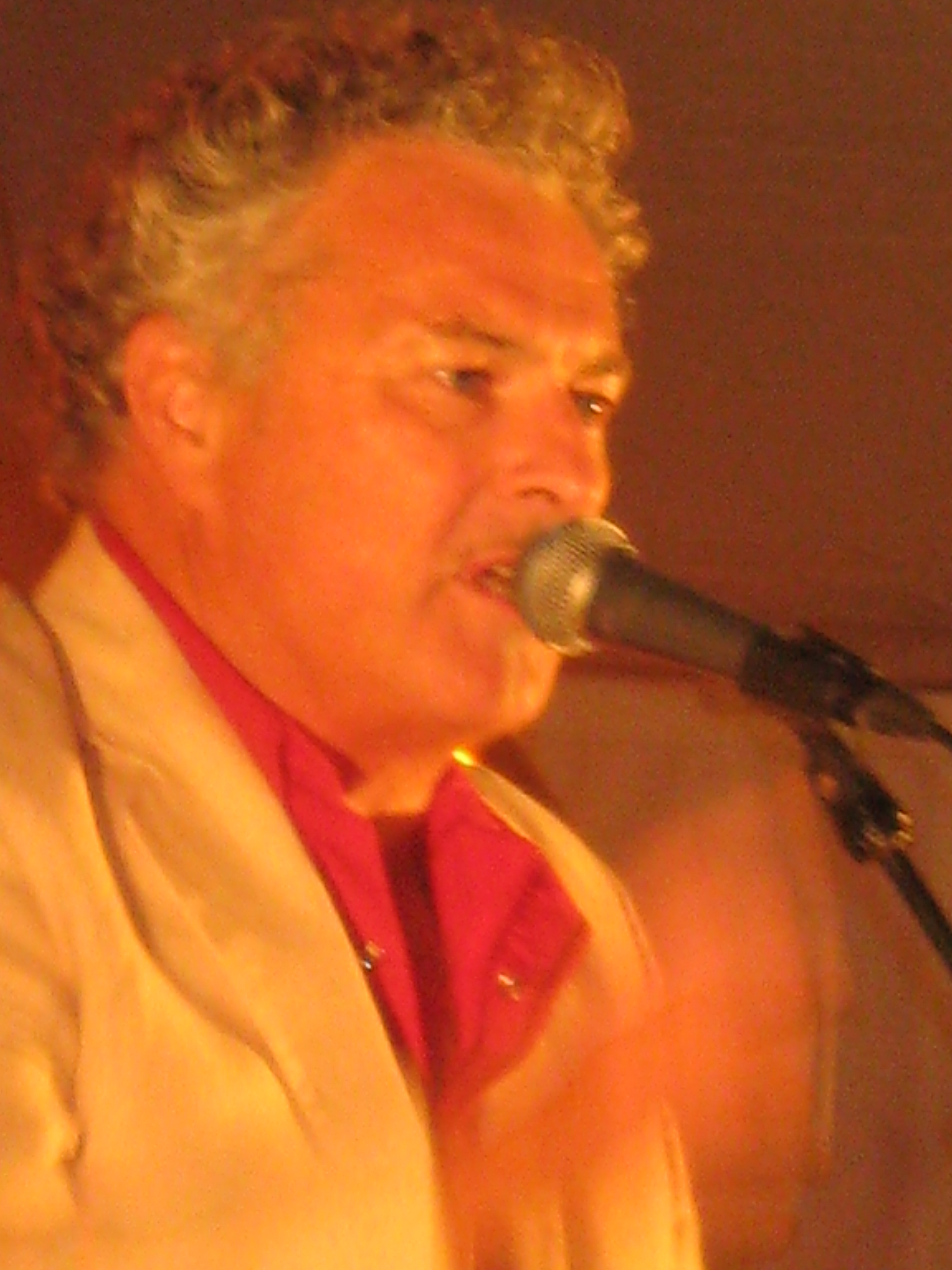
As usual, a baby-boomer headline act. No doubt our children cringe with embarrassment at seeing their 50+ parents grooving out the front. Does it count as a mosh-pit when you’re worried about breaking your hip or people standing on your toes?  Ross Wilson this time, a little rounder than he used to be.  Somehow, singing songs about “she was just seventeen” sounded a little creepy from a man in a white suit.  But what a showman! It struck me how many Daddy Cool/Mondo Rock songs are just part of my mental soundtrack. A good night.

Red faces

I never cease to be amazed by the search terms that bring people to this blog, and I often laugh at the bemusement they must feel when they realize what’s here.  So, given that much of my readership has arrived in unusual ways, I may as well share with my diverse readership (such as it is) some beauty tips! Those of you who know me will probably snort with derision- as indeed I do myself.

This little thought bubble was generated by an earnest discussion I had with my 60+ male doctor this week as we sat down together and discussed beauty regimes at night.  Not quite- I was there for yet another prescription to treat roseacea.  I developed this about eight years ago, at a time when my health was rather precarious and changeable.  I’m not sure whether the two are linked, or whether it was just moving into middle age where one’s body seems to be following its own secret instruction sheet.  Anyway, roseacea I have, and antibiotics keep it under control, necessitating far more frequent visits to the doctor than I’ve ever had to have for anything else.

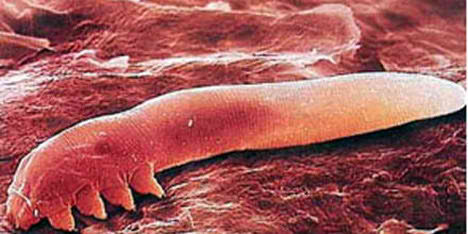
On for a bit of a chat, which my doctor often is, he said that he’d developed roseacea himself last year and decided to do his own research on it.  He found research that linked a skin mite to roseacea.

Here it is climbing across your skin.

Eeuggh! are you scratching yet?

Anyway, he had treated himself with scabies treatment but had also been looking at sunscreen- and this is where I stopped shuddering and started listening because I’ve also noticed the beneficial effects of sunscreen on roseacea.  I became severely sunburnt on the face over Christmas, even though I had a hat on and was sitting in the shade.  Then I recalled my dermatologist muttering something about the sun and remembered that the antibiotics I take have a fluorescent sticker plastered on them warning of sun damage while taking them. The next day I plastered myself liberally with sunscreen and ended up with a magnificent outbreak of roseacea a few days later.  So onto the Googly I went and found that sunscreens with zinc were beneficial, as long as they were removed carefully at night.  So, I’ve been using Ego Sunsense Daily Face (with matte tint and under $20 for 200 ml!!!) and Neutrogena Extra Gentle Cleanser (for $10.00 for 200 ml- don’t tell me that I don’t PAY for my beauty!) at night.  My doctor, meanwhile has gone the Ego QV route with good old Country Life soap at night (he obviously pays even less for his beauty!)

What has surprised me is that my skin has cleared up so well- it’s no longer dry and stinging- that I think I MAY even be able to ease off the antibiotics, which would be a VERY GOOD THING. If nothing else, I wouldn’t have to sit there so often having beauty chats with my doctor.

And meanwhile, continuing the downward theme of this blog, you’ll just have to wait until next Saturday for my best household hint ever.

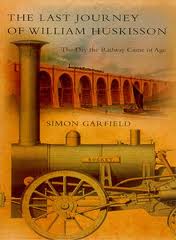
‘The Last Journey of William Huskisson’ by Simon Garfield

2002, 229 p

(3.5/5)

My real work has taken me away from the Resident Judge of Port Phillip, John Walpole Willis, to the Puisne Judge of the Kings Bench of Upper Canada, the same John Walpole Willis.  So here I am, wading through the Colonial Office correspondence from Upper Canada that looks and sounds so similar to the Colonial Office correspondence from New South Wales.  Because it’s dated some fifteen years earlier, it is addressed to Secretary of State for War and the Colonies Huskisson instead of Secretary of State for War and the Colonies Russell, then Secretary of  State for War and the Colonies Stanley.  Huskisson, Huskisson- where do I know that name? Corn Laws? And then I remembered this book, written by Simon Garfield, that lies directly in my eyeline in the bookshelf beside the television in Mr Judge’s loungeroom. William Huskisson, as well as being  the Secretary of State for War and the Colonies, was also the first victim of a railway accident in 1830.

From the title and the preface, you know that this is not going to end well:

There were a great many witnesses to the terrible accident which befell William Huskisson, but none could agree precisely what occurred.  Some said his left leg fell on the track in one way, some quite another, and some said it was his thigh.  A few observed a ‘fiery fountain’ of blook, but others saw only a trickle.  Some claimed there was shrieking, but the rest believed he was rendered mute by the shock. Yet there was one thing on which everyone agreed. They all said that the accident was the worst thing they had ever seen, and the one thing they would never forget.

The following pages recount how a day of triumph became a day of despair at the turn of a wheel.

This is only a short book, and Garfield certainly takes his time getting the accident that we all know is going to occur- 140 pages no less. On the way, he takes us on quite a journey into British parliamentary politics, the economics of railways compared with canal transport, the rivalry between competing inventors and the  entrepreneurial drive of railway promoters.  Not that it’s a boring trip- in fact, it is quite fascinating- but it does take rather a long time to get there.

The book is generously illustrated with black and white photographs and images, and it has a lively conversational tone.  The irony that this popular, if somewhat politically clumsy politician should be run over by the first train running on the railway that he had done so much to champion,  is rich and runs throughout the narrative.  Garfield has captured well the energy of industrializing Britain, the edginess of pre-Reform Bill politics and the bustling self-importance of Victorian Man.  It’s an interesting, easy ride.