
SPOILER ALERT
I often find that there is a sort of brittle formality about books written in early-mid twentieth-century Australia, echoing the slightly-British, self-conscious tone of newsreaders and documentary narrators that you hear in black-and-white footage from the 50s and 60s.This book, first published in 1966, and reissued by Text in 2012 starts off in a similar way. The scenario of two sisters, Laura and Clare, being brought into the headmistress’s office to hear of their father’s death and their removal from school evoked children’s books of the past (Frances Hodgson Burnett’s A Little Princess, anyone?) The focus at first is on sixteen-year old Laura, who had had aspirations to be a doctor like her father, and she is more conscious of the economic and social fall in their circumstances when their fey and selfish mother turns to Laura to be the breadwinner of the family. At this stage, neither Clare nor her mother are particularly well-rounded characters, Clare (seven years younger than Laura) being merely childish and her mother Stella a languorous, demanding presence who decides to sail back ‘home’ to England, leaving the girls to fend for themselves.
Instead of a medical degree at university, Laura finds herself packed off to business college and a secretarial job at a box factory, owned by Felix Shaw. Although she feels no great attraction to him, when Felix Shaw proposes to her – largely as an economic arrangement – she accepts, seeing it as a means of financial security for herself and her younger sister Clare. Felix offers to support Clare to go to university- a dream that Laura had had for herself- but this promise is soon broken once Laura and Felix are married. I can’t really decide whether Felix is a complex character or a caricature. He almost willfully makes unwise financial business decisions, selling off mildly successful companies to spivs and incompetents, while expecting Laura to pick up a heavier work burden as a result. They are not poor: they live in a large house overlooking Sydney Harbour, and he enjoys driving luxury cars dangerously while abusing everyone else on the road. He sells the house – the one thing that Laura loved- from under her to underline her financial impotence in this dependent relationship.
Harrower skillfully juxtaposes the glittering sunshine of the Harbour, with the darkness of their house. It is as if a shadow lies over this beautiful home and its extensive gardens. The book is set in the 1940’s and 50’s, and although neighbours are aware of the arguments next door, nothing is done to help them. In fact, in spite of living in the midst of other houses and working with other women, Laura and Clare are socially isolated, with Felix’s happiness their main concern.
The term ‘coercive control’ did not exist when Harrower wrote this book, but all the signs are there: the emotional blackmail over the prospect, later withdrawn, of Clare’s university education; the changeability of mood; the oscillation between extravagant generosity and meanness; the rigidity in expectations for the women in his life compared with his own recklessness. Felix is physically violent towards Laura, and the possibility of sexual violence towards her sister Clare lurks in the shadows.
Most insidious of all is Laura’s own coercion of Clare to remain in the family home as a peacemaker and mediator, and her adoption of Felix’s own sense of victimhood as a reason to make her stay. Felix has made his own wife the enforcer. At times Laura dreams of an escape, but faced with the consequences, she represses her own will and becomes an extension of Felix.
Meanwhile, as the novel progresses, Clare becomes the main focus when she resists the narrowing of her own horizons and as all of the colour leaches out of Laura. The arrival of Bernard, a young refugee, to stay in the house to convalesce breaks the spell, even though for a while it seems that he, too, is going to be lured into Felix’s orbit by the promise of academic support, similar to that offered to Clare. In fact, there is a latent thread of repressed homosexuality in most of Felix’s relationships with other men, be they fellow entrepreneurs or employees.
The threat of violence runs through this book and it is clearly felt by Laura and Clare as they scramble to meet Felix’s standards and demands. Knowing, as we do, the physical danger to women at the point where they finally decide to leave a coercive partner, as readers we feel unsafe as Laura, and increasingly, Clare contemplate an escape
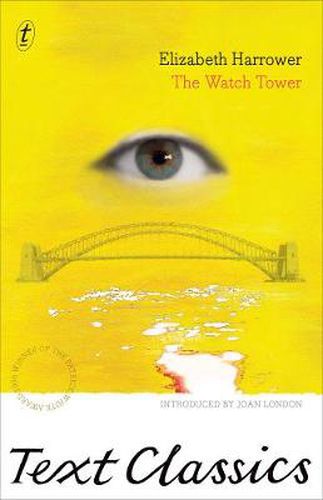
The title ‘The Watch Tower’ is interesting, because it can be interpreted in many ways. It has connotations of punishment and incarceration, which the beautiful house on the Harbour becomes. But it also suggests a lookout as well, and as the book progresses Clare is increasingly looking out, to a wider world, even while Laura becomes more deeply entombed in her relationship with Felix.
So, for a book which I thought was going to be rather insipid and old-fashioned, I found a book that in many ways predates Jess Hill’s See What You Made Me Do (my review here). I read this as part of the Ivanhoe Reading Circle’s program, and one of the questions raised was whether we know of another Australian book of similar vintage that deals with the issue of what we now recognize and name as ‘coercive control’. I haven’t read it, but I suspect that Elizabeth von Arnim’s Vera treads similar ground (The Pastor’s Wife (my review here) does too, to a lesser extent. I can see why Michael Heyward at Text Publishing re-published this book. Unfortunately, it reads just as true today – possibly even more true now – as it would have sixty years ago.
My rating: 9/10
Sourced from: Brotherhood Books
Read because: November book selection for Ivanhoe Reading Circle.
 The Resident Judge of Port Phillip
I read this book last month and found it hard going, because I felt so unsettled and angry with how Laura and Clare were treated by their mother and then by Felix. Laura later coercing Clare infuriated me.
Down in the City by Elizabeth Harrow also uses cohesive control. It left me in the same emotional state, however in my mind it had a stronger sense of being a Sydney book.
Now that you have pointed it out, I can most definitely see the link between the mimicry of the television newsreaders of the time and the book’s early tone.
I wouldn’t say that I enjoyed this book, but it did leave me with a lot to think about. Your review has given me even more to think about as you have touched on ideas that I didn’t see or take on, such as the title. My initial idea was that the title referred to a panopticon where everyone is watching over everyone else.
I must look for Down in the City