
2021, 352 p.
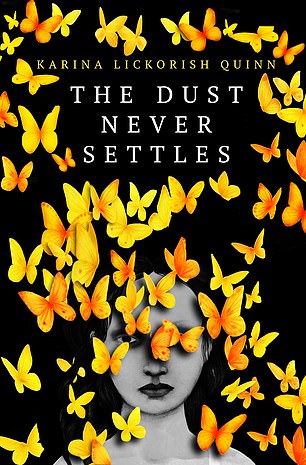
I don’t very often read a book just on the basis of a blurb alone, but in this case I did. Paul Lynch, the author of Prophet Song spoke highly of Quinn’s book in author interviews and his blurb describing it as ‘a mesmerising feat of imagination and a masterful debut’ graces the back cover. It’s a beautiful front cover, and the yellow butterflies evoke Gabriel Garcia Marquez, to whom this book owes quite a debt.
Anaïs Echeverría Gest has returned to her childhood home in Peru after an absence of several years in England. The family is expecting her to sign the papers authorizing the sale and inevitable demolition of her grandmother’s house, la Casa Echeverría in order to free up the inheritance. The house, which is a character in its own right, is a large yellow colonial mansion and garden overlooking the shacks and slums built by squatters on the dry plain behind the house called Los Polvos de Nadie y Nunca (the dusts of no-one and nothing) during the Agrarian Reforms of the 1960s. As soon as she steps over the threshold, she is assailed by the memories of the house- not just her life in that house, but the memories of the house itself- and the ghosts of family members and employees who had lived and worked there. Time seems to stretch and contract in the house; one minute the rooms are intact and the furniture dusted and lights illuminated, and the next minute the house is derelict and dark.
Anaïs has left her fiance Rupert Napier, a thoroughly English gentleman, in order to come home to Peru. She is curiously detached from Rupert, telling herself that she loves him but never really feeling it, and she is likewise ambivalent about her pregnancy. The future baby exists as a little pink fish in the corner of her vision, and as her pregnancy progresses the little fish changes shape until it is a huge, snapping lobster. When Rupert comes over to Peru, probably at the request of the extended family who are frustrated by Anaïs’ refusal to sign the papers, he brings with him all the Englishness of his family, an Englishness that Anaïs resented in her own English father’s refusal to acknowledge his second family in Peru, choosing instead to stay with his wife in England.
The house, built at the turn of the century, has seen multiple deaths, that are only just hinted at: a baby whose cries still echo through the house, the suicide of her Aunt Paloma and most importantly, the death of a 17 year old maid, Julia Álvarez Yupanqui who died when she fell (jumped?) from a window. As Julia falls from the window, the Earth falls away from her and is like a sheet of cloth; she sees Time “spread like an ocean, flowing this way and that, tossing up moments, driving them forwards on the crest of a wave then swallowing them again, pulling them back into the deep“. (p. 96) A disembodied presence, Julia wanders unseen through generations of the Echeverría family, right back to the Conquistadors and through centuries of dispossession, enslavement, poverty and violence. The people of Los Polvos, who saw her fall, believe that she has become a saint- and indeed, it seems that she has, as she walks unseen through history dispensing kindnesses as she passes.
It was not only the Polvorinos who saw her fall: Anaïs did too, crouched under a geranium bush. She becomes electively mute, and is seen by a succession of psychiatrists and doctors who try to make her talk. Anaïs could see the ghosts in the house and the adult Anaïs has a tenuous grasp on reality, and you are never really sure whether she is going mad.
So the story shifts back and forth between two realities: that English reality (denoted by chapters with English numerals) and the Peruvian reality in chapters with Spanish numbers. The Spanish chapters follow the disembodied Julia Álvarez Yupanqui and take us on a meandering journey through Peruvian history. There is an exhaustive list of characters in the appendix of the book, divided into the Echeverría family and a longer list of historical and imagined characters who feature in small, passing vignettes as Julia crosses the earth. These vignettes are beautifully written and draw you in just enough to feel disappointed as Julia passes by, leaving that narrative thread hanging loose. Reflecting the tragedy and complexity (and complicity) of various generations of the Echeverría family, there is a convoluted family tree that challenges the one found in One Hundred Years of Solitude with its seventeen Aureliano Buendías.
The complexity of this book is both its great strength, and its greatest weakness, particularly as the book goes on. The last quarter of the book is Julia’s journey through history, and Anaïs’ story drops away. I found myself having to consult the list of characters at the back of the book, having ‘met’ these characters earlier in the book but having forgotten them in the cavalcade of ghosts passing by. I enjoyed the frequent use of Spanish, which she paraphrases in the following sentences, but I don’t know if I would have felt that way had I not been able to read Spanish.
Because this book is just as much about time, land and colonialism as it is about individual people, it reminded me of Alexis Wright’s Carpentaria, which was similarly shape-shifting and which caused you to think “am I even understanding this?” In fact, I often said that out loud while I picked it up each night, enjoying the experience of reading it, but unable to hold it all in my head.
I like magical realism, but many people do not. This is a really ambitious, fearless book, and I suspect it is more memorable for its overall shape than for its details. It is flawed, but it’s very good.
My rating: 9/10
Read because: I loved Paul Lynch’s Prophet Song and I thought- if he loves this book, perhaps I will too. I did.
 The Resident Judge of Port Phillip