
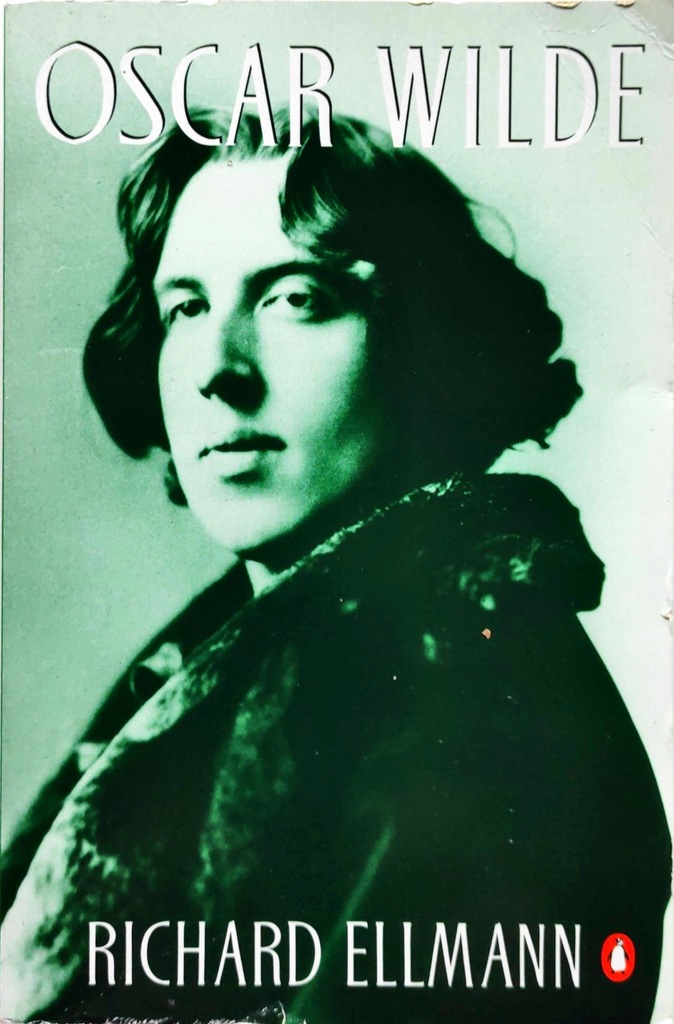
I can hardly believe that I have read this enormous tome not once, but twice. The first time was in 2002, when I read it for an online Literary Biography book group, and this second time was for my former-CAE bookgroup (which I nicknamed ‘The Ladies Who Say Oooh’, which is what my daughter used to call us). The CAE has disbanded its bookgroups and farmed out its book collections to groups, no doubt to save themselves the hassle of getting rid of thousands of books. None of us actually chose this book, but we were happy to read it. That was before the group members realized how long it was, and how small the font was. I think that I was the only one to actually finish it, largely because I knew that I enjoyed it the first time. But I think that I was more impatient with it this time.
Richard Ellman’s biography of Wilde won both the National Book Critics Circle Award and the Pulitzer Prize. It has been described as the ‘definitive’ biography, and I certainly don’t think that another Wildean fact could possibly to be dredged up that hasn’t been included in this exhaustive and exhausting book.
The first time I read it, I was largely unaware of Wilde and his story. I knew that he wrote plays, that he wrote ‘The Happy Prince’, that he was homosexual and that he ended up in jail. Perhaps my enjoyment of the book the first time was that it was all new to me then, although I have since watched Stephen Fry’s wonderful performance in the movie ‘Wilde’, seen an excellent local performance of David Hare’s The Judas Kiss and read Fanny Moyles’ Constance: The Tragic and Scandalous Life of Mrs Oscar Wilde.
Ellmann certainly leaves no stone unturned, starting right back with Wilde’s birth and and going through to rather graphic details of his death. He draws parallels between Wilde’s writing and his own life, and then (as now), I found myself regretting that I have never read The Picture of Dorian Gray. The courtcase that led to his downfall does not appear until about 4/5 of the way through the book, so there is plenty of time for Ellmann to establish Wilde’s large circle of artistic friends – including even Australia’s Charles Conder and Dame Nellie Melba- and Wilde’s conscious creation of ‘aestheticism’ as a cultural movement. In the late 1880s-early 1890s, he seemed to be everywhere: in print, on the stage, amongst the wealthy, the glittering and the cognoscenti. Ellman’s sympathies are clearly with Wilde, although he shows us his fecklessness (especially in relation to his wife Constance), his recklessness and his odd mixture of weakness and doggedness.
This second reading, however, found me impatient at the denseness of the prose and overwhelmed by the minuscule level of detail. It is as if he could not bear to leave a single fact out, and if he couldn’t squeeze it into the text, then he would carry it on in the lengthy footnotes at the bottom of the page. (That said, I was grateful that he included translations of the French in the footnotes as well). I read now that Ellman completed the book just before his death with Motor Neurone Disease in 1987, and that he was not able to revise it or correct errors which have since been corrected by another writer. Perhaps, had he had more time, he might have stripped the book back a bit, which would not have harmed it in any way and indeed may have enhanced it. As it is, Ellmann has covered Wilde’s life so exhaustively that any further biographers could not compete in thoroughness, only in incisiveness.
My rating: First time 8.5. This time round 7.5?
Sourced from: ex-CAE bookgroup stock
Read because: book group selection.
 The Resident Judge of Port Phillip