
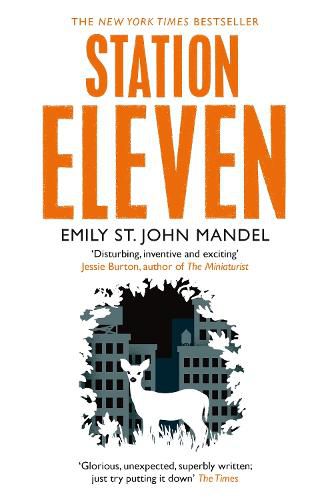
I had heard about this book during the COVID pandemic, and no wonder. Published in 2014, some six years before the world locked down, it describes a world where 21st century Western industrialization has collapsed in the wake of a virulent influenza that has wiped out 90% of the population. What cheering reading during a pandemic!
However, reading it ten years later and with those COVID years behind us, does Station Eleven stand on its own two feet? I think it does. Right from its opening chapter, which starts with a Shakespearean actor, Arthur Leander playing King Lear, collapsing on stage, I was hooked.
As Arthur falls to the floor, a member of the audience, Jeevan Chaudhary, a trainee paramedic rushes to give him CPR, watched by a little girl Kirsten Raymonde who stands in the wings. Returning home, he takes a phonecall from a friend who is a doctor, who warns him that the Georgia flu is rampant, and to take his girlfriend Laura and his brother, and to get out of town.
The narrative then jumps ahead twenty years and takes up again with Kirsten, now an adult, with only scattered memories of that night at the theatre, before everything changed. She is now part of the Travelling Symphony, a rag-tag group of actors and musicians, who move from settlement to settlement to perform music and plays. Electricity, gasoline, the internet and all the things enabled by these had ceased, and in the first years after the pandemic, life had reverted to a light-governed, subsistence struggle against other frightened groups, who were themselves fighting for existence. After twenty years, things had stabilized, albeit at a stagnant level, but a level of menace had been recently introduced by the rise of the Prophet, drawing on a mixture of messianic religion and violence to consolidate his power.
If this sounds at bit like Cormac McCarthy’s The Road, it is. I certainly had the same feeling of dread in the pit of my stomach as I read. But unlike The Road, there is not the same relentless hopelessness. This is a world that is trying to hold onto the best in music and literature, and trying to collect as many artefacts from the old world as possible so that the ‘before’ world is not completely lost. The world still looks for beauty. The book’s ending, while ambiguous, is hopeful.
It is beautifully written with strong control of the narrative, as Mandel slips back and forward between the ‘before’ and ‘after’ worlds, moving from one character to another. How prescient she was, and how chilling it must have been to pick up this book in the early days of COVID. But as a piece of writing, it doesn’t need the experience of the last few years to give it strength: it’s a very human, well-crafted book that celebrates creativity and the best of being human, giving hope without sentimentality.
My rating: 9/10
Sourced from: the op-shop.
 The Resident Judge of Port Phillip