
[Warning: discussion of suicide]
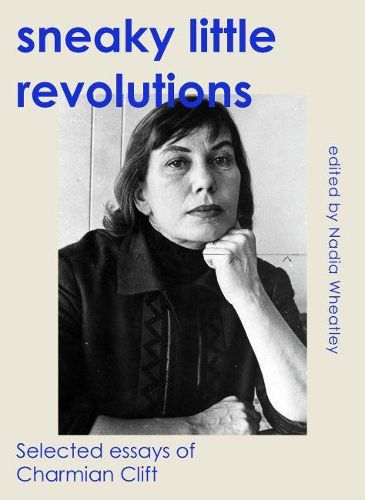
This book, edited by Clift’s biographer and former daughter-in-law Nadia Wheatley, is marketed as ‘selected essays’. More properly, they are a selection of 80 of her 225 newspaper columns published mainly in the Sydney Morning Herald and Melbourne’s Herald between 1964 and 1969, when they came to an abrupt halt with her suicide.
The newspaper columnist was (is?) a curious beast. Although there are innumerable bloggers and sub-stack writers, there seemed to be something rather special about turning over the page of a print newspaper, and seeing an article by a regular columnist, in its accustomed place on the page. I used to enjoy the columns of Sharon Gray (who I see is actually Adele Hulse), Pamela Bone and Gillian Bouras who ended up living in Greece – all women- and Martin Flanagan in the Age. I know that Anne Deveson wrote a regular column, but I only know of her through her daughter Georgia Blain. The only physical newspapers that I still receive are the Saturday Paper and The Age on Saturdays and although they have a stable of staff writers and comment columns, the only one who comes close to my perception of the ‘newspaper columnist’ in the Charmian Clift mould is Margaret Simons with her gardening columns in the Saturday Paper, and perhaps Kate Halfpenny and Tony Wright in The Age. Somehow you feel as if you know them, and that you could plonk down beside them in a coffee shop and just take up talking with them.
Of course, it’s all artifice because despite the appearance of confidentiality and intimacy, columnists project a particular view of themselves, and one that is often quite removed from reality. This is the case with Charmian Clift whose columns brim with confidence and warmth, when instead she had lived, and was still living, a life that was far removed from the suburban Australian life of many of her readers. She and her husband, writer George Johnson, circulated in an artistic and intellectual milieu on the Greek island of Hydra that could simply not be found in Australia (barring, perhaps, the communal living at places like Heide in Bulleen). There’s little sign in her columns of the infidelities and arguments that wracked her marriage. She never mentioned her family members by name, and referred only obliquely to her husband’s long hospitalization with TB. The birth of an illegitimate, and relinquished, daughter when she was 18 years old was coded as “a wrong road…that led me to disaster”.
I could find only one mention of her alcoholism:
A whole human life of struggle, bravery, defeat, triumph, hope, and despair, might be remembered, finally, for one drunken escapade.
One can only read with hindsight her essay about her husband’s forthcoming semi-autobiographical second book Clean Straw for Nothing, which she had not dared read, for fear of what he might reveal about her through the character Cressida Morley
I do believe that novelists must be free to write what they like, in any way they liked to write it (and after all who but myself had urged and nagged him into it?), but the stuff of which Clean Straw for Nothing is made, is largely experience in which I, too, have shared and … have felt differently because I am a different person …
Indeed, several commentators have linked her apprehension about the publication of this book with her suicide in July 1969 at the age of 45- a suicide that seems so paradoxical with the fiesty, intelligent personae that she had curated through her columns.
Wheatley has titled this book ‘Sneaky Little Revolutions’, echoing a rather condescending but also self-effacing comment that Clift made about her own columns to her publisher in London:
I have been making my own sneaky little revolutions …writing essays for the weekly presses to be read by people who don’t know an essay from a form guide but absolutely love it….
Some of her essays are disarmingly suburban, but there are many others that are subversive and indeed, “little revolutions” for the mid-1960s, deep in the midst of the Menzies-era. She resisted the smugness of white-Australia that expected her gratitude for returning to comfortable Australia from a ‘foreign’ country; she supported the rights of women and decried their ‘second-class’ status; she said “sorry” some forty years before the Australian government did; and she revelled in young ‘protestants’ (i.e. protesters) who challenged the complacency of the 60s. In an essay that was not published at the time, she criticized the contingency and unfairness of the National Service draft, which left some men untouched and diverted the life course of others.
As a middle-aged (who am I kidding?) woman myself, I loved her essay ‘On Being Middle Aged’.
…the middle-aged drag time around with them like a long line of fetters, all the years that they cannot escape, the mistakes that can never be undone, the stupidities that can never be uncommitted now, the sames and humiliations and treacheries and betrayals as well as the prides and accomplishments and happinesses and brief moments of wonder…. I often think that middle-aged people have two lives, the one they’ve lived, and a parallel life, as it were, that walks around with them like a cast shadow and lies down with them when they go to sleep, and this is the life they might have lived if they had made different choices in that time when time was so abundant and the choices were so many.
There is a run of essays in the volume about her trip to central and northern Australia. At a time before cheap airfares and mass international travel, her beautiful writing brought to life a view of Australia from above- something that not all Australians had seen. In ‘The Centre’:
Pitted pores. Dried out capillaries of watercourses. Culture slides of viridian clotting thick creamy yellow. Wind ridges raised like old scars, and beyond them the even, arid serrations of the Simpson Desert, dead tissue, beyond regeneration. And yet, the tenderness of the pinks, the soft glow of the reds, the dulcet beige and violet seeping in.
She has a distinctive voice, although one that is not completely unlike my own with her colons and lists and parentheses and made-up words. The genre of the newspaper column does impose a straitjacket of must-haves: an engaging introduction, a set word length, and a rounding-off last paragraph. I found myself longing for a longer essay than the requisite six pages in my e-book and something more thorny and less self-contained.
Is there any point to re-publishing seventy year old newspaper columns? Yes, I think there is in exceptional cases, and few newspaper columnists have that honour bestowed upon them. I think that it rescues some good thought, good thinking and prescience from the flow of ephemera and evokes a humility in us to remember that many others have held certain political positions and made similar observations in the past.
My rating: 8/10
Read because: Ivanhoe Reading Circle selection
Sourced from: purchased e-book
 The Resident Judge of Port Phillip
I used to enjoy all those columnists you mentioned, and especially Sharon Gray. I see Hulse was awarded an OAM last year.