As my son could no doubt tell you, I have a bad habit of leaving journals and magazine unread and wrapped up in their plastic for months…well, years… but with the US election bearing down on us next week, I thought that I’d better read Don Watson’s most recent Quarterly Essay before it was completely out of date.
Don Watson has been writing about America for some time, and he wrote his Quarterly Essay 63 ‘The Enemy Within’ in 2016, deploring the prospect of a Trump victory the first time around. In fact, how ironic that Trump is using the phrase ‘The Enemy Within’ during this campaign to describe the people he will target after becoming president.
In this most recent Quarterly Essay he adopts a similar methodology to the one he used in his earlier essay, and in his book American Journeys where he travels to American cities to talk with voters of both Republican and Democratic persuasions. In Enemy Within he focussed on Wisconsin, and in this most recent iteration he focusses on Detroit and Kalamazoo. The essay is dated 23 August, and the narrative moves as events unfold, including the assassination attempt and Joe Biden’s withdrawal from the candidacy, opening the way for Kamala Harris. Just as in his earlier essay, he has nothing but contempt for Trump, but recognizes that people’s motivations for supporting him have to be at least acknowledged.
Could there possibly be anything left to say about Trump? Probably not, at this stage of the game although events continue to highlight some of the points that he makes in this essay, most of which have been also made by other people. Most particularly, he talks about Trump’s connection with wrestling:
Trump has turned Republican politics, and therefore much of American politics, into the wildly adversarial and addictive world of TV wrestling, an entertainment he used to make money and forge his public persona…TV wrestling involves a lot of boasting, posturing and abusing, as well as body slamming. The wrestlers are real, but not real…. Fans enter the world of TV wrestling as they enter any other fiction, knowing it’s make-believe but open to its seduction. They boo and hiss and shout, much as kids used to at Punch and Judy shows, much as we all do during elections. By making politics like TV wrestling, Trump created a fictional setting for his fictions. He can be as abusive and as untruthful as he likes. In a fictional world, to lie and keep on lying is a requirement…You can sound demented, might even be demented; the more demented you are the more you blend with the environment. (p. 4)
When I saw Trump at Madison Square, with the audience brandishing their signs behind him on cue, it certainly evoked a wrestling match. Not just the presence of Hulk Hogan on stage with him, but also the booing and braying of an audience looking for goodies and baddies and enjoying the ‘show’. Don Watson is not the only person to note the Trump/wrestling connection, but it certainly sprang to mind after reading his essay so recently.
It’s rather discouraging to think that by the time the next Quarterly Essay hits the shelves, with the correspondence responding to this essay, we’ll know the outcome. For better or worse.
Shell GameThis is a six-part series hosted by journalist Evan Ratliff, although you’re never really sure whether you’re listening to HIM or not. He created a voice clone using AI which pretty much sounds like him, except for the long pauses between utterances: something that I’m sure will be overcome in the future. He has great fun trying it out on cold-callers until he starts to feel a bit guilty, given that it’s someone’s job, so he then turns to scammers without any feelings of guilt. Ironically, the scammers are happy to play along because they’re just paid to keep people on the line. The rise of therapy-language (“thank you for reaching out” etc) makes it fairly easy to give the appearance of sincerity, and he tries it out with AI-generated therapists, and then with a ‘real’ therapist through Better Help. But even though he’s having fun with all this, even he draws the line with using his voice clone with his father who is battling cancer. Ironically, his father embraces the whole idea of a voice clone and embarks on some cloning of his own. Shell Game was named one of the the best podcasts of 2024 by New York Magazine, and it’s good.
In the Shadows of Utopia From Cambodge to Kampuchea I’m really enjoying this series, but the length of episodes is becoming ridiculous. This one went for 2 hrs and 45 minutes. It covers the period 1930 – 1945 and I learned just so much. After 75 years of French rule, there was little appetite in Cambodia to rebel against the French (unlike in Vietnam). In Vietnam Ho Chi Minh was part of Comintern, itself under Russian influence, but rather resentful that he was forced to call his party the Indo-Chinese Communist Party, even though there was virtually no activity anywhere other than Vietnam. Indo-China generally was affected by both the Japanese expansionism and the fall of the French government to become the Nazi-endorsed Vichy Government. In both Vichy France and in Cambodia itself, there was a harking back to the glories of the past: in France it was Joan of Arc, and in Cambodia it was Angkor. After yet another Thai/Cambodian war, where territory was lost once again, Japan stepped in and gave both Battambang and Siem Reap back to the Thai government (but not Angkor itself). In 1941 King Monivon lay dying at Bokor Hill Station (which I didn’t get round to seeing- but next time!), humiliated by the loss of his territory, and on his death, the French chose his grandson, Nordom Sihanouk to be King. He was only 19 years old and a bit of a playboy. Meanwhile, in 1936 the first Khmer-language newspaper started, edited by Son Ngoc Thanh. It increasingly took a pro-Japanese and anti-colonial line. In 1942 the French tried to impose the Gregorian calendar and a romanized alphabet (Oh! if only they had succeeded!!) and this led to strong resistance from the Monks. On 20 July 1942 the newspaper led a protest of perhaps 1000-2000 people, of whom about half were monks. The editor was arrested, along with 200 other people, including members of the Indo-Chinese community party. The editor Thanh escaped jail, but his letters reveal his naivete and lack of meaningful support for an uprising against the French, looking to Japan as the saviour of the “yellow nations”. The US bombed Phnom Penh as the war turned against the Japanese. In response, the Japanese began training local militias and they interned French officials (a bit of a surprise because these were Vichy French officials). Sihanouk declared independence at the request of the Japanese. Six weeks later, Thanh returned and was made foreign minister, and later Prime Minister after the defeat of the Japanese. There was strong distrust between Thanh and Sihanouk, and by now the French were talking about coming back. Thanh was arrested, and Sihanouk welcomed the French back. There was now a split between those nationalists who saw their future allied with Vietnam, and others who were keen to claim Khmer identity.
Meanwhile, in Vietnam, Ho Chi Minh declared Vietnamese independence. The Indo-Chinese Communist Party embedded itself within the peasantry, who were suffering from a Japanese-induced famine. The Viet Minh arose after a series of brutal repressions, and soon after the Japanese defeat, Ho Chi Minh declared independence from the Japanese, hoping that the Allies wouldn’t oppose it. But the French are coming back.
Phew- a lot there! While I was in Phnom Penh I saw where the director of the National Museum died at the hands of Japanese interrogators, and I just assumed that the Japanese had taken over as part of their sweep down through Asia. It had never occurred to me that Cambodia would welcome the Japanese, as a way of freeing themselves from the French.
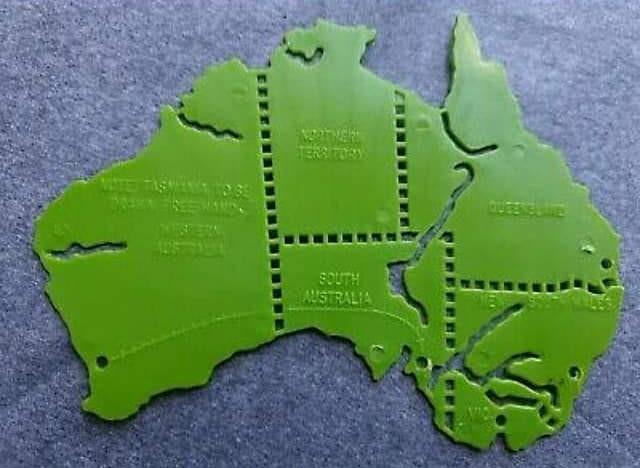
As I remember, it was in about Grade 5 that we “did” Australian history – the first taste of ‘aborigines, explorers, gold and Eureka’- and we used a plastic template to draw Australia. Poor old Tasmania didn’t even get a look-in, but I was also disconcerted by the borders of Victoria, which started with off the solid line of the Murray River before trailing off into dotted lines, like the other state boundaries. Not that the dotted lines were any use: they were impossible to fit a pencil point into, anyway, but they did give a visual sense of state borders. (And emphasized the importance of water compared to boundaries, even though that water might disappear completely from time to time).
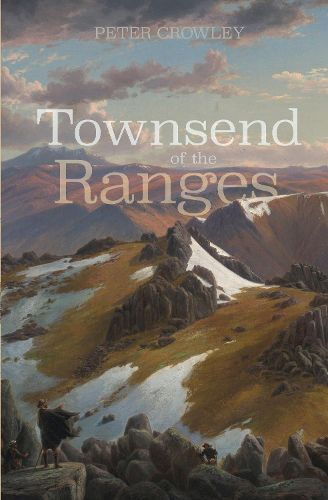
Australians are not unaware of surveyors in their history. Travelling around South Eastern Australia, one often encounters the ‘Major Mitchell Trail’, or markers of the trail of Hume and Hovell, more often described as ‘explorers’ but at early stages of Australia’s colonization, the distinction was perhaps less clear cut. Many Australians are aware of Goyder’s Line that separates arable from drought land in South Australia, and the final proclamation of the Black-Allan line in 2006, more than 130 years after it was surveyed, brought the names of surveyors Alexander Black and Alexander Allan to (somewhat) public notice. But I must confess that I had never heard of Thomas Scott Townsend, the subject of this biography, although his name was given to the second-highest mountain in Australia and Townsend Corner marks where that solid line dissolved onto dots on my plastic school template. The author of this book, Peter Crowley, felt that Townsend had been short-changed:
As far as I am aware, this is the first biography dedicated to Townsend, a man who was the pre-eminent field surveyor of the south-east during the squatter age…I felt for Townsend and his family and wanted to restore his memory to the place it deserved. His triumphs and his travails were of compelling human interest, a tale of suffering and sacrifice endured in service to the public, and they were always going to be the backbone of this narrative. (p.18)
Narratively, Crowley gets you in from the outset. He starts with a suicide in 1869, more than twenty years after most of the action in this story, when the reclusive and belligerent Townsend kills himself by cutting his own throat. What could have led to this “pre-eminent field surveyor” taking his own life?
Thomas Scott Townsend was born in England in 1812. He, along with his parents and 10 siblings, lived at Woodend House in Buckingham Shire. His older brother Joseph was apprenticed to a land surveyor and then began his own surveying business, and it was later noted by Major Thomas Mitchell, the explorer and Surveyor General of New South Wales that Thomas Townsend had been “bred in a surveyor’s office in England”. Thomas had arrived in NSW at the age of 17, and after being unable to find employment, was the recipient of a recommendation to the Surveyor-General from the MP for Oxfordshire, generated no doubt as part of the lobbying and patronage network which underpinned colonial mobility around the empire. He was initially appointed as a draftsman in a temporary capacity in 1831, but remained an employee of the survey department for over 20 years. Those same patronage networks, deployed to the advantage of other new arrivals, were to stall his progress up the career ladder when other aspirants were appointed over him on the basis of similar recommendations from ‘home’. He had to wait under 1845 to be promoted to the position of ‘surveyor’ and the highest position he reached was Acting Deputy Surveyor General of New South Wales.
In these twenty years he was appointed to various projects: laying out towns in Albury, Geelong, Eden; acting as Surveyor-in-Charge of the Port Phillip District; surveying coasts in Gippsland and the South Coast; ascertaining the source of the Murray River; and traversing the Main Range of the Snowy Mountains, making an ascent of the then-unnamed Mt Kosciuszko. Even though the Surveyor-General, Major (Sir) Thomas Mitchell, was able to inveigle long periods of leave for himself to return ‘home’, it seemed that each time the opportunity for a voyage or desired excursion arose, the government found Townsend indispensable and directed him to another suddenly-urgent project. Located far from Sydney and beyond the reach of official orders, he devised his own surveying activities as well, using the time when snow and floodwaters made surveying impossible to go back over areas that had been surveyed in haste earlier. He was ridden hard by the government, but he was a self-driven man as well : perhaps there is a streak of madness in all explorers and surveyors? He was not the first man to enter these areas – he found that squatters had preceded him nearly everywhere he went, following generations-old indigenous paths to find open pastures – but the methodical, documented act of surveying was a form of exploration in its own right.
Surveying involved long periods living in tents in the bush, unless the territory was so impenetrable that supplies had to be left with the oxen and horses so that the surveying party could move unencumbered, sleeping in the open at night – surely a daunting prospect in south-east Gippsland and in the Great Dividing Range. Surveyors used the ‘chain and compass’ method, using a Gunter’s chain to measure distance and taking bearings and angles with a compass. Sometimes they had access to a circumferentor, a compass mounted on a tripod with a sighting arm, or later a theodolite to measure angles. They recorded information in field books, from which they later plotted their data onto maps. At this stage they did not use contour lines, but instead depicted ridges, spurs and valleys by parallel lines known as hachures. Thus, those early maps look quite different to the contour maps we are accustomed to today, and certainly they have their own beauty.
Townsend was instructed to record the indigenous names for the geographical features he surveyed, even though those other names were later overlaid by British names awarded as an act of homage to patrons at ‘home’. Crowley emphasizes throughout the presence of indigenous clans and nations across the whole area that Townsend surveyed. Indigenous guides could easily be procured from squatting stations, and Charley Tarra (or Tara) was a member of several surveying parties. Crowley notes the massacres associated with various squatters, although he does not interrogate the role of the surveyor in a political and legal sense. Certainly guns and violence led to appropriation of the land on-the-spot by the squatters, but it was the legal act of survey and resultant gazetting that imposed British title and sovereignty over Aboriginal land.
Townsend’s work was directly impacted by colonial politics. When he first arrived, the NSW government had already lost control of the squatters outside the Nineteen Counties, and pastoralists were moving into the Port Phillip district from across Bass Strait. When he arrived in Port Phillip as Surveyor-in-Charge, there was already a large backlog of work awaiting him, which only increased further with the influx of population during the gold rush. With the cessation of transportation, the source of cheap surveying teams dried up, and it became difficult to find men prepared to face the isolation and sheer hard work of the task. Squatting regulations introduced a degree of urgency into surveying work, with the imperative to mark out town reservations close to water supplies, to avoid them being swallowed up into large estates. Separation in 1851 brought politics into surveying, with suggestions of a border on the Murrumbidgee which would have placed the Riverina and the later Canberra district within Victoria. Townsend had his own opinion about where the boundary should be, suggesting that instead of rivers being used (which can, after all, expand and shrink depending on climate), mountain ridges and port access should guide the decision.
Crowley depicts well the arduousness of surveying work. It seems that Townsend suffered more from the heat of surveying the Murrumbidgee than he did the snowdrifts and dankness of the south-east. Men could get lost just when stopping aside to relieve themselves; sometimes ticket-of-leave and convict team members were unruly or absconded; and the sad death of Major Mitchell’s son 18 year old son Murray, who accompanied Townsend on his survey of the lower Snowy River, highlighted the isolation and dearth of medical assistance out on the field.
The isolation, the incessant work and the rootlessness of surveying work over such a long period of work did not augur well for a desk-bound job in Sydney once Townsend finally achieved the promotion he craved. In fact, he was quite clear with the governor that he felt that he still needed to be in the field to ensure the accuracy of the surveys conducted by men under his supervision. He married, but seemed unsettled and increasingly paranoid about his wife’s fidelity and sure that he was being ‘watched’. Many people were concerned about him, and felt that a trip back ‘home’, which had been postponed for so many years might alleviate his mental distress. This was not to be… and here we are back at the start of the story, with Townsend’s suicide. I had felt at the start of the book that Crowley had laboured the ‘ignored hero’ point a bit, but by the end, I no longer felt that way. Townsend has been overlooked. Strezlecki has garnered most of the praise for his exploration of the Great Dividing Range, and Alexanders Black and Allen received acknowledgement for tracing the Murray River that Townsend had surveyed twenty years earlier.
Crowley tells the story well, interweaving the biographical with the historical. He draws on official correspondence between Townsend and his colleagues and superiors, Colonial Office files with and about Townsend (which reflect the usual aggrieved tone of correspondents and pompous tone of Colonial Office officials), Townsend’s maps and drawings, and in quite a coup, family correspondence that fills in the last years of Townsend’s life. At times, particularly at the start of the book, I felt that he was distracted by the weeds a bit, giving more context and background information than was necessary. The book does not have an index, which would have been appreciated, but the old fashioned chapter summaries at the start of each chapter helped you to locate information. There was a single list of footnotes that spanned across all chapters. The book did seem to take an inordinately long time to get started, with a note about measurements, geographical notes about what constituted the Great Dividing Range, or the Murray River, a cast of characters, a timeline, acknowledgments and an introduction- all before we get to chapter one. Much of this could have gone at the end of the book.
The one thing that I cannot understand, however, is the dearth of clear, modern maps in this book. With the National Library of Australia as publisher, use of historic maps and documents is to be expected but they were virtually illegible once reduced in size and rendered into grayscale. For much of the book I had no idea where Townsend was or where he was going and no sense of distance or remoteness. This was a book that cried out for a visual representation of land: something to which Townsend devoted his whole life.
But these are quibbles about decisions that may well have been beyond the author’s control. Crowley captures well the incessant demands of the work, the beauty and intimidation of the lands he was surveying, and Townsend’s inexorable spiral into mania. It is both a very human story, and yet one placed within the vastness of unsurveyed territory. Townsend may have had to have wait more than 150 years for his biographer, but with Crowley’s book he receives the recognition earned and withheld for so many years.
Sourced from: review copy from Scott Eathorne, Quickmark Media
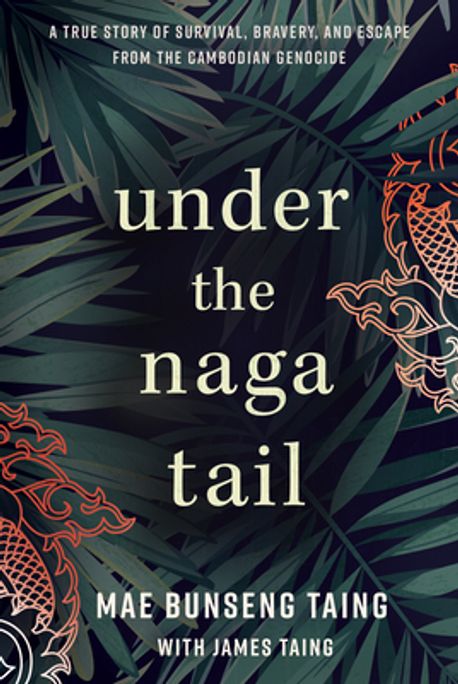
I was in Cambodia, and I wanted to read something Cambodian, but most of the fiction involved the Khmer Rouge period written by people who have escaped to Western countries. This book falls into this category too, although it is slightly different in that the narrator, Mae Bunseng Taing, is of Chinese ethnicity, living in Cambodia. I was interested to know what difference that would make. Unusually, all of Mae’s siblings survived, which is not true of many Cambodian families.
Mae was a teenager and living a fairly affluent life with his entrepreneurial family when the Khmer Rouge marched into Phnom Penh. As with other stories I have read, there was the utter bewilderment as Phnom Penh was completely emptied of people, urged (forced) to leave on the pretext that the Americans would bomb the city. He and his family were forced into the provinces to undertake agricultural work- a far cry from their trading activities in Phnom Penh previously. The family was split up as siblings were sent to different agricultural projects and communities, while his elderly and ill father was left behind in a village. They had secreted away some jewellery, so they were not completely penniless, but under the surveillance of soldiers and ‘Angkar’ operatives, they were only safe if they could merge in amongst other people. The book gives a good glimpse into the ideology that the Khmer Rouge were imposing on their countrymen, who were reduced to a form of slavery.
He finally decided to escape into the jungle, and survived several heart-stopping confrontations. With the defeat of the Khmer Rouge, he decided to cross back over into Thailand and look for his family amongst the refugee camps there. But there had been a change in Thai government policy, and now refugees were being returned to Cambodia, taken into the jungle, and left to find their own way through the explosive-laced jungles at Preah Vihear. It was an inhumane form of mine-clearing, using desperate refugees who were left screaming alone in the jungles, limbs missing, after standing on mines. Mae was, in many ways, in more danger now than he had been under the Khmer Rouge.
This, then, was a second form of Killing Fields. I found myself feeling ashamed at the kindness and the prejudice and indifference that these refugees faced, all too aware that our refugee policy some fifty years later has elements of both. The story was written down by Mae’s son James, who makes an unheralded and abrupt appearance during the narrative, and clearly Mae found his way to a Western country to start a new life.
There is a film by James Taing that you can see on You Tube here. (If you can stand the incongruent ads)
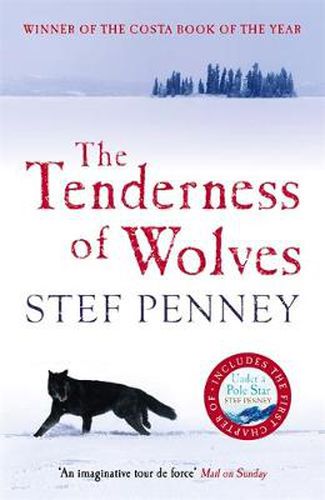
I’ve read Big House mysteries; I’ve read Outback Solitary Aussie Bloke mysteries; I’ve read London-based mysteries. But I don’t think that I’ve ever read an Upper Canada mystery before, especially one set in 1867 which is relatively familiar territory for me because my Judge Willis (the real Resident Judge of this blog) served there in the late 1820s. It is rather strange -and rather amazing, given how vividly she writes- that the author Stef Penney has never visited Canada. The snow and isolation and colonial machinations that she describes in this book all spring from her desk research alone.
Set in the last days of the fur trade, Mrs Ross, a local resident, discovers a brutal murder in the small hut occupied by Laurent Jammet, a French trapper. Suspicion falls on her adopted 17 year-old son, Francis, who was friends with the trapper, and his disappearance from the village only heightens speculation that he is the killer. Donald Moody, an accountant with the Hudson Bay Company, is sent out to investigate the murder, along with Mackinley, the sarcastic and bullying Company Factor from Fort Edgar. They are accompanied by Jacob, Moody’s self-appointed native American protector. They arrest half-Indian William Parker, who was apprehended searching Jammet’s hut after the murder. After Parker is ‘roughed up’ by Mackinley and Scott, the wealthy storekeeper in whose shed Parker is confined, Parker and Mrs Ross go off in search of Francis. There is someone else who is eager to search Jammet’s hut as well: Thomas Sturrock, who believes that a bone tablet which may be of archeological significance is in Jammet’s possession. He has been to the small settlement of Dove River before, having been there years earlier in search of the twon local Seton girls, who disappeared in the forest, never to be found.
And so, we have various people all heading off into the frozen wastes: Francis in search of the man he thinks is the murderer; followed by Mrs Ross and William Parker who are in search of Francis; and then Mackinley and the love-sick Moody who are in search of William Parker. The only nearby settlement is a Lutheran Norwegian community in Himmelvanger, and they take in all of these groups as they stumble in from the snow and icy marshland. Attention then turns to the nearby Hanover House, the company Trading Post, administered by James Stewart. As in the best Mystery Novel tradition, there are many red-herrings and subplots.
The book starts with Mrs Ross’ first person account, and it alternates with other present-tense chapters told by an omnipotent writer, who knows all the characters’ thoughts and backstories. There are rather a lot of characters, and because the book is written in very short chapters without chapter numbers, I found myself getting a bit lost with all the Mr. This and Mr. Thats.
I’m rather mystified by the title, though. There are certainly wolves in this story, surrounding the various groups as they trudge through the snow, and the colonists are all frightened of them. They keep their distance though, and the closest they come is when they sniff around one of the tents at night, breathing over the sleepers and leaving paw-prints. The wolves are certainly less violent than the trappers.
Most impressive of all, though, is Penney’s depiction of the bitter cold and isolation. The landscape, along with the short chapters, makes it a very filmic novel and I wasn’t surprised to find out that she is, in fact, a screenwriter. The book won a Costa Book of the Year in 2007
Emperors of Rome PodcastEpisode CCXXVII – The Catiline Comparison (The Catiline Conspiracy VIII) Matt and Rhiannon have studiously avoided making comparisons between Catiline and Donald Trump, but in this episode they give in to the obvious temptation. They are joined by Professor Nick Bisley (Dean of the School of Humanities and Social Sciences, La Trobe University)- keeping it in the La Trobe family! They agree that there are surface similarities: a rich guy pretending to be a saviour of the poor; a macho male harking back to a golden age, and refusal to accept the results of an election. But there are so many differences too, and there is a limit to how far the parallels reach.
The Rest is HistoryCuster vs Crazy Horse: Rise of Sitting Bull (Part 4) From Tom and Dominic’s summary (better than I could ever do) “Following the bloody Fetterman Fight, which saw the Lakota warlord Crazy Horse and his warriors ambush and massacre American troops, the American public was left stunned, its government and civilian population hungry for revenge. In the wake of this a new treaty was signed, further restricting the Lakota Sioux’s freedoms, but nevertheless signed by their political leader, Red Cloud. Still, many would not be constrained to reservations, and instead sought war. Chief amongst them was Sitting Bull, a legendary, mythologised figure of the Great American Plains and the Wild West – the embodiment of a vanished age. Born into the Lakota Sioux, and a world of shifting allegiances, violent initiation rituals, and intransigent spiritualities, as a young man Sitting Bull’s herculean destiny was sung to him by an eagle. The career that followed in his war against the U.S. government would exceed even the greatest of epics. By 1860 he was paramount leader of the Sioux Nation, when news reached him of the imminent arrival of a survey party, lead by none other than George Armstrong Custer…”
History Extra: Communism: everything you wanted to know. I’ve been getting a really good analysis of communism in its different manifestations in my Shadows of Utopia podcasts, but I thought that I’d listen to this as well. It features Danny Bird, Staff Writer at BBC History Magazine. He points out that Communism is a point in time, reached by different ideologies. It was Lenin who introduced the idea of a ‘vanguard’, and between 1919 and 1943 Comintern with its branches in different countries had a world-wide revolutionary purpose. Just as each communism is different, so too each anti-communism is different too. Stalinism was a product of Stalin’s own paranoia, but as the only successful Communist party at the time, it dominated and dictated Comintern. In a way, the Spanish Civil War operated as a release valve for Communists who were becoming uneasy about Stalin’s communism.
The Turbulent World with James M. Dorsey. I heard James M. Dorsey being interviewed somewhere (Global Roaming, perhaps?) and I thought that he sounded interesting. He is a senior fellow at the S. Rajaratnam School of International Studies, co-director of the University of Würzburg’s Institute for Fan Culture, and co-host of the New Books in Middle Eastern Studies podcast. His podcast is mainly about Middle East affairs. His podcasts are of varying lengths, and they’re interesting. Israel’s Reputational Self-Immolation was just one of the podcasts that I listened to here.
Well, Marx and Engels died without ever seeing Communism in practice. Everybody thought that, if there was to be a revolution, then it would be in industrialized Germany, which was just hanging on in the war. But canny Germany sent all the Communists off to Russia instead (hence the fantastic book To the Finland Station) hoping that they would destabilize Russia instead. After all, 1905 had been a dress-rehearsal for revolution, and now in 1917 there were two October revolutions (old calendar). The first was the revolt that led to the Tsar’s abdication and the second was the call for Peace, Land and Bread. Lenin took charge on October 5 and stormed the Winter Palace. Lachlan suggests the metaphor of nuclear energy: it was as if Marx and Engels split the atom, but as if Lenin drew up plans for the nuclear power plant.
To be honest, I thought that Homage to Catalonia was a novel, and it never even occurred to me that it might be an eye-witness account, written in the year after his return from fighting in Spain. The book starts in Barcelona, where he embarks on rudimentary training using antiquated equipment before heading for the front. He had joined to support the Republican government from an ideological commitment, entering Spain under the auspices of the Independent Labour Party and by chance ended up with the POUM militia (Partit Obrer d’Unificació Marxista) an anti-Stalinist communist party.
His account, which was written after the event, traces his arrival in Barcelona, and his time on the front first in the hills around Zaragoza and his later deployment with a group of Englishmen to a position at Monte Oscuro, within sight of Zaragoza. He is then sent 50 miles away to Huesca where he takes part in an attack, throwing two bombs which he thinks may have hit their target. After three months on the front, which seem mainly to have been a time of lice-picking and boredom, he returns to Barcelona where the Republican forces have turned on each other. Disillusioned by the political infighting, he returns to the front, where he is shot through the throat, shuffled from hospital to hospital and finally discharged from duty. At this point, the internal Republican politics mean that he is in danger because of his previous involvement with POUM and so he and his wife decide to leave Spain.
The political infighting amongst the Republicans was completely unknown to me. I had always thought of the Spanish Civil War as being Republicans vs. Franco’s Nationalists. But the battle was just as much one within the Republican forces. At one stage while reading, I became completely overwhelmed by the acronyms for the various Republican groups and just happened to notice a footnote that referred to ‘Appendix 1’. (I was reading this as an e-book, and footnotes at the bottom of the page are awkward, clunky things). Lo and behold, there were two chapters attached as appendices, completely about the politics and machinations of the various Republican groups that had previously been part of the text, but had been later shifted to be appendices lest they disrupt the flow. I found these two fairly long chapters illuminating, describing the ideological differences between the Russian government and the other communist groups over the role of proletariat and whether they were ‘ready’ for Revolution. Once I had this sorted out in my mind, I could return to the rest of the book.
[Was it the right decision to excise these chapters from the main text? Probably, because he does get into the ideological weeds here. But I would have struggled on with the acronyms had I not followed up on the footnote to the appendices. Perhaps he should have sign-posted the appendices better.]
As a journalist, Orwell is a keen observer, and he captures well the boredom of trench warfare, interspersed with times of frantic, bumbling terror. His description of being shot reminded me a little of Tolstoy’s account of the battlefield in War and Peace. I must say, though, that he seems to be a particularly inept soldier, with little solidarity with the Spanish soldiers he was fighting alongside, with whom he could barely converse with his rudimentary Spanish.
And I can see why Anna Funder in Wifedom looked at the space around “my wife” in Orwell’s work and wondered about Eileen O’Shaughnessy. In Orwell’s book, she is this nameless, shapeless figure bobbing around behind the lines (literally), sending parcels, warning her husband, fleeing with him, but always just “my wife”.
My rating: 8/10
Sourced from: free as part of Kobo subscription. Inspired to read it by the film ‘The Teacher Who Promised the Sea’.
In the Shadows of Utopia I was in Cambodia for most of this time, so I immersed myself in Lachlan Peters’ In the Shadows of Utopia podcasts. I didn’t really listen to much else. These episodes are LONG (over two hours) and very detailed. Episode 7 The French Protectorate ( I really wish he’d keep his naming conventions regular: it’s also called Khmer Nationalist and French Rule) deals with the years 1880 – 1938. At first, the French treated Indo-China in a fairly hands-off way but in 1885 the French Government insisted on a new treaty which abolished slavery and tried to disrupt the patronage networks that governed Khmer society. However, after rebellions, these reforms were not carried out, although French interests became uppermost. World War I had little effect in Cambodia, especially compared with Vietnam and the rural ‘old people’ lifestyle remained largely unchanged. In fact, when May Ebihara undertook her ethnographic study of a Khmer village in 1959-1960, published as Svay: A Khmer Village in Cambodia, her research was the first and only study of traditional Khmer life. The nuclear family was the basic unit, there was little mobility and a distrust of strangers. From the 1930s on, Phnom Penh began growing and we had the stirrings of an urban nationalism, spurred by the Buddhist Institute, the introduction of secondary education and the first newspapers.
Episode 8: An Introduction to Communism Part I goes right back to Marx and Engels, starting with Engels and his investigation into the condition of the working class (even though his family were capitalists). Engels and Marx saw all history and activity about the economic struggle, and capitalism would be the second last stage before the final, inevitable clash between the proletariat and the bourgeoisie. At first there was great excitement over the 1848 revolutions that gripped Europe, but they were not led by the working-class, but by liberals and nationalists. Marx blamed the petit-bourgeoisie, and he had to wait until the 1871 Paris Commune as perhaps a better, if short-lived, example of Revolution. Meanwhile, we had the rise of a united Germany as a sign of things to come, but in the end it was backward Russia where first revolution took place. If you’re a bit foggy about Marx and Engels, this is a good place to start.
Background Briefing . Kidnapping the Gods Part II. This is the second and final part of this Background Briefing episode. This episode takes us to the involvement of several ‘art collectors’ including Douglas Snelling, who became an unofficial Australian consul to Cambodia and managed to ‘collect’ many artefacts that he sold in New York. Then we have Alex Biancardi in NSW, whose Egyptian father was also a collector. The Art Gallery of NSW offered to store his huge collection at no cost (probably with the expectation that they might access some of it). He may have been in contact with the notorious ‘collector’ Douglas Latchford. The episode shows the messy links between looters, ‘collectors’ and galleries and museums.
The Rest is HistoryCuster vs Crazy Horse: Horse-Lords of the Plain (Episode 3) The lifestyle of the Native American had changed immeasurably. In 1492, when Columbus arrived, it was thought that there were 3-4 million (and maybe as many as 8-9 million) Native Americans. By 1796 this number had halved. No tribes were on their ancestral lands: they had all been shifted around. In effect, it was a clash between emigrants. The Lakota had been shifted to the plains from their ancestral lands and were a warlike people. There are no photos of Crazy Horse (which was the name he took from his father). He was a medicine man i.e. he had a spirit animal, and had visions. He was a careful fighter- unlike Custer.
The Rest is Politics (US edition) with Katty Kay and Anthony Scaramucci is one of my regular listens, but I don’t record it because it’s usually too topical, and their commentary will be overtaken by other things. But they have recently had a four part series (only three have been released so far). on How Trump Won the White House. It starts with him winning the Republican nomination after years of bragging about (threatening) to run for President, when no-one took him seriously. The second episode (Did Obama create Trump?) looks at Obama’s ridiculing of Trump at the Press dinner, and speculate about whether this goaded him into finally running for president. The third episode (Collusion Collapse and Chaos) traces through the crazy 2016 election campaign, and the way that the momentum shifted between the Access Hollywood tapes and the accusations of Russian collusion that threatened Trump’s campaign to the ‘basket of deplorables’ and FBI Clinton emails that brought Hilary’s campaign undone. I guess I’m waiting for the last episode.
Emperors of Rome Episode CCXXVI – The Reputation of Catiline (The Catiline Conspiracy VII) At first, Catiline was seen as a by-word for ‘conspiracy’ but over time writers have softened their view of him, often reflecting the political events of the time. In Medieval times, he was re-cast as a Robin Hood type figure, and the Renaissance had a more sympathetic view of him. He was picked up in French Literature, with Voltaire and Alexandre Dumas wrote plays about him, as did Ibsen. The recent, widely panned film Megalopolis uses the names of the protagonists of the Catiline Conspiracy in a film set in an imagined modern United States. I haven’t seen it
Conversations (ABC)My brother’s death- writing the story of a family’s grief and loss. At the Ivanhoe Reading Circle, we always start our meetings with people talking about books they have read recently. A couple of people mentioned Gideon Haigh’s new book My Brother Jaz, a small volume that was written in a frenzy of writing after years of avoiding writing about the death of his brother. The book is less than one hundred pages, and the people reporting on it said that you could get as much from listening to this ‘Conversations’ interview as you would from reading the book. It was very good, although a little distant and rehearsed, which is understandable having written about it.
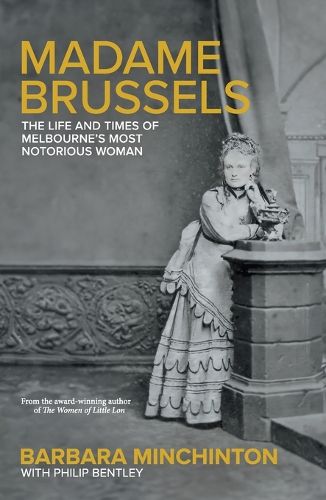
This book is both companion and expansion of Barbara Minchinton’s The Women of Little Lon (my review here) which looked at the sex work industry in nineteenth century Melbourne. Madame Brussels is one of the brothel keepers that Minchin described in the earlier book as part of the ecology and economy of Melbourne’s brothel precinct, but here she deals with Madame Brussels as biography, rather than one name among others.
Madame Brussels is probably the best known of Melbourne’s ‘flash madams’, now immortalized with her own lane and roof-top bar. She was certainly well known in the late 19th century, too, through her political and policing contacts that largely shielded her from prosecution, court appearances and notoriety. Caroline Hodgson nee Lohmar was born in Germany, married in UK and arrived in Melbourne with her husband ‘Stud’ Hodgson in 1871, shortly after her marriage. She rode the exhilaration of the ‘Marvellous Melbourne’ land boom, suffered the 1890s recession, and was increasingly hemmed in by the ever-tightening moral strictures of the early 20th century.
Soon after her arrival in Melbourne her husband left her to work as a policeman ‘up-country’, returning twenty years later in the depth of the 1890s depression in poor health. Left in a strange city as a deserted wife, she opened a boarding house in Lonsdale Street and gradually began accumulating property adjoining her original purchase, later purchasing property in South Melbourne, Middle Park and Beaconsfield Parade in St Kilda. She presided over her brothels, but there is no evidence that she worked as a sex worker herself. Her brothel attracted politicians and magistrates and there were rumours that Alfred Plumpton, then music critic for The Age and composer, was her lover. Although she appeared in court several times, she was always well represented and almost magically the magistrate’s bench filled up with worthy JPs who were not otherwise active in the courts (but may well have been active in her brothel). She remarried after her first husband’s death, but this marriage to fellow-German Jacob Pohl was no more successful than her first, as he soon left her to live in South Africa for several years. After a couple of years’ absence from the brothel scene, she started up again but times and politics had changed.
In the years preceding the turn of the century she became increasingly name-checked by moral reformers, particularly Henry Varley, and became a regular object of scandal in John Norton’s Truth newspaper (which had plenty of the former, and little of the latter, despite the name). In April 1907, after appearing in court charged under new laws with “owing and operating a disorderly house”, she closed her brothel in Lonsdale Street, and died soon after in 1908. Despite an extravagant funeral, she had little to show for the wealth which had passed through her hands.
As might be expected of a notorious entrepreneur, the sources for her life are skewed by real estate transaction documents and court appearances reported breathlessly by the newspapers. There is a genealogical record, although it is patchy: for example, it is not clear whether her ‘adopted’ daughter Irene was actually her own daughter. There are the annual ‘in memoriam’ notices that she placed in the newspapers after her first husband’s death, as was the practice in the early 20th century. But in terms of letters, diaries etc, there is nothing.
In an afterword Phillip Bentley, who is credited as co-author writes:
…we have remained resolute our desire for all conjecture to have a basis in fact and so have resisted the temptation to speculate on how she overcame her early education towards ‘moral earnestness, humility, self-sacrifice and obedience to authority’ in order to become Melbourne’s most famous brothel madam of the nineteenth century (p. 253)
I’m not absolutely convinced that the authors fulfilled this resolution. There are many times that they raise questions which they leave hanging in the absence of evidence, but the questions are raised nonetheless, couched in “may” and “could” statements. The chapter ‘A Curious Gentlemen’s Club’ I found particularly unconvincing, where the question of flagellation is raised, largely on the basis of her first husband’s uncle’s involvement in the ‘Cannibal Club’ and the presence in Melbourne of journalist George Augustus Sala, who was said to have coined the phrase ‘Marvellous Melbourne’ as well as being the anonymous author of flagellation pornography. As the final paragraph of the ten-page chapter says:
In all the records and writings and newspaper reports examined to date there is no suggestion that Caroline’s establishments offered anything other than ordinary common-or-garden variety male-female sex. There are no wild rumours, no snide passing remarks from journalists or parliamentarians under privilege, in fact no hints at all of anything alone the lines of the ‘fladge brothels’ in London. That does not mean it was not happening of course: it means that if it was, we simply can’t see it. (p. 82)
Likewise the chapter where they raise the question of whether her first husband Stud was homosexual raises the question but then admits “There is no way we can know for certain whether Stud was gay” (p.140). I’m not sure that raising questions, identifying parallels and possible networks is sufficiently rigorous, although surely a temptation when writing a life of such notoriety which provided relatively barren and biassed documentary evidence.
This book stands on its own two feet, but I think that I appreciated it more for having previously read The Women of Little Lon, a book which has firmer evidentiary foundations than this one. But I guess that’s part of the challenge of biography: finding the individual person while confronting the dearth of evidence. Even Phillip Bentley admits that perhaps they have not unpacked her personality as much as they would have liked (p. 253), but certainly the authors have succeeded in bringing out the person behind the name now adopted by popular culture with such glee.
Dan Snow’s History HitThe Warsaw Uprising. It’s the 80th anniversary of the Warsaw Uprising, which I have always had confused in my mind with the Warsaw Ghetto. This episode features Clare Mulley, the author of Agent Zo: The Untold Story of Fearless WW2 Resistance Fighter Elzbieta Zawacka. To be honest, I’d never heard of Agent Zo. She was born in German-occupied Poland, and was 11 years old at the end of WWI. Once WWII began, she was involved in active service with the Polish Home Army from the start, a resistance force of 400,000 to 500,000 people. The Polish government and army escaped and set up a government-in-exile, and never conceded defeat. From 1942 she used her German language skills and appearance to bring information into Berlin, and in 1943 was sent to Britain with microfilm. She brought parachutists back to Poland to join the uprising, which started on 1 August with an outbreak of brutal street fighting. Hitler was furious and ordered that every Pole be shot. Meanwhile, with Stalin advancing from the east (he had changed sides by now), the Russian government stepped back and let the battle continue, as it was in their interests for the Polish nationalists to be wiped out. The Warsaw Uprising continued for two months, and Warsaw was completely destroyed. Agent Zo was arrested and imprisoned in 1951, long after WW2 had finished. She died in 2009.
In the Shadows of UtopiaBecoming Cambodia Pt 2: Cambodia after Angkor This episode deals with the increasing European influence in Cambodia, and the shift from a subsistence economy to a trade economy. Longvec (or Lovec) was the capital for 50 years until it was conquered by the Thai. A multitude of foreign traders moved into the area, including Portuguese and Spanish traders who were competing with each other. The first phase of trading involved the extraction of gold and silver (and the spreading of religion in return), but the second phase involved Dutch trading for goods, rather than mere extraction. In 1594 the Thais threatened again so the King looked to the Spanish in the Phillipines for support. By the time his envoy returned, the Siamese had invaded and the King fled. When the Thais were distracted by conflict with Burma, the King took Lovec back again. The Spanish envoys decided to support the King in exile, and were promised that they were free to spread Christianity. By the time the envoys arrived in Laos to liberate the King, he was already dead, so they brought his son back again, only for the son and the envoys to be killed. Meanwhile Pierre De Behaine, a French missionary stationed in Vietnam where there was north/south tribal conflict, went back to Spain and organized the Treaty of Versailles – no,not that one- this one was in 1787 between the French King Louis XVI and the Vietnamese lord Nguyễn Ánh, the future Emperor Gia Long. Not a good time to be ratifying treaties, and when the French government fell through with its promises of aid, Pierre brought mercenaries and modern warfare methods. In 1801 Nguyễn proclaimed himself emperor of North and South Vietnam. Meanwhile, the Vietnamese and Thai governments both kept fighting to-and-fro over Cambodia. There was 40 years of Vietnam influence, then the Thais installed a pro-Thai King who gave away land around Angkor to a warlord, which was strongly resented. In the 1820s there was a new Vietnamese emperor who very anti-Catholic.
Episode 6 The Dawn of French Indochina This episode deals with the years 1789 – 1887. He starts off this episode with an engaging story of two little village boys growing up under the French protectorate. It’s only after you’ve been listening for a while that you realize that he’s talking about the man who became Pol Pot, and suddenly the story doesn’t seem quite so engaging any more. In telling the story of how the French came to dominate French Indo-China, he draws on three longer themes. The first is the French Revolution, which embodied nationalism as a source of power. When Napoleon III wanted to regain the empire that had been lost after Waterloo, he seized on the persecution of French missionaries in the 1850s as a cause to justify colonialism. The second factor was the unification of Vietnam, which had previously been split between clans in north and south Vietnam. This strengthening of Vietnam meant that Cambodia was being tussled over between two stronger countries: Vietnam on one side and Thailand on the other. The Cambodian king, crowned under Thai influence, started to look for a third power that he could turn to. Finally, we had the French naturalist Henri Mouhot who toured Siam, Cambodia and Laos and saw the potential for growing cotton, to fill a possible market failure with the American Civil War, and a way of competing with Great Britain’s imperial power. He also uncovered Angkor Wat during his travels. France invaded Vietnam by the end of the 19th century, as an opportunity to access Chinese trade, under the excuse that they were protecting French Missionaries from mistreatment. But the French didn’t need to invade Cambodia; King Norodom welcomed its presence.
Background Briefing. Kidnapping the Gods Part 1. Over this week, I was in Phnom Penh and visited the Cambodian National Museum, where they had a display about looted artefacts that had recently been returned to Cambodia. This two-part Background Briefing program looks at the Australian collection of Khmer artefacts purchased, of all places, from David Jones department store in Sydney, which had a special section for fine arts. Although the director of the gallery, Robert Haines, seemed completely above-board, he sourced his artefacts through a Bangkok dealer called Peng Seng who also worked for Douglas Latchford, an infamous dealer in Khmer looted goods.



 The Resident Judge of Port Phillip