
First Saturday, so it’s Six Degrees of Separation day, hosted by Kate at BooksAreMyFavouriteandBest. She chooses the starting book – in this case, Tom Lake by Ann Patchett- and participants think of six titles that they associate, springing from that original book.
Although I have read several Ann Patchett books, I haven’t read Tom Lake, but that’s par for the course because I almost never have read the books with which she starts her chain. This time I’m going completely by the title of the book, jumping from one word in the title to its use in the next title in the chain. I confess to having to resort to the sub-title at times, but it’s still on the front cover! So…Tom Lake…
Blue Lake by David Sornig is subtitled ‘Finding Dudley Flats and the West Melbourne Swamp’ and it deservedly won the Judges’ Special Prize in the Victorian Community History Awards in 2019. Sornig describes himself a writer and a psychogeographer, not a historian, but this is beautifully written history that starts with Blue Lake, known variously as Batman’s Swamp, Batman’s Lagoon, the North Melbourne or West Melbourne swamp, now a vast construction site. The narrative shifts back and forward as the narrator walks – literally – what he called ‘the Zone’, while he also delves archives, sifts newspapers, follows up family history links. (Read my review here)
Night Blue by Angela O’Keeffe is about Jackson Pollock’s ‘Blue Poles’ painting. Presented in three parts, Parts I and III are told by Blue Poles the painting itself as narrator- something that requires the reader to suspend disbelief and cynicism. It is, as Yes Minister would say, a “courageous” narrative decision. Part II is told by Alyssa, an academic art historian, who many years earlier had done some conservation work on Blue Poles. I must admit that I found this second part of the book rather unsatisfactory, although it did work as vehicle by which the author could work in the factual information about the painting. (Read my review here)
Our Souls at Night by Kent Haruf is a simple, affirming, grown-up book and an absolute gem! It’s only 179 broadly spaced pages long, but it’s gentle and wise and sad and when I finished it too late into the night, I sat in bed and cried. (Read my review here).
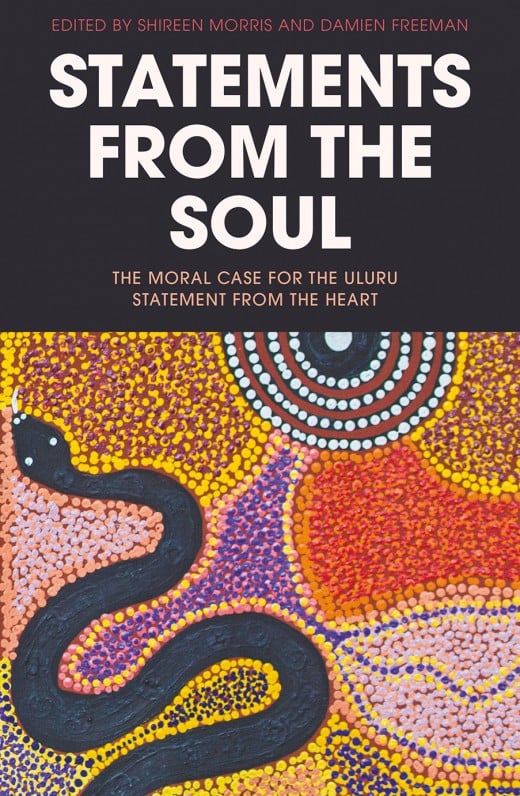
Statements from the Soul: The Moral Case for the Uluru Statement edited by Shireen Morris and Damien Freeman. Although the Uluru Statement comes ‘from the heart’, it is not hard to sense its moral force. Religion does not have a monopoly on moral thinking, but this particular volume contains essays from people of faith, speaking about their moral response to the Uluru Statement and talking about the elements of their own faith that have brought them to that position. I am heart-broken that moral force was not enough. (Read my review here).
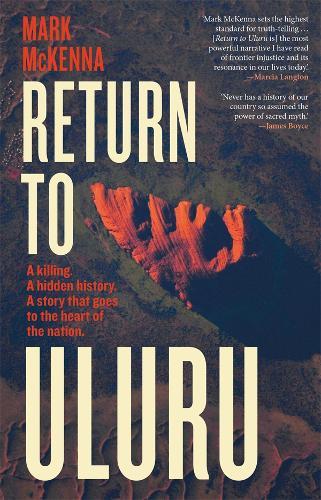
Return to Uluru by Mark McKenna explores the shooting of Anangu man Yokununna in a cave nestling within Uluru by Northern Territory policeman Bill McKinnon back in 1934. I sometimes bridle at the historian-as-detective trope that is used to pump up the narrative in order to make a history more ‘saleable’, but here it is absolutely justified. Coming to a case some 80 years later, and in a world where the politics of indigenous history are changing but still contested, McKenna tracks down some interesting leads and sources, some of which make him reflect on the sheer, remorseless plunder of indigenous country, others which challenge the ethics of doing history. (Read my review here)
Australian writer Christopher Koch makes a return, too, in his book The Many Coloured Land: Return to Ireland. As a reader, I have little red flags that pop up when authors do particular things. I must confess that when the book started with family history, I inwardly groaned. Family history, while fascinating to the descendant, can be rather eye-glazing for other people, unless it’s contextualized and the author has convinced you that it’s going to be worth your while. Nor do I enjoy descriptions of food, and I don’t really care what people look like. This book violated all of these no-go zones at times. Nonetheless, I really enjoyed it. It’s a beautifully written plaiting-together of historic research, family history, travel narrative and memoir. (Read my review here).
I seem to have travelled all over the place in my chain: West Melbourne, Canberra, a small town in Colorado, Uluru and finally Ireland.
 The Resident Judge of Port Phillip
That’s interesting what you say about the Koch, I have it on the TBR, and yes, family history *groan*…
I wish I had a book of my choice for every time I’ve been at a gathering and been introduced as a litblogger to someone who is writing their family history and that’s it, the night is ruined while they tell me all about it.
I do not subscribe to the common belief that everyone has a story to tell!
Ah! You have the always readable Kent Haruf in your chain too! Every one of your other choices looks interesting, though I’m not sure they’ll all be readily available in the UK.
Well done. I don’t know any of these books.
Some interesting reads I wasn’t aware of.
Ha, yes, I’m currently doing a memoir writing course because I feel like you about family history – is it really of any interest except to the family in question (and sometimes not even to them)? Answer still to be determined.
I really like your chain of book titles – must try that at some point, it feels effortless although I’m sure it wasn’t, since subtitles got involved.