Yearly Archives: 2018

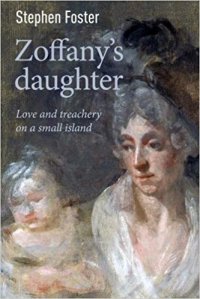
‘Zoffany’s daughter’ by Stephen Foster

Zoffanys-Daughter

2017, 138 p & notes

It must be all those Dickens and Trolloppe BBC miniseries. When you’re reading 19th century colonial letters and newspapers, you’re often engulfed with a sense of deja vu. You’ve seen these dilemmas before; the characters feel familiar- you can even picture the the actor who’s going to depict them when it comes to television…

Except that this feeling of deja vu is an illusion. The past is not just “us in funny clothes” as Greg Dening once said. (Readings/Writings p. 209)  If we’re trying to make sense of people’s actions in the past, there is a whole web of constraints and sensibilities that are largely invisible to us if we’re just relying on imagination and common-feeling. Especially when we’re writing as historians, rather than novelists.

The historian’s methodological self-discipline is exemplified by Stephen Foster’s book Zoffany’s Daughter. As a historian, he encountered a newspaper article from 1825 about the Horne custody case on the Isle of Guernsey.  As he tells it:

 The report seemed irrelevant to the research I was then pursuing – yet I paused, intrigued by a narrative that appeared at once remote and familiar. …Indeed, stories about child custody disputes today seem all too familiar(p.2)

And it is an arresting little story.  After their marriage breakdown, the Rev. Thomas Horne agreed to his wife taking custody of two of his daughters, and paid their maintenance. However, he later changed his mind and demanded the return of his daughters. Cecilia Horne (nee Zoffany – hence the title) hid her youngest daughter Laura and refused to reveal her whereabouts.  This is the story of the case.

As Foster suggests in an epigraph “Most of this story is true.  So far as I know, none of it is false. Much of it is fiction”.  He’s right- if you counted up the pages, much of the book is turned over to the invented journal of Cecilia’s older daughter,  Clementina, who was not part of the court case because her father, after some consideration, allowed her to stay with her mother.  There was a Clementina Horne, but there was no journal. These pages are pure Foster, but as a historian, he operates within the constraints of those invisible sensibilities and the factual parameters of the time.

“Remote and familiar” is how the story appeared to him, and “remote and familiar” is the balance that a historian needs to keep. It’s a balance that Foster explores in reflective chapters that are interspersed throughout this book. In this regard, Foster is very much a present narrator. He strolls onto the stage in these reflective chapters in the first person to discuss various elements of the historiographical challenge.  These are discussed more as discursive, personal, writerly challenges, rather than academic ones. The nature of gossip and its influence on the written record, for example, makes no mention of Kirsten McKenzies’ Scandal in the Colonies, a highly pertinent resource. In his chapter ‘On history and pictures’ he discusses the attempts to find a likeness of Cecilia Zoffany within his self-portraits and portraits of his family.  His chapters ‘On the history of child custody’ and ‘On the rule of law’ explain the colonial law about divorce and custody in operation at the time, and the distinctiveness of Guernsey law.  Methodologically, the most important chapter is ‘On small history’ where he defends the use of microhistory to illuminate a broader picture, pointing to the well-known examples of Ginsburg’s The Cheese and the Worms, Natalie Zemon Davis’s The Return of Martin Guerre (neither of which I have read, I must confess) and Emmanuel Le Roy Ladurie’s excellent Montaillou (which  I have read).

One of the things that Foster does very well was to capture the differences between Guernsey law and society, and the English context which we think we know through Trollope and Dickens.  The French influence was deep-seated, and anti-Catholicism was more nuanced. On the other hand, I don’t know whether Foster gave enough emphasis on the rarity of a situation where a father would grant not only custody but maintenance as well to his estranged wife.  Fathers – or their extended family – kept the children if they wanted them, full stop. Foster acknowledges that the court case split the small Guernsey community, but I think that his sympathies are rather too strongly with the mother, Cecilia.  However, he has the humility to leave judgments about the significance of the case, its lessons (if any) for modern custody cases and the effect on the child to the reader.  Perhaps this is the 21st writer speaking, rather than the historian.

This is a self-published volume, which is an interesting choice by an academic historian, although Foster has also published with Pier9 (a Murdoch company).  Certainly his thanks extend to other well-known historians (Michael McKernan, Alan Atkinson) and the blurb from Ann Curthoys, the author of Is History Fiction? is well-chosen.  I was delighted to find full colour plates interspersed throughout the text, capturing well the Guernsey location at the time, and emphasizing Mrs Cecilia Horne’s connection with her painter father Johan Zoffany.

I was also really pleased to find that the notes at the back made clear the sources and documentary basis of his work as a historian in the book.  I’m sometimes uneasy, I must admit, with ‘creative non-fiction’ and the blurring of lines between history and fiction.  I appreciated Foster’s straightforwardness about what was invented, and what was not.  For me, it’s only when the author has signalled their awareness of the distinction, that I can really relax. And relax I did, with this book, and I was genuinely interested to find out what happened in the end, and satisfied with the fidelity of the ending.

Source: review copy courtesy of the author

My rating: 8.5
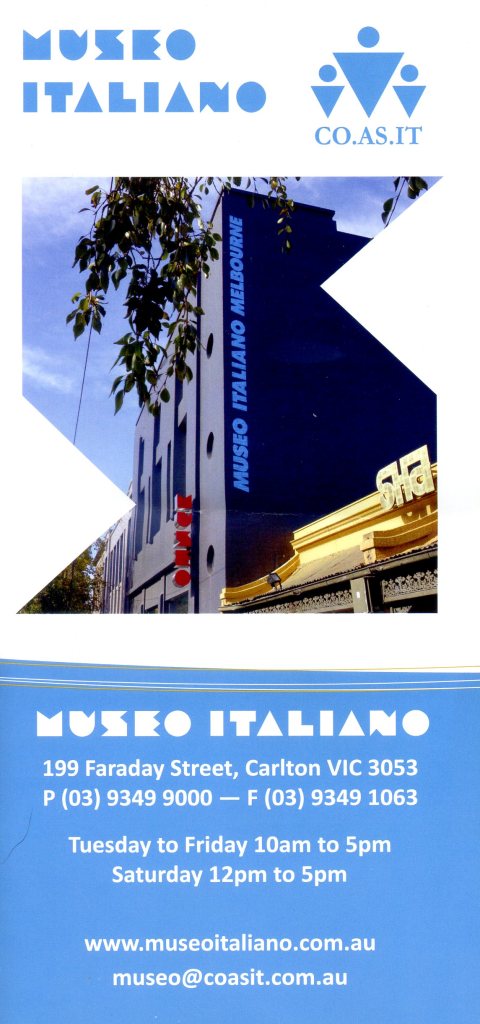
 

Museo Italiano, Carlton

img486

In January we had a day off from caring for Dad. It was a stinking hot day (41 degrees) and coming out of the air-conditioned comfort of Cinema Nova, we weren’t quite ready to head home yet but didn’t want to relinquish our undercover car park. What could we do? Then I remembered the Museo Italiana at the CoAsIt building in Faraday Street, which I’d promised myself I’d visit one day.  Was it open? Yes! open Tuesday to Saturday.  Was it air-conditioned? Yes! Beautifully!

It’s a good little museum, documenting the Italian migrant experience right back to convict days and the gold rush, but focussing on post-war migration.  During the 1950s and 1960s, Carlton was known as the Italian part of Melbourne, a small remnant of which remains in Lygon Street today.  The displays are professionally mounted, and there’s good use of music and video.

And if you need any further encouragement- it’s free!

Movie: Wonder

Dad thought I’d probably enjoy this. Then he thought again.  As someone with a cleft lip and palate, I’ve had my own share of stares and cruelties as a child.  I’ve also felt the pain of being the parent of an affected child.  Perhaps it might be too close to the bone? he wondered.

He need not have feared.  I was not uplifted.  I was not cast down. My main response to this movie was nausea at its unrelenting saccharine-ness.

The little boy who starred in the movie does not have Treacher-Collins syndrome. His appearance was created through prosthetics and makeup. I’m not sure how I feel about this. I acknowledge that it would be an exceptional child who could both act and live a life of being stared at and shunned.  I don’t know if anyone would want to play in a kid’s head that way.

On the other hand, there’s something inauthentic about a movie with the message of “you are beautiful no matter what” and “be kind” choosing a non-affected child to pretend to have Treacher-Collins.  Something a little too easy about being able to wipe off the prosthetic and then go on to the next movie.  I’m uneasy about it.

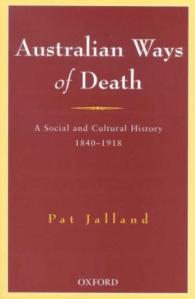
‘Australian Ways of Death’ by Pat Jalland

jalland

2002,  328 p & notes

This might seem a really perverse book for me to have read recently. My father died a fortnight ago, and I began reading it while he was gravely ill.

You’ll note from the title of this book Australian Ways of Death: A Social and Cultural History 1840-1918 that Jalland finishes her book at the end of WWI. In the epilogue she explains why she made 1918 the cut-off point. Most obviously, the death and disappearances of so many soldiers overseas in WWI, with their bodies  buried on the other side of the world (if found at all), forced a change in the way people mourned. Information was incomplete and delayed, and there was no physical grave nearby to be visited.  But she also points to the present-day medicalisation and denial of death that has emerged since 1918.  The influence of Christian churches declined; there was a change in the meaning of death as life expectancy rose with a shift from infancy to old age as the most probable time of death; the medicalization of death meant that the death of a patient represented ‘failure’, and the physical act of caring was relocated from women relatives to hospitals and nursing homes. (p.327)

So why read this book now? I felt with Dad’s death that we were reverting to an older, more traditional way of facing death. First, after several bouts of bypass surgery and an inoperative stent over a period of thirty-five years, Dad was dying with heart and renal failure – a slow, inexorable death for which there was no magical surgical or medical cure, just as was the case during the 19th century.  Second, we chose to help Dad die at home, not in hospital. Even though we had a hospital bed, carers and nurses attending him and twice-weekly visits from a wonderful GP, they were walk-on, walk-off players. The more common scene was just us, day and night, in the lounge room where Dad decided he’d prefer to be, with a bag of prescription drugs to be sure, but more importantly face-washers, ice chips and glasses of water. And so, I sought out this book, out of curiosity and fellow-feeling, and probably as an attempt to intellectualize what we were experiencing these last few weeks.

Prior to the publication of this book, Pat Jalland had written about death and the Victorian family, most particularly in Britain. In this book, she looks for continuities but also differences between the Australian and British experience.

Part I examines immigrant deaths at sea, both of children and of adults. Her time frame extends beyond the mass immigration of the 1840s and the gold rush, into journeys made later in the century. Chapter 1 ‘The Terror of a Watery Grave’ explores the experience of losing a child while on-board ship, which was all too common, and which was often dealt with expeditiously and without formal ceremony. That did not mean, however, that the parents did not grieve: they did, from the ‘poshest’ cabins through to the meanest steerage berth. Chapter 2 ‘Faith, Fever and Consumption’ took up the experience of on-board death amongst adult passengers, who rarely had the opportunity to have the ‘good death’ that nineteenth-century people sought, even though the ‘sea air’ and Australian climate was thought to be restorative.  Because the journey was such a huge life-event, taking people far from their families, there is a cache of correspondence that Jalland can draw on that represents a range of families of differing economic status.

In Part II, ‘The Good Christian Death’, she explores the transmission of ideals of ‘the good death’ from Europe to Australia. She notes that it survived strongly over two generations from the 1830s through to the 1880s.  She follows  Hilary Carey’s suggestion that during the last decades of the 19th century and early decades of the 20th, religious indifference increased among the working classes and intellectuals began to question their faith. She argues that the ‘good Christian death’ was experienced differently by Roman Catholics and Protestants. Protestants emphasized a more individualistic death, dependent on family support, where Catholics relied more on rituals dispensed through the priesthood, and thus somewhat removed from family responsibility.  She notes that deathbed scenes from the 1870s onwards, as described in condolence letters and correspondence to those at ‘home’, moved away from a pious concern with the spiritual state of the sufferer, to a desire that the patient die without pain. A ‘good’ death early in the century was a spiritual one; by the end of the century it was a painless one.  She notes that although funerals like Burke and Wills’ extravaganza consciously set out to emulate a British funeral like that of Wellington’s, there was discomfort both with the expense and extravagance on the one hand, and embarrassment at shoddiness of the colonial attempt on the other.   Strangely, amongst the clergy, there was more emphasis on hell in Australian theology than British theology, despite attempts by Unitarians and liberal Anglicans to abolish or at least moderate the terrors of the doctrine. Tombstones were derivative of the graveyards of Great Britain and Europe, but there was greater emphasis on ‘In Memorium’ advertisements in the newspapers.  Keepsakes, hair remembrances and photographs were popular, especially as they could be conveyed physically across the ocean.

Most of this section draws on the writings of middle-class, educated correspondents, and Jallard pauses to examine two particular examples of masculine middle-class memorialization: that of Herbert Brookes for his first wife Jennie.  Even though he later went on to re-marry Ivy Deakin, the daughter of Alfred Deakin, throughout his life he visited Jennie’s grave twice a year.  The other case study was Dr John Springthorpe, whose memorial tomb I wrote about here.  I found it interesting that both these intellectual men, who mourned so deeply and openly, were associated with (although not adherents to) Rev Charles Strong’s Australian Church – in fact, Jennie was Strong’s daughter.

Part III shifts gear, and looks at ‘Death and Destitution’.  Part II had been drawn from the correspondence and writings of middle-class families, but here Jalland turns to the statistical reports and records of ‘benevolent’ asylums, where the individual voice is rarely heard. Although by the 1870s reforms in Britain were gradually changing the nature of the workhouse from a punitive institution to a form of general hospital . This did not occur until decades later in Australia.  Jalland compares the major institutions in different states, noting that conditions were better in Adelaide and Melbourne Asylums. In Tasmania, there was a particular stigma attached to the convict stain, and many sick and dying paupers were ex-convicts. She devotes a whole chapter to benevolent asylums in New South Wales, where a number of government inquiries called on inmates as witnesses, eliciting changes to key institutions in the early 20th century.

In Part IV, Jalland examines death in the bush and in the Great War. Although the literature and artwork of the 1890s sentimentalized the bush burial, or emphasized the heroic deaths of explorers and bushrangers, it was more common for men to die of accidents, illness and – quite frankly- stupidity.  The harsh environment made elaborate rituals impossible and inappropriate. There was respect for the dead, and a stoic acceptance of its inevitability. There were wakes- often “noisy and exuberant masculine affairs” (p. 259). Aboriginal deaths at the hands of settlers were silenced, and many old bushmen, often ex-convicts, died lonely and destitute deaths.  Lost children captured the public imagination, but more commonly women died in childbirth, and children often died after birth or through illness.

In the epilogue, Jalland links the stoic, pragmatic attitude towards bush funerals with the death of mates in the trenches during WWI.  For those at home, there were no graves to visit, and death permeated the community. Churches became more feminized, especially in Protestant churches, and some turned to spiritualism.  As in Part II, Jalland turns again to the example of middle-class, intellectualized masculine grief at WWI loss through the example of John Roberts, who kept detailed scrapbooks about his son and Justice Henry Bourne Higgins who suffered silently.  These men were not religious, and their response marked the increased secularization of death in the twentieth century.  Jalland explored this further in her later book Changing Ways of Death in twentieth-century Australia: war, medicine and the funeral business.

This was a strange book to read at a strange time.  I much preferred the chapters where she cited letters and case studies, rather than the demographic and statistical chapters.  I really liked the way that she approached the question of 19th century death from so many aspects: middle class/ working class; male/female; Catholic/Protestant; Urban/Rural; English/Australian. Other writers have since picked up where she left off (for example, Tanya Evans on benevolent asylums, or Bart Ziino on war graves).  But there is real human interest here,  with a common humanity, even though practices may have been different.  At a difficult time I found it interesting and oddly comforting.

AWW-2018-badge-rose-199x300

I’ve read this book as part of the Australian Women’s Writers Challenge.

Strange things from the box of photos No. 3

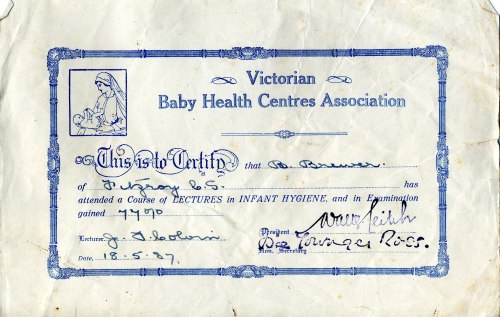
This certificate was awarded to my mother when she was in Grade Six.  It’s hard to imagine Grade Six girls (because I’m sure that it was only girls) being taught baby-wrangling at school today.  No doubt these 1930s girls would have been expected to help their mothers.

And her 77% result? Well, I guess that’s 3/4 of a baby.  It was obviously enough.

img565

‘Anything is Possible’ by Elizabeth Strout

strout_anything

2017, 254 p.

The front cover of this book announces that it is “From the author of My Name is Lucy Barton“. That’s important, because the books are matching parts of the same scenario: the famous Lucy Barton has written a highly acclaimed book.  In My Name is Lucy Barton, which I reviewed here, Lucy the author is lying in hospital and her estranged mother comes to visit her. They speak past each other, rather than to each other, about the past and much is left unsaid.

In Anything is Possible, the back story is filled in. The events referred to obliquely which strike either Lucy or her mother dumb in My Name is Lucy Barton, are explored here in a series of tangentially linked short-stories. As with Olive Kitteridge (which I reviewed here) there are references between one story and another, and it’s as if a network map is being created here of small-town life in Amgash, Illinois. It’s about exclusion, regret, loneliness and willed blindness, and the inexorable march of one day after another.

The stories stand in their own right, but they’re more enjoyable for having read Lucy Barton beforehand. But there is of course a synergy between the two books, and the technique is very Kitteridge-esque, and I do wonder if Elizabeth Strout is going to break and do something different soon.

Sourced from: Yarra Plenty Regional Library

My rating: 8/10

Strange things from the box of photos No.2

We’re going through photos that we can show at Dad’s memorial.  One Australia Day several years ago I wrote about the Bicentennial Beacon, and Dad’s fortuitous involvement. And lo and behold, I found a photo!

You can read about it and see the newly discovered photo here.

Strange things from the box of photos No.1

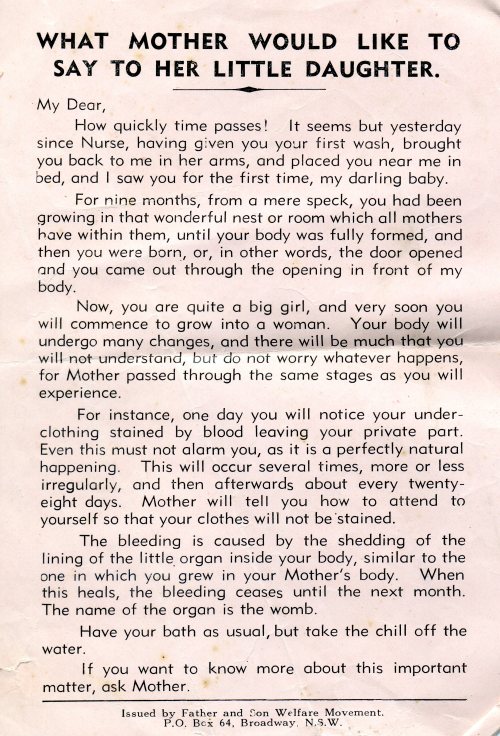
We’re going through boxes of photographs, in preparing for Dad’s memorial service. We started doing it the other day and rushed through it, because we were finding it hard. We did put aside a pile of photographs that have since inadvertently been placed back into the pile of boxes, so I’m going through them again, more slowly. Very slowly. It’s hard to stop being the historian!

I was interested by this leaflet, issued by the Father and Son Welfare Movement. It starts off in the mother’s voice, but seems to become very abstract and third-person by the end. “The opening in front of my body” seems an odd place to be born from: no wonder some children thought they came from their mother’s belly button!  It was presumably a different place from “your private part” (singular).  It reads as if this little letter was designed to be left somewhere to be discovered by the young daughter.

I’m mystified to know why and by whom this leaflet was kept. It was in an old case of photos and documents belonging to my parents, but everything in it predates their wedding (and my birth as their daughter). Curiouser and curiouser.

img562

John Lumley 22.2.29- 25.1.18

My dad died last week from congestive heart failure and renal failure. He lived with us, in the back unit adjoining ours, and I feel as if he is present everywhere I look.  With the assistance of Banksia Palliative Care and Kincare, we nursed him at home to the end. We will miss him so much.

P1010788


Movie: Loving Vincent

Loving Vincent is the story of a young man who, charged with delivering a letter between the now-deceased Vincent Van Gogh and his brother, tries to find out how Vincent died.  Story-wise, it’s a bit of a whodunnit, questioning the assumption that it was suicide.

But you’re not here for the story, which is lacklustre. Instead, you’re here for the animation, which is just amazing.  You can detect who the actors through their voices and posture but they, along with the backgrounds, are painted with trademark Van Gogh brushstrokes. Each of the 65,000 frames has been painted by one of 125 artists, organized into 125 teams

It’s not a long movie at 95 minutes, but originally it was conceived as a short 17 minute film. It could possibly have remained at the shorter length and made a similar impression on the watcher.  I use the term ‘watcher’ deliberately, because this is very much a visual experience rather than an intellectual or emotional one.

Worth seeing for the spectacle.