Yearly Archives: 2018

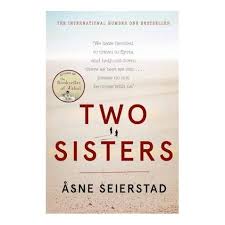
‘Two Sisters: Into the Syrian Jihad’ by Asne Seierstad

seierstad

Translated from Norwegian by Sean Kinsella 2018, 448 p.

In October 2013 two sisters, Ayan (aged 19) and Leila Juma (aged 16) left Oslo, where they had lived since 2000 after being accepted as refugees from Somalia. They were on their way to Syria, where they joined jihad by becoming the wives and mothers of IS fighters. In the afterword of this book ‘The Basis of the Book’, Norwegian investigative journalist Asne Seierstad writes that her most important question about the radicalization of these Somali-Norwegian sisters was “How could this happen?”(p. 437)   Further, “Is this merely to do with them, or does it also have something to do with us?”  She lays out the information, but as she admits, she doesn’t really answer her own question:

I offer no explanation, neither of what attracted them to Islamic radicalism nor what propelled them out of Norway. I relate my findings.  It is up to each reader to draw his or her own conclusions. Where did it start? What were the underlying reasons? When could they have taken different choices?…Why did they become more interested in life after death than this life? (p.441)

To my mind, their radicalism began when a group of Somali mothers paid for a Koranic teacher to provide extra-curricular Koranic classes for their children. The mothers, who were themselves marooned in Norwegian society, felt that their children were becoming swamped by their Norwegian schooling and friendship groups, to the detriment of their Muslim background.  The girls were further radicalized by what in Christian circles would be called an evangelical campus program.  They became more devout – something that their parents neither encouraged nor discouraged at first – and gradually grew more supercilious, judgmental and independent. In planning their trip to Syria, Ayan took advantage of credit cards and bought up mobile phones and plans on credit that she then onsold, with no intention of ever making payments for either. Social media amplified and solidified their radicalism.

Once in Syria, they gloated about their access to free housing, electricity and food, appropriated from the infidels who fled or succumbed to the IS influx. They refused to return with their father when he finally located them, and they embraced the communal, cloistered life of an IS wife and mother.  Their father Sadiq, charged by his wife Sara with bringing them back, felt that he had failed; his wife returned to Somalia to give her younger sons the Islamic education and culture that she felt her now-estranged daughters had lacked, and their brother Ismael, who maintained sporadic online contact with his sisters, rejected Islam completely, largely in response to their actions. The two girls broke their family, even though they claimed at first to have acted in order to save it from judgment.

As Seierstad explains at the start of the book, it is a “documentary account” drawn from a variety of sources. It is told as a narrative, switching its focus from one character to another in a largely chronological account. In her final chapter, she explains in more detail how she compiled this “documentary account” which is rather more than just written words. Instead, it is supplemented with interviews, most importantly with their father Sadiq, but also with other people who knew the girls and the family.

It is only at the end of the book that she reveals just how fundamental Sadiq was to the writing of the book.  We have read much of the narrative through Sadiq’s eyes, where as well as distraught father we also come to see him as a fantasist, liar and man who flirted with the idea of criminality as a way of getting the money to ‘rescue’ (i.e. kidnap) his daughters who did not want to return to Norway.  She reports all these things, but does not comment. In hindsight, I find her uncritical acceptance of Sadiq’s narrative in the main text problematic.  It was only when I checked back in my reading journal that I found that I had read Seierstad’s earlier book ‘The Bookseller of Kabul’ (before I started this blog) where I was likewise conflicted about Seierstad’s readiness to accede to her narrator’s viewpoint without challenging it or interrogating its effect on the story she is telling.

That said, I found the book compelling.  I feel that I have a better understanding of Syria, and its tumultuous last decade.  It had the page-turning drive of a thriller, and I found myself squirrelling away opportunities to read, just to find out what happened. I alternated between gratitude to Norway for its generosity in picking up the pieces of this shattered family, and resentment at the Juma family’s exploitation of that same generosity.  It has both made things clearer, but complicated them as well.

Sourced from: Yarra Plenty Regional Library

My rating: 8.5

Reading challenge: A Norwegian book in translation!
 

Movie: The Post

[Actually, I saw this film two months ago and forgot to post this review.  I often refer back to this blog when I can’t remember whether I’ve seen a film or not, so here goes…a review of a film that’s no longer screening]

This movie has both the big heavy hitters: Meryl Streep and Tom Hanks who of course make acting look so simple that it barely seems as if they are acting. Having said that, I didn’t recognize Tom Hanks at first, so he was playing someone other than Tom Hanks.  It is, of course, the story of Katharine Graham’s decision to publish the Pentagon Papers, the forerunner to Watergate (to my shame, I wasn’t completely sure that they were two separate events).

The Smithsonian Mag has an interesting article about the authenticity of the film. They point out that Graham wasn’t quite as innocent and untried as the film suggests, because she had been running the paper for eight years previously.  They also point out that Graham was strongly involved in the decision to publish the Watergate papers too, even though she is almost expunged completely in All the President’s Men.

The film is produced by Steven Spielberg, who can be relied on to over-egg the pudding and he does it here too, with music so intrusive and such a wave of feel-good-ness at the end that it almost felt like a parody.

I found myself wondering whether it had been written post-Trump, as so many of the themes (freedom of the press, influence of the government, women) are so relevant right this minute. Apparently, the Smithsonian Mag article claims, the film rights were sold a week before the 2016 election.

The film underlines the importance of the press – a paid, professional, independent press. It made me feel a little smug and self-righteous but also proud that I continue to subscribe to several newspapers (even though I have a love-hate relationship with them all at one stage or another.)  I also feel a little frisson of pride that the Unitarian Universalist publishing arm, Beacon Press, was involved in the very risky act of publishing the first full edition of the Papers. You can read more about it here.

Movie: The Chess Player


<p><a href=”https://vimeo.com/214700589″>THE CHESS PLAYER – Trailer with English subtitles</a> from <a href=”https://vimeo.com/user31838675″>Latido Films</a> on <a href=”https://vimeo.com”>Vimeo</a&gt;.</p>

Well,  I can’t embed it so you’ll just have to follow the link to the trailer. I saw this as part of the Spanish Film Festival, in amongst what seemed to be a whole lot of comedies that did not attract me in the least.  I enjoyed it, but it felt a bit like ‘Dr Zhivago’ meets ‘The Count of Monte Cristo’ . It seemed rather dated in its narrative, as if it had stepped out of the 1970s, but it was beautifully filmed.

I was able to follow the Spanish relatively well, but thank God for subtitles!


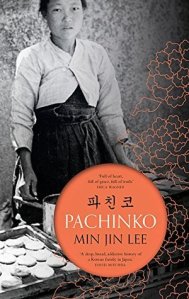
‘Pachinko’ by Min Jin Lee

pachinko

2017, 485 p.

Back in the early 1970s, at the age of 18,  I went to Japan with a Rotary group.  It was a very wholesome tour, but I do recall seeing two things which perplexed me at the time, but I understand better now. They were both in the same building, as I recall: a largish building, similar to an RSL. There was a large, dimly lit bar, with drunken men in white shirts and ties, crooning along off-key to an instrumental soundtrack that I now recognize as karaoke. At the time- and indeed now over forty years later – I couldn’t work out why male office workers (and they were entirely male) would want to make a fool of themselves in this way.  On another floor was what I was told was a pachinko parlour, likewise windowless and dimly lit except for the carnival lights around the pachinko machines. I couldn’t really make sense of the machines, which seemed like a mixture of pokie and pinball machine.  But when I saw the title of this book, I knew exactly what  pachinko was.

I came to read the book solely on the say-so of Whispering Gums Sue’s reading group  who selected this book as one of their favourites for the year. When I put it on hold at the library late last year , I found that almost eighty people were ahead of me.  Three months later I picked it up, read the back blurbs and my heart sank.  “Oh no!” I thought as memories of Falling Leaves and Amy Tan sprang to mind, dreading another three-generation Asian family saga mired in the author’s own autobiography that ends up in America with a self-entitled middle-class, middle-aged woman alternately intrigued and repelled by the lives of her grandmother and mother.

But I need not have worried. In her acknowledgments at the back of the book, the author notes that the story originated in a lecture she heard about Koreans in Japan, where a boy bullied by his classmates in his year book, jumped from a building and died. Fascinated by the failure of Japanese-born Koreans to be recognized as Japanese, and the scant prospect of this changing in the future, she researched further and conducted interviews.  These people may be historical victims, she conceded, “but when I met them in person, none of them were as simple as that”.  I think that the origins of this book in historical situation, rather than genealogy, is what lifts it right out of the pack of Amy-Tam-clones.

The book is divided into three parts: ‘Gohyang/Hometown 1910-1933’, ‘Motherland 1939-1962’ and ‘Pachinko 1962-1989’. Within these parts, the narrative is told chronologically, with jumps of perhaps three or four years, shifting between Korea, which Sunja leaves permanently, and Nagano, Osaka, Yokohama and Tokyo in Japan where she raises her family.  The story starts in 1910, the year of Japan’s annexation of Korea, when Hoonie, a good man hampered by his cleft palate and club foot, marries a poor young rural girl, Yangjin.  They have a single surviving daughter, Sunja.  When Sunja falls pregnant to a married man, Hansu, her situation is relieved by another good man,  the Christian preacher Isak, who marries her and takes her to live with his childless brother Yoseb and sister-in-law Kyunhee in Japan.  Sunja’s first-born son, Noa, grows up believing that Isak is his father, while his real father, Hansu, by now a gangland leader, is an ever-present, watching presence.

The tumultuous events of the second half of the twentieth century (comfort women, Japan during WWII, the communists in North Korea, the US involvement in the Korean war, the American acceptance of Christianized South Koreans as immigrants) all occur off-stage. They are not unimportant, because they form the background to the family’s situation as ongoing outsiders, too frightened to return to the silence of North Korea, accruing wealth and remaining distrusted by the Japanese. The pachinko industry is mired in the Korean underworld, but it lures the family as the only means of progress when education – held up as the path of responsibility – has its limitations. The pachinko game stands as a metaphor for life, where the game is tweaked and manipulated, but it draws its players on for just one more play, in the hope that this time, there will be a win. Life, like a pachinko game, “looked fixed but … also left room for randomness and hope.”

I really enjoyed this book.  It’s long, and not for nothing does Lee cite Dickens in her epigram to Part 1 of the book (“Home is a name, a word, it is a strong one; stronger than magician ever spoke, or spirit answered to, in strongest conjuration”). The book evoked Dickens in its sweep and length, and I found it entirely engrossing, luxuriating in a whole Easter Sunday to sit and finish it in one big gulp.

Source: Yarra Plenty Regional Library (e-vent-ually)

Read because: Sue’s book group enjoyed it

My rating: 9/10

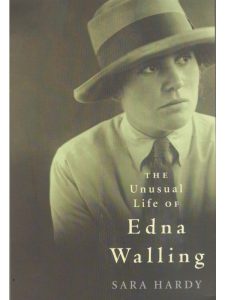
‘The Unusual Life of Edna Walling’ by Sara Hardy

hardy_walling

2005, 320 P.

Have I ever seen an Edna Walling garden? I don’t know if I have, having never visited Cruden Farm.  I know what they look like, though: lots of stone walls, curved paths, and a mixture of deciduous and native plants. This book, however, is only tangentially about gardens.  Instead, it is about landscape architect Edna Walling herself, through the houses and places she made for herself.

The author, Sara Hardy, is a playwright whose work has focussed on strong, educated women and the complexities of their relationships.  Is there a pun perhaps, in the word ‘unusual’ which she uses to describe Walling’s life?  Because with her masculine dress, short hair and succession of close friendships with women, the supposition today would be that she was gay -or to pick up on the title, ‘queer’ – and certainly Hardy circles around this question.  She does not, however, definitively answer it because she cannot find the evidence to assert it with confidence.  For a book that flows so easily, Hardy is actually a disciplined biographer. There are no footnotes, but there are long endnotes that cite the sources for assertions including interviews, books, letters and Walling’s own writings. There are hints about her sexuality. The single surviving overwrought letter written by the 40 year old Walling to her close friend Esme.  The night in a single bed, when another friend, Olwyn arrived late at night.  An observation that ‘we’ enjoyed watching the birds in the garden outside from bed. But there’s no hard evidence.  Hardy notes that

Edna named her otherness as ‘misfit’ or ‘odd’ – her half joking way of saying she didn’t fit the standard female mould.  She may have recognized her otherness as an aspect of her sexuality, or she may not.  There are subtleties rather than clear-cut certainties.  Even Edna’s understanding of the term ‘sexuality’ would have been a world away from the informed and liberated use of the word today. (p.83)

It was a different time – in the first half of the twentieth century – and silence cloaked what we would now see differently

…many women who would now be called lesbians didn’t recognize their intensity as sexual desire; they simply loved their very best friend- who loved them in return. They would have been horrified by the suggestion that their love was anything but pure, and if they did have an inkling, if they did share their bodies,as well as their hearts, why then – they kept quiet about it, and who could blame them? (p.83)

Walling told her niece Barbara in a letter

Often I wish I were in double harness & pulling with someone & then the inner voice says ‘you be grateful you’re not living with the wrong person – that’d drive you mad’  (p. 237).

She was friends with other women who lived openly in  a partnership, like bookshop owner Margareta Webber and Dr Jean Littlejohn, and landscape architect Mervyn Davis (she had a Welsh name) and Daphne Pearson. There seems to have been a succession of close female friends who threaded through her life, but they tended to marry and move on. Some acted as helpers in a domestic sense, others as professional colleagues who laboured with her in paid and unpaid jobs.  As she grew older, some were carers. When she designed the English-style communal village Bickleigh Vale, now in suburban Mooroolbark, it was known locally as ‘spinster’s row’.

[From https://www.bickleighvalevillage.com.au/%5D

Walling was born in England, and it was an idealized English landscape that influenced her early garden designs, with walls and deciduous trees and cottage plantings.  Over time, she became more enthusiastic about native plants, and was greatly exercised about the ugliness of road construction and the sterility of the roadside.  Interestingly enough, by the time she retired to Queensland, she had re-embraced exotic plantings again. So, too, her politics shifted, from conservative to left-wing.

She wrote gardening columns for many years, mainly in Home Beautiful, which greatly increased her profile.  She was obviously a forceful woman: some bridled against her control at Bickleigh Vale, and she had definite ideas about how her gardens should look. Her work brought her into contact with wealthy people (the Murdochs, Dame Nellie Melba) and her creativity brought her into intellectual circles as well.  She didn’t make her fortune from her gardens though: some wealthy clients refused to pay.  For a woman so attuned to place, she suffered three fires in her life: the first in England caused the family to emigrate; the second took her first home ‘Sonning’; and the third fire engulfed East Point at Eastern Beach near Lorne, just after she had given it to the Bird Observer’s Club.  Her first houses, at Bickleigh Vale, were a consciously constructed  landscaped scene, highly reminiscent of England, where she imposed a covenant over the design of houses and their gardens. By the time she built East Point, she built the house to respond to the landscape, re-aligning walls and incorporating rocky outcrops into the design of the house itself: a shift to the natural not unlike her shift from exotic to native plants.

Walling’s own columns were written in a jaunty, jolly-hockey-sticks sort of way, and Hardy’s text seems to have picked up a similar tone.  While she does not go beyond the evidence available to her, she does break into present-tense imaginings that embroider and bring to life some of the events she describes.  These imaginings are well sign-posted as conjecture, and as a reader I’m inclined to trust her renderings, given the rigour with which she supports her work otherwise.

An unusual life? For its time, certainly. A queer life? Most probably, but along with Hardy, I suspend judgment over that.  She may have died as an elderly woman living on the Queensland coast, but her life was richer than such a mundane death suggests.  New owners have taken over many of her gardens, imposing their own visions onto them, but they remain at heart Edna Walling gardens.

Read because: It was a CAE bookgroup choice

My rating: 8.5/10

AWW-2018-badge-rose-199x300

I have included this review in the Australian Women Writers Challenge 2018

A couple of days in the Wimmera Part II

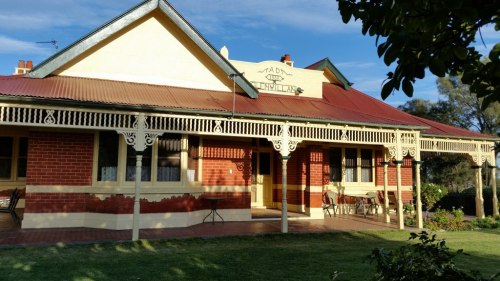
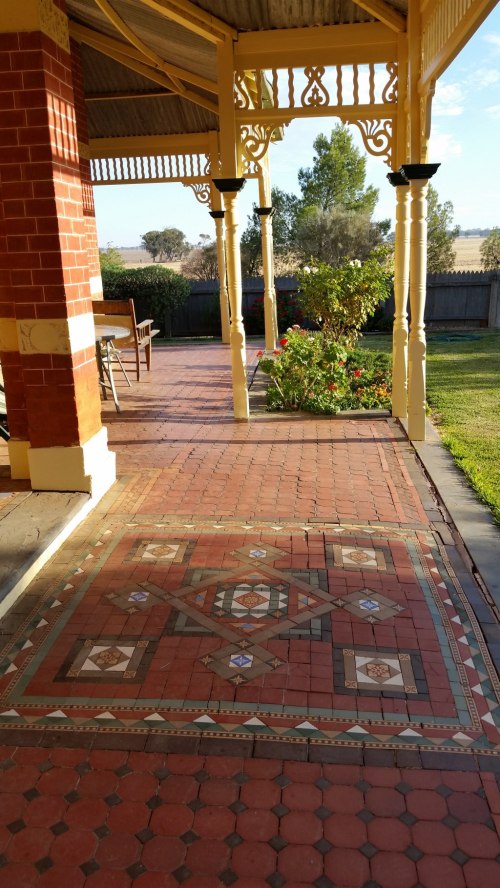
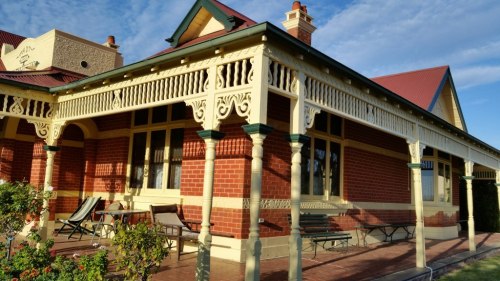
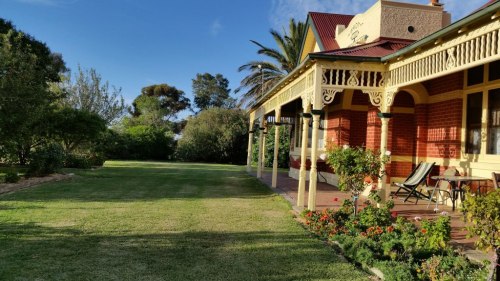
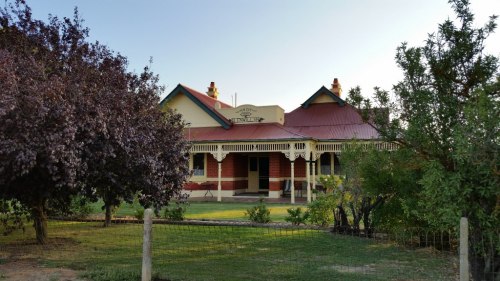
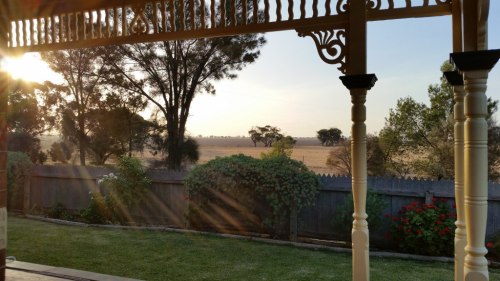
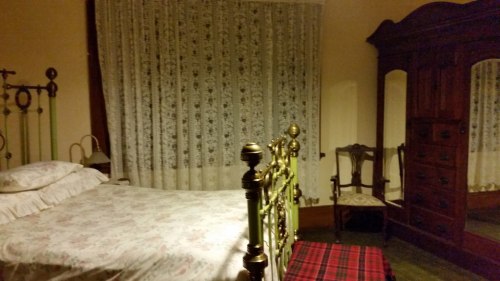
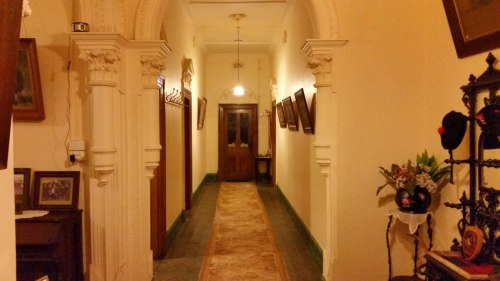
Dusk was falling as we turned into our accommodation for the next two nights: a fantastic pastoral homestead at Wallup called Glenwillan. The date on the front of the homestead references 1888, the date that the three McRae brothers – Duncan, John and Farquahar- selected this property in the Mallee. It was cleared and sown with wheat and oats, as well as running sheep.  Glenwillan was constructed in 1912 using bricks from Stawell at the cost of £1500. It is now owned by the great-grandson of Farquahar McCrae. At first I was very excited, thinking that it was Georgiana McCrae‘s brother-in-law Farquahar, but it’s a different branch of the family.

20180419_081935_small20180419_082027_small20180419_082059_small20180419_082103_small20180419_171352_small20180419_171459_small20180419_171542_small

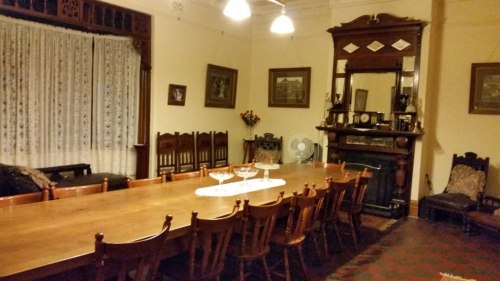
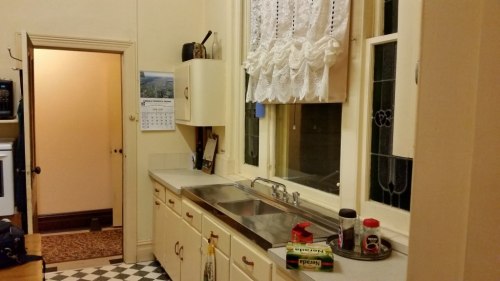
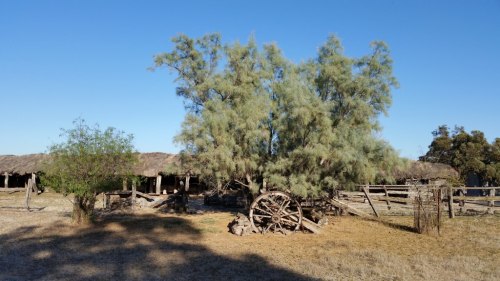
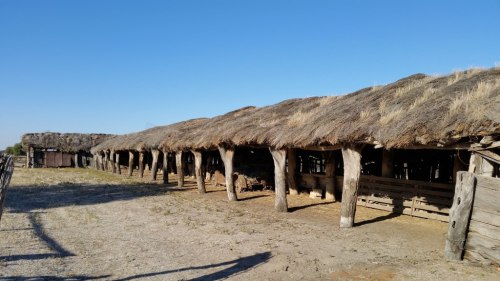
We had the whole place to ourselves! What fun I had, checking out the photographs and paintings of McCraes long passed on the walls and admiring the original furniture- especially the huge dining table which was larger than original envisaged because the furniture maker could not bear to cut up such a beautiful length of wood.  The 1950s kitchen felt just like a Nana’s Kitchen.  At the back of the homestead were thatched stables, which were amazingly dry.

20180418_183002_small

Our bedroom

20180418_183044_small

The hallway.  As a notable local, Farquahar McCrae and his wife attended the Proclamation of Federation at the Exhibition building in 1901, and there was a lot of memorabilia from that occasion.

20180418_183200_small

Just look at that table! Just beautiful

20180418_183247_small

The sort of kitchen that should have the smell of scones cooking wafting from the oven

20180420_084856_small20180420_084939_small

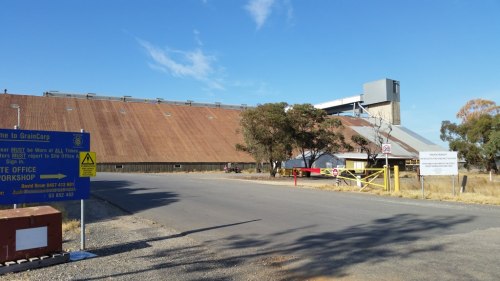
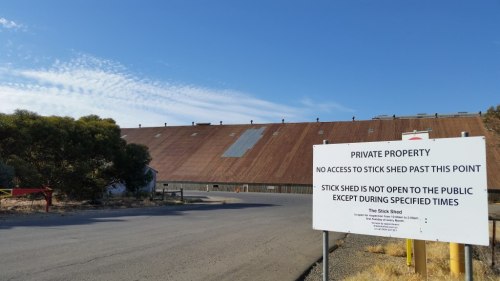
Next time I come up this way – and I will, just for Glenwillan itself – I’m going to make sure that the Murtoa Stick Shed is open. [Check out the link- it shows the inside] It’s open on the first Sunday of each month between 10.00 and 2.00.  It’s HUGE. It was built in 1941 to accommodate the wheat harvest during the war, and unlike other sheds of its type, it had a concrete floor.  It’s on the National Heritage Register. It’s so big that I couldn’t fit it into the one shot.

20180419_092230_small20180419_092301_small

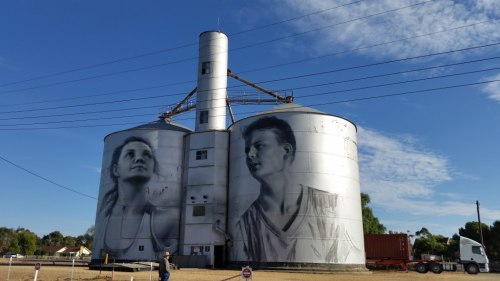
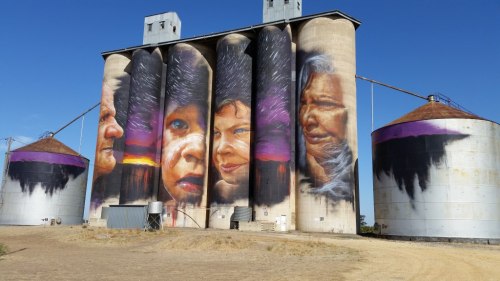
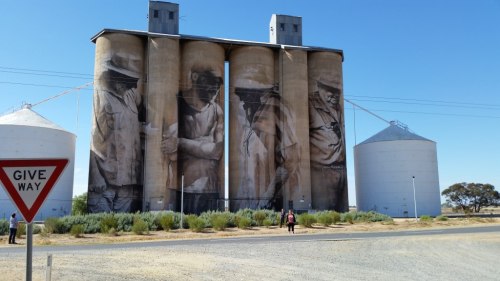
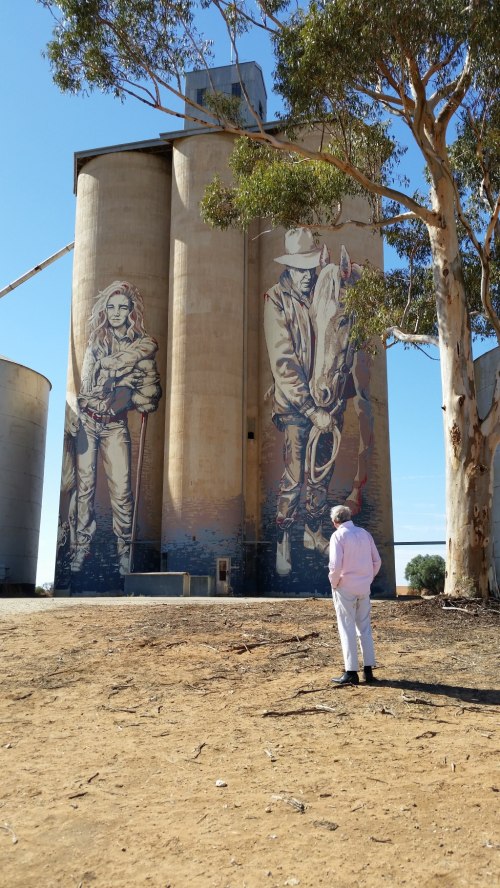
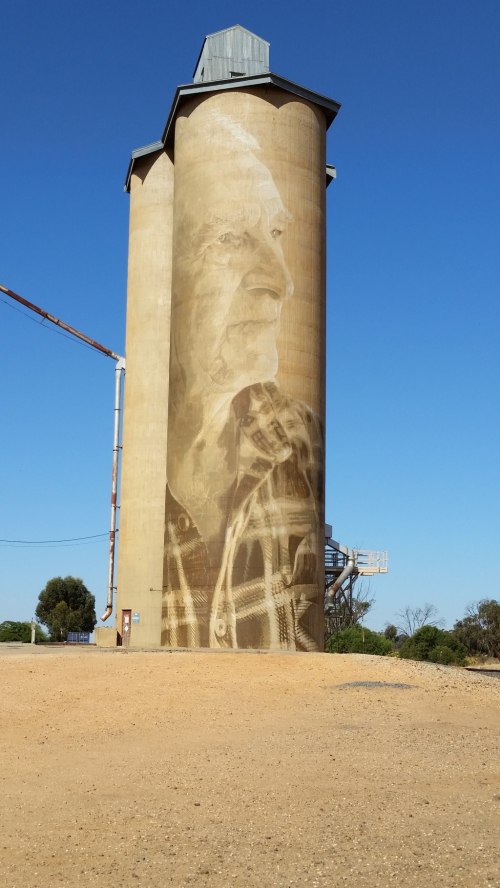
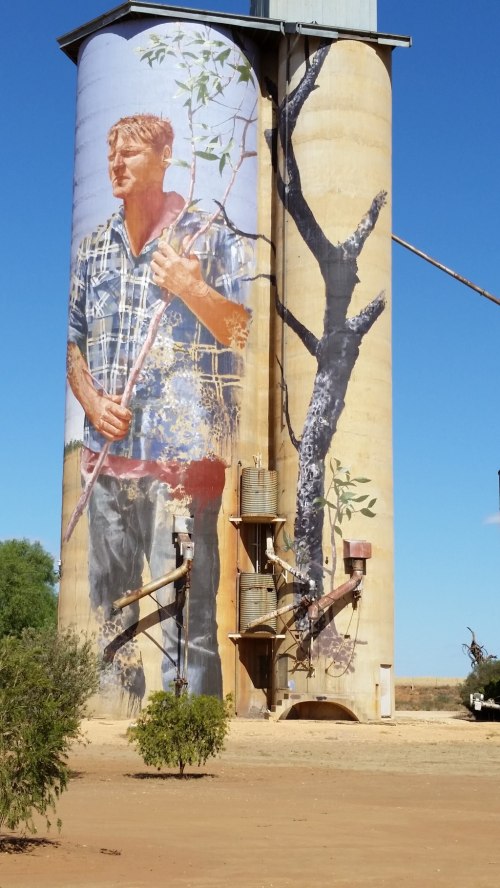
The whole impetus for this little trip to the Wimmera was to see the Silo Art Trail. This fantastic tourist initiative has funded artists to paint the disused wheat silos along the railway sidings in the Mallee area.  I notice that other towns (e.g. Benalla most recently) are also funding silo art. These ones in the Wimmera are a celebration of farming men and women, and to a lesser extent a nod to the continuing indigenous presence in the area.  The silos were built during the 1930s, and are between 28 and 50 kilometres apart. Some are on the outskirts of town; others are just on the siding with nothing else there. What a brilliant idea.

20180419_094102_small

Rapanyup, Artist: Julia Volchkova, featuring two Rapanyup young people, in their netball and Aussie Rules attire.

20180419_105638_small

Sheep Hills, Artist: Adnate. His mural depicts Wergaia Elder Uncle Ron Marks and Motjobaluk Elder Aunty Regina Hood, along with two young children.

20180419_112905_small

Brim, Artist: Guido van Helten.  The first of the silo murals, it was completed in 2016 and depicts an anonymous, multi-generational quartet of male and female farmers.  And yes, that’s me standing at the bottom, along with anonymous photo-bomber (who was very apologetic!)

20180419_115323_small

Rosebery, Artist: Kaff-eine. Completed in late 2017, it captures a young female farmer and a contemporary horseman.

20180419_123936_small

20180419_132041_small

Patchewollock, Artist: Fintan Magee.  Completed in late 2016, this is a portrait of Nick ‘Noodle’ Hulland, a local farmer.  [Just as well that pipe isn’t located any higher!] An interesting ‘flaking’ effect in the painting – at least, I hope it IS an effect and not the real thing.

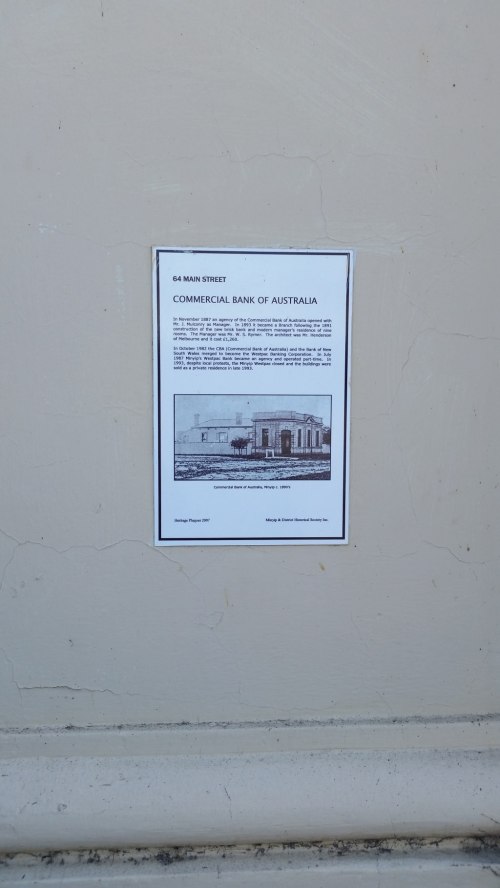
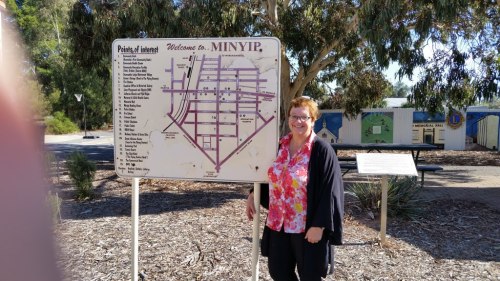
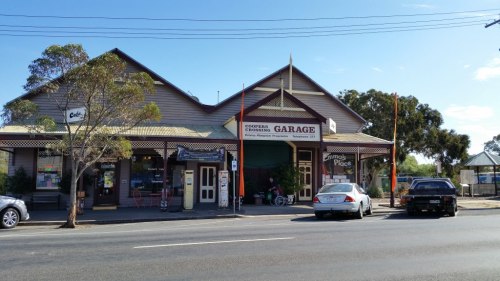
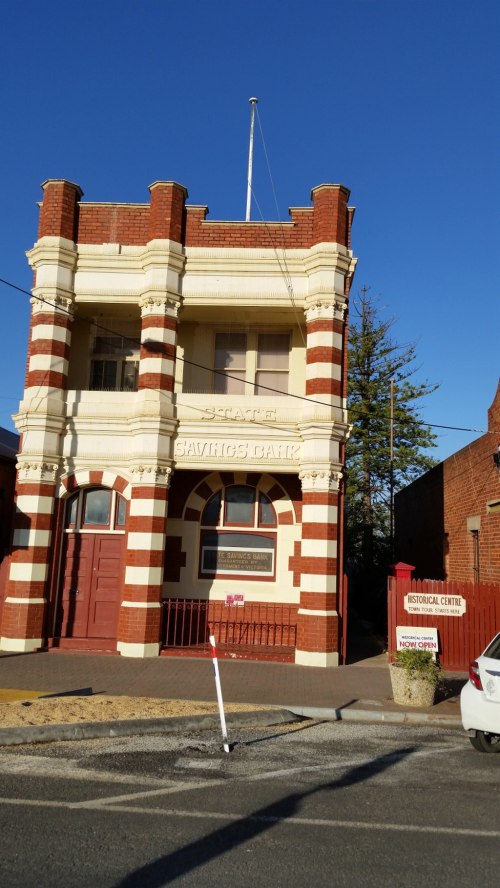
I mentioned in Part I that I felt that the Grampians/Gariwerd were resting on their touristic laurels a bit.  That certainly couldn’t be said of the Silo Art Trail.  I was really impressed with the little town of Minyip, where the local historical society had developed a trail of plaques up and down the largely deserted main street.  Minyip was used as the set for filming The Flying Doctors television series, and the only cafe in town was named ‘Emma’s place’ for one of the characters in the series.  I think that the whole idea is a wonderful tourist feature that entices city folk like us to an otherwise pretty remote area.

20180419_102433_small

One of the plaques on, in this case, the disused Commercial Bank building.

20180419_104206_small20180419_104341_small

We stopped off at Warracknabeal on the way home where, once again, we were lucky enough to find the historical society open.  This time, it was located in the old State Bank Branch.  When the bank closed, it was handed over to the Historical Society ‘as is’, complete with all the internal banking furniture.  It is a wonderful time capsule of a time when tellers wrote in your passbook, and there was a bank manager who actually knew you. Upstairs, in the bank manager’s quarters, there is a good display of a wide range of Warracknabeal artefacts, including the contents of the pharmacist’s shop. Really worth stopping off to visit, for the banking chamber alone.

20180419_163226_small

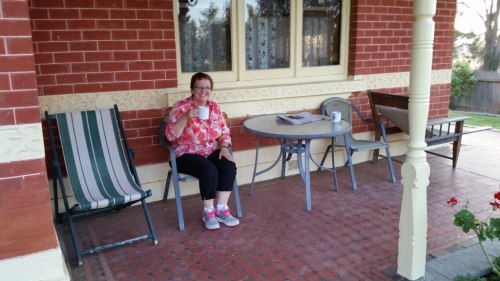
We returned home to Glenwillan,  where we sat on the front porch with our books before returning to the very good Creekside pub at Warracknabeal some twenty kilometres away.  That night we turned off all the lights and stood in the back yard of the homestead, gaping at the stars in the vast sky.  Just think of it – they’re there every night but we just can’t see them in the city.

And so, eventually, we turned for home. We seemed to pack a lot into just three nights. It was great.

A couple of days in the Wimmera: Part I

In our retired state, we are no longer restricted to school holidays for trips away but we seem to have found new shackles: the U3A timetable! Steve conducts classes in beginner French at our local U3A so he prefers not to miss classes. Fortunately, our U3A terms do not start until the week after school returns, to give members who’ve been minding their grandchildren for a fortnight a bit of breathing space.  So, now that school is back, off to the Wimmera we headed for a couple of days. For those not familiar with the Wimmera, it’s located to the northwest of Melbourne, near the border of South Australia, and it’s a flat, arid dryland farming area.

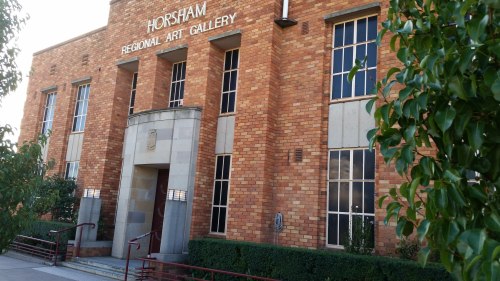
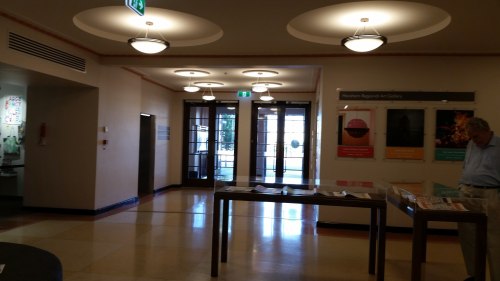
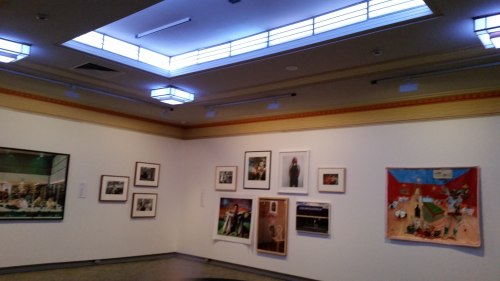
We spent our first night at Horsham, the main population centre of the Wimmera, some 300 kms from Melbourne. We got there in time to visit the Regional Art Gallery, and a very fine gallery it is too. It was constructed in 1938-9 and is quite reminiscent of Heidelberg Town Hall.  A recent refurbishment really enhances its art deco features.

20180417_161756_small20180417_161725_small20180417_161322_small20180417_160602_small

It has a terrific collection, largely based on the gift of its major benefactor, Mack Jost. There’s most of the Australian artists you know represented there, with a strong emphasis on modernist work,  but I hadn’t seen any of them before. Well worth a look.

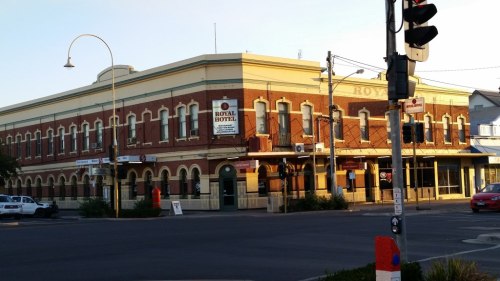
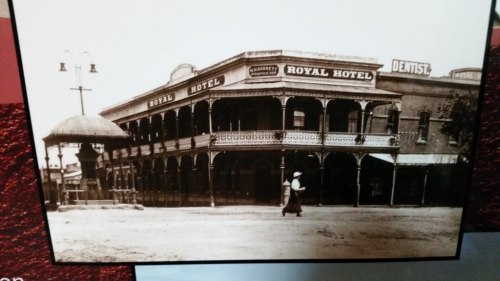
I really don’t like motel rooms much, so when we saw that the Royal Hotel had accommodation, we thought that might be fun.  Once the cast iron balcony came down in the 1960s, it lost a lot of its charm.

20180417_173911small20180417_200257small

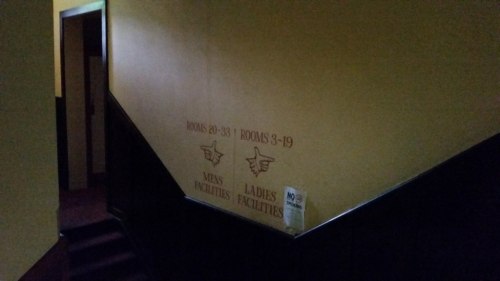
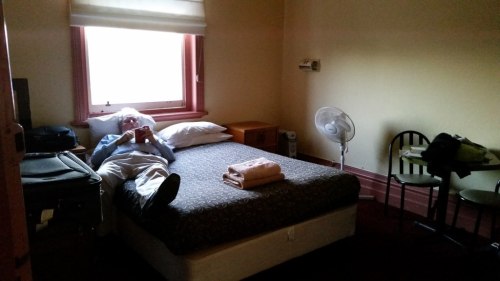
Hey- at only $60.00 a night, you can’t expect the Hilton.  The bed was comfortable, the hot water was hot and the Parma Night excellent. And it has a certain rustic charm.

20180417_175650

Shared bathroom

20180417_175728_small

20180417_175745_small

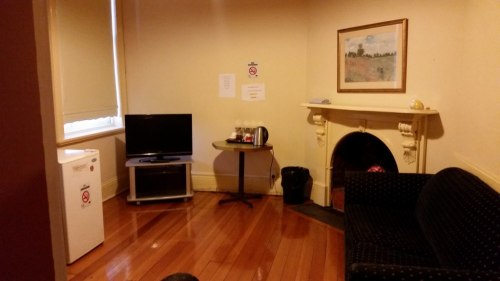
The small but functional lounge

20180417_175826_small

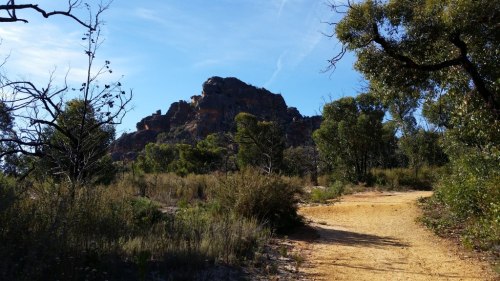
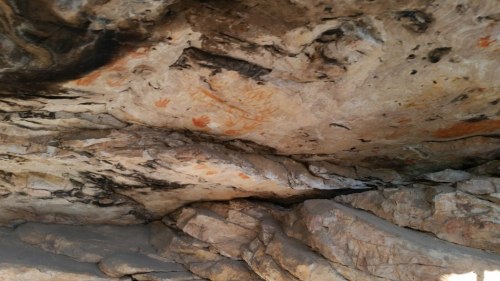
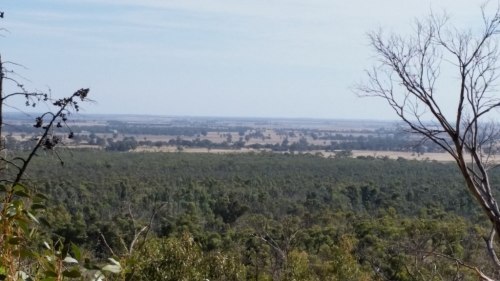
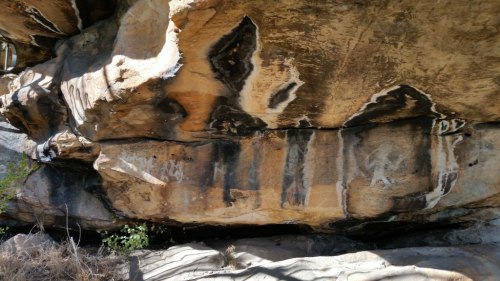
On Wednesday we backtracked a bit to the Grampians – or rather, Gariwerd- to see the aboriginal rockart in the National Park.  The area was hit by bushfires in 2014. It has grown back well, especially in comparison with Marysville which seems to have taken longer to revegetate, but I don’t know….I feel as if  Gariwerd /the Grampians have dropped the tourist ball a bit.  Their signage at the rock art sites was poor, with signs defaced or faded to the point of illegibility.   It’s an important part of Gariwerd – dammit, I’m going to use the indigenous name, even if they won’t – with its approximately 200 rock art sites comprising 80% of the Southern Victorian rock art. Five of them are open to the public, and we saw three of them.

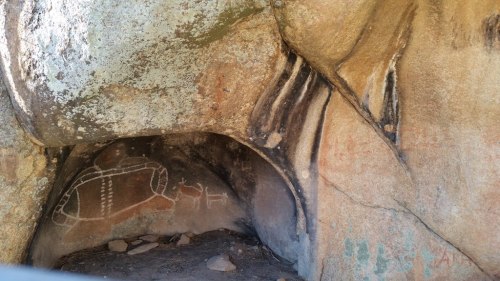
First, Gulgurn Manja. It’s in a cave in a rocky outcrop, overlooking the valley. The handprints were made by children.

20180418_094613small20180418_094716_small20180418_095212_small20180418_095455_small

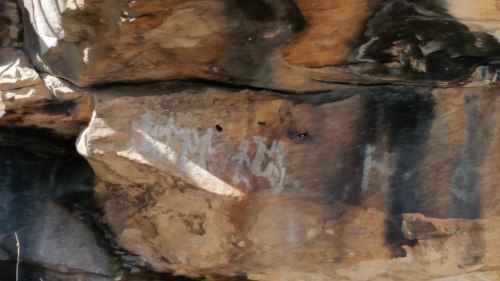
Then a bit further on to Ngamadjidj Shelter. Actually, a lot further because we got lost. Again, a bit of decent signage wouldn’t have gone astray.  This art has sixteen white figures, which is unusual because figures were usually painted in ochre. No one knows exactly what it means, because the traditional lifestyle of the  Jarwadjali people had been destroyed before it would be documented.

20180418_111354_small20180418_111404_small

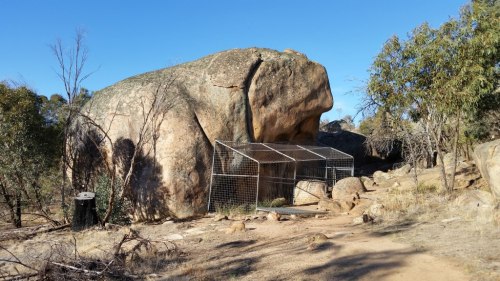
Finally, Bunjil’s Shelter, near Stawell. This site is very significant because it’s the only depiction of Bunjil, the creator of the land, the people, the plants, the animals and the law.   You can see the presence of burnt trees around the site. Shame about the cage protecting it, but it’s necessary unfortunately.

20180418_160803_small20180418_161018_small

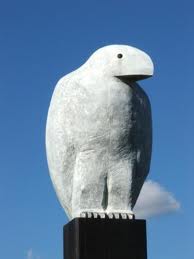
Actually, I hadn’t realized how well the sculptor Bruce Armstrong had referenced the stone above the Bunjil drawing when he created the Bunjil statue in central Melbourne that is rapidly disappearing amidst all the high-rises near Southern Cross (always Spencer Street) station.

bunjilstatue

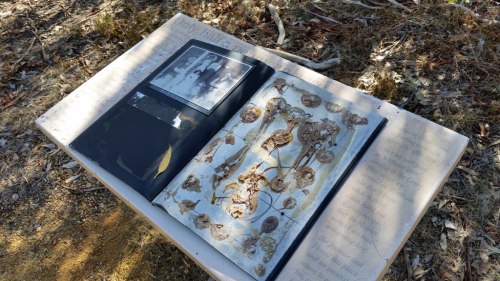
We called at Zumsteins Picnic Area.  It, too, was burnt out in 2014.  It was quite disorienting because it looked nothing like the way I remember it, with deciduous trees and kangaroos everywhere.  This article from 2013 shows how it was prior to the fire.  The signage was damaged here too,  with images torn from the information boards, exemplifying what I mean by ‘dropping the tourist ball’.  I wouldn’t have thought that it would take four years to replace.

20180418_120314_small20180418_120442_small

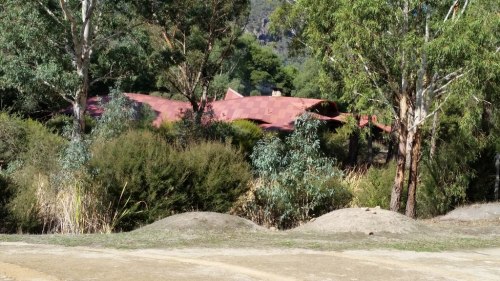
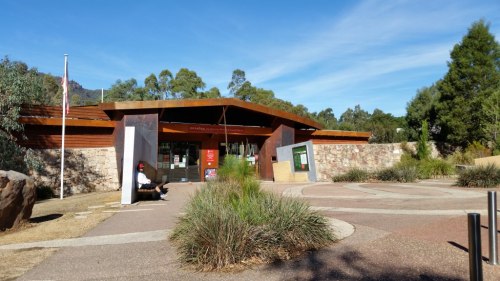
There was a similar sense of dislocation when we visited Brambuk Cultural Centre. When I was there years ago, the distinctive curved roofline of the Brambuk Centre stood out, but it is now surrounded by trees, and obscured completely by a rather ordinary National Park centre.  Unless you knew otherwise, you wouldn’t even be aware that Brambuk was behind the National Parks building. It seems that plenty of money has been lavished on the National Park building, but the displays at Brambuk itself could do with some care.  On the top level the information boards from the excellent Koorie display are arranged in a haphazard way, and they are looking rather tired and worn. Are local politics at play here? Methinks they are.

20180418_142140_small

The distinctive roof of Brambuk Cultural Centre

20180418_142454_small

The National Park Centre

The afternoon drawing to a close, we just managed to catch the Stawell Historical Society while it was still open. It is located in the old Pleasant Creek courthouse, as is my own Heidelberg Historical Society, but through a combination of a generous bequest and council and government funding, the administrative offices and records of the Society are in a brilliant new office building adjoining the court house. They have extensive records of families and newspapers, and very impressive temperature controlled store rooms.  The courthouse holds various honour boards from local organizations, a good photograph display from the 1860s -so early!- and a modelled streetscape.

20180420_102359_small

It was past the closing time for the Historical Society, and so we headed for our accommodation for the night. $60.00 a night at the pub in Horsham last night…what will tonight bring?


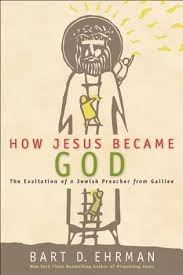
‘How Jesus became God’ by Bart D. Ehrman

ehrman

2014, 371 p & notes

It seemed rather appropriate, if somewhat transgressive, to read this book over Easter. As a Unitarian, I don’t celebrate Easter but there’s a lot of God going around at Easter, particularly this most recent one which coincided with Passover. The author Bart D. Ehren is the James A. Gray Distinguished Professor of Religious Studies at the University of North Carolina, and he has written over thirty books about Christianity. He used to be an evangelical Christian, but is no longer. In fact, it sounds as if his distancing from his faith is very similar to my own, when he describes the way that he found that he could subscribe to less and less of the Nicene Creed. The exact same thing happened with me.

In this book Ehrman traces the historical development of the idea that Jesus was/is God.

He starts his book by noting that the divisions between the divine and human were not clear-cut, either in the Greek or Roman worlds in which Jesus operated, or indeed within Judaism itself.  In Greek mythology, there is constant slippage as gods become temporarily human, and humans become permanently gods.  In the Old Testament, there is the Angel of the Lord who appeared to Abraham, Hagar and Moses, and humans like Enoch who became angels. There’s the Son of Man figure and Wisdom and the Word, and the King of Israel.

He then turns to the question of what/who Jesus thought he was, and whether he talked about himself as God. He starts by considering the methodological problem of dealing with the source texts.  Paul’s letters were written twenty to thirty years after Jesus died, but Paul himself never met Jesus.  The gospels themselves were not written by eyewitnesses, and they were written between 35 and 65 years after Jesus’ death, based on oral stories. He notes that Matthew, Mark and Luke have both stories held in common, and some unique stories that do not appear elsewhere.  He characterizes Jesus as an apocalyptic prophet,  who predicted the end of the current evil age, who believed that God would intervene soon to destroy everything and everyone opposed to him. God would then institute a new kingdom on earth, and he (Jesus) would be king in that kingdom.   This was not a unique view: it could be found in the teachings of other apocalyptic-oriented Jews of his day.

He then turns to the resurrection.  There are many discrepancies between the gospels, so many that it is almost impossible to make a single narrative that combines the ‘facts’ of all four gospels.  We don’t really know whether he was buried, or whether there was an empty tomb.  But we do know that some of Jesus’ followers believed that he had been raised from the dead, that some of them had visions of him, and that the belief that he had been raised from the dead led them to consider him, in some sense, God.

The earliest Christians thought that Jesus had been ‘exalted’ and lifted up and given divine status after his crucifixion i.e. that he was a human who became God.  Others moved the moment of ‘exaltation’ further back in Jesus’ life:  the moment of baptism with John the Baptist and the dove, the moment of birth in the stable; the Annunciation.

Others- and this view came to dominate- saw him as already God, who became human i.e. became ‘incarnate’. This was the big change, and it occurred in the first twenty years after Jesus’ death. Jesus came to be seen as a pre-existing divine being, who became human.

He turns to Paul’s letters and John’s gospel at this point.  In particular he looks at Paul’s second letter to the Philippians, where the text suddenly breaks into a quite different rhythm and vocabulary. (Who, although he was in the form of God did not regard being equal with God something to be grasped after etc.) This, he suggests, is a poem that Paul is quoting.  In the book, the poem is presented broken up into poem-like metre, and it’s amazing how typography can change the way a test is read.   Likewise, he looks at John 1 (the ‘in the beginning’ prologue) and its reflection of Old Testament texts. I found this part fascinating: the idea that the gospels are a palimpsest of oral and poetic traditions, that can be traced backwards and identified by concepts and language that do not appear elsewhere.

He then shifts to the different heresies that arose in the second, third and fourth centuries:  the divine/human nature of God and Jesus;  whether there was ever a time when God existed but Jesus didn’t; whether they are one unitary being or two (or even three) separate entities, and the resultant concept of the trinity.  He then turns to the Nicean creed, our mutual stumbling block, which he demonstrates as not so much an affirmation of faith, as a refutation of the various heresies that were circulating the Christian world.

A good summary of his argument throughout the book appears in the epilogue:

To use the older terminology, in early Christianity the views of Christ got “higher and higher’ with the passing of time, as he became increasingly identified as divine. Jesus went from being a potential (human) messiah to being the Son of God exalted to a divine status as his resurrection; to being a pre-existent angelic being who came to earth incarnate as a man; to being the incarnation of the Word of God who existed before all time and through whom the world was created; to being God himself, equal with God the Father and always existent with him. (p.352)

This is almost the mirror opposite of his own beliefs about God (and a trajectory I have also followed), where Jesus became “lower and lower” until he understood him as a human being, no different to any other human being.  He now understands Jesus as “a true religious genius with brilliant insights”, but a man of the first-century Palestinian Jewish apocalyptic milieu.  He says that he resonates with the ethical teachings of Jesus (as do I) but that these, too, were delivered in a first-century apocalyptic format.  He argues that the views of Jesus have changed over time, and continue to change as Jesus is recontextualized, on an ongoing basis by each generation.

I enjoyed this book, which is very clearly set out with discrete sections and subheadings, and clear previews and summaries topping and tailing each chapter.  He interweaves his own personal spiritual journey through the telling, which I identified closely with.  I don’t know if I’ll read other books of his, though, because from their titles alone, they seem to be further elaborations on the themes in this one.  This book was a New York Times Bestseller, and perhaps that’s the level that I’m happy to leave my reading at.

Source: Yarra Plenty Regional Library

Read because: it’s Easter

My rating: 8.5


Lecture video: Diana Paton, ‘Seeing Women & Sisters in the Archives of Atlantic Slavery’

From the Royal Historical Society site:

This is a fascinating lecture about a letter brought to Prof. Paton, written by a ‘brown’ Jamaican woman complaining about the treatment of slaves on a plantation from which she had been forced to return. The abstract reads:

“I was a few years back a slave on your property of Houton Tower, and as a Brown woman was fancied by a Mr Tumoning unto who Mr Thomas James sold me.” Thus begins Mary Williamson’s letter, which for decades sat unexamined in an attic in Scotland until a history student became interested in her family’s papers, and showed it to Diana Paton. In this lecture, Paton will use the letter to reflect on the history and historiography of ‘Brown’ women like Mary Williamson in Jamaica and other Atlantic slave societies. Mary Williamson’s letter offers a rare perspective on the sexual encounters between white men and Brown women that were pervasive in Atlantic slave societies. Yet its primary focus is on the greater importance of ties of place and family—particularly of relations between sisters—in a context in which the ‘severity’ of slavery was increasing. Mary Williamson’s letter is a single and thus-far not formally archived trace in a broader archive of Atlantic slavery dominated by material left by slaveholders and government officials. Paton asks what the possibilities and limits of such a document may be for generating knowledge about the lives and experiences of those who were born into slavery.

I like the way that she closes her lecture by reflecting on the forces that led to the preservation of this extraordinary letter, albeit within the archives of the owner in Scotland and not the family or homeland Mary Williamson herself.  As a result, it has been made available to her as a researcher in Edinburgh, but would not have been for a researcher in Kingston Jamaica.


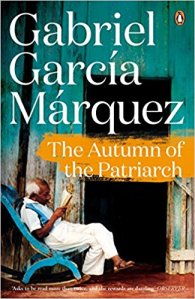
‘The Autumn of the Patriarch’ by Gabriel Garcia Marquez

AutumnofthePatriarch

1975, 240p.

I cannot tell a lie: I don’t think that I’ve ever been as glad to finish a book as this one.  It was a difficult book anyway, and my choice of reading platform was disastrous.  I was reading it on an e-reader and then had to swap to a tablet when the e-reader kept crashing (I suspect that the size of the file is too big for it).

Why so difficult- apart from the technology? Because it is the same story told six times, with variations between each telling, and because there are very, very few full stops.  You could go pages and pages without a pause.  In this regard, it is similar to the short story ‘The Last Voyage of the Ghost Ship’ that I read earlier this year. But a technique that was quirky and interesting in a short story became suffocating in a full-length novel.  I found myself thrashing through the text, as if I were drowning, waiting for somewhere to take another gasp of air. Because I was reading it electronically and the table of contents in such a large omnibus edition did not go down to chapter level, it was not easy to flip through to find where the chapter ended, for fear of losing my place – I’d never find it again.  In fact, I didn’t know where the book itself ended, and as the next chapter started up with the same story again, I began to despair lest I never reach the end of this book.

But I think that that’s how Garcia Marquez wanted you to feel. The story is about an unnamed dictator in an unnamed Caribbean island, who just does not die. Well – he does, ostensibly, in the first chapter where he engages a double to deflect any assassination attempts, and the double dies as a result. But in the succeeding chapters, his death is foreshadowed, but he just doesn’t die.  In a decrepit palace that is invaded with creepy-crawlies during the night, the Patriarch wanders from room to room, locking up the house, playing dominoes with other old dictators that he has imprisoned, raping the young women in the women’s quarters until he finally falls asleep on the floor, his arms cradling his head, only to wake up again the next morning and do it all again.

His country is submerging into debt and decay, and he is kept in power by his debtors, after they have pillaged the nation, causing him to even sell them the sea. He is uneducated and he forces the church and the people to deify his mother after she dies. Although impotent against his international debtors, he has absolute power within his own country, ordering mass deaths at will.  But he is fearful of losing his power, which is why this lonely figure wanders the house at night.

I read this story as part of a course that I am doing through Coursera called Gabriel Garcia Marquez: Between Power, History and Love, delivered in Spanish. Of course, I read the book in English: my mind just boggles at the thought of translating such complex sentences! After hours of translating, I worked out what the lecturers were saying, and their comments certainly added to my enjoyment of the story, but also highlighted to me how much is lost when reading an author who makes so many references to other (Spanish) texts.  I would never have picked it up, but the book pays homage to and subverts at least two other texts: Christopher Columbus’ account of the discovery of the Americas, and a poem ‘The Triumphal March’ by twentieth-century Nicaraguan poet Rubio Dario.  Well- both of those would have just slipped right past me!

The other point made by the lecturers was that this book, one of three ‘historical’ novels by Garcia Marquez, was published during the 1970s. The Patriarch is not named, but he could be any one of the dictators who have emerged from Latin America, and continued to do so when the book was published ( Pinochet in Chile, the Dirty War in Argentina etc).  It is part of a genre of Latin American ‘dictator novels’, but Garcia Marquez’s Patriarch is none of them and all of them.

Worth reading?  Yes – but be prepared for a really difficult read. And buy or borrow it as a real book. It’s just too hard to read electronically.