Monthly Archives: December 2016

‘Only Daughter’ by Anna Snoekstra

snoekstra

2016, 250 p

The hugely successful Gone Girl with its taut and if somewhat implausible double narrative has spawned quite a few imitators, and this is one of them.  In 2003 Rebecca Winter disappeared, prompting a huge but ultimately fruitless police investigation. Eleven years later, a young woman on the verge of being arrested, blurts out that she is the missing Bec. We (and she)  know that she is not.  Her family and friends welcome her back, but she is soon uneasy about them as she pieces together what might have happened to the real Rebecca Winter.

The book is ostensibly set in Canberra, with reference to Canberra landmarks, but is peppered with Americanisms, most particularly ‘Mom’ which jarred every time, and a house that sounds far more like a double-storey American weatherboard house than a Canberra one.   Beyond the double narrative, there’s a back-story to the Bec-imposter as well, which is probably one storyline too many.  The book has a rather adolescent voice, using alternating past and present tense and third and first person in the two time periods, and relies heavily on dialogue. It tended to get rather flabby in the middle, and I was finding the banality of description and dialogue rather wearing.  However, the ending came as a surprise, not only in the ‘whodunnitness’ but also in the rapid change of pace in the last twenty pages or so. It doesn’t surprise me at all that it has been optioned by American producers for a film release.

The book was published by Harlequin, not one of my usual publishers. The book itself finished 3/4 of the way through with the remainder of the pages is made up of teasers from some of their other publications. It felt a bit like commercial television and did a disservice to Only Daughter by firmly reinforcing its place within the romantic/ domestic thriller genre.

aww2016

I’ve posted this review on the Australian Women Writers Challenge website


This Week in Port Phillip 1841: 1-7 December 1841

The Indigenous Question blows up

[Warning:Aboriginal and Torres Strait Islander readers are warned that this posting contains the names of deceased persons.]

I hadn’t realized until looking through the papers for this week that there were two court trials involving indigenous people running concurrently in Port Phillip during these first weeks of December.  They were very different trials.  The first, involved the ‘VDL Blacks’ or ‘The Tasmanians’, the group of Tasmanian aborigines that George Augustus Robinson had brought over with him when he took up the role of Chief Protector of Aborigines for the district of Port Phillip. I’ve written about Tunnerminnerwait and Maulboyheener on several occasions previously (see here, here, here and here ) They were accused of ‘outrages’ and murder, and had finally been captured and brought to Melbourne.  During this first week, initial hearings were held in the Police Court before a bench of magistrates.

The second trial involved a settler, Sanford George Bolden, who was indicted for shooting with intent to murder an aboriginal native called Tatkier on his squatting run near Layton, down near Portland.

So, we have two trials: one of a group of  indigenous people for murdering a settler, and the other of a settler for intending to murder an indigenous man.  Add to this press outrage, an equivocal government response, the fanning of controversy by a missionary- and the authorities had a problem on their hands.

The ‘Tasmanians’

On Wednesday 1 December the Port Phillip Gazette reported that large benches of magistrates had sat in the Police Court since the preceding Friday to hear evidence on the case.  They sat on Friday, continued on Saturday, resumed on Monday and proceeded on Tuesday, before a large audience.  The Port Phillip Gazette had pretty much made up its mind:

The crimes alleged against them have been too clearly made out to leave any chance of acquittal, and their employment under Mr Robinson for such a number of years, precludes any hope of mercy on the plea of ignorance.  The case, therefore, is one of peculiar and distressing interest: and the only door of escape, or alleviation of guilt, rests in the fact of their having been deprived of their liberty, and enslaved under British authority.

Their conclusion was:

First, the prisoners are civil subjects of the Crown, by the most indubitable proofs of international law; they belonged to a people who were conquered by arms, and who subsequently yielded their independent rights by treaty to the Government of the country.  Secondly, they have a knowledge of British jurisprudence, are acquainted with the moral as well as civil law of the country, and can neither plead ignorance nor self-defence; they are, in fact, condemned under that very exposition of the law which the Resident Judge (from humane motives, but on mistaken principles) laid down in the case of Bon Jon.

So what did the Port Phillip Gazette think should be done? Their prescription was that they should

consider…them as they are- the wildest children of nature, without laws, religion, or obligation- and by taking them under our protection, with a view at once to curb their evil propensities, and instill into their minds the rudiments of our social order; in one word, by introducing a separate system of legislation for the Aborigines

The editor’s reasons for this stance, however, were steeped in the language and philosophy of the 1840s (however unacceptable it might be to us today):

We do not wish it to be understood, however, that these prisoners are, in consequence of such an issue, to be discharged; their conduct is far too dangerous to authorize so rash a proceeding; they must be placed under restraint; they must no more be considered free or irresponsible agents; civilization, it is proved, has no effect on their savage spirit of destruction. Like the tameless hyena, they are irreformable; they must be placed beyond the means at once of mischief and of want. A similar course should be pursued with all adults: and it is upon the sucking infant only that any complete system of education should be commenced, and progressively practiced. It is in their case only that success can be looked for; and while the present generation remains, specific treatment, distinct legislation, should be enforced  [PPG 1/12/41]

The evidence given over these days to the Police Court  was reported in full in the newspaper.

At the same time the Gazette ran a two-part series giving the history of aboriginal-settler relations in Van Diemens Land, describing the Black War and Robinson’s ‘friendly mission’. The article criticized Protector Robinson in particular on the grounds that once the Blacks had surrendered themselves to him, they never attempted to leave him and that he left them completely to their own control, seemingly taking little notice of them. [1/12/41; 4/12/41]

The trial was set for the next session of the  Supreme Court.  We’ll read more about this case later.

The Bolden case

At the very same time that the magistrates at the Police Court were committing the Van Diemens Land black to trial, the case of Sanford George Bolden was being heard before Judge Willis in the Supreme Court.  I’ve written about this case in Law & History Vol 3, which has recently been issued.  As Willis said several times during the hearing, the Boldens were neighbours of his in Heidelberg, and he was at pains to say that this had not influenced him in the slightest. (I think the Judge doth protest too much.)

Mr Sanford George Bolden was indicted for shooting at with intent to murder, an aboriginal native named Takier [Tatkier], with a pistol loaded with powder and a bullet at Layton, on 1st November. The second count charged it to have been committed with power and shot.  And the third with powder and slugs. [PPG 4/12/41]

Reading through the trial reports – and there is a very full account of the trial in the Port Phillip Patriot of 6 December (see here) – you’ll see that Judge Willis took a very active part in this case.  He usually did, but it is particularly marked in this case.  Much of the case revolved around the failure of the Assistant Protector Charles Sievwright to follow proper procedures in taking evidence. Willis certainly had cause to criticize. Sievwright indicated to Bolden that the body of Tatkier had been found, when this was not the case. Moreover, Sievwright was the object of rumour about his domestic arrangements and strongly criticized by the settlers.  Willis certainly didn’t hold back, and this criticism at a time when the Chief Protector, George Augustus Robinson, was being held responsible for the Tasmanian added to a generalized attack on the Protection policy as a whole.

La Trobe was blamed by the settlers, too. In an editorial on 11 December, the Port Phillip Gazette complained that Willis said that he can act against natives for depredations on the whites but La Trobe discountenanced the practical amenability of the natives to that law. Willis said that a settler who had the privilege of a run from the Government had a right to exclude the intrusion of the natives but when settler brought complaints before La Trobe, he intimated that they must abide by the consequences of coming to a country infested with savages. [PPG 11/12/41 p.2]

Most importantly in this case, Willis clearly stated that leaseholders had the right to turn aborigines off their land.

“ I wish it to be distinctly understood from this bench, that if a party receives a licence from Government to occupy a run, and any person white or black come onto my run for the purpose of stealing my property, I have a right to drive them off by every lawful means in my power. … The blacks have no right to trespass unless there is a special clause in the licence from the government  [PPG 4/12/41]

This statement was received with alarm by both La Trobe and Gipps, who feared that this would encourage settler violence even more.  The settlers, however, warmly embraced Willis’ opinion. It took the Colonial Office until 1848 to definitively state that pastoral leases were

not intended to deprive the Natives of their former right to hunt over these Districts, or to wander over them in search of subsistence in the manner to which they have been heretofore accustomed… [Earl Grey to Fitzroy 11 February 1848]

By this time, of course, Willis was long gone from the colony and the Port Phillip frontier completely ‘pacified’.  But back in the courtroom in 1841, Willis instructed the jury that

you can find no other verdict than an acquittal of the prisoner… I tell you again and again, the prisoner must be acquitted.”  [PPG 4/12/16]

And Bolden was, too.  Although his acquittal was not without some dissension.  Edmund Finn, writing as ‘Garryowen’ felt that Willis’ charge to the jury was “so favourable to the prisoner as to amount to marked partiality”(p. 350).  One of the jurymen stood up in court to declare that Bolden left the court “without the slightest imputation on his character”, but he was contradicted by the foreman of the jury who said that that was not the unanimous opinion of the jury.

A missionary has his two-pennethworth

Just to add to the controversy, the Wesleyan missionary repeated to a Wesleyan meeting in Melbourne comments that he had previously made in Launceston where he had accused some Portland settlers of parties of going out on the Sabbath with guns, ostensibly to shoot kangaroos, but in reality to hunt and kill blacks. Because the evidence of the native was not admissible in court, he claimed,  the white murderers had escaped with impunity.  [PPP 6/12/41 p.2]  The settlers of the District published a letter in the newspapers denying his claims and stating that

the information by which you seem to have been guided is false and calumnious… we would call upon you to justify yourself for having made such statements by attempting to prove at least some of your many and heavy charges. [PPG 8/12/41]

One of the signers was Sanford George Bolden.

Wreck of the William Salthouse

During the first week in December, the Port Phillip Gazette reported the loss of the William Salthouse, the first vessel to be wrecked within the bay of Port Phillip itself. A 260 ton vessel, bound to Port Phillip from Quebec, it was laden with timber, flour saltfish, beer, cider and vinegar. It was wrecked at the Heads on the reef that runs out from Point Nepean.

This reef we may observe was never properly laid down, it is represented as terminating abruptly at the last rock which shows itself above water, whereas the dangers continue under water at various depths, to the length of a cable or about 110 fathoms. [PPG 4/12/41]

The ship was boarded by one of the pilots from Shortland’s Bluff but she was unmanageable; the pilot gave her a second anchor but it snapped and the barque ran onto the sand known as the Pope’s Eye.  The water was rising.

The captain and the sailors succeeded in saving the ship’s boats and the sails of the ship, together with the ships papers, and some portion of their own clothes, but as the vessel was rapidly settling down in the water, they were speedily compelled to abandon her and take refuge on shore until assistance came to their aid. [PPP 2/12/41]

The owner of the consignment, Mr Ashurst, sailed down to render every assistance in his power.

On reaching the wreck, it was seen that no hope remained of saving the vessel or the cargo- she had fallen off the shoal into deep water…It is expected that she will go to pieces in a short time, especially as the weather has been very rough and the window blowing hard from seaward since the hour she sank.[PPG 4/12/41]

And sure enough, within a week there was an advertisement in the papers advertising that James Cain had purchased the wreck and cargo:

The undersigned having purchased the above wreck with all her cargo, hereby cautions all persons from appropriating any portion of the same.  Any person picking up any part ashore or afloat will be paid a salvage on delivery to JAMES CAIN, Queen’s Wharf. [PPG 11/1241 p 2]

The William Salthouse is now one of Victoria’s most important shipwrecks and is on the Victorian Heritage Database.  But at the time, as the Port Phillip Patriot pointed out:

The William Salthouse was, we believe, the first vessel excepting the prison ship Buffalo with the Canadian rebels, that ever came direct from British North America to any of the Australian Colonies, the catastrophe is therefore doubly to be deplored as likely to case of damp upon an opening trade which might have proved highly advantageous to these Colonies.[PPP 2/12/41]

And how’s the weather?

Obviously it was typical early-December weather, with all the changeability we Melburnians have come to love (?!) The highest temperature for the week was recorded as 88 (31C) and the lowest 45 (7.2).  It was notable enough for the Port Phillip Gazette to devote a long paragraph to Melbourne’s Favourite Topic:

The Weather. – The variations of temperature which have marked the past week are worthy of notice — the extreme of heat during the season has probably taken place, and the most sudden alteration which we may experience has accompanied it. For several days previously, the weather showed all the indications of gloom, storm, and heat. On Saturday,fitful gusts of wind swept over the town,and caught up columns of dust and sand into the air, which were carried away in whirlwinds, that gave a miniature idea of the horrible simooms of the Eastern dessert. One of these, particularly large and well defined, was traced from the river bank across the western end of Flinders and Collins-streets, through the opening in the Church-square ; hence it took the direction of Bourke-street, and enlarging as it proceeded, shot up a column of sand, the ruddy colour of which was strongly contrasted against the blue sky and rarified atmosphere ; the gyrations of the whirlwind, accompanied by a progressive motion carried it diagonally across the Eastern end of the town down to the river bank again, where crossing, it was dispersed on the opposite bank. Sunday was remarkable for its stormy character, the sand flew in broad clouds with a piercing force, that drove the pedestrian from the street, and the squalls raged round the building occupied as the New Church, that the congregation was obliged to disperse without the performance of divine service. One or two heavy thunder showers succeeded, which falling on the shingled roof of St. James’s Church, succeeded in penetrating, those parts where the heat had made the timber covering shrink, and threw down such a shower bath upon the inmates, as compelled many to change their seats. Monday and Tuesday were both sultry and oppressive, and the heat on Wednesday had arisen to a degree that rendered It almost insupportable. Towards the evening, the bush in every direction took fire,and from the signal hill a semicircle of burning forest was visible, through the darkness of the night, for twenty miles in the direction of Geelong. While the sun remained above the horizon the air was perfectly breathless, but at dark a hot northerly wind set in, that drove the fires nearer to the site of Melbourne, and carried with it a smoke that at daylight was descried hanging like a vast pall over the town, and spreading the panic of a conflagration. During this period the thermometer stood at 75 degrees, or nearly the same average temperature as at Calcutta through the year. With the additional stimulus of the sun’s rays the column nearly reached 90, when a sudden shift of wind took place— the sea breeze came up, swept away in the “twinkling of an eye” the superincumbent smoke and brought to the gasping inhabitants the long looked for relief. The mercury shortly fell to nearly 10 degrees below its former mean range, on about 18 degrees in as many minutes. The remain der of the day (Wednesday) was clouded and threatening. On Thursday it rained heavily ; the weather has now resumed its usual tranquility. [PPG 8/12/41]

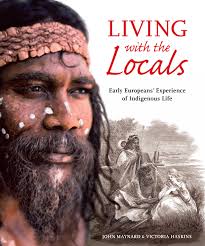
‘Living with the Locals’ by John Maynard and Victoria Haskins

maynardhaskins

2016, 223 p plus notes

Living with the Locals: Early Europeans’ Experience of Indigenous Life by John Maynard and Victoria Haskins, NLA publishing, Canberra, 2016

One of the few Australian expressions to make it into Brewer’s Dictionary of Phrase and Fable is the saying “You’ve got Buckley’s” -a little Australianism that I myself use quite frequently to mean “you’ve got no chance”.  Although its origin probably lies in a reference to the Buckleys and Nunn department store (“you’ve got Buckley’s chance or Nunn (non)”), for Melburnians it has another layer of meaning . William Buckley was a tall escaped convict who emerged from the bush, startling the early settlers of Melbourne, having lived with the  Wathaurong people for thirty-two years after escaping from the short-lived convict settlement at Sorrento in 1803.  He was not, however, the only white person to be accepted into an indigenous group, as John Maynard and Victoria Haskins show in this book. The information that these Europeans brought back into white society when they were ‘discovered’ or ‘saved’ can, read sensitively, provide a different perspective on pre-invasion or invasion-era indigenous life to counter the settler or missionary narratives which then (and to a large extent, now) largely framed knowledge of indigenous practices.

Our main focus and concern has been on trying to recapture what living with the locals was really like for these European individuals. The fact is that, in the main, they were treated with great kindness, compassion and care by their Indigenous hosts.  And therein lies a great tragedy of the Australian historical experience.  The wild white men and women were witness to the beauty and richness of Indigenous culture in this country that no other outsiders would ever see.  For us, these men and women are our eyes into another world on the cusp on an incredible upheaval. (p. 8)

The fold-out front cover of the book serves both as map and chapter outline as it plots the examples discussed in each chapter against the coastline of eastern Australia.  Early white settlements clung to the edge of the continent, with the sea the main source of communication and commerce.  The chapters of this book proceed chronologically, and the first two examples deal with Sydney and Melbourne.  All the other examples, however, are plotted from Brisbane northwards, where the Great Barrier Reef spelled the end of many ships and where the ‘frontier’ was shifting inexorably up the coast.

Of course, the authors could only deal with those Europeans who actually returned. Maynard and Haskins occasionally mention that the tribes were aware of other Europeans who were among them, or sometimes the escapee/survivors themselves report catching sight of them, but they do not break into the European historiography at all.  Maynard and Haskins only draw on the cases where there is sufficient  written documentation or oral testimony- flawed and incomplete though it may be- but there could be countless other similar scenarios that went unreported or even unknown. Continue reading

Exhibition: The Jesus Trolley

If you nip into Central Melbourne for some Christmas shopping, stop off at the City Gallery that nestles into a corner of the Melbourne Town Hall on Swanston Street.  ‘The Jesus Trolley’ exhibition has been on since 8 September but with my habitual tardiness, I’m only writing about it now- and it closes on 24 December, most appropriately.

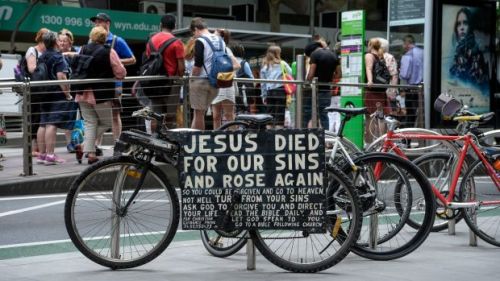
I see from today’s paper there have been a number of ‘Jesus bikes’ left around Melbourne with evangelical slogans on them.

jesusbike

I thought instantly of the Jesus Trolley exhibition. The exhibition features Desmond Hynes who, for thirty years since 1983, pushed a decorated shopping trolley around the streets of central Melbourne and stood in his ‘Jesus is Lord’ windcheater, holding aloft a hand-painted sign proclaiming Jesus’ resurrection.  It was a full-time job for this self-appointed street evangelist, who lived with his sister in a rented property in Hotham Street Elsternwick, immediately opposite Ripponlea which, until sold and demolished, was similarly festooned with posters and exhortations (see photo here). All his preaching paraphernalia was headed for  the tip until a neighbour recognized it for the social history it is and salvaged some of it.  And here it is in the exhibition- a little cluster of shopping trolleys- and posters, photos showing the ephemeral nature of his eternity-oriented quest.

jesustrolley

There’s also a short 4 minute documentary about Desmond Hynes called ‘Doing’Time with Desmond Hynes’ filled by Russell McGilton in 1997 as part of the Race Around the World series. It’s also available here on YouTube:

But take advantage of seeing the exhibition while it’s still on.  There’s a beaut little book that you can pick up, with an excellent essay by Chris McAuliffe about street preaching more generally in Melbourne and photos of objects from the exhibit.

On until 24 December 2016 City Gallery, Melbourne Town Hall.

Contesting Australian History: A Festschrift for Marilyn Lake

lake

Strictly speaking, a  ‘festschrift‘ is a book of essays written by colleagues and students that is presented to an honorable person, generally an academic, during their lifetime. Well in this case, the collection of essays may come later in the form of a special edition of History Australia, because the main event here was a two-day celebration of Marilyn Lake’s career and writing at the beautiful 1888 building at the University of Melbourne. What a line-up! Even though I’ve only read a few of Lake’s works, and she wouldn’t recognize me at all, I couldn’t resist hearing such eminent historians responding to the wide range of issues upon which Marilyn Lake has written, held over two days in my own home town!

Marilyn Lake is an Australian historian whose work has spanned the homefront response to WWI (both at the time and recently), feminism and gender, and the White Australia Policy. Her book Drawing the Global Colour Line, co-written with Henry Reynolds, is a major contribution to transnational history internationally and here in Australia. She is a fearless public intellectual, most notably after the Age published an abridged version of the public lecture ‘The Myth of ANZAC’ that she delivered in 2009.  In the bitter and highly personalized response to her book, one angry male writer asked her “What have you ever done for Australia?” Well, this festschrift was a resounding answer – even if he wasn’t there to hear it.

Different speakers took various approaches to the festschrift task.  Some spoke about Marilyn herself and their own relationship with her.  Others engaged with her main academic interests and publications. Some spoke about their own research, and Marilyn’s influence on their own work. Others paid tribute to her as public historian, course convenor, research partner and supervisor. Continue reading

Movie: Joe Cinque’s Consolation

As a Helen Garner fan, of course I was keen to see this adaptation of Helen Garner’s book Joe Cinque’s Consolation, which she wrote in 2004. Joe Cinque was a young man who was killed by a lethal dose of heroin administered by his girlfriend, Anu Singh, who blamed him for her rather vague ‘ill-health’. Singh had told her friends, particularly Madhavi Rao, of her intentions but no-one acted definitively to stop the crime from occurring.

However, the film is very much an adaptation as Garner is completely absent in this film.  In the book (as with This House of Grief), Garner is the lens through which we interpret the court case which she reconstructs from testimony, but which is completely manifested in words only.   As a result, the tension of the film lies in waiting for the crime to occur  -will it be tonight? is this where she does it? – with the question of why she does it less fully explored.  However in the film, as with the book, I was left feeling angry (as Garner did) at the moral slothfulness of her friends,  the utter pointlessness of Joe’s death and the inadequacy of the sentence that Singh was awarded.

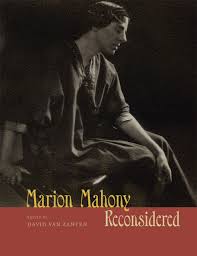
‘Marion Mahony Reconsidered’ by David Van Zanten (ed.)

marionmahony

2011, 147 P & notes.

I come to this book feeling as if I have entered a room at a party where everyone knows everyone else. The so-called Prairie School, Frank Lloyd Wright and the Griffins are well-furrowed academic fields, quite out of my own area.  My own knowledge of Walter Burley Griffin and Marion Mahony Griffin is limited to awareness of their houses and landscaping in the Heidelberg and Ivanhoe area, and what I have gleaned from Heidelberg Historical Society’s exhibition Against the Forces that we mounted three years back.  In photographs she looks stern and formidable, and I’m aware of an underlying Unitarian/Anthroposophical influence in her work. What I hadn’t realized is that there is an ongoing controversy over her status as an architect.  Was she a merely helpmate to her husband Walter Burley Griffin,  and architectural collaborator, or was she the hidden force behind him?

The four essays in this book are extended versions of six presentations delivered at a symposium conducted alongside an exhibition at the Block Museum ‘Marion Mahony Griffin: Drawing the Form of Nature’ in 2005. The other two presentations made at the symposium were published in the exhibition catalogue. It is significant, I think, that the book utilizes her maiden rather than married name, seeking to delineate her identity as woman, thinker, artist and representationist in her own right, and not just as an adjunct to the two other men with whom she is professionally associated: Frank Lloyd Wright and Walter Burley Griffin. Continue reading

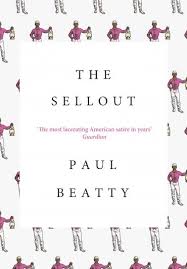
‘The Sellout’ by Paul Beatty

sellout

2015, 289 P

I still haven’t really come to terms with the fact that the Booker Prize now includes American works. Yes, I know that we’re all globalized and agile these days, but I think that the Booker has lost its distinctiveness since it was opened up beyond Commonwealth countries. While I’m ambivalent about the Commonwealth as a political entity, I do think that there is some underpinning cultural thread that links countries – especially the ‘white’ part of their population-  where, in living memory,  large numbers have grown up with a portrait of the Queen on the wall. The Booker Prize, I feel, is still the Commonwealth’s prize.

So I spent the first half of this Booker-Prize winning  book being angry at its American swagger, showoffiness and shoutiness. It was almost exactly half-way through that I started laughing, and then found myself chuckling away at various points to the end. I don’t read a lot of satire, and it’s a rather wicked pleasure when I do.

The un-named narrator, living in a post-Obama time, is African American and lives in Dickens, a lower-middle-class suburb on the outskirts of Los Angeles. His home-schooled upbringing had been unconventional and overseen by his sociologist father who seemed determined to visit on his son all the most ethically-controversial psycho-social laboratory experiments of the twentieth century. After his father’s death, the narrator drifts into his father’s circle of old, idle chatterboxes who he dubs “The Dum Dum Donut Intellectuals” and tries to hook up with an old flame. It is while he is wooing his bus-driving love-interest Marpessa that he jokingly starts off re-segregation on her bus (yes, re-segregation, not de-segregation) and, discouraged by the neglect of Dickens as a suburb, initiates a broader grass-roots program of resegregation throughout the suburb that actually works. School results improve, crime declines, civic pride burgeons – all because of a self-imposed segregation.

It’s all very slick and clever and  the book would probably easily reward a second reading. The blurb on the back describes it as “a powerful novel of vital import and an outrageous and outrageously entertaining indictment of our time”. Which is probably true. But I still think that it’s better recognized under the New York Times Book Review (as it was) than as winner of the Booker Prize.

My rating: 8/10

Sourced from: Yarra Plenty Regional Library

‘Everywhere I Look’ by Helen Garner

garner_everywhere

2016, 240 p.

When I checked out how many Helen Garner books I’d reviewed on this blog there are five, which makes her (along with Kate Atkinson) the author I’ve read most often in the last eight years. I read others of hers, too, read before I started blogging. It’s no secret that I very much enjoy her writing and feel a sense of wary affinity with her, bolstered by being much the same age and a fellow-Melburnian.

This book differs from the others I’ve reviewed in that it is a collection of her essays, several of which I have read before in the Monthly. None of them are particularly long and they offer a slice of perspective and a way of looking, as the title suggests. She has a penetrating intensity that disguises itself as a general-looking-around. I find myself wishing that I could discipline myself to look more carefully and thoughtfully, instead of just letting things wash over me.

As with short stories, it’s hard to talk about essays, because each one stands on its own two feet and it feels almost unfair to single one out above the others. A collection of essays, just as with short stories, does not just fall together but is instead a curated arrangement and selection.  This is particularly apparent in this book, which is divided into six parts. Continue reading

Movie: ‘Ruin’

On Saturday afternoon (3 December 2016) I caught the final screening of ‘Ruin’ at ACMI.  This Australian film is filmed and set entirely in Cambodia and although described as a ‘romance’, it’s a very bleak one. A volatile, violent young man meets a very young prostitute who has escaped from her pimp who bashes her and threatens to kill her. In a gritty, violent road movie- or more correctly, river movie- and in the midst of brutality and exploitation, they gradually fall in love.  If you watch the trailer, you’ll see that there’s lots of slow-motion shots, lots of water, a nausea-inducing hand-held camera throughout and unsettling, droning music.  I suspect that it’s going to stay with me for far longer than I want it to.