
In a laneway near the Queen Vic market yesterday….


In a laneway near the Queen Vic market yesterday….
Posted in Life in Melbourne
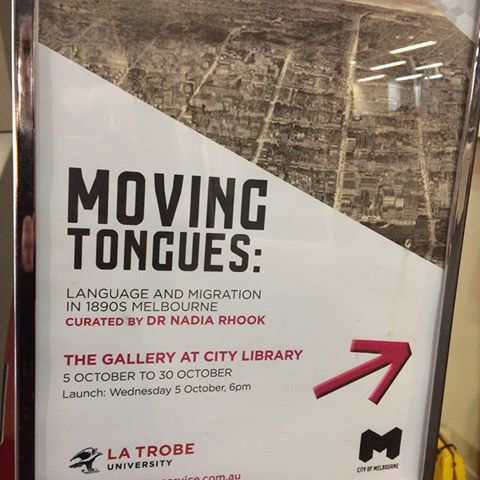
Once again, here I am talking about an exhibition that’s about to close in a few days so if I pique your interest, you’re going to have to hurry up to catch it. It’s called ‘Moving Tongues:Language and Migration in 1890s Melbourne’ and it’s on at the City Library branch in Flinders Lane, close to Ross House, until 30 October.
The first image that you encounter is that shown in the poster above: the rectilinear street-grid imposed onto British settler colonies with little regard to topography or earlier use, conveying the impression of a single, replicable British culture. However, this display argues that a multiplicity of languages and cultures existed within that grid, and it draws from the proceedings of Melbourne courtrooms in the 1890s to illustrate the point.
And so we meet Charles Hodge, the long-standing interpreter in Chinese cases and the ‘Chinese oath’ that was accepted by Victorian courts for many years which involved the lighting of a flame and the recitation of a pledge to tell the truth. We read of the ultimately tragic case of young Norwegian servant Louisa Fritz who accused her employer Theodore Ulstein of rape. We read of the presence of Syrians and “British Hindoos” and see their sleeping arrangements in the terraced shops of Little Lonsdale and Exhibition Streets, and the alliances formed with indigenous people, especially at the Cummeragunga mission. We see the November 1898 Parliamentary hearing called by the Victorian government, in order to hear opinions of the Immigration Restriction Act that was one of the first legislative acts of the newly federated Parliament of Australia.
The print-based display is supplemented by a small number of artefacts and replicas of courtroom documents, poetry based on the Melbourne Poetry Map and artwork. One large art piece by John Young is based on selections from the diary of Jong Ah Sing, who was incarcerated in lunatic asylums for 33 years. He wrote his diary in an attempt to prove his sanity.
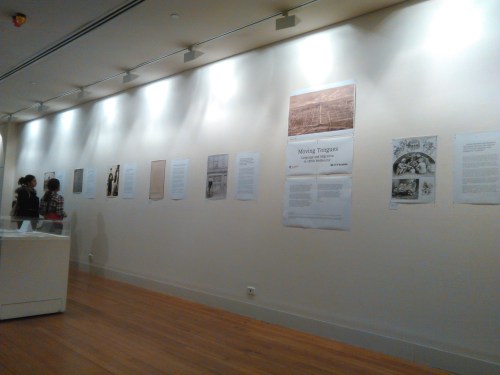
It’s a small, modestly presented display that conveys a broader linguistic and aural view of Melbourne than that presented in the Sentimental Bloke and other depictions of the underside of Marvellous Melbourne. But hurry up- it closes on 30 October. The City Library is open Mon-Thurs 8.00am – 7.45, Friday 8.00 to 5.45, Saturday 10.00 to 4.45 and Sunday 12 noon to 4.45.
Posted in Exhibitions, Melbourne history
Governor Gipps’ visit
I let slip last week that Governor Gipps was to visit the Port Phillip District in October 1841. There had been hints and rumours but now it had been confirmed: Governor Gipps was to visit for the first time. He hadn’t been to Port Phillip, but he had already met the superintendent Charles La Trobe, who stayed with him in Sydney before coming down to Port Phillip. The warmth of their relationship is reflected in the Gipps-La Trobe Correspondence, edited by A.G.L. Shaw.
The newspapers didn’t know whether to gush with excitement or to continue with their ongoing litany of complaint about the Governor and New South Wales generally. i.e “we provide all the money through land sales and they give us nothing back”; “why doesn’t Sydney give us more for infrastructure?” etc (not unlike the State Premiers in Australia today, come to think of it). In the end the glamour of vice-regal ceremony won out and whole columns were devoted to the visit.
We’re not at that stage yet: they were still knee-deep in planning, and a public meeting was held at the Exchange Rooms to plan the visit. First question: how should he arrive? Mr Verner suggested that
the meeting should nominate a deputation to wait upon the Governor on board the steamer on her arrival in the Bay, and to request his Excellency to land publicly at the Beach at such time as might suit his convenience. Mr Arden was of opinion that the better mode would be for the deputation to proceed in the Aphrasia to meet the Governor, and that His Excellency should be brought in the steamer to the wharf where the colonists could assemble to receive him on his arrival. A lengthy discussion on this topic ensued, the one party maintaining that it was desirable that His Excellency should land at the Beach, because the approach to the town from that direction was calculated to give him a much more favourable impression of its beauty and extent that the approach by the river, and the other party insisting that if subjected to the necessity of wading through the swamp, His Excellency would scarcely have leisure or inclination to survey the opening beauties of our metropolis. (PPP 11/10/41)
In the end, it was decided to leave it up to the committee. Next question- the public dinner. Who should be the chairman? It was decided that La Trobe should be asked to do the honours, to which he promptly agreed. And so, soon this advertisement appeared:
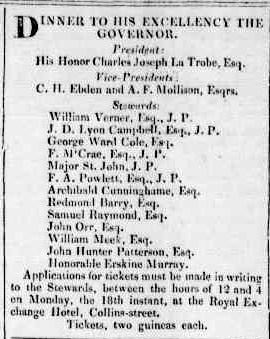
The social calibre of the stewards and the two-guinea-a-head ticket price indicated that this would be a thoroughly respectable gathering. None the less, a correspondent to the Port Phillip Patriot (who, you may remember could well have been one of the authors of the Patriot itself) wrote to ask “is the Dignity Ball farce to be played out over again?” Certainly not, the Editor replied:
Character- not wealth or the fanciful distinctions of birth and station- is to be the test of exclusion from the dinner to the Governor, and that test no reasonable man can object to. [PPP p.2]
A night at the theatre
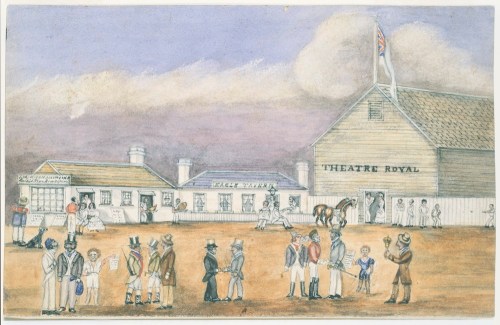
William Liardet’s depiction of the Theatre Royal (formerly The Pavilion) shown as it stood before its demolition in 1845 and sketched from memory in about 1875. Source: State Library of Victoria
Not quite so respectable was the prospect of a night at the theatre. It’s easy to lose sight of how closely the theatre was scrutinized in early Melbourne. The Pavilion in Bourke Street, opened in April 1841 went through several name changes. Edmund Finn, writing as Garryowen gives one of his typically colourful descriptions of the building:
Its dimensions were to be 65 feet by 35 feet, the sum of £11ooo was to be expended on its construction.Its dimensions were to be 65 feet by 35 feet, the sum of £11ooo was to be expended on its construction,…it was one of the queerest fabrics imaginable. Whenever the wind was high it would rock like an old collier at sea, and it was difficult to account for it not heeling over in a gale.The public entrance from Bourke Street was up half-a-dozen creaking steps ; and the further ascent to the ” dress circle,” and a circular row of small pens known as upper boxes or gallery, was by a ladder-like staircase of a very unstable description. Internally it was lighted by tin sconces, nailed at intervals to the boarding, filled with guttering candles, flickering with a dim and sickly glare. A swing lamp and wax tapers were afterwards substituted, and the immunity of the place from fire is a marvel. It was never thoroughly water-proof, and, after it was opened for public purposes, in wet weather the audience would be treated to a shower bath. (p. 451)
Apparently it was licensed to hold concerts and balls, but no ‘theatre’ as such and the violation of its licence conditions led to a rather rambunctious night :
THE PAVILION. There was a tremendous ‘flare up’ in this establishment on Monday night last. Major St John had countermanded the entertainments in consequence of ballet dancing being introduced, that being contrary to the express rules laid down for their guidance. Application was then made to His Honor the Superintendent, but without it being stated to him the decision at which Major St John had arrived. His Honor, in ignorance of this circumstance, said he had no objection to the performance taking place as usual. The time arrived, the doors opened, and the house filled to the ceiling; the leader of the band flourished his bow, a crash followed and the overture was gone through in good style; the curtain rose, and a song by a lady succeeded. At this critical juncture the chief constable, Mr Falkiner, stepped forward and caused a halt, upon the order given by the Major; an awkward pause followed, which the audience filled up by smoking cigars and sipping from stone bottles; a gentleman in top boots, accompanied by a ruffianly looking groom, cleared the orchestra at a bound, and commenced a reel; Mr Miller quickly served upon them a writ of ejectment, by propelling them into the pit. Thus passed about an hour, when Mr Miller came forward and announced that His Honor the Superintendent had forbidden the performance- and the curtain dropped again. Then commenced a scene which we never hope to witness again- the hubbub was immense- Waterloo was a fool to it. After the house was cleared, which was with considerable difficulty, in consequence of the demand of the auditory for their money, a servant of His Honor rode up and announced that the concert might proceed; it was however too late, the public had dispersed. The parties interested in the success of the pavilion may thank themselves for this failure, having broken the rules laid down by the police magistrate for their guidance. Until this place is under the control of respectable parties it never can prosper.[ PPG 13/10/41]
Rude servants
Reading through the Police Court columns, it comes as a jolt to realize just how draconian the N.S.W. “Act for the better regulation of Servants, Labourers, and Workpeople”(1828) legislation was, even exceeding the English Masters and Servants legislation on which it was based.Not just content with dismissal, employers could (and did) take their employees to court where they could be imprisoned, sentenced to hard labour or fined. And so we read in October 1841 of Captain Smyth of Heidelberg taking his servant Ruth Robinson before the court for gross misconduct in what Smyth clearly intended as an exemplary punishment. I haven’t been able to locate any information about the Hired Servants’ Act, but it seems to have restrained Captain Smyth somewhat – although the punishment was still harsh when servants’ wages were about £15 per annum.
HIRED SERVANTS. Ruth Robinson, a hired servant in the employ of Captain Smyth, of Heidelberg, was charged with the following gross misconduct. The previous day she wished to leave his service, when Captain Smyth said he would go to Town, and when suited with another servant, she was at liberty. During his absence the conduct of the woman Robinson towards Mrs Smyth was most abominable. She gave her mistress to understand that, the master being absent, she should not obey orders. Upon being requested to bring in the dinner, she said that she would not, until she had dressed herself, then she would bring in the dinner, after which it was her intention to walk into Town; and as she said, so she acted. The woman also had put herself into so violent a passion that Mrs Smyth had reason to fear personal violence. Captain Smyth said, that he brought the woman before the Bench upon public grounds; here were a number of females coming to the colony, honest and well behaved no doubt, but totally ignorant of their duties as servants; when they had obtained the necessary degree of knowledge, they became insolent, and endeavoured by every means in their power to obtain their discharge. They were however particularly cautious not to commit themselves before their master, fearing that he might appear against them, but taking advantage of his absence abused their mistress, well knowing the objection of ladies to come into a public Court. He hoped the Bench would make such an example of this woman as to deter others from offending in like manner.
The Bench regretted that under the 10th section of the Hired Servants’ Act, they were forbidden to imprison females for misconduct in their hired services. By the 8th section of the same act they were empowered to inflict a fine, and sentenced her to pay the penalty of £5; if not paid in a fortnight her goods would be levied upon. She was ordered to return to Captain Smyth’s house, and deliver to Mrs Smyth what articles had been placed in her charge.
How’s the weather?
Winds mostly strong; a gale on 12th, weather frequently cloudy, threatening rain at times but none fell. Top temperature for the week was 70; lowest 45.
Still I paddle along as quickly as I can in my Coursera course on Gabriel Garcia Marquez‘s work, reading the literature in English with relish and the transcripts of the videos and linked articles in Spanish very slowly!
1962
This week I read a collection of short stories called ‘Big Mama’s Funeral’, so named for the final story in the collection. As the course explains, some of these short stories are in effect practice-runs for material that would appear in A Hundred Years of Solitude, while others ‘speak to’ other literature that would be familiar to Spanish-language readers (but not necessarily English-language ones). One of Garcia Marquez’ stories, ‘One of These Days’ involves a dentist whose patient, the Mayor, comes in with an abscessed tooth which the dentist- maliciously- tells him can only be extracted without anaesthetic. This story ‘speaks’ to a story by Hernando Telles called ‘Lather and Nothing Else’, a fantastic story available here that has a barber called upon to shave the military officer responsible for mass killings and atrocities. (To be honest, I preferred the Telles story.)
The two most memorable stories for me were ‘Tuesday Siesta’ and ‘There Are No Thieves in this Town’. ‘Tuesday Siesta’ is about a woman and her daughter who travel by train to visit a priest in order recover the body of her son, shot in an Oscar Pistorius-like encounter. Garcia Marquez captures well the hot somnolence of the Tuesday siesta and the mounting hostility of the villagers who surround the priest’s house. The second story ‘There Are No Thieves in this Town’ involved the theft of billiard balls.
There is another short story I’ve been reading, which was published in ‘Eyes of a Blue Dog’, another collection of Garcia Marquez’s short stories. It’s called ‘Monologue of Isabel Watching it Rain in Maconda’ and it’s the longest short story I’ve ever read because this time, I am reading it in Spanish! By the time I’ve read half a page, I’m sweating with exertion (to say nothing of the humid, rainy weather I’m reading about) and no doubt I’ll still be reading it in three weeks when the course is over!
Posted in Book reviews
‘Scrutator’ fall-out
One of the problems of writing a libelous letter against the only Judge in town is that, when you’re hauled over the coals for it, it will be before that very same Judge. So 21-year-old George Arden was to learn, after publishing the Scrutator letter in the Port Phillip Gazette. At the next sitting of the court, the Crown Prosecutor made an application grounded on an affidavit made out by the Acting Crown Solicitor against George Arden for “false, scandalous and malicious libel, reflecting on the administration of justice and upon His Honor [Judge Willis] personally”. Willis made a long speech in his own defence, then, after quite properly declaring his unwillingness to act as a judge on his own case, turned proceedings over to the Police Magistrate Major St John and three other magistrates on the bench: Powlett, Verner and Lyon Campbell. The personalities of these magistrates is important: William Verner and James Lyon Campbell were strong supporters of Willis and his neighbours in Heidelberg. They announced that Arden should be bound over with recognizances of 400 pounds and two sureties of 200 pounds each (in effect, a form of good-behaviour bond) and attend the Police Court the next day.
Arden fronted up as required at the Police Court on Saturday morning, where Major St John was joined by a different group of magistrates: McCrae and Were. Now these magistrates were no friends of Willis’, each coming into conflict with him in their own right. In Willis’ absence, they decided that it was not necessary to enforce the order (a rather ‘brave’ decision, one would think, given Willis’ combativeness). On hearing of this decision, Willis immediately launched an appeal which was heard in Quarter Sessions on the following Monday before the same magistrates as on Saturday, but this time they were joined by six other magistrates of the district, including Powlett, Verner, Lyon Campbell. After much discussion, they re-affirmed the order about recognizances.
The three newspapers devoted columns and columns to these events, framing it as a liberty of the press issue which, indeed it was. All three were scathing of Willis’ actions, with even the pro-Willis Port Phillip Patriot under the proprietorship of John Fawkner declaring that Willis should “resign the office of Resident Judge into the hands of one or other of his brethren on the bench” (PPP 7/10/41).
As it turned out, Arden was released from his recognizances a month later amongst all the bonhomie surrounding the visit of Governor Gipps- but, oops!- that hasn’t happened yet. But rest assured, this matter isn’t going to go away, and we’ll revisit it in February next year.
St Francis’ Catholic Church
On 4th October 1841 Fr. Geoghegan laid the foundation stone for St Francis’ Church which still stands on the corner of Lonsdale and Elizabeth Street, looking much as it did in the 1840s.
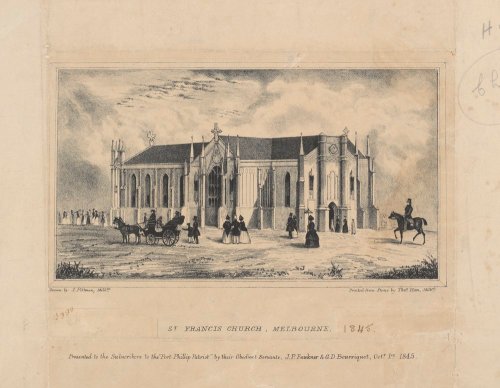
St Francis Church 1845 from stone by Thomas Ham. Source: State Library of Victoria
The major denominations were hard at work in these early years of the 1840s building their first permanent churches to replace the rather makeshift structures had had been quickly erected as the population of Melbourne began to boom. There was nothing that Melburnians liked so much as a good ceremony (in fact, that’s still true) and the Masons were usually on hand to make an occasion of it. But not so when it was a Catholic chapel, notwithstanding the general co-operation between the denominations at this stage.
On Monday last the foundation stone of the new Catholic Church was laid by the Rev. Mr Geoghegan on the ground set apart for that purpose in Lonsdale-street, and upon a portion of which the temporary edifice at present stands. In consequence of the reverend gentleman being a member of the order of St Francis, the church was dedicated to that saint. It was contemplated that the Masonic body should have proceeded in due form, and assisted in the ceremony; but the opinions of others being at variance with this suggestion, it was dropped to prevent a schism. About £200 was collected on the ground. The following inscriptions upon parchment were deposited, along with some coins, in the foundation stone:
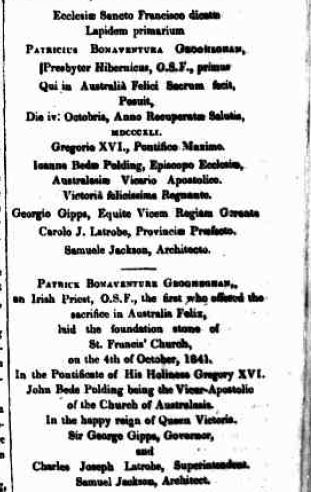
PPG 6 October 1841
The Port Phillip Herald, which gave more attention to news of the Catholic church than the other two papers, carried a full report of the ceremony and the addresses given in its 12 October issue. The crowd, it seems, was smaller than might have been hoped:
The day was unfavourable, being tempestuous and showery, besides many of the congregation and persons of other religious persuasion were prevented attending by reason of occupation at either of the two Courts which were then adjudicating [on the Arden case above!] nevertheless a considerable assemblage was present at the sacred ceremony.[ PPH 12/10/41]
Fr. Geoghegan finished his oration praising the ecumenical spirit that generally existed in these early Melbourne years (the absence of the Masons notwithstanding). I’ve often wondered if it was the arrival of the bishops that hardened the sectarian lines in Port Phillip society, or did it just reflect the increasing size and complexity of a town outgrowing its frontier status?
Thanks to God we live in a country of liberty where it is the recognized right of everyone to worship God according to his conscience: Australia Felix! a country happy and true to its name, where we can appeal even to our Dissenting brethren to defend us from an encroachment on our religious freedom as if it were their own [PPH 12/10/41]
Unfortunately it seems that the coins did not stay for long in the foundation stone. On the 7th October the Port Phillip Patriot carried this report:
SACRILEGE. On Monday night last some paltry ruffians removed the foundation stone of the new Roman Catholic Chapel, which had been laid during the day, and carried away the bottle containing the inscription and the different specimens of the coins of the realm, which were deposited in the stone. The whole value of the property stolen is not more than thirty shillings and to accomplish this notable feat there must have been at least six thieves employed, the dimensions of the stone being such as to preclude the likelihood of a smaller number being able to accomplish the theft without the aid of machinery.
How’s the weather?
Light winds 1st and 2nd, gale on 3rd, afterwards fresh and strong winds; weather damp and cloudy until 4th, afterwards bright and clear. Top temperature 74 (23.3C), lowest 41 (5.0C) and the coldest day of the month was on 5th October.

2003, 288 P.
Is a steady diet of Wallander, Scott and Bailey, The Bridge and -sheesh- even Midsomer Murders softening me up for detective murder mysteries? Stranger things may have happened. Whatever: I found myself quite engrossed in this Australian crime story chosen by someone in my face-to-face book group.
As with the above-mentioned television crime series, this book is just as much about the interactions and messy personal lives of the police investigators as it is about the crime. Although the book is subtitled ” A Detective Inspector Challis murder mystery”, Detective Inspector Hal Challis is only one of an ensemble of police characters. There’s Detective Sergeant Ellen Destry, whose 17 year old daughter is recovering after almost falling victim to a rapist and serial killer in an earlier book. There’s the sleazy Constable John Tankard who hits on his female colleagues and who doesn’t seem far removed from the criminals he is chasing. Detective Constable Scobie Sutton bores everyone rigid yabbering on about his daughter, while Constable Pam Murphy has waded in over her head financially.
In many ways this book is a snapshot of the paradoxes of the Mornington Peninsula in Victoria. There’s the affluent and often absent population up in the forested mountainside (think Red Hill) and the financially straitened underclass in ‘Waterloo’ (Hastings, perhaps? It overlooks Phillip Island, but it felt more like Rosebud to me). An immigration detention centre has opened up nearby, and the reactions of inhabitants remind me that we haven’t moved far in the 13 years since this book was published. There’s drugs, crime and unsavoury connections among the underclass where boyfriends and broken families criss-cross each other. As the police note in one of their briefings, criminals often announce themselves through their defiance of small things like parking in the disabled bay. Rings true to me.
Disher’s chapters are only short and they rotate in their attention from one police officer to another. Too much, perhaps, and there does not seem to be one main character in the book which feels as if it’s leaving itself open as the springboard for another book in the series.
But- and this is important- I actually knew who’d done it in the end, even though not all the ends were tied up. And, as someone who’s not normally a fan of crime fiction, that’s a good thing!
Sourced from CAE bookgroups
My rating: 8/10
Posted in Book reviews, The ladies who say ooooh
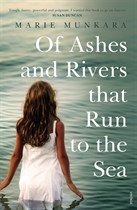
2016, 274 p.
For me, the day that then-Prime Minister Kevin Rudd apologized to the Stolen Generations is a day lodged in my memory, along with moon walks, assassinations, bushfires and planes crashing into buildings. I was on a train to Bendigo for a history conference, and it seemed rather appropriate to sit with other historians, heads bent over a small transistor radio, listening to Rudd give a historic speech that was much better than I expected it to be. But although as white Australians the speech may have made us feel a bit better about ourselves, it was always an apology to indigenous Australians. They sat in the parliament and on the lawns outside, many in tears. This was their apology. As a white Australian, I know the policies and justifications that led to the removal of indigenous children from their parents, but I can only imagine, incompletely, the emotional toll of this government-encouraged policy.
Marie Munkara’s book takes us into the heart of it because the author is one of those stolen children. Born on the banks of the Mainoru River in Arnhem Land in the Northern Territory, she was taken from her mother at three years of age. Her white foster father sexually abused her for years, and her white foster mother was bitter and harsh. Nothing was said about her birth family, although her religious family did meet with other families who had likewise adopted Aboriginal children under the aegis of the Catholic Church. Twenty-eight years later she found a baptismal certificate, and after some enquiries, she found out that her mother was still alive and that she had siblings at Nguiu on Bathurst Island. Within weeks, she was aboard a plane to meet her family. It is a troubled, awkward reunion. Months after returning for a second stay, she confronts her birth mother:
‘Did you want me to come and stay here with you?’ I say petulantly. ‘You’re always so grumpy.’
‘You nebber ask me,’ she says tetchily like I’ve struck a raw nerve.
And mummy is right, I didn’t ask her. And I have never asked her about how she felt about her three-year-old child being taken from her life and a twenty-eight-year-old stranger waltzing back into it again. I assumed that we would take up where we left off but I realise now that the years have been too long and the differences between us too many for that to occur. (p 232)
Certainly Munkara crashes back into her family’s life full of justifiable anger at her foster-parents. But her perspective on her new family is steeped in urban, white values. She is appalled by the squalor, poverty and community violence and frightened by the snakes, rogue cattle, crocodiles and lice. Repulsed by the barely-cooked meat served up to her, she decides to become a vegetarian: an urban affectation not easily catered for in a remote area. She is torn between judgment and an aching need to be accepted and folded back into her family.
If you’ve read Munkara’s Every Secret Thing (my review here) you’ll recognize the humour in this book with it’s ‘up-yours’ insouciance. Many of the book’s small chapters are short vignettes where Munkara tells of meeting family members, nights at the alcohol-sodden club house, hunting trips and bush-bashing in completely unroadworthy cars. Much of the time the humour is at her own expense.
The narrative voice is simple and feels to me as if it belongs to a younger writer. Munkara is fifty-six, but sounds almost adolescent. This is not high literature by any means.
The crispy sauvignon blanc that I had bought to help pass the time left a subtle lingering citrus taste on my palate… (p. 4)
Nonetheless, particularly in the last forty pages of the book, there is an honesty and poignancy that transcends the rather pedestrian prose.
…there’s a little piece of something in my heart that no one can reach because it lives deep down inside me. I think this family wants to take the something out of my heart and make me black, just like the other family wanted to tame me and make me white. I know that nobody is interested in the parts of me that don’t concern them. The white parents aren’t interested in the pre-assimilation black bits because they wanted a white girl with black skin. And my real family don’t want to know about the post-assimilation white bits because they think I’m a black girl with a white heart. I know that I’ve disappointed them all. The anger from the white parents. The pitiful looks from the black. The fretful and all-consuming silences from them both. I wish I could open the doors to my mind and let them in, so they could see the world from my eyes and forgive me for not being able to fit their expectations. (p. 234)
Despite the raucous auntys and cousins surrounding her in her black family and the sterile figures in her white family, this is a lonely journey with higher emotional stakes than, say, Sally Morgan in My Place. Its authenticity transcends its unsophisticated prose and structure. I haven’t read a book quite like it.
Sourced from: Yarra Plenty Regional Library
My rating: 7/10
I have posted this review to the Australian Women Writers Challenge website. 
Census results
Given that in September 2016 we’ve had the census uppermost in our thoughts, you might be interested in the results of the 1841 census. Mind you, the Port Phillip Gazette scoffed at the figures recorded for Melbourne, boldly declaring that:
If [the figures] are all as incorrect as Melbourne, this document is sheer humbug [PPG 29/9/41 p.3]
| LOCATION | MALE INHABITANTS | FEMALE INHABITANTS | GENERAL TOTALS | NUMBER OF HOUSES |
| Melbourne | 2676 | 1803 | 4479 | 769 |
| Geelong | 304 | 150 | 454 | 70 |
| Total Melb & Geelong | 4933 | 839 | ||
| Rest of NSW | 48,584 | 4052 |
What would they say on ‘Gruen’?
‘Gruen’ is a weekly ABC program that dissects advertising and marketing, and the angles and techniques used to persuade consumers. I wonder what they’d think of these advertisements?
The first, for the grocery store Albion House, places itself as on the side of the embattled settler while at the same time trying to entice him into buying:
ALBION HOUSE. AN ESSENTIAL PUBLIC GOOD. The depressed state of the times, the stagnant state of commerce, the scarcity of cash, the great reduction in wages, the number of persons thrown upon our shores sixteen thousand miles from their friends and native homes, having no employment and but little cash in their possession, have long cried aloud for a reduction in the high prices of the necessaries of life; indeed it is whispered in the cottage, it is muttered in the cheerless unfurnished cot, “Give us cheaper food; let us have a reduction in the prices of the measures of life, or we starve!” Their demands are satisfied, their cries are heard, and they have now an opportunity of procuring not only the necessaries of life, but also many little comforts that have existed only in desire without the means of procuring them, because of the highness of prices. C. S. BARRETT & CO having recently taken those extensive premises lately occupied by Mr Empson, draper, Collins-street, which they have opened with a very large stock of grocery, tea and provisions of every description, direct from England; and, that the public may not be deceived, they have named in The Albion House, where the above named articles may be purchased at prices astonishingly below anything as yet submitted to the inhabitants of Melbourne. [PP Gazette 29/9/16 p.1]
Or how about this advertisement for a laundry service? Mangling…a ‘beautiful science’ no less!
IMPORTANT TO FAMILIES. W. Herbert begs to acquaint the inhabitants of Melbourne and the surrounding district that he has opened those premises lately occupied by Mr Melbourne, Hairdresser, Little Flinders-street and invites the attention of the public to the circumstance that he, with Mrs H and female servants, intend Washing, Mangling &c for those families who will honour him with their patronage; and having brought a Patent Mangle with him, will be able to accomplish this beautiful science in first-rate style. W. H. is aware of the scarcity of money, and therefore will work for the lowest figure; but he must have cash, as nothing else will keep the Mangle going: a man has been engaged for the express purpose of keeping it in constant motion; and as steady women are engaged for the washing department, W. H trusts he will have a share of patronage for so novel a business or profession. The prices will be as follows:
Washing and Ironing per doz….4/6
Mangling per ditto…………….0/6
Mrs Herbert has female servants that may be hired by the hour or day to wash and clean as charwomen. [PPG 29/9/16 p.2]
A new variation on the ‘dogs-as-nuisance’ theme
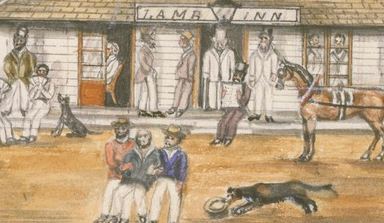
Detail from Liardet’s picture of the Lamb Inn, Collin’s street. Note the dogs. Source: SLV
The Port Phillip newspapers have had plenty to say in their columns about the nuisance posed to the inhabitants of Melbourne by stray dogs. But even the attempts to curb the numbers of dogs by offering a bounty seems to have backfired:
PUBLIC NUISANCE. We have to call the attention of [Police Magistrate] Major St John to the disgraceful conduct of the constables in leaving the carcasses of the dogs they have killed for the sake of their tails, putrefying on the sides of the street. We would suggest that in order to abate the evil, the reward given for the tails of unregistered dogs shall not be issued in any case, unless the claimant can show that the carcasses of the animals have been disposed of in such a manner as to prevent the possibility of their becoming a public nuisance. [Port Phillip Patriot 30/9/41 p.2]
Family Jars
The Police Intelligence columns are the gift that keeps on giving. Obviously the whole family, including the women, got into this one:
FAMILY JARS. Peter Connell was charged with cracking the head of Stephen Moore with a ginger beer bottle. From what could be gathered from the statement of Connoll, whose head was bound in a Turkey red handkerchief, it appeared that on Saturday, about half-past one o’clock, he was requested by Moore, who is a neighbour, to remove a water cask then reclining against a fence near his door.This being complied with, Connell’s servant pulled down some of the fencing, and made a thoroughfare through the premises; to this he objected whereupon Mrs C. came out and emphatically laid down the law on the case; this was rebutted by Mrs M., who declared that a free passage and female rights were her motto, and on that she would stand. Connell and Moore then came upon the ground, and issue was quickly joined, and scuffling, thrashing and the cracking with the ginger beer bottle followed.[(PP Gazette 29/9/41 p3]
The ‘Scrutator’ letter
On 29 September George Arden, the young editor of the Port Phillip Gazette published a letter which criticized Judge Willis , supposedly penned by ‘Scrutator’. After starting with a complaint about Judge Willis’s ban on raffles, the letter moved onto a wide-ranging attack on Willis’ fitness as a judge. The authorship of the letter was never questioned but Arden’s role as editor in publishing it certainly was, suggesting that Arden himself probably wrote the letter (as did most of the other editors when wanting to stir the pot a bit). In fact, as we’ll see as time goes on, Willis’ heavy-handed response to press criticism was to be one of the loudest complaints against him, both by Melbourne inhabitants and eventually, by the government as well. So, because this letter was so important for Judge Willis’ career and for the public debate for the next six months or so, I’ll transcribe it in full (but I give you permission to skip reading it and just jump down to my comments below!):
TO THE EDITOR OF THE GAZETTE: SIR- In consequence of some sensible remarks which appeared in your last paper, as to the impropriety of Judge Willis directing the Crown Prosecutor to take steps to prevent raffles, I beg to direct your attention to a habit of His Honor’s which is not only unbecoming in a Judge, but which has done much injury, and the baneful consequences of which will extend more widely over the colony, unless at once stopped by the interposition of an independent press: I allude to His Honor’s practice of giving his opinion and directing the proceedings, not only in matters collateral, but even in those totally unconnected, with the question he is called upon to decide. To one who has attended the English courts of justice, and observed the scrupulous caution with which the judges therein refrain from allusions to all portions of a case except that immediately at issue, and even then declining to make any remarks upon- not to say decide- any point to which their attention has not been directed by full an deliberate discussion, Judge Willis’s conduct is in most startling contrast. No opportunity escapes him for scattering his dicts, for stating what he conceives to be the law and merits of every subject, no matter how extraneous to that under consideration, if it happens to strike his fertile fancy. Who has not censured the un-called for stigmas he carelessly heaps on the conduct and character of Magistrates, Barristers, Attorneys, Witnesses, Suitors, or any one whose name may have been unfortunately mentioned in his court? the praise he never awards, except to those who flatter and cringe to him, is nearly as disgusting as the unmeasured censure he so copiously visits on the other wretched individuals who are dragged beneath the outpourings of his bilious temperament; and should he ever find a dearth of legitimate victims, Simpsons, Carringtons, Editors &c with what a master hand, supported by what ancient authorities, will he summon from the peaceful repose of a newspaper advertisement a Cunningham or a McNall, …entire horses, donkeys, raffles, and gambling. But, Sir, what is equally to be lamented, though not so generally known, is his practice of advising upon titles to land, the validity of grants from the crown- stating that deeds are inoperative, conditions not being complied with- that the land fund having been applied to immigration, and not to the consolidated fund, all the Governor’s conveyances are illegal, and even if they were not, lands sold before the Governor has dated his grant can never pass the property to the purchased; in fact, whether in or out of court, the sole result of his unfortunate temper and his distorted judgment is raising disputes and fomenting instead of suppressing litigation. Is this a fit or proper person to fill the highest judicial chair in the province? Judge he is not, nor ever will be, being in every case so much a creature of deluding impulse. To those who are so connected with him as to be obliged to bear the burthen of his acquaintance, the endless disparaging terms in which he speaks of his late brother Judges, the gentlemen of the bar, and all with whom he came in contact in Sydney; the egotism and vanity which actuate his very look and expression, have demonstrated that the fountain of his acts is drawn not from the pure sources of liberal learning and enlightened knowledge, but the sterile rock of ignorance and self conceit; coupling these with his penurious miserly habits (for never was he, whom from his position and salary should be an example of liberality, known to see a friend within his poverty-stricken doors) is he, I would ask a proper person to have been sent to a young colony as its Judge? Yet, Sir, Some hope remains that this paralyzing member of an otherwise healthy community may ere long be removed, under the [indistinct] fearless catchcry of an independent press. I have the honour to be Sir &c &c &c. SCRUTATOR. [PPG 29/9/41 P.3
In transcribing this letter,I’m struck anew by how barbed it is, even for the time. Even though the three Port Phillip newspapers were published legitimately and regularly, they were a mixture between, using the example of 20th century Melbourne, the Herald Sun and Truth magazine, or to bring us into the 21st century, very similar to the internet’s mixture of hard news and utter scurrility. Judges were criticized in the press (it seems to me, more than today but I’m not sure) but then, as now, it would have been a dangerous undertaking, particularly in a district that had only one judge.
Looking at the letter, ‘Scrutator’ starts off by criticizing Willis for making extraneous commentary from the bench, asserting that the judges in England did not do so. That’s not true: the judge’s speech at the opening of term was a time-honoured occasion for moral commentary, usually about the evils of alcohol and godlessness (but gambling could conceivably fit under such a tirade). That said, Willis used the opportunity to make such commentary excessively. ‘Scrutator’ then makes criticisms that were to be echoed two years later when the whole Willis thing blew up. Willis’ attacks on magistrates, barristers and individuals like Simpson and Carrington were all listed as reasons for his dismissal and ended up being aired in the Judicial Committee of the Privy Council in Whitehall. Even Houndsfoot the stallion and Montezuma the donkey get a look in!
More pointed, though, is ‘Scrutator’s’ report of Willis’ private conversation, and here we get into murky territory. Arden was most certainly not part of Willis’ social or conversational circle- so who was telling him all this? And the content of this reported conversation at a time when the property bubble was just about to pop was incendiary, then as a final kick to the shins was a dig about Willis’ dearth of friends and lack of gentlemanly sociability.
How’s the weather?
This week the weather was more settled, with light winds generally and bright and clear after 24th September. The 28th and 29th were the warmest days of the month, with a top temperature for September of 76F (24.4 C) and a low for the week of 45 (7.2C)
I wanted to like this Australian movie but – oh dear- there’s 1 hour and 17 minutes of my (not inexhaustible) life wasted. A mixture of ‘Where the Wild Things Are’ and ‘Heathers’, ‘Grease’ and every other teen movie you’ve ever seen, it was derivative and wallowing in 1970s kitsch nostalgia. The red-headed boy from ‘Upper Middle Bogan’ (Harrison Feldman) played exactly the same character here; Bethany Whitmore was quite good as 15 year old Greta but overall it just left me cold. Very disappointing.
Two stars from me, David.
Posted in Movies
 The Resident Judge of Port Phillip