
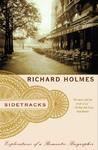
2000, 410 p.
As you know, I’ve become enamored recently of the writings of the biographer Richard Holmes- in particular his autobiographical works ‘Footsteps’ and now ‘Sidetracks’. He’s been a prolific biographer over the last 30 years and in the prologue to Sidetracks he lists his major biographical subjects and the outcomes of his work:
1969-70 : Chatterton (an essay, no biography)
1971-74: Shelley (a biography Shelley, the Pursuit)
1973-79: A Gothic Victorian (many sketches, no biography)
1975-79: Gautier and Nerval (sketches, translations, unpublished biography)
1979-80: Scott and Zelda Fitzgerald (a single sketch)
1980-85: A Romantic Traveller (sketches, finally Footsteps)
1986-87: William Godwin and Mary Wollstonecraft (an essay, no biography)
1982-89: Coleridge (half a biography, Coleridge: Early Visions)
1990-94: Johnson (a fragment of biography, Dr Johnson & Mr Savage)
1994-98: Coleridge (second half of a biography, Coleridge: Darker Reflections)
1999… A Runaway Life (but, as he says “that could go anywhere”)
His book Sidetracks consists mainly of essays that have been published elsewhere (particularly The Times), with 2 radio plays- the one on Nerval I wrote about here, and a second play “To the Tempest Given” about the death of Shelley. The short-ish essays in this book, as the title of the collection suggests, follow up on peripheral characters and suggestions that he passed by while working on his “main” topics. As they have been written as stand-alone newspaper articles, they are engaging works that quickly familiarize the reader with sufficient contextual information to make sense of the story- often framed as a single event or problem- that he lays out and then explores, sometimes via a meandering route, with us.
My favourites were the two radio plays on Nerval and Shelley, and a real historian’s delight- the essay ‘Lord Lisle and the Tudor Nixon Tapes’, written in 1982. This essay describes the cache of over three thousand letters written to and by Lord Lisle, Henry VIII’s civilian governor who served in Calais, the last English outpost on the continent. His correspondence was seized when he was placed under house arrest as part of the machinations of the Tudor state machine. It is said that he ended up in the Tower, where, as a privileged prisoner he was exercising on the ‘leads’ of the tower and spied the King’s barge floating down the wintry Thames. He called hoarsely to the King for mercy: the King heard him and pardoned him. The letters have been compared with Pepys’ diaries as a source of “eavesdropping” on history, and after surviving fire, flood, and the Blitz, they came into the hands of Muriel St Clare Byrne, who worked on them for fifty years, culminating in a six-volume publication of nearly 4,000 pages and close to two million words.
The essays in this book are loosely grouped, tied together by a theme of place (e.g. France and Paris) or tangentially related to one or another of his major biographical characters (e.g. Shelley; Boswell; Gothic authors). Each part is prefaced by his own statement about the essays that is interwoven with a reflection on his growth as a biographer. I found myself laughing out loud at his description of watching someone reading one of his newspaper essays on a train.
It was a salutary experience. Over several minutes an expression of lively interest steadily faded to one of judicial blankness, soon followed by deep and blameless sleep. (p. 136)
He verbalizes one of the biographer’s (and indeed, the historian’s) ongoing anxieties:
This question of how the biographer achieves authenticity, now began to trouble me. How much is constructed from broken evidence, a scattered bundle of letters, the chance survival of a diary? How much is lost, forgotten, changed beyond recognition? What secret thoughts are never recorded, what movements of the heart are never put into words? And more than this, by the very act of biographical empathy, how much does the biographer create the fiction of a past life, the projection of his- or her- own personality into a story which is dramatically convincing, even historically correct, but simply not the human truth as it happened? (p. 197)
He speaks of biography as a human exchange: “a handshake across time”, an “act of human solidarity, and in its own way an act of recognition and of love.” (p. 198)
There is love in this book; and so, I found myself going all goo-ey inside when he reveals his relationship with the writer Rose Tremain, with whom he spent four months in Paris, “looking for some literary expression of the passionate understanding which had brought us, so late and so unexpectedly, together” (p. 319).
In fact, I think I’m a little in love with him myself.


Pingback: ‘Writing Lives: Principia Biographica’ by Leon Edel « The Resident Judge of Port Phillip
Pingback: A-writing I will go | The Resident Judge of Port Phillip
Pingback: ‘Redcoat’ by Richard Holmes | The Resident Judge of Port Phillip
Pingback: ‘Reflections on Biography’ by Paula R. Backscheider | The Resident Judge of Port Phillip
Pingback: ‘Kathleen O’Connor of Paris’ by Amanda Curtin | The Resident Judge of Port Phillip