
Tag Archives: religion

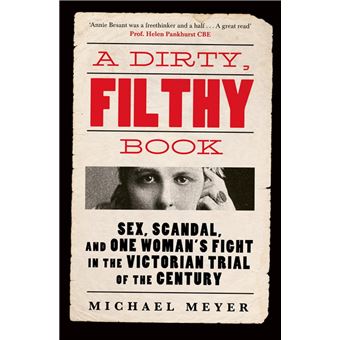
‘A Dirty, Filthy Book’ by Michael Meyer

2024, 331 pages & notes

Some people seem to live not just one life, but many. Annie Besant was one such woman who went from parson’s wife, to public speaker and publisher, social worker and activist, to university student and Theosophist. Michael Meyer’s book, subtitled ‘Sex, Scandal and One Woman’s Fight in the Victorian Trial of the Century’ focuses particularly on the court case in which she and her colleague Charles Bradlaugh were charged with “unlawfully wickedly knowing wilfully and designedly” printing and publishing “a certain indecent lewd filthy bawdy and obscene book called Fruits of Philosophy” which would bring the subjects of Queen Victoria into “a state of wickedness lewdness debauchery and immorality”, as well as offending against the peace and dignity of the Queen. (p. 140)

Neither of the accused had actually written the book, which was quite an old text written forty years earlier by an American doctor, Charles Knowlton. In fact, Charles Bradlaugh didn’t think much of the book at all, but it was more the principle of making knowledge available at a cheap price (sixpence) that drove Annie and Charles to defend publishing the book in court. They wanted a high profile case, and they got it. Conducted in Westminster Hall (before it burnt down), it was a jury trial held before the Lord Chief Justice Sir Alexander Cockburn. Already an accomplished public speaker, albeit completely untrained in the law, Annie conducted her own defence, and from the extracts published in the newspapers in this widely-discussed trial, she did a damned good job of it too.

She, even more than her co-accused Charles Bradlaugh, had a lot to lose. She had married a clergyman, Rev. Frank Besant at the age of 18, without actually loving her husband but hoping, as a devout Christian, that the role of minister’s wife would be a way through which she could serve the Church and her fellow man. It was an unhappy marriage from the start. She had two children, a son Digby and daughter Mabel, and managed, through her brother, to procure a separation from her husband but he kept custody of her son, and refused a divorce. If found guilty, Annie would lose custody of her daughter as well.

She had lost her faith during her marriage, and after her separation became heavily involved in the National Secularist Society, where she met Charles Bradlaugh. They were very close, although Meyer does not explore whether their relationship was sexual or not. Both were still married, and as public figures, could not expose themselves to scandal. She wrote numerous articles for the National Reformer weekly newspaper published by the NSS and was an accomplished public speaker. It was this experience of debate and public discourse that stood her in good stead in the courtroom at Westminster Hall, but did not shelter her from the fallout of the case. Charles Bradlaugh went on to have a successful political career, being repeatedly re-elected and repeatedly refused being able to take his seat in Parliament because, as a secularist and atheist, he refused to swear on the Bible. As their lives split off in different directions, the obloquy of her atheism prevented her from being able to graduate from the University of London, once they accepted female students, even though she was clearly a brilliant student. She threw herself into social activism in the East End, particularly in leading the Match Girls strike about working conditions and the use of white phosphorous in making lucifer matches at Bryant and May. Over her life, she had been a devout Christian, a strident atheist, and eventually she moved into Theosophy, to which she devoted the latter part of her life. She abjured her earlier publications, and especially the book about birth control methods that she wrote after the court case which was even more explicit than Fruits of Philosophy. It really is as if she had several careers.

In the book, there are parallels drawn between Besant and two other women. The first of these is circus performer Zazel (Rossa Richter) who drew fame for being shot out of cannon, night after night. The second is Queen Victoria herself, who had a much happier experience of married life than Annie Besant did, and whose politics were diametrically opposed. Queen Victoria was not particularly aware of Besant, but she did record her disapproval of Bradlaugh in her diaries.

When I first started reading this book, I enjoyed its breezy tone and discursive narrative but I soon tired of it. In trying to contextualize Besant and her various campaigns, he draws on newspapers to illustrate what else was occurring at the time, and in the end it became a distracting lack of attention- as if he couldn’t bear to let a juicy tidbit pass, without reporting it. I enjoyed his reporting of the court case itself, but the lack of discipline elsewhere in the book detracted from his analysis of the case and its aftermath. Like the court case itself, it all felt a bit tabloid.

The author is a travel writer, which did not surprise me. He is also Professor of English at the University of Pittsburgh, which did.

Nonetheless, it’s a really interesting story and, despite his digressions, Meyer tells it in an engaging and entertaining style. I just wish that there had been a little less ‘colour’ and more analysis.

My rating: 7.5/10

Read because: I heard a podcast about the book

Sourced from: Yarra Plenty Regional Library
I hear with my little ear: Podcasts 17-24 December 2023

History in the Bible. Good grief- so much preparation for such a short service at my Unitarian fellowship In. Episode 2.25 The Quest for the Historical Jesus. I thought that this was going to be about the quest itself, but instead it was about three different waves of analysis of the historical Jesus. The First Wave was in the 18th century when Reimarus, a contemporary of Voltaire, anonymously published 10 years after his death, an analysis of the historical Jesus which depicted him as a fanatical revolutionary and highlighted the differences between different factions of disciples. F. C. Baur took up this interest in factions in the mid 1800s, distinguishing between the pro-Jewish faction of Peter and James, versus the pro-Gentile faction of Paul. After this first wave, there was a period when theologians like Albert Schweitzer and Rudolf Bultmann decided that the Quest was useless anyway. In the Second Wave, after WWII, there began a systematic search for authenticity in the bible, which meant excluding everything that was Jewish and everything that was Christian. Walter Bauer argued that Jesus’ message had been corrupted by a warring Christian community from the start. When the Dead Sea Scrolls were discovered in the 1940s, the diversity of belief among factions was demonstrated. The principle of Embarrassment arose- i.e. if what Jesus said was likely to be embarrassing to either Jews or Christians, then it was probably authentic. The Third Wave in the 1970s featured theologians like N. T. Wright, Ed Sanders and J.G.D. Dunne – and these were international scholars, not solely German ones as in the First and Second Waves. They looked at books outside the canon, and sought to place Jesus within the Jewish context. They rejected the Embarrassment Principle, arguing instead that whatever was authentic must be consisted with 1st century Judea (which is the way that I lean).

The Secret History of Western Esotericism. Good grief. How did I end up here? Looking for more on Apollonius of Tyana, that’s how. Episode 65: Graeme Miles on Apollonius of Tyana features Graeme Miles a lecturer in classics and researches Greek literature (especially of the Roman Era) and philosophy (especially the Platonic tradition). At the time of this podcast, he was at the University of Tasmania. He looks at the life of Apollonius and Philostratus’ biography of him written in the time of Julia Domna. This is a very learned podcast, with many references to other philosophical figures- and it was a bit beyond me, to be honest.

The Ancients Jesus of Nazareth. You know that point in preparing for writing an essay or thesis when suddenly you’re not reading anything new anymore- well I have finally reached that point. However, if you wanted a one-episode summary of the current state of play in looking at the historical Jesus, this episode featuring Dr Helen Bond, a Professor of Christian Origins at the University of Edinburgh, might be useful (except for her annoying giggle every time she is asked a question). Things I hadn’t thought of before: Matthew’s gospel looks at Kings, Wise Men etc., emphasizing the link with King David where as Luke looks at low status people. Jesus had 12 Disciples, even though he had many more adherents than just 12, but the number reflects the Twelve Tribes of Israel.

History Hit Napoleon Part 2: The Commander features military historian Dr Zack White who is rather conflicted about Napoleon as a Commander. Napoleon interpreted maps well; he physically touched (not in a sexual way) his men and yet he was cavalier with their lives in his quest for victory. He didn’t invent the corps system, but he used it well. His enemies soon learned that the best way to fight Napoleon was not to fight him. As not only military commander, but also ruler of France, he thought about what he wanted from a battle. He was a good commander, but poor negotiator. His skills remained the same, but he himself changed over time. Increasingly he began using his men as battering rams, losing huge numbers, and calling on his imperial guard to act as shock troops. He was a “come on” commander rather than a “go on” commander. Dr. White identified five traits that made Napoleon a great commander: 1. choosing good marshalls 2. use of the corps system 3. his opponents didn’t know how to deal with him 4. he had a Machiavellian mind 5. his ability to inspire (manipulate?) his men. [None of these traits were demonstrated in the Ridley Scott film, by the way]. His actions changed world history through prompting the fall of the Holy Roman Empire after Austerlitz, and changing the balance in the Americas through the Louisiana Purchase.

The Rest is History. Continuing on with Ep. 388 The Fall of the Aztecs: The Festival of Blood (Part 5) takes up with Cortez dividing his troops and heading off to confront Pánfilo de Narváez, who has been sent by the governor of Cuba, taking along Montezuma as a hostage. He confronted and defeated de Narváez, taking his troops (who were more a band of mercenaries than regular troops) and heading back with his vastly enlarged group to Tenochtitlan, increasingly aware of the sullenness of the people as he was moving through. On arrival, his lieutenant Pedro de Alvarado told him of a massacre that had erupted after Cortez’ departure, and now Cortez and his additional men embarked on a new battle on the eve of one of the most hallowed Aztec festivals. Montezuma was brought out to address the Mexica, but by now he had lost all authority with the people, and now that he was of no use to Cortez, they killed him. It’s interesting to speculate why the Mexica even allowed them to come back- was it a trap?

Literature and History Podcast Episode 10 Homer’s Gods deals with books 9-16. He starts off with giving a summary of the books, which saves you the effort of reading it yourself (although I found this really useful after listening to summarize). He then goes on to discuss Homer’s gods. The gods of the Pantheon moved in and out of favour with readers at different times, but Zeus was always the most important. Zeus was the superintendent, but the other gods demonstrate the wicked, perverse sides that the gods could display. They had preferences, rather than being subject to laws. Much of books 9-16 involves the to-and-fro of battle, as if they were wearing a rut in to the earth. The presenter, Doug Metzger, backtracks to give us the origins of the war, even though this merits only a line or two in the Iliad itself. It was started by Eris, the goddess of discord who asked Paris to judge who was the most beautiful between Athena, Aphrodite and Hera, all for the prize of a golden apple. When Paris went for Aphrodite (who bribed him with the offer of Helen, the most beautiful woman in the world), that instantly put Athena and Hera onto the Aegean’s side. Whatever we might think of Homer’s Gods now, other Greek philosophers weren’t too impressed with them back then either: Xenophanes was a critic, and Plato thought that the Iliad should be censored because of the bad values it promoted.