The Rest is ClassifiedEpisode 101: Putin’s Secret Army: Wagner’s Control of Africa (Episode 4) As the French withdrew from the Central African Republic, Yevgeny Prigozhin and the infamous Wagner Group saw an opportunity to make themselves useful to the Kremlin by globalizing his model and applying it to new conflicts. After all, the East Indian Company had used this privatized company model of colonization way back in the 18th century. In the end, is there a difference between mercenaries and a government contractor? For quite some time, Prigozhin denied any involvement in Africa, adopting some fairly risible disguises when flying in for meetings. He made a deal with Sudan in exchange for gold; he took advantage of the Civil War in Libya after Gaddafi; in Mozambique different countries were pitching for deals. In exchange for his security and information warfare, he received mining concessions. Ever the publicist, he was heavily into branding, and started making his own publicity films in Africa, starring his own troops. But by January 2022 he came into conflict with the Russian Ministry of the Defence who, he felt, were locking him out.
The Rest is HistoryEpisode 637 Revolution in Iran: The Rise of the Ayatollah Part 2. The Iranian Revolution, despite being characterized in the west as ‘medieval’, is a classic 20th century revolution, with the involvement of the petite-bourgeousie, young unemployed working class men and students but also with the addition of clerics and religious students. The Shah neither repressed nor appeased the protestors, and U.S. President Jimmy Carter was completely out of his depth. He appointed the dovish Cyrus Vance as Secretary of State (of course, Tom points out the irony of having a man called Cyrus being appointed to Iranian (Persian) affairs given the historical Cyrus the Great) as well as the hawkish, anti-Russian Zbigniew Brzezinski as National Security Advisor. Needless to say, the two men did not get on. In October 1978 the Sunni, Arab, Baathist Saddam Hussein expelled Khomeini from Iraq, and he went to Paris where he made himself very available to the world press, who were happy to report his anti-colonial, anti-imperialist views. He did express to the international press his radical view that the mullahs should run the state, but he was quite open about it in his taped lectures which were sent home to Iran and circulated widely. On New Years Eve he issued a call for nine days of protests, and by 19 January 1979 the Shah had agreed to leave, wanting to go to California, which led to more conflict between Vance and Brzezinski over US’ responsibility to the Shah. On 1 February 1979 Khomeini returned after fifteen years’ exile and was greeted by crowds. Brzezinki was urging a coup, but the US Ambassador to Iran, Sullivan, rejected this plan, arguing that there were fears for US businessmen and that oil prices would skyrocket. Meanwhile, back in America, evangelical Jimmy Carter was convinced that US was gripped by a spiritual crisis, exemplified by what came to be known as his televised ‘malaise’ speech, calling for people to use less oil- not the sort of message Americans are accustomed to hearing from their President. Khomeini announced the export of Sharia Law, and the increasingly ill Shah was stuck in the Middle East.
Journey Through TimeEpisode 63 The Spanish Civil War: Fighting Fascism With Hemingway and Orwell (Episode 2) Despite their governments’ squeamishness about getting involved in the Spanish Civil War, combatants from more than 53 countries came to support the Republicans under Comintern. In fact, the Lincoln Battalion, a force of volunteers from the United States who served on the Republican side in the Spanish Civil War from January 1937 until November 1938, was the first racially integrated US military force. Despite the Republican fighters’ enthusiasm, they were amateurs: some came to Spain intentionally, others just happened to be in Barcelona for the 1936 Peoples Olympiad, set up in opposition to Hitler’s Olympics, which ended up being cancelled anyway because of the outbreak of the Civil War. The Republican effort was working class, but its public image has been largely shaped by the writers and photographers who attended, who had the contacts with publishers to get their work out. Women were involved too, defending the feminism in Republican Spain compared with the sexual violence amongst the Nationalists, who were not beyond using systematic rape. The Republican military training was more ideological than practical. Because of Spain’s neutrality during WWI, the Nationalist troops were not particularly experienced either, and the battle-hardened leaders from the foreign legions took control in Franco’s army. Nonetheless, the battle for Madrid was hard fought on both sides.
Late Night Live Barry Jones on a life of public service and the state of politics today Barry Jones might be 93 years old, and in frail health, but his feats of memory are amazing. Obviously interviewer David Marr was apprehensive that Jones might ramble on and kept him on a fairly tight leash, even ringing an imaginary bell when Jones went on for too long. I couldn’t believe how easily Jones could bring to mind names and acronyms in a wide-ranging conversation: none of the -oh-it’s-on-the-tip-of-my-tongue lapses of people half his age. I loved his discussion of the ‘numinous’.
The Rest is ClassifiedEpisode 100 Putin’s Secret Army: Fighting with Assad in Syria (Episode 3) Prigozhin met with Dmitry Utkin, a Nazi-leaning ex-soldier with the GRU Military Intelligence Unit. His favourite composer was Wagner, which is not unexpected amongst neo-Nazis, and this became his call sign, and later the name of the group he founded with Prigozhin. The hosts of the podcast, former CIA analyst turned spy novelist, David McCloskey, and veteran security correspondent, Gordon Corera, note that in all ages and all countries have their own mercenaries, not just Russia. There was restlessness in the Crimea and Ukraine, and with his contacts and supply lines of food to the military, Prigozhin could make himself “useful”. He arranged for 200 mercenaries (the ‘little green men’) in Crimea and Ukraine before their takeover by Russia, and it was proRussian groups who shot down Malaysian airlines MH17. Using his PR skills, Prigozhin was able to muddy the waters over the whole affair. The Wagner group fought a dirty war and by 2011 they had committed 1000 men, but the 2015 Minsk theoretically brought the fighting to a close (theoretically). By Sept 2015 the Wagner group was involved in Syria, where Russia had many interests and wanted to project its power. Russia was a big arms supply to Assad, and by 2016, 2500 mercenaries had been equipped by Russia. Soon there were very violent videos circulating on the internet showing beheadings etc. which all helped to build the mythology of the Wagner mercenaries. Prigozhin’s men were involved in fighting IS in Palmyra, and he soon started taking his cut from the infrastructure he ‘liberated’. But when the Wagner group attacked a US base, the Russians denied all knowledge of him and the attack, and suggested that he was freelancing (which he may very well have been doing). Prigozhin was furious with the Russian Ministry of Defence for not backing him up. In 2018 he was indicted by the US for interference in the 2016 election, and he shifted his attention to Africa.
The Global Story. The whole world was talking about Mark Carney’s talk at DAVOS, and I just felt relief that someone was FINALLY standing up to the Orange Bully. In Is Canada leading the global resistance against Trump? we hear a familiar voice, Lyse Doucet, the BBC’s chief international correspondent who I certainly would never have picked as Canadian.
Journey Through TimeEpisode 62 Spanish Civil War: A Nation in Flames (Episode 1) Ah good- I’m looking forward to this. As they start off by commenting, the Spanish Civil War is better known for its cultural effects, especially in terms of the writers and artists it attracted. But why did it matter so much to people outside? 1936 the Spanish army staged a coup, but it neither succeeded nor failed- it just stalled, and the country split with the east coast and urban areas in favour of the Republicans, and the rural areas especially in the South for the Nationalist/Falangists and as they were known even then, the Fascists. The Nationalists were supported by Germany and Italy; the Republicans by Russia . The UK and France decided to abstain, and people in other countries, feeling that their countries had dropped the ball, arrived to fight themselves. In fact, they draw parallels between Spain then and Ukraine today. When the Republic was formed in 1931 it was faced immediately with the Depression. The coup actually began overseas, and Europe was already on edge. Hitler sent the Condor legion, and made Spain the testbed for international intervention, to see what he could get away with. Hitler felt that a Nationalist Spain would threaten France, and would block access to the Suez Canal, as well as distract attention from what he was doing in Europe. Meanwhile, Baldwin was occupied with the abdication crisis, and he gave oversight to Anthony Eden, who was on Franco’s side. The non-intervention pact was signed by France, UK, Germany, Italy and the Soviet Union and the latter three promptly ignored it. The League of Nations failed to act, and the US signed the Neutrality Act, which ostensibly meant that there would be no arms sales, no loans etc. However, that didn’t stop US companies from ignoring sanctions and giving support to the Fascists. Meanwhile, Stalin gave support to the Republican goverment in exchange for gold reserves. The International Brigades were organized through Comintern and soon began attracting participants including Orwell, Hemingway, Gellhorn and Kim Philby no less.
The Rest is HistoryEpisode 636 Revolution in Iran: Fall of the Shah (Part 1) Very topical, eh. This episode starts with an absolutely dreadful impersonation of Jimmy Carter toasting the Shah, just before the Revolution began. Dom and Tom make the rather big claim that the Islamic Revolution is comparable to the French and Russian Revolutions. I need to think about that. They point out that Iran (formerly Persia, and meaning ‘Land of the Aryans’) is neither Arab nor Sunni, and their monarchy stretches back to Darius and Cyrus, before Islam. Shah Mohammad Reza Pahlavi (the father of the man who is in the US agitating to lead the current protests) was the rather timid son and heir to an overbearing bully, and he was sent to a Swiss boarding school, where he became quite the connoisseur and Francophile. His father, who was supported during WW2 to prevent the Germans from taking over, was forced by the British to abdicate after the war in favour of his son. As a result, the Shah has long been seen as a foreign puppet. In 1953 the Prime Minister of Iran Mohammad Mosaddegh threatened to nationalize BP (formerly the Anglo-Persian Oil Company) so the CIA organized a coup. The Shah did nothing. In the mid 1950s the Shah began modernizing, and began believing his own publicity that he was a celebrity. In 1967 he organized a second coronation and renamed Persia to Iran as part of the 2500 year anniversary (quite amazing really, that any nation could have a 2500 year anniversary!) Corruption was rife, with the CIA training the Savak, the Iranian secret police, and big US arms sales going to Iran, even though the other Middle East countries tried to warn America. Then along comes Jimmy Carter- Christian, Southern Democrat, inexperienced in international affairs, populist outsider and micromanager. He appointed William Sullivan as Ambassador, but the US embassy was largely oblivious to the unrest that rising under Khomeni. Khomeni himself was born in 1900 to a middle class family, he was clever, serious and revered as a Shi’ite ayotollah. It is this Iranian Shi’ite identity that distinguishes Iran from the Arab Sunnis. Local mullahs are very important, and there was always tension between the clerics and the Shah. Khomeni entered politics in 1960, drawing on anti-Zionist, anti-imperialist rhetoric. Revolution was brewing with inflation, unemployment and the bombing of the Cinema Rex, probably by Islamic militants. Strikes shut down the oil fields but the US government, under the unlikely President Jimmy Carter, was slow to realize what was happening until finally William Sullivan, the US ambassador began warning that perhaps the US should distance itself from the Shah, because change was afoot.
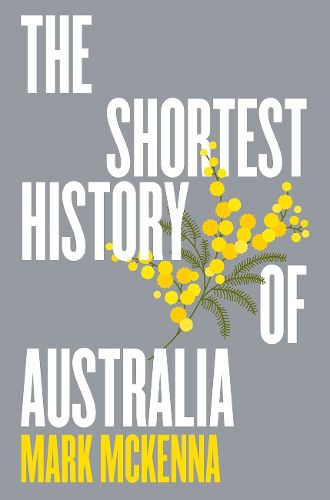
It’s appropriate that I should be writing this review on January 26, Australia Day. Here’s a recommendation: if you’re going to read a survey history of Australia, then read this one.
There’s lots of survey or short histories written by eminent historians to choose from, many of which appear in several editions as they were updated to encompass later events: Keith Hancock’s Australia first written in 1930; Gordon Greenwood’sAustralia A Social and Political History (1955) Manning Clark’s A Short History of Australia (1963) ; John Rickard’s Australia: A Cultural History (1988); Creating a Nation (1994) by Pat Grimshaw, Marilyn Lake, Ann McGrath and Marian Quartly; David Day’s Claiming a Continent (1997) and Stuart Macintyre’s A Concise History of Australia (2000). There’s even Alex McDermott’s Australian History for Dummies (2011). One could quite justifiably ask “Does the world need another short history of Australia?” And I would answer: yes, and it should be this one.
In 1968 New Zealand historian Keith Sinclair wrote an article for Historical Studies called ‘On Writing Shist’ (that second ‘s’ is very important!) He pointed out that shist (i.e. short history) is not a summary of what is known in order to be memorized, but a summary interpretation of a topic, intended to make it understandable. It should be aimed at the educated non-specialist, and the author cannot assume more than the most vague background knowledge. Facts are illustrative and form a “very thin, hard skeleton”, and the overwhelming problem is what to leave out, rather than put in. The heart of the task is to shape the overall pattern of ideas, facts and prose, interwoven into a pattern of thought and story. It is meant to be read, rather than consulted, utilizing the novelists’ tools of suspense and pace, driven by the author’s sense of commitment to his subject.
McKenna addresses the issue of the need for “new ways of thinking about the nation’s history” right in his first chapter. He writes:
Most national histories are ‘rise and rise’ narratives. They narrate the nation’s formation and walk chronologically through familiar milestones. In Australia’s case, there’s a chapter on Indigenous Australia before 1788, before moving onto the main story: penal colony to gold rushes and responsible government, then to Federation, the First World War and the Anzac legend, the Depression, the Second World War, postwar reconstruction and the Cold War; before waves of non-British migration, the new social movements of the 1960s and 1970s and the end of White Australia usher in the emergence of a more open, global economy and culturally diverse society. Or words to that effect. The history of the nation-state- from one formative event to the next. (p. 7)
So how is he proposing to avoid this straightjacket? His fundamental strategy is to see Australia as a continent rather than a nation, to turn both Edward Barton’s declaration “a nation for a continent and a continent for a nation” on its head. He foregrounds place, both the climate, ecologies and histories of different regions of Australia, and the Indigenous understanding of history which can never be divorced from place. And rather than that awkward, dangling introductory chapter of “The Aborigines”, he integrates Indigenous perspectives and actions throughout the whole book, from start to finish. Nor does he follow a well-ploughed chronological trench: indeed, Captain Cook and Botany Bay don’t appear in detail until Chapter 9, more than half-way through the book, in a chapter titled ‘Facing North’.
He starts right up front in Chapter 1 ‘The Founding Lie’, with a reflection on the Sydney Opera House, its design and construction, then considers its site – Bennelong Point. In Chapter 2 ‘From Ubirr’ he joins hundreds of visitors at Ubirr, in the Kakadu National Park looking north to the Arafura Sea at dawn- again, starting at a place- to emphasize the great migration from Asia into northern Australia, and the influence of trade with the north. Chapter 3 ‘The Island Dilemma’ looks at the sense of geography and the ‘island’ perspective that encouraged isolation as both a negative and positive force. He takes us to Christmas Island, both its now-deserted CI Club for administrators and Europeans, then its use as a detention centre for asylum seekers. Ch.4 ‘Taking the Land’ (and there, again is that ‘place’ emphasis) starts with John Howard at the Longreach Stockman’s Hall of Fame in 1997, promising that government legislation would ensure pastoralists’ rights after the Wik decision. He traverses land policy from Cook’s act of possession to the spread of ‘settlement’ and Aboriginal resistance, especially in Queensland. He notes that Australia has silenced not only the evidence of frontier warfare, but also the many efforts at reconciliation that were made between British settlers and First Nations Australians (p. 75).
Chapter 5 ‘War and Memory’ takes us to Australia’s “most storied beach”, 15,000 kms away. In a desperate craving to be connected to European history through blood sacrifice:
Over time, the birthplace of their nation was conveniently displaced 15,000 kilometres offshore to Anzac Cove. Australia thus became the only modern nation-state to create an origin myth not located on its own soil p.90
He points out that, two decades before the outbreak of the Great War, and for at least a decade after the war ended, in areas like Wave Hill and Victoria River of the Northern Territory and the Pilbara and Kimblerley regions of Western Australia, frontier violence was still occurring. War memorials to the First World War stand in villages, towns and cities throughout Australia, but the Australian War Memorial resists calls to recognize the loss of life in frontier wars.
Chapter 6 ‘Fire and Water’ takes us to Red Bluff, Kalbarri in Western Australia way back on 25 January 1697, and the desperate search for water by the men and officers from the Dutch East India Company who anchored three ships in Gantheaume Bay and rowed towards the coast. Drought, fire and flood are “a cycle as ancient as the country itself”, and while non-Indigenous Australians have long been familiar with bushfires and floods, the memory of one is swiftly erased by the arrival of the other, as if we’re fighting the same battles with the country (p. 111). Here are the plans for irrigation using the Murray-Darling, the Snowy River scheme and the fires at Mallacoota in December 2019. In Chapter 7 ‘Fault Lines’ we go to Waverley cemetery in Sydney, and the grave of Louisa and Henry Lawson, before embarking on a really good analysis of Catholic/Protestant sectarianism, touching on Ned Kelly, Billy Hughes and conscription. Chapter 8 ‘Fault Lines’ starts with Dorothy Napangardi, one of Australia’s most acclaimed artists, and the gradual recognition and appreciation of Indigenous ways of belonging to Country in the late twentieth century. For many non-Indigenous Australians, works of First Nation artists are a reminder that, as recently arrived migrants in a country, we do not have the same keys to Country. Modern Australia has always been a migrant society, and McKenna returns 19th century migration, especially from Ireland, and the Chinese migrants lured by the prospect of wealth on the goldfields. He goes through the conversion from a white, British enclave to a diverse multicultural nation, while noting that it was driven by self-interest and economic necessity. He reminds us of the memories of discrimination and prejudice through the story of William Yang, born in 1943 on a tobacco farm on the Atherton Tablelands. In Chapter 9 ‘Facing North’ (there’s that sense of place and geography again) we finally meet Captain Cook face to face. To illustrate the short-term economic mentality of resource extraction he turns not to gold, but to pearls, and the pearling industry not just for its importation of divers from Asia, but its mix of voluntary and forced Aboriginal labour (I didn’t know about this). He then moves on to New Guinea, and Australia’s WW2 in the Pacific.
I’d like to look at Chapter 10 ‘The Big Picture’ in more detail as an example of the diffuse way in which McKenna writes, his integration of stories of individual people into broader historical events, and the sweep of a theme across time. He starts with Charles Doudiet’s sketches of Eureka, which were only discovered in 1996 through a Canadian family which found them in their attic. These sketches verified for the first time the location of the Eureka Rebellion and the use of the Eureka flag, and they are the springboard for McKenna to discuss Australian democracy and its evolution from Eureka and the anti-transportation movement, through to self-government of the colonies in the mid 19th century. Then he moves to a second picture, Tom Roberts’ ‘Opening of the First Parliament of the Australian Commonwealth 9 May 1901′ and federation as a political compromise that combined elements of the US federal constitution and the Westminster system. The opening of Parliament House in Canberra in 1927 had many guests, but two uninvited guests were Jimmy Clements and John Noble, two Wiradjuri elders who walked 150 kilometres from Brungle Aboriginal station near Tumut in NSW to attend the opening. Here McKenna turns to Indigenous agitation for their rights in the 1920s and 1930s, set against Queen Elizabeth’s tour of 1954, the first reigning British monarch to set foot on Australian soil. He returns to Indigenous activism and the 1967 referendum, and the myths that surround it, before moving on to Whitlam and his deliberate cultivation of what Whitlam called “a vigorous national spirit” and ending the era of assimilation in favour of land rights and self-determination. This was encapsulated by the photograph of Whitlam pouring a handful of red earth into the hands of land rights leader Vincent Lingiari in 1975. However, the most seismic shift was the High Court Decision in the Mabo case, and he returns to Eddie Mabo’s sketch of his ancestral land on Mer which hangs not far from Tom Roberts’ ‘Big Picture’ in Parliament House. McKenna finishes the chapter with another painting of the people on Mer executed by Tom Roberts on his way to London in 1903. Twenty years after his arrival in London, Roberts presented the painting to the British Museum, and there it stayed undiscovered until found in 2009 by a curator from the National Museum of Australia.
He closes his book with an Epilogue titled ‘Modernity and Antiquity’ which starts with suburbia and the humble Sydney houses of both John Howard and Paul Keating. He notes that in the half-century since the dismissal of the Keating government, the old verities have vanished: Australia is now one of the world’s most diverse, multicultural and liberal democracies. The Indigenous cultures that White Australia tried to eradicate are now fundamental to the nation’s identity. From a protectionist economic policy, we are now an open, free-trade economy; the alliance with the US remains the linch-pin of its defence; the population has doubled since the mid 1970s and there is a distinctive rise of environmental consciousness, with the Tasmanian Greens the first Green party in the world. He notes that the closer we come to the present, the harder it is to discern which reforms will be of lasting significance. He returns to the “Big Lie” with which he started his book, and the question that continues to gnaw at Australia’s soul is how to tell the truth about the nation’s history and what Noel Pearson called “a rightful place” for First Nations Australians. Here are the apologies, the Uluru statement and the referendum campaign. He closes as he started with a place: this time Lake Mungo National Park (the most spiritual, life-changing place that I have visited in Australia) and the potential for Mungo to be “for all Australians, black and white. It can embrace us all in its spirituality, and draw us closer to the land.” (p. 266)
This is a beautifully written, really carefully crafted and highly original book. Although part of the ‘Shortest History’ series that ranges across the whole world, I feel that it is far more directed at an Australian audience than an international one, but both readers could take much from the book. Indeed, the word ‘shortest’ obscures the deep-time and Indigenous emphasis of the book. By eschewing completely the chronological approach, he prioritizes understanding of a theme illustrated through many kaleidoscopic prisms. In the author’s note at the end of the book, he says that he decided to “say more about some things rather than a little about many things”. He has certainly succeeded in this. His prose is beautiful, drawing your interest from vignettes based on people, with a pace that doesn’t get bogged down in details. It’s excellent. Read it.
My rating: 10/10
Sourced from: Review copy from Black Inc. but that hasn’t influenced my rating!
Journey Through TimeEpisode 27 The Trial that Made Hitler Famous Ep. 2 It wasn’t the Beer Hall Putsch that made Hitler internationally famous, but the trial held afterwards. After the coup had collapsed, Hitler and his group marched through Munich hoping that crowds would join them (they didn’t) and there was a brief shoot-out where four police were killed. Hitler fled Munich, but was arrested. Even though the putsch ended in farce, Hitler saw the trial as a platform. One of the panel of judges in particular was sympathetic to him: he was not forced to wear prison clothes, it was a 24 day trial and he was allowed to make long speeches and cross-examine witnesses himself. He pleaded guilty but nonetheless some judges wanted to acquit him. He received a five year sentence but released after 13 months. He was given special treatment in jail, but it fed his martyr-complex. Once the Nazis gained power in the 1930s, the anniversary of the putsch was celebrated, and in fact Kristallnacht was conducted on the anniversary. The two presenters, David Olusoga and Sarah Churchwell, then went on to draw parallels with the current day.
The Rest is ClassifiedEpisode 99: Putin’s Secret Army: Trump, Wagner and Russia (Ep.2) As an entrepreneurial caterer and restauranteur, Prigozhin got into P.R. where he was not beyond indulging in dirty tricks. Because of his PR skills, the Kremlin turned to him. Prigozhin was behind the Internet Research Agency, a troll factory based in Russia employing 800-900 workers. First the Internet Research Agency targetted a domestic Russian audience, particularly demonizing Alexy Navalny. In 2014 after the invasion of the Crimea, it moved its focus to the West, then it looked to the 2016 US election. The Internet Research Agency paid for Facebook ads, often pushing both sides, in order to sow division. At this stage Prigozhin became visible to the FBI, leading to a 2016 FBI indictment. He denied the connection with the Internet Research Agency, and took it to the courts. The title of Peter Pomerantsev’s book sums it up: Nothing is True and Everything is possible. Doesn’t that just describe the world we live in?
The Rest is History. I haven’t listened to my old friends Dominic and Tom for a while, so I scrolled back to 2022 and found a series that they did on Australia’s prime ministers to mark Albanese’s victory. Although Episode 187 is titled Australia’s Prime ministers from Edmund Barton to Robert Menzies, it didn’t give much attention to the early prime ministers (perhaps I was day-dreaming at that point?) and they concentrate on post-WW2 prime ministers. Now, as I found with their episode on the Tupamaros, Dom and Tom might be very good – are very good- on European, British and American history, they’re not so hot on the rest of the world, especially ‘middle powers’ like us, or the Global South. They deal respectfully with Menzies, Curtin, Chifley and Menzies again, but in Episode 188 Part 2 they become a little skittish. They point out that Harold Holt was Australia’s youngest Member of Parliament and succeeded Menzies. They laughed (as do we all) at the unfortunate naming of the Harold Holt Swimming Pool. They think that Gorton was an excellent character, almost French in personality, war hero and larrikin. They question (as do we all) Billy Macmahon’s sexuality and his propensity to steal things (really?). They see Whitlam as a patrician figure, who was brought undone by his plan to borrow petro-dollars during the oil shock. They thought that Fraser looked like the classic Australian, welcomed the Vietnamese and opposed apartheid- and he lost his trousers. By Episode 189 Part 3 they are completely silly, and admittedly, they have plenty to work with here. Hawkie held the world record for sculling a yard of ale, but was economically similar to Thatcher; Keating was impressive but a paradox; Howard was stolid; Rudd was part of a culture of spills; Gillard exemplified The Guardian newspaper in female form; Abbott exemplified the Daily Mail. Turnbull could have been a Labor P.M. ( I rather wish he was, personally) while Morrison exemplified the Man at the Garden Centre and looked like a koala. So as you can see, Dom and Tom’s powers of analysis declined over this three part series, and ended in farce. Perhaps Australia did too.
Big Ideas (ABC) This talk, recorded at the University of Technology Sydney’s Vice Chancellor’s Democracy Forum on 14 May 2025 features Sarah Churchwell, who is one of the presenters of the Journey Through Time podcasts that I’m enjoying. She is the author of The Many Lives of Marilyn Monroe, Careless People: Murder, Mayhem and The Invention of The Great Gatsby, Behold, America: A History of America First and the American Dream, and The Wrath to Come: Gone with the Wind and the Lies America Tells. From the ABC website it says: Sarah Churchwell takes you on a gripping and confronting journey into America’s recent past to explain its extraordinary present, starting with dark story at the heart of that American classic Gone with the Wind. Knowledge lies at the heart of a healthy democracy, and its many custodians include libraries, universities, cultural institutions, and a free and independent media. So what happens when these institutions are intimidated, dismantled or destroyed, as is happening in America right now, under the government of President Donald Trump? I really enjoyed it.
The Birth Keepers- the Guardian. The Birth Keepers This year-long investigation by Sirin Kale and Lucy Osborne looks at Emilee Saldaya and Yolande Norris-Clark, two influencers who made millions selling a radical version of free birth where women would birth ‘wild’ with no medical intervention whatsoever through their Free Birth Society. I was appalled by the length of time that some of these women laboured after their waters had broken, and the hands-off attitude of a baby ‘choosing’ to take a breath. Despite having no formal medical training, these two doulas created courses that have ensured that the Free Birth movement has moved world-wide, while netting them a fortune. There are six episodes.
Short History Of.. Having seen the film Nuremberg, I decided I’d listen to Short History’s take on The Nuremberg Trial. I was far more impressed with this podcast than I expected, fearing a couple of kids giggling, but it was very professional and the narrator has a lovely voice. At the Moscow Conference of 1943 it was decided that Germany would be held criminally responsible for the atrocities committed during the war, but this was uncharted territory. Churchill wanted the death penalty, without trial; Stalin wanted a judicial trial but with the outcome already decided, America wanted the Germans treated as any other judicial process. One of the problems was that the Germans’ actions were not crimes when they were committed. In the end the prosecutors settled on four charges (i) conspiracy to wage aggressive war, which encompassed the crimes before the war began (ii) crimes against peace (iii) war crimes (iv) crimes against humanity. It was decided that the trials needed to take place in Germany in front of the German people. They would try 24 people, comprising a cross-section of high ranking officials across all sectors, although in the end there were only 21 defendants. It was not difficult to find defence lawyers, because many lawyers craved the spotlight in an exotic social environment. They did not use witnesses, but documents. In the second week they showed film of the concentration camps, which had a seismic impact. Hermann Göring was the ringleader of the defendants: he and Speer were the most forceful, the rest were rather pathetic. 12 were sentenced to death, 7 others were imprisoned and there were 3 acquittals. Within 10 days all appeals were rejected. The hanging equipment arrived on 13 October, but on 15 October Göring suicided before his execution which was scheduled that night. The International Military Tribunal packed up at the conclusion of the first trial. There were twelve other Nuremberg trials, but the first one was the only truly international trial.
The Global Story (BBC)The Death of Reading This episode was based on a recent essay by James Marriott ‘The Dawn of the Post-Literate Society’ which can be found on his Substack here. Both the essay and this discussion go back to the mid- 1700s when the spread of reading beyond the elites meant that power no longer had to be performed visually, but could be disseminated and reinforced by the written word. Marriott draws on Neil Postmans work ‘Amusing Ourselves to Death’, and argues that beyond the concern about the decline of reading in the 1990s, the spread of the smart phone from 2010 onward has led to a steep drop in educational standards. With the rise of TikTok and Instagram, we are returning to the primacy of visual display – a sort of counter-revolution in thinking and perception.
Journey Through Time Episode 48: The Paris Commune: Can the City of Light Govern Itself? After the uprising over the cannons on Montmatre, the radicals took over, but with no leader, they split almost immediately. Auguste Blanqui would have been the leader, but he was in prison (as indeed he was for whole decades of his life). Supplies were allowed in, but Paris was still lunder siege. Napoleon III’s column was pulled down, although it was later re-erected. Elections were held with 4 days to give the leaders legitimacy with the result that there was an anti-nationalist government but otherwise, the movement splintered. The new government started issuing executive orders (and don’t we know about THEM!) to separate church and state, provide rent relief and soldier pensions, provide free secular and compulsory co-education, cap salaries, and give workshops to co-ops. So far, all normal socialist fare, but also they imposed decimal time (10 day weeks, 10 hour days etc), banned night baking as a labour market reform for bakers, and banned croissants (can’t remember why). They treated legitimate and illegitimate children equally and had same and equal pay for teachers. The army was a citizen’s militia, and army discipline broke down almost immediately. 150,000 people per day fled Paris, where there was constant violence but no terror as such (in Revolutionary terms). From afar, Marx was interested but because he didn’t support the French International, he waited a while before writing about it. Women were influential in organizing, but they were not inspired by feminist or suffragist ideals. To get Auguste Blanqui released from prison, they took hostages which backfired on them. There were small mini-communes in the rural towns, but essentially Paris was on its own.
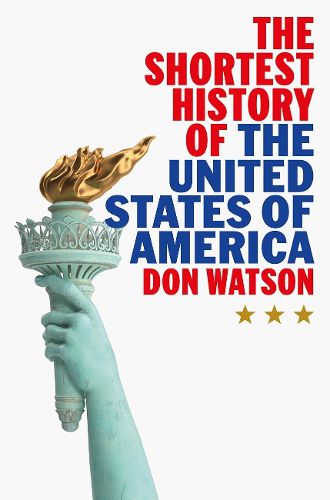
I’ve always been a bit puzzled by the ‘Shortest History’ part of the title of this series of books published by Black Inc dealing with world history, many written by Australian authors. Declaring to be the shortest history seems rather definitive and pugnacious, and almost a challenge to later authors to become even shorter. The blurb for the series claims that the books can be read in an afternoon -something that I doubt, in this case – but certainly they are a work of concision and discipline on the part of the author, in being able to confidently assert a fact or event in a single paragraph instead of hedging with qualifications, nuances and debates. Of course, much is elided in such an approach, but there is also a bracing forthrightness about a sweeping history that needs to tie together so many small details into an overarching narrative.
Don Watson comes to the task as a historian in his own right, political speechwriter, and a commentator on current-day American society and political culture. As well as his American Journeys published in 2008 (my review here), he has been a regular contributor to the Black Inc./Schwartz stable on American politics with three Quarterly Essays: No.4 Rabbit Syndrome: Australia and America (2001), No 63 Enemy Within: American Politics in the time of Trump (2016) (my review here) and most recently in 2024 with No. 95High Noon: Trump, Harris and America on the Brink, which I reviewed here. With The Shortest History…. he is writing as an outsider, and a long-term, well-informed watcher as well.
His outsider status is most apparent in the opening chapters of the book, where he makes clear that there were competing European powers – England, France, Spain, Netherlands, Sweden- that put ‘boots on the ground’ on what was to become American territory. Drawing the distinction between the 1776 establishment of the United States, and the history of ‘America’ starting in 1492, he goes even further back 20,000 years to the first peoples, and the early introduction of enslavement that followed early European ‘discovery’. In what, perhaps, might be characterized as ‘black armband history’, he continues to turn the spotlight around onto First Nations and Black experience as the narrative of United States history marches forward…always forward.
The book progresses chronologically, but the chapters are thematic. In his introduction Watson notes that:
While the history of the United States is to an uncommon degree a history of ideas, it is equally the story of men and women testing the truth of those ideas against experience: in politics, in churches, on frontiers, in cities, in industries, in battle, in homes, in schools, in Hollywood, in literature and in music. (p. xiv)
Watson places strong emphasis on ideas: on the intertwined Puritan ideas of harsh punishment and discipline set against competing ideals of individualistic self-reliance, which in turn existed alongside traditions of social justice, education, communitarianism and democracy. He notes the influence of Enlightenment philosophers and the scientific revolution in providing an intellectual framework for their grievances and the language to express it through the Declaration of Independence, Constitution and the Federalists papers. He puts his historian hat on to discuss Turner’s Frontier thesis on the ‘freedom’ of the frontier in the popular imagination and he notes the recurrent waves of religious ‘awakenings’ and the struggle between order and chaos-‘ the American id and the American superego’ (p 58). Challenging these were the ‘maniacal appetite for wealth’ whetted by the financial opportunities following the Civil War, and especially during the ‘Gilded Age’ of the 1890s which pushed aside “the restraining influences of conscience and religion, or the egalitarian principles implied in the country’s democratic creed” (p.94) The Civil War, in his telling, had a long advent of compromises on the part of the North, which was well aware of the incompatibility of slavery with the ideals espoused in the republic’s founding documents.
Although we know the political landscape in the United (huh!) States today as being Republican and Democrat, the meaning of both words has changed over time. To be ‘republican’ was to champion the idea of the American republic, and it was not necessarily democratic. The nature of the parties changed over time, with the immigrant influx between 1890 and 1920 shaping the cultural and political evolution of urban America:
The Democratic Party evolved into the party of both the burgeoning multiethnic cities and the reactionary South, while the Republicans remained the voice of white Protestant provincial America. (p. 112)
Looking at the policies of Presidents over time, particularly in the Progressive era, it is not easy to distinguish to which party the president belonged. For example Woodrow Wilson was a southerner from the Democratic Party, and a progressive as well as a segregationalist. Kennedy did not like Martin Luther King, and he had little interest in domestic politics. Nixon was mad, but he was the most liberal republican of the century excluding Teddy Roosevelt (p. 187). Some Presidents receive more attention than others. Probably because of current-day parallels, President Andrew Jackson receives more attention than he might have in a book written 30 years ago. For a former speechwriter for Labor Prime Minister Paul Keating, I was surprised that he was so critical of FDR. It seemed to me that the emphasis on presidential personality and actions received more emphasis in the latter part of the book, within the time of Watson’s own memory, I would guess. Interestingly for a historian, he ascribes ‘luck’ as an important factor that determined a President’s actions and reputation.
This is not just a political history because Watson interweaves popular culture, including music, Hollywood and literature, as well as broader social movements including Communism and anti-Communism, evangelical religion and protest movements. However, the political emphasis does mean that it is a predominantly male history, with political actors Eleanor Roosevelt and Hillary Clinton receiving more attention than other women in his narrative. As the book moves on, the early emphasis on indigenous and Black history is muted and where it is mentioned it is mainly in political terms. Particularly in the post-WW2 years, he integrates conformity, consumerism and commercialization into the “American Dream”, which was very much restricted to white America:
Nothing spoke more eloquently of the American dream than the bustling heartland towns, their Main Streets lined with mom-and-pop stores, barber shops, diners, ice cream parlours, theatres and movie houses, with Fords and Chryslers and De Soto Coronados parked in rows; and, just beyond them, unlikely numbers of regularly attended churches, schools, sports stadiums and public swimming pools (p. 154)
Watson started his book in the introduction, with the attack on the Capitol building on 6 January 2021. At first, I thought that this reflected Watson’s own expertise and reputation as a commentator on American affairs, but when he returns to 6 January at the end of the book as part of his argument, it is as a historian.
The United States was born with one foot in the Christian church and the other in commerce. It might equally be said that it had a foot in the high ideals of religion and the Enlightenment and a foot in the frontier philosophy of whatever it takes. The loathing felt for the liberal elites, and for intellectuals in general, was an old one, and the failure of liberals and intellectuals to understand either the people who loathed them or the degree of their loathing was just as old. The ‘Washington swamp’ was not new [and] …the coonskin hats and the shaman’s horns in the Capitol building were as if lifted from a picture in my childhood Davy Crockett book…All these gestures to contemporary grievance connected to threads of belief and myth, and patterns of ideological dispute, that are as old as the country itself. Extraordinary, even ‘unprecedented’ as the insurrection of 6 January 2021 seemed, it occurred in the same grindhouse of uncrossable divides and undying fixations.” p. 261
I guess that only time will tell if Watson’s decision to start and finish the book with Trump was a narrative framing, or whether it is a historical analysis in its own right. Only in coming years will we know whether Trump II marks a whole new phase, or whether as Watson suggests in 2025, the Trump presidency reflects a continuity that flows across the United States’ history. By its very nature, a ‘short history’ with its abridgments and encapsulation, is probably best placed to provide an answer.
Let’s just jump ahead, shall we? I have been listening to podcasts between September and November, but many of them have been current affairs podcasts, which just come and go.
This is the story of patient B-19, a 24-year old who, in 1970, walks into a hospital in Louisiana troubled by the fact that the drugs he’s been abusing for the past three years are no longer having the desired effect. He claims he is “bored by everything” and is no longer getting a “kick” out of sex. To Dr Robert Heath’s intrigue, B-19 has “never in his life experienced heterosexual relationships of any kind”. Somewhere along the way, during the consultations, the conclusion is drawn that B-19 would be happier if he wasn’t gay. And so they set about a process that involves having lots of wires sticking out of his brain. Julia and Adam hear from science journalist and author, Lone Frank, author of The Pleasure Shock: The Rise of Deep Brain Stimulation and Its Forgotten Inventor.
Actually, I wasn’t particularly shocked by this episode. It was the 1970s after all, time of ‘Clockwork Orange’, and brain stimulation and operant conditioning was all the go. While most of us wouldn’t see being gay as something that had to be ‘cured’, I do wonder if truly deviant behaviour that would otherwise see a person incarcerated for life (an inveterate child abuser?) might not still turn to methods like this?
The Rest is History Episode 606: Enoch Powell Rivers of Blood With Nigel Farage on the loose, it seems appropriate to go back to revisit Enoch Powell and his ‘Rivers of Blood’ speech. As Dominic and Tom point out, Enoch Powell is better remembered than a lot of Prime Ministers are, and he influenced Thatcher and inspired the Brexiteers. He was born in Birmingham in 1912 and was a precocious child who seemed destined to be a classics scholar. He had no interest in women, but he was obsessed by Nietzsche. He was a Professor of Greek at Sydney University by the age of 25 (I didn’t know that!), but he really wanted to be the Viceroy of India (as one does). He fought in WW2 but not in a combat role. He was a Tory, but he was often critical of the party, and championed English nationalism in Parliament in his hypnotic droning voice. He decriminalized homosexuality, was anti-Vietnam, anti-US but economically very dry. Despite the influx of Windrush and British/Pakistani immigrants in the late 1940s, immigration was seen more as a regrettable necessity rather than a national issue. At first Powell did nothing about the reported ‘white flight’ from areas like his electorate of Wolverhampton, but by 1964 it was recognized that immigration had to be controlled to avoid the ‘colour question’, a question supercharged by television of unrest in Montgomery and Alabama in the US. Why did Powell change? He argued that he was representing the views of his electorate, and he held up an ideal of the English people and became more radical as a way of distinguishing himself from Heath. In 1967 there was an influx of Indians from Kenya after Kenyatta expelled them and an Act was passed to restrict immigration. The Labour government introduced a Racial Relations Bill in 1968 which prohibited racial discrimination in areas like housing. When the Tories decided to quibble over the details but accepted the principle of the bill, Powell was furious and this was the impetus for the ‘Rivers of Blood Speech’, which was publicized beforehand, so television crews were there to record it. He was sacked as Minister for Defence, but he had strong support on the streets. He never distanced himself from violence, but he was wrong- there were no rivers of blood. And until now Tories wouldn’t touch the issue again.
The Rest is HistoryEpisode 577: The Irish War of Independence: The Violence Begins (Part 2) After their largely ceremonial electoral victory in 1917, Sinn Fein established an alternative shadow government which had cabinet positions, courts and issues a Declaration of Independence. It wanted to attend the Paris Peace Conference, but it didn’t get a seat at the table. The IRA was recruiting heavily, but the majority were more involved with logistics and protection rather than firing guns. The conflict hotted up in the early 1920s when the IRA began attacking police barracks and courts. There was a mass resignation of police, and they were replaced by ex-army soldiers, the notorious ‘black and tans’ and auxiliaries. In 1921 the Flying Columns and IRA intelligence ramped up, with localized violence. But this violence was not necessarily a sectarian war, but it certainly had sectarian aspects.
In Our Time (BBC). Apparently Melvyn Bragg is stepping down from In Our Time after 26 years. He is 85, after all, and he was starting to sound a bit quavery. So, they’re dipping back into the archives and they replayed an episode on Hannah Arendt from 2017. She was born to a non-observant Jewish family in Hanover in 1906, a family that was so non-observant that she was surprised when she found herself singled out as being Jewish. She had an affair with Heidegger, but then he became a Nazi. She was a classicist, and she maintained this interest throughout her life. She escaped to America in 1941 as a refugee, where she developed English as her third language. In her book Eichmann in Jerusalem, she warned of a new sort of atomized evil, like a fungus, and she saw Eichmann as thoughtless, rather than evil. Actually, I hadn’t realized that she was anything other than a political writer: she was just as focussed on the human condition as politics.
The Rest is HistoryEpisode 576 The Irish War of Independence Part I. The Rise of the IRA Between 1909-11 Britain wanted to give Home Rule, but the Northern Irish unionists didn’t want it. World War I froze any progress on the question. Then, during the war, in 1916 the Easter Uprising took advantage of the opportunity of Britain being otherwise distracted, but it was quickly crushed, leading to the arrests of between 1000-1500 people. 187 were imprisoned, and 14 were executed, including Roger Casement. The Nationalists used the deaths for propaganda purposes in the midst of UK apathy. The Unionists, who constituted about 30% had influence in the British cabinet butBritain was taking an each-way bet as Sinn Fein became more prominent. Arthur Griffith, the founder of Sinn Fein, worked as a printer, and organized boycotts and agitation and stood for by-election. Michael Collins was a military organizer within Sinn Fein, not just a gun runner. He emerged when the other leaders were jailed in 1917. De Vallera was the President, and Griffith was the Vice-President of Sinn Fein and they accepted the aim of an independent Irish Republic. In December 1918 there were elections held in the UK and Ireland with an enlarged electorate, with 70% of electors voting for the first time. It yielded a Sinn Fein victory.
The Human Subject The Man With the Artificial Windpipe was Andemariam Beyene, an engineering student from Eritrea studying in Iceland. In 2011 he was desperate for a cure for the large tumour that had been discovered in his trachea. He had tried surgery and radiotherapy and nothing had worked.Dr Paolo Macchiarini, Karolinska Institute’s star surgeon presented himself as Andemarian’s best and last option. He proposed an experimental treatment – but one that had never been done before on a human being. Andemariam would be the first. Unfortunately, he agreed to it. Macchiarini was a good publicist, and published the results of the surgery soon afterwards- too soon, because Andemarian died, as did all three patients who had this surgery. Macchiarini ended up being jailed for 2 1/2 years, and his papers were retracted.
History HitThe Surrender of Japan In the broadcast to mark the surrender of Japan on August 15th, 1945 Emperor Hirohito’s voice crackled over Japanese airwaves to announce the unthinkable – the surrender of Japan. It was the first voice recording of him, and there would be many Japanese who had never heard him before. This episode, featuring Dr. Evan Mawdsley, points out the Allies wanted regime change because they distrusted the deepseated militarism of Japanese society. Technically, there was a neutrality pact between Japan and USSR signed in 1941, but on 9 August 1945 Russia entered into the Japanese arena, which meant that Japan could no longer defend Manchuria. Days later, the nuclear bombs were dropped. In a bit of what-if history, the podcast goes on to explore what would have happened had Japan not surrendered.
In the Shadows of Utopia Season 2 Episode 12 The Cambodian Civil War Begins Part 2: A Revolution Waged with Empty Hands Time Period Covered 1967-1968. In November 1967 Jackie Kennedy visited Sihanouk (in fact, I saw photos of her at the Raffles Hotel in Phnom Penh when I dropped by there one day). Sihankouk was convinced that there was a communist insurgency in his own country, surrounded by Communist countries, so he began looking increasingly to the United States.
Meanwhile, in November 1967 Pol Pot went to the north eastern base of the CPK (Communist Party of Kampuchea), which was supported by local tribespeople, but poorly armed. Both Vietnam and the CPK planned to have uprisings at New Year in 1968, but there was little support from the Communist parties in other countries: China discouraged the uprising because it was preoccupied with its own cultural revolution, and Vietnam ignored the Khmer pleas for help when skirmishes were being quashed. On January 17th and 18th the CPK attacked army and police depots in order to seize their arms, and the uprising began. It started in Battambang (over near the Thai border), where 10,000 villagers joined in, and moved into the jungles. With no support from China or Vietnam, the CPK went it alone, identifying itself as the vanguard of the revolution, and Pol Pot set himself up as leader. He lavished high praise on China, especially the Cultural Revolution and the Great Leap Forward (despite the reality) and the Chinese Student Association emulated the Big Character posters of the Cultural Revolution. All this pro-China action was too much for Sihanouk, who withdrew his ambassador from China. In January 1968 Sihanouk cracked down on the Battambang uprising, blaming everyone. He brought back Lon Nol, who undertook a scorched-earth approach against the uprising. Yet Sihanouk continued to support the Viet Cong and the Vietnamese communists who were in Cambodia, just not the home-grown ones. The United States was aware of the border camps and the Pentagon was even considering invading Cambodia, which was officially neutral, but the State Department put the kibosh on the plan. Sihanouk said that he couldn’t prevent crossings from Vietnam over the border, so he couldn’t object to the US engaging with them. He said he would shut his eyes to any American bombing. Did he know? Did the bombing start under LBJ? Meanwhile, the Tet offensive was under way in Vietnam.

 The Resident Judge of Port Phillip