
Tag Archives: ireland

I hear with my little ear: Podcasts 8-15 September 2025

The Rest is History Episode 576 The Irish War of Independence Part I. The Rise of the IRA Between 1909-11 Britain wanted to give Home Rule, but the Northern Irish unionists didn’t want it. World War I froze any progress on the question. Then, during the war, in 1916 the Easter Uprising took advantage of the opportunity of Britain being otherwise distracted, but it was quickly crushed, leading to the arrests of between 1000-1500 people. 187 were imprisoned, and 14 were executed, including Roger Casement. The Nationalists used the deaths for propaganda purposes in the midst of UK apathy. The Unionists, who constituted about 30% had influence in the British cabinet butBritain was taking an each-way bet as Sinn Fein became more prominent. Arthur Griffith, the founder of Sinn Fein, worked as a printer, and organized boycotts and agitation and stood for by-election. Michael Collins was a military organizer within Sinn Fein, not just a gun runner. He emerged when the other leaders were jailed in 1917. De Vallera was the President, and Griffith was the Vice-President of Sinn Fein and they accepted the aim of an independent Irish Republic. In December 1918 there were elections held in the UK and Ireland with an enlarged electorate, with 70% of electors voting for the first time. It yielded a Sinn Fein victory.

The Human Subject The Man With the Artificial Windpipe was Andemariam Beyene, an engineering student from Eritrea studying in Iceland. In 2011 he was desperate for a cure for the large tumour that had been discovered in his trachea. He had tried surgery and radiotherapy and nothing had worked.Dr Paolo Macchiarini, Karolinska Institute’s star surgeon presented himself as Andemarian’s best and last option. He proposed an experimental treatment – but one that had never been done before on a human being. Andemariam would be the first. Unfortunately, he agreed to it. Macchiarini was a good publicist, and published the results of the surgery soon afterwards- too soon, because Andemarian died, as did all three patients who had this surgery. Macchiarini ended up being jailed for 2 1/2 years, and his papers were retracted.
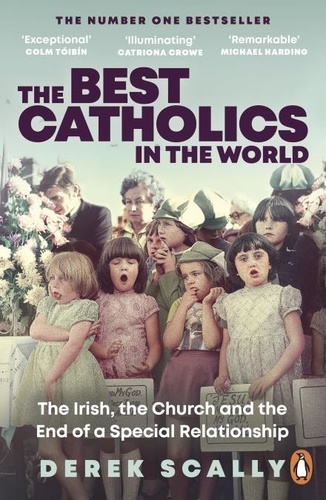
‘The Best Catholics in the World’ by Derek Scally

2021,310 p.

It amazes me that, of all countries in the world, IRELAND should have voted for gay marriage and legal abortion. My impression of Ireland is that it is mired in religion and conservatism, and I don’t think that I’m alone in this perception. In this book, Derek Scally, after many years of living in Germany, returns to Ireland, the land of his childhood, and asks himself how these changes came about. It is a story both of his own personal journey from a weakly-held Catholicism into a consideration of how Ireland, as a country, can come to terms with its past.

The book is divided into three parts. In Part I, ‘The Leaning Tower of Piety’, he writes of his own Irish upbringing and his own contact through St Monica’s Church with Father Paul McGennis, who was later to plead guilty to four counts of indecent assault. In going through the church archives, he learns of the league table on donations that existed between the parishes, and through speaking to old parishioners he learns of the suspicions about Paul McGennis, and the inability of parish priest Michael Geaney to impose any authority on him. In Part I he challenges the perception that there is a special type of ‘Celtic Christianity’, suggesting that this is the result of previous centuries’ public relations, generating important political momentum, emotional comfort and offering touchstones against historical events like the Penal Laws and Protestant/English occupation. It was not enough: he suggests that Irish Catholics perceived themselves the Most-Oppressed-People-Ever. Yet, when he looks back to his own education within the Catholic system in the 1980s by revisiting the text books used at the time, he feels patronized and short-changed by the experience.

Part Two ‘Implosion’ looks at the effect of the clerical sexual abuse revelations in the 1990s. He focuses on Fr. Brendan Smyth, who was investigated in 1975 but went on to abuse children for a further sixteen years. The fallout, when it came, spread beyond his own activities: Cardinal Brady, who was involved in the 1975 investigation, was also accused of cover- up. He interviews Sean Brady, a man whom some see as a modest figure who knew which boats not to rock; while others see him as a coward and an accomplice to a predatory paedophile priest. Australian readers will see parallels with Archbishop George Pell. He goes on to explore the Magdalene laundries and the treatment of inmates in religious-run institutions. He argues that when the Catholic Church lost its monopoly on giving meaning or creating a sense of community, coupled with the sense of betrayal over the hypocrisy and intransigence of the church regarding sexual abuse, many left the church.

In Part Three ‘Among the Ruins’ he talks about the reformulated religion that transformed Famine-era faith into an earnest, Rome-focussed Sacred Heart Catholicism. He draws on his experience of living in Germany to wonder if Ireland does not need some form of national reckoning, as a form of healing and reconciliation. He considers the roles of museum and memorials in this process. At the end of the book he writes:

This journey has taken me from apathy to ambivalence, then anger to acceptance…[For] whatever anger I harbour towards the Irish Church, echoing the anger of those whose lives were ruined by its institutional inhumanity, I see remnants of its noble aspirations through the many ordinary Irish people who tried- and try- to lead better, Christian lives. No one can draw a line under the past, or airbrush away their role in it, but- for perhaps the first time ever- Irish people can approach their history on their own terms. That is, if they want to. (p. 307)

I’m not quite sure how to rate this book, and my reading was interrupted by a two-week holiday and so I did not read it as a continuous whole. I was happy enough to pick it up again, but I don’t know if I really grasped his argument well. In fact, summarizing it here gives me a better shape of the argument than the actual experience of reading the book did.

My rating: 7?

Sourced from: Yarra Plenty Regional Library