We don’t go into the city together much because Steve finds walking difficult, but the milder weather was such a relief today that I really wanted to do something ‘in town’. So off we went….
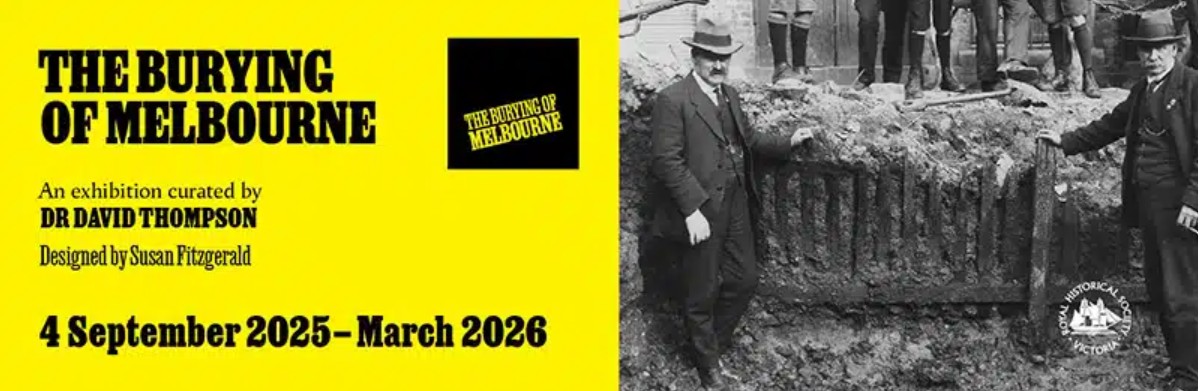
First stop was the Royal Historical Society of Victoria to see their current exhibition ‘The Burying of Melbourne’
In the mid-1850s some areas of the Melbourne CBD were buried under a layer of clay at the direction of Melbourne City Council, a rather extraordinary event that until recently had been largely forgotten. It is only in recent years that archaeologists carrying out the excavations required prior to developments in the city have uncovered evidence of the clay layer.
A study commissioned by the Heritage Council of Victoria found that the burying was part of efforts by the City Council to control flooding, caused largely by the original laying out of Melbourne’s street grid without due consideration of the flow of water over the underlying topography.
The depositing of the clay layer, metres thick in some places, had a significant effect on the lives and circumstances of those affected but did result in the sealing off of a layer of archaeology stemming from the earliest days of European settlement.
This exhibition, The Burying of Melbourne, describes events leading up to the burial and looks at some of the archaeology discovered beneath the clay.
The problem was that people started building their houses before the roads were built, which meant that when the roads finally did come through, the houses were much lower than the road. As a result, the houses flooded in heavy rain. The council ordered that the properties had to be filled up to road level with clay. In some cases, particularly where the houses were not owned by the occupants, the house was in effect entombed by the clay, with new houses built on top of them. The layer of clay was located when a compulsory archaelogical inspection was made for a new development near the Wesleyan church in Lonsdale Street. Comparisons were made between the contour maps pre-filling and after-filling to identify the sites where the clay was likely to have been spread. Six terrace houses dating from the 1840s were found in Jones Lane.
This exhibition is not high-tech: indeed, it is mainly maps and photographs of the archaeological dig. There are a few of the objects on display that were located on the site, most particularly the level under the clay. But I find the idea of a whole layer sealed off by clay for 170 years quite fascinating.
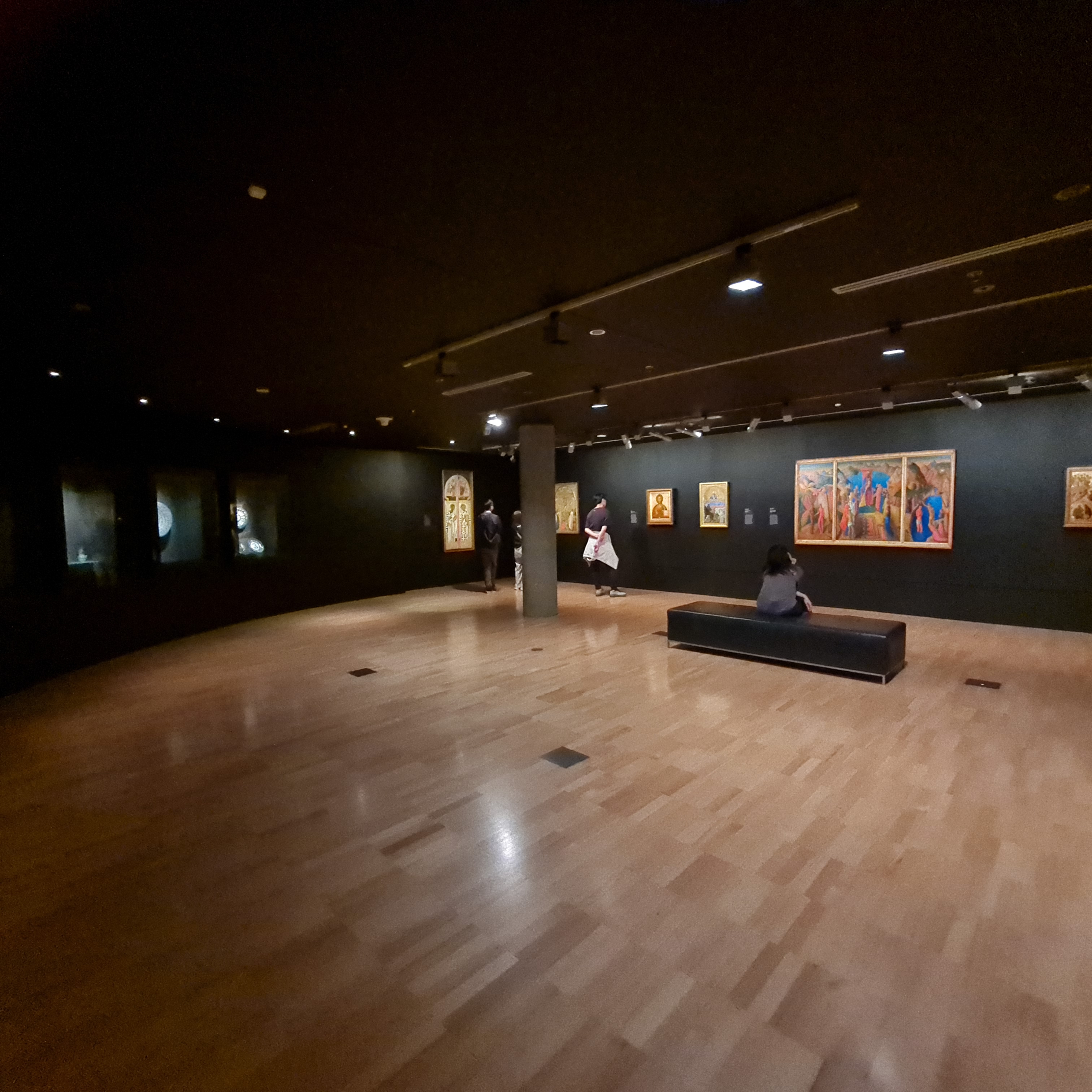
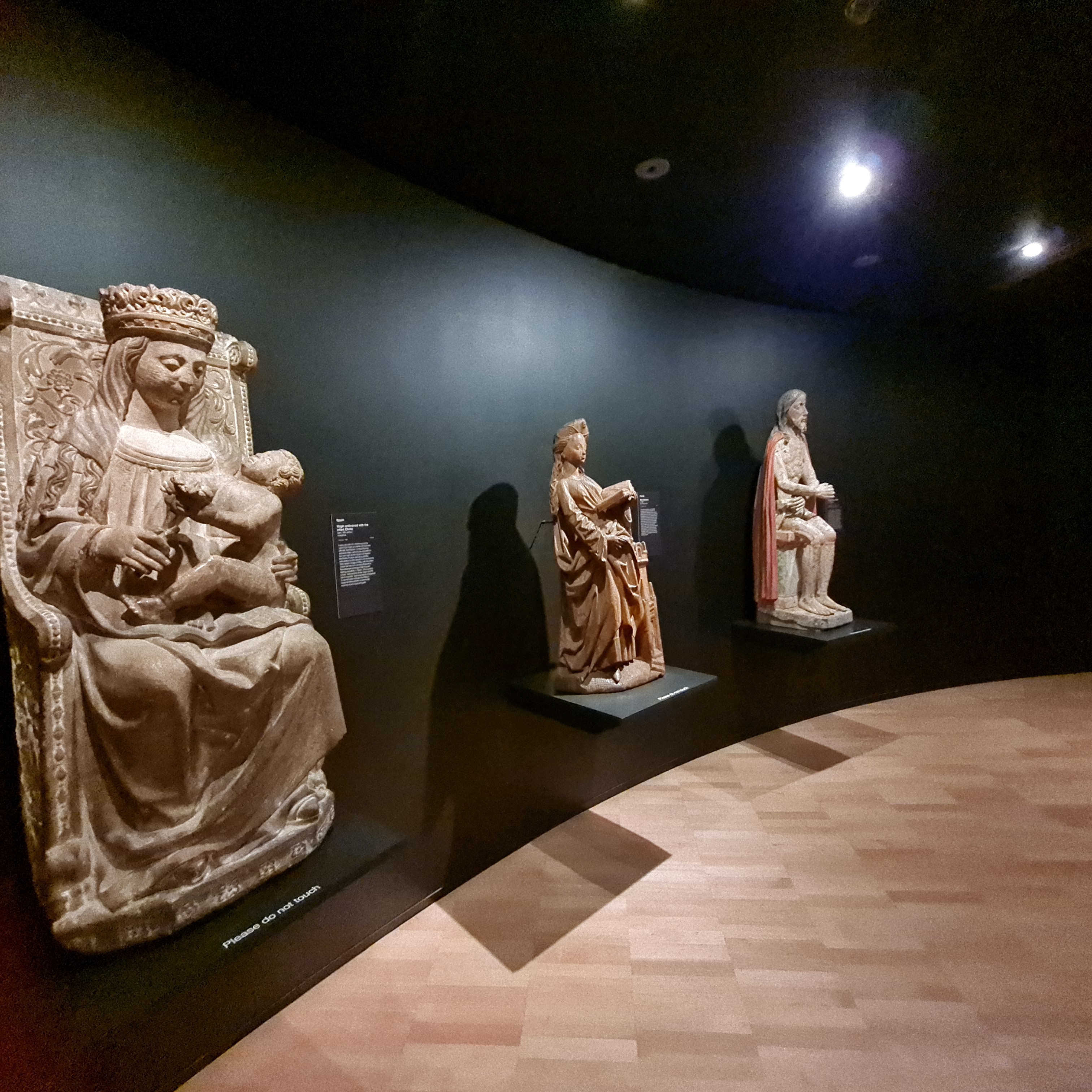
Then back onto the train and down to the Swanston Street tram for a quick trip up to the NGV International in St Kilda Rd. I wasn’t interested in the $40 Westwood/ Kawakubo exhibition (when did these exhibitions become so expensive?) and just stuck to the freebies. Somehow or other we ended up in the British and European Collection 13-16 Century, which you can see in a 3D version here if it doesn’t induce too much nausea for you. Actually you can see it online better than you can in real life because at least they turned the lights on to film it: probably because of the age of the artwork, it is very dimly lit. Their signage of the objects themselves is appalling- white print of about 12 pt font on grey behind glass. I just couldn’t read it at all. However, given that I’m not likely to visit Europe again, it was a little bit like being in a grand European cathedral close up.
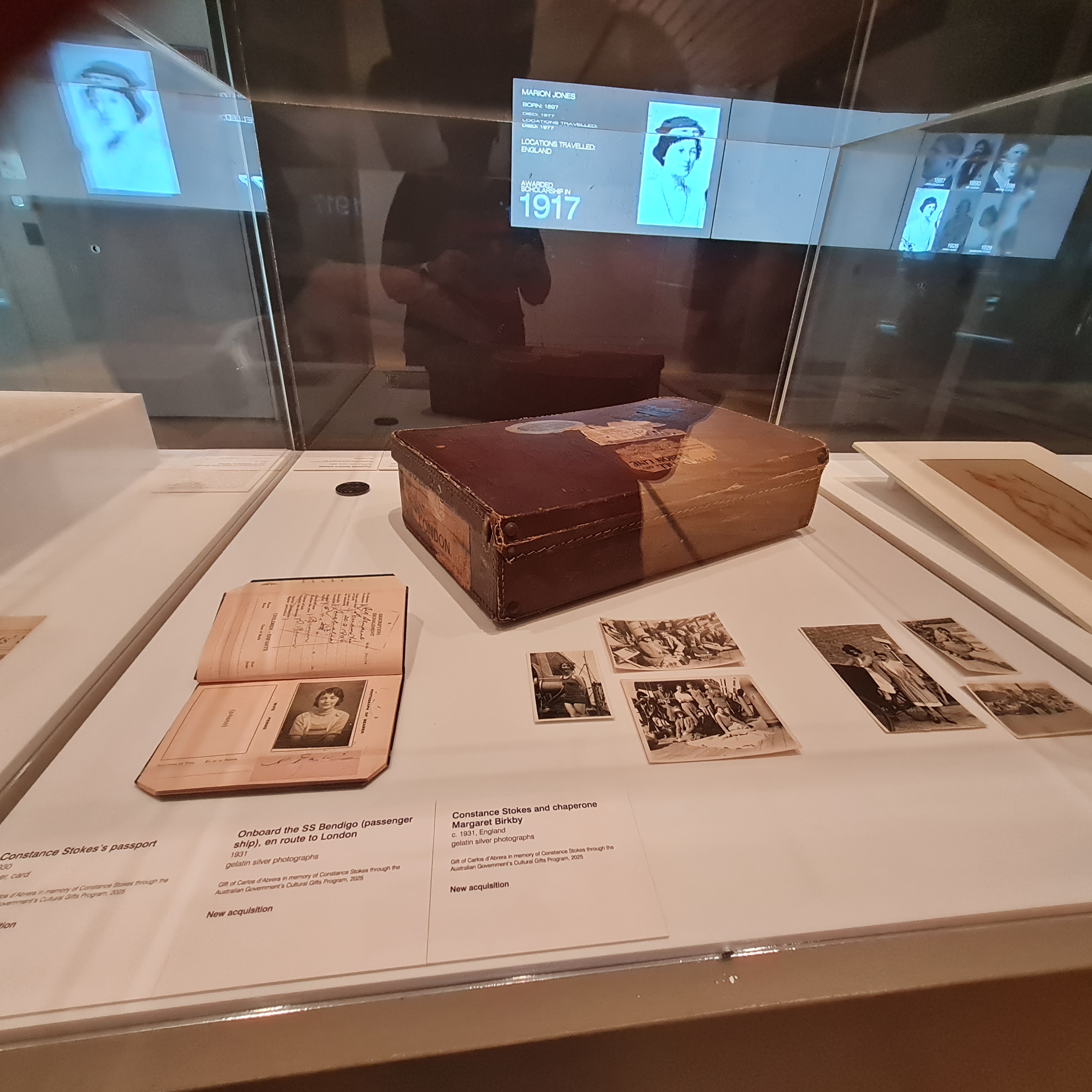
What I really intended to see was a display of the National Gallery of Victoria Travelling Scholarship. This is a tiny exhibition, tucked away on the first floor near the escalators. The NGV established its Travelling Scholarship in 1887, just 25 years after the Gallery opened. Awarded every three years, the three-year scholarship granted a stipend to study at art epicentres across Europe. Scholarship-holders were required to provide to the Gallery a replica of an Old Master painting, a nude study, and an original composition. A cheap way of increasing the size of the collection, I suppose. The exhibition is mainly just a projection on a wall, showing biographical details of several recipients (nicely balanced between male and female artists) with a few glass cases containing objects belonging to Constance Stokes (nee Parkin) trip that she received as part of her scholarship in 1929. Just a slight young girl, you get a sense of how exciting it must have been to travel over to London to study at the Royal Academy of Arts, with her passport, photographs and ball invitations.
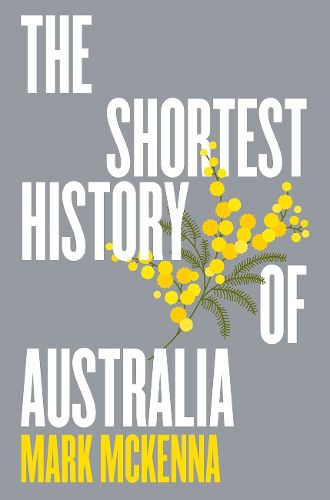
It’s appropriate that I should be writing this review on January 26, Australia Day. Here’s a recommendation: if you’re going to read a survey history of Australia, then read this one.
There’s lots of survey or short histories written by eminent historians to choose from, many of which appear in several editions as they were updated to encompass later events: Keith Hancock’s Australia first written in 1930; Gordon Greenwood’sAustralia A Social and Political History (1955) Manning Clark’s A Short History of Australia (1963) ; John Rickard’s Australia: A Cultural History (1988); Creating a Nation (1994) by Pat Grimshaw, Marilyn Lake, Ann McGrath and Marian Quartly; David Day’s Claiming a Continent (1997) and Stuart Macintyre’s A Concise History of Australia (2000). There’s even Alex McDermott’s Australian History for Dummies (2011). One could quite justifiably ask “Does the world need another short history of Australia?” And I would answer: yes, and it should be this one.
In 1968 New Zealand historian Keith Sinclair wrote an article for Historical Studies called ‘On Writing Shist’ (that second ‘s’ is very important!) He pointed out that shist (i.e. short history) is not a summary of what is known in order to be memorized, but a summary interpretation of a topic, intended to make it understandable. It should be aimed at the educated non-specialist, and the author cannot assume more than the most vague background knowledge. Facts are illustrative and form a “very thin, hard skeleton”, and the overwhelming problem is what to leave out, rather than put in. The heart of the task is to shape the overall pattern of ideas, facts and prose, interwoven into a pattern of thought and story. It is meant to be read, rather than consulted, utilizing the novelists’ tools of suspense and pace, driven by the author’s sense of commitment to his subject.
McKenna addresses the issue of the need for “new ways of thinking about the nation’s history” right in his first chapter. He writes:
Most national histories are ‘rise and rise’ narratives. They narrate the nation’s formation and walk chronologically through familiar milestones. In Australia’s case, there’s a chapter on Indigenous Australia before 1788, before moving onto the main story: penal colony to gold rushes and responsible government, then to Federation, the First World War and the Anzac legend, the Depression, the Second World War, postwar reconstruction and the Cold War; before waves of non-British migration, the new social movements of the 1960s and 1970s and the end of White Australia usher in the emergence of a more open, global economy and culturally diverse society. Or words to that effect. The history of the nation-state- from one formative event to the next. (p. 7)
So how is he proposing to avoid this straightjacket? His fundamental strategy is to see Australia as a continent rather than a nation, to turn both Edward Barton’s declaration “a nation for a continent and a continent for a nation” on its head. He foregrounds place, both the climate, ecologies and histories of different regions of Australia, and the Indigenous understanding of history which can never be divorced from place. And rather than that awkward, dangling introductory chapter of “The Aborigines”, he integrates Indigenous perspectives and actions throughout the whole book, from start to finish. Nor does he follow a well-ploughed chronological trench: indeed, Captain Cook and Botany Bay don’t appear in detail until Chapter 9, more than half-way through the book, in a chapter titled ‘Facing North’.
He starts right up front in Chapter 1 ‘The Founding Lie’, with a reflection on the Sydney Opera House, its design and construction, then considers its site – Bennelong Point. In Chapter 2 ‘From Ubirr’ he joins hundreds of visitors at Ubirr, in the Kakadu National Park looking north to the Arafura Sea at dawn- again, starting at a place- to emphasize the great migration from Asia into northern Australia, and the influence of trade with the north. Chapter 3 ‘The Island Dilemma’ looks at the sense of geography and the ‘island’ perspective that encouraged isolation as both a negative and positive force. He takes us to Christmas Island, both its now-deserted CI Club for administrators and Europeans, then its use as a detention centre for asylum seekers. Ch.4 ‘Taking the Land’ (and there, again is that ‘place’ emphasis) starts with John Howard at the Longreach Stockman’s Hall of Fame in 1997, promising that government legislation would ensure pastoralists’ rights after the Wik decision. He traverses land policy from Cook’s act of possession to the spread of ‘settlement’ and Aboriginal resistance, especially in Queensland. He notes that Australia has silenced not only the evidence of frontier warfare, but also the many efforts at reconciliation that were made between British settlers and First Nations Australians (p. 75).
Chapter 5 ‘War and Memory’ takes us to Australia’s “most storied beach”, 15,000 kms away. In a desperate craving to be connected to European history through blood sacrifice:
Over time, the birthplace of their nation was conveniently displaced 15,000 kilometres offshore to Anzac Cove. Australia thus became the only modern nation-state to create an origin myth not located on its own soil p.90
He points out that, two decades before the outbreak of the Great War, and for at least a decade after the war ended, in areas like Wave Hill and Victoria River of the Northern Territory and the Pilbara and Kimblerley regions of Western Australia, frontier violence was still occurring. War memorials to the First World War stand in villages, towns and cities throughout Australia, but the Australian War Memorial resists calls to recognize the loss of life in frontier wars.
Chapter 6 ‘Fire and Water’ takes us to Red Bluff, Kalbarri in Western Australia way back on 25 January 1697, and the desperate search for water by the men and officers from the Dutch East India Company who anchored three ships in Gantheaume Bay and rowed towards the coast. Drought, fire and flood are “a cycle as ancient as the country itself”, and while non-Indigenous Australians have long been familiar with bushfires and floods, the memory of one is swiftly erased by the arrival of the other, as if we’re fighting the same battles with the country (p. 111). Here are the plans for irrigation using the Murray-Darling, the Snowy River scheme and the fires at Mallacoota in December 2019. In Chapter 7 ‘Fault Lines’ we go to Waverley cemetery in Sydney, and the grave of Louisa and Henry Lawson, before embarking on a really good analysis of Catholic/Protestant sectarianism, touching on Ned Kelly, Billy Hughes and conscription. Chapter 8 ‘Fault Lines’ starts with Dorothy Napangardi, one of Australia’s most acclaimed artists, and the gradual recognition and appreciation of Indigenous ways of belonging to Country in the late twentieth century. For many non-Indigenous Australians, works of First Nation artists are a reminder that, as recently arrived migrants in a country, we do not have the same keys to Country. Modern Australia has always been a migrant society, and McKenna returns 19th century migration, especially from Ireland, and the Chinese migrants lured by the prospect of wealth on the goldfields. He goes through the conversion from a white, British enclave to a diverse multicultural nation, while noting that it was driven by self-interest and economic necessity. He reminds us of the memories of discrimination and prejudice through the story of William Yang, born in 1943 on a tobacco farm on the Atherton Tablelands. In Chapter 9 ‘Facing North’ (there’s that sense of place and geography again) we finally meet Captain Cook face to face. To illustrate the short-term economic mentality of resource extraction he turns not to gold, but to pearls, and the pearling industry not just for its importation of divers from Asia, but its mix of voluntary and forced Aboriginal labour (I didn’t know about this). He then moves on to New Guinea, and Australia’s WW2 in the Pacific.
I’d like to look at Chapter 10 ‘The Big Picture’ in more detail as an example of the diffuse way in which McKenna writes, his integration of stories of individual people into broader historical events, and the sweep of a theme across time. He starts with Charles Doudiet’s sketches of Eureka, which were only discovered in 1996 through a Canadian family which found them in their attic. These sketches verified for the first time the location of the Eureka Rebellion and the use of the Eureka flag, and they are the springboard for McKenna to discuss Australian democracy and its evolution from Eureka and the anti-transportation movement, through to self-government of the colonies in the mid 19th century. Then he moves to a second picture, Tom Roberts’ ‘Opening of the First Parliament of the Australian Commonwealth 9 May 1901′ and federation as a political compromise that combined elements of the US federal constitution and the Westminster system. The opening of Parliament House in Canberra in 1927 had many guests, but two uninvited guests were Jimmy Clements and John Noble, two Wiradjuri elders who walked 150 kilometres from Brungle Aboriginal station near Tumut in NSW to attend the opening. Here McKenna turns to Indigenous agitation for their rights in the 1920s and 1930s, set against Queen Elizabeth’s tour of 1954, the first reigning British monarch to set foot on Australian soil. He returns to Indigenous activism and the 1967 referendum, and the myths that surround it, before moving on to Whitlam and his deliberate cultivation of what Whitlam called “a vigorous national spirit” and ending the era of assimilation in favour of land rights and self-determination. This was encapsulated by the photograph of Whitlam pouring a handful of red earth into the hands of land rights leader Vincent Lingiari in 1975. However, the most seismic shift was the High Court Decision in the Mabo case, and he returns to Eddie Mabo’s sketch of his ancestral land on Mer which hangs not far from Tom Roberts’ ‘Big Picture’ in Parliament House. McKenna finishes the chapter with another painting of the people on Mer executed by Tom Roberts on his way to London in 1903. Twenty years after his arrival in London, Roberts presented the painting to the British Museum, and there it stayed undiscovered until found in 2009 by a curator from the National Museum of Australia.
He closes his book with an Epilogue titled ‘Modernity and Antiquity’ which starts with suburbia and the humble Sydney houses of both John Howard and Paul Keating. He notes that in the half-century since the dismissal of the Keating government, the old verities have vanished: Australia is now one of the world’s most diverse, multicultural and liberal democracies. The Indigenous cultures that White Australia tried to eradicate are now fundamental to the nation’s identity. From a protectionist economic policy, we are now an open, free-trade economy; the alliance with the US remains the linch-pin of its defence; the population has doubled since the mid 1970s and there is a distinctive rise of environmental consciousness, with the Tasmanian Greens the first Green party in the world. He notes that the closer we come to the present, the harder it is to discern which reforms will be of lasting significance. He returns to the “Big Lie” with which he started his book, and the question that continues to gnaw at Australia’s soul is how to tell the truth about the nation’s history and what Noel Pearson called “a rightful place” for First Nations Australians. Here are the apologies, the Uluru statement and the referendum campaign. He closes as he started with a place: this time Lake Mungo National Park (the most spiritual, life-changing place that I have visited in Australia) and the potential for Mungo to be “for all Australians, black and white. It can embrace us all in its spirituality, and draw us closer to the land.” (p. 266)
This is a beautifully written, really carefully crafted and highly original book. Although part of the ‘Shortest History’ series that ranges across the whole world, I feel that it is far more directed at an Australian audience than an international one, but both readers could take much from the book. Indeed, the word ‘shortest’ obscures the deep-time and Indigenous emphasis of the book. By eschewing completely the chronological approach, he prioritizes understanding of a theme illustrated through many kaleidoscopic prisms. In the author’s note at the end of the book, he says that he decided to “say more about some things rather than a little about many things”. He has certainly succeeded in this. His prose is beautiful, drawing your interest from vignettes based on people, with a pace that doesn’t get bogged down in details. It’s excellent. Read it.
My rating: 10/10
Sourced from: Review copy from Black Inc. but that hasn’t influenced my rating!
Bill Gammage, The Biggest Estate on Earth: How Aborigines made Australia
384 p. 2011
I was aware, while reading this book, that I was reading what could turn out to be one of the really big books in Australian history: a book that changes the received understanding of Australian settlement,eventually rippling out beyond historians to politicians and the media to finally become part of the way we see ourselves and our country. Maybe.
Gammage’s argument is that, instead of being marginal hunter-gatherers, ‘people’- for that is the terminology he has chosen to distinguish aborigines from ‘newcomers’- farmed prior to 1788. They were not farmers, which is a lifestyle; but they did farm – the activity of tending and shaping landscape. They developed what he calls a ‘template’ of landscape, a mosaic comprising open pasture with few trees, strips of scrub and stubby trees, other plains, then clearly delineated forest. It was a landscape ideally suited to the growing of tubers and providing both shelter and feed to encourage the presence of kangaroos and animals suitable for hunting. Instead of being forced to keep moving because they were on the verge of starvation, people were well-supplied with food through this manipulation of their environment. They moved across country as part of tending it, shifting and imposing the template, created through careful burning, onto new land at will. They were well aware of species that tolerated or encouraged fire.
It is an argument that forces us to change our view of the landscape around us. The bushland that we prize as ‘native’ landscape is often not that at all- instead it is product of neglect as the custodians of the country could no longer farm it. The plains of green ‘pick’ were engulfed by scrub, and forests left unburned exploded into huge conflagrations that were not seen under the care of ‘the people’.
He mounts his argument through repetition, almost to the point of overload. He draws on the writings of early settlers and explorers who again, again and again, observed and documented the same thing:
The country consisted of open forest, which, growing gradually thinner, at length left intervals of open-plain…Penetrating next through a narrow strip of casuarinae scrub, we found the remains of native huts; and beyond this scrub, we crossed a beautiful plain, covered with shining verdure, and ornamented with trees, which, although ‘dropt in nature’s careless haste’, gave the country the appearance of an extensive park. We next entered a brush of the acacia pendula, which grew higher and more abundant than I had seen it elsewhere (Major Mitchell, NSW, cited on p. 219)
And Gammage repeats their descriptions too- twenty, thirty, fifty, more- explorers and settlers, repeating ‘parkland’ and ‘plains’ again and again. He is at pains to emphasize that this occurred across the breadth of Australia as he draws together descriptions from each state, identified in brackets. The open spaces were covered in kangaroo grass, a summer-flowering grass that turned tan-coloured in summer, and their horses sank into the soft, flour-like soil.
Gammage reinforces these descriptions with photographs and paintings. I had always assumed that the similarity of early paintings reflected a shared English sensibility that superimposed an English aesthetic of parkland onto an Australian landscape. But when you couple these paintings which again and again depicted open grassland fringed with forest, with written testimony that again and again described exactly the same thing, the supposition that they were blinded by European sensibility becomes shaky. The blindness is ours.
If you’re not convinced by the descriptions and the paintings, he then moves from one capital city to another, drawing on the same descriptions that sprang from their earliest newcomer settlers, reinforcing that he is not just talking about one corner of Australia, but the continent as a whole.
I had been anticipating reading this book for some time. Many people speak of Gammage’s book The Broken Years in glowing terms, and his contribution to documentaries (e.g. The War that Changed Us that is screening on ABC1 now) and public discourse more generally has always been sensitive, articulate and insightful. This book was awarded the Prime Ministers Literary Prize for Australian History in 2012, and Victorian, ACT, and Queensland awards. Yet I found myself disconcerted by the abrupt and utilitarian tone of the opening chapters. Chapter 2, ‘Canvas of a Continent’ is replete with colour photographs and landscapes and paintings, but the text reads like a series of separate, lengthy captions. Chapter 3 ‘The nature of Australia’ is divided up into a number of subheadings, enumerating 5 changes, followed by 8 notes. It felt a bit like reading a speaker’s notes.
But these two chapters are followed in Chapter 4 ‘Heaven on Earth’ and Chapter 5 ‘Country’ by one of the clearest explications of the Dreamtime and its connection with action in relation to land that I have ever read. He made intelligible to me the connection between spiritual and ecological activity on the land, highlighting even more starkly the insult on so many levels that settler activity inflicted on Aboriginal reality.
Gammage’s beautiful, clear writing seemed to be ribboned with utilitarian, ‘hard’ writing, not unlike the ecological template that he was describing! I think that I only really grasped what he was doing in the writing of this book when I read Appendix 1. There he explained that he had been invited by the Department of Geography and Environmental Studies of the University of Tasmania to speak on 1788 land management. As it transpired, the invitation lapsed. This book seems to be to be the response he would have given to the scientists with whom he hoped to speak. In many ways, I feel as if he is not writing for historians, but for scientists. His footnotes- so beloved by historians- are stripped back and unwieldy, as they give author and page only, requiring a further search within the bibliography. Sometimes the original date of the quote – an important detail in this case- is obscured in the publication date of recent editions . The footnotes corroborate, rather than carry on a conversation. The dotpoints and headings are part of constructing an argument on scientific terms, and a perusal of his truly extensive bibliography shows his immersion in not only historical, but also scientific, archaelogical and ecological literature.
I read this book after reading Bruce Pascoe’s Dark Emu, and I wondered when reading that book how it compared with Gammage’s. Although there is some cross-over between the two books, Pascoe’s describes people much more, and their economic practices across a range of activities- fishing, , food storage, shelter, etc. Gammage’s book, I think, focusses more on manipulation of the landscape. Pascoe’s has the emotion of political action: Gammage’s is more dispassionate. Gammage has the academic clout of a long and distinguished career in academe: Pascoe speaks as a Bunurong/Tasmanian indigenous man. Pascoe reports on the academic debates from the side: Gammage is there, (especially in the Appendix) right in the midst of that academic skirmishing.
Taken together, the two books challenge our conceptions of ‘hunter/gatherer’ and what ‘native bushland’ looks like. This in turn has implications for our responses to fire and how to act ecologically. Most importantly, it throws up a direct challenge to the idea of ‘terra nullius,’ not in a legal sense this time, but in a practical and environmental one, by completely reshaping our idea of pre-1788. It doesn’t fit neatly into a “defining moments” view of history at all and it should give the lie completely to our Prime Minister’s view that Australia was “um, scarcely settled” prior to white settlement. That’s what a big history can do.

 The Resident Judge of Port Phillip