Cuba’s National Art Schools

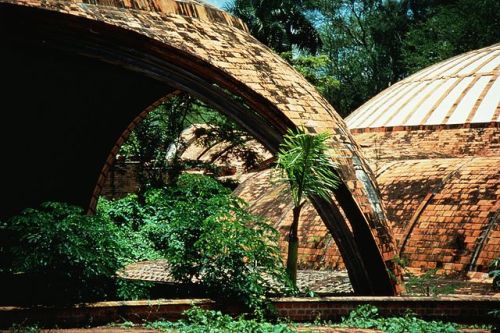
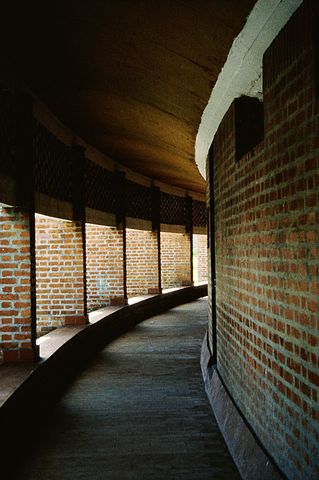
In the movie Yuli, the young Carlos Acosta stumbles on the abandoned National Art School on the outskirts of Havana. When I saw it in the film, I recognized what it was from an episode of ‘News in Slow Spanish’. In that episode they talked about these stunning, abandoned buildings, but being a podcast only, I didn’t realize just how incredible they are.

Loomis_school_ballet-small

By DuendeThumb – Donated to Creative Commons by author John Loomis, CC BY-SA 3.0, https://commons.wikimedia.org/w/index.php?curid=14906296

Started in the early 1960s after the Cuban revolution on the site of a Country Club golf course, the Cuban government drew on the skills and vision of international architects to design a school for the arts that nestled into the curves of the former golf links.  But this sinuous, visionary architecture did not conform at all to the prefab, concrete architecture of the Soviet Union, which increasingly dominated Cuban architecture, and they were never finished.

Loomis_school_music

By DuendeThumb – Donated to Creative Commons by author John Loomis, CC BY-SA 3.0, https://commons.wikimedia.org/w/index.php?curid=14906270

They were abandoned, and despite being put on the 2016 World Monuments Watchlist, two of the buildings are now close to collapse.  The movie Yuli is correct in that dancer Carlos Acosta wanted to restore them, but that caused controversy because it was seen as a form of privatisation by stealth.

In the most recent article that I could find (from 2018) it would appear that the Getty Foundation granted $195,000 for a project to conserve the site. (I wonder if that is still proceeding, given Trump’s attitude towards Cuba? And Cuba’s attitude towards America, as well)

I found a fascinating essay called Reading the Future of Cuba in its Abandoned Art Schools, which describes the background to the project, its use of space, and the role of the crowd in revolutionary spaces.

And here is a video, which starts off with very stirring Russian music, but then moves to a documentary about the construction of the schools. It’s in Spanish only, but if you turn on the subtitles (also in Spanish), you’ll probably be able to follow it.  It’s fascinating.  If I go back to Cuba someday, guess what I want to see.


‘The Great Irish Famine: A History in Four Lives’ by Enda Delaney

Delaney_Irish_Famine

2012 (under the title ‘The Curse of Reason’), 2014, 235 p. & notes.

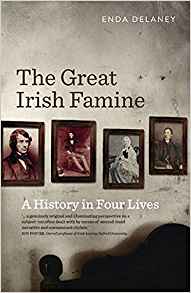
Enda Delaney finishes his book with the death of Michael Collins, aged fifty, by the side of the road on 23 November 1850. This isn’t the famous Irish Michael Collins: instead he is an otherwise unknown man who, dying of hunger, was taken into a house. The priest was sent for, and he died on the floor.  He comes into historiographical view because of the inquest that was held into his death. That is one of the problems with writing about the Irish Famine: it can be writ large because such huge numbers were involved but when you come down to individuals, it’s harder to find them. The reality is, as Nobel Laureate Amartya Sen wrote, starvation ‘is the characteristic of some people not having enough to eat. It is not the characteristic of there being not enough to eat.’ (cited p. 115)  Those people not having enough to eat were overwhelmingly the poor, illiterate and  politically weak.

Books about the Irish Famine are nothing new – indeed, there has been a deluge of them since the 150th Anniversary in 1997. Because of the flow of Irish immigrants to America, Canada and Australia, each of those settler countries has its own Irish famine refugee stories as well. Where this book differs, perhaps, is that it takes a biographical approach to an economic/political event that is usually approached from a wide-angled perspective.  The four lives that Enda Delaney has chosen, because of the limitation of the sources, are not the victims. Instead, they were at the other end of the famine. There is John MacHale, the Catholic Archbishop of Tuam, who at first saw the famine as God’s punishment on his flock for their sins. Over time, he became increasingly critical of the British Government response. There is the radical nationalist John Mitchel, a leading member of the Young Ireland and Irish Confederation movements, who ended up in Van Diemen’s Land for his seditious activities. There is Charles Trevelyn, the assistant secretary to the Treasury, who has often been depicted as the Main Villain because of the policies implemented by the British Government. Finally, there is Elisabeth Smith, the Scottish-born wife of a Wicklow landlord, whose sympathies for the Irish peasantry became increasingly rigid.

The book moves more-or-less chronologically, but the four stories are interwoven with the factual narrative.  He is particularly good on the colonial networks that indirectly linked Elisabeth Smith and Charles Trevelyn, who were both in India at one stage. As events change, so too do people, and you can see the increasing radicalism (albeit expressed in different ways) with John MacHale and John Mitchel; the hardening attitudes of Elisabeth Smith who would otherwise be seen as a relatively enlightened landlord, and the increasingly harsh political medicine being doled out by the British Government wanting Ireland to deal with its own problems.  Even though Trevelyn is seen as the author of these policies, I know through my own work with the Colonial Office, that civil servants in a parliamentary system could not act completely independently.

I always tend to think of 1845 as the Irish Famine year, but in fact it continued right through until the early 1850s. Many of the people who perished died of ‘fever’ rather than outright starvation, although it was severe malnutrition that weakened their whole system. The British Government instituted a system of work-for-the-dole, but this broke down completely when people were just too weak to work. They then insisted that the Irish Poor Law look after the people in the workhouses, rather than have access to British Assistance.

What comes through most strongly is a dogged determination to follow the prevailing economic orthodoxy of free markets and punitive charity which 165 years later still holds sway.  Food was still being exported from Ireland; food imports into Ireland were not allowed to threaten the market; ‘charity’ was grudging and demanded complete abasement.  What did work was soup kitchens, but they were withdrawn prematurely in case people became ‘dependent’. The flood of famine refugees was feared and stigmatized, and landlords took the opportunity to clean-out small landholders by eviction, or somewhat more charitably, emigration schemes.

The power of this book is seeing these politics of ideology, and the politics of resistance being expressed in the words of individuals, and watching their positions harden as the crisis continued.  If you’re looking for ‘getting to know’ these individuals at an emotional or moral level, this is not the book for you. The book does work, however, at the level of personalizing the political. The original title of this book was ‘The Curse of Reason’, and although probably too vague as a title for a publisher, the orthodoxy of the free market and individualism was indeed a curse.  Hard-baked ideology, of any kind, is really not an edifying sight.

You can hear Enda Delaney being interviewed here.

My rating: 7/10

Source: La Trobe University Library


I hear with my little ear: Podcasts 24-30 November 2019

Letters of Love in World War II. That’s it- it’s over. What a fantastic podcasts!!!  Listen to them!! Home at Last: Grief and Relief.  I hadn’t really thought about those months after the war was over, with the German soldiers coming home to Germany.  You’re told in the very first episode that Cyril and Olga went on to have a happy marriage together, so you know that nothing awful is going to happen at the last minutes before he gets home.  Really, really good.


Rough Translations.   Ghana’s Parent Trap  (20/06/18 – yes, it’s old)  In Ghana, parents ambitious for their children’s education send them to school at ONE year old, and expect rote learning and homework. A program to instruct teachers in play-based education had results, but when it was extended to the parents, it did not go as planned.

History Workshop. My very wise PhD supervisor, Richard Broome, advised me that when you’re presenting a paper at a conference, you should work on a ratio of 140 words per minute available to you. It’s a shame that Yasmin Khan wasn’t given the same advice when she presented her 2019 Raphael Samuel Memorial Lecture on “Women on the Frontline of Empire”. The podcast itself is interesting- looking at women during WWII across the empire (Africa, India, to a lesser extent Australia and Canada) and how the stationing of soldiers affected them, and the economic changes for individual countries brought about by the empire’s involvement in war.  But … her presentation is so fast and garbled that it’s really hard work.

Russia If You’re Listening (ABC). Episode 5  (18/11/19) When the Father of Brexit met Mother Russia is a bit of a misnomer, because there is no evidence (yet) that Nigel Farrage, (the Father of Brexit) actually met with Putin or his operatives. This episode traces the rise of Nigel Farrage, prompted by Mad Cow Disease of all things, and claims that Russia influenced the Brexit campaign through social media.

RevolutionsPodcast  Episode 10.18 The Witte System. Well, if the peasants aren’t up to a revolution, and your bourgeoisie is non-existent, what’s a revolutionary to do? Fortunately Sergei Witte (never heard of the man) arrived in Russia to stimulate an industrial economy and build the Trans-Siberian Railway.


‘The Lake House’ by Kate Morton

morton_the-lake-house

2015, 591p.

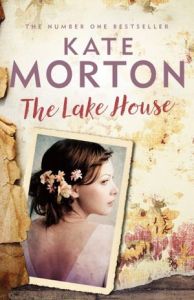
It was not my choice to read this book. Call me snobbish and superficial, but I’m even  turned off by the cover. There it is with its anachronistic photo of yet another woman’s back (although at least you can see her face here), and the fact that the author’s name is in a larger font than the title (one of my ‘amber lights’ warning of books that I probably shouldn’t read).  Kate Morton is a best-selling Australian author and has written several books, all with similar names and covers. Normally, I would steer well clear. However, this book was the selection for my bookgroup and because I am a very conscientious book-grouper, I read it.

It’s a mixture of a  historic big-house novel and a current-day police cold-case story featuring a middle-aged female detective. I’m rather guiltily partial to both genres. I’ve read my share of ‘big house’ books: I loved The Go-Between in Year 12, Rebecca, Jane Eyre, innumerable Victoria Holt books when I was 15, Molly Keane’s books and Atonement.  And in terms of cold-case police stories, after I finish writing this review, I’ll go off to watch Unforgotten on the TV to get my dose of intelligent female police detectives. All these indulgences are just that: they’re ‘down-time’ leisure, when I turn my mind off and just go with it. Which is how I think about The Lake House. It’s the sort of book you might read when you’re on a week’s holiday and want to just immerse yourself in a fairly-undemanding read.

There are two narratives interwoven through the book, one set in 1933 and the other in 2003, both based on the house Loeanneth and its mysteries. In 1933 it was the home of Anthony and Eleanor Edevane and their three daughters and baby son, Theo who mysteriously disappeared on Midsummer’s Eve.  The second narrative, set in 2003 centres on Sadie Sparrow, a London detective who has been stood down and told to ‘take a holiday’ after she spoke to the press about a missing-child case.  She travels down to Cornwall to stay with her grandfather and when she stumbles on the now-derelict Loeanneth, she is driven to find out what happened to the family who left it so abruptly after the disappearance of the little boy.

There are red-herrings and misdirections galore, and although some of them took me by surprise, I guessed the too-pat ending ahead of time.  I suppose that I should be pleased that I actually knew who dunnit by the end, instead of plaintively wailing “But I don’t get it…..”

The book contains every possible big-house and cold-case cliche and at just off 600 pages it certainly is a big baggy monster. There are whole plot lines that could have been omitted without loss, but the twin-narrative structure was well-constructed and sustained across the whole long book. It certainly romped along and drew me in so that I didn’t at all mind reading great slabs of it, which is probably the way you’d read it if it were a holiday read. But it’s not high literature, and I suspect that much of its appeal is that it is so recognizable and comfortable. I won’t be rushing to read another Kate Morton – there are too many other books that are more challenging to read and enjoy, and at 500+ pages, the rewards just aren’t there

My rating: 6/10

Read because:  CAE bookgroup choice.

AWW2019I have included this on the Australian Women Writers Challenge 2019 database.


Movie: Yuli

I confess that I was mainly attracted to this film because it is in Spanish, rather than because it’s a ‘dancing’ film.  It’s the true story of Carlos Acosta, the famous Cuban dancer who has danced with the major (Western) dance companies of the world.  Born to a poor family in Havana, it was his father who drove his career when Carlos himself was a reluctant draftee into the world of dance. It’s a Cuban Billy Elliot in reverse. It is filmed in Havana, which surprised me a bit – perhaps the fact that it is not an American movie opened doors. Carlos Acosta plays himself as an adult, and the narrative is intercut with dance scenes that tell the story – beautifully.

But it is, after all, a dance movie so you more or less know the story before you even see it.  I see that Cinema Nova isn’t showing it any more, either. As it turns out, I saw it at its very last showing.

My rating: 3.5 stars out of 5.

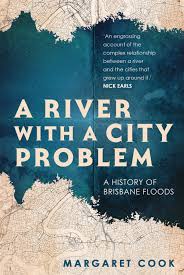
‘A River with a City Problem’ by Margaret Cook

River_City_Cook

2019, 198 p plus notes

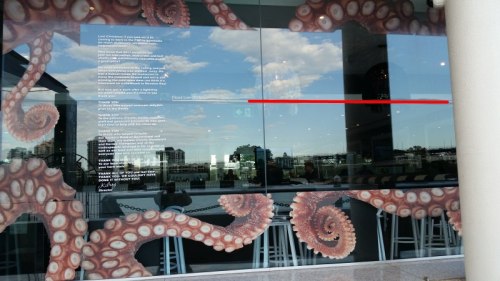
As it happened, when I was in Brisbane earlier this year, we ambled along the Riverwalk floating walkway. Watching the ferries and catamarans plying the river, crossing the pedestrian bridges and feeling the sand under our toes on the man-made beach, we wondered “Why doesn’t Melbourne do more with its river?”  Then we passed a restaurant on the walkway that had a mark on its window (which I’ve highlighted here in red) to show the height of the 2011 flood.  You can gauge its height by the legs on the stools at the bottom of the window.

river

At first I thought “What resilience!” but after reading Margaret Cook’s book, I’m not so sure.  This restaurant would have been under water in 1893 and 1974 had it been there then, and it will be under water again when the floods inevitably return. This dogged determination to keep rebuilding is exactly what Cook means when she says that the Brisbane River is a river with a city problem, and not the other way round.

White settlers, like the indigenous people who were here before them, are always drawn to fresh water sources. They should have listened to the Turrbal and Jagera people whose Dreamtime stories tell how the river was created by Moodagurra, with an emphasis on the rain and cloud that allowed him to wriggle to form the sinuous river. Of course, they didn’t listen to anyone. Early development took place on the floodplain, subjected to regular floods, but riverfront continued to be viewed as prime land.

Until 1893, that is, when the floodwaters surged onto the floodplains, where homes, wool sheds warehouses and industries had been located. Thirty-five people drowned. The solution? Why, build a dam, of course!….and this has been the approach in Brisbane ever since. There was a hiatus between 1893 and 1974, when drought was often more of a problem than flood, but inevitably the floods came again, and the Somerset dam was found lacking. And so, the solution? Why, build another dam – this time, the Wivenhoe, which was designed to be a dual-purpose dam that would maintain a water supply for Brisbane in times of drought, but also prevent Brisbane and Ipswich from flooding during heavy rains.  A shorter hiatus this time, between 1974 and 2011, then inevitably the floods came after days and days of rain. This time, the ubiquity of smart phones meant that the flood was captured in all of its swirling, turbid power, and rank, stinking aftermath.

This book tells the story of the three major floods – 1893, 1974 and 2011 – from ecological, geographical and human perspectives. More importantly, though, it looks at the failure of policy as successive governments of both persuasions lacked the courage to say ‘enough!’ and prevent development on the floodplain. In the aftermath of a crisis, there’s a proud defiance in claiming that” we will rebuild” but often it defeats good sense.

But the Queensland governments were even more egregious than other Australian governments, in their dogged pursuit of growth and development at all costs. It’s not just Joh Bjelke-Petersen’s white shoe brigade here; it’s Clem Jones the Labor Mayor of Brisbane, and a succession of Premiers of both persuasions who consistently looked to technology instead of asking the harder question “Should we even be building here?” When other governments were looking at floodplain planning, especially in the light of global climate change, Queensland governments went through the motions, leaving loopholes that were (of course!) exploited, and tip-toeing around developers and their investments.

By the time the 2011 floods came, even though the water level itself was lower than earlier floods, the financial implications were disastrous because of the encouragement of higher-density development on the floodplain. She discusses the role of Newscorp media after this flood, most particularly the Australian, in attacking the science behind the decision to release dam water to save the dam, and blaming individuals rather than opening up a broader analysis of the systems that had led to such disastrous results.

The book had its origins in a PhD thesis, which is a remarkably hard genre to shrug off when writing for a more general audience.  This is most obvious in the chapter ‘Flood Management with Hindsight’, which examines the decision to release flood water during the 2011 floods. There are lots of acronyms in this chapter, and I rued the lack of a glossary of abbreviations. I also regretted, as a general reader not local to Brisbane, the lack of a more detailed map of the Brisbane River within the city of Brisbane. There is a map that shows the Brisbane River Catchment more broadly, but when mentioning suburbs and city landmarks, the names meant little to me without a map.

The presence of  images throughout the book, especially when discussing the three floods, breaks up the text. I liked that the pictures were placed within the text, instead of being corralled in the middle of the book as a set of plates – a decision probably made easier by the fact that they were black-and-white newspaper images, rather than colour photos.

By the end of the book, I was not at all confident that anything had been learned at all, and I don’t think that Cook is, either.  That line on the restaurant window showing the flood level that I spoke of earlier seems now to be more an act of hubris, than a mark of resilience.  For now.  Her conclusion, titled “The Floods Will Come Again” is a statement of fact, rather than a prognostication of doom. Perhaps then the political courage might be found to acknowledge that the city itself is the problem, rather than the river.  As the title says, it is a river with a city problem, and not the other way round.

Source: review copy courtesy of the author

AWW2019I have included this review on the Australian Women Writers Challenge Database.


I hear with my little ear: Podcasts 16-23 November 2019

RevolutionsPodcast.  After blowing up the Czar, the revolutionaries went into exile in Europe and began having theoretical arguments amongst themselves.  Episode 10.17 The Emancipation of Labour Group goes through the arguments mounted by different groups e.g. you had to allow industrialization so that the industrial proletariat could rise up like Marx predicted; or you had to rely on the peasants because Russia was different to other countries and hadn’t even embarked properly on feudalism; or – from Marx and Engels themselves- criticism that Marxism was being twisted out of its original meaning.

Letters of Love in World War II. Oh no- only one more episode after this. Episode 7: Bergen-Belsen: Sorrow and Shock, deals with late 1944 to mid 1945. The people of England are anticipating that the war will soon by over, but Cyril knows that it may take longer. Faced with ‘ordinary’ Germans, Cyril finds their instructions against fraternization to be very harsh, but Olga is more clear-sighted, especially in view of the news coming out from the concentration camps.

Shaping Opinion. (August 5 2019)  I’m on a bit of an Irish Famine thing at the moment, but I’m almost ready to leave it alone.  In The Famine that Changed Ireland and America podcaster Tim O’Brien interviews Christine Kinealy, the Director of Ireland’s Great Hunger Institute at Quinnipiac University, an author, and a member of the Irish American Hall of Fame. She says much the same things: that it wasn’t that there wasn’t enough food but the problem of access and that the British Government was inexorably wedded to an ideology that made things worse. She also argues that even for those who emigrated to America, it wasn’t really until the 1960s with the election of President Kennedy that they felt American. She suggested that the prominence of the Irish Famine in the historiography is largely due to the Irish Peace Treaty and the Celtic Tiger economy of the 1990s which encouraged Irish people to look back at their history.

AirRace

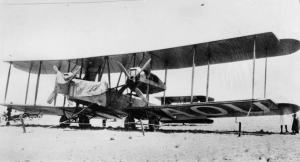
Vickers- Vimy that Ross and Keith Smith flew between London and Darwin Source: Wikipedia

The History Listen (12/11/19)  I write a regular feature in our Heidelberg Historical Society newsletter about what happened in the Heidelberg district one hundred years ago. One hundred years ago, the Great Air Race between London and Darwin brought fame and celebrity to the winners, Ross and Keith Smith and two mechanics Jim Bennett and Wally Shiers. Their achievement is celebrated in The great air race, but unfortunately for me, the contribution of Cedric Ernest Howell from Heidelberg is only a footnote.  And if you want to find out more, you could join Heidelberg Historical Society for only $40.00 and have access through our newsletter to my pearls of wisdom every two months about Heidelberg 100 Years ago!!! (including a piece about Cedric Ernest Howell)

Movie: Locas Mujeres

Gabriela Mistral was the first and only Latin American woman to win the Nobel Prize for Literature. Born in 1889, she was a poet, educator and ambassador.  I had actually heard of her: when I was in Santiago there was an exhibition about her in the library across the road, and then when I went to their cultural centre, I found that it was named after her.

But I think that Latin American audiences must know MUCH more about her, because this documentary about her relationship with her younger lover Doris Dana (who, when she was younger, was a dead ringer for Katherine Hepburn) was very light on details. Mainly it was about Doris Dana’s American niece, who ended up being the custodian of all Gabriela Mistral’s papers that had previously gone to Doris Dana. Doris intended sorting them out and publishing them but died before she did so…and there’s so much of the stuff that Doris Dana’s young niece may do the same thing.  So many boxes; so much paper!! As a documentary, film shots of opening boxes and shuffling through papers only gets you so far. Also there were crackly old tape recordings of Gabriela and Doris talking, once Gabriela was getting old and crotchetty.

Still, Steve and I had a good chat about celebrity, and muses, and translated poetry, even if the documentary itself was rather lacklustre and frankly, boring.  It was screened by Filmoteca, who present a Spanish and Latin American film every month through ACMI. It was in Spanish with English subtitles (unlike the trailer I have posted above).

I hear with my little ear: Podcasts 8-15 November 2019

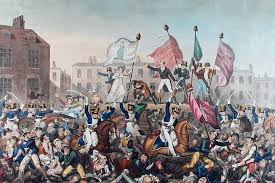
peterlooThe Documentary (BBC) 14/08/19 Another podcast that has been hanging round on my phone for ages, Peterloo: The massacre that changed Britain commemorates the 200th anniversary of this repression of popular dissent in 1819.  It tells the story of the massacre, also commemorated in the recent Mike Leigh film, and interviews descendants of people who participated in the protest.

Empires of History Podcast Well, I’ve finished my U3A class on the Ottoman Empire, and this podcast is still back in the 14th century, and they seem to stop completely in June 2019. S Episode 9  The Thunderbolt Turns to Europe has Sultan Bayezid going into Anatolia. Episode 10, which is in two parts is called A Crusade Dies at Nicopolis, and it goes through Sultan Beyezid’s battle with the European Crusaders, headed by King Sisimund of Hungary. This sure is blood-thirsty history- on both sides.

The History Listen (ABC) In War Recipes (5/11/19) the theme of food amongst starving prisoners is explored, through recipe books compiled clandestinely by prisoners. One is a metal-bound recipe book compiled by POW Ron Foster in Borneo as a ‘dream cookbook’ to share with his family when he returned home; the second was a communal cookbook compiled by women at Ravensbruck Concentration Camp.

Rear Vision (ABC) The Berlin Wall has now been down longer than it was up. In The Making and Breaking of the Berlin Wall (10/11/19) I was fascinated to learn that only about 2km of the wall still stands, and that it now has to have heritage protection!

Russia If You’re Listening (ABC) Gee I like this program. Episode 3 How To Spin A War (4/11/19) is about Russia’s invasion of both Ukraine and the Crimea and its success in muddying the waters so much that in the end you really aren’t quite sure what happened.


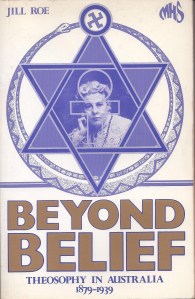
‘Beyond Belief: Theosophy in Australia 1879-1939’ by Jill Roe

Roe_theosophy

1986, 388 P.

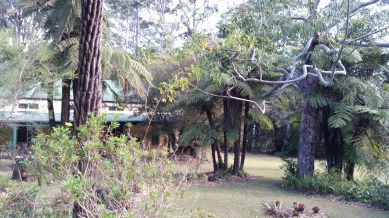
20190823_150525A couple of months back, I went with my Unitarian fellowship to a retreat near Springbrook in south-east Queensland, owned by the Queensland Theosophical Society. Curious about theosophy and wondering if it has any parallels with Unitarianism, I decided to read Jill Roe’s book Beyond Belief. (Thank you for asking: no, Unitarianism  is completely different in terms of philosophy although maybe it does have similarities in terms of public profile). Roe herself was not a Theosophist, so this book is no ‘insider story’ – in fact, it is written with a dry, dispassionate but not hostile air of curiosity. And curious the history of Theosophy in Australia certainly is, but given its attraction to politicians, judges and some academics in the first decades of the 20th century, it can’t be discounted either.
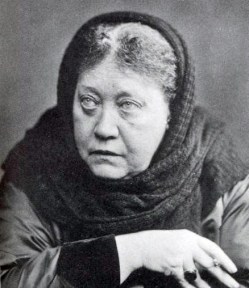
Blavatsky.010

Mme. Blavatsky, Wikimedia Commons

Roe’s book covers the years 1879-1939. Its starting point is 1879 when the Theosophical Society, an international organization, enrolled its first Australian member.

Established in  America in 1875 and eventually based in India, with the so-called psychic Mme Helena Blavatsky as its founder, people joined the central Society as individuals rather than joining a local satellite.  When Mme. Blavatsky was pronounced a fraud for manipulating her seances, she fled to Europe and never returned to India,  and the Theosophical Society continued on without her.

Between 1891-1894 Theosophy gained an effective foothold in Australia with small groups established in various states. Success was mixed. Melbourne, with its solid network of liberals and secularists might have seemed a fertile ground for Theosophy: think Alfred Deakin, Henry Bourne Higgins, Vida Goldstein etc. However, in Melbourne the experimental spiritual space was already occupied by Charles Strong’s Australian Church, the Melbourne Unitarian Church and the Victorian Association of Progressive Spiritualists.  Sydney was a more fractious place, with either hardline churches or frankly ‘nutters’ (have things changed?) and a “freer market for heterodoxy”. The surprising thing to me was that Brisbane became a stronghold for Theosophy (evidenced perhaps by the continuing presence of the retreat I visited in Springbrook?), and it attracted professional and commercial people like judges, doctors, lawyers etc.
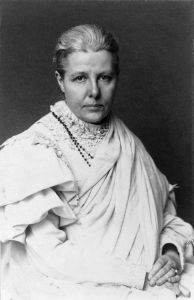
Annie_Besant,_LoC

Annie Besant, Wikimedia Commons

The real international “catch” for Theosophy world-wide was the recruitment of Annie Besant (did you know that it should be pronounced to rhyme with ‘pleasant’?), already well-known for her activism on contraception and championing the cause of the British Match-Girls. (I’m still haunted by a picture I saw in primary school fifty years ago of a girl my then-age, suffering phossy jaw).  She visited Australia quite often in her role as President of the Theosophical Society and was well received as an excellent public speaker. There was a personal connection too: her daughter had married English journalist Ernest Scott, who ended up the first Professor of History at Melbourne University. He had eschewed both Theosophy and his double-barrelled surname Besant-Scott by the time he received his university appointment , and the marriage had broken up.

Now, for me as a non-Theosophist, this all gets pretty weird. Not only the clairvoyance, but also a belief in Lemuria- an Atlantis-like mega-continent encompassing the Himalayas, Madagascar, Tasmania, Greenland and Siberia before sinking into the sea because of volcanic activity. Then there’s the onward evolutionary cycle of rise and fall of dominant civilizations, with the Aryan world in decay, waiting for the sixth cycle which would be presaged by the arrival of the Coming Christ, the World Teacher. There was the connection with Co-Masonry;  the esoteric offshoot ‘The Order of the Star in the East’; and the takeover of the Old Catholic Church, renamed the Liberal Catholic Church complete with Bishops, mitres and ‘mysteries’.

Then there was the World Teacher himself, whom the Theosophical Society identified as Jiddu Krishnamurti born around 1895 in India and adopted by Annie Besant and fellow Theosophist Charles Leadbeater (no relation to the possum). Expectations of the arrival of the messiah reached their zenith in the 1920s, which was also the high point of Theosophy in Australia. The Star Ampitheatre was built on prime harbourside Balmoral Beach in Sydney for the World Teacher “when he comes” (see image here), but not for Jesus walking through Sydney Heads as the legend goes.  The land cost £7000 and the ampitheatre building itself cost £20,000.  It was demolished in 1951.

During the heady 1920s Theosophy was strongest in Sydney (despite schism) and prominent real estate was purchased in all the capital cities.  It owned and controlled 2GB (home of Alan Jones -HUH!). It moved into education, particularly kindergarten education, with a later offshoot into Anthroposophy and Rudolf Steiner education. It encouraged art (particularly the Arts and Crafts movement) and dance (especially eurhythmics). Despite claims to being ‘progressive’, it was a rather straitened progressivism by today’s standards: vegetarian, teetotal, dislike of ‘luxury’, anti-vaccination, proponents of ‘racial hygiene’ and attracted to some of  Mussolini’s ideas.

By the 1930s Theosophy was in decline, and has remained that way. Anthroposophy attracted many of its leading lights; the World Teacher Krishnamurti rejected Theosophy himself and went off in a different spiritual direction; the Society lost 2GB and people drifted into other religions or apathy. It had become an anachronism. Theosophy is, as Roe says “best understood as an alternative religious position dating from the age of imperialism. The ground it stood was undermined by the crises of the early twentieth century” (p. 378)

Quite apart from my curiosity about this esoteric (and in my opinion eccentric) philosophy, the book highlights three interesting themes.  First- here is a church where the major figures are women (Mme Blavatsky and Annie Besant) although, as Roe points out, women only held 1/3 of the officebearing positions in the organization.  Second, this is an imperial endeavour, with India at its heart. The frequent communications and visits between Australia (particularly Brisbane) and India are a different way of looking at empire, largely ignoring the metropole. Finally, there are those rich intersections between Australian intellectual life in the early 20th century and Theosophy- a veritable Who’s Who of connections.

This book was published in 1986 as part of the NSW University Press ‘Modern History Series’. It has the look and feel of a typed manuscript or thesis, with very dense text and footnotes at the end of each chapter (as used to always be the case). Apparently Wakefield Press are crowd-sourcing for a revised edition edited by Marion Quartly  (I wonder how they’ll get around the problem that Wakefield already have another book under their imprint called ‘Beyond Belief’?)

This is an academic text, and it is more an institutional history than a bottom-up, personalized history.  However, in our increasingly rabid religious world, perhaps there will be a readership for this strange history which has so many intersections with early 20th century intellectual history. After all, in an interview with the Australian Humanities Review in 2004, Roe said

if you want to understand the norm, you should look at what isn’t the standard. It’s very illuminating to look at those who have taken a position to the edge, it casts a different light on what really is in general.
AWW2019I have read this book as part of the 2019 Australian Women Writers Challenge.