Movie: The Nightingale

Yep, it sure is violent. I was forewarned that the first ten minutes were particularly violent, but I didn’t realize that the violence continued throughout the film. It’s a vivid and gritty depiction of 1820s Tasmania, a place steeped in violence and killing.  It’s more than just tricking-up a horror film with historical artefacts: it’s also about powerlessness and dispossession and revenge. I thought that the ending was going to descend into bathos, but the last two seconds saved it from that fate.

Larissa Behrendt has written an interesting review of it.

It’s now down to one showing a day at the Nova, so it will soon disappear.

My rating: 4 stars

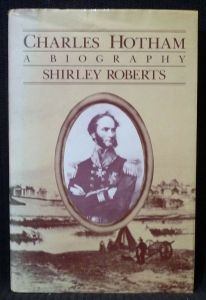
‘Charles Hotham: A Biography’ by Shirley Roberts

roberts_charles_hotham

1985, 201 p.

Even though I’m a historian of Victoria, I confess to drawing rather a blank when it comes to all but the most recent Governors of the state. La Trobe springs to mind immediately, but many of the others I ‘know’ only by things that have been named after them, especially hotels and public buildings.  I was aware that Hotham had taken over from La Trobe, and that he has been characterized as the villain in the Eureka Stockade story.  There’s a street named after him, a pub in Geelong and a mountain… but that’s about all I could have come up with before I read Shirley Roberts’ biography of Charles Hotham.

In her opening pages, Shirley Roberts announces that “Hotham appears as a man who has been most unfairly denigrated”. Clearly her intention in writing this book is to rescue him from this fate.  Of course, historians mount arguments about individuals all the time, making judgements “from the enormous condescension of posterity” as E. P. Thompson put it.  In this case, however, Roberts’ intention to scrub the mud from Charles Hotham detracts from her book as history. She accepts uncritically certain sources and cherry picks from others, and when actions contradict her argument she brushes them off as inexplicable or strange.

However, despite these flaws, Roberts has written what seems to be the only biography of a man whose short 15 month governorship coincided with a political flashpoint in a colony on the verge of receiving self-government.  It starts in a workman-like fashion, with a family tree – the kiss of death for a biography.  Probably the book would be written very differently today, with more emphasis on the networks of empire and the significance of patronage links, and a widening of the focus from white politicians to include protestors’ and women’s forms of influence. But given that we are reading the book we are holding, and not a book as we would wish it written 35 years later, she has captured well the far-flung nature of the British Empire, and the circuits along which colonial authorities and civil servants travelled.

Charles Hotham never aspired to be a colonial governor. He far preferred his naval role, and the command of ships and navy personnel without the complications of representative democracy and colonial elite structures. His work took him to Argentina, where the British Navy at first played a type of peace-keeping role between Argentina and what is now Uruguay, before intervening to protect their trade routes along the rivers that bordered the two countries. After the putative abolition of slavery, he was sent to West Africa (generally seen as a grave-yard posting) to harass slave shipping along the trade routes, especially en route to Brazil. He demanded, and received, loyalty from his crews in an established hierarchy of authority and obedience.

But these very qualities made his posting to Victoria, already seen as a problematic colony, even less appropriate and bound to end in tears. The discovery of gold had led to a deluge of new arrivals, the complete disruption of the bureaucracy, and a crying need for infrastructure. The economy was wobbly, and running at a deficit. In true economic technocrat style, he pronounced and held to hard-line economic prescriptions, announced and implemented without consultation. The colony, like those in the other Australian states, was holding its breath waiting for the legislation for self-government (see Peter Cochrane’s Colonial Ambition) and this return to authoritarian, centralized rule was not likely to please anyone – even those who had craved a more ‘governor’-like presence than La Trobe had cast.

Roberts explains the origin of Hotham’s world-view in terms of his naval background, but uses it to excuse his too-quick turn to repression, and recourse to delay through ordering a Royal Commission (that old standby to gain time). She portrays him as a man surrounded by flawed men, who let him down.

In filling out Hotham’s early career, which she does very well, she draws on a biographical sketch written by Hotham’s sister as a gift to his sister-in-law on their marriage. Although no doubt drawing Hotham in a good light, it has been gift to his  biographer, too. In her analysis of Hotham’s time in Melbourne, she draws strongly on the conservative, pro-Hotham Argus with little reference to opposing newspapers. As an author, she is mounting a pro-Hotham argument, although she does not make it clear exactly what or who she is arguing against.

I was very impressed with her ability to summarize a scenario or event clearly and succinctly, without overwhelming the reader with detail.  This was especially true of Hotham’s time in South America and Africa, which I knew absolutely nothing about.  She is not an academic historian – and the paucity of her reference list attests to this – and her book is more a matter of setting things out, rather than complicating by nuance.

Hotham only governed the colony between June 1854 and November 1855. This short period of time is largely dominated by the Eureka uprising, and Hotham’s role in it. This short, pragmatic book fleshes out his career more fully, and portrays him as more than just the villain of the Eureka rebellion. But Roberts’ determination to rescue Hotham from blame has led her to mount a polemic, rather than write a biography.  The reader should approach this book with admiration at the job she has done, and appreciation for filling in otherwise little known information. At the same time, however, this book needs to read with care and a raised, sceptical eyebrow.

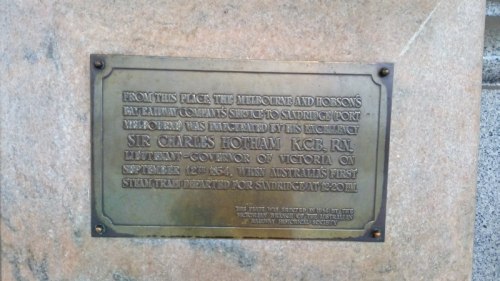
And look at this – I was half-way through the book when I found this plaque at Flinders Street Railway Station!  So he did leave a mark on Melbourne after all!

20191203_182909_small

From this place the Melbourne and Hobson’s Bay Railway Company’s service to Sandridge (Port Melbourne) was inaugurated by His Excellency Sir Charles Hotham K.C.B., R.N. Lieutenant-Governor of Victoria on September 12 1854, when Australia’s first steam train departed for Sandridge at 12.20 P.M.

My rating: 6.5/10

Sourced from: CAE bookgroups. You’ll have trouble tracking it down, I suspect.

AWW2019

I have included this on the Australian Women Writers Challenge database.


I hear with my little ear: Podcasts 17-25 December 2019

annear_nothing_on_TVNothing on TV I’ve just started listening to Robyn Annear’s podcast series ‘Nothing on TV’. It’s great. Annear is a Victorian historian, whose book Bearbrass largely sparked my interest in Melbourne, and she is wry, funny, and quirky. As is this podcast. She draws on the marvellous resources of the online Trove database to chase down odd events, and researches them further. In Episode 1 Enter the Elephant, she takes the story of a tragic drowning of a young boy in Cremorne in 1854 whose body was finally recovered by the elephant at Cremorne Gardens nearby- or was it? She then goes on to a discussion of elephants in 1850s Australia and the phenomenon of the Pleasure Garden. All accompanied by the pop of a champagne cork, and a lovely, broad Australian accent.

RevolutionsPodcast. Well, the revolutionary ‘People’s Will’  assassinated Csar Alexander II in 1881, hoping that it would launch the revolution but it didn’t. All it did was unleash another wave of repression. But by the late 1890s, the stars were aligning for the socialists again. In Episode 10.21 The Socialist Revolutionaries, Mike Duncan identifies four different groups who come under the ‘Socialist Revolutionary’ umbrella, although it’s almost Monty Pythonesque “Peoples Front of Judea” overtones. He talks about Catherine Breshkovsky – what a fascinating life! I wish I could find a biography of her.

In Our Time (BBC) I always thought that the Rapture was an American Evangelical thing, but it originated with Irish Anglican minister John Nelson Darby, who was influential amongst the Plymouth Brethren in England in 1832 and founded the Exclusive Brethren in 1848. He travelled and preached in America, where his ideas about pre-tribulation rapture theory was embraced (i.e. that God would take up the elect and whisk them up to heaven, away from the seven years of tribulation which will end when Jesus returns, ushering in 1000 years of Gods reign on earth). In this program, The Rapture, Melvyn Bragg discusses the Rapture, and its political and theological consequences.  Perhaps not for everyone – it gets pretty hard going theologically, although the second half is more interesting.

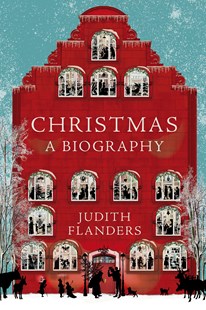
‘Christmas: A Biography’ by Judith Flanders

Flanders_Christmas

2017, 244 p.

You’ll often hear people sigh “Ah, Christmas isn’t like it used to be”. After reading Judith Flanders’ Christmas: A Biography, you’ll realize that Christmas was never “like it used to be”. The idea of an idealized, ‘lost’ Christmas  is just as much a myth as many of the so-called ‘Christmas traditions’- most of which are wrong or misplaced.

The gospels themselves don’t really give specifics, and the few specifics they do give are problematic. There was a census in 6CE, but Herod had died ten years earlier, and there is no record of a census that required men and women to return to their place of ancestral origin. There is no mention of a date, but it would have been too cold for sheep in December, so it certainly wasn’t in December.  From the second century, the Eastern church celebrated Epiphany on 6 January (and indeed, it still remains an important date in many Christianized cultures)  and it was Julius I, Bishop of Rome (337-352) who decreed that Christmas should be observed on 25 December. A whole clump of Saints Days occurred in December and January, as well as the Roman Saturnalia festival in the first half of December, Kalends to bring in the New Year and the celebration of the solstice on December 25. There was a rich brew of traditions which could be incorporated into what we know as ‘Christmas’.

From the start, food and drink was important. By 389 the Archbishop of Constantinople warned against the dancing and feasting to excess that were occurring on the day, and by the mid 7th century Theodore of Tarsus, Archbishop of Canterbury was reminding his congregation that the church frowned on gluttony. Certainly the few remaining menus from medieval feasts are stomach-churning. All the food, both savoury and sweet, was laid out at once, and often cleared away for a second ‘mess’ where a whole new table of food would be laid out just in case you hadn’t gorged yourself witless with the first ‘mess’.  It was very meat-oriented. Mince, or ‘shred’ pies really did have meat in them, Christmas pudding was thick beef stock with dried fruit. (I wonder if that explains the persistence of suet in pudding recipes, although I always used butter).

Processions, fairs and plays all  provided entertainment. There was an element of ‘misrule’ in many of these entertainments, with servant-as-master inversion and Twelfth Night japes.  But the rosy myth of all the villagers being invited into the ‘big house’ was just that – a myth.  If anything, the gift-giving went the other way with people giving presents upwards to their patrons, and any charity flowing back down again was given rather grudgingly.

The Puritans did outlaw Christmas, forcing the shops to stay open, but as Flanders points out, what the law says and what people do in the privacy of their homes are two different matters. When the prohibition on Christmas was lifted – amazingly, not until the 1950s in Scotland! – the shops still had to stay open because now everyone was feasting and drinking openly again.

A friend of mine mentioned how she invited friends around two years in a row to help decorate the tree, and on the third year she was expected to do it again “because it’s a tradition!” Traditions don’t take long to embed themselves, as the later chapters dealing with the 20th century manifestations of Christmas show. Flanders goes from one invented tradition to the next, popping them like balloons.  Carols were just secular songs (pop!); Santa was originally a little elf, as in The Night Before Christmas (pop!); then he was a tall skinny man (pop!); it wasn’t Price Albert who introduced the Christmas tree to England, but rather the Princess Lieven or Queen Adelaide wife of William IV (pop!) The ‘ancient’ tradition of carol services was invented in 1880 and held at Kings Cathedral only since 1918 (pop!) More recently,  Chanukah (Hanukah) and the Afro-American invented ‘tradition’ of Kwanzaa have been rolled into the ‘festive’ season.  First books, (e.g. Washington Irving’s History of New York and Charles’ Dickens A Christmas Carol)  and now films shape our visual impression of a “traditional” Christmas.

The book moves chronologically, but I confess to finding that it skipped around quite a bit, with similar information appearing in different chapters. The chapters don’t actually have titles, and so it’s not clear quite what the organizing principle is. The lack of an index exacerbated this problem. In fact, it’s only now in writing this review that I realize that there is a ‘legend’ of icons that appear in the margins of each page  (e.g. carnival and riot; drinking and drunkenness;  greenery; religion ritual and rite).  However, the icons are so liberally sprinkled that they don’t make locating specific information any easier. The chapter-notes and primary/secondary references are only available through her website. The footnotes at the bottom of the page (yes!) are digressive and quirky. The whole book has the feeling of being a light read.

The book is also rather Protestant-focussed if  it is about religion at all, which is of course Flanders’ main point: that Christmas is at heart a polyglot secular festival, rather than a religious one.  The book deals with England, America and German and Scandinavian Europe but there is no mention at all of the ‘New World’ except a fleeting mention that improved transportation could bring Australian or Argentian meat to British Christmas tables.  In keeping with the research interests of her other books (e.g. The Victorian House: Domestic Life from Childbirth to Deathbed and The Victorian City: Everyday Life in Dicken’s London) her focus is on the domestic and everyday, the emotional and the experiential.

She starts her book with a quote from the poet C. Day Lewis:

there are not Christmases – there is only Christmas – a composite day made up from the haunting impression of many Christmas Days, a work of art painted by memory. (cited p. 2)

She finishes her book by pointing out:

By repeating the rituals, we can go back there every year. Christmas nostalgia is not only for the Christmases of our childhoods, or those we have read about, or seen in films and television. It is a conflation of all those Christmases, a pick-and-mix collection of traditions, emotions and rituals. Some are ours, some our parents’, or what we think we remember of what our parents have recalled of their own childhood. Others come from books, from magazines, from how Martha Stewart or Nigella Lawson or the Food Network or Oprah tells us things have ‘always’ been done, validating our own, or brand-new, customs by claiming that they are long-standing rituals based in historical reality. (p.244)

With just one more sleep until Christmas, I enjoyed this book even if it brings out the ‘bah-humbugs’ in me. It provides plenty of ammunition against the conservative ‘keep Christ in Christmas’ and ‘Ban Happy Holidays’ culture warriors.  And if you want a visual, cut-down version of the book, here’s the video that alerted me to Judith Flanders’ book and prompted me to read it:

My rating: 7/10

Sourced from: Yarra Plenty Regional Library

I hear with my little ear: Podcasts 9-16 December 2019

tamerlane

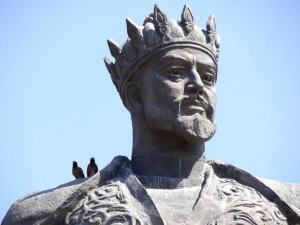
Amir Timur or Tamerlane  Photographer: Adam Jones https://www.flickr.com/photos/adam_jones/7494229100

Empires of History – The Ottoman Series- Not many episodes left to listen to, but centuries of the Ottoman Empire left to go. I’ve got a feeling that this series is just going to peter out.Episode 11: Of Thy Insolence and Folly looks at the Battle of Ankara between the Thunderbolt Sultan Bayezid and Timur- better known to me as Tamerlane. Ye Gods, what a monster HE is! In Episode 12: The Battle of Ankara and the Death of Sultan Bayezid 1 follows through to Tamerlane’s victory.


My 2019 Adelaide Writers’ Festival. Perhaps I should just pretend that I’m there, eight months later! David Marr discusses the essays in his collection My Country, but it’s a pretty digressive (and, being David Marr, loquacious and at times rather arch) talk about his writing over the years, particularly his writing about ‘monsters’.

In Rise of the Right,chaired by Dominic Knight, there are three speakers: Carolin Emcke
(Against Hate), Nancy MacLean (Democracy in Chains) and Jeff Sparrow (Trigger Warnings.) This festival took place in March 2019, before the Australian Federal Election and there was still an expectation in this pro-Labor crowd that Labor would win, and Brexit was still a great muddle.  Emcke spoke about the European, and particularly German experience of the rise of hate, while Nancy MacLean spoke about the work of economist James McGill Buchanan and the influence of the Koch brothers in a determined attempt to subvert democracy. [There wasa great deal of controversy over this book when it was released in America].Jeff Sparrow spoke about the Australian experience, and the use by the right of the concept of ‘political correctness’ as a form of attack in the culture wars.  It’s an interesting podcast.

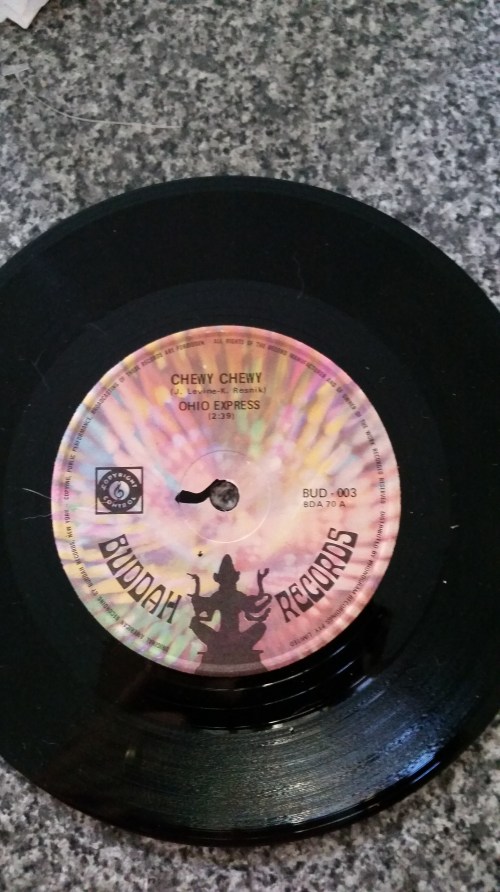
Chewy, chewy

20191221_174017

My brother is no Marie Kondo. He finds it very hard to throw anything out, which is why he brought this 45 rpm record back to me yesterday. Yep, it has my name on it. Chewy, chewy? The Ohio Express? Do you even remember that song? We started humming ‘Sugar, Sugar’ until we realized that we had the wrong song, and then we were stumped. What was Chewy, Chewy???

Ye Gods.

In 1968 I received 25 cents pocket money per week. Singles like this cost 99 cents. That’s a month of saving. I have been robbed.

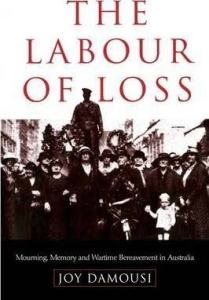
‘The Labour of Loss’ by Joy Damousi

damousi_labour_loss

1999, 163 p & notes

It really wouldn’t have surprised me if this book had been reissued in the last five years, but it wasn’t. It would have done very well in the deluge of books about WWI between 2014 and 2018, and dealing as it does with loss experienced during and resulting from World Wars, it fits very neatly into the  ‘history of the emotions’ school of historical enquiry, which has high prominence at the moment.  But it wasn’t reprinted, and so it remains a fore-runner to much work that has been completed in its wake.

As Damousi says in her introduction

This book examines the stories of those for whom loss in war remained the experience through which they understood themselves, and through which they shaped their lives. After the wars ended, their lives had been irrevocably changed through continuing grief, for the burden of memory would remain with them as they attempted to rebuild an internal and external world without those to whom they had been so fundamentally attached. (p. 6)

Damousi is very conscious that she is dealing with ‘white’ soldiers and the experiences of their families, and mentions in several places that the burden of memory was often disregarded for indigenous soldiers.  A strong gender theme runs through her analysis.

The book is divided into two parts. The first deals with the First World War, the second part deals with the Second World War.

Part I : The First World War

1. Theatres of Grief, Theatres of Loss

2. The Sacrificial Mother

3. A Fathers Loss

4. The War Widow and the Cost of Memory

5. Returned Limbless Soldiers: Identity through Loss

Part II The Second World War

6. Absence as Loss on the Homefront and the Battlefront

7. Grieving Mothers

8. A War Widow’s Mourning.

Conclusion

The themes of the grieving mother and wife are dealt with in both sections, while other themes e.g. soldiers writing to bereaved families, the return of limbless soldiers, or absence from home are dealt with in one section only. I’m not sure that there is a qualitative difference between these emotions and events between the two world wars, and perhaps the decision to locate a topic in one war rather than the other depended on the sources that Damousi uses.

As Damousi points out in Chapter 1, when a soldier died at the front, it was quite common for his friends in the battalion to write to his grieving family themselves. Sometimes bereaved families ‘at home’ drew their son’s friends to themselves like adopted sons. While writing these letters to other families at home, the soldiers were almost rehearsing their own possible death.  Meanwhile, back on the homefront, delayed letters continued to arrive from sons who had been killed , and bereaved families forged their own links with each other.
Blood_vote

Wikimedia


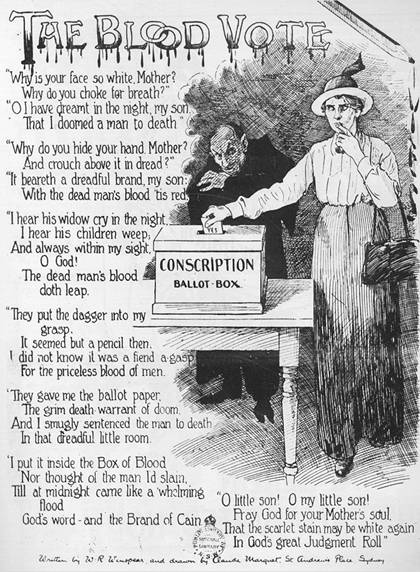
Chapter 2 and Chapter 7 both deal with grieving mothers, but in World War I the mother figure had a political as well as familial role. Not only was the mother lauded for “giving up her son” but the Conscription debates drew heavily on the image of the mother both as  the one who sacrificed, but also the one who determined, men’s fates.  ‘The Blood Vote’, for instance, placed the burden of decision onto mothers, rather than fathers or sisters.

Yet when it came to financial support for widowed mothers who lost their sole breadwinner, mothers soon found the limits to compassion for their sacrifice. After being giving a prominent role in the immediate post-WWI period, by the 1930s mothers found themselves shunted to the side of parades and their pensions became increasingly inadequate over time, especially when additional payments were granted to widows but not mothers.

In the World War II section on mothers, Damousi makes similar observations, drawing on the diary of Una Falkiner, whose son died in a plane accident in September 1942, and Hedwige Williams whose son  Charles Rowland Williams died in Germany in May 1943. This chapter -, shaped perhaps by the sources available? – seemed to me to have a deeper emotional timbre than the corresponding WWI chapter.

Chapters 4 and 8 deal with war widows. What is common to the experience in both wars was that the war widow tended to become public property as her lifestyle and life choices were judged by others to determine whether she qualified for a widow’s pension. It became rather unedifying as neighbours, other widows and mothers informed on those who they felt were ‘undeserving’. Again, in relation to the Second World War section, the same themes recur in the experience of women in the two wars, but in Damousi’s account she draws more heavily on a particular source – in this case, Jessie Vasey, the widow of General George Vasey who died in an Australian plane crash when he and several other high-ranking defence officers died near Cairns. She channelled her grief into political and charitable action for war widows but, once again, after the immediate post-war years, women found themselves and their sacrifices pushed aside.

The correspondence between the Vaseys also features strongly in Chapter 6  ‘Absence as Loss’ where Damousi  draws on Vasey’s letters back home to illustrate the yearning for domesticity expressed in much wartime correspondence. Interestingly, I have just finished listening to an excellent podcast series called Letters of Love in World War II, where a British couple range over philosophy, yearning and domestic trivia in their 1000-letter correspondence. Again, it is perhaps not so much a qualitative difference between the two wars, as a question of sources.

The depth of sources has possibly also influenced Damousi’s decision to deal with fathers’ grief in World War I, and not in World War II. In Chapter 3, ‘A Father’s Loss’ she examines the extensive archive of John Roberts, an accountant with the Melbourne Tramways Board, who lost his son Frank on 1 September 1918 at Mont St Quentin. Perhaps there was a particular plangency in losing a son so close to the Armistice; or perhaps the almost-obsessive pursuit of every possible way of documenting and making contact with those who may have seen, or been with, his now-departed son reflected Roberts’ own personal approach to traumatic events. In either case, Roberts’ correspondence is a rich and complex archive of grief for the historian.  More generally, however, fathers maintained a more prominent public part than mothers and widows in commemorating their sons through political organizations and they leveraged their ability to influence policies.  In the Second World War, however, fathers (many of whom had served themselves in World War I) found that the reactivation of war challenged their ideas of patriotism and their own earlier sacrifice. They often found themselves harking back to their lost pre-WWI world, which they had been unable to secure.

Of course, World War I and World War II was interspersed by the experience of the Depression. It forced hard decisions about sacrifice and worth in finding and holding scarce employment. As Damousi points out in Chapter 5, initially there was strong pressure for governments, councils and private employees to offer jobs to returned WWI soldiers, and particularly soldiers who had been injured. However, when jobs became scarce,  returned men without injuries were preferred employees, and war widows were expected to yield their jobs to returned soldiers.

I’ve been thinking a lot about the title of this book.  I’m not sure if the loss that she mentions here involves “labour” as such, although it certainly was a life-changing event for those who were left. But then I find myself thinking of the title of Shakespeare’s play “Love’s Labour Lost” which to me has its echoes in this title. For, without actually spelling it out in her title,  what comes through in Damousi’s examination of memory and grief, is “love”.
AWW2019I have included this on the Australian Womens Writers Challenge database for 2019.

Source: La Trobe University Library

 

Movie: Knives Out

This is a real hoot, with a fantastic cast. But among all these cinematic luminaries – Daniel Craig, Christopher Plummer, Jamie Lee Curtis, Toni Collette- this film absolutely belongs to Cuban actress Ana de Armas. She cries beautifully, and is completely convincing.

I usually don’t like big-house murder mysteries, but this is really good!

My rating: 5 stars. Really? Maybe 4.5 stars. Nah. 5 stars.

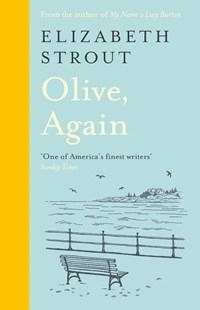
‘Olive, again’ by Elizabeth Strout

Strout_OliveAgain

2019, 289 p.

I’ve read quite a bit of Elizabeth Strout over the last few years, after falling in love with the first book of hers that I read in 2015- Olive Kitteridge.  I’ve read three others since then: The Burgess Boys, My Name is Lucy Barton and Anything is Possible, but I found myself enjoying them less as their similarities became more obvious. I decided to give myself a break from the Strout ‘brand’ for a while.  But when I saw that she had released another book about Olive Kitteridge -my favourite of all her books-  I lined up straight away to read it.

Like the original Olive Kitteridge book, Olive, again is a series of linked short stories where Olive Kitteridge appears at some stage- a bit like Alfred Hitchcock in his movies. The stories are all set in Crosby, Maine which appears to an Australian reader as the quintessential East Coast American town.  Sometimes the chapter is about Olive’s life, at other times she just has a walk-on part with the focus on someone linked to her.  What is common to all chapters is a clear-sighted wisdom about human limitations and frailties. People here are snippy, bad-tempered, frustrated but these are foibles lived out amongst other people similarly flawed.  It’s a very domesticated, family-oriented world, that is very conscious of how stifling and lonely that world can be.

I absolutely loved these stories, and found myself rationing them out to just one chapter a day to make it last longer. Frances McDormand, who starred in the HBO television series now completely inhabits the Olive Kitteridge in my mind as the large, ungainly, abrupt and socially awkward woman who is almost oblivious to her (often negative) effect on other people. But this is an older Olive, who remarries after her first husband dies, and now needs to negotiate her estranged son and his new second-marriage family, with all the nuances of step-vs-natural children. Her health is failing; people are dying; she moves into aged care.  Finally, after all these changes, she mellows somewhat. She recognizes that she doesn’t have to say exactly what’s on her mind; that she can choose to say nothing.

I think that Elizabeth Strout is ‘killing off’ her Olive in this book – I can’t see how she could write another volume about her (death beds are a scenario that would be difficult to stretch to a whole book). But she is letting this character go with her own dignity and sense of self intact, and draws us as readers to view this with empathy and even love.

My rating: 10/10  – just as I rated the first Olive Kitteridge

Sourced from: Yarra Plenty Regional Library.

I hear with my little ear: Podcasts 1-8 December 2019

Maree Man geoglyph at Finnis Springs near Maree

Aerial shot of Marree Man. Source: Wikipedia

Earshot (ABC) 24/10/19 Marree Man- is he a relation of Mungo Man perhaps? Well- no. He’s a huge carving of an Aboriginal man, etched into the red dust around the South Australian outback town of Maree 21 years ago. Yes- you read right- twenty one years ago, not 20,000. At four kms. in length and 28 kms in circumference, this is a huge piece of artwork – but who did it? Not  Erich Van Danikan’s Gods and their Chariots, but maybe  U.S. or Australian servicemen from the nearby Woomera base? Someone as a joke? It’s certainly a complex hoax, with fax machines clattering into life with mysterious faxes, and clues planted all over the world. The Mystery of the Marree Man is a fascinating podcast.

Hazel Rowley Lecture. Did you know that many of the Adelaide Writers Festival talks are available on podcast? In 2019 the Hazel Rowley Memorial Lecture was given by Maria Tumarkin, whose most recent book Axiomatic draws on the stories of multiple people, as did much of Hazel Rowley’s work with her joint biographies of Franklin and Eleanor Roosevelt, and Simone de Beauvoir and Jean-Paul Satre. In this lecture, Maria Tumarkin presents as series of nine alternative openings to her talk, covering a  range of perspectives on life writing, the ‘NON-fiction’-ness of non-fiction, the art of biography and the hard graft of writing.  She identifies as the ‘take-away’ of her lecture, as Americans would put it, and it is that the task of the non-fiction writer is to write about real people in a way that makes it impossible for them to be scooped up and repurposed, or turned into something or someone else, to meet other people’s fantasies.  The person, she says, is sovereign: they are never ‘character’. This beautifully-written lecture is read, so it is a little too garbled in places and rather stilted in its delivery but it is nonetheless excellent listening (although the interference of a lecture from an adjoining hall at the Writers Festival is distracting)

Russia If You’re Listening (ABC) In Episode 6 The Spies Who Suck at Spying, Matt Bevin looks at the Russian assassination attempts in England dating from the poisoning of Alexander Litvinenko, up to the unsuccessful poisoning of former Russian military office and double agent Sergei Skripal and his daughter. (25/11/19)

Revolutionspodcast  While we’re over in Russia, Episode10.19 introduces Nicky and Alix, who were going to face the 1905 and 1917 revolutions. This is a pretty sympathic analysis of two people completely interwoven within the European royalty network of Queen Victoria’s children.  Episode 10.20 The Liberal Tradition (Such as it is) goes back to even Catherine the Great to examine people who might be described as ‘liberals’, even though they were few and far between, and reluctant to use the term. It then goes through the Tsar Liberator in the 1870s, the repression of Alexander III and culminating with historian and politician Pavel Milyukov who would become involved with the Constitutional Democratic Party (known as the Kadets)