I hear with my little ear: Podcasts 8-15 July 2020

History Chicks  I’m on a bit of a Helen Keller binge at the moment, so I downloaded the History Chicks episode on Helen Adams Keller– one of their earliest from 2011. I suspect that they have read Dorothy Hermann’s biography because it’s staying fairly close to that. But I like that they spend considerable time on her radical activities, although they don’t mention her spirituality.

Historical Figures also had a podcast on Helen Keller, but it focussed more on her childhood. They do mention her political activities, but most of the podcast repeats the water-pump story.

Heather Cox Richard’s History of the Republican Party Episode 4 looks at the rivalry between Ulysses Grant (ex-military rather than a career politician ) and Charles Sumner (the guy who got bashed up on the Senate floor in 1854) who felt as if he should have been President.   Heather Cox Richardson pushes back against the idea of Grant being corrupt. We see the rise of ‘liberal’ Republicans, as well as the rise of the KKK and the creation of the Dept of Justice. The party splits, and turns to big business, who switch their loyalty to the Republicans. We also get the fear of ‘communism’ and wealth distribution through coloured voters (something we still have today)

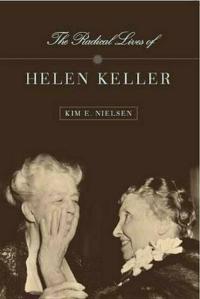
‘The Radical Lives of Helen Keller’ by Kim E. Nielsen

Nielsen_Keller

2004, 194 p.

I’m plunging into some reading about Helen Keller, in preparation for a talk that I’m giving this week at my UU Fellowship. I remember reading the story of Helen Keller standing by the water pump in one of my school readers in primary school, and of course, I saw Patty Duke in ‘The Miracle Worker’. But I hadn’t realized that Helen Keller had such a rich intellectual, political and spiritual life after water flowed over her hands prompting her ‘aha!’ moment and once she became an adult woman- and that’s what I’m exploring at the moment.

I hadn’t realized just how much had been written about Helen Keller. Children’s books, in particular, abound. The Radical Lives of Helen Keller is a relatively recent book, published in 2004, and I’m a little sorry that I hadn’t read Dorothy Herrman’s more conventional biography Helen Keller: A Life prior to reading Nielsen’s book, which is more overtly rooted in a theoretical stance than a ‘straight’ narrative biography.

Nielsen’s book comes from a Disability Studies perspective, which challenges the idea of disability as something to be ‘overcome’ and instead focuses on the social, political, economic and cultural factors that define ‘disability’. As she says, this perspective

”  reveals to historians, such as myself, the depth to which those definitions of disability and normality are ever-changing, are historically bound, and have immense consequence. Using disability as a tool of analysis necessitates a profound rethinking of power and the dynamics which create social power.” (p.13)

While not at all discounting the effects of blindness and deafness on Helen Keller, Nielsen argues that:

As the world’s most famous person with an acknowledged disability in the twentieth century, whatever Keller wrote, spoke or did mattered. The policies and attitudes she espoused regarding people with disabilities had political, legal, medical, financial, cultural and educational consequences.  Her public persona was held up as a standard for other people with disabilities and shaped their personal and political options, whether or not she or they desired it. She understood the political implications of class She also actively involved herself in advocating for people with disabilities. But she rarely explored the political implications of disability. For most of the her life, the disability politics she adopted were frequently conservative, consistently patronizing, and occasionally repugnant.” (p. 9)

It is because of this reframing of Keller’s life through a Disability Studies lens that I wish I had been more familiar with the entirety of her story, before critiquing it through this very late 20th-early21st century lens. Taking a contemporary intellectual stance and revisiting a well-trodden story is valuable and enlightening, but I am a little uncomfortable with the suggestion of blame that sometimes attaches to the project –  “why didn’t she act in a certain way?”

In particular, Nielsen is critical of Keller’s deliberate distancing from other people with disabilities throughout most of her life, most particularly the Deaf community. Keller’s education was recommended by Alexander Graham Bell, an oralist who was fiercely opposed to the use of American Sign Language. Possibly without being aware of it, she was aligned with one side of the cultural and political debates about signing and orality that still run through the Deaf community today. Moreover, she appears to have had little contact with other networks of blind professionals, intellectuals or activists of her own generation. She became a mythologized individual rather than part of an oppressed minority.

Nonetheless, Nielsen admits:

Given the limited practical or theoretical options perceptible to her, her isolation from other people with disabilities, and her inability to politicize disability, her career can be explained as a pragmatic choice. Few viable alternative choices existed. (p.12)

Nielsen explains why she titled her book in the plural:

This political biography is not simply entitled The Radical Lives of Helen Keller because of Keller’s interest in radical politics. She also lived radically different lives at different points in her life. Internal and hard wrought personal decisions effected these changes. External factors…also prompted these changes. The Radical Lives of Helen Keller seeks to recognize the various political lives Keller lived and the reasons for those political and personal revolutions. (p.14)

The book is divided into four chronological chapters, and a concluding chapter. The first chapter ‘I Do Not Like This World As It Is’ covers 1900-1924, thus starting with Keller’s entry to Radcliffe College, rather than the more common opening scene of the pump in the garden. It describes her spiritual conversion to Swedenborgianism and her involvement in socialist politics, something that was encouraged by John Macy, who was originally engaged as an editor/secretary, and ended up marrying Annie Sullivan

Chapter 2 ‘The Call of the Sightless’ covers the years 1924-1937 when she and Annie (now separated from her husband John Macy) focussed on the fundraising activities of the American Foundation for the Blind, a position which required Keller to suppress her socialist activities so as not to spoil ‘the brand’. At the end of this period, Annie Sullivan died, leaving Keller bereft.

Chapter 3 ‘Manna in my Desert Places’ 1937-1948 covers her first visit to Japan, a deathbed promise to Annie Sullivan, and her increasing concern over the rise of Hitler in Germany. She increasingly came under the purview of the FBI, especially for her support of the American Rescue Ship Mission, which planned to take European refugees to Latin America, but the project was scuppered because it attracted communist support. She became friends with the sculptor Jo Davidson who introduced her to many progressive, engaged people.  She returned to Japan in 1948 as part of a tour that planned to visit Australia, New Zealand, Asia and the Middle East, but it was cut short because of the illness of her travelling companion Polly Thomson. She did, however, visit Hiroshima and Nagasaki, and was appalled by the dropping of the bomb.

Chapter 4 ‘I will not allow Polly to Climb a Pyramid’ takes the last 20 years of her life (1948-1968) and her work as a goodwill ambassador for the United States, representing the United States “as a courageous, interesting, vibrant but quirky country that could accomplish virtually anything.”

The political  implications of her actions were implicit, her political opinions left private. Her message was inherently political but her image was of a living miracle. This seemingly placed her above the squalor of international and partisan politics” (p. 106)

The final chapter ‘One of the Least Free People on Earth: The Making and Remaking of Helen Keller’ examines the project to curate the Helen Keller image, both at the time, and since. It was a project that depended on her exceptionality, and it demanded the suppression of political solidarity with both disability activists, and with the progressive politics that might offend donors to the American Foundation  for the Blind.

I enjoyed this book, even though I recognize that I should have read it later, rather than sooner. I am now reading Hermman’s biography, and find myself reading the two books against each other. And I find myself astounded by Keller’s preternatural intelligence, her political involvement and deep spirituality.  Nielsen is right-

Keller is a complicated icon, just as she was a complicated individual, who lived a complicated life. She thrived, however, on complication, on debate, on excitement and on constant movement. She liked Scotch, not tea (p. 131)

Sourced from:  ebook through State Library of Victoria

I hear with my little ear: Podcasts 1-7 July 2020

Heather Cox Richardson continues with Episode 3 of her History of the Republican Party. In this episode, she deals with Reconstruction. No wonder Andrew Johnson was impeached by the House of Representatives- after Lincoln was assassinated he took over, and in a few months stitched up arrangements so that the South (which had lost the war) was largely excused, and he passed the Black Codes to limit the rights of afro-Americans.  As H.C.R. says, in these years you can see the origin of many of the issues tearing America apart today.

Her Politics and History talk of 30 June was a bit more present-focussed than usual. She starts off with the history of treason, pointing out that until John Brown was executed (as in the John Brown’s Body song) in 1859, no-one really knew what actually constituted ‘treason’ and how it should be punished. The 1949 definition, passed in the Cold War, assumed that the enemy country had declared war- so how does that work with terrorism? Another question was: What happens if Trump retires? She wouldn’t be surprised if he did, on the basis of his prior behaviour where he breaks things then leaves. Next question: Why didn’t Obama do something about Russian interference? Her suggestion: it would have given the Republicans real ammunition to say that the Russians thought America so weak that they could interfere with impunity. And finally: why do so many sports teams reference Native Americans? Her answer: because in the 1890s and early 20th century, when most of this naming occurred, there was anxiety about white men becoming effeminate, and so the names referenced a physically strong imagery.

Earshot (ABC) Life After Hate is a two-part series that follows a young British-Canadian Tony McAleer who was a white supremacist. He was imprisoned for crimes committed while he was involved with the far right, and on his release he decided to leave it all behind. He became involved with a charismatic life-coach and public speaker, and is now on the public-speaking circuit, building his shtick from his far-right past. Is this just another form of self-aggrandisement?

99% Invisible A few months back, I mentioned a 99% Invisible program about a statue of the Spanish conquisador Juan de Oñate. Activists had hacked the foot off the statue, replicating Oñate’s own action when he cut the foot from indigenous men to punish them. Well, with all the statues toppling all over the world, Oñate’s statues (the old fashioned man on a horse and a more recent one) came in for attention. Return of Oñate’s Foot reprises the original one, and catches up with recent events.

Talking Politics: History of Ideas – Mary Wollstonecraft David Runicman is obviously trying to draw connections between Episode 1 (Hobbes’ Leviathan) and Wollstonecraft’s work but it’s a strained connection at times. Writing during the French Revolution, Wollstonecraft wrote two books in response to Edmund Burke’s critique of the French Revolution: first Vindication of the Rights of Man and then Vindication of the Rights of Woman. He points out that although it’s rather cold in tone, it is surprisingly graphic when describing sexual practices. He finishes talking about Jane Austen, who probably read Wollstonecraft’s book, and her novelistic expression of Wollstonecraft’s arguments in Sense and Sensibility and Pride and Prejudice.

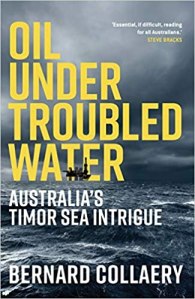
‘Oil Under Troubled Water’ by Bernard Collaery

collaery_oil

466 p. 2020

This blog post is actually an amalgam of two blog posts. The first one explained why I didn’t finish reading this book. This second post is written after I gritted my teeth and did finish it after all.

I’ve become more interested in international politics over the last twenty years. This interest was spurred by my outrage at the oleaginous Alexander Downer’s airy dismissal of concerns about Australia’s behaviour over East Timorese oil resources, waving off the whole question as a merely a matter for foreign aid, rather than principled policy. I decided then that I needed to know more about the world around me.

I still feel that way, particularly about East Timor and West Papua. I watched a Readings ZOOM session where former Victorian Premier Steve Bracks launched this book and decided that I should read it. Bracks describes it in a blurb on the front cover as “Essential, if difficult, reading for all Australians”. I assumed that it was difficult from a moral/political point of view (which it is), but for me it is difficult because of the way it is written. It is very detailed : nearly 400 pages of very dense foreign policy with different departments and diplomats and acronyms. It’s a lawyer writing, not a historian, and fact after fact is rammed through, lest nothing be left out. This is a real insider’s book, for someone who already knows the lie of the land and the big picture. That reader is not me.

Bernard Collaery is a former Attorney-General of the Australian Capital Territory and worked for many years as legal counsel to the government of East Timor. He makes no secret of his admiration for and allegiance to Xanana Gusmao, the first President and fourth Prime Minister of the newly-independent East Timor. The black and white photographs sprinkled through the book, often including the author, show that he is not just a commentator but a participant in the events. In May 2018 he was charged by the Australian Commonwealth Director of Public Prosecutions with conspiracy to breach the Intelligence Services Act of 2001, introduced in the wake of September 11. He, and Witness K, a former senior ASIS agent, have been effectively gagged over a claim that ASIS had bugged the offices of the East Timorese team during negotiations over Timor Sea oil.

This, then, is a history of Australia’s dealings with East Timor and Indonesia over the oil resources- and more importantly, the helium reserves- in the Timor Sea. It moves chronologically, but it is a lawyer’s argument rather than a historian’s. However, as a historian, I learned much: about the way that England’s treaty with Portugal affected how England wanted to hide behind Australia in taking action in Timor during WW2; the strategic importance of the Azores in the middle of the Atlantic for British defence and hence its concerns about getting Portugal offside over Timor; about the Whitlam and later Fraser government assumptions that Indonesia would take over East Timor, in preference to independence. In Collaery’s telling, Australia’s foreign policy reached its high point with H.V. Evatt, and from then on has been underhand and coercive, and largely and inexplicably beholden to the petroleum industry (although, as he points out, Alexander Downer’s almost immediate employment by Woodside Petroleum is telling).

Australia does not come well out of this. The Australian government was quick to act when the new nation of Timor Leste was just finding its feet; it has played hard ball with questionable geological and cartographic ‘facts’ , and yet ineptly managed to lose the benefits of the ‘inert’ helium commodity not only for Timor Leste but for Australia itself.

I did manage to finish this book, but I found it very hard to read. Inexplicably, there is no map until page 362 and in a book that bristles with acronyms, there is no glossary.  It is meticulous, with every fact noted, but it groans under the weight of so much detail. My gut feeling all those years ago was that Australia was acting like a bully, and this book only confirmed it further.

My rating: 6/10

Sourced from: Yarra Plenty Regional Library


I hear with my little ear: Podcasts 25-30 June

Heather Cox Richardson.  I really am enjoying her ‘chats’ (which are an hour long- she has a lot to say!) In her History of the Republican Party Part II  she talks about the relationship between Lincoln’s view of equality and the economics of the Civil War. In order to provide what the people wanted (as distinct from what the oligarchs deemed to give them), income tax was introduced to provide a source of income when many of the eastern seaboard ports were confederate controlled. In a way, this was a bit of a repetition of her history of income tax in last week’s History and Politics Chat.

In the History and Politics Chat of June 23rd she talks about the history of policing. She points out that in the north, policing had its roots in maintaining public order while in the south it was based on slave patrols.  Police forces became corrupted by their ownership by the city municipal bodies; eventually they broke through to become professionalized, then went to the other extreme by taking on ‘scientific techniques’ which saw a lot of people jailed incorrectly.  Then she went on to talk about newspapers. At first newspapers, in their four pages, provided ‘what an educated man needed to know’;  but from the 1840s onwards became increasingly partisan. The Fairness Doctrine of the 1920s, which insisted on the presentation of both sides of an argument, was repealed under Reagan in the 1980s, leading us to our current phenomenon of Fox ‘news’ (which is entertainment, not news). She finishes with a question about women in the political sphere, pointing out that under 2nd wave feminism in the 1970s there were women in politics and as journalists. Her most recent book How the South won the Civil War ends with the hope that women, by voting differently to men, will rescue America from Trump.

The Music Show. Does the world really need a three volume opus on the Beatles? Mark Lewisohn’s ‘The Beatles: All These Years – Volume 1 – Tune In’ is a 1000 page book, with two others yet to go. I think that this program The Beatles- the early years was recorded a few years back, but it’s well worth a listen. Lewisohn is a historian as well as a fan, and so he has written a fascinating social history of 1950s Liverpool, which includes a consideration of the 1944 Education Act (which made a grammar school education available to bright children) and the abolition of national service (which freed the Beatles to go to Germany as 18 year olds) as influences on the Beatles. They play some really unusual tracks during the program too.


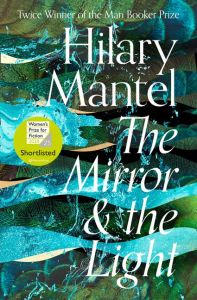
‘The Mirror and the Light’ by Hilary Mantel

Mantel_mirror_light

2020 875 p.

What does one say at the end of this almost 900 page conclusion to a trilogy? Just as I felt at the end of reading War and Peace, how could it be fair to turn to another fiction book straight away?

I purchased this book when I realized that the coronavirus lockdown was going to extend for weeks, if not months. I had intended reading it straight away, having already read (and loved) Wolf Hall and Bring Up the Bodies, but for the first weeks of the lockdown I felt too unsettled. Now that the doors are being opened again, and life is starting to resemble pre-coronavirus reality again, I realized that I might not have such an encumbered expanse of time to throw myself into such a long book and so I opened it up….

I must confess that I did find it hard to get back into, in spite of its compelling opening pages. That distinctive present-tense narrative viewpoint from a perch on Thomas Cromwell’s shoulder takes you immediately back to the earlier books but it still took me some time to get used to the “He, Cromwell,…” construction again. By 100 pages in, though, I was hooked again and found myself sitting up in bed at 1.30 to finish the last pages. How did Mantel manage to do this? After all, we all know how the story ends, and her fidelity to the history precludes any post-modern trickery at the end. You just know, through the consistency across all three books, that this is a carefully researched book and yet, with the exception of the occasional recitation of lists of food, Mantel does not labour its accuracy or parade her research.

While Bring Up the Bodies dealt with only a nine-month period, this book spans May 1536 to July 1540, starting Anne Boleyn’s beheading and Henry’s marriage to Jane Seymour and ending with Thomas Cromwell’s imprisonment in the Tower, facing execution. There were quite a few flashbacks, especially to Wolf Hall, in this book. I’m not sure whether that was to reinforce the unity between the three books, and to draw the narrative arc more strongly, or whether perhaps it reflected the tendency we (well, I, anyway) have with age to look to past events and now-absent people as a way of connecting where I am right now with the experience of getting here.

You look back into your past and say, is this story mine; this land? Is that flitting figure mine, that shape easing itself through alleys, evader of the curfew, fugitive from the day? Is this my life, or my neighbor’s conflated with mine, or a life I have dreamed and prayed for…

Within the constraints of the historic record, I loved the way that she laid out the narrative points so carefully. The trilogy starts and ends with the kicking he received from his father: this particular book starts and ends with a beheading. Very skillfully, she foreshadows the wives that are to come, after Thomas’ death.

Even though it could not have been her intention (given that she started on this project 15 years ago) I found myself drawing parallels with current day events. The acolytes of the  mercurial, prickly clown in the White House would need every one of Cromwell’s skills of soothing, distracting and evading- and, as we have seen, many of them have been sacked when they failed. Dominic Cummings in UK could be perceived as Boris’ Cromwell: seen as too powerful by an elite disgruntled at his power who want him removed.

In Mantel’s unreservedly sympathetic rendering of Cromwell, the few places where he actually voiced his ambition to take over as vice-regent came as a shock to me. More dismaying was the clear maneuvering of the noble families against him, the betrayal of one of his closest associates and the manipulation of events that you had read about previously to be used against him. I felt sick with dread at the thought of torture, and the interplay between him and his inquisitors is deft.

I listened to a podcast where actors read excerpts from all three books. It made me regret that I always read silently without subvocalizing, and therefore missed out on hearing the beauty of Mantel’s language. I’m not a great audiobook fan, but if you had the long stretch of hours required to devote to it, this would be a beautiful book to have read aloud to you.

So, is it going to win the Booker Prize again? I really don’t know how you could go past the beautifully crafted language, the distinctive “He, Cromwell” voice,  and the depth of research. Many writers have written of Henry and his six wives, but by shifting her gaze to the side, Mantel has brought us a new Henry and fleshed out and made human that square, dour figure at his side.

My rating: a big fat 10

Sourced from: Eltham Bookshop.

Six Degrees of Separation: from What I Loved to….

It’s the first Saturday of the month, and so it’s Six Degrees of Separation day. To find out more about this meme, check out Books are My Favourite and Best where all will be explained.

what-i-lovedSo, the starting book is Siri Husdvedt’s What I Loved. I could have sworn that I have read this book, but I have no record of it at all, and when I read the synopsis it doesn’t sound familiar either. But I gather that it starts off with an art historian and a painting, so that leads me to….


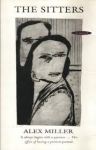
sittersAlex Miller’s The Sitters which is about an aging portrait painter and his young portrait subject, a visiting academic. It’s only a small book, and like much of Miller’s work, it has layers under its apparent simplicity. Talking about sitting for a portrait leads me to…..


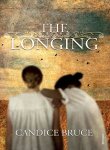
thelongingCandace Bruce’s The Longing, which has a dual narrative: one set in the mid 19th century where a young indigenous woman working as a domestic servant in one of those large Western Districts homesteads, observes her mistress’ infatuation with a visiting portrait painter, and a second narrative where 150 years later an art historian visits the same homestead to make a significance assessment of a portrait kept by the family in their now-decayed mansion.  That Western Districts of Victoria setting takes me to….

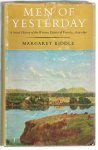
kiddle_menofyesterdayMargaret Kiddle’s Men of Yesterday: A social history of the Western District 1834-1890. This book, written in 1961, is written by a daughter of the Western District herself, celebrating the white settlement of western Victoria. Its reverence for ‘settlement’  and ancestral pride, without considering the theft of indigenous lands, does not sit well today but it is beautifully written by a young historian who died before it was published. Another historian who discovered Margaret Kiddle’s work was Maggie Mackellar, who used it in writing her own work on Western Districts squatter Niel Black. I haven’t read that work, but I did read Maggie Mackellar’s memoir which led me to….

Whenitrains

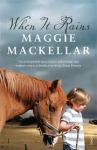
When it Rains, Maggie’s memoir of packing up after a family tragedy to return to her grandparent’s property in outback New South Wales. She steps into small town life, while continuing to write through her grief, which she expresses as a series of short chapters, acting as a voyeur in her own life, circling around the pain. The isolation of pain and grief leads me to….

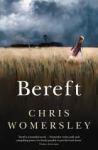
bereftChris Womersley’s Bereft, set during the influenza epidemic of 1919, when Quinn Walker returns from the Western Front of WWI to his childhood home. There is no grand home-coming for him because he had fled his hometown ten  years earlier, when he was accused of a rape, and had been reported dead on the front.. Realizing that his mother is very sick with influenza, he approaches the house when his father is absent, and speakers with his mother, who thinks she is hallucinating. The setting of the book during Australia’s influenza epidemic leads me to….

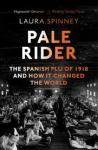
Spinney_paleriderLaura Spinney’s Pale Rider: The Spanish Flu of 1918 and how it changed the world  is  a global account of the influenza pandemic that reached Australia in 1919. It is well researched and fascinating. She focuses on the disease, its manifestations and the scientific response, but she also interweaves this with a consciousness of how the experience of suffering and recovering from the flu leached out into music and literature in the succeeding decade.

How odd. I seem to have spent quite a bit of time in Australian literature this time, with only my book-end books set internationally.


I hear with my little ear: Podcasts 17-24 June

Heather Cox Richardson continues on with her Facebook chats, although now they are on her You Tube Channel as well. On her History Channel, she is now talking about the History of the Republican Party, which she knows well because she wrote To Make Men Free: A History of the Republican Party in 2014, after a number of earlier books dealing with the Republican Party. In Part I she focuses on Abraham Lincoln. What a fascinating life! I guess that Americans just grow up with all this, but I knew nothing about his early life.

In her History and Politics Chat on June 16th dealt (at rather excessive length, I thought) on the history of taxation and whether Republicans or Democrats are responsible for increasing taxes. She points out that during Eisenhower (Republican), top bracket taxation was 95%! She then went on with a really interesting response to why all those Confederate statues were erected between the 1890s-1920s (an expression of white supremacy, she argues) and how to view any statue. She finishes off with the question of voter suppression and whether anything can be done to stop if (yes, she says, if Americans have the will to do so).

Talking Politics: History of Ideas is a program produced in conjunction with the London Review of Books, so it’s rather earnest and demanding. David Runciman (who I discovered on Start the Week last week) starts off the series with Thomas Hobbes 1651 book Leviathan, the book that Runciman feels began the modern state, written in the midst of the English Civil War. I’d heard of his description of life being ‘nasty, brutish and short’, but I didn’t realize that he was talking about life before men agreed to have one person (the sovereign, the government) to have complete authority so that they wouldn’t fight amongst themselves. Demanding, but interesting.

Nothing on TV. This is such a fun series. Robyn Annear (of Bearbrass fame) has used the quirky stories that can be found in the National Library of Australia’s TROVE newspaper collection as the basis for this fantastic podcast. It’s very fitting that she starts and finishes her podcast with the ‘pop’ of a wine cork, because Episode 4 Champagne and Anarchy is about the first Governor General of Australia, Lord Hopetoun and his curious friendship with anarchist ‘Chummy’ Fleming. Bound back ‘home’ for London, Lord Hopetoun decided to provide 100 pounds and 300 bottles of champagne for the unemployed of Melbourne to celebrate the crowning of Edward VII in June 1902. He handed the arrangements over to Chummy Fleming, who distributed the largesse over two days from his small bootmaker’s shop in Argyle Place Carlton. Really good- listen to it!

History Workshop. This episode Populism, the Left and progressive resistance dates from May 28, 2019 and I thought that it might have been overtaken by events and no longer worth listening to. Not true – D.D. Guttenplan is a journalist and historian, and in this podcast, he talks about the long, often subterranean thread of progressive politics. In this podcast, he mentions the presence at demonstrations of many grey-headed people who are there for every protest (something I have noticed too, as one of the grey-headed people. I was so pleased to see young people at the Black Lives Matter protests when we grey-heads were too frightened of COVID to attend). He talks about populism as a feeling of loss, and something that can be harnessed by the left as well as the right, and something can be beneficial as well as dangerous.


‘Friends and Rivals’ by Brenda Niall

Niall_friends_rivals

2020, 288 p.

In her most recent book Friends and Rivals, Brenda Niall has gone almost full circle. One of her early books was Seven Little Billabongs: The World of Ethel Turner and Mary Grant Bruce, published in 1979 and here she is, some forty years later with another group biography, this time linking “four great Australian writers”: Ethel Turner, Barbara Baynton, Henry Handel Richardson and Nettie Palmer. This book is more a quartet of essays rather than one integrated study. Indeed, it might be more appropriate to speak of two twinned biographies, as she was able to pinpoint a documented link between Turner and Baynton,  and likewise between Richardson and Palmer in a literary quest of degrees-of-separation.

I have come across three of these writers over my lifetime. We did not have a lot of books in our house, but my mother did give me three books from her childhood. One of them was the 1935 Children’s Treasure House, a book of 768 pages on very thin paper, full of English stories and full-length fairy stories, with beautiful Art Deco black-and-white illustrations and colour plates.  In Australia, the rights were reserved by the Australian Women’s Weekly and it cost 5/- plus 1/- postage to buy a copy. I still have the one my mother owned.

The other books she gave me were her copies of  Family at Misrule and Flower O’ the Pine– long since gone (unfortunately, because they were first editions I see, although of no great value).  These were both written by Ethel Turner, and I loved them. I borrowed Seven Little Australians from the library as well, and I can remember being heartbroken when Judy died.  I was never a Billabong girl- only ever Ethel Turner.

In contrast, I only encountered Barbara Baynton’s Bush Studies three years ago (my review here) and the stories are still etched in my mind, so different were they from the Bulletin/Lawson/Paterson nationalist bush stories of the turn of the twentieth century.  Elizabeth Webby’s introduction to the 1999 edition  really piqued my interest in this shape-shifting woman, whose final presentation of self was more fictional than her work was.

I read The Getting of Wisdom as a teenager, but was deterred from ever embarking on The Fortunes of Richard Mahony by a friend at the time who was made to read it at school (interestingly, she went to PLC – perhaps the school had forgiven HHR by then). She warned me that it was the most boring book ever written and to be avoided like the plague. I took her at her word, and did not read it until the summer of 2008, down at the beach. I just loved it, and it’s right up there on my list of favourite Australian novels.

Nettie Palmer I have only ever encountered as part of the two-for-one partnership of “Vance-and-Nettie-Palmer”, public intellectuals and champions of Australian literature. But I have encountered her often, through my interest in her uncle Henry Bourne Higgins, whose biography she was commissioned to write, and I’ve wanted to know more about her. In fact, it was Niall’s study of her that led me to read this book.

The book starts with an introduction ‘Women’s Work’, which I found a little lacklustre. The introduction didn’t explain why she chose these four women in particular (rather than others), because, as she points out, they did not make up a group, as such.

The lives of Turner and Baynton, Richardson and Palmer criss-crossed one another from the 1890s through the Federation period to the late 1920s. Their writing careers differ widely, as does the quality of their work. The writer of children’s books, the short story writer and the novelist, all were doing something new, as was Nettie Palmer, literary journalist and public intellectual. Their achievements, against the odds, were substantial and surprising. They didn’t make up a group; there were no groups for them to join. How did they do it?Each life story illuminates the others. (p. 10)

However, there were themes that arose her analysis of all four women. One such theme was that of reinvention. Ethel Turner was evasive about her childhood and parentage. There has never been documentary evidence of the man who was named as her father on her birth certificate, and she took the name of her stepfather, Henry Turner, a 39 year old widower with four sons and two daughters. Her mother had falsified both her own age, and the ages of her children. When Turner died her mother remarried quickly to Charles Cope, a bachelor ten years younger than her mother, and he was to take an unhealthy interest in his step-daughters. Niall observed that “Turner was strangely tolerant; it is as if she was blinkered to the sexual desire that he so plainly felt for her” (p. 35)

Barbara Baynton was even more evasive about her own history, giving her own family a completely fictional account of a Captain Robert Kilpatrick, who seduced Penelope Ewart away from her husband, and finally married her just before Barbara’s birth, thus rescuing her from illegitimacy.  No trace of this Captain Kilpatrick has been found. Instead, her father was a bush carpenter, and Barbara and her six siblings were all illegitimate, although her parents married later. She became a governess to the Frater family, close to Scone in NSW, and married her employer’s eldest son – shades here of My Brilliant Career. Her husband, however was a “shiftless, neglectful and unfaithful husband” (p.86) and she initiated divorce proceedings against her husband. She found security with her second marriage, to the elderly, wealthy Dr Thomas Baynton. Educated by her husband into the appreciation of furniture and porcelain, she took her place within Sydney social circles. When he died  in 1904, just after the publication of Bush Studies, he left her a substantial estate which she had a free hand in administering. She moved to London, and after WWI married Baron Headley, an eccentric peer but this was an unhappy marriage. When they divorced, she retained her title, and still had her money, and returned to Australia.

Henry Handel Richardson did not try to hide her background- indeed, she mined it heavily for The Fortunes of Richard Mahony, but she did manipulate her name. Ethel Richardson adopted the name ‘Henry Handel Richardson’ with the publication of her first novel, Maurice Guest as a sort of game – would anyone detect it as a woman’s work? Although married to the scholar J. G. Robertson, no one was allowed to call her Mrs Robertson, going by ‘HHR’ and ‘Henry’ amongst family and friends.

Nettie Palmer was probably the most straight-forward of them all, with an open and uncomplicated liberal Melbourne upbringing. She happily took her husband’s name, and was happy to be known in tandem with him.

When it came to publication, the three writers turned their eyes to British publishing houses, as was common at that time. Ethel Turner was probably the most put-upon amongst the three, with her publishers demanding a Christmas book each year, setting her up in competition with Mary Grant Bruce, and changing the endings and pruning the plots so as not to alienate a Sunday School prize market.

Baynton was already in England when she started looking to publish the short stories she had written back in Sydney, but even with her husband’s position in society, she could not find a publisher. Then, in keeping with her already fantastical life, she had the fairy-tale luck to be rescued from the slush pile at Duckworth’s publishing company through Edward Garnett (husband of the famous translator Constant Garnett), who had also discovered Joseph Conrad, John Galsworthy and D. H. Lawrence.  However, after this start, she struggled with her novel Human Toll, which received a few respectful reviews among mainly lukewarm ones.

Henry Handel Richardson began her first novel Maurice Guest while living in Strasbourg, and The Getting of Wisdom was also written and published overseas. Her husband took charge of most of the business side of publication, and was willing to pay for the publication of the third part of the Richard Mahony trilogy himself, when Heinemann rejected it. That volume,  ended up Ultima Thume being received with acclaim.

Most of Nettie’s work in reviewing books appeared in Australian newspapers and her survey of Australian writing in Modern Australian Literature 1900-1923  was published in Melbourne. She did, however, have a London publisher for her first book of poems The South Wind, followed by a second book of poetry in Shadowy Paths also published in London.

Another theme that comes through the essays is that of patronage and support. Both Barbara Baynton and Henry Handel Richardson had husbands whose interest and connections (and in Baynton’s case, money) supported their writing. Niall suggests that J.G. Robertson sacrificed his academic career for HHR’s writing success, and the incorporation of a young woman Olga Roncoronis into their household further left space for HHR’s own writing – (Niall leaves open the question of a sexual attraction between the two women). With Nettie Palmer, the tables were turned, with her assiduous promotion of her husband Vance’s work within literacy circles – a devotion which Niall feels to have detracted from her own career as critic.

A biography, if it is to be more than a chronology of facts and actions, is an argument or judgment, based on a reading of documents, conversations and actions. These are not necessarily accepted on their face value: sometimes they are ‘read against’ or set up in opposition to one another.  Especially when dealing with writers, there are not only the writer’s own works, and sometimes an autobiography written with varying degrees of deprecation or self-regard, but often there is also a body of correspondence with other writers, who in turn write to other writers. The retention of such correspondence is sometimes a matter of chance, at other times the target of ruthless culling or assiduous gate-keeping either by the author herself or her literary executors. For good or ill, these remaining letters are mined by biographers, giving them a life and significance far beyond the original intent.

The crafting of a biography as an argument is particularly apparent in a multi-essay volume like this one, where the same author deals with multiple and interlinked characters. Niall’s reading of Henry Handel Richardson is censorious, while she clearly admires Nettie Palmer and feels that she has not been sufficiently recognized as part of the Vance-and-Nettie-Palmer partnership. In dealing with Ethel Turner, she also examines the British-dominated publication culture of the day, and with Barbara Baynton she finds a paradox, interlaced with reinvention.  New material is always being uncovered, additional links discovered, and historical ‘turns’ invite historians and biographers to stand in a different place to re-evaluate their subjects. That is why there are no definitive biographies.

I admire Brenda Niall as a biographer. She is deft and efficient, and attuned to the nuances of relationships.  She paints a broad canvas for her subjects, but also hones in on details that give definition to her subjects, helping you understand why this particular person was distinctive.  That said, I was somewhat startled by the abrupt ending of this volume. In fact,  I felt a little short-changed by both the introduction and the absence of a conclusion. While I know that her focus is on her four subjects, I found myself wishing that Brenda Niall herself had come back on stage to draw out further the contrasts and commonalities in these four lives.

Sourced from: Yarra Plenty Regional Library

My rating: 8/10

aww2020

I have included this as part of the Australian Womens Writers Challenge 2020

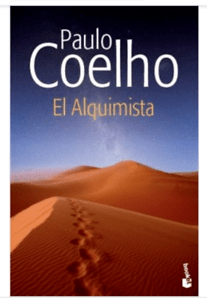
‘El Alquimista’ por Paulo Coelho

el_alquimista

1988, 177 p.

Yes, it’s The Alchemist, but it’s in Spanish, translated from the Portuguese by Montserrat Mila. I read this as part of my Spanishland course, so it’s at Intermediate level. For such a small book, it took quite a while to read.

The book is an allegorical tale about a young  Andalusian shepherd called Santiago (but often referred to as ‘the boy’) who sells his sheep after dreaming twice of finding treasure at the Pyramids. It’s a quest tale as he gets robbed repeatedly, meets people who further him on his journey, and finally ends up crossing the desert with the Alchemist, who gives him wise advice. Does he find his treasure?- well, you’ll have to read it yourself, in whatever language.

I must confess that the book was too new-agey and self-affirmational for me. It’s in the same genre as Jonathan Livingstone Seagull and those “wish for it and you’ll get it” type books.

But even in a language with which I am not particularly fluent, I could recognize that this was beautifully written, especially in its descriptions of the desert and in its telling of  falling in love with Fatima, the love of his life. Like most allegorical tales, it is simply told but it is not a children’s book at all.