The first Saturday of each month -and its attendant Six Degrees of Separation- seems to come round so quickly! The instructions for this meme can be found on Kate’s Books are My Favourite and Best blog, but essentially Kate chooses the starting title, and then you link six books that you associate with that title. As usual, I haven’t read the starting book Rachel Cusk’s Second Place and I know nothing about it. So going purely on the title, my reviews are of books with a number in the title.
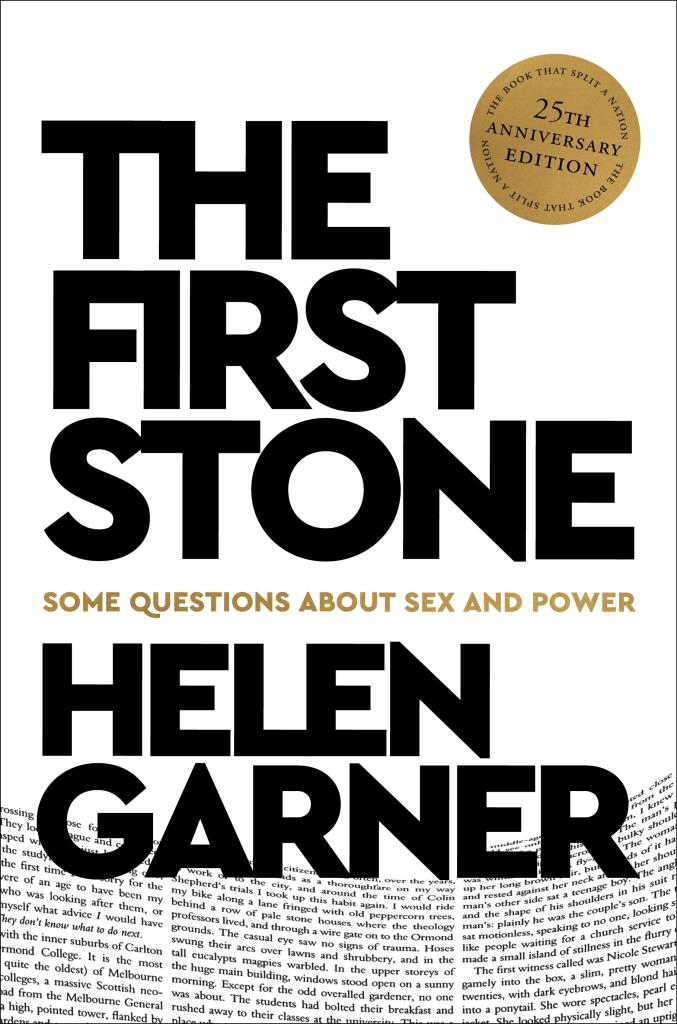
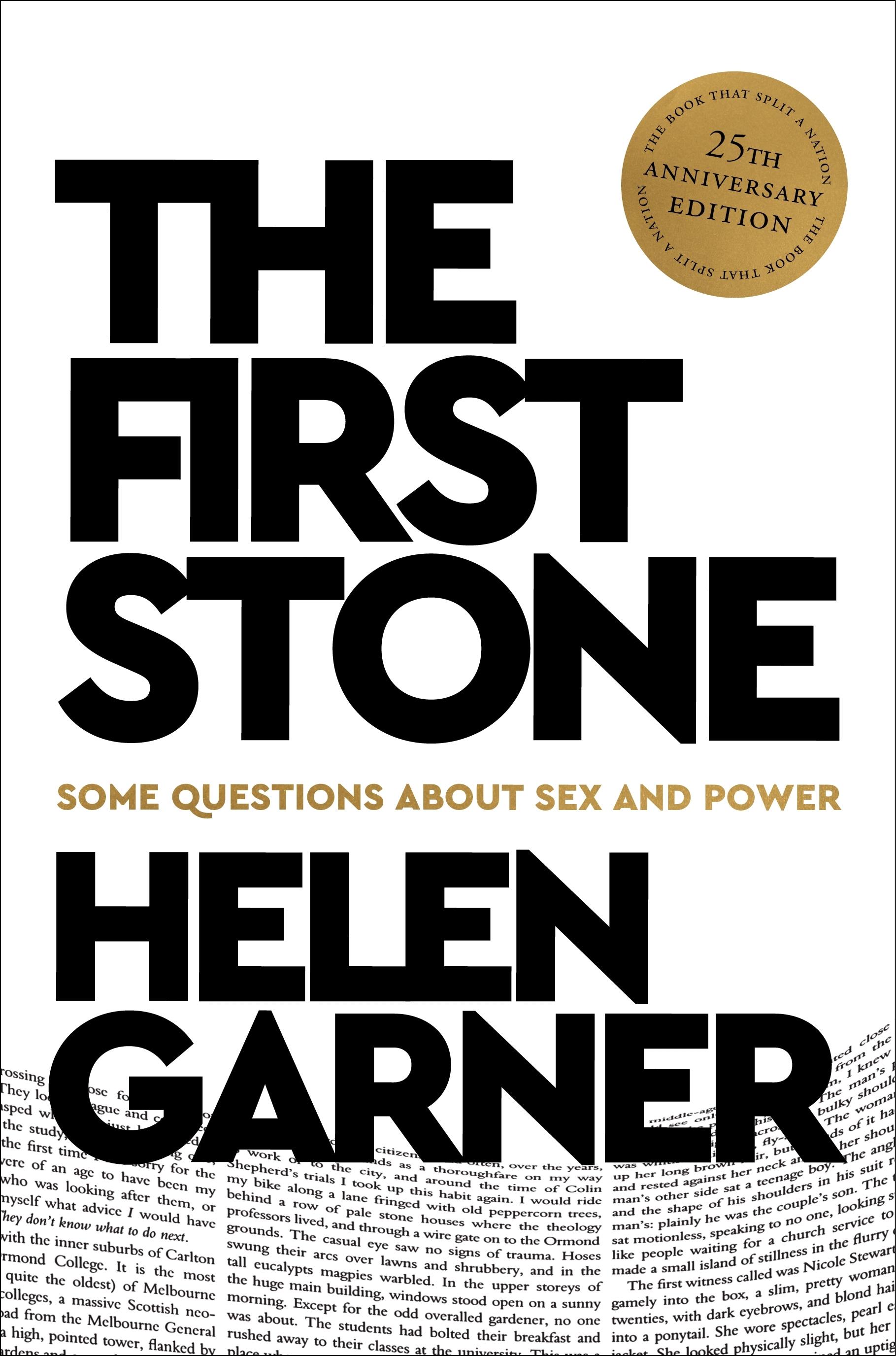
I recently re-read Helen Garner’s The First Stone which has been reissued to mark its 25th Anniversary. Garner’s defence of the Master of Ormond College is uncomfortable today and in that regard, the book has dated badly. But the questions of proportionality, agency/victimhood, generational change, the law, class and feminism are just as pertinent – if not more pertinent- today.
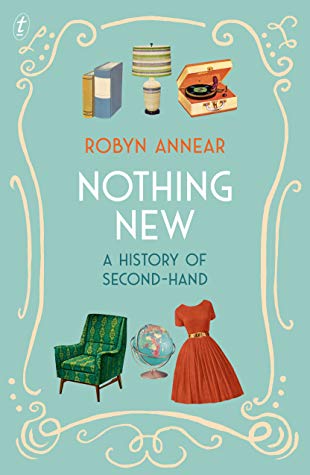
I absolutely love Robyn Annear’s podcast, drawn from articles found in the NLA’s wonderful Trove newspaper database. (You can find it at Nothing on TV) But she has a recent book out as well, called Nothing New: A History of Second Hand. It takes a historical look at second-hand clothing, going right up through opportunity shops and the current Third World clothing trade.
I read Jared Diamond’s The Rise and Fall of the Third Chimpanzee before I started my blog. This was the first of his “big” points, and he picked up on many of the ideas he raised here in his later Guns, Germs and Steel and Collapse. He shows his humour here more than in his other books, and he certainly is a man of broad learning and experience.
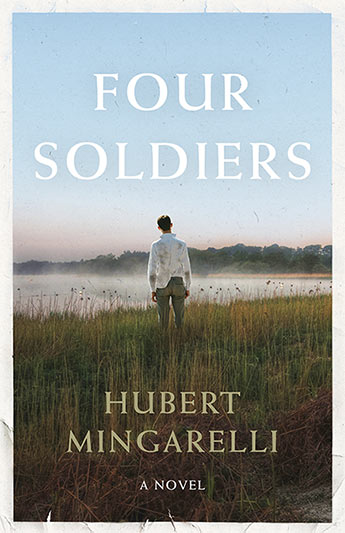
Hubert Mingarelli’s Four Soldiers is only a small book at 155 pages. It is set in the Russian Civil War with four soldiers – Benia, Pavel, Kyabine and Sifra- who are turned out from their regiment to fend for themselves until the weather improves and the fighting commences again. They establish a camp near a lake. Here they live day-by-day, a quiet self-contained peaceful existence in the midst of war, with the prospect of returning to battle hanging over them.
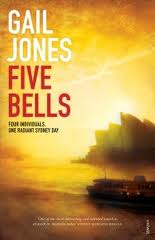
Gail Jones’ Five Bells is set on one summer Saturday, around Circular Quay as four people converge there from somewhere else, and the narrative swings from one character to another, in a sequence, not unlike the chiming of bells. It is very carefully written with almost every phrase and image carefully burnished.
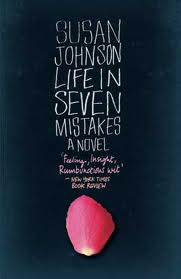
I can’t find one for ‘six’ so I’ll jump ahead to Susan Johnson’s Life in Seven Mistakes. There are two intertwined narratives in the book. The first, written in the present tense, is told from the perspective of Elizabeth, a middle-aged ceramicist on the verge of her first international exhibition. The other narrative strand takes Elizabeth’s parents as they meet in the 1950s, begin courting, marry, have children, become increasingly affluent. Both narrative threads were strong and well-made, and I didn’t find myself regretting when I turned the page to find that the narrative was about to switch again. The dialogue was particularly good, and the author obviously has a sharp, observant eye. The ending had an emotional authenticity, at least for this middle-aged reader.
So there you have it- six books that some how added up to the number ‘seven’. I never was good with figures.
History of Rome Mike Duncan, the narrator of this series wanted to take advantage of the week before Christmas to talk about the co-option of Saturnalia by the newly converted Constantine in Episode 18 The History of Rome Christmas. Hah! He probably thought that he would be finished before the next Christmas – instead it took him three and a half more years! Christmas over, he launched into the Punic Wars. In Episode 19 Prelude to the First Punic War he explains that if we were consistent, we would be calling them ‘The Carthagenian Wars’ because they were waged against Carthage (near present-day Tunis in Africa) and the term ‘Punic’ refers to the Phoenician origins of the Carthagenians. He explains that Carthage only kept a mercenary army, unlike Rome, where serving in the Army was the highest form of service. Also, Carthage was an oligarchy based solely on wealth – if you became rich, you had access to power and privilege; if you lost your money you were not. The wars mainly took place in Sicily. Episode 20a First Punic War explains that, flushed with success, the Romans were not averse to expanding their territory further. However, they were inveigled into being involved in Sicily by the Mamertines, a group of Italian mercenaries who asked for their help. This first Punic War was a stuff-up on both sides because of poor decisions by both Carthagenian and Roman generals. In Episode 20b First Punic War, the Romans took advantage of a shipwrecked Carthagenian ship, pulled it apart to see how it worked, and then promptly built their first naval fleet (up until now they had been a terrestrial, but not naval force). They decided to invade Carthage in 256BC. The Romans were the more powerful force, so the Carthagenians sued for peace, but The Roman commander, Gaius Atilius Regulus demanded such harsh terms that the Carthagenians decided to fight on. They enlisted the help of the Spartan commander Xanthippus, who led the Carthagenians in battle and the Romans retreated, then their ships sank in a storm on the way home. Episode 21 Interbellum looks at the time between the 1st and the 2nd Punic Wars. Carthage made the mistake of not paying the mercenaries who fought for them, and got caught up with fighting their own soldiers. Rome, meanwhile, not content with having the whole of the ‘boot’ of Italy, decided to go after the Gauls for something to do.
Then follows a succession of episodes about the Second Punic War. Episode 22 Prelude to the Second Punic War makes the point that this was the closest the Romans came to destruction until 500 years later. It was also the end of the ideal of Roman frugality, virtue and nobility, replaced by excessive debauchery. The episode introduces 25 year old Hannibal, who took over after his father died. Episode 23a The War with Hannibal starts off for Rome from Spain on his 17 year war, marching on a 15-day crossing through the Alps with 50,000 men and his elephants. He had a crushing victory over the Romans at Lake Trasimine, and realized that you didn’t have to out-fight the Romans, you just had to out-think them. Episode 23b The War with Hannibal, Hannibal reaches the high point of his career with the Battle of Cannae but he doesn’t actually march on Rome- things might have been very different if he had. In Episode 23c The War with Hannibal the Romans didn’t lose heart, but the Senate and the elites did seize more control. So many young men had died in battle, that there was a turnover in leadership, based on merit rather than blood. The Romans even bought slaves from their wealthy citizens and enrolled them in the army. The fighting turned to Sicily. Hannibal negotiated with the nobles of Syracruse on (Roman controlled) Sicily to come over to the Carthage side. Archimedes of Syracruse contributed inventions to assist the Carthaginians, but the Romans were victorious, and Archimedes was killed in the looting that followed. In Episode 23d the tables had been turned, with the appointment of the 25 year old Publius Cornelius Scipio (later known as Scipio Africanus), who Mike Duncan describes as a mixture of Jim Morrison, Alexander the Great and Jesus. He detours into the First Macedonian War, but then returns to Spain. Scipio , taking a leaf out of Hannibal’s book, outsmarted the Carthaginians, by creeping up behind them, and swapping the composition of his fighting lines. The tide has turned. Episode 23e The War with Hannibal sees Hannibal’s brother Hasdrubal trying to join forces with Hannibal to create a super-Carthaginian army to invade Rome, but Hasdrubal was defeated at Battle of the Metaurus. Meanwhile, Scipio invaded Carthage itself and finally defeated Hannibal (who had been recalled from Italy) at the Battle of Zama. The Romans imposed very harsh punitive damages on Carthage. Scipio had brought about the idea of the ‘great man’ which would drive Roman politics in the future.
In Our Time (BBC) I guess that podcasts about classical history don’t date! This podcast from 2012 Hannibal features three historians from the Classics departments of various British universities. After Mike Duncan’s relentless emphasis on individual battles, it was good to get this sweeping view of Hannibal’s life. Apparently the elephants weren’t the big African ones, but smaller forest elephants. And he came to a rather sad end- he fled into voluntary exile, and after being handed over to the Romans he poisoned himself to avoid the Romans getting him in the end.
Heather Cox Richardson I’ve been so caught up in Rome that I didn’t finish listening to her series of indigenous history. So I return to 18 June where she backtracks a bit to give the context for the creation of the Indian Schools. She starts off by noting that often bad things start from good intentions, and then goes on to talk about the way that originally ‘care’ of the Native American people was contested between the Dept of the Interior and the Dept of War. Indian Agents were set up to distribute food as part of the treaty arrangements, but it was a pretty corrupt system. When Ulysses S. Grant came in, he decided to put ‘care’ into the hands of the church instead, as a way of solving the tussle between the two bureaucracies. The intention was to deliver ‘care and Christianity’. Meanwhile the Comanche and Apaches were conducting their war against the settlers, and so Civil War veteran Richard Henry Pratt gets the job of guarding the prisoners in Fort Marion and he starts giving them some good old military discipline and Christianity. This is going to lead to the Carlisle Indian Industrial School. Actually, she goes off in lots of tangents in this one- I found it a bit hard to follow because I don’t know my Native American Tribes and geography very well.
Rear Vision (ABC). This episode was only four days old when I listened to it, and it was already out of date. Who are the Taliban? was recorded before the fall of Kabul, when a shared Taliban/Afghan govt was still a possibility, with the alternative of civil war. It gives the history of the Taliban, particularly its links with Pakistan and Pashtun nationalism. I’ve gotta say though- surely with the sound manipulation technology we have today, telephone interviews could be cleaned up so that they don’t sound as if they are coming from another planet- even when the female interviewee has that infuriating vocal fry.
History Hit While I’m in the mood for Afghanistan, I listened to Dan Snow’s History Hit podcast where he interviewed William Dalrymple in Afghanistan: History Repeating Itself. Dalrymple (who wrote The Anarchy about the East India Company – see my review here) talks about the first Anglo-Afghan War which ended in 1842 with the crushing defeat of the British forces. The British had been inveigled into placing a puppet ruler in Kabul by the East Indian Company claiming that Russia was going to invade (fake news) and when the Afghans attacked, only one man escaped. Dalrymple also talks about his own personal encounters with Hamid Karzai (who, believe it or not, is a direct descendent of the puppet leader in 1842 and for whom Dalrymple has quite a bit of admiration) and Ashraf Ghani (who Dalrymple thinks became too Westernized).
Offtrack. I hate mice. I remember about 20 years ago I went with a friend and her husband and all our kids up to a farmhouse for Easter. We didn’t mention to the kids that the place was over-run with mice: scuttling round the rooms, in their beds under the doonas- horrific. In Going home to a mice plague, reporter Rowdie Walden goes home for the last time to the family farm in regional NSW. His family- his mother in particular- just can’t stand the mice anymore, and they’re moving into town.
I read in the newspaper this morning that Donna Merwick (1932-2021) has died. Donna Merwick was an American-born historian who worked as a Lecturer in History at the University of Melbourne between 1968 and 1995. She entered the Order of the Sisters of Charity of the Blessed Virgin Mary in 1953, and completed her M.A. and Ph.D as a sister until leaving the order in 1968 to take up her position at the University of Melbourne. She is known as one of the members of the ‘Melbourne School’ of history comprising her husband Greg Dening (a former priest), and La Trobe University historians Rhys Isaac and Inga Clendinnen, although in an interview in The Australasian Journal of American Studies published in Vol. 34 No.1 (July 2015), she questions the idea that there was ever such a ‘school’. It’s an interesting interview, combining personal and professional academic considerations (albeit referring to academics of the 1970s and 1980s in a very different academic environment) and is available through JSTOR at State Libraries. She has an entry in the online Encyclopedia of Women and Leadership in Twentieth Century Australia. While I could never in any way hope to emulate it, the history writing of this ‘Melbourne School’ (her skepticism about its existence notwithstanding) has been a huge influence on the way I read and appreciate history.
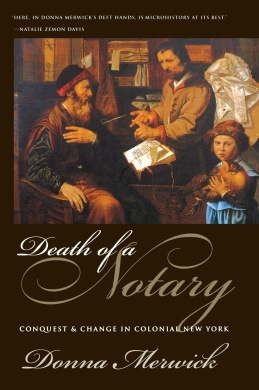
I read her Death of a Notary back in 2008, before I started this blog, and so I dug out my reading journal to see how I responded to it then. I was obviously mightily impressed. Reading it now, what I like is that in prefiguring some of the current trends in history writing of imagination and extrapolation from other sources (particularly in books written for a wider, popular rather than academic audience), she justifies and delineates where the sources start and finish, revealing her thinking as a historian. Here’s what I said at the time:
1999, 186 p. text and 51 p. ‘Notes and Reflections’
What a brilliant and original book! It is in effect two books. The first is a conversational, present tense, rather speculative narrative that pieces together the small documentary fragments that refer to Janse, the Dutch-speaking notary in Albany, who commits suicide in the late 17th century, a number of years after the English have taken possession of New Amsterdam. The British renamed it ‘New York’ and incorporated it into the British common law tradition, introducing the English language and British colonial bureaucracy. It is largely chronological, told in dated episodes, that change their focus from father to son, and from New Amsterdam to Amsterdam and then back to Albany again. She incorporates observations from parallel, but different experiences that have been documented to supplement where Janse’s record is silent, and she invents, drawing on this other data to give the narrative life and image.
In the second, ‘Notes and Reflection’ section, we see the historian with her hard-hat on. Every ‘invention’ in the first part is sourced and validated; every assumption is justified, and every source is credited. The sheer volume and perspiration is here for all to see in this second part with its more clinical and measured tone.
Brilliant.
My rating (then) 10/10
Sourced from: La Trobe University Library. I see that it is available online through the Internet Archive too, although I’m not sure how much of it you are able to access.
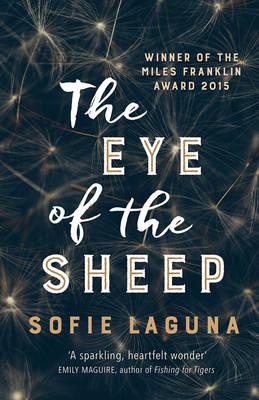
I’ve often noticed that, by chance, I read two books in a row that seem to ‘speak’ to each other, even though I had not selected them for that reason. This happened again on reading Sofie Laguna’s The Eye of the Sheep for my bookgroup, just after finishing Kazuo Ishiguro’s Klara and the Sun. At first glance, there may not be much of a link between a young boy growing up in Melbourne’s Altona in an unspecified time (1980s?) and a ‘smart’ mannequin marketed as an Artificial Friend for teenagers during another unspecified time in the future. What links them them is the narrator’s voice: flat, literal and yet crystal-sharp at the same time. Underlying their blinkered vision is a deep well of sadness and pain.
Author Sofie Laguna does not offer a diagnosis for Jimmy, but today we would probably say that he is “on the spectrum”. We meet him as a six-year old, obsessed with his instruction manuals for the household appliances, puzzled by other people, who he sees mechanistically as a series of ‘pipes’ and networks, linked by strings to other people. We see the world – his baffling, frustrating world- through his eyes, but it is not hard to imagine how he appeared from the other side to his teachers and other children. Here he is, when his teacher Mrs Stratham, knowing that he liked threes, asked him the answer to ‘three times thirty-three’.
The class went very quiet as they waited for me, the Detective of Threes, to solve the problem. I closed my eyes and saw more and more threes everywhere I looked. In every line of threes there was one other number- six, four, one, nine, seven, seven, one – but was the answer in the diagonal or the straight? Nobody in the class made a sound.
The threes kept coming. I couldn’t see beyond them; it was an infinity of threes. I went from still to running, with no time in between. I got off my seat and ran around the chairs and around Mrs Stratham’s desk and past the windows to the door and back again. “Three three three three!” I shouted, touching everything I could. The answer lay on the surfaces and every surface was a clue “Three, three, three”. The answer lay on the surfaces and every surface was a clue. “Three three three!”
Crash! The lizard’s aquarium shattered behind me. “Three, three, three!” I shouted.
p.75
Jimmy is frustrated at school, and home offers little respite. His mother, morbidly obese and asthmatic, smothers him with love. His father, who works at the nearby oil refinery, drinks too much Cutty Sark and abuses his wife: something that Jimmy and his older brother Robbie are powerless to stop, escaping into the flat grasslands behind their house or cowering in bed together at night until the violence stops. It is harrowing, and Jimmy responds in his own way:
Panic streamed through her and was transmitted to me. I ran from wall to wall, my cells spinning me around the rooms, one after the other. Hallway! Kitchen! Bedroom! Bathroom! Sitting room! Hallway! Nobody could stop me! …I was faster than the speed of light. I knew if it went on much longer I would disintegrate.
p.63
Jimmy is labelled as being “slow” and yet, he is too fast. He is not well-equipped for when his life spirals out of control, through no fault of his own. I found myself fearing for this child and I was spurred to keep reading to keep the story going so that he would be safe (yes, I know that’s illogical). I ended up in tears.
The real strength of this book, which won the Miles Franklin, is the power of the narrator’s voice, which doesn’t slip for a second. The author has disappeared completely behind this guileless yet perspicacious character, who becomes real: someone I cared and worried about enough to lie awake at night, thinking of him. Her book is an exploration of class and deprivation, but also love and fear, strength and weakness. It deserved its Miles Franklin Award.
My rating: 9.5/10
Read because: CAE bookgroup selection. (The other Ladies Who Say Ooooh (my daughter’s name for my Bookgroup) loved it too)
In 2015 Nobel Prize winning author Kazuo Ishiguro admitted in an interview with the Guardian that “I tend to write the same book over and over, or at least, I take the same subject I took last time out and refine it, or do a slightly different take on it.” I must admit that this is the way that I felt about his most recent book Klara and the Sun which seemed to be almost a companion novel to his 2005 Never Let Me Go.
Klara, the eponymous narrator of this novel is an AF – ‘artificial friend’ – a type of intelligent mannequin marketed at parents and children who want a trusted, safe ‘friend’ for the child. From her storefront window, basking in the warmth of the sun which replenishes her solar cells, Klara is observant as she watches the passing pedestrians and traffic while affecting a mannequin-like blankness. She is purchased for Josie, a young girl suffering from some unspecified illness. Josie has been ‘elevated’, a form of genetic engineering for intelligence, but now her mother is desperate that Josie, like her older sister Sal, is going to die. When she acquiesces to Josie’s urging to purchase Klara, we do not know why, although it becomes clearer as the book goes on.
As with Never Let Me Go, the narration is flat and just somewhat off-kilter. Klara can move, but her perception and observation is very much limited to what is immediately in front of her. She has no sense of smell, and her vision at times is broken into small screen-like boxes. We have no idea what she looks like, or what anyone else looks like for that matter. For some reason, I had assumed that it was set in England but it was only when ‘being English’ was seen as a distinguishing trait, that I began wondering where it really was set. Things are described with the eyes of the outsider: people look at their ‘oblongs’ (phones?) and just as Klara needs to piece together stimuli to make sense, so we too gradually understand what being ‘elevated’ involves, and Klara mother’s intentions for Klara and Josie.
I felt that the book was a bit heavy-handed in its treatment of ‘sacrifice’, a deity and miracles, which are superimposed over the limited worldview of Klara. Just the scenario of a deliberately constrained consciousness, and a body so utilitarian in its construction, is bleak and though-provoking in its own right. I found myself fearing for Klara, an emotion that she did not hold for herself. Like Cathy in Never Let Me Go, the real strength of this narrative voice is its emptiness, punctured by savage shards of awareness.
I think that my enjoyment of this book was heightened by having read Never Let Me Go, which as Ishiguro himself admitted, has a similar theme, with a slightly different take. They make two companion stories. In Never Let Me Go (which I think is the better book) we have the creation of the physical body for a purpose; here we have a consciousness awakened (but not allowed to develop) with the body itself immaterial. Other people have dealt with similar themes of course – I’m thinking here of the television series Humans – but being taken into the limited worldview of Karla, and Cathy from Never Let Me Go, gives both these novels added and memorable poignancy.
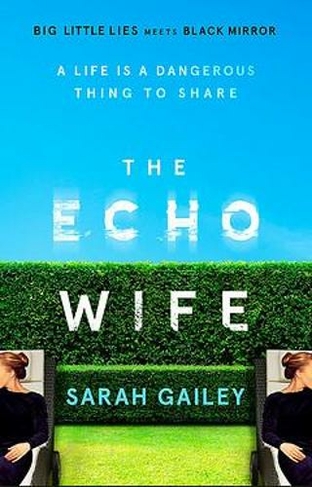
I’m not in the habit of getting book recommendations from the New Scientist, but when I saw this review, I thought that it sounded interesting. My library, which insists on putting genre labels on its books, describes it as a ‘thriller’, while the blurb on the front describes it as ‘Big Little Lies meets Black Mirror’. I guess that it is a mixture of all three, but I thought that it also raised questions about coercive control and domestic relationships not suggested by its marketing.
Evelyn Caldwell is an acclaimed developmental biologist, who is at the top of her field in adult cloning research. Her marriage, under strain for some time, has failed and her husband Nathan has left her for a younger, less driven woman happy to give him the children he craved. She had been aware of ‘the other woman’ for some time, but this was a more fundamental betrayal. Nathan had been using her own research in adult cloning to develop a copy of her, but less intelligent, more pliable, more maternal and less threatening.
And that’s probably as much as I will say, because I don’t want to give away the story, but suffice to say that it branches into murder and crime, as well as its science-fiction-y premise of adult cloning. Our narrator, Evelyn, is insensitive and unaware, and she has her own back story of a bullying father and a nervous, anxious mother – both of whom she resembles at all times, even though she consciously tries to avoid doing so.
One thing that did not strike me about the book was the New Scientist designation of it as “a comedic look at the risks of cloning”. I found little comedy in this book at all. It raises questions about identity, autonomy and coercive control, and I was not completely surprised to read the author’s lengthy ‘acknowledgments’ where past abuse is still very present.
This book is probably more commercially-marketed than I am accustomed to reading, it’s not high literature, and it is more plot-driven than I prefer. At times the plot strained credulity and the ending was far too neat. But for all that, I found it compelling and disturbing, with more depth than I expected.
The History of Rome Episode 10: Barbarians at the Gate deals with the sack of Rome by the Gauls in 390AD. The Gauls besieged the Roman army in the Citadel, and in the end they had to pay their way out. It was the last invasion on Roman territory for 850 years. Episode 11: The Morning After The Gauls trashed the city so much that there was serious consideration of deserting Rome and settling in Veii instead (it was, after all, only 12 miles away and though deserted, still in good condition) but they decided to rebuild instead. They rebuilt in a hurry so that, even though the towns that Rome built throughout their Empire were to a standardized template, Rome itself was a hodge-podge. The Plebes and Patricians were still sparring with each other. The Plebes, saddled with debt from the reconstruction, forced through reforms in 367 BC that finally gave them access to the most powerful office of state: the Consulship. Then in Episode 12: The First Samnite War we have the Romans winning an inconclusive victory in a war against one of the surrounding hill tribes, the Samnites, in 343-341 BC. No sooner had the dust settled, in Episode 13: The Latin War, they are lured into fighting their Latin neighbors from 340-338 BC. This time they won more convincingly, and the Latin League was abolished. Episode 14 is in two parts as he breaks off to talk about military strategy. In Episode 14a A Phalanx with Joints, he notes that under Romulus, Roman armies just plunged headlong into battle. Then they adopted the Phalanx, a Greek strategy which worked well when you were fighting another army that had phalanxes on flat ground. However, with the Samnites, they were fighting on steep rocky ground, and the Samnites were able to get round the side of the phalanx, so they had to find another way. Episode 14b A Phalanx with Joints, they invented the Maniple formation, where they had long lines of soldiers, three deep. At the front were the young, inexperienced soldiers, then behind them veterans, and in the third line the seasoned, long-time soldiers.
Those Samnites didn’t lie down, and sure enough there was a Second Samnite War (Episode 15a). The Romans did well at first, but then they were handed a humiliating defeat at Caudine Forks. The fighting stopped for five years, and Rome emerged victorious in 304 AD (Episode 15b). During that five year hiatus Appius Claudius embarked on an infrastructure building spree that resulted in the Appian Way and the first aqueduct the Aqua Appia (not beyond a bit of branding, our Appius). He came from a prominent patrician family, and served as censor, consul and dictator. Finally in Episode 16 The Third Samnite War, Rome took on the combined army of Samnites, Etruscans, Umbrians and Gauls. At Sentinum, the two sides fought the largest battle in Italian history up to that point. Once the Samnites and Etruscans were seen off, Rome turned its attention to the Greek city-states (Magna Graecia) on the Italian mainland. They appealed for help to Greece, and it came in the form of King Pyrrhus of Epirus. This was the first time that the Maniple faced a tradition Greek phalanx, and the first time that the Roman army encountered elephants in battle. Episode 17: Phyrric Victories goes through the various battles between Phyrrhus and the Roman army. Phyrrus won the battles, but decided that it wasn’t worth it and sailed home. In effect, all he did was show the Romans how to fight Greek-style.
Time for a video interlude I think. Episode 2 of the TV documentary the History of Rome (narrated by Peter Coyote) took me too far ahead, right up to Augustus. I only want to hang around in the 3rd century BC.
99% Invisible A lavishly illustrated cookbook, The Book of Tasty and Healthy Food was produced in 1939 by the Soviet government to develop a ‘Soviet’ cuisine as a unifying feature of Soviet nationalism, even though it bore very little resemblance to the food that was actually available. It was developed by Anastas Mikoyan, who Stalin had named to be the People’s Commissar of the Food Industry in the 1930s. He travelled to America to investigate their mass-food industry, and took advantage of the opportunity on his return to build factories that produced hamburgers, orange juice, canned food etc., naming many of the products after himself. The podcast finishes with an extract from another podcast describing the communal kitchens in Soviet Russia – no glossy photos there!
The Daily (New York Times) The Daily sometimes has a reading of articles that appear in the New York Times Magazine, as is the case with The Sunday Read: He Wants to Save Classics From Whiteness: Can The Field Survive? As you know, I’m churning my way through Mike Duncan’s History of Rome podcast series because I feel that there is something lacking in my knowledge of –what? history? the world? my culture? — through never having studied any Roman history at all. So it’s a good time to listen to this podcast about Dan-el Padilla Peralta, a Classics scholar himself from the Dominican Republic, who is really challenging the field of Classics over its links with White Supremacy. The podcast starts off with a conference in 2019, where after giving his presentation, Padilla Peralta was strongly challenged by an ‘independent scholar’ in the audience, Mary Frances Williams, who attacked him for his views and very directly in a personal sense- it must have been quite a conference. I found this podcast really interesting and challenging. I wonder how Mary Beard (my idol) responded to his views?
Travels Through Time. This podcast keeps adding to my list of TBR books. This time it features Colin Jones, talking about his recent book The Fall of Robespierre. In this episode The Fall of Maximilien Robespierre, Jones chooses 9 Thermidor, Year II in the Revolutionary Calendar (27-28 July 1794) when, after giving a speech in the Convention and then in the Jacobin Club, Robespierre goes home to sleep. The next day the Convention turns against him and he was captured and wounded by a gunshot that has never been entirely explained. By the following day he was beheaded.
Conversations(ABC) I’ve just finished reading Dale Kent’s The Best I Could Be (review coming soon). I was hoping that Richard Fidler would conduct this interview, but it was Sarah Kanowski who spent too much time on being regaled with anecdotes. It made me realize that I had read most of these in the book, and that they come over well as after-dinner-tales, which is pretty much how they did in the book too.
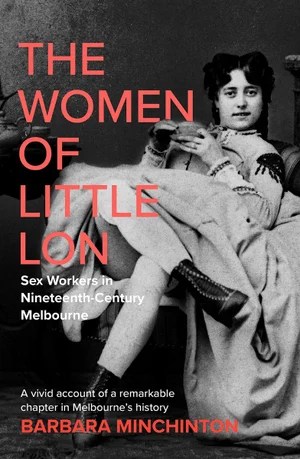
It was odd that I should be reading this book when the issue of prostitution re-emerged into the public discourse. First, the state of Victoria finally decided to decriminalize sex-work by the end of the year. Second, The Age published an article about The Men’s Gallery in Lonsdale Street being accused of facilitating prostitution and breaching liquor and planning guidelines. Concerns about breaching planning guidelines are a very 21st century concern, but the anxieties about prostitution and liquor, especially in Lonsdale Street (albeit at the other end) are highly pertinent to Barbara Minchinton’s lively, well-researched and eminently readable book about sex workers in ‘Little Lon’ during the 19th century.
As she points out in the author’s notes, the term ‘sex worker’ was not used at the time. In fact, the word ‘sex’ did not appear at all in the newspaper or court reports. Instead they were ‘common prostitutes’, ‘gay women’ or ‘streetwalkers’. As society became more censorious, they were ‘sly girls’ and ‘she traps’, and ‘unfortunate creatures’. Surprisingly, prostitution itself was not illegal in the 19th century. Women could be (and were) charged with ‘behaving in a riotous or indecent manner’ or ‘being drunk and disorderly’ but not prostitution or soliciting per se. The focus was on ‘disorderly’ behaviour, and there was a feeling that shutting down brothels in one area would only shift the problem elsewhere. This changed in 1891, and even more so in 1907 with amendments to the Police Offences Act, which made street soliciting, and then soliciting from windows and doors illegal, and outlawed profiting from prostitution. It may have destroyed the business of prostitution that existed in Little Lon for Melbourne’s first seventy years, but it did not eradicate the profession itself. (p.239)
Thanks to C. J. Dennis’ Songs of a Sentimental Bloke, ‘Little Lon’ became notorious as the site for gang violence, drunkenness and prostitution. However, as Minchinton points out through her informative maps, there was an equally notorious site in the block between Bourke Street and Little Bourke Street, bounded by Spring Street and Stephen Street (today Exhibition Street). In a city riddled with lanes and small cross streets that have been largely obliterated by large-scale development today, Romeo Lane, Juliet Terrace and Bilking Square were central to another sex work precinct, just opposite Parliament House, and close to the Eastern Market, the Haymarket Theatre and the Theatre Royal. She likens these precincts to a cake in layers. Streetworkers were on the bottom level, using parks, gardens and laneways as their workplace. Some of these workers were just starting out, and perhaps doing it for pocket money, while others were alcoholic, ill and destitute. The second layer comprised women working out of rented rooms or houses. Some of them doubled as bar-maids, some paid only for the time they used the bed or the room, while others lived in ‘short time’ houses, sometimes known as ‘cribs’. The ‘flash brothels’ were the icing on the cake: double storey houses, with domestic servants, extravagantly decorated with lavish dining and entertainment services. Men could stay for weeks at a time, and the “dressed girls” entertained them with singing, cards and dancing. (p. 23-26)
Minchinton captures well a whole economy, dominated by women, that had spin-offs in other, more ‘respectable’ endeavours. Food, drink, drapers, dressmakers, chemists, money-lenders and furniture-hire companies all catered to the sex-work industry. Real estate lay at the base of it, ranging from the short-term hire of a room, the lease of house from landlords (and landladies) who often held several properties in their portfolios, right up to the purchase of adjoining houses to create a ‘flash brothel’, at times purchased by female brothel-keepers themselves . Nor were these areas solely turned over to prostitution: shops, hotels and residences existed side-by-side, sometimes in a reciprocal arrangement, at other times in a more censorious relationship.
There are nearly 100 women named in this book. Many are of Irish origin. Some appear just fleetingly, while others keep emerging from the court reports and newspaper articles that Minchinton has drawn upon, where she often reproduces the article in full. At times, the names threaten to become over-whelming, and so I was pleased when Minchinton drew breath to concentrate on six women in particular, who demonstrate the range of wealth (or poverty) and prominence (or anonymity and confusion in the public record) of women involved in the sex work network.
Annie Britton was famous for marching down Bourke Street in January 1873, with a captain’s cap on her head, scabbard by her side, sword over her shoulder and smoking a cigar: all probably the possession of her client Captain Gillbee of the East Melbourne Volunteer Artillery who frequented her “house of ill fame” in Spring Street. Sarah Fraser, the daughter of convicts, was the owner of one of the flashest brothels in Melbourne comprising 24 rooms across four separate houses. At the other extreme of wealth, there is Mary Williams who co-owned a series of brothels with her husband, starting with a two-room crib in a back lane. At her peak she had two adjoining houses and at least 3 women working from her premises. Sarah Sarqui, a singer, was said to have catered to the desires of the Duke of Edinburgh when he visited Sarah Fraser’s brothel during his visit to Melbourne in 1867-68. Finally, Mrs Bond worked from a house in Stephen (later Exhibition) Street, and later in Grattan Street Carlton. She purchased 143 Lonsdale Street in 1875 and set it up as a grocery store. It is thought that the absinthe bottles unearthed as part of the archaelogical dig in the Little Lon area were associated with her establishment at 143 Lonsdale. As part of explaining the decline of Little Lon through increased surveillance and harsher legislation, Minchinton looks at one of the most famous ‘flash madams’ of all, Caroline Hodgson or ‘Madame Brussels’ whose multiple court appearances and vilification in the tabloid newspapers between 1889 and 1906 reflected changing social and legislative changes.
In developing these portraits of women who were part of the Little Lon network, Minchinton draws on newspaper articles, court reports, family history and archaeological objects uncovered by the archaeological projects conducted at the ‘Commonwealth Block’ and later ‘Little Lon’. By broadening her vision out from the breathless, flippant and often censorious newspaper reports, she gives a picture of the whole lives of these women. For some of them, the appearances in court were just part of the price of doing business; for others they were part of a cycle of violence, drunkenness and imprisonment. They were daughters, sisters, wives and mothers as well as sex workers, and many of them moved in and out of the purview of the courts. In Minchinton’s view, the true villains are those misogynist male writers like Marcus Clarke (who wrote as the ‘Peripatetic Philosopher’) and “slummer journalists” like John Freeman (‘Liber’) and The Vagabond (John Stanley James – see my review of his work here, where I am less critical than Minchinton) who sensationalized and moralized within the same breath. Then there was David Blair, who wrote a Report on the Social Evil to Parliament in 1873 on the dangers of ‘contagion’, who after enumerating the reasons why European women might be driven to prostitution, claimed that the good wages for servants in Australia meant that only “vicious inclination and evil example” could explain its presence in ‘young’ Australia.
In representing the whole lifespan of these women, beyond court appearances and titillating newspaper articles, Minchinton emphasizes the agency and independence of this 19th century women’s network. Certainly there was violence, addiction and illness -and she does not in any way downplay it- but as she says:
The predominance of Melbourne’s nineteenth-century brothels shows that in a world where sex has has a commercial value, women can and will make use of their sexuality when it suits them, without necessarily suffering harmful consequences.
p.241
Minchinton’s wide-ranging research and focus on whole lives emphasizes the networks between women in this largely (but not completely) female-dominated economy that extended far beyond just the provision of sex. You get a sense of the collective ‘up-yours’ of women who danced in the streets -not quite the vision of degradation and evil depicted by journalists and moralists.
My rating: 9/10
Sourced from: review copy from Black-Inc/Schwartz Media
It was the little sticker announcing ’25th Anniversary Edition’ that attracted my attention to The First Stone, which I read back in 1998. Is it really 25 years since this came out? How did this edition differ to the original? I wondered. Has Helen Garner added anything to this book? How does she feel about The First Stone now? How do I feel about The First Stone now?
Well, the first and easier questions first. This edition has a foreword written by Leigh Sales in November 2019, and has three additional pieces at the end. The first of the additions, ‘The Fate of The First Stone’ is a speech delivered by Helen Garner herself as the Sydney Institute’s Larry Adler lecture in August 1995, just after the book had been released and when Garner herself was coming under heavy criticism. The second ‘Helen Garner’ was written by David Leser and published in the Good Weekend in March 1995. The final piece is an excerpt from Bernadette Brennan’s A Writing Life: Helen Garner and her Work first published in 2017. Garner herself has not added anything else to the book. I was interested that its publication in 2020 did not seem to provoke any further commentary from her or anyone else for that matter. And so, I don’t know how she feels about The First Stone now. The only question that I can answer is how I feel about The First Stone now.
So what was The First Stone? It was a book where Garner reflected on the case of the Master of Ormond College at Melbourne University, who was charged with indecent assault by two female students. The events had occurred after the ‘smoko’ after the Valedictory Dinner in October 1991. One student claimed that the Master had groped her breast while they were dancing; the other claimed that he had asked her into his office after the smoko and groped her there. He denied both accusations. The charge on the second offence was dismissed in the Magistrates’ Court. He was found guilty on the first groping charge, but successfully appealed the verdict in the County Court. After initially backing the Master, Ormond College withdrew their support and he lost his position.
On first reading about the groping case, Garner, as a veteran of the women’s movement of the 1970s, was appalled that the girls had gone to the police over what she saw as such a minor offence. After all, she and practically every woman she knew had been exposed to similar lewdness. She felt that the feminist struggle had been transmogrified into a legalistic, puritanical, punitive, petty process, that conflated minor infractions and egregious assaults. Her immediate response was to write and send a letter of support to the Master of Ormond College, who was personally unknown to her. When she came to interview the women themselves and their supporters, she was seen as being an apologist for the Master and to have betrayed her own feminist identity. Positions quickly hardened, on both sides, despite Garner depicting her book as series of questions and reflections.
I read The First Stone in January 1998 and then quickly followed it up with Virginia Trioli’s Generation F (which has also been republished in late 2019) and Jenna Mead’s Bodyjamming, the latter two written fairly soon after the original book’s publication. I noted in my reading journal that Trioli’s book was seductively easy to read, but that I felt that I had had enough after Jenna Mead’s edited collection of essays. It is hard to capture now just how controversial Garner’s book was. It was pretty unedifying really. Reading it 25 years later, I found myself wincing at her venom against the feminist supporters of the two women, and her blithe dismissal of the power imbalance between the Master of Ormond College and two students. Garner bridles against the smooth entitlement of the ‘Ormond Man’, but seems oblivious to how it would reinforce power, when two young women took on The Establishment writ large, as Ormond College surely is, by taking their complaints to police. Reading the essays that follow the reprint in this Anniversary edition, I am not comforted by the fact that she spoke at the conservative Sydney Institute, or that her stance was supported by conservative commentators P.P. McGuiness or John Laws (much to Garner’s own horror). She tried to interview the two women, but they would not speak to her (as indeed was their right), and they have kept their silence ever since. No doubt, The First Stone would have been a different book had they spoken to her, but I’m not sure whether it would have entrenched, or challenged, Garner’s argument.
Nonetheless- and that’s a very Garneresque thing to say- her point about ‘degree’ still stands. Reading this edition, 23 years after I first read it, I am now closer in age to Garner (both then and now) than I am to the young women. I do wonder about, and am glad that I do not have to negotiate, the sensitivities over ‘ongoing consent’, and the red-lines over banter and flirting. I enjoy Garner’s writing- I always have- and even though I intended reading only the foreword and the closing essays, it was so easy to be drawn into re-reading her original book, with her mixture of self-effacement yet grit, her questioning and her uncertainty. The older I become, the more appreciative I am of nuance and ambivalence, and you find them both in her writing.
But – and there’s another very Garneresque expression- 25 years later we have had the ‘Me Too’ movement, something that Garner herself pre-figures in the book by telling us of her own experiences, some where she felt she had agency, others where she did not. The organizational and legislative channels that were in their infancy then -and indeed had been created as a result of the work of those 70’s feminists – failed the young women at the time but have become more robust. Even more disturbingly, we have seen a number of powerful, well-connected, QC-laden men rebut ‘strenuously’ (as if the strength of their rebuttal is sufficient proof of their innocence), and often successfully, the accusations against them through the courts, sometimes in their own defence, at other times in order to seek legal redress from their accusers. Today, the power-relations implicit in this case would be not have been overlooked, or side-lined, as they were at the time.
However- and there’s another qualifier – even though it might seem more clear-cut, questions still remain. Because we are talking about ‘humans’ and ‘relations’ then questions should, must remain. There might not be many who would spring to the Master of Ormond College’s defence today – would Garner? (I don’t know). In that regard, the book has dated badly. But the questions of proportionality, agency/victimhood, generational change, the law, class and feminism are just as pertinent – if not more pertinent- today.
My rating: How do I rate this? Should I rate high because it drew me in just as much as it did when I first read it. Or should my rating reflect the fact that time has moved on? I don’t know. I can’t say
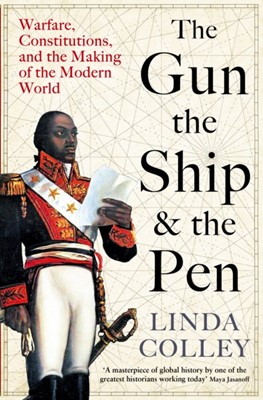
When I was thinking about writing my thesis, my supervisor exhorted me to “go big”. I disregarded his advice, but now I wish that I had listened to him. Linda Colley certainly “goes big” in this book that explores warfare and constitutions and the making of the “modern world”. It’s a big modern world, that includes Corsica, Tahiti, Japan, Tunisia as well as Britain, France, Russia and America. It’s only when I read such an expansive book as this that I realize how rarely I read a history that spans such a broad canvas.
Many people assume that constitutions emerge out of revolutionary politics, the rise of the nation state and the inexorable progress of democracy. Drawing on constitutions developed between 1750 and the present day Colley argues, instead, that constitutions are written in response to warfare and threats of foreign aggression, prompted by ‘umbrella wars’ involving both naval (i.e. the ‘Ship’ in the title) and land battles (the ‘Gun’) conducted across different regions of the world. They are not a feature of the nation-state, but more often an artefact of empires: Britain, China, Russia, France, Germany, the Netherlands, the Habsburg monarch, the Ottoman empire, Japan, Italy and the United States (p.9). Historically, through their constitutions governments held out the promise of rights, especially the franchise, to compensate men who would fight with their own bodies and pay the taxes to support large armies. Because constitution-making was interwoven with war and violence, along with monarchs, politicians, lawyers and political theorists, there were also military, naval and imperial officers, intellectuals, clergymen and cultural figures of all kinds who made their contributions (p. 11). These were written constitutions, responsive to increased literacy, an explosion in print and its transmission, translation and even the rising popularity of the novel (p.12).
Linda Colley is one of my favourite historians. She is probably best known for Britons (which I have on my shelf and haven’t actually read, even though I have read many papers that cite it) and I loved her The Ordeal of Elizabeth Marsh which combines the ‘small history’ that I love and the ‘big history’ that my supervisor wanted me to write. She does not particularly address methodology in this book, but she does make this comment:
For some, laying stress on the impact of transcontinental warfare – or on any other large-scale and wide-ranging sets of changes – risks flattening out important and essential differences, and detracts from the specific roles and contributions of particular nations, cultural groupings and individuals. There can be a fear, as the anthropologist Arjun Appadurai puts it, that addressing the large-scale will tend ‘to marginalise the already marginal’ and foster neglect of ‘small agencies and local lives’. Yet there is no need, I would argue, to become trapped in such chicken-and-egg type arguments. Drawing attention to the big and the wide and to connections does not mean – and should not mean – ignoring and effacing the specific, the local, the small-scale and finely researched individual details.
p.42
Her book, vast in scale as it is, honours both elements. Each of her chapters starts up close with an individual or an episode before she draws back to take a wider perspective. These individuals, each with their own lived history and cultural context, form a touchstone in that chapter and she returns to them at various stages throughout the text to highlight the distinctions and commonalities between different constitutional responses.
The book is divided into three parts. Part One: Into and Out of Europe has two chapters. Chapter One, ‘The Multiple Trajectories of War’ starts with Pasquale Paoli and his ten-page constitution for Corsica, written in 1755 on re-used letters with the inked words scraped away. Colley then moves outward to discuss the way in which warfare became more expansive and more expensive, pointing particularly to the Qing dynasty of China in the 1640s as an example of imperial force against the Zughar-Mongolian empire. Hybrid wars involving both maritime and terrestrial warfare helped give rise to a series of revolutionary conflicts which expanded the design of written constitutions, namely in North America after the War of Independence and in France and Spain after the Seven Years War. Haiti, she suggests, is the exception that both broke and proved her claim that wars preceded revolution. Toussaint Louverture is the best-known revolutionary war leader on Haiti, but she focusses instead on another, less-recognized leader, Henry Christophe. Colley often does this: she acknowledges the well-known figurehead, but then turns her attention to another player standing off-stage.
Chapter Two ‘Old Europe, New Ideas’ starts off with Catherine the Great, writing her own constitutional document, the Nazak. Colley points out the influence of Rousseau and Montesquieu, then returns to Catherine and her Nazak, and its dissemination and influence across geographical borders and on Frederick II of Prussia, and Gustaff III of Sweden, both Lutherans and both influenced by Enlightenment thinking. She rounds out this chapter with Tom Paine, whom she dubs ‘Charter Man’, who championed the constitution as a real, tangible paper or parchment outline of power, rights and laws, prompting a new interest in the 1215 Magna Carta.
Part Two: Out of War, Into Revolutions has three chapters which are quite different each from the other. Chapter Three ‘The Force of Print’ starts in Philadephia with the Constitutional Convention in May 1787. She describes in detail the development of the 4,500 word American Constitution which was inscribed on four sheets of parchment, each about two feet wide and two feet high. It appeared on the front page of the Pennsylvania Packet on 19 September and by late October, the text had been picked up by over 70 other American newspapers. She points out that this constitution was publicized widely throughout the world, and particularly influenced South American states, especially in Venezuela, the Irish Free State, Norway, Calcutta and the Cherokee nation within America.
Chapter Four ‘Armies of Legislators’ starts in Paris in 1789 when the American Gouverneur Morris [sic] of New York arrived after finalizing a draft constitution for the United States, slap bang in the middle of the summoning of the Estates-General which kicked off the French Revolution. Although Morris returned to America, Colley stays in France with her analysis, following Napoleon and his imposition of constitutions on the lands he conquered. In particular, she looks at the Constitution of Cadiz of March 1812 which was explicitly a document for a reformed, more inclusive Spanish empire in South America and the Phillipines.
Chapter Five ‘Exception and Engine’ looks at the paradox that even though Britain does not have a written constitution (and glories in the fact), London in particular was the heart of constitutional inquiry. Jeremy Bentham plays an important role here, with his belief that written constitutions were a template of rational principles of liberal justice and rights that could be imposed on any society, no matter its history or customs. Bentham met and corresponded with men (always men) interested in constitutional matters from all over the world- Greece in 1821, Haiti, Islamic North Africa, Argentina. Colley returns to look at Britain’s relationship with her own Magna Carta and Cromwell’s unsuccessful attempts to codify republican politics. Some two hundred years later John Cartwright, a colleague of Bentham’s, was travelling Britain and corresponding with European politicians, promulgating the ideas that led to Chartism. For some, the essential beauty of the British constitution was that it didn’t exist physically and was perpetually in flux. Many of the politicians and intellectuals in South American countries (e.g. Simón Bolívar) looked to the inroads that British commerce, capital and shipping were making in their countries, and some spent time in London (the British Library was a particular drawcard).
Part Three New Worlds travels to far-flung places in its examination of constitutions. Chapter Six ‘Those Not Meant to Win, Those Unwilling to Lose’ starts off in Pitcairn, of all places, where English mariner Capt. Russell Elliot gave the islanders a spare Union Jack and a ‘few hasty regulations’ that ended up being regarded as a written constitution. It was a remarkably sensitive list: it paid attention to the environment by regulating dogs, pigs and goats; it limited the cutting down of trees; made school attendance mandatory for all children between 6 and 16, and elections for Pitcairn’s ‘magistrate and chief ruler’ were held annually and all adults (including women) voted. This differed from other countries, where women were excluded, largely because they could not fight. The places where women did achieve some sort of franchise were generally on the edges of the British Empire (e.g. Cook Islands, New Zealand, Australia). Turning to settler warfare, especially in the Pacific, she focusses on Governor Gipps in NSW and his nemesis John Dunmore Lang, that fiery Presbyterian minister, who travelled to America and Brazil and dreamed of a future republican Australian federation that might include NZ, New Guinea and Fiji. She discusses Pomare II in Tahiti, and Kamehameha III and King Kalakaua in Hawaii – countries I would never have thought of including in a discussion of constitutions!
Chapter 7 ‘The Light, the Dark and the Long 1860s’ picks up on her interest in the 1860s (she co-organized a conference ‘The Global 1860s’ at Princeton University in 2015). Good grief- here are General Hasayn Ibn ‘Abdallah and Khayr al-Din in Tunisia, a long way from America emerging from the Civil War in the mid 1860s, which she examines in some detail. Then across to Africa, where James Africanus Beale Horton, from Sierra Leone and of African-British heritage, encouraged the emergence of west African political communities with strong African monarchies alongside strong African republics, with ‘universal’ suffrage.
Chapter 8 ‘Break Out’ starts with an analysis of the 1889 woodblock print ‘Issuing of the State Constitution in the State Chamber of the New Imperial Palace’ where the artist Adachi Ginko indulged in some imagination in depicting the handover of a new constitution. Most of this chapter deals with Meiji Japan, and Japan’s victories against China and then Russia in the early 20th century, and its seizure of Taiwan in 1895 and annexation of Korea in 1907.
Her Epilogue picks up on WWI, drawing in all the empires, and further amplified by the Spanish flu epidemic. The collapse of the Russian Empire triggered off a new bout of constitution-making, while other earlier constitutions across the globe collapsed. The dissolution of the Soviet empire in 1991 resulted in the emergence or re-emergence of fifteen ostensibly independent countries in Eastern Europe, central Asia and Transcaucasia. The civil wars that still afflict the world drive up constitution-writing to unparallelled levels. By 1991, she claims, only about 20 of the 167 single document constitutions in existence were more than 40 years old. She brings her analysis into the present day, with a 2016 poster promoting the repeal of the 8th provision of the Irish constitution that effectively banned abortion, and photographs of a demonstrator in Pretoria, South Africa hiding his face behind his pocket-book edition of the constitution, and Olga Misik protesting in Moscow in 2019, holding her copy of the Russian constitution.
What a journey across time and place! Who would have thought that a history of constitution-writing could take us across so much territory? I must confess that I find it hard to become exercised over constitutional discussions – although we are often glad of robust constitutions and rules when they are challenged. I feel that historians have to use their very best narrative skills to breathe life into a study of constitutions, as Colley has here and as Peter Cochrane did in Colonial Ambition. But even the most inflexible constitution is not written in stone. We are seeing the rise of Originalism in the U.S. Supreme Court and with the Uluru Statement from the Heart, Australians are being asked again to consider their constitution and the place of First Nations people in it (or not). And rather more ominously, the constitution of the People’s Republic of China identifies Taiwan as “part of the sacred territory of the People’s Republic of China” and claims that “re-unifying the motherland” is a “lofty duty”. Colley’s magisterial and beautifully written book – and I don’t use that term lightly – highlights constitutions as forever-evolving political creations, shaped by individuals and larger historical forces. And still they keep forming….


 The Resident Judge of Port Phillip