Category Archives: Uncategorized

A Call to Peace- Heidelberg Chorale Society

image003

I went to a beautiful concert last night by the Heidelberg Chorale Society.  It was the world premiere of a piece called ‘When the Bugle Calls’ written by Australian composer Nicholas Buc to a libretto by one of the chorale members, Leigh Hay.  It commemorates two battles: the July 1916 battle at Pozieres, and the battle only fifty years later at Long Tan.  The motifs of the bugle, the army chaplain and the nurse combine the two battles, and the spine-tingling final movement asks:

They fought for home and country, not for an empty fame

Ask of your hearts, which shall we do- rejoice or mourn for them?

It’s a strange feeling, knowing that you’re hearing something performed in public for the first time.  It’s a beautiful piece- and you can hear it again at the Melbourne Recital Centre next Saturday 20th August, along with Karl Jenkins’ The Armed Man: A Mass for Peace. They sang a couple of pieces from that last night, too, and I realized that I had heard fragments of it before.  It should be a lovely concert and you can find out more about it here.

There’s an associated photographic exhibition at Ivanhoe Girls’ Grammar school this week until Thursday 18th in their Hillsley Centre, Noel Street Ivanhoe. Called Cameras at War, it features an exhibition from Bendigo RSL of  WWI images taken by the local Grinton brothers, which were discovered in a biscuit tin in a farm shed ninety years later. These photographs are supplemented by images from Long Tan, including some of the Little Pattie and Col Joye concert that was held that very day (I hadn’t realized that), and photographs from Heidelberg Historical Society showing the military presence on homefront Heidelberg during WWI.  It’s on between 15-18 August inclusive between 10.00 and 3.oo.

This Week in Port Phillip 1841: 24 June-30 June 1841

MR DIGHT’S FLOUR MILL

You might remember that on May 1-7 the Port PHillip Herald announced that construction was to begin on a water-driven mill at what we now know as Dight’s Falls. Work had continued apace:

NEW FLOUR MILLS. Mr Dight, a gentleman lately arrived in our province from Sydney, has commenced operations for the erection of a flour mill, at the junction of the Merri Creek and Yarra Yarra.  This will be an inducement for the settlers in the neighbourhood to cultivate more extensively than hitherto, as they will now be enabled to have their wheat ground without the necessity of exporting it to V. Diemen’s Land, or any other of the neighbouring colonies, and being at the additional expense of importing flour in return.  The back or “tail” race has already been cut, and the building itself will be commenced in about six weeks; and as almost all the fittings up, and other requisites are already provided, we may expect that the mill will be in full operation before many months. The situation has been well selected, and the government have promised every encouragement which such undertaking so richly merits.  We heartily wish the spirited proprietor, who is a native of the colony, every success; and we embrace the opportunity of congratulating our fellow-colonists upon the prospect of being enabled to produce facts in refutation of the jealous misrepresentations of such productions as Murray’s Review, in which the province is said to be entirely “unfitted for agriculture”.(PPH 25/6/41)

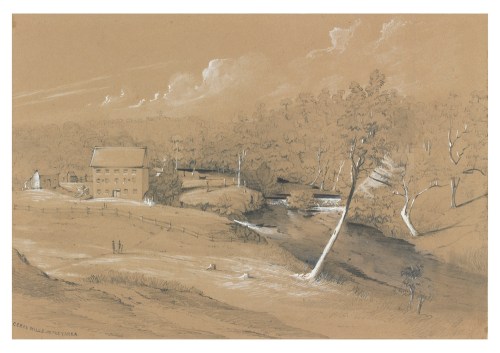
Ceres Mills on the Yarra

Ceres Mill on the Yarra by George Alexander Gilbert, 1846-7 SLV (or possibly by one of his pupils)

http://handle.slv.vic.gov.au/10381/298652

THINGS LOOKING WORSE

The same inactivity which existed in our markets last week has still continued and no expectation of a rise can be entertained when a comparison is made between the present stock of all articles of general consumption and what it was at this present period in 1840 (PPH 25/6/41)

Wages for recently arrived emigrants were falling. Several recently arrived emigrants engaged at £25 per anuum for single farming men; their wages used to be from £35-40. However, at this stage it was perceived that

This is to be attributed solely to the pressure of the times, and not to the labour market being over stocked. (PPH 25/6/41)

Not only were wages falling, but prices were falling as well. A  4lb loaf of bread fell from 1s.6d to 1. 3d, and meat could now be purchased at 4d. a lb instead of the 5d and 6d a pound that was the going price in May. (PPH 29/6/41)

BUT YOU CAN’T GO WRONG WITH LAND, CAN YOU?

IMPORTANT LAND SALE. On Friday morning last, it was generally known in Melbourne, that Sir George Gipps had given notice of his intention to throw open for selection, on the uniform-price system of 1 pound per acres, a very large quantity of Port Phillip land.  The consequence was, that during the whole of that and subsequent day the Survey Office was thronged by parties desirous of obtaining information on the subject. We are indebted to Mr Hoddle for the following particulars, and are requested by that gentleman to state, he will feel obliged if parties will not call at the Survey Office to make enquiries relative to the sale until after tomorrow, as the clerks are all busily engaged in making out the descriptions which are very lengthy. The land will be advertised in the usual way, either at the end of this or the beginning of next week. It may be as well to remind our readers that the following are the conditions under which the land will be disposed of. Immediately after it has been advertised, parties who pay in their money first will be entitled to first choice, that is if they are in attendance at the time appointed by the Government for the selection to be made; provided always that no land order from England of previous date be presented at the same time.  The allotments vary in size from 35 to 800 acres, but the majority of them are about 150 acres each.  The sale will not take place before three months from the date of it being first advertised; at the expiration of which period there will doubtless be a considerable rush on the opening of the door of the Treasury.

Land was offered on the Werribee River, Geelong, Lake Colac and at Doutagalla parish “between the Salt Creek and the Moonee Moonie chain of ponds”. In the parish of Bulleen, 7635 acres was put up for sale:

The land in the Parish of Bulleen is for the most part thickly timbered with stringy bark, and is also very hilly. There are however several extensive patches of “good grassy hills” (as laid down in the chart at the survey office). The land for sale is immediately adjoining Mr Unwin’s special survey, near Dr McDermard’s cattle station and about seven miles distant from Melbourne, on the South bank of the Yarra.” (29/6/41)

AND THE WEATHER?

Well, it’s winter. A maximum for the week of 60 (15.5C) and a minimum of 42 (5.5C). The weather continued variable, with a gale on 26th.


Graeme Davison on visions of the future

I mentioned the History of the Future exhibition at the Melbourne Town Hall. In the little booklet that accompanied the exhibition (which I had to email for, as they had run out), there is an essay written by the  curator Clare Williamson.  In it she references, several times, an essay written by Graeme Davison called ‘Melbournes that Might Have Been: Three Dreams of the Future City’. It was published in the Victorian Historical Journal, vol 63, nos. 2 & 3, October 1992 p.168-188.   Backcopies of the Victorian Historical Journal can be accessed here.  If negotiating the SLV’s clunky Cedric document loader doesn’t make you hate your life, the article’s well worth reading.

Davison starts his article by referencing Geoffrey Blainey’s idea of a seesaw in relation to utopian and utilitarian planning visions. There were periods of dreaming in 1910 and in the 1940s (often influenced by international innovations reaching Australia), and more routine planning approaches in the 1880s and 1980s. However, the three visionaries he studies in this article do not fit into this broad arc at all.  The first  planner ‘Anonymous’ (who he suggests may have been Redmond Barry or the editor of the Australasian G. H. Wathen) wrote in 1850, just before Victoria was to be separated from New South Wales.  The second was Frank Stapley writing in 1935 and the final was Robin Boyd, writing in 1969. Davison provides good long extracts from each of them.

‘Melbourne As It Is, and As It Ought To Be’ was published in the Australasian No. 1 in 1850 (and an abridged version can be found here). Unfortunately, this abridged version leaves out all his detailed prescriptions for public squares, streets and boulevards – and you’re going to have to be a Melburnian to appreciate all this.

View of the city of Melbourne from the Observatory

View of City of Melbourne from the Observatory [c.1858-1860], Artist George Rowe, State Library of Victoria

http://handle.slv.vic.gov.au/10381/81212

‘Anonymous’ starts his suggestions on the elevated ground between the flagstaff on the top of the hill at Flagstaff Gardens (shown above). On the elevated ground between the flagstaff and the ‘government offices’ on the corner of King and Collins Street, he believed that there should be a Grand Square, a Hall of Assembly, the Vice-Regal residence and other government buildings. A 200ft wide boulevard would sweep from there to the Supreme Court on the corner of Russell and La Trobe Streets where there would another square, then onwards towards another square located near St Peter’s Anglican Church in Eastern Hill. This 200 ft boulevard would then curve down to the Yarra River where a bridge could connect it to a similar boulevard on the other side of the river.  On the brow of Flagstaff Hill (ie. facing the other direction from where George Rowe did his painting) there was – but is not, today- a splendid view of Hobson’s Bay, the Melbourne plains and mountains. ‘Anonymous’ suggested a public promenade along this slope with statues and vases with a terrace down to the North Melbourne lagoon, with avenues of ilex (holly) and shrubberies of mimosa. A road leading to Batman’s Hill (i.e. where Southern Cross Railway Station is today) could have a hall for busts of Great Men, and an avenue could be constructed to Flemington. He was particularly dismissive of the Market Square at the time (i.e. near Market Street), and said that the centre of the city should be bounded by Collins, Swanston, Bourke and Elizabeth Streets- which is pretty much where it is.

2. Frank Stapley 1935

In his treatise on Melbourne planning, Frank Stapley looked ahead fifty years (i.e. to 1985). By then, he said, Melbourne would have two million people (he underestimated) and the traffic would be at a standstill, with Swanston Street at saturation point. He was a big roads man- he wanted to build a bridge through Yarra Park to Punt Road behind the MCG (our current Brunton Avenue perhaps?),and  widen both  Bridge Rd Richmond and Sydney Road Brunswick.  In a prescription sure to gladden the hearts of Save Our Suburbs, he wrote:

Zoning should be regulated in the metropolis according to a definite plan. Areas set apart in the first instance for residential purposes should remain so.  Some areas should even be reserved exclusively for single family residences.  (Davison p. 182)

3. Robin Boyd 1969 ‘Melbourne 2001 AD’

Robin Boyd, likewise, foresaw a Melbourne choked by cars but in his scenario, people had given up using them to actually get anywhere, and instead used them as extra rooms.  The tramway system would be vastly increased, with four to six lines in some streets.  The bay would be bitumized as far as Rosebud.  Melbourne would be infested with flies. The underground railway would be at test drilling stage only, or if it did exist, it would consist of recycled rolling stock painted in psychedelic colours.  There would be bushfires every year. Men (he doesn’t mention women) would dispense with clothing altogether on weekends and holidays.  Growth would be channeled into ‘fingers’ to protect the prettier parts of the bush and riverside, and a ring road would surround Melbourne. The Flinders Street railway yards would be covered, with a huge perforated structure, similar to a stock of ceramic cheese graters, housing 50,000 people.  There would be multilevel streets, and tall buildings would be built on consolidated blocks of land.

Oh dear. Robin Boyd’s not far off the mark in many ways.  I think I prefer the vision ‘Anonymous’, his halls of Great Men notwithstanding.

And so here we go again….Banyule Homestead

It’s Groundhog Day here in Heidelberg, with changes to Banyule Homestead in the air again.  You can read about it at https://banyulehomestead.wordpress.com/2016/07/29/and-so-here-we-go-again/

Exhibition: A History of the Future

history-future

There’s a terrific little exhibition on at the City Gallery, off the Melbourne Town Hall at the moment. It’s called ‘A History of the Future’ and it’s on until August 12.

I’ve always been drawn to things that didn’t happen. While I tut-tut at ‘what-if’ and speculative histories, deep down I enjoy them.  This exhibition displays the plans of grand dreams that planners and architects have had for Melbourne that weren’t even built- and in most cases, I’d have to say “….and a good thing they weren’t, too”.

So there’s a giant hand-shaped building planned for what is now ACMI, between St Pauls and the Forum, with its index finger pointed skyward.  “Nothing remotely like it in all the world!” proclaims the plan. That’s for sure.  The finger nail of the index finger would contain an observation deck, while the thumb could contain a restaurant.  “The hand is particularly beautiful from its palm side, conformed thusly with three fingers clasped and one pointing heavenward, it symbolizes nothing specifically, but many things generally.” Unlike a middle figure pointing heavenward.

There’s several plans for pedestrian walk-way elevated above the footpath, with escalators running up from road level.  Or Robin Boyd’s plan for Bourke Street on five levels, the bottom consisting of public transport, then two levels of car parking, then finally cars going east and west.

For grand buildings, there could be a huge pyramid built beside the State Library (not unlike the one at the Louvre) or – most topically- a plan for the Queen Victoria Market in the 1970s that would have seen it enclosed completely, with a highrise government building erect on the Victoria/Therry Street corner.  It doesn’t sound all that much different to what is being proposed by the City of Melbourne right now.

It’s a fun little exhibition, so spend a spare half-hour looking through it the next time you’re in town.  It’s free and opening hours are Mon: 10am – 2pm ; Tue – Friday: 11am – 6pm and Sat: 10am – 4pm (closed Sunday) For a taster, here’s a slideshow:

http://www.melbourne.vic.gov.au/arts-and-culture/city-gallery/Pages/current-exhibition.aspx


Movie: God Willing

A friend recommended this film as a feel-good, gentle comedy and that’s exactly what it is. It’s in Italian with English subtitles. A surgeon, who has rather a God-complex himself, is rattled when his son decides that he is going to become a priest.  The surgeon, who is certainly a sceptic if not an outright aetheist, decides to investigate the priest with whom his son has become friends and finds more to him than he expected.

It’s not deep or challenging in any way, but certainly worth considering if you want to while away an hour or two.

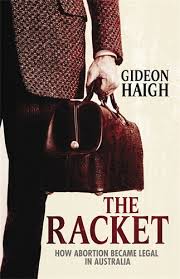
‘The Racket’ by Gideon Haigh

haigh

2008. 250 p.

I read this book several weeks ago, during the week when finally an exclusion zone was actually enforced outside the East Melbourne Fertility Control Centre. For more than 20 years, pro-life protestors had taken up their positions on the footpath outside the surgery armed with posters and brochures in a final attempt to dissuade women from entering to have abortions. It’s been going on for years, despite the fact that in Victoria abortions no longer fall under the Crimes Act (even though they still do in  New South Wales and Queensland). In reading this book, I was taken back to black-and-white images and newspaper articles that threw up for me names like Peggy Berman, Bertram Wainer, and Jack Ford: all familiar, but I couldn’t quite remember how it all fitted together.

As Haigh points out, abortions had always been available in Australia through sharp instruments, potions and purgatives. These solutions were more within the purview of midwives than doctors, who were more often called upon to conduct a D&C after the abortion had been induced at home. Some operators worked with remarkable impunity, but it was also difficult to collect evidence and women often kept silent, partly from fear of charges and also from a sense of solidarity.  Doctors became more involved after World War II and through vigorous defence in the courts remained generally untouchable, but they remained interwoven with the remaining midwives and unqualified operators, often receiving commissions for referrals.  Increasingly, they became involved with corrupt police as well, in what formed a self-sustained ‘racket’, where everyone had their hand out for their share. Central to all this money changing hands was Peggy Berman, who went to an abortionist for an abortion herself, came out employed as his secretary, had an affair with the Homicide chief Jack Ford who was on the take, and became the main collector and enforcer of bribes and payments. When she felt betrayed by Ford, she began to talk, exposing the whole tacky, crooked racket.

I found myself angered by the casual profiteering that took place over the bodies of these women and girls, and the callousness of the exposure of women, their mothers and boyfriends when the police broke down the doors and the resultant cases ended up in court.  Take, for example, the Windsor Court raid on 25 May 1965. Police staked out the back and front entrances, then fanned out through the surgery, upending everything they did not confiscate, rummaging through the patient information cards. Upstairs they found three groggy women recovering from surgery, who they questioned on the spot. The women were spirited away to the Royal Women’s Hospital for internal vaginal examination, with a police photographer hovering beside the trolley taking pictures that, hugely magnified, would be part of the prosecution brief in court.  One girl, distressed, asked them to stop but her request was rebutted. When she asked for her mother, she learned that her mother had been taken into custody. (p. 87)

Then there were the court cases themselves.

Very seldom, in fact, do the transcripts read as though the abortionists themselves are on trial.  Because the witnesses are largely younger women, and the judges, barristers, solicitors, police and jurors almost exclusively older men, they often read like moral tribunals- and while men in an adversarial systems are apt to check one another, there are moments that smack of male prurience and mental cruelty, even a certain sadism. (p. 140)

Gideon Haigh is a journalist and this is very much a journalists’ book.  You can get the flavour of it in Haigh’s essay from the Monthly in 2007.  It rattles along, and every interview, every anecdote, gives the names of protagonists and informants just as a newspaper article would do.  I found it overwhelming.  I’d often find myself thinking “Do I know this person?” and would have to resort to the (thankfully) exhaustive index at the rear, which is dominated by surnames. I wished that at times Haigh would step back from the story, and sketch out the broad contours of the story, rather than the details.

That said, writing recent history is a special challenge, even if that is not necessarily what Haigh would claim to be doing here.  It’s well researched, thorough and perceptive.  But I must confess to feeling a bit voyeuristic and grubby. I’m aware that the young girls he reports on here are now grandmothers, and I wonder how they and their children feel now, reading about this terribly-public exposure of their distress on the front page of old ‘Truth’ newspapers and now reheated in Haigh’s book. Sometimes I am surprised at the use of pseudonyms in stories that seem quite innocuous, but I found myself wishing that perhaps Haigh had used them here.  I know that  full names and photographs were splashed all over the more prurient publications, and that these young women entered the public record through the court cases they were dragged through.  But I think I’d feel more comfortable as a reader, in this case, if I knew that I wasn’t perpetuating the shame and exposure that, wrongly, was attached to women exercising their right to control their own bodies.

Movie: Hunt for the Wilderpeople

Oh NO!! I thought as I settled into my seat, looked around, and realized that I’d just paid good money to go to a kid’s movie, and worse still, there were kids sitting all around me. When did I become so ageist?

Well, as it turned out, one of the real pleasures was watching the little boy sitting next to me (kicking the back of the seat in front the whole way through) become increasingly involved in this delightful, engaging story (and even stop kicking).   The scenery is beautiful and it’s pure New Zealand gothic.  Ward-of-the-state and misunderstood ‘bed igg’ (it IS New Zealand) Ricky Baker worms his way into the affections of his foster-uncle as they set off on a escape from the Miss Truchball-esque welfare officer. I admit to a little tear in the eye and felt thoroughly satisfied by this feel-good family story.  In fact, if pressed, I felt so warm and squishy that could even extrude a grim smile at the little boy sitting next to me if I really had to.

This Week in Port Phillip in 1841: 8-15 June 1841

Oh dear, I’ve fallen so far behind with all of these. House renovations and conferences seemed to get in the way and I’m quite embarrassed by my tardiness. Apologies.

THE ‘DIGNITY’ BALL

And we’ve all been waiting so long for the Dignity Ball- and here it is! As you might remember, the Patriot and Gazette railed against the elitism displayed by the ‘gentlemen’ of Port Phillip wanting to distance themselves from the ‘common’ (sniff) Queens Birthday Ball.  But apparently the stewards had a change of heart, and decided to include some people who had been previously excluded.

The Ball is in preparation to come off on the 8th instant. The Stewards may be congratulated upon the wisdom they have shewn in acting after the suggestions of the press, by modifying their senseless exclusionism, and extended the issue of their tickets. This policy, which we learn from the Stewards has been thus tardily adopted , will certainly bring the fete off with greater credit to themselves and the character of the population.  (Port Phillip Gazette 5 June 1841)

Notwithstanding this change of policy, the Port Phillip Patriot predicted a poor turnout:

The famous ‘Dignity Ball’ postponed in the first instance till the races, then till Her Majesty’s Birth day, then till the 4th June and then till the 8th instant, will eventually, it is expected, come off tomorrow night, but the attendance it is expected will be as poor as unpopularity can make it.  A bold manoeuvre was made by the Stewards at the eleventh hour to retrieve their original blunder by issuing invitations to the parties previously passed over as unfit for admission, but it has very properly failed.  Our contemporary, the Gazette has, we regret to observe, taken this manifestation of a defeat as an evidence that the stewards have had the good sense to modify their “senseless exclusionism” but we know them better.  Nevertheless we are sorry that it is so, for it is not in our nature to war either against the men or the amusement, though we have warred, and will war to the death against them, or any other set of men who, like them, attempt to set themselves up to decide automatically as to the eligibility or non-eligibility of their fellow-colonists for admission to society(PPP,June 7) p. 2

And sure enough, its report of the ball portrayed it as a drab affair:

The far famed  and long expected “Dignity Ball” came off on Tuesday night, and a very dull affair it proved.  The attendance was but thin and few of the ladies of Melbourne honoured the assemblage with their presence in consequence of certain doubts which had got about touching the reputation of one or two fair dames expected to be present.  The only really good part of the evening’s entertainments was the supper, which , as we are told, did great credit to Mr Meek’s knowledge of the science of gastronomy. (PPP June 10)

And so we need to turn to the Port Phillip Herald, regarded as the newspaper of choice for ‘better’ society to give us a more positive report

THE BALL- This private entertainment took place at Mr Davies’ long room, on Tuesday evening, and went off with much spirit.  There were forty-four ladies and sixty-seven gentlemen present, His Honor, Mr La Trobe and Lady, amongst the number, who seemed highly delighted with the evening’s festivities.  The Stewards had provided a most magnificent supper, which was done ample justice by the guess. The party did not finally separate till five o’clock. (Port Phillip Herald 11 June 1841)

It is the presence of Superintendent La Trobe and his wife Sofie, that marks this Ball out as ‘respectable’, in a way that the earlier Queen’s Birthday Ball was not.  And the stamina- kicking up their heels until 5.00 a.m. (and we thought all-night dance parties were a new phenomenon!)  And was Judge Willis there? No!   Fourteen years ago in Upper Canada he had been a bit of a socialite with his first wife, but there’s little evidence of party-going antics in British Guiana or New South Wales.  Perhaps he’d learned his lesson in Upper Canada; or maybe his second wife (who was expecting a baby in September) was reluctant to go. One way or another, he wasn’t there.

PROGRESS IN PORT PHILLIP

Things were really starting to move in Port Phillip. Early buildings of canvas and wood were giving way to more substantial constructions as a very physical demonstration of progress in the District.

PUBLIC BUILDINGS: We feel a pleasure in recording the fact, that the public buildings in Melbourne, in the progress of erection, are going ahead in a steady and praiseworthy manner, when the limited mechanical force employed is taken into consideration. The Custom House “where merchants most do congregate”, a building in all extensive mercantile communities of the utmost importance, is now ready for slating, that description of covering being preferred to shingles.  The Bonded Store beneath may be found too small for its legitimate purpose, if so the plan of licensing stores, belonging to private individuals in the town, may be continued as an present.  The Post Office, at the junction of Bourke and Elizabeth-streets, is progressing rapidly, and in a couple of months, if nothing intervenes, may be in possession of the proper officers, “a consummation devoutly to be wished.” The New Watch-house, on the Eastern Hill, has been completed, and taken possession of within the last few days.  It is a stone building, conveniently designed, and well executed, and will be appropriated to the reception of the idle and disorderly in the vicinity of New Town, instead of their being dragged upwards of a mile to the Melbourne receiving house, as heretofore.  The foundation of the Jail has been excavated, and one wing of the building already commenced, which will be completed before any further portion of the building is proceeded with. This wing will be appropriated solely to the reception of convicts, or parties committed for trial.  The plan of the building is that of the wings of the new Sydney Jail, and will contain forty-two cells upon the ground floor, and in the upper stories it is to be three in height, rooms 12 by 6, for the purpose of classification.  The second wing is for a House of Correction, and Debtor’s Prison. When completed, the whole building will consist of two wings, facing Swanston Street, in a line with the Caledonian Hotel, having the Jailer’s house etc. in the centre.

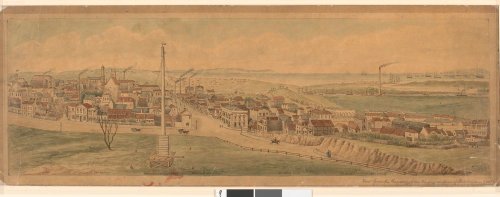
The Customs House mentioned here is not the one that stands in Flinders Street today. The picture below, by Robert Russell in 1844, shows the brownstone Customs House described here. It is, nonetheless, one of the most impressive buildings in Melbourne.  It was replaced by a second Customs House from 1858 onwards.
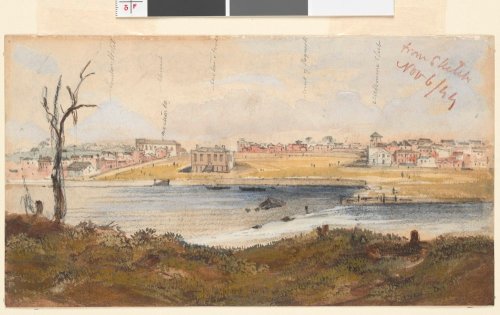
Melbourne from the falls 1844

Melbourne From the Falls, Robert Russell 1844, SLV

http://handle.slv.vic.gov.au/10381/56125

The jail mentioned here is the Old Melbourne Jail, but it is not the bluestone cellblock that still stands today, which was commenced in 1853. Earlier buildings were demolished in the 1930s, so presumably the buildings described here would have been removed at that time.  The Eastern Hill watch-house described here, according to Robyn Annear’s Bearbrass was on the corner of what we know as Exhibition and Little Collins Street.  Its proximity to ‘Newtown’ (i.e. Fitzroy) would be along Exhibition Street.

AN EARTHQUAKE!

Actually, this occurred on 6th June, but wasn’t reported for a few days.

EARTHQUAKE: An Sunday last, during the hours of divine service, a rumbling noise was heard in the earth, supposed to be the fore-runner of an earthquake. In the Church it was distinctly heard, and the congregation alarmed; also, in several parts of the town, giving rise to various speculations. (PPH June 11)

It often strikes me that, for these early settlers, everything was still new.  Were earthquakes common?  They didn’t know.

AND THE WEATHER?

A high of 18 (64F) and a low of 4 (40) for the week. Fresh breezes on 9th, 10 and 12th. Weather mostly dry but cloudy.




AHA Conference 8 July 2016

When I woke at 4.30 a.m. this morning, I decided that I may as well get up, leave even earlier and catch the first paper for Session 1, as I’d arrived late the other days. So, for the 99.9% of the world who are not likely to catch the 5.20 a.m. train from Macleod to Southern Cross, I can tell you that, unlike the 6.33 Macleod train which has many slightly sleep-befuddled office workers, the 5.20 carries a healthy contingent of construction workers in high-viz jackets. I just thought you might like to know.

Many of the sessions and morning teas/lunch were held at the Mechanics’ Institute.

The inside of the hall has been recently renovated. I can only assume that the paintwork is using original colours because it’s -um- an ‘unusual’ colour selection:

 Environmental histories (things that swim, scurry and fly)

There has been a strong environmental history stream running throughout the conference and so I decided to room-hop between adjacent rooms where presentations dealt with different creatures and their environments.

First, David Harris gave his paper “At a Brisk Simmer: Commercial Fishing in Nineteenth Century Victoria 1860s-90s.” As he pointed out in his introduction, this is only a sliver of time within the longer history of the Gippsland Lakes area, which had long been a fishing site for the Gunaikurnai people (albeit a relatively recently formed area, given that Bass Strait did not exist until 8000 years ago). Within the long term, the decline in fish numbers post-settlement could be seen as a slow catastrophe, or as historians have described the collapse of the Newfoundland fisheries “managed annihilation”. However, focussing on this small time period of 30 years provides a context for political decisions, enlarges the scope for considering individuals, and reveals complexities in what might seem a relatively benign period during the nineteenth century. During this time, there was the influence of the acclimatization movement, the rise of commercial fishing and the development of the fresh fish trade. But it was also a time in which fishing became less diverse as indigenous and Chinese fishers were excluded and the market shifted from dried fish- as happened elsewhere in the world at this time. He reminded us that even the ‘old timers’ amongst white settlers and fishers had only been there for thirty years. The cyclical appearance of the pilchard shoals was not yet understood, leading to anxieties about shortages and abundance. These anxieties prompted a political response as the government introduced commissions and regulations, thus privileging political approaches over scientific ones.  Reminding us of the influence of individual people within this political context, he  gave the example of William Carstairs, a Scots immigrant who had shifted to the Gippsland Lakes and often served as a spokesman for the fisher in government inquiries before he died, fittingly enough, in a fishing accident.


At this stage I went next door, into a room that seemed to be serving up its own environmental context with a heating system that delivered warmth but only at the cost of a noisy, escalating whirlwind. I arrived to hear the end of Andrea Gaynor’s presentation “Taking Locust Country” where she noted the use of military metaphors in the “war on locusts”, including defensive action against a hostile invader, coordinated surveillance and mobile strikes, and in a 2010 outbreak, adopting the language of the war on terror and exhortations to be ‘alert’ (and although they didn’t say it) alarmed.

Katie Holmes’ presentation on “Mallee Mice” had many in the audience squirming, which verified her contention that mice, despite their size and furriness, often evoke a strong emotional response  and unsettle the human psyche. She focussed on the 1917 plague in the Mallee, where mice thrived in the well-drained soil, the cleared land and the rainfall after a period of drought. Mice were fierce competitors for the much-celebrated bumper wheat harvest that year, but they have a material presence: not only do they yield underfoot (shudder) but they disrupt the human order as they collapsed wheat stacks and invaded houses. She noted the gendered response to the plague as men in Mallee towns competed over the size of the piles of dead mice, and as women despaired of the domestic invasion.

She shared this vision of the 1993 mouse plague with us. During this plague the density was five times the official definition of plague- i.e. 2500 mice per hectare, when the plague definition is 500 per hectare.

It was interesting to note the response amongst the audience to her descriptions, pictures and videos of swarms of mice which, although they spread disease and attacked livestock, are a short-lived plague that does not have the same health consequences as malarial mosquitoes, which were discussed in Emily O’Gorman’s paper “Irrigation, Insects, Infection: Mosquitoes and the Murrumbidgee Irrigation Area, NSW in the Twentieth Century”. During the period 1916-1945 there were five inquiries into mosquitoes in irrigation areas, three of which she described in this paper. Malaria is a medical phenomenon that challenges many binaries: it requires both humans as host and non-human mosquitoes as vectors for the disease to spread; it challenges the border between temperate and tropical climates, and it pushes the boundary between agriculture and nature as the dangers of the wetland came into the home. There was particular anxiety about soldiers, who were slated for settlement in the Murrumbidgee area, bringing malaria with them as they returned from overseas service; and the 1916 study looked at whether the area itself was malarial. It concluded that the danger of malaria from returning soldiers could be averted by careful screening.  Another study in 1919 found eggs of the anopheles mosquito in pools, and particularly noted the danger of small collections in water in hoofprints from cattle.  Although concluding that the prospect of a malaria epidemic was unlikely, the study recommended the elimination of small pools and their incorporation into flowing water instead. After ricegrowing was introduced, anxiety was again raised over such large bodies of water, especially with the return of the WWII soldiers onto soldier settlement blocks in the Murrumbidgee region. This time the study recommended the use of DDT.


PLENARY: JOSEPH BRISTOW “Homosexual Blackmail in the 1890s”.

This plenary was auspiced by the Australian Victorian Studies Association, and was very well attended. Joseph Bristow from UCLA (Los Angeles) is a prolific scholar, who has written and continues to work on Oscar Wilde, and is currently working on a reconstruction of the two trials that led to Wilde’s imprisonment. In his fascinating, witty paper, he described a police raid on a party hosted by John Watson Preston in his rooms at 46 Fitzroy Square, London, where twenty men were arrested, including two, Arthur Marling and John Severs, dressed in women’s clothes.It was not so much a party as a commercial enterprise  which extended over two days, to which tickets were sold.  Marling, along with two other attendees at the party, Charles Parker and Alfred Taylor, were later to play a role in later episodes which drew attention to the prevalence of homosexual blackmail, which was often concocted between groups of men against wealthy victims. At the Old Bailey in April 1895 thirty-three year old Taylor was charged with Oscar Wilde for conspiring to commit, and committing, acts of gross indecency, while Parker served as a witness to the Crown Prosecutor’s case against Wilde. A case belonging to Taylor contained incriminating letters that were used as evidence against Wilde, and during the trial Wilde was questioned about the Fitzroy Street arrests (even though he was not there himself). Although, as we know, Wilde paid heavily for his ‘crime’ neither Parker nor any of the other male sex workers were charged after admitting to committing the crimes of which Wilde was accused. Bristow drew on newspaper reports of the time, and noted that the provincial newspapers provided much fuller coverage than the London press.

A library interlude….

What a fantastic nineteenth century reading room there is in the Mechanics’ Institute! Although the institute opened in 1860, this reading room was apparently part of the trading floor of the Mining Exchange.

My last session

I had hoped to attend the ‘Negotiating Aboriginal Histories’ session, but it had been cancelled. I was starting to flag after my very early start, so I decided that this would be my last session for the conference. I again skipped between two sessions.

Tamson Pietsch spoke on “Bodies at Sea during the Migration Boom 1850s-1870s”, which was based on an article which she has had published in the most recent issue of the Journal of Global History (Journal of Global History / Volume 11 / Issue 02 / July 2016, pp 209-228). Picking up on Braudel’s observation that ‘the sea’ is not one monolithic entity but that different seas have geographies of their own, she also notes that there is a chronology of the sea as well, most particularly the shift from sail to steam and the attendant changes in labour and ship design. Using Foucauld’s work on disciplining and rendering docile the body, she draws on shipboard diaries written by eight passengers en route to Australia to argue that oceanic journeys disrupted and upended the land-based bodily practices that passengers embarked with.  There was the management of time, which passed slowly on board ship (at least for cabin and saloon passengers; steerage passengers had to work much harder just keeping body and soul together).  Indolence, especially in the tropical zones, evoked fears of idleness, and so ‘useful’ activities, including diary writing itself, were devised.  Then there were the bodily boundaries that were violated by the very close proximity with strangers and the noise and smells of human life, and the intrusion of lice and rats.  Finally, passengers on these journeys became conscious of the fragility of authority once the boat had left shore. Power was embodied in the Captain, who had the authority to punish in public, and to a lesser extent in the Cook, who could make life difficult if he so chose. She finished by asking what effect this disruptive experience of bodily chaos and breakdown of boundaries had on passengers once they landed – especially when considered against those they had left behind at ‘home’.

The final paper was not delivered by the author. “Revisiting Clunes: Race Riot or Fight for the Eight Hour Day” was written by Lynn Beaton, and delivered posthumously by a friend after Lynne died suddenly in June 2016.  The Clunes riot of 1873 has often been described as an anti-Chinese riot, but her paper argued that it was instead part of a campaign against scab labour.  The owners of the Lothair mine wanted their miners to work Saturday afternoons but the miners, who were contractors rather than wage employees, refused to do so (thus hurting their own hip-pockets, rather than the mine-owner’s). Ballarat, along with the rest of Victoria, was proud of the achievement of the Eight Hour Day, and working on Saturdays would have compromised that.  When the mineowners brought in Chinese to work on Saturdays, riots broke out and five miners were arrested.  She argued that anti-Chinese feeling was a component of the riot, but the issue was about protecting the Eight Hour Day.  Lynn’s paper was read by a friend, and her family was in attendance. You could not help but sense the sadness. It reminded me, as so many of the papers at the conference did, that history is- as Katie Holmes said in launching Tom Griffiths’ book- a collaborative, interlocking process. It’s what historians do, and why we love it.

So, with that, I headed for home.  And- hah!- as I headed for the station, the sun came out.