Category Archives: Uncategorized

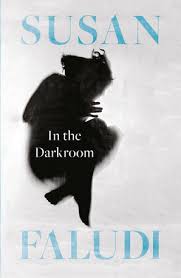
‘In the Darkroom’ by Susan Faludi

faludi

2016, 417p

As it happens I found myself reading, almost end-to-end, two memoirs written by daughters about their fathers.  Both fathers experienced World War II and both daughters, in their own ways, were affected at second-generation remove, by their fathers’ responses to the war.  Much as I enjoyed Magda Szubanski’s book, Reckoning,  I did find myself thinking once I started Susan Faludi’s book “now this woman can write!”  As authors, they’re not really comparable. Szubanski writes from the heart, where Faludi writes from the head, and Faludi’s skill in crafting her story is that of the polemicist as well as the story-teller.

Faludi’s father only really came back into her life in 2004 after decades of estrangement. As she says in her opening paragraph:

In the summer of 2004 I set out to investigate someone I scarcely knew, my father,  The project began with a grievance, the grievance of a daughter whose parent had absconded from her life.  I was in pursuit of a scofflaw, an artful dodger who had skipped out on so many things- obligation, affection, culpability, contrition. I was preparing an indictment, amassing discovery for a trial.  But somewhere along the line, the prosecutor became a witness. (p.1)

In the summer of 2004 she received an email from her father telling her that “I have had enough of impersonating a macho aggressive man that I have never been inside” and that he had had gender reassignment surgery. Now, instead of Stefan (or, when he was in America, Steven) he was now Stefanie. It was the first email she had received from her father in years. He had left the family while she was a teenager in 1977, and had returned to his birthplace Hungary after the fall of communism in 1989. “You said you were going to write my life story, and you never did” he taunted her. “It could be like Hans Christian Andersen,” he later told her, “When Andersen wrote a fairy tale, everything he put in it was real, but he surrounded it with fantasy.” (p. 21, p.1).

Faludi has not indulged the fantasy, but she has surrounded her father’s story with an extended reflection on identity: personal, gendered, racial and national. She is well placed as a feminist theorist to analyze the permutations of gender in her father’s  hyper-feminized Stefanie identity, and there is a rather creepy hint that her father was flaunting and almost flirting with his daughter. Her father is Jewish but during WWII, he refused to identify as such, and slipped across racial boundaries to pose as an Arrow Cross partisan, thereby rescuing his parents as his final act of filial responsibility to parents he resented and then rejected. She reflects on her father’s assertion of a latent female identity, and draws parallels with the recent reassertion of Magyar identity at a national level since the fall of Communism.  These observations and questions are framed at a theoretical level, and although the book does not have notes or footnotes, they draw on the writings and interviews with theorists, historians and medical and psychological practitioners, as well as other people who have undergone gender reassignment.

She describes her father as a ‘shape shifter’ and it is not lost on her that, as a photographer employed to touch-up photographs in pre-Photoshop days of the mid-twentieth century, her father has always played with ‘erasure and exposure'(p.35).  He shows her photographs where he has photoshopped his own features onto women’s bodies; he tells half-truths and he affects a vacuous neutrality as he distances himself from his own history.  I am reminded of the loss experienced by people who were close to the pre-operative person undergoing gender reassignment, as in the recent film and book The Danish Girl that I have reviewed previously.

As she points out Magyar (the Hungarian language) does not have gendered pronouns, and her father had always mixed them up in English. Faludi follows the practice of referring  to her father each time she mention him first as ‘my father’ and then ‘she’. It’s a bit disorienting at first, but it keeps you, like Faludi herself, constantly aware of this duality.

When reviewing Szubanski’s book, I mentioned my own sense of guilty complicity in the author’s minute scrutiny of her parent.  I didn’t feel the same way in this book.  Perhaps the historical, political, psychological and sociological theorizing with which Faludi laces the book removes it from the emotional to the intellectual realm, or perhaps it’s that Stefanie has clearly co-operated with, and even goaded, her daughter to write it.  In her preface, Faludi braced herself for her father’s response to the news that she had completed her first draft, assuming that

My father, who had made a career in commercial photography out of altering images and devoted a lifetime to self-alteration, would hate, I assumed, being depicted warts and all.

His response?

“I’m glad. You know more about my life than I do”.

Sourced from: Yarra Plenty Regional Library

Read because: Book review in newspaper

My rating: 9/10


Franklin ship ‘Terror’ found

I’m sitting here looking at the video of the discovery of Sir John Franklin’s ship, Terror that was found in – how appropriate- Terror Bay. Amazing- even the glass in the windows! Two years ago the Erebus was found, in much poorer condition than this most recent discovery and I wrote about it at the time here.  Academic Russell Potter, who released his book Finding Franklin: The Untold Story of a 165-Year Search on July 26, has written about the discovery on his blog and the Guardian has a very full report.

It’s all very exciting!


‘Leaf Storm’ by Gabriel Garcia Marquez

leafstorm

1955, (originally published as La Hojarasca)

Have I mentioned here that I am learning Spanish?  Not content with bursting my brain with learning verb conjugations (it has taken me an inordinately long time to move on from the present tense- quite a drawback for a historian!), or sitting puzzled over News in Slow Spanish (which although slow, is not slow enough for me!), I have enrolled in a Coursera course on the works of Gabriel Garcia Marquez which begins today.  One Hundred Years of Solitude is one of my favourite books and it seemed a good way to struggle with Spanish while reading something that interests me. No, I am not reading the books in Spanish: I’m having enough trouble reading the lecture notes and following the videos on the course because the ‘translate’ function doesn’t seem to be working for the subtitles.  As a result, if I get through even one week’s work in the six weeks allocated, I’ll be doing well. However, it has prompted me to plunge into a cram-reading of Gabriel Garcia Marquez.

It seems fitting, therefore, to start off with his novella Leaf Storm, which was his first published work.  It appeared in 1955 after a seven year search for a publisher. It is only short: about 90 pages although it is hard to tell on an e-reader. I kept feeling that I had read it before, which I have, because he picked up the same themes in much of his other work.  It’s as if he was trying the story on for size in novella form, which he later expanded into a whole body of work. It is set in Maconda, the fictional village to which he returns again and again.

The story starts with an epigraph from Antigone, and this short novella, like the earlier Greek story, focusess on a contested funeral. It is told from three perspectives: an unnamed small boy, his mother Isabel, and his grandfather, the Colonel.  The three people are sitting in a closed room with the body of the doctor, who had committed suicide, each with their own thoughts.  The child is preoccupied with the discomfort of his formal clothes and the wonder that he’d been kept from school to come sit with this body.  The daughter thinks about the dead doctor, and his strained relationships with the villagers, and his generally disapproved concubinage with their former servant.  The colonel gives the widest perspective of all, as he reflects on the hatred of the village for this doctor because of his refusal to treat wounded soldiers during one of the civil wars that convulsed the country after the arrival of industrialization.

It is hard now to appreciate the novelty of a multi-perspectival narrative because it is relatively common now.  However, the frequent references- even now, 66 years later,  to the 1950 film Rashamon as the prime example of a multi-perspective work, highlight the strangeness of the narrative technique that Gabriel Garcia Marquez developed at much the same time.

The novella itself is easy to read (in English!) but I must confess to not being able to easily detect the difference in voice between the Colonel and his daughter Isabel. However, as I often find with my favourite authors, Garcia Marquez is a master in being able to slip seamlessly between past and future without interrupting the narrative with asterisks or chapter headings.  The element of an eerie timelessness is here, and a sense of the teeming physicality of the village- both memorable features of his other work.

And so- onward to the next book!

Read because:  I’ve enrolled in the ‘Leer a Macondo’ Coursera course to challenge my budding Spanish.

Format: e-book The Gabriel Garcia Marquez Library: Fifteen of his best-loved books.


Movie: ‘Neruda’

We caught this film last week at the Latin American Film Festival.  I actually knew who Pablo Neruda was, because we read several of his most famous poems in my Spanish conversation class at the local library.  He was a Chilean poet, who became famous through a collection of poems called Twenty Love Poems and a Song of Despair that he wrote in 1924at the age of nineteen. He went on to have a prominent political and diplomatic career.  He was a senator for the Chilean Communist Party, but when Communism was outlawed in Chile in 1948, he escaped to Argentina. His death has become increasingly controversial over recent years, with the Pinochet government assertion that Neruda died of cancer, being increasingly questioned.

This film is the imagined story of Neruda’s escape to Valparaiso and across the mountains to Argentina, pursued to a Javert-type policeman (think Les Miserables) who, although unfamiliar with him as a poet, sees the chase in very personal terms.

And no- I couldn’t follow the Spanish very well.

This Week in Port Phillip 1841: 17-24 August 1841

THE WATER CARTERS

At this stage, Melbourne was reliant on water carters for its water supply. Having recently spent some time in Nairobi where our house was reliant on tanked water for its domestic supply, I have a new appreciation for the angst caused by the non-appearance of the water delivery tank.

THE WATER CARTERS: Of late, several impositions have been attempted, and threats made by the carters who are in the habit of supplying the inhabitants of Melbourne with water. On Tuesday last one of these worthies was requested to bring a load to a resident in Bourke-street, which he willingly promised he would, and proceeded, as he said, direct to the pumps for the purpose. Hours, however, passed over, and no water cart made its appearance.  After waiting for so long a time, absolutely in the greatest want of the water, there was no other alternative left than to send through the streets and purchase a cask from another man. When a considerable period had elapsed after the so-much-required supply had been procured, the first carter arrived with his load, but as he had so disgracefully broken his agreement, and besides, as the water was not only then not required, but as there was no vessel for its reception, it was refused, and no payment of course would be made. Upon this announcement, the villain burst out into a violent storm of passion, discharged the water upon the path near the door, and threatened he would instantly have the person who had given him such offence summoned to the court.  Certainly there must, in a civilized colony, be some law wherewith to punish such vagabonds. It would be well for a case to be tried to solve the question. [PPH 17/8/41]

AN AFFAIR OF HONOUR

On 20th August the Port Phillip Herald reported a “hostile meeting” between “Mr B___ a gentleman of the bar” and Mr S_____.  These thinly disguised names would have been readily known to Port Phillip inhabitants: Redmond Barry (then aged 28) and Peter Snodgrass (aged 24).  As Edmund Finn, writing as ‘Garryowen’ described in his inimitable way:

In August 1841 occurred a hostile meeting, remarkable in consequence of the position attained in after time by the principals. Mr Peter Snodgrass was by no means the least pugnacious individual of an extinct generation, and it did not take much to get up a casus belli with him. Mr Redmond Barry was a gay and promising young Barrister, and the two were prominent members of the Melbourne Club. Barry had written a letter to a friend, who injudiciously showed it to Snodgrass, about whom it contained some reference, which was deemed to be personally offensive, and a challenge was the consequence.  The gage of battle was taken up, the preliminaries were quickly arranged, and in the rawness of a winter’s morning the meeting came off by the side of the “sad sea waves,” between Sandridge and the present Albert Park Railway Station.  Though the weather was the reverse of promising, Barry made his appearance on the ground done up with as much precision as if attending a Vice-regal levee.  Even then he wore the peculiarly fabricated bell-topper, which a future Melbourne Punch was destined to present to the public in illustrated variety; he was strap trousered, swallow-tail coated, white-vested, gloved and cravated to a nicety.  He even carried his Sir Charles Grandison deportment with him to the pistol’s mouth, and never in years after appeared to such grandiose advantage as on this occasion.  When they sighted each other at the recognized measurement, before Barry took the firing-iron from his supporter, he placed his hat with much polite tenderness on the green sward near him, ungloved, drew down his spotless wristbands, and saluted his wicked-looking antagonist with a profound obeisance that would do credit to any mandarin that ever learn salaaming in the Celestial Empire.  They taking his pistol and elevating himself into a majestic pose, he calmly awaited the word of command.  Snodgrass fussed and fidgetted a good deal- not from the nervousness of fear, for he was as brave as an English bull-dog, but rather from a desire to have the thing over with as little ceremonial nonsense as possible, for he was Barry’s antithesis as a student of the proprieties.  It was his over-eagerness on such occasions that caused his duelling to eventuate more than once in a fiasco, and unfitted him for the tender handling of hair-trigger pistols. By a laughable coincidence, the present “engagement” was terminated in a manner precisely similar to what happened at the duel of the year before, when a hair-trigger prematurely went off.  The same fire-arm was now in use, and just as the shooting-signal was about to go forth, the pistol held by Snodgrass, getting the start, was by some inadvertence discharged too soon, whereat Barry at once magnanimously fired into the air. Little could either of the duellers foresee what futurity had in store for both.  The one grew into the esteemed and popular forensic Advocate, and on to the eminent and universally-valued Judge; whilst the other, in the following year, was a gallant capturer of bushrangers, and ended his career as an active Member of Parliament, and a voluble if not eloquent Chairman of Committees in the Legislative Assembly.

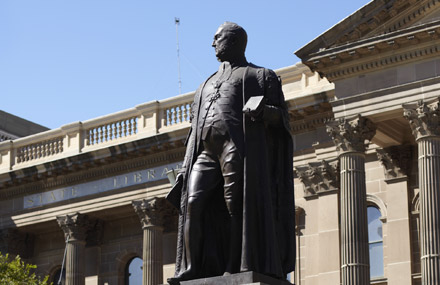
redmond_barry_statue

Redmond Barry in his later, more sober years.

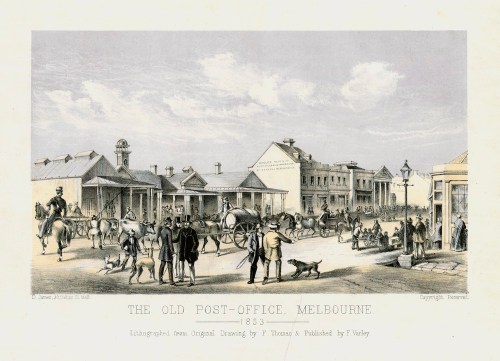
A NEW POST OFFICE

The new post office had opened on the corner of Bourke and Elizabeth Streets week earlier, having vacated its former premises in Little Collins Street.

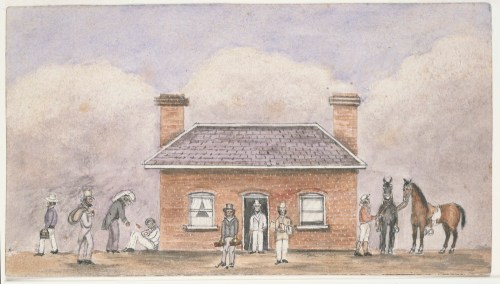
Secondpostoffice

The Second Post Office by William Liardet. This post office in Little Collins Street was superseded by the ‘new’ post office on the corner of Bourke and Elizabeth Streets, which opened in August 1841.  State Library of Victoria

http://handle.slv.vic.gov.au/10381/151517

[Actually, looking at this picture- is that a beggar sitting against the wall, receiving alms from a lawyer??]

3rdpostoffice

The third post office, which opened in August 1841, is shown here in 1853, only six years before it was demolished for the first GPO which was built on the site. Note the deep gutter to the right of the image, built to try to control the unruly waters of Elizabeth Street. Original drawing by F. Thomas. State Library of Victoria

http://handle.slv.vic.gov.au/10381/261742

On August 17 the Port Phillip Herald praised the appearance of the letter-carrier, who seems to have cut quite a dash:

The scarlet coat, gold band on the hat, and leather case under the arm of the letter carrier, give a very gay appearance to the town of Melbourne, and to the gay lothario who sports them [PPH 17/8/41]

SOME BITS AND BOBS

An arrival in port

There was a 62 ton schooner called Truganini that arrived from Hobart. Interesting that the the woman we know as Truganini (Trugernanner) was at this stage in Melbourne, having come across with the Aboriginal Protector George Augustus Robinson.  I wonder how and why the boat was named Truganini?

A caution

An interesting advertisement:

CAUTION.  The public are hereby Cautioned against giving credit or harbouring my wife, Agnes Brown, she having decamped from her home, taking with her a watch, tea caddy, box and bed quilt on Thursday last.  Any person found harbouring her, will be dealt with according to law; and persons giving me such information as will lead to conviction, shall receive Five Pounds Reward.  James Brown. X his mark.

Until the passing of the English Divorce Act in 1857, divorces could only be granted by an Act of the British Parliament: an avenue restricted to very wealthy people. Only one petition for divorce was ever made in New South Wales (and that, interestingly enough, was on the part of the wife). Although legislation to protect Deserted Wives and Children was introduced in NSW in 1840, the emphasis was on men deserting their wives rather than the other way around.  However, as the advertisement above makes clear, women did not have property rights to any family goods, when they left a marriage, an illegal act in itself. A watch, a tea caddy, a box and a quilt: possibly  the watch and the contents of the tea caddy were all the portable property the couple held, while the quilt seems a particularly female object to take. [Memo to self: must go see the Quilt Exhibition at NGV Australia before it finishes in November].

And another interesting advertisement:

STRAYED about a fortnight ago- a boy about nine years old, had on light trowsers, blue cloth jacket, rather large pair of old worn out boots, dark hair, freckled features, round plump face; a small dog following blind of one eye.  The boy has strayed in a similar manner before and went in a fictitious name. He is supposed to be in the vicinity of Melbourne. Whoever will give information where he may be found to Mr Henny, Irish Harp, will be thankfully received. [PPH 17/8/41]

AND THE WEATHER?

Strong winds prevailing, weather cloudy or rainy.


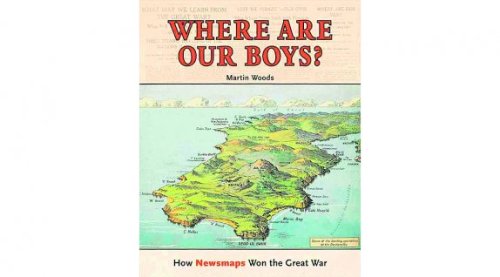
‘Where Are Our Boys?’ by Martin Woods

OurBoys

Where Are our Boys: How Newsmaps Won the Great War Martin Woods

2016, 227p & notes

Now that I come to think of it,  maps don’t figure prominently in our graphic-rich environment much any more.  I’m old enough to remember wall maps strung up on a classroom wall, and I’m old-fashioned enough to still have a Melways in the car.  Our use of maps has become very functional and specific. Google Maps takes you right to where you’re looking and the  GPS in your car gives a one-dimensional snapshot of your immediate surroundings as you travel to your pre-selected destination. While there are still maps occasionally in newspapers and on television news – to pinpoint the sites of a specific event like an earthquake, tsunami or terrorist events, for example- I’m not particularly aware of maps that show a broad region and topographical features any more. Perhaps that’s why I’d be hard-pressed, I must confess, to tell you which countries border Syria- or even exactly where Syria is, even though it’s on the news every night.

However, few maps are completely neutral- or even accurate, as the ‘true size’ map makes clear.  Even that world map of my memory, with the pink Commonwealth countries, was an argument for Empire, and as the Worldmapper website shows, it is possible to revision the world according to different parameters, depending on the argument you want to make.  And as Martin Woods shows us in his book Where Are Our Boys? this was also true in the more map-oriented environment of World War I where Australian families, anxious about ‘our boys’ on the battlefields were exposed to maps in an unprecedented way.  ‘Newsmaps’, as Wood coins them, were newspaper maps that were placed in the news, often at the core of the commentary and became “the window through which most news was viewed and understood” (p. 1).  His book focuses on the production and reception of maps for an Australian readership during the years 1914-18 and thus reflects the narrative of the time  of ANZAC troops fighting within the bigger picture of a British war, and not the skewed nationalistic map of ANZAC commemoration-tourism that we hold today.

The opening chapter of the book places the WWI newsmaps into a longer cartographic tradition, springing from the late 16th century with the rediscovery of Ptolemy’s maps from c.90-179CE. and the expansion of printing techniques, particularly during the Dutch Golden Age, which enabled the production of maps to demonstrate exploration, urbanization and -especially- the bird’s eye view of battles and sieges. Maps were fundamental to military strategy, both for commanders and commentators.  However, these maps were separate artefacts to be unrolled and consulted alongside the news received either by despatch, word of mouth or, later, through the columns of newspapers.While the publication of maps as a separate product continued into the twentieth century, this book emphasizes the integration of the map into the newspaper itself as a ‘newsmap’.

As Chapter 2 ‘Remaking the Map of Europe’ shows, maps, generally imported from Britain, were popular with Australian readers.  Geography had been added to the school curriculum in the 1870s, and maps were used to track the progress of explorers across the Australian continent. Scouts and cadets learned map-reading skills, and the compulsory military training for men and boys aged 12-26 under the Commonwealth Defence Act of 1911 exposed more men to maps.

During the first decade of the twentieth century, newspaper consumption reached an all time high in Australia (p. 43). The first map produced in an Australian newspaper accompanied a report of the Crimean War in the Sydney Illustrated News published on 13 May 1854, and during the Boer War, maps were embedded into news articles or placed alongside correspondents’ reports.  This was a practice that continued with the Russo/Japanese War, the San Francisco earthquake and the Italo-Turkish war of 1911-12. In this way, Australians were exposed to a steady diet of maps to explain conflicts and risings in Europe during the first decades of the twentieth century.

The Balkans had been an area of concern in Australian newspapers from 1908 onwards, but for Australian readers on the other side of the world, the rapid transition to war came as a jolt.  At this stage, the whole world was the stage and Ch. 3 ‘Tinker, Tailor, Soldier, Sailor’ demonstrates, the maps were big too, with large wall and billboard maps produced for shared consumption, like the large billboard map outside the the Argus office.  Commercial maps were produced for home use  by companies like Robur Tea, or by the newspapers as a special feature.  Many of these maps were cheaply produced and ephemeral, hence their relative scarcity today.  As attention focussed on the French/German frontier and Belgium, the maps became smaller in scale, moving from one battle front to another.  The German colonies now came into contention and war maps now often had a breakout box showing Australia’s proximity to the Pacific colonies.

With all this emphasis on Europe, France and Belgium there was initial disbelief when the ANZACs were sent to Egypt instead of the European front (Chapter 4). As 21st century Australians, we now know the layout of the Gallipoli peninsular better than Australian readers did at the time, (notwithstanding our relative cartographic ignorance).  The actual location of the soldiers was not divulged until mid-May and the Dardenelles were rarely shown on world maps at the time. It was not until September that a detailed map of the Gallipoli peninsula was issued. Shortly afterward, the ‘War Map of the Dardenelles and Bosporus’ was forwarded to schools, where it was intended that it form the basis of classroom discussion. A Robur war map was available for subscribers giving a bird’s eye view, unconstrained by detail and optimistically misleading, complete with little flags to pin onto the map to show progress. But of course, as we know, there was little progress, and little sense of orderly movement in the heavily censored letters home. Maps issued after the withdrawal were more detailed and provided the topographic detail necessary to make sense of what had happened, especially H.E.C. Robinson’s  map ‘ANZAC: Date of Landing April 1915: Date of Evacuation Dec 19-20 1915’ which was issued as a fundraiser in April 1916 in time for the first anniversary of the landing.

In Chapter 5 ‘Reading the Front’, Woods emphasizes that maps were just one part of the printed deluge that swept across Commonwealth readers. Australia was part of an Empire-wide publishing market, and there was lots of analysis, with special ‘War Issues’, technical articles, campaign diaries and maps, poetry, sheet music and novels.  Special collections of maps were marketed as gifts.  War films were shown at cinemas, and he notes in particular animated battle maps that were shown as shorts before the main feature, where using stop-motion animation, simple flag armies were shown moving across the screen (my- it was a simpler time!). The social aspect of map reading is emphasized, deepening our understanding of the homefront response to the war.

With the shift to ‘Somewhere in France’ (Chapter 6) from 1916 onwards, readers were frustrated by the lack of detail about Verdun and and readers now were aware that lack of detail generally indicated enemy gains. Although the ANZACs landed in France in March 1916, little was noted in the newspapers for two months.  When maps for public consumption began being produced again,aerial photography added a new perspective to maps. Nonetheless, maps of the Western front were in themselves a form of fantasy which did not capture the obliteration of geography caused by trench warfare.   The London-based Daily Mail syndicated its birds-eye map across the world which showed villages and farms that were no longer there. Today – and especially during this and the next two years- Australians are aware of Menin Road, Polygon Wood and Passchendaele, but readers of the day saw them as part of the wider campaign and geography of ‘Flanders’.  There was genuine fear that Britain itself would be invaded, but by July 1918 the narrative had shifted. Instead of fear and gloom, there were more hyperbolic, nationalistic reports, and instead of the ebb-and-flow nature of the news, there were almost unalloyed good tidings.

By the latter half of 1918, as Ch 7 ‘Victory – In memorium’ shows, the newspapers displayed the discordancy of headlines urging victory, while the personal columns and lists of casualties revealed the ongoing sadness.  Henry B. Manderson (Melbourne) rather prematurely issued the ‘Victory Instant Reference Large Scale War Map of Western Europe and Australian Fighting Fronts’ in mid 1918, with an index of 7000 place names, and locations of Australian cemeteries.  The map came complete with British, French, Italian, Australian and American flags and instructions to

Cut the flags out, mount on pins, and from the information published in the newspapers each morning you may, by moving the flags, follow the movements of the various armies as they retreat or advance (p. 210)

Australian crowds anticipated the Armistice, with the Argus war billboard in front of the Argus building being torn down by jubilant crowds on 9th November.  Following the announcement of peace, maps were produced showing the reconfiguration of Europe, and local maps revealed Australia’s new interest in Germany’s Pacific holdings, especially Nauru. Within months the first battleground tourism maps were being produced, for Australians wealthy enough to make their own pilgrimages to visit the sites where their sons and husbands fell.

This is a clearly written,  beautifully produced book,with full colour maps on nearly every page. Its chronological approach presupposes a certain familiarity with the progress of WWI, but its emphasis is on the media depiction of the war and its homefront reception.   If I have one criticism, it is that I was not always aware that the map under discussion would be on the next page, and I would have appreciated a note in brackets, perhaps, indicating the page on which the map might be found if it was included.

I do find myself questioning, though, the subtitle “How Newsmaps Won the Great War”.  It’s a big claim, and not one that Woods addresses in detail. Certainly, as he notes:

The war of 1914-1918 was a modern, mechanised, media-fuelled global conflict, in which newsmaps were part of a campaign bolstering public confidence, punctuated by well-pitched moments of alarm… To a map- and news- literate early twentieth-century audience, the power of maps was undoubtedly more immediate and widespread than in any previous war (p. 224)

War maps did, as he claims, prove a template for reading the war as it unfolded, and military propaganda notwithstanding, “contemporary audiences were arguably better acquainted with the flow of events than most of us today, and more able to understand the context of the Great War.” (p. 227). They did, as he also claims, have an impact on the geographical imagination and educational curriculum and raised expectations of the possibilities of technology.  But newsmaps won the war? I’m not convinced. The war wasn’t won staring at the huge map on the Argus billboard, or moving the flag pins on a map on the other side of the world while Mother knitted socks- scenarios that Woods captures so well. As Woods has shown us, newsmaps did not drive actions, but instead were a commodity created for an audience  whose thoughts and prayers spanned the globe, unconstrained by geography.

Source: Review copy



‘Black Rock White City’ wins the Miles Franklin

In past years I’ve assiduously worked through the short list for the Miles Franklin, but it seems to have crept up on me this year. What was on the shortlist? Actually, I’ve read several of them without realizing it.

  • The Natural Way of Things by Charlotte Wood (my review here)
  • Hope Farm by Peggy Frew  (well, I did borrow it to read it, but didn’t get round to it)
  • Salt Creek by Lucy Treloar
  • Leap by Myfanwy Jones (my review here)

and the winner

  • Black Rock, White City by A. S. Patrić (my review here).  And I’m quietly chuffed to see that I thought ‘Miles Franklin material’ right back in August 2015, when I read it.

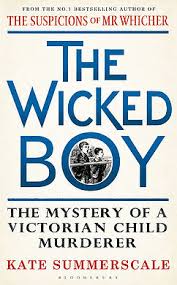
‘The Wicked Boy: The Mystery of a Victorian Child Murderer’ by Kate Summerscale

summerscale

2016,  307 P & notes

Spoiler alert

When watching yet another episode of the interminable Midsomer Murders, it is our practice to time how long it takes until the murder takes place. (In fact, I was rather disconcerted that in a recent episode there was no murder as such- although there was a surfeit of dead bodies being buried in unusual places.)  The first 43 pages of this book reminded me of our Midsomer Murder countdowns until the body is found.  In this case, you know there’s going to be a murder and you know that one of two boys have done it, because the title of the book tells you so.  Set in summer 1895, thirteen year old Robert Coombes and his younger brother Nattie head off to watch the cricket at Lords,  visit the theatre,  inveigle an older family friend to come and stay with them and tell lies in order to get ready cash. All the while, their mother’s bedroom door remains shut.  You know what’s behind that door.

It’s testimony to Kate Summerscale’s skill as a writer that she is able to hold you for so long across this extended introduction, and to keep you reading once the murder is actually disclosed.  Like her earlier book, The Suspicions of Mr Whicher which I reviewed here, this is a really accomplished work of non-fiction writing that roams across courtroom reporting, social history, ‘penny dreadful’ juvenile fiction and the history of asylums. Her use of dialogue is drawn from the court transcripts, and if she sometimes follows rabbits down some rather strange and sometimes tangential rabbit holes, it’s because her fidelity to her sources forces her to draw on contextual material to flesh them out and do them justice.  The book does not show footnotes but it is strongly tethered in institutional sources – court documents, asylum records, army documentation- and heavily supported by secondary sources.

The lengthy epilogue marks quite a break as she, as author, comes out on stage.  She has followed the murderer to Australia, documented him at Gallipoli and followed him archivally back to Australia again, then abruptly she breaks into present-day history. All of a sudden she encounters people who knew him and who are deeply troubled by what she has found out. Now she is cognizant of present-day pain that her writing could cause, and the story takes her in a different direction that, as a story-teller, enables her to bring it to a close in a narratively and morally satisfying way.

This is skillful non-fiction writing that has similarities with The Suspicions of Mr Whicher in its choice of subject matter and approach. There is a risk, I suppose, that she’s becoming rather formulaic in her choice of Victorian subjects. But this book, despite its parallels with Whicher, has taken her to Broadmoor Asylum, where she has had to rethink her preconceptions of asylum life, and to the Australian concept of Gallipoli which was largely unknown to her. She has followed the facts and brought her researcher’s eye to material and a country that is new to her. She’s very good.

Movie: Mustang

Set in Turkey, five orphaned adolescent sisters find their freedom increasingly circumscribed when the neighbours complain about the girls’ rambunctious behaviour with boys. Prompted by the girls’ uncle, their grandmother insists on them wearing shapeless, all-covering clothes outside, their schooling is discontinued and the wheels are in motion for the girls to be married off in traditional arranged marriages.

Although viewers are clearly intended to identify with the girls’ resistance to this familial and cultural oppression, I must confess that some  (just some) of my sympathies rested with the grandmother who was bullied by her son into bringing them into line, and who, in the final analysis, had to find some way to get these five (five!) sisters off her hands. They are all very close in age, all rather voyeuristically tactile with each others, and yes- they are out of control.  I found the contrast between their freedom inside the cloistered house incompatible with their restrictions outside it, and the sudden imposition of traditional values within a cosmopolitan city seemed forced and implausible.

So, three-and-a half stars from me.

NSW Premier’s History Awards Shortlist

The shortlists for the NSW Premier’s History Awards have been announced.

Australian History Prize (on Australian history, addressing subjects of national significance)

  • The Eighties: The Decade that Transformed Australia – Frank Bongiorno. (see my review here)
  • Just Relations: The Story of Mary Bennett’s Crusade for Aboriginal Rights – Alison Holland
  • Australia’s Boldest Experiment: War and Reconstruction in the 1940s -Stuart Macintyre

General History Prize (on international history that is of national or international significance)

  • Holy Legionary Youth: Fascist activism in Interwar Romania – Roland Clark
  • Illicit Love: Interracial Sex and Marriage in the United States and Australia – Ann McGrath
  • Prince of Darkness: The Untold Story of Jeremiah G Hamilton, Wall Street’s First Black Millionaire- Shane White.

NSW Community and Regional History Prize (significant contribution to the understanding of community, institutional, urban or regional history in NSW)

  • Fractured Families – Tanya Evans (see my review here)
  • Lord Wolseley Hotel: A social history of a very small pub – Shirley Fitzgerald
  • Unnamed Desires: A Sydney Lesbian History – Rebecca Jennings.

You can read more about the NSW Premier’s Awards prize, including the shortlist for the Young People’s History Prize and the shortlist for the Multimedia History Prize by going to the NSW Premier’s History Awards website.  You can also see the winners and shortlists back to 2012.