Category Archives: The ladies who say ooooh

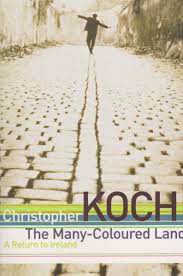
‘The Many-Coloured Land: Return to Ireland’ by Christopher Koch

koch

2002, 244p.

How have I read the hundreds (probably thousands?) of books that I have without encountering Christopher Koch before?  I’ve been aware of the name on Miles Franklin lists (he won it twice) and I’d heard of the film The Year of Living Dangerously, which was based on his book.  But I’ve never read any of his work up until now.

The Many-Coloured Land is part memoir/part travel narrative/part history.  Koch grew up in Tasmania, but his awareness of his background centred mainly on his German heritage – reinforced, no doubt, by questions about his surname- and his Anglo-Irish background that had been thoroughly researched by a genealogy-obsessed uncle.  Suppressed within his family history was another great-great grandmother, Margaret O’Meara, a convict  from Tipperary.  His two Irish great-great grandmothers arrived in Van Diemens Land within five years of each other, in very different circumstances- Margaret O’Meara and Jane Devereaux- one convict, one free; one Protestant, one Catholic; one a servant girl, the other the daughter of decayed aristocracy.  The older Koch became, the more he was drawn to the story of Margaret O’Meara, and this book is, in part, the story of his pilgrimage to a ‘home’ land that he only really acknowledged in later life.

I put ‘home’ in inverted commas intentionally, because Koch is never anything but Tasmanian.  The opening chapters of the book are located in Tasmania and chronicle his growing awareness of his family, and particularly Irish, heritage.  It was in his description of Oyster Bay near Swansea, a childhood holiday spot, that won me over.  I’ve sat on the dunes of the beach myself in a pink-infused sunset, with a warm breeze riffling over the grass at my back, the waves shushing onto the shore, and as I read this description I felt as if Koch had been leafing through my own memories:

Coswell (his holiday cottage) was set on gently-rising ground a few hundred yards from … a beach, looking out over white-gold paddocks and long, drystone walls to the blue expanse of Great Oyster Bay. The paddocks’ open spaces were dotted with a few long gum trees, and dark little Oyster Bay pines grew in the hollows.  The beach was usually deserted, except for Coswell’s few guests.  A creek flowed into the sea there, with a rickety jetty and diving board; an old wooden dinghy lay near the marram grass on a dune, and had lain there for as long as I could remember.  At each end of the beach were great, smooth rocks of pinkish granite; beyond them, to the north, more white beaches could be seen, with a few tiny dots that were people, and occasional beached dinghies.  Set with tall towers of spume, these long, far beaches curved off into mauve and white distances whose features grew tiny and illusory, faint as a distant music: a region beyond Swansea and the common world; perhaps beyond the real world together. (p. 48)

Koch visited Dublin as a young man in 1956 and remembered it as a dismal, grey, sad place.  Returning in 2000 with his friend, the folk-singer Brian, he finds another Ireland.  Ireland has changed- it was at the peak of its Celtic Tiger power of the new millennium- but so had he.  He is unsettled by the brash, surface-level confidence of the new Ireland and it is only when he moves away from Dublin that he finds the layered Ireland that he seeks.

Nothing much happens in this book.  They go from one B&B to another; they drink the night away in the fug of cigarette smoke with the beat of Irish folk music thrumming at their feet; they stand on coastlines; they survey landscapes.  Koch finds the derelict Big House of his ancestor Jane Devereaux and is drawn to the story of the  Young Irelanders who ended up as aristocratic convicts in VDL.  Because all this research re-emerged in  Koch’s fiction work Out of Ireland, which deals with the Young Irelanders,  it reminded me a bit of Kate Grenville’s Searching for the Secret River, without the methodological angst.

There’s an unintended poignancy about this book, because we know, as Koch couldn’t when he wrote it, just how brittle and insubstantial that Celtic Tiger economy was to be.   There’s another poignancy too, in my realization that this writer that I’ve never read  passed away last year, and that all his deep inhalation of life, people and surroundings is at an end.

As a reader, I have little red flags that pop up when authors do particular things. I must confess that when the book started with family history, I inwardly groaned. Family history, while fascinating to the descendant, can be rather eye-glazing for other people, unless it’s contextualized and the author has convinced you that it’s going to be worth your while.  Nor do I enjoy descriptions of food, and I don’t really care what people look like.  This book violated all of these no-go zones at times.  Nonetheless,  I really enjoyed it. It’s a beautifully written plaiting-together of historic research, family history, travel narrative and memoir.  And I’m going to track down his other books as well.

My rating: 8.5/10 (although I know that others haven’t been quite so fulsome in their praise)

Read because: it was a bookgroup choice with The Ladies Who Say Ooooh

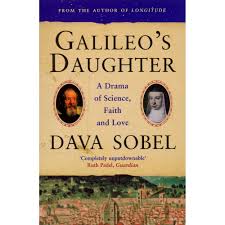
‘Galileo’s Daughter’ by Dava Sobel

galileos daughter

1999,  432 p.

The whole way through reading this book, I was thinking how much my husband (who had read it before I did) must have loathed it.  A man of scientific inclination, given to dot-points and resistant to ‘dumbing down’,  he grumbles when a plot line in a crime show or a documentary becomes clogged up with relationship-type stuff.  This book offends on both counts. Although titled Galileo’s Daughter, it is actually about Galileo and his discoveries and theories in astronomy,  explained simply for the non-scientists among us, and framed through the letters that his daughter wrote to Galileo.

Galileo had three illegitimate children through the same woman.  He was able to ‘buy’ legitimacy for his son, but to circumvent the disadvantages that illegitimacy and lack of dowry would confer on his two daughters, he placed them in a convent.  If you’ve read Mary Raven’s Virgins of Venice, you ‘ll know that convents were used as a way of solving the  dynastic problems of the Venetian (and other Italian state) noble families.  If a girl could not be married successfully and strategically, then a convent provided a means of providing for her, and in a deeply religious society, bolster the family’s heavenly credit through her lifetime of intercession on their behalf.   Convents  were not necessarily stark, isolated experiences.  They were often filled with educated, noble women who maintained an interest and knowledge of her family’s outside activities, albeit from behind a grille.

Galileo placed both his daughters with the Poor Clares in the Convent of San Matteo in Arcetri, Florence.  His eldest daughter, Virginia, took the name Suor Maria Celeste, while the younger daughter became Suor Arcangela.  The book reveals the letters that Suor Maria Celeste wrote to her father, translated by Sobel herself, interwoven with a narrative of Galileo’s development of his astronomical theories and the resultant conflict with the Inquisition.

Here is the historian’s lot writ large: a cache of letters from one party only.  However, continuous archives like this, where the letters were frequent- and these ones certainly were- allow for reconstruction of the missing side of the correspondence.  I was struck by the waste of this lively intelligence.  Although Suor Maria Celeste’s writing is larded with expressions of deference and spirituality that don’t sit comfortably with us today, she was well aware of her father’s work and made good copies of his correspondence.  She assisted him in more quotidian ways too: making repairs to his clothes, cooking jams etc. and making solicitous inquiries about his health.  Certainly this convent was more straitened than those described in Virgins of Venice, with the nuns often going hungry and poorly served by the priests who ‘ministered’ to them.

Although the story of Galileo’s clash with the Inquisition is well-known, Sobel argues that he was, and remained, a deeply religious man.  But she also reveals the rather duplicitous manoeuvres that Galileo made to appear to conform, while ensuring at the same time that his controversial theories, so blasphemous in the eyes of the Church, reached beyond the Inquisition’s grasp.  She creates a nuanced overview of theology, and Galileo’s challenge to it, and a clear (if rather simplified) explanation of his theories.

I must confess that I preferred the letters to the science in the book, and felt tempted at times to skip over those sections.  But I did feel genuinely saddened by the short and constrained life that this intelligent woman lived.  I enjoyed the book, even if my husband didn’t.

My rating: 8

Read because: It was a bookgroup (Ladies Who Say Oooh) selection.


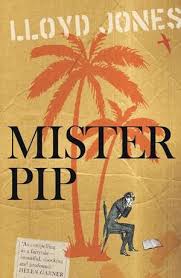
‘Mr Pip’ by Lloyd Jones

mrpip

2006 256 p

Sometimes the challenge in reading a book lies in negotiating its different threads and clambering over complex language that is so clever and slippery that you’re constantly on your mettle as a reader.  But sometimes – ah, sweet relief!- the book itself is so easy to read that you just lie back and let it sweep you along, only to find yourself rewarded with layers and counterpoints that emerge long after you shut the book. Mr Pip, for me, was such a book.

Everyone called him Pop-Eye” is the opening sentence of Mr Pip, echoing Dickens’ immortal opening lines of Great Expectations,

My father’s family name being Pirrip, and my Christian name Philip, my infant tongue could make of both names nothing longer or more explicit than Pip. So, I called myself Pip, and came to be called Pip.

Pop-Eye, or Mr Watts, is the last remaining white man on Bougainville after the implementation of the blockade by Papua New Guinea in 1990 and the descent into civil war between the ‘rambos’ (village boys who joined the rebel insurgency) and the ‘redskins’ (PNG soldiers).  Fourteen year old Matilda lives on the island with her deeply religious mother Delores, her father having travelled to Townsville for work with the Australians and unable or unwilling to return because of the civil war.   Successive raids by the rambos and the redskins have left the village in tatters and Mr Watts offers to teach the school, in the absence of any other alternative teacher.

What Mr Watts brought to these children was Charles Dickens’ Great Expectations: a book which, at first sight, could hardly be more removed from the experience of these village children, or their parents.  Mr Watts invited the parents into the schoolroom, where they shared their own stories with the children, and the parents too, came to know of ‘Mr Pip’, Miss Havisham and Estella through their children.  Mr Watts was always an outsider.  He was quite frankly eccentric, pushing his demented village wife around the village in a shopping trolley.  But somehow he managed to interweave the experience of Pip and his great expectations into the shared knowledge of this small Pacific village.

The book changes direction abruptly and I don’t want to spoil it for you.

There is a coda to the book where Matilda, as an adult, revisits Mr Watts’ hometown, trying to fill in more of the paradox and mystery of ‘Pop-Eye’ and his wife.  What she learns there gives the narrative yet another twist, unsettling much of what has preceded this.

Despite its simple, flowing almost-fable-like language, this book has multiple levels.  I found myself thinking about it long after I’d finished it.

Rating: 9

Read because: CAE bookgroup selection read with The Ladies Who Say Oooh (my bookgroup)


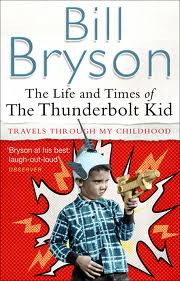
Bill Bryson ‘The Life and Times of The Thunderbolt Kid’

bryson_thunderbolt

2006, 375 p.

When feeling that I need to justify being in a CAE bookgroup when, heaven knows I surely have enough reading that I should be doing, I often say “Well, you read books that you wouldn’t normally choose”. This is very much the case with this book. As it happened I didn’t really mind sinking into its fairy-floss peaks, aware that I had only two days to read it before our bookclub meeting. I’d just finished reading N and was feeling exhilarated and supremely sated, and I would have found it difficult to turn straight away to a challenging or complex book. Fortunately, in this case then, The Life and Times of the Thunderbolt Kid is neither of these things.

I’ve read a couple of Bill Bryson’s travel books, and find them wryly amusing. Although this is a memoir, he approaches it in much the same way: it is a travelogue around his childhood memories. The book moves chronologically towards his adolescence, but is structured thematically with chapters titled (among others) ‘Hometown’, ‘Welcome to Kid World’ ‘Birth of a Superhero’ ‘Boom!’,’What, Me Worry?’ and ‘The Pubic Year’.

Bryson was born and raised in Des Moines Iowa in 1951. Unusually for the time, both his parents worked at the Des Moines Register, his father as sports writer and his mother in the women’s section. Bryson’s viewpoint is unashamedly child-centred, with his parents benign but almost peripheral characters, and his sibling almost invisible. Bryson is much attracted to lists, and they pepper the book- a rather lazy way, I think, of leaving the reader to recognize and make the connections. There are one-liners on every page, and it’s the voice of the raconteur that you hear.

One of the things that struck me was how self-containedly American his life was. He lists his favourite television programs (all American), films (all American), comic books (all American) and school readers (all American). It reinforced for me how much an Australian childhood (albeit five years later than his) was a mixture of British, American and Australian influences.

This is not to say that there’s not some social commentary in here as well. He points out the disjunction between the fears of the time (polio, Communists, nuclear war) and the sunny abundance and self-confidence of affluent, middle class White America.   He deals with racism in a couple of pages because it was not on his horizon at all.

All in all, it’s an affectionate, humourous wallow in nostalgia. It reminded me a bit of the television show ‘The Wonder Years’.  I enjoyed it in half-hour episodes but I know I would have drowned in schmaltz had it gone on for an hour.

Like a sit-com or a travel book, this book could have stopped ¾ of the way through, or gone on for another 100 pages, although at nearly 400 pages I think that it was plenty long enough.

I’ll leave the last words with him:

What a wonderful world it was. We won’t see its like again, I’m afraid.

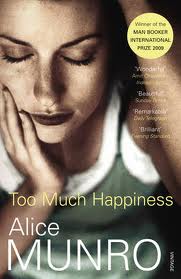
‘Too Much Happiness’ by Alice Munro

munro

2009, 320 p.

Alice Munro was awarded the Man Booker International Prize in 2009 not so much for any particular book but for the entire body of her work over several decades. In 2013 she received the Nobel Prize for Literature.  I must admit to having only read one Alice Munro (Lives of Girls and Women) about fifteen years ago, and that was a novel rather than a collection of short stories, a genre for which she is more commonly celebrated.   I seem to be rather re-thinking my response to short stories (wink to Whispering Gums) and reading more of them on my own initiative, but this was book group selection, which raised its own challenges.

Most of the stories in this collection are set in or around Ontario, which has its own appeal to me now that I’ve been there. Interestingly, the only one with a markedly different setting is the final and longest one which is set in late 19th century Russia, and it is this rather (to my mind, disappointing) final story that gives the collection its name. Even though the action occurs in different decades over the last 40 years and her narrators include men and women, there is a middle-class, softly liberal leaning to the narrative voice in most of the Canadian stories.   A number of motifs arise repeatedly: women seem to wear kimonos over their underwear; first wives are usurped by younger women, and there is a curious preponderance of devilled eggs. I was wondering if there was a talisman link between them, but if there was, I couldn’t find it.

There is, however, an edge to these stories which are at the same time domestic and yet transgressive. There are disturbed children, sexual deviants and murderers here amongst the minutiae of North American small town and suburban life.

Her endings are rather curious and abrupt, but this didn’t worry me. In fact, I resisted the rather decisive, pat ending in ‘Dimensions’, otherwise one of the strongest stories in the collection and chillingly evocative of some recent crimes that have occurred in Melbourne in the last few years. She has certainly mastered the art of the narrative time shift, even in the short story. Sometimes I wonder if writers restrict themselves to short stories because this is so hard to do in a longer novel, but it’s obviously not the case here. She packs so much skill into 20-30 pages.

I find it very hard to review a collection of short stories. There is no point in summarizing the different stories beyond an aide-memoire for myself (perhaps not an altogether unworthy rationale), and a short story is shrivelled by being reduced to its bare bones. As I mentioned, this was a book group selection, and similar issues arose during our discussion as well. We seemed to spend a lot of time in silence, flipping through a short story to remind ourselves what it was about. Through our discussion I did, however, find nuances and alternative meanings that hadn’t occurred to me reading the stories alone.

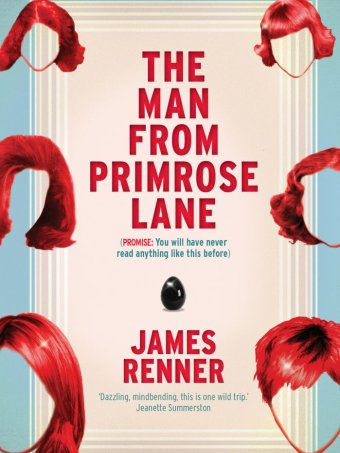
‘The Man from Primrose Lane’ by James Renner

manfromprimrose

2012, 400p.

I’m going to be very old-fashioned and curmudgeonly, but I REALLY didn’t like this book.  I really can’t talk very much about it without divulging spoilers.

Oh, alright – just the start then….an old recluse is murdered.  He had been shot in the stomach and his fingers had been cut off and minced in the blender.  He always wore mittens and seemed to have no friends or family.  David Neff, who had written a best-selling true crime book some years earlier is alerted to the case by his publisher, who is concerned that David is spiralling into depression after the apparent suicide of his wife four years earlier.  Who is this old man? Why does he always wear mittens?…..and then you’ll have to read the rest (if you still want to after this review).

The book is a mash-up, I suppose, of several different writing genres.  It’s all very self-referential and tricksy, but at the end of it, that’s just how I felt- tricked. Call me thin-skinned, but having the author jeering at the reader for wanting some sort of resolution at the end is a bit rich.

It is, apparently, going to be made into a film and it will probably work better on the screen than it does on the page.

The book is a one-off.  The blurb on the front brags that ‘you’ve never read anything like this before!’.  Well, that’s for sure and I certainly won’t in the future.  It’s the equivalent of a sight gag: it only works the first time.

My rating: 3/10

Sourced from: CAE bookgroups.

Read because: it was a bookgroup selection with The Ladies Who Say Oooh. In this case, the Ladies Said “Eeewwww”. Boy, I’m glad that I didn’t choose this book!


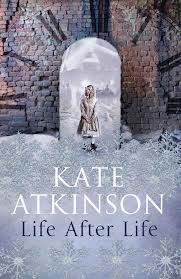
‘Life after Life’ by Kate Atkinson

lifeafterlife

2013, 477 pages.

Spoiler alert

This should be my absolute favourite, top-of-the-list read for 2014, even though the year has just started.  After all, it’s written by Kate Atkinson, an author whose books, across various genres, I really enjoy.  It’s a time travel book and I love those too, even though it feels a little bit adolescent. It has the Sliding Doors/Groundhog Day thing going on as well, which is also good, although my enjoyment of these two movies became a bit rocky when I began thinking “But hold on, how….?”  and questioning the logistics of it all.  In terms of subject matter, much of this book is based during the Blitz, which has attracted me ever since I read Sarah Waters’ The Night Watch.  So, all in all, it should have been a 10 out of 10 winner.

Spoiler alert

The reason why it isn’t a 10/10 winner confronted me on the opening pages.  On November 1930 Ursula enters a German cafe and joins a table laden with cakes where a blonde woman is draped over a fleshy, “softly repellent” man.  She places her handbag under the table and settles amongst the others at the table, then reaches down for a handkerchief from her bag.  She pulls out a gun and shoots the Fuhrer dead. Darkness falls.

This is the first of multiple deaths that Ursula experiences in this book, each marked by the appearance of snow before darkness falls.  She is strangled by her umbilical cord at birth: or she is not.  She catches Spanish influenza: or she does not.  She is beaten to death by a brutal husband: or she is not.  She is killed in an air-raid attack during the Blitz: or she is not.  It takes a little while to adjust to these constantly-reset scenarios, and by the end of the book I found myself turning frequently to the table of contents that lists the dates of the different episodes.  Once I’d realized what was happening, I was happy to go along with the premise and there were few times when the death, or not-death, did not seem completely natural or plausible.

With the exception of the Hitler scenario which opened the book, that is.  I found the whole scenario that placed Ursula in Germany unconvincing, and by tying this fictional character to a real-life historical figure Atkinsin rather clumsily and half-heartedly opened up the ’what-if’ historical can of worms. She doesn’t really DO anything with this historical question (which I do enjoy rather guiltily as an historian) and the book as a fictional work doesn’t really need to venture into historiographical waters.

Most of the scenarios are fairly short, until she reaches 1939-40. The Blitz takes up a large proportion of the book and I found myself wishing that Atkinson could get herself out of this narrative quagmire somehow.  She does, with the same sleight of hand as she does elsewhere in the book, and even though I like Blitz stories, I was glad that she could leave them behind eventually.

By the time I finished this fairly lengthy book, I found myself pondering just how well Atkinson had developed Ursula as a character.  The old writing adage is “show, don’t tell” as far as character development is concerned, and certainly the plot-driven structure of this book means that there is a lot of showing, again and again.  Ursula’s responses to these various scenarios all ring true, so Atkinson must have succeeded in creating enough of a character for me, as reader, to judge fidelity against.  This is character revealed through events, and through events that occur to Ursula alone. Do we become ourselves only through the events that befall us, I wonder?   I found myself wishing that the spotlight could shift away from Ursula for a moment, to encompass the views of other characters as well.

And so, my enjoyment of this book that seems at first sight to tick all my boxes, is somewhat alloyed.  I still very much like Kate Atkinson as a writer, and the book brought me a great deal of pleasure.  But a 10 out of 10?  Probably not….

My score:  8.5/10 ???

Read because:  CAE book group selection.  I missed the meeting- I wish I’d been there to discuss it further!

Sourced from:  CAE Bookgroups.

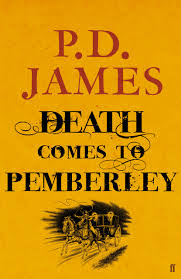
‘Death Comes to Pemberley’ by P.D.James

pdjamespemberley

2011, 310 p

I can remember as a (much) younger reader experiencing a kind of grief when I finished a book where I had fallen in love with the main characters.  What pleasure I took in series of books where you could meet up with them again! I must admit that I rarely feel that way today (one exception is Kate Atkinson’s Jackson Brodie character) and I’ve decided that I can’t remember characters well enough between books and their sequels to read them in real time – I’m better off waiting until a trilogy is done and dusted and then gorging on it in one big reading feast.

But the frequent re-reading of classics is another matter entirely and Jane Austen in particular rewards frequent re-reading. And, as many canny authors have found, there are rewards in re-writing Jane Austen as well.  I’m not particularly attracted to the Jane Austen zombie mash-ups (or mash-ups of any kind, for that matter) but when one comes from the pen of P. D. James, that’s different.  Although I am not, admittedly, a great detective fan, P. D. James herself is a great Jane Austen fan, as she explains in this video.  James’ own introduction to the book reflects her sense of humility and presumption in even endeavouring to marry her love of Jane Austen and the murder investigation genre in the book that follows:

I owe an apology to the shade of Jane Austen for involving her beloved Elizabeth in the trauma of a murder investigation, especially as in the final chapter of Mansfield Park Miss Austen made her views plain: ‘Let other pens dwell on guilt and misery.  I quit such odious subjects as soon as I can, impatient to restore everybody not greatly in fault themselves to tolerable comfort, and to have done with all the rest.’ No doubt she would have replied to my apology by saying that, had she wished to dwell on such odious subjects, she would have written this story herself, and done it better.

The scenario is this:  Darcy and Elizabeth have been happily ensconced at Pemberley for the past six years where Elizabeth has duly delivered two Darcy heirs.  It is the eve of the traditional Pemberley ball instituted by Darcy’s mother Lady Anne.  Sweet Jane and Bingley have arrived early, Darcy’s sister Georgiana is fending off two suitors in Colonel Fitzwilliam and the young lawyer Mr Alveston,  the silver is being polished and the house is crackling with anticipation. Suddenly the preparations are disrupted by Elizabeth’s younger sister Lydia Wickham, arriving unannounced and hysterical, shrieking that Wickham has been murdered in the nearby wood.  He hasn’t , but his friend Captain Denny has.  I shall go no further: if you have read the book, you’ll enjoy John Crace’s ‘digested read’ from the Guardian here.

I was interested to see how (and if) P.D. James was going to pull this off.  The need to provide background information entangled the book in several places. She starts by a prologue that briefly encapsulates Pride and Prejudice should there be any reader absent from planet Earth in the last forty years who has missed both the reprints and the frequent film versions- does such a soul exist?  The backgrounding completed, she then launches into her own trajectory, in a voice that echoes Austen’s writing with long, convoluted but controlled sentences but a sad dearth of the cutting, clear-eyed quip that Austen-readers so enjoy.   There are sly Austenesque references to Austen’s own oeuvre, most particularly Mansfield Park, and nods and winks to the original book, but often the clumsy backgrounding sections make you aware as an Austen-savvy reader that you are eavesdropping on a rather laboured explanation to other readers that you’d rather not have to sit through.

Conversely,  there is also P.D. James’ need as a  writer to mould the expectations of her own crime-writing fans by warning that the timing of this book predates the rise of the detective and a paid constabulary.  And so we see Darcy, who was himself a magistrate and surely familiar with such matters, intently listening to the lawyer Alveston’s explanation of the courtroom procedure and strategies and again, as a reader, you become aware of the backgrounding nuts-and-bolts that James is tightening as author.

However, as an aspiring historian of nineteenth century English legal practice- and does a historian ever stop reading as a historian?- I was impressed by her fidelity to the role of the magistrate in pre-Peelite policing days and her sensitivity to early 19th century  courtroom procedure, most particularly the nature of evidence and Wickham’s statement to the court.  All of this involved James relinquishing those stand-bys of the modern crime genre and as such, testifies to her careful research, no doubt bolstered by her work on the true crime non-fiction book The Maul and the Pear Tree which she co-authored with historian T. A. Critchley.  The crime itself and its motivations, while rather insipid by modern standards, faithfully reflect 19th century moral standards .

My qualms come not with P. D. James as crime writer, but with P. D. James as Austen fan. I was perhaps most disappointed by the flatness of the relationship between Elizabeth and Darcy and wondered if, perhaps, Elizabeth HAD been taken over by a zombie after all.  The Elizabeth Darcy of this book admits that she would not have married a poor man, and weights young Georgiana’s choices between love and status equally on the scale of marriage choices.  She’s an insipid shadow of her feisty self.

This all sounds rather negative, which I don’t intend.  The thing that I enjoyed most about this book was the sense of  rather wicked glee that comes through when P.D. James reveals herself as Austen fan, talking back to Jane Austen herself.  Here she is, as Elizabeth thinks back to Darcy’s two proposals: the first rather insulting proposal, and the second request for her love, made a day later, just after she had learned of Lydia’s elopement:

It still surprised her that between Darcy’s first insulting proposal and his second successful and penitent request for her love, they had only been together in private for less than half an hour… If this were fiction, could even the most brilliant novelist contrive to make credible so short a period in which pride had been subdued and prejudice overcome?  (p.50)

It’s a question that James herself seeks to answer in the epilogue as Darcy unburdens himself over the same issue: “But how could you believe me altered? How could any rational creature?” (p. 307).  I don’t know if James’ answer satisfies completely, but I enjoyed the interchange.

I received this book in my face-to-face bookgroup (AKA ‘The Ladies who Say Ooooh”) where at our December meeting we anonymously lend a book that we have enjoyed, knowing that it will be returned to us. After giving our response to the book, we then try to guess who donated it.  I think I know who donated it.  I’ll say that in spite of my qualms, I enjoyed reading this response to Pride and Prejudice written by an honest fan, who brings her own wealth of literary skill (and sound historical research) to the challenge.  I don’t think it will propel me towards the zombies though.

Other reviews:  Hah! Try to find a review of the book when the mini-series has been screen just days earlier!!  Probably the best review that I’ve read is by our own Whispering Gums, a true Janeite!

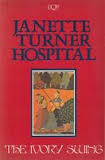
‘The Ivory Swing’ by Janette Turner Hospital

ivoryswing

1982 (1991 reprint)252 p.

I don’t tend to think of Janette Turner Hospital as an Australian writer. She has lived in Canada and America for many years,  and is claimed in Canada as a Canadian writer- in fact this book won Canada’s $50,000 Seal Award for Best First Novel in 1982.  To be rather petty, even her name doesn’t sound particularly Australian (and it’s not a pseudonym: she married Clifford Hospital in 1965).  She is Melbourne born, and taught in outback schools in Queensland, but moved with her husband to Canada and then America, living at various times in Britain, France and also spent a year in India where her husband undertook study leave.  She’s not particularly part of the Australian writer’s circuit of  literary festivals and writer’s talks, even though she visits Australia frequently in a private capacity.

The Canadian/Indian connection emerges from the pages of this book.  Juliet has married her older, academic husband David partially out of -frustration with the non-commitment offered by her tom-catting lover Jeremy.  With David she shifted to Winston, Ontario as a faculty wife, where she had two children, feeling increasingly oppressed by the small-town life and the weight of expectations of the other faculty matrons.  When David went to India for study purposes, she and the children followed.  Jeremy remains in her consciousness as the road not travelled, always off to the corner as a possible option for another way of living.

In India they encounter the stolidity of patriarchal gender roles and the uncompromising rigidity of the caste system.  In their rented house, Juliet tries to challenge them by including a young servant Prabhakaran as part of her family, and both she and David take an interest (for different motivations) in Yashoda, a beautiful young widow who is at the mercy of her wealthy and tradition-bound brother-in-law Shivaraman Nair.  Juliet’s sister Annie arrives, untrammelled by family and commitments and living the life that Juliet still years for.  Where Juliet and David are wary of blundering in with Western values, Annie is fearless.  All of them, in their various ways, trigger consequences that fall more heavily on others.

This is a very ‘interior’ book, with page after page of internal dialogue as Hospital shifts her attention from one character to another.  I found myself wondering whether I even wanted to be inside these characters’ heads, and the short answer is ‘no’.  The narrative is an insistent voice-over, and as a reader you become so deadened by its drone that when action occurs, you need to stop yourself and re-read to work out what is actually happening.  Hospital’s descriptions of setting are very good and capture well the lassitude and sticky humidity of their environment, and it is mirrored in the pace of the novel as well….slow…very slow.  The imagery of the Ivory Swing is heavy-handed and at times the writing is overwrought.

This was a book-group selection.  One thing about a bookgroup is that you read books that you wouldn’t choose yourself, which can be a good and bad thing.  Many of the books in the CAE catalogue (like this one) are fairly old, which means that they outlast the frenetic marketing merry-go-round of modern bookselling.  I’ve read books that have largely disappeared from bookshops and library shelves (with their rather ruthless culling these days) and been glad to have done so.  But without my sense that I  ‘should’ struggle on with the book as a commitment to my fellow book-clubbers , I probably wouldn’t have finished reading the book. I wouldn’t rush to recommend it.

My rating: 6/10

Sourced from:  CAE bookgroup

Read because: it is our October book for bookgroup.  Who chose THIS book, I wonder?

awwbadge_2013This is a book by an Australian woman writer, so I’ll count it towards the Australian Women Writer’s Challenge.

‘The Conjuror’s Bird’ by Martin Davies

conjurersbird

2005, 400 p.

On Captain Cook’s second voyage to the Pacific, a bird- not necessarily uncommon and rather unprepossessing – was caught, preserved and sent back to England where it became part of Joseph Banks’ enormous collection.  But the Mysterious Bird of Ulieta was never seen again, in either its preserved form or in the Pacific.  The lost bird is the central motif of this book.

The story is told through two separate and alternating narratives.  The first, set in the present day  tells the story of  John Fitzgerald, an academic whose specialty is extinct birds, who is visited by his ex-lover, conservationist Gabriella. He is spurred by her visit to renew his search for a trace of the now-lost specimen, aided by Katya, a young graduate student.  There’s lots of skullduggery and double-crossing as various people, with even more various reasons, are all looking for the same lost bird.

The second story line, displayed in a smaller font and voiced in  more formal, old-fashioned language, tells the story of Sir Joseph Banks, a man well-known to Australians as the naturalist on Cook’s first voyage of discovery.  He intended travelling on Cook’s second voyage as well, but suddenly withdrew, ostensibly because the cabin arrangements were not to his liking.  This narrative thread explains his withdrawal and the provenance of the preserved remains of the mysterious bird.  It’s a love story and is quite beautifully told, in a way that honours the careful  style of nineteenth-century fiction.

Martin Davies is a BBC television producer and he brings this experience to the first narrative thread of this book.  It’s all very much BBC Friday night mini-series fare: fast paced, with multiple story-lines and red herrings and a nice satisfying ending.   I preferred, and have more respect for the second storyline, woven around on a number of documented facts into a plausible and satisfying explanation.

I read this book with my bookgroup, and quite a few of us spent time Googling Joseph Banks.  It made me almost regret that Googling is so easy now, because the real art of historical fiction of this type is colouring in the spaces between the known facts.  It brought to mind something I read in the London Review of Books recently, where a review of Rupert Thomson’s book Secrecy discussed techniques that writers like Peter Ackroyd and A. S. Byatt have adopted (changing the name of their character; cutting the biographical link) in order to defend the imaginative space to write about historical figures:

…instant access to information strengthens the case for  such defensive strategies.  It only takes a mouse-moment to move from ignorance to an unrooted expertise.  There’s a lesser allocation of breathing space to projects that both plunder the real and depart from it.  It becomes all to easy to collapse a fictional narrative into a piece of failed history, turning it into a travesty of something it never claimed to be  – Adam Mars-Jones ‘The screams were silver’ London Review of Books 25 April 2013.

I enjoyed this book as a bit of a romp, with enough fidelity to the historical record to go along willingly for the ride.

My rating: 8.5/10 (it would be a good holiday read)

Read because: Book group selection

Sourced from: CAE Bookgroups.